When someone says “thank you,” you do not always have to reply with “you’re welcome.” Depending on the situation, you can say “my pleasure,” “happy to help,” “anytime,” “of course,” “no problem,” “glad I could help,” or several other natural expressions.
The best alternative depends on who you are talking to, what they are thanking you for, and the tone you want to create. A response to a close friend does not need to sound like a customer-service email, while a reply to a client should usually be warmer and more polished than “sure.”
This guide covers 30 other ways to say “you’re welcome,” including professional, casual, friendly, warm, texting, workplace, email, customer-service, and relationship-specific options. You will also learn the subtle differences between phrases that may look interchangeable but communicate slightly different things.
Best Alternatives to “You’re Welcome” at a Glance
| Alternative | Tone | Formality | Best For | Example |
| My pleasure | Warm, gracious | Professional | Clients, work | “My pleasure. Glad I could help.” |
| Happy to help | Friendly, positive | Neutral | Work, service | “Happy to help!” |
| No problem | Relaxed | Casual | Friends, coworkers | “No problem!” |
| No worries | Easygoing | Casual | Friends, texting | “No worries!” |
| Anytime | Warm, supportive | Casual | Friends, family | “Anytime!” |
| Of course | Reassuring | Neutral | Most situations | “Of course!” |
| Glad I could help | Sincere | Neutral | Work, favors | “Glad I could help.” |
| Don’t mention it | Polite | Neutral | Small favors | “Don’t mention it.” |
| You’re very welcome | Warm | Neutral/formal | General | “You’re very welcome.” |
| The pleasure is mine | Gracious | Formal | Professional settings | “The pleasure is mine.” |
| Sure thing | Friendly | Casual | Friends, coworkers | “Sure thing!” |
| Absolutely | Positive | Neutral | Helpful responses | “Absolutely!” |
| It was nothing | Humble | Casual | Small favors | “It was nothing.” |
| Certainly | Polished | Formal | Business | “Certainly. Glad to assist.” |
| You got it | Upbeat | Casual | Everyday conversation | “You got it!” |
There is no universally perfect replacement. For example, “my pleasure” emphasizes that you enjoyed helping, while “no problem” emphasizes that helping was not an inconvenience. “Anytime” goes a step further by suggesting you would be willing to help again.
30 Other Ways to Say “You’re Welcome”
My Pleasure
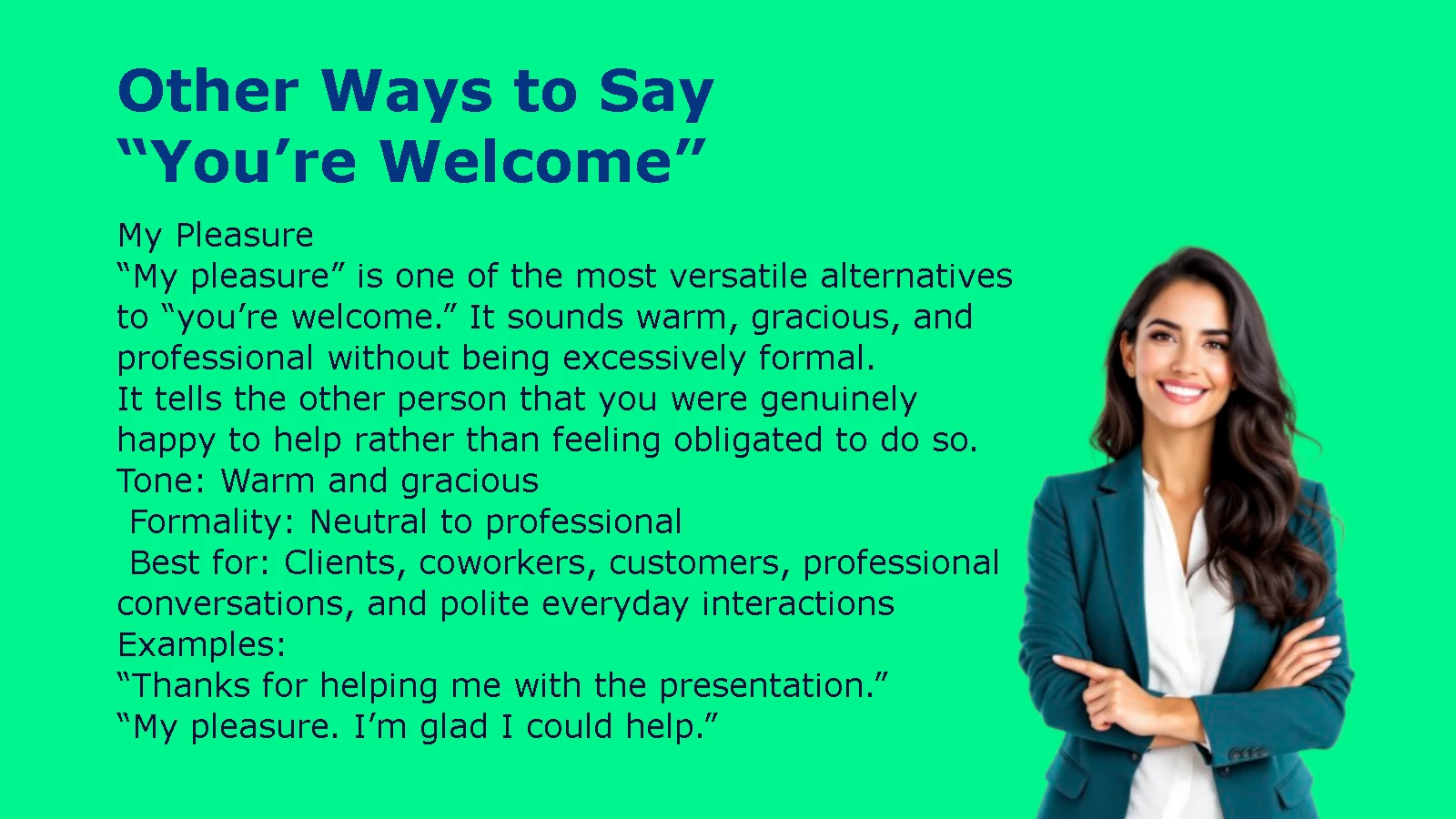
“My pleasure” is one of the most versatile alternatives to “you’re welcome.” It sounds warm, gracious, and professional without being excessively formal.
It tells the other person that you were genuinely happy to help rather than feeling obligated to do so.
Tone: Warm and gracious
Formality: Neutral to professional
Best for: Clients, coworkers, customers, professional conversations, and polite everyday interactions
Examples:
“Thanks for helping me with the presentation.”
“My pleasure. I’m glad I could help.”
Another example:
“Thank you for taking the time to explain everything.”
“My pleasure.”
It works particularly well in customer-facing situations because it acknowledges the person’s gratitude while keeping the interaction positive. Current usage guides also commonly identify it as a professional, warm response.
Happy to Help
“Happy to help” sounds friendly without becoming too casual. It is particularly useful at work because it communicates both willingness and professionalism.
Tone: Friendly and positive
Formality: Neutral/professional
Best for: Coworkers, managers, customers, clients, and emails
Examples:
“Thanks for sorting that out.”
“Happy to help.”
In an email, you can expand it:
“Happy to help. Please let me know if you need anything else.”
This phrase is especially effective when you want to leave the door open for additional questions.
No Problem
“No problem” is a very common casual response to “thank you.” It tells the other person that their request or favor did not inconvenience you.
Tone: Relaxed and friendly
Formality: Casual
Best for: Friends, family, coworkers, and everyday conversations
Example:
“Thanks for giving me a ride.”
“No problem!”
It is natural in American English, but context matters. If a client thanks you for completing a substantial piece of work, “my pleasure” or “glad I could help” may sound more attentive.
The difference is subtle: “no problem” minimizes the inconvenience, whereas “my pleasure” emphasizes the positive experience of helping.
No Worries
“No worries” has a relaxed, reassuring quality. It tells the other person that they do not need to feel concerned about having asked for help.
Tone: Casual and easygoing
Formality: Casual
Best for: Friends, texting, coworkers, and informal conversations
Example:
“Sorry to bother you, but thanks for sending that file.”
“No worries!”
You can also combine it with a warmer statement:
“No worries. Glad I could help.”
Avoid assuming that “no worries” is appropriate everywhere. Workplace culture varies, and a highly formal client interaction may call for something more polished.
Anytime
“Anytime” is short but carries an additional meaning: you would be willing to help again.
Tone: Warm and supportive
Formality: Casual
Best for: Friends, family, coworkers, and people you know reasonably well
Example:
“Thanks for helping me move.”
“Anytime!”
It can be particularly warm after a meaningful favor.
“Thanks for being there for me.”
“Anytime. You know that.”
Because “anytime” suggests future willingness, use it when you genuinely mean that you would help again.
Of Course
“Of course” makes the assistance sound natural and expected.
It can communicate, “You didn’t need to worry about asking.”
Tone: Reassuring and friendly
Formality: Neutral
Best for: Friends, family, coworkers, and many professional situations
Example:
“Thanks for staying late to help me.”
“Of course.”
It becomes warmer when paired with another phrase:
“Of course. Happy to help.”
That combination works particularly well when you want to sound helpful without becoming overly formal.
Glad I Could Help
“Glad I could help” is a particularly good choice when someone thanks you for solving a problem.
Tone: Warm and sincere
Formality: Neutral/professional
Best for: Work, customer service, technical assistance, and meaningful favors
Example:
“Thanks for fixing the issue so quickly.”
“Glad I could help.”
The phrase focuses on the result rather than simply acknowledging the thanks.
For example:
“Thanks for helping us get the report finished.”
“Glad I could help. It looks great.”
This can sound more personal and purposeful than simply saying “you’re welcome.”
Don’t Mention It
“Don’t mention it” is a traditional polite response that means the other person’s thanks is unnecessary.
Tone: Polite and modest
Formality: Neutral
Best for: Small favors and polite conversations
Example:
“Thank you for helping me carry those boxes.”
“Don’t mention it.”
It can sound somewhat traditional depending on the speaker and setting. It is still understandable and natural, but younger speakers may more often choose “no problem,” “no worries,” or “anytime” in casual conversations.
You’re Very Welcome
Sometimes the simplest way to make “you’re welcome” warmer is to emphasize it.
“You’re very welcome” sounds more gracious and enthusiastic than the basic expression.
Tone: Warm and polite
Formality: Neutral to formal
Best for: General conversations, customer service, and situations where you want to emphasize sincerity
Example:
“Thank you so much for your help.”
“You’re very welcome.”
It is especially useful when the person’s gratitude is particularly sincere.
The Pleasure Is Mine
“The pleasure is mine” reverses the perspective and tells the other person that you were the one who benefited from the interaction.
Tone: Gracious and polished
Formality: Formal
Best for: Professional relationships, networking, special favors, and formal conversations
Example:
“Thank you for taking the time to meet with me.”
“The pleasure is mine.”
It can sound too formal for an ordinary exchange with a close friend, so context matters.
Sure Thing
“Sure thing” is a friendly and casual response.
It suggests that the favor was easy and that you were happy to do it.
Tone: Friendly and relaxed
Formality: Casual
Best for: Friends, coworkers, texts, and everyday conversations
Example:
“Thanks for grabbing me a coffee.”
“Sure thing!”
It is less appropriate in highly formal correspondence.
Absolutely
“Absolutely” can work as a concise and enthusiastic response.
It is especially natural when the thanks follows an offer or willingness to help.
Example:
“Thanks for helping me with this.”
“Absolutely!”
You can make the meaning clearer:
“Thanks for taking care of that.”
“Absolutely. Happy to help.”
The phrase is flexible enough for professional environments while still sounding energetic.
It Was Nothing
“It was nothing” minimizes the effort involved.
Tone: Humble and casual
Formality: Casual
Best for: Small favors and informal conversations
Example:
“Thanks for helping me carry that.”
“It was nothing.”
Be careful when someone is thanking you for something that required significant effort. Saying “it was nothing” can unintentionally minimize something important to them.
Not a Problem
“Not a problem” is a slightly fuller version of “no problem.”
Tone: Relaxed and reassuring
Formality: Casual to neutral
Best for: Coworkers, friends, and everyday interactions
Example:
“Thanks for changing the appointment.”
“Not a problem.”
It is particularly useful when the person seems concerned that they inconvenienced you.
Happy to Help Anytime
This combines two useful messages: you were glad to help, and you are willing to do so again.
Tone: Warm and supportive
Formality: Neutral
Best for: Coworkers, friends, clients, and ongoing relationships
Example:
“Thanks again for helping with the project.”
“Happy to help anytime.”
It works especially well when you want to maintain an open, cooperative relationship.
You Got It
“You got it” is an informal, upbeat response.
Tone: Friendly and confident
Formality: Casual
Best for: Friends, coworkers, and everyday conversations
Example:
“Thanks for sending that over.”
“You got it!”
It can also be used before or after completing a request, so its exact meaning depends heavily on context.
Certainly
“Certainly” is more formal than “sure” or “of course.”
It works particularly well when professionalism and politeness matter.
Tone: Polished and respectful
Formality: Formal
Best for: Business communication, customer service, and formal interactions
Example:
“Thank you for your assistance.”
“Certainly. I’m glad I could assist.”
In casual conversation, however, it may sound unnecessarily formal.
Glad to Help
“Glad to help” is a shorter version of “glad I could help.”
It sounds natural and positive.
Example:
“Thanks for walking me through the process.”
“Glad to help.”
It Was My Pleasure
“It was my pleasure” is a fuller form of “my pleasure.”
Tone: Warm and polished
Formality: Neutral to formal
Best for: Professional conversations, customer service, and meaningful favors
Example:
“Thank you for helping us with the event.”
“It was my pleasure. I really enjoyed working with your team.”
The longer form can sound more deliberate and sincere than the shorter “my pleasure.”
Always Happy to Help
This expression communicates continuing willingness to provide assistance.
Tone: Warm and supportive
Formality: Neutral/professional
Best for: Coworkers, clients, customers, and ongoing professional relationships
Example:
“Thanks for helping me with that report.”
“Always happy to help.”
It works especially well when you expect to work with the person again.
No Trouble at All
“No trouble at all” reassures the other person that their request did not inconvenience you.
Tone: Reassuring and polite
Formality: Neutral
Best for: Everyday and semi-professional conversations
Example:
“Sorry for asking you to stay late. Thanks for your help.”
“No trouble at all.”
Think Nothing of It
“Think nothing of it” means that the person should not feel obligated to thank you.
Tone: Polite and somewhat traditional
Formality: Neutral/formal
Best for: Small favors and polite conversations
Example:
“Thank you for helping me with the bags.”
“Think nothing of it.”
It can sound more old-fashioned than “no problem” or “no worries,” so use it when that style fits your voice.
I Was Happy to Help
“I was happy to help” directly expresses that you were willing to provide assistance.
Tone: Warm and sincere
Formality: Neutral
Best for: Professional and personal situations
Example:
“Thanks for staying after the meeting.”
“I was happy to help.”
It is especially useful when you want your response to sound more heartfelt than a one-word acknowledgment.
Always
For close relationships, “always” can be remarkably warm.
Example:
“Thank you for being there for me.”
“Always.”
This is not a universal replacement for “you’re welcome.” It works best when the relationship already carries a sense of mutual support.
It’s Nothing
“It’s nothing” minimizes the effort involved.
Example:
“Thanks for holding the door.”
“It’s nothing.”
It is best reserved for small favors because it may feel inappropriate if the other person is thanking you for something substantial.
You Bet
“You bet” is an enthusiastic, informal response commonly associated with American English.
Tone: Friendly and upbeat
Formality: Casual
Best for: Friends, coworkers, and relaxed conversations
Example:
“Thanks for helping me out.”
“You bet!”
It is not generally the first choice for a formal business email.
Sure
Sometimes the simplest answer is the most natural.
“Thanks!”
“Sure!”
“Sure” is highly dependent on tone. A warm delivery can sound friendly, while a flat delivery can sound dismissive.
In writing, adding an exclamation point or another phrase can make the intended warmth clearer:
“Sure! Happy to help.”
Happy to Assist
Tone: Polished and helpful
Formality: Professional
Best for: Business emails, customer service, clients, and formal workplace communication
Example:
“Thank you for helping us resolve the issue.”
“Happy to assist. Please let me know if anything else comes up.”
This is more corporate than “happy to help,” so use it when that register fits your workplace.
I’m Glad It Helped
This response focuses on the outcome rather than the act of helping.
Example:
“Thanks for explaining that. It finally makes sense.”
“I’m glad it helped.”
It is especially natural when someone tells you that your advice, explanation, or assistance solved a problem.
Of Course, Anytime
This combines reassurance with future willingness.
Example:
“Thanks for helping me prepare for the interview.”
“Of course, anytime.”
It works especially well between friends, family members, and trusted coworkers.
Professional Ways to Say “You’re Welcome”
Professional communication requires a little more attention to tone. You generally want to sound warm, competent, and helpful without becoming overly casual.
Strong choices include:
- My pleasure
- Happy to help
- Glad I could help
- Happy to assist
- Certainly
- It was my pleasure
- I’m glad it helped
- Always happy to help
Professional Email Examples
Client:
“Thank you for sending the revised proposal.”
Response:
“My pleasure. Please let me know if you have any questions.”
Another example:
Manager:
“Thanks for getting this report finished so quickly.”
Response:
“Happy to help. I’m glad we could get it finalized on time.”
For a customer:
“Thank you for resolving this issue.”
“My pleasure. I’m glad we were able to get everything sorted out.”
A recent collection of professional alternatives similarly emphasizes “my pleasure,” “happy to help,” and “glad I could help” for workplace and client communication.
Casual Ways to Say “You’re Welcome”
Casual conversations give you much more freedom.
Good options include:
- No problem
- No worries
- Anytime
- Of course
- Sure thing
- You got it
- You bet
- Sure
- Absolutely
Example With a Friend
Friend: “Thanks for picking me up.”
You: “No worries!”
Or:
Friend: “Thanks for helping me move.”
You: “Anytime. You know I’ve got you.”
The second response communicates more than simple acknowledgment. It reinforces the relationship.
Warm and Friendly Ways to Say “You’re Welcome”
Sometimes “thank you” carries emotional weight.
If someone thanks you for being there during a difficult moment, “no problem” may sound too casual. You might instead say:
- I’m glad I could be there.
- Of course.
- Always.
- Anytime.
- It meant a lot to me too.
- I was happy to be there.
- You never have to thank me.
- I’m always here for you.
For example:
“Thank you for staying with me last night. I really needed someone.”
A warmer response would be:
“Of course. I’m always here for you.”
That response does not merely acknowledge the thanks. It addresses the emotional meaning behind it.
Short Ways to Say “You’re Welcome” in Texts
Texting generally favors short, natural responses.
| Situation | Natural Response |
| Friend thanks you | “Anytime!” |
| Coworker thanks you | “No problem!” |
| Close friend | “Of course!” |
| Partner | “Always ❤️” |
| Customer | “Happy to help!” |
| Manager | “Of course.” |
| Someone thanks you for advice | “Glad it helped!” |
| Someone thanks you for a small favor | “No worries!” |
You do not always need a complete sentence.
For a low-stakes text exchange:
“Thanks!”
“Anytime!”
is completely sufficient.
A reaction emoji can also work in an informal conversation when the meaning is obvious, although a written response is generally more appropriate when the thanks is sincere or substantial.
Ways to Say “You’re Welcome” at Work
Workplace communication sits between casual conversation and formal business writing.
To a Coworker
Good options include:
- Happy to help.
- Glad I could help.
- No problem.
- Of course.
- Anytime.
- Happy to pitch in.
Example:
“Thanks for helping me finish the presentation.”
“Happy to help. Glad we got it done.”
To Your Boss or Manager
Your response should be respectful without sounding overly ceremonial.
Good choices include:
- Of course.
- Happy to help.
- Glad I could help.
- My pleasure.
- Absolutely.
Example:
“Thanks for taking care of that.”
“Of course. Happy to help.”
To a Customer or Client
Customer-facing communication usually benefits from a warmer professional phrase:
- My pleasure.
- Happy to help.
- Glad I could assist.
- You’re very welcome.
- Happy to assist.
For example:
“Thank you for helping me resolve this.”
“My pleasure. I’m glad we could get it sorted out.”
Ways to Say “You’re Welcome” in an Email
Email gives you an opportunity to add a little context.
Instead of responding with only:
“You’re welcome.”
you might write:
“My pleasure. Please let me know if you need anything else.”
Or:
“Happy to help. I’m glad we were able to resolve the issue.”
For a coworker:
“Of course. Glad I could help with the report.”
For a client:
“It was my pleasure. Please feel free to reach out if anything else comes up.”
Short Email Responses
When the exchange is routine, keep it simple:
- My pleasure.
- Happy to help.
- Of course.
- Glad I could help.
- You’re very welcome.
You do not need to turn every simple “thank you” into a three-sentence email.
Sweet and Caring Ways to Say “You’re Welcome”
When speaking to someone you love or care about, the most natural response may not resemble “you’re welcome” at all.
Consider:
- Always.
- Of course.
- Anytime.
- I’m always here for you.
- Anything for you.
- You never have to thank me.
- I was happy to do it.
For example:
“Thanks for coming with me. It meant a lot.”
“Always. I’m glad I could be there.”
These phrases work because they respond to the relationship, not just the transaction.
Funny and Playful Ways to Say “You’re Welcome”
Humor can work when you know the other person well.
Examples include:
- No applause necessary.
- Anytime, superstar.
- I accept payment in snacks.
- You owe me one.
- What are friends for?
- Happy to provide my services.
- My work here is done.
For example:
“Thanks for fixing my computer.”
“No applause necessary.”
These are playful alternatives, not professional substitutes. Do not use them with a client or manager unless you already have a very informal relationship.
“You’re Welcome” vs. “My Pleasure” vs. “No Problem” vs. “Anytime”
These phrases are often treated as interchangeable, but they communicate slightly different ideas.
| Phrase | What It Communicates | Tone | Formality | Best Context |
| You’re welcome | Accepts the gratitude | Neutral | Neutral | Almost anywhere |
| My pleasure | Helping was enjoyable | Warm | Professional | Clients, work |
| No problem | The favor wasn’t burdensome | Relaxed | Casual | Everyday situations |
| Anytime | You would help again | Supportive | Casual | Friends, family |
| Happy to help | You were willing to assist | Warm | Neutral/professional | Work, service |
| Of course | Helping was natural or expected | Reassuring | Neutral | Most situations |
| Glad I could help | You are pleased with the outcome | Sincere | Neutral | Work, problem-solving |
| No worries | There was no reason for concern | Relaxed | Casual | Friends, texting |
Understanding this distinction makes your communication more precise.
If someone thanks you for a small favor, “no problem” is perfectly natural.
If someone thanks you for professional assistance, “my pleasure” may be more polished.
Is “You’re Welcome” Still Natural?
Yes.
There is nothing incorrect or outdated about “you’re welcome.” It remains a standard response to “thank you.”
You do not need to replace it every time someone expresses gratitude.
The reason to use alternatives is not that “you’re welcome” is bad. Instead, alternatives allow you to communicate additional shades of meaning.
For example:
- You’re welcome = I acknowledge your thanks.
- My pleasure = I enjoyed helping.
- No problem = It wasn’t an inconvenience.
- Anytime = I would gladly help again.
- Glad I could help = I’m pleased that my assistance was useful.
- Of course = Helping you was natural or expected.
This distinction is more useful than simply memorizing a long list of synonyms.
Does “You’re Welcome” Sound Formal?
Not necessarily.
It is generally neutral. However, in a very casual conversation, “no worries,” “anytime,” or “of course” may feel more relaxed.
Tone of voice also matters.
A warm “you’re welcome” can sound friendly. A flat “you’re welcome” may sound more distant, even though the words themselves are perfectly polite.
Does “No Problem” Mean the Same as “You’re Welcome”?
Not exactly.
“No problem” focuses on the absence of inconvenience.
“You’re welcome” directly acknowledges the gratitude.
Consider:
“Thanks for giving me a ride.”
“No problem.”
The speaker is effectively saying, “It wasn’t difficult or inconvenient.”
Compare that with:
“Thanks for giving me a ride.”
“My pleasure.”
Now the emphasis is on the positive experience of helping.
Neither response is inherently better. The appropriate choice depends on what you want to communicate.
Is “My Pleasure” More Polite Than “You’re Welcome”?
“My pleasure” can sound warmer or more polished, especially in professional settings, but that does not mean “you’re welcome” is impolite.
For everyday communication, “you’re welcome” is completely acceptable.
“My pleasure” simply adds another layer of meaning: I was pleased to help.
Which “You’re Welcome” Alternative Should You Use?
If you are unsure what to say, use the situation as your guide.
| Situation | Good Choice |
| Professional email | My pleasure |
| Customer service | Happy to help |
| Your boss or manager | Of course |
| Coworker | Happy to help / Glad I could help |
| Friend | Anytime |
| Close friend | Of course / Anytime |
| Text message | No problem / Anytime |
| Formal interaction | My pleasure |
| Someone you love | Always |
| Small favor | No problem |
| Significant help | Glad I could help |
| You want to offer future help | Anytime |
| You want to sound especially gracious | The pleasure is mine |
| You want to sound casual | No worries |
| You want to sound professional | Happy to assist |
A simple rule is:
Match the response to the relationship and the meaning you actually want to communicate.
Common Mistakes When Responding to “Thank You”
Using an overly formal phrase in a casual conversation
Imagine your friend says:
“Thanks for sending me that picture.”
Responding with:
“It was my distinguished pleasure to assist you.”
would obviously sound strange.
The problem is not politeness. It is register.
“Anytime!” would be much more natural.
Using “No Problem” When Warmth Matters
If someone thanks you for something emotionally significant, “no problem” may not fully express what you mean.
For example:
“Thank you for staying with me when I was having a difficult time.”
A warmer response could be:
“Of course. I’m glad I could be there.”
That acknowledges the emotional importance of the situation instead of minimizing it.
Saying “Anytime” When You Do Not Mean It
“Anytime” implies future willingness.
If someone asks for a major favor, do not automatically say “anytime” unless you genuinely want to leave the door open.
Using Humor in Professional Communication
A joke may work perfectly with a friend but poorly with a client.
For example:
“Thanks for fixing the account issue.”
“You owe me one!”
That might be funny among coworkers who know each other well. It would be a poor choice for many customer-service interactions.
Treating Every Alternative as Interchangeable
The biggest mistake is assuming that all alternatives mean exactly the same thing.
They do not.
“No problem” minimizes inconvenience.
“My pleasure” expresses positive willingness.
“Anytime” suggests future availability.
“Glad I could help” focuses on the result.
“Of course” makes the help sound natural or expected.
Choosing based on these nuances makes your English sound much more intentional.
Natural American English: How People Actually Respond to “Thank You”
In everyday American English, several responses are especially common:
- You’re welcome
- No problem
- No worries
- Happy to help
- My pleasure
- Of course
- Anytime
- Glad I could help
The exact choice depends on the situation and the speaker.
There is no rule saying that one response must always be used in a particular context.
For example, “no problem” is perfectly ordinary in casual American conversation, while “my pleasure” is common in service-oriented or professional interactions. Current language resources likewise distinguish these phrases primarily by tone and context rather than treating them as exact synonyms.
The safest approach is to think about what your response communicates, rather than asking which phrase is technically the correct synonym.
Examples of Natural “You’re Welcome” Responses in Real Conversations
Workplace Conversation
Coworker:
“Thanks for covering that meeting.”
You:
“Happy to help. Glad we got everything sorted out.”
Customer Service
Customer:
“Thank you for getting that issue resolved.”
You:
“My pleasure. I’m glad we could get it sorted out.”
Friend
Friend:
“Thanks for picking me up.”
You:
“Of course!”
Text Message
Friend:
“Thanks for sending that over!”
You:
“Anytime!”
Family
Family member:
“Thanks for helping with dinner.”
You:
“Of course.”
Romantic Relationship
Partner:
“Thanks for being there for me.”
You:
“Always.”
Helping With a Problem
Coworker:
“Thanks for walking me through the spreadsheet.”
You:
“Glad I could help.”
Small Favor
Friend:
“Thanks for grabbing my coffee.”
You:
“No problem!”
These examples show why context matters. The most natural response changes according to the relationship, emotional weight, and situation.
A Simple Framework for Choosing the Right Response
When someone says “thank you,” ask yourself three quick questions.
How formal is the situation?
For formal or professional settings, consider:
- My pleasure
- Happy to assist
- Glad I could help
- Certainly
For casual situations:
- No problem
- No worries
- Anytime
- Sure thing
How significant was the favor?
For something small:
“No problem.”
For something meaningful:
“I’m glad I could help.”
For something emotionally important:
“Of course. I’m always here for you.”
What do you want to communicate?
If you want to say the favor was easy:
“No problem.”
If you want to say you enjoyed helping:
“My pleasure.”
If you want to say you would help again:
“Anytime.”
If you want to say you are pleased with the result:
“Glad I could help.”
If you want to say helping was natural:
“Of course.”
This framework is more useful than memorizing dozens of disconnected alternatives.
Frequently Asked Questions About Saying “You’re Welcome”
What is another way to say “you’re welcome”?
Some natural alternatives include “my pleasure,” “happy to help,” “no problem,” “no worries,” “anytime,” “of course,” and “glad I could help.” Choose based on the level of formality and the relationship.
What is the most professional way to say “you’re welcome”?
“My pleasure,” “happy to help,” and “happy to assist” are strong professional options. For clients, “my pleasure” can sound warm while remaining polished.
What can I say instead of “you’re welcome” in an email?
Try:
“My pleasure. Please let me know if I can help with anything else.”
For a shorter email:
“Happy to help.”
“Glad I could assist.”
What is a casual way to say “you’re welcome”?
Common casual choices include “no problem,” “no worries,” “anytime,” “sure thing,” “you got it,” and “of course.”
What is a warm way to say “you’re welcome”?
Try “my pleasure,” “glad I could help,” “always,” “anytime,” or “I’m glad I could be there.” For emotionally meaningful situations, a relationship-focused response can sound more sincere than a standard phrase.
Is “no problem” a good response to “thank you”?
Yes. “No problem” is common and natural, especially in casual American English. It emphasizes that helping was not an inconvenience.
For formal customer or client communication, however, “my pleasure” or “happy to help” may better match the situation.
Is “my pleasure” more formal than “you’re welcome”?
Usually, yes. “My pleasure” often sounds more polished and service-oriented, while “you’re welcome” is neutral.
That does not make “you’re welcome” less polite.
Is “anytime” the same as “you’re welcome”?
Not exactly. “Anytime” acknowledges the thanks while also suggesting that you are willing to help again.
That makes it especially natural among friends, family, and trusted coworkers.
What can I say to my boss instead of “you’re welcome”?
Good options include “of course,” “happy to help,” “glad I could help,” and “my pleasure.” The best choice depends on your workplace culture and your relationship with your manager.
What is a cute or sweet way to say “you’re welcome”?
For someone close to you, try “always,” “of course,” “anytime,” “anything for you,” or “I’m always here for you.”
These phrases are more personal than a standard “you’re welcome” and work best when the relationship supports that level of warmth.
Conclusion: Choose the “You’re Welcome” Alternative That Fits the Moment
There are plenty of natural other ways to say “you’re welcome,” but you do not need to replace the phrase every time someone thanks you.
The better goal is to understand what each alternative communicates.
Use “my pleasure” when you want to sound warm and professional. Choose “happy to help” when you want to emphasize your willingness to assist. Say “no problem” or “no worries” when the conversation is casual. Use “anytime” when you genuinely want to offer future help. “Glad I could help” works particularly well when you have solved a problem, while “of course” can make your assistance sound natural and reassuring.
Ultimately, the most natural response is the one that fits the person, the situation, and what you genuinely mean. You do not need the fanciest phrase. You just need the right one for the moment.













