The passive-aggressive meaning describes a way of expressing anger, frustration, or resentment indirectly instead of communicating those feelings openly. Someone might say “It’s fine” while acting irritated, agree to help but repeatedly delay the task, or use sarcasm to express displeasure without addressing the real problem.
Passive-aggressive behavior can make everyday conversations confusing. The person’s words may sound friendly or neutral, yet their actions suggest something different. You might leave a conversation wondering whether you misunderstood a comment or whether the other person is upset with you.
Understanding this behavior helps you recognize indirect hostility, avoid unnecessary arguments, and communicate more clearly. It also helps you identify the difference between genuine frustration, harmless sarcasm, and a repeated pattern of indirect resistance.
In this guide, you’ll learn what “passive-aggressive” means, how the phrase is used in sentences, what passive-aggressive behavior looks like, and how “passive-aggressive” differs from related expressions such as “aggressive” and “assertive.” You’ll also see clear examples to make the meaning easy to understand.
What Does Passive-Aggressive Mean?
Passive-aggressive means expressing negative feelings, disagreement, or resentment indirectly rather than addressing them openly. A passive-aggressive person may hide their frustration behind sarcasm, silence, backhanded compliments, or repeated delays. Their words may appear agreeable, but their behavior can communicate irritation or resistance. Context and repeated patterns matter when interpreting these actions.
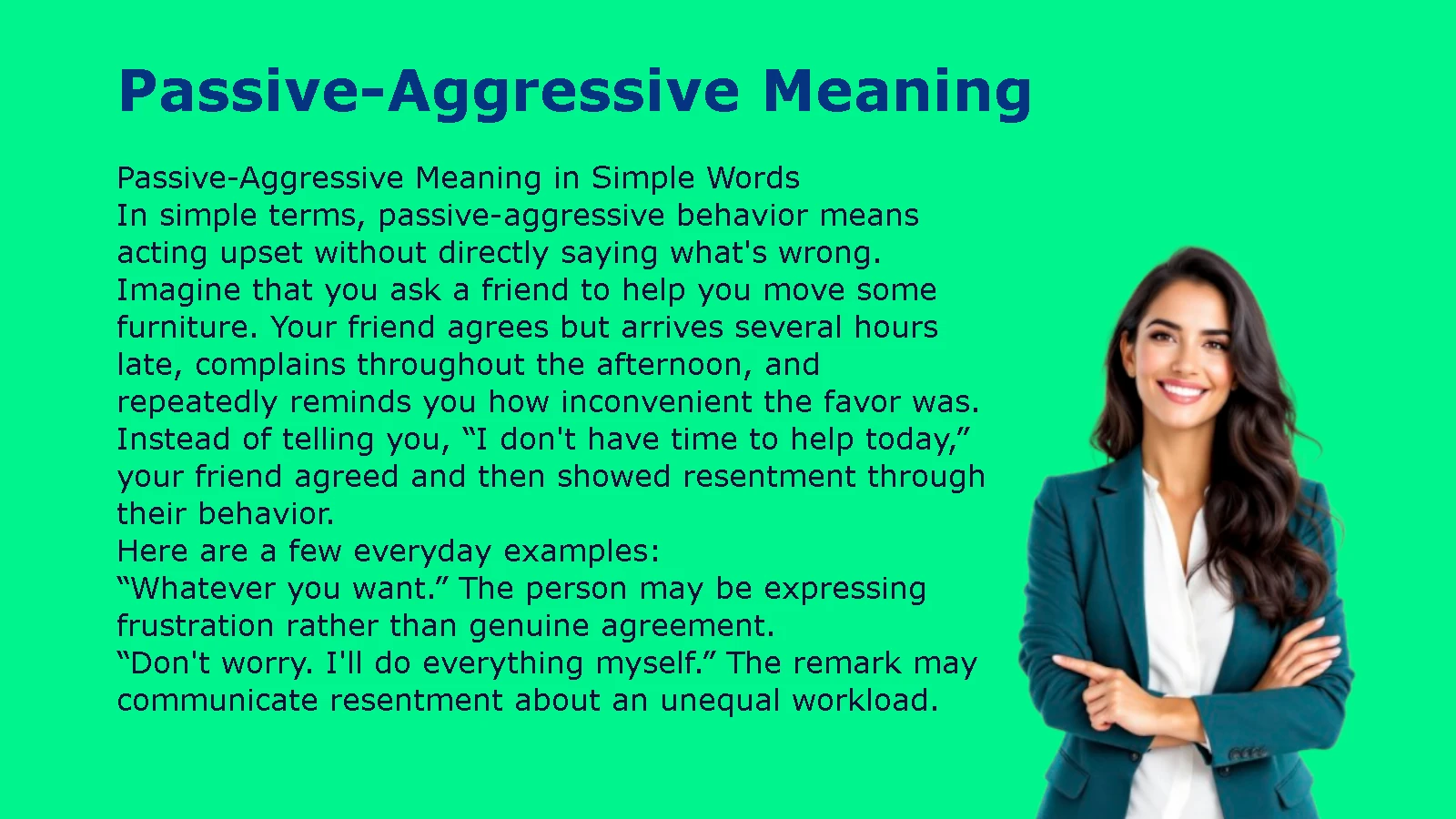
Passive-Aggressive Meaning in Simple Words
In simple terms, passive-aggressive behavior means acting upset without directly saying what’s wrong.
Imagine that you ask a friend to help you move some furniture. Your friend agrees but arrives several hours late, complains throughout the afternoon, and repeatedly reminds you how inconvenient the favor was.
Instead of telling you, “I don’t have time to help today,” your friend agreed and then showed resentment through their behavior.
Here are a few everyday examples:
- “Whatever you want.” The person may be expressing frustration rather than genuine agreement.
- “Don’t worry. I’ll do everything myself.” The remark may communicate resentment about an unequal workload.
- “Nice of you to finally show up.” The speaker expresses irritation through sarcasm.
- Agreeing but repeatedly delaying: Someone says yes to a request but continues putting it off, possibly as an indirect way of resisting it.
These examples don’t prove that someone is passive-aggressive. A person might be tired, distracted, overwhelmed, or joking. The pattern becomes more meaningful when indirect hostility repeatedly replaces honest communication.
Passive-Aggressive Definition and Part of Speech
Passive-aggressive is an adjective used to describe behavior, communication, or attitudes that express negative feelings indirectly.
For example:
- “His passive-aggressive comments made the meeting uncomfortable.”
- “She sent a passive-aggressive text after the disagreement.”
- “Their passive-aggressive behavior created tension at home.”
The related term passive aggression is a noun. It describes the behavior or communication style itself.
Passive-aggressively is the adverb form. It describes how someone performs an action.
For example: “He passive-aggressively reminded everyone that he had completed the project alone.”
Although the word contains passive, passive-aggressive behavior isn’t simply quietness or a lack of assertiveness. It involves indirect expressions of displeasure or resistance that may create tension or interfere with cooperation.
What Does It Mean When Someone Is Passive-Aggressive?
When someone behaves passive-aggressively, they may communicate frustration through actions, tone, or indirect remarks instead of stating their concerns clearly.
Consider this conversation:
Maya: “Did you have a chance to review my report?”
Daniel: “Oh, yes. It was certainly an interesting read.”
Maya: “Was there something wrong with it?”
Daniel: “No, no. It’s great.”
Daniel’s responses could be harmless sarcasm, awkward humor, or indirect criticism. Without further context, Maya cannot know which interpretation is correct.
A more revealing sign would be a repeated pattern of dismissive comments whenever Maya shares her work, especially if Daniel refuses to discuss specific concerns.
The important distinction is between what you observe and what you assume. You can identify a sarcastic remark or an unfulfilled commitment without claiming to know exactly what another person feels or intends.
Passive-Aggressive Examples in Everyday Life
Passive-aggressive behavior can appear in conversations, text messages, friendships, romantic relationships, and workplaces. It often involves a mismatch between what someone says and how they subsequently act.
Passive-Aggressive Comments and Phrases
Certain phrases can sound passive-aggressive when the speaker uses them to express resentment indirectly.
| Passive-aggressive phrase | Possible implied meaning | More direct alternative |
| “Fine, do whatever you want.” | “I disagree, but I don’t want to discuss it.” | “I disagree with this decision because…” |
| “Thanks for finally helping.” | “I’m frustrated that you didn’t help sooner.” | “I needed your help earlier and felt overwhelmed.” |
| “I guess some people have different priorities.” | “I feel that you haven’t made this important to you.” | “I felt disappointed when our plans changed.” |
| “Don’t worry about me.” | “I feel neglected or unappreciated.” | “I’d appreciate some support right now.” |
| “Must be nice to have so much free time.” | “I resent how you’re spending your time.” | “I’m struggling to balance my responsibilities. Can we discuss the workload?” |
| “I’m not upset. It’s whatever.” | “I may be upset, but I’m not ready to talk about it.” | “I’m frustrated and need some time before we discuss this.” |
These phrases aren’t automatically passive-aggressive. Someone might genuinely mean what they say. Tone, circumstances, and the person’s broader communication habits determine how a remark comes across.
A useful clue: If a comment repeatedly makes you guess what the speaker actually wants, a direct conversation may be overdue.
Passive-Aggressive Text Messages
Texting makes passive-aggressive behavior especially difficult to identify because readers cannot reliably hear the sender’s tone or see their facial expression.
A short message can sound cold even when the sender feels perfectly normal.
Common examples include:
- “K.” This may signal annoyance, but it can also be a quick acknowledgment.
- “Whatever.” Depending on the conversation, it may express dismissal or a genuine lack of preference.
- “No worries.” This might be sincere reassurance or a way of concealing disappointment.
- “Do what you want.” The sender may be giving you freedom or expressing frustration about a decision.
- “Thanks for letting me know.” This could be neutral or sarcastic, depending on the situation.
Consider this exchange:
Alex: “Sorry, I can’t make dinner tonight. Something came up at work.”
Jordan: “No worries. Have fun working.”
Jordan’s reply might be a sarcastic expression of disappointment, especially if the pair has canceled plans several times. However, a single message doesn’t establish that Jordan intended to criticize Alex.
Before responding defensively, consider the broader context.
A calm reply might be:
“I know work gets busy. I was looking forward to seeing you, though. Can we choose another evening?”
This response expresses disappointment without turning an ambiguous text into an argument.
Passive-Aggressive Behavior in Relationships
Passive-aggressive behavior can strain romantic relationships and friendships because it makes problems harder to identify and resolve.
Instead of saying what bothers them, a person may expect their partner to notice a change in mood, understand an indirect comment, or guess what they should do differently.
Common examples include:
- Giving the silent treatment to punish a partner after an argument.
- Agreeing to a plan but repeatedly complaining about it afterward.
- Making sarcastic remarks about a partner’s habits rather than discussing concerns.
- Saying “I’m fine” while repeatedly bringing up the same unresolved issue indirectly.
- Using guilt-inducing comments instead of making a clear request.
Example conversation
Lena: “Could you please wash the dishes tonight?”
Mark: “Sure. Apparently, I’m the only person who knows how to do anything around here.”
Lena: “I only asked you to wash the dishes.”
Mark: “Forget it. I’ll do it. I always do everything anyway.”
Mark may feel overworked or unappreciated, but his remarks don’t clearly explain what he needs. Lena now has to respond to his resentment as well as the original request.
A healthier exchange would sound like this:
Mark: “I’ve been feeling overwhelmed by the chores lately. Can we work out a schedule that feels fair to both of us?”
That statement identifies the underlying concern and creates room for a practical solution.
Passive-Aggressive Behavior at Work
In professional settings, passive-aggressive behavior can damage trust, delay projects, and make teamwork unnecessarily difficult.
It may appear through sarcasm, indirect criticism, repeated resistance, or a reluctance to communicate problems clearly.
Examples include:
- Agreeing to complete a task but repeatedly delaying it without explanation.
- Responding to a colleague’s suggestion with, “Well, that’s certainly one way to do it.”
- Sharing important information too late for a coworker to use it effectively.
- Making a backhanded compliment about a colleague’s promotion.
- Repeatedly bringing up past mistakes through pointed jokes rather than discussing them constructively.
Imagine that a manager asks an employee to prepare a report by Thursday.
The employee replies, “Absolutely. Since apparently, my existing workload isn’t enough.”
The remark may reflect a legitimate concern about workload. However, it doesn’t clearly communicate the problem or propose a solution.
A more productive response would be:
“I can prepare the report by Thursday, but I’ll need to postpone the inventory review. Which task should take priority?”
This wording makes the conflict visible and gives the manager a chance to resolve it.
One late assignment doesn’t prove deliberate resistance. Workload, unclear instructions, illness, and competing deadlines can all cause delays. Look at the facts before assigning a motive.
Funny or Subtle Passive-Aggressive Examples
Passive-aggressive humor often hides criticism inside a joke. The speaker may use humor to communicate irritation while maintaining the ability to say, “I was only kidding.”
Examples include:
- “Wow, look who’s finally decided to join us.”
- “Don’t strain yourself. We wouldn’t want you to do too much.”
- “I love how organized this project is.”
- “You’re always so helpful when you feel like it.”
- “Take your time. It’s not like we have a deadline.”
Friends may exchange these comments playfully without causing harm. The same words can become hurtful when someone repeatedly uses them to embarrass, criticize, or undermine another person.
The best way to distinguish teasing from indirect hostility is to consider the relationship, the circumstances, and the response to feedback. If someone learns that a joke hurts you and makes a genuine effort to stop, that’s different from someone who repeatedly dismisses your concerns.
Common Signs of Passive-Aggressive Behavior
Passive-aggressive behavior can be difficult to recognize because it doesn’t always involve obvious anger. Someone may remain polite, use humor, or insist that nothing is wrong while repeatedly acting in ways that communicate frustration.
The following signs can help you identify possible patterns. None of them proves someone’s intentions on its own.
The Silent Treatment and Emotional Withdrawal
The silent treatment occurs when someone deliberately withholds communication, often to express anger, punish another person, or gain control of a situation.
For example, two friends disagree about a weekend trip. One friend refuses to answer messages for several days, then resumes the friendship without discussing the disagreement.
That behavior may leave the other person confused about what happened or afraid of causing another conflict.
However, not every period of silence is passive-aggressive. People sometimes need time alone to calm down, organize their thoughts, or avoid saying something hurtful.
Compare these two situations:
- Healthy space: “I’m upset right now. Can we talk about this tomorrow when I’ve had time to think?”
- Punitive silence: Someone deliberately ignores repeated attempts to resolve a disagreement and uses the silence to make the other person feel guilty.
The difference lies in communication, purpose, and pattern. Taking a break can support a healthy discussion. Using silence to punish someone can prevent one.
Sarcasm and Backhanded Compliments
Sarcasm can be funny, harmless, or affectionate. It becomes a possible sign of passive-aggressive behavior when someone repeatedly uses it to express resentment or disguise criticism.
A backhanded compliment sounds positive at first but contains an insult or negative judgment.
Examples include:
- “You look great today. I almost didn’t recognize you.”
- “You actually did a good job on that presentation.”
- “You’re much more organized than I expected.”
- “That outfit is surprisingly flattering.”
Each statement contains a suggestion that the person normally looks different, performs poorly, or fails to meet expectations.
One awkward compliment may reflect poor wording rather than hostility. Repeated comments that undermine someone’s confidence deserve closer attention.
If a coworker says, “You actually handled that meeting well,” you could respond calmly:
“Thanks. Was there something about my previous meetings that you wanted to discuss?”
This invites specific feedback without returning the insult.
Procrastination and Deliberate Noncooperation
Repeated delays can sometimes serve as indirect resistance. Instead of openly refusing a request, someone agrees to it but fails to follow through.
For example, a roommate agrees to pay a shared utility bill but repeatedly waits until the last minute, even after several reminders. When asked about the delays, the roommate responds, “Relax. It’s not that serious.”
The problem isn’t simply that the payment was late. The concern is the repeated failure to honor an agreement, combined with dismissive responses when the issue comes up.
Still, procrastination has many possible causes:
- An unrealistic workload.
- Poor time management.
- Unclear expectations.
- Forgetfulness or disorganization.
- Anxiety about completing a difficult task.
- Genuine disagreement that the person hasn’t expressed.
Before labeling a delay passive-aggressive, ask whether the person understood the request, had the resources to complete it, and had a reasonable opportunity to explain any difficulties.
Focus on the practical issue first: what was agreed upon, what happened, and what needs to change.
Saying “I’m Fine” When Something Seems Wrong
Sometimes a person’s words and behavior appear inconsistent.
Someone might say “I’m fine” while avoiding eye contact, withdrawing from a conversation, or making repeated sarcastic remarks. You may suspect that the person feels hurt or frustrated but doesn’t want to discuss it.
There are several possible explanations. They may be uncomfortable expressing emotions, unsure what they feel, afraid of conflict, or simply unwilling to talk at that moment.
The phrase itself isn’t proof of passive-aggression.
A respectful response leaves room for honesty without demanding immediate disclosure:
“Okay. If something is bothering you and you’d like to talk about it later, I’m willing to listen.”
This communicates interest while respecting the person’s choice.
If the behavior continues to affect you, address the specific issue rather than repeatedly asking whether the person is upset.
Sulking, Complaining, and Indirect Criticism
Another possible sign is repeatedly expressing dissatisfaction without clearly identifying the problem.
Examples include:
- Sighing dramatically whenever someone makes a suggestion.
- Making vague remarks about how nobody appreciates their effort.
- Complaining to other people instead of speaking to the person involved.
- Making pointed jokes about a decision after agreeing to it.
- Bringing up old grievances during unrelated conversations.
Imagine that a colleague agrees to a new workflow but spends every meeting commenting, “Well, I suppose this is how we’re doing things now.”
The colleague may have legitimate concerns. The difficulty is that indirect complaints don’t identify those concerns clearly enough for the team to address them.
A useful response would be:
“You seem concerned about the new workflow. Which part do you think will cause problems?”
This turns a vague complaint into a conversation about specific issues.
Why Do People Act Passive-Aggressively?
Passive-aggressive behavior can develop for several reasons, including discomfort with confrontation, resentment, difficulty expressing emotions, or a belief that direct disagreement will lead to negative consequences.
There isn’t one universal explanation. The same behavior can arise from very different circumstances, and you cannot reliably determine a person’s motives from a single interaction.
Fear of Confrontation
Some people learn that expressing anger or disagreement leads to arguments, rejection, punishment, or embarrassment.
They may therefore avoid direct conversations even when something bothers them.
For example, a person who doesn’t want to attend a family gathering might agree to go, then complain throughout the event. They may feel unable to say no because they fear disappointing relatives.
The indirect approach can feel safer in the moment. However, it creates confusion because other people cannot respond to the real concern.
A more effective approach is to make a respectful statement:
“I appreciate the invitation, but I need a quiet weekend. I won’t be able to attend this time.”
Direct communication doesn’t require hostility. It simply makes the person’s position clear.
Difficulty Expressing Emotions
Some people struggle to identify their feelings or explain what they need. They may recognize that they’re unhappy without understanding whether they feel ignored, overwhelmed, embarrassed, or disappointed.
Without clear language, frustration may emerge through sarcasm, withdrawal, or vague complaints.
For example, someone who feels excluded from a group decision might say, “Well, it’s nice to know my opinion matters.”
The underlying concern may be that nobody asked for their input.
A more constructive statement would be:
“I felt left out when the decision was made without me. I’d appreciate being included next time.”
Learning to name emotions can help people replace indirect reactions with specific requests.
Resentment and Feeling Unappreciated
Resentment can build when people believe that responsibilities, attention, or recognition aren’t distributed fairly.
Consider a couple who share household responsibilities. One partner believes they handle most of the cleaning and planning, but they never discuss how to divide the work.
Over time, that partner starts making comments such as, “Don’t worry. I’ll clean up after everyone, as usual.”
The remark communicates frustration but doesn’t establish a workable agreement.
A better starting point is to describe the imbalance:
“I’ve been handling most of the cleaning this month. Can we divide the chores more evenly?”
This gives both partners a chance to compare expectations and agree on a solution.
Power Imbalances and Fear of Rejection
Direct disagreement can feel risky when one person has more authority or influence than another.
An employee may hesitate to challenge a manager. A child may fear a parent’s reaction. A partner may worry that expressing a preference will trigger rejection or conflict.
In these situations, indirect communication may become a way to express dissatisfaction while avoiding an immediate confrontation.
That context matters. A person who fears retaliation may need greater safety and clearer communication channels, not simply advice to speak up.
For example, an employee who disagrees with a manager’s deadline might ask for priorities in writing, explain the workload conflict, or seek help through an appropriate workplace process.
The goal is to make concerns easier to raise without ignoring the power dynamics that may discourage direct communication.
Passive-Aggressive vs. Passive vs. Aggressive vs. Assertive Behavior
These communication styles differ in how people express their needs, handle disagreement, and respond to frustration.
Passive communication tends to suppress personal needs. Aggressive communication expresses them through hostility or intimidation. Passive-aggressive communication expresses resistance indirectly. Assertive communication states needs and boundaries clearly while respecting other people.
Comparison Table of Communication Styles
| Communication style | Typical behavior | Example phrase | Likely effect |
| Passive | Avoids expressing needs or disagreement | “It’s okay. I’ll manage somehow.” | Needs may remain unaddressed. |
| Aggressive | Uses hostility, blame, or intimidation | “You’re useless at this.” | The other person may feel attacked. |
| Passive-aggressive | Expresses resentment indirectly | “Don’t worry. I’ll do everything myself, as usual.” | The real problem remains unclear. |
| Assertive | Communicates needs directly and respectfully | “I need us to divide this work more evenly.” | Creates an opportunity for resolution. |
These are broad descriptions, not rigid personality categories. Someone may communicate assertively in one situation and passively in another.
Passive-Aggressive vs. Manipulative Behavior
Passive-aggressive behavior and manipulation can overlap, but they don’t mean exactly the same thing.
Passive-aggressive behavior involves expressing negative feelings or resistance indirectly. Manipulation involves influencing another person’s choices through indirect, deceptive, coercive, or otherwise unfair methods.
For example, a person who makes sarcastic comments about doing all the housework may be expressing resentment indirectly.
A person who deliberately invents a crisis to make a partner abandon plans may be using deception to influence that partner’s behavior.
The distinction depends on the specific actions and circumstances. Not every sarcastic remark is manipulation, and not every indirect expression of frustration is intended to control someone.
Rather than relying on labels, consider these questions:
- Does the behavior repeatedly undermine your ability to make your own decisions?
- Does the person communicate concerns honestly when you ask?
- Do they respect reasonable boundaries?
- Can you discuss the problem without being punished or intimidated?
These questions focus on the relationship’s actual dynamics rather than trying to diagnose someone’s character.
Passive-Aggressive vs. Gaslighting
Passive-aggressive behavior and gaslighting are also different concepts.
Passive-aggressive behavior communicates displeasure indirectly. Gaslighting refers to a pattern of psychological manipulation that undermines someone’s confidence in their own perceptions, memories, or judgment.
For example, a person might respond to a disagreement with a sarcastic, “Whatever you say.” That response may be dismissive or passive-aggressive, but it doesn’t automatically constitute gaslighting.
By contrast, imagine someone repeatedly denies events that occurred, misrepresents conversations, and insists that the other person cannot trust their own memory. If this forms a sustained pattern intended to undermine the person’s grasp of reality, it may indicate gaslighting.
The distinction matters because these terms describe different behaviors. Using them interchangeably can make it harder to identify the actual problem.
When assessing a difficult relationship, pay attention to repeated actions, the impact on your well-being, and whether the other person respects your boundaries.
How to Respond to a Passive-Aggressive Person
Responding to passive-aggressive behavior doesn’t require you to expose someone’s hidden feelings or win an argument. The goal is to address the observable behavior, clarify expectations, and protect your boundaries without escalating the conflict.
Stay Calm and Avoid Matching Their Tone
Sarcasm often invites sarcasm in return. If someone makes a pointed remark, responding with an equally sharp comment may feel satisfying, but it rarely clarifies the underlying problem.
Imagine a coworker says, “Must be nice to leave early while the rest of us do the actual work.”
You could reply, “Maybe if you worked more efficiently, you could leave early too.” That response escalates the exchange and shifts attention away from the real issue.
A calmer response would be:
“I hear that you’re frustrated about the workload. Is there a specific task you need help with?”
This doesn’t mean accepting unfair criticism. It means choosing a response that keeps the discussion focused on facts and possible solutions.
Try these practical steps:
- Pause before responding to a provocative comment.
- Avoid assuming that every ambiguous remark is an attack.
- Ask for clarification when you genuinely don’t understand the message.
- Keep your response focused on the situation rather than the person’s character.
You don’t have to respond to every sarcastic comment. Sometimes, a brief acknowledgment and a return to the task are enough.
Address the Behavior Directly
When the same behavior keeps causing problems, describe what happened instead of accusing the person of having a particular attitude.
For example, avoid opening with, “You’re always passive-aggressive.”
That statement labels the person and may encourage them to defend their character rather than discuss the problem.
Instead, try:
“When you agreed to send the report on Tuesday but didn’t send it or let me know about the delay, I couldn’t finish my part of the project. Can we agree on a realistic deadline?”
This approach identifies three important things:
- The specific behavior: The report wasn’t delivered as agreed.
- The impact: Your work was delayed.
- The next step: Agree on a workable deadline.
You can use the same structure in personal relationships.
“I felt disappointed when you canceled our plans at the last minute. If you’re no longer interested in meeting, I’d prefer that you tell me directly.”
Direct communication makes expectations easier to understand without claiming to know what another person intended.
Ask Open-Ended Questions
Sometimes, an indirect remark signals a concern that the person hasn’t explained.
A thoughtful question can give them an opportunity to express it more clearly.
Useful questions include:
- “Is there something about this plan that concerns you?”
- “You seem unhappy with the decision. What would you like to change?”
- “Did I misunderstand what you meant?”
- “Is there a reason this task has been difficult to complete?”
- “What would make this arrangement feel fair to you?”
Ask these questions sincerely rather than using them to corner the person.
If they say nothing is wrong, you don’t need to force a confession. You can respect their answer while addressing any concrete issue that remains unresolved.
For example:
“Okay. If your concerns change, we can discuss them. For now, I still need the report by Friday.”
This balances openness with accountability.
Set Boundaries and Follow Through
You cannot control another person’s communication style, but you can decide how you’ll respond to repeated behavior.
A boundary explains what you will accept and what action you’ll take if a situation continues. It isn’t a threat or an attempt to control someone else’s feelings.
Suppose a friend repeatedly makes insulting jokes after you’ve asked them to stop.
You might say:
“I enjoy joking with you, but I don’t want comments about my appearance. If the jokes continue, I’ll leave the conversation.”
The boundary identifies the behavior and explains what you’ll do.
At work, you might say:
“I need project updates by Wednesday so I can meet the deadline. If that timeline isn’t realistic, please tell me early so we can adjust the plan.”
Effective boundaries should be:
- Specific: Identify the behavior or expectation.
- Reasonable: Focus on something you can realistically enforce.
- Consistent: Follow through rather than repeating the same warning indefinitely.
- Respectful: Avoid insults, threats, or attempts to punish the other person.
If the behavior involves harassment, intimidation, or a serious workplace issue, you may need formal support rather than another private conversation.
Know When to Seek Outside Support
Some communication problems can improve through honest discussion. Others persist despite repeated attempts to resolve them.
Consider seeking support when:
- Arguments repeatedly follow the same pattern without resolution.
- You feel anxious about expressing ordinary needs or preferences.
- A relationship involves persistent humiliation, intimidation, or retaliation.
- Workplace behavior interferes with your ability to complete tasks.
- You struggle to communicate your feelings and want help developing healthier habits.
Depending on the circumstances, support may come from a trusted person, a manager, a mediator, a counselor, or a licensed therapist.
You don’t need to prove that someone is passive-aggressive before asking for help. The practical question is whether the behavior is affecting your work, relationships, safety, or well-being.
How to Stop Being Passive-Aggressive
If you recognize passive-aggressive habits in yourself, you can learn to express frustration more directly. The aim isn’t to eliminate anger or disagreement. It’s to communicate those feelings without relying on sarcasm, indirect resistance, or silence to get your message across.
Recognize Your Triggers
Start by noticing the situations in which you become resentful or avoid speaking openly.
Common triggers include:
- Feeling ignored or unappreciated.
- Believing responsibilities are unfairly distributed.
- Feeling pressured to agree with something you dislike.
- Fearing that a disagreement will damage a relationship.
- Struggling to say no to requests.
For a week, pay attention to moments when you want to make a sarcastic remark, withdraw from a conversation, or agree to something you don’t actually want to do.
Ask yourself:
- What happened immediately before I felt irritated?
- What did I want the other person to understand?
- What stopped me from saying it directly?
- What could I request instead?
For example, you may discover that you repeatedly complain about helping coworkers because you feel unable to refuse additional assignments.
The underlying issue may not be the coworkers themselves. You may need clearer priorities or more confidence in setting limits.
Recognizing the trigger gives you a more useful starting point than criticizing yourself for feeling frustrated.
Express Anger Without Attacking Others
Anger is a normal emotion. The important question is how you communicate it.
Compare these examples:
| Indirect or hostile statement | Clearer alternative |
| “I guess I’ll do everything myself.” | “I’m overwhelmed and need help with these tasks.” |
| “Nice of you to remember I exist.” | “I felt hurt when I didn’t hear from you.” |
| “Whatever. It doesn’t matter.” | “This matters to me, and I’d like to discuss it.” |
| “Must be nice to have no responsibilities.” | “I’m struggling with my workload. Can we review how we divide responsibilities?” |
| “Don’t worry about asking me again.” | “I can’t take on another assignment this week.” |
Notice that the alternatives don’t require you to pretend you’re happy.
They allow you to express dissatisfaction without turning it into a personal attack.
A useful formula is:
When [specific situation] happens, I feel [emotion] because [reason]. I’d like [specific request].
For example:
“When our plans change without warning, I feel disappointed because I set aside time for us. I’d like you to tell me as early as possible when something changes.”
You don’t have to use this formula word for word. Its purpose is to help you identify the situation, explain your concern, and state what would help.
Practice Direct and Respectful Requests
Many indirect communication problems begin when people expect others to understand needs that they’ve never clearly expressed.
Instead of hoping someone notices that you’re overwhelmed, ask for help. Instead of agreeing to a commitment you can’t manage, explain your limits.
Try these replacements:
- Instead of “I guess nobody can help me,” say, “Could you help me finish this before Friday?”
- Instead of “Fine, whatever you decide,” say, “I prefer the first option because it gives us more time.”
- Instead of silently resenting a canceled plan, say, “I’m disappointed, but I understand. Can we choose another day?”
- Instead of agreeing to an unreasonable deadline, say, “I can finish this by Monday, but not by Friday. Which timing works better?”
Direct communication also means accepting that the other person may disagree.
You can make a reasonable request without guaranteeing that you’ll receive the answer you want. The goal is clarity, not control.
Take Responsibility for Your Communication
Changing a communication habit takes practice. You may still make sarcastic remarks or avoid a difficult conversation occasionally.
What matters is recognizing the behavior and correcting it.
If you realize that you’ve made an indirect, hurtful comment, acknowledge it without making excuses.
For example:
“I said that because I was frustrated, but it came out sarcastically. What I meant was that I felt left out of the decision. I’m sorry for how I said it.”
Then explain what you need more clearly.
You can also practice these habits:
- Say no when you cannot reasonably fulfill a request.
- Raise concerns before resentment builds.
- Ask for clarification instead of assuming the worst.
- Apologize when your words hurt someone.
- Follow through on commitments or communicate delays promptly.
- Allow other people to express disagreement without treating it as rejection.
If indirect communication has become a persistent habit that damages your relationships, counseling or therapy may help you understand the pattern and practice healthier responses.
The objective isn’t perfect communication. It’s making honest communication more common than indirect hostility.
Passive-Aggressive Meaning in Different Contexts
The meaning of passive-aggressive stays broadly consistent across situations, but the behavior can look different depending on the relationship, communication channel, and circumstances.
Passive-Aggressive Meaning in a Relationship
In romantic relationships and friendships, passive-aggressive behavior often involves expressing disappointment or resentment without openly discussing it.
For example, a partner might say, “Go ahead and spend the evening with your friends. I clearly don’t matter anyway.”
The remark may express a desire for more time together, but it communicates that concern through guilt rather than a direct request.
A clearer alternative would be:
“I was hoping we’d spend time together tonight. Can we plan an evening for just the two of us?”
This approach makes the underlying need easier to understand.
Not every disagreement or emotional withdrawal signals passive-aggression. People sometimes need time to process feelings. The concern arises when indirect hostility repeatedly prevents honest discussion or pressures the other person to guess what they did wrong.
Passive-Aggressive Meaning at Work
At work, passive-aggressive behavior describes indirect expressions of resentment, criticism, or resistance that complicate professional communication.
An employee might respond to a new policy with, “Well, I suppose someone thinks this is a brilliant idea,” rather than explaining why the policy may cause problems.
The remark expresses disapproval without giving the team useful information.
A direct alternative would be:
“I have concerns about how this policy will affect our turnaround time. Could we review the expected workload before implementing it?”
The same principle applies to missed deadlines, unclear responsibilities, and disagreements over priorities. Specific concerns give coworkers and managers something they can actually address.
Passive-Aggressive Meaning in Texting and Social Media
In digital communication, passive-aggression may appear through sarcastic replies, pointed posts, indirect references, or messages that communicate displeasure without identifying the problem.
For example, someone who feels excluded from a gathering might post, “Funny how you learn who your real friends are.”
The post could express genuine hurt, refer to an unrelated situation, or simply be a dramatic statement. Readers cannot reliably determine its meaning without more context.
When a message concerns you, avoid treating vague online comments as definitive evidence.
If the relationship matters, a private question may help:
“I saw your post and wondered whether something happened between us. If I upset you, I’m open to talking about it.”
This invites clarification without starting a public argument.
Passive-Aggressive Meaning in Everyday Conversation
In everyday speech, passive-aggressive describes indirect hostility or resistance that may be hidden behind polite language, sarcasm, or seemingly cooperative behavior.
For example:
“Her passive-aggressive remarks made it difficult to discuss the project openly.”
The sentence suggests that her comments communicated criticism indirectly rather than identifying specific concerns.
The word can also describe a communication style:
- “That response sounded passive-aggressive.”
- “He made a passive-aggressive joke about the schedule.”
- “They need to address the disagreement instead of communicating passive-aggressively.”
When using the term, distinguish between describing a particular remark and labeling someone’s entire personality. The first is often easier to support with observable evidence.
Passive-Aggressive Synonyms and Related Terms
Several words describe behavior that overlaps with passive-aggression, but they don’t all mean the same thing. Choosing the right term helps you describe what happened without exaggerating or misrepresenting someone’s behavior.
Common Synonyms for Passive-Aggressive
Here are some related words and phrases, along with their specific meanings.
| Word or phrase | Meaning | Example |
| Indirectly hostile | Expressing hostility without stating it openly | “His indirectly hostile remarks made the discussion uncomfortable.” |
| Resentful | Feeling bitterness or displeasure about a situation | “She felt resentful about carrying most of the workload.” |
| Sarcastic | Using irony or mocking remarks to criticize or amuse | “His sarcastic response dismissed her suggestion.” |
| Obstructive | Making progress or cooperation more difficult | “Repeatedly withholding necessary information was obstructive.” |
| Uncooperative | Unwilling to work with others toward an agreed goal | “The employee was uncooperative during the planning process.” |
| Antagonistic | Showing opposition or hostility toward someone | “Their antagonistic exchange disrupted the meeting.” |
| Backhanded | Seemingly complimentary but indirectly insulting | “That was a backhanded compliment about her promotion.” |
These words describe different aspects of behavior. Resentful describes a feeling, sarcastic describes a way of communicating, and obstructive describes behavior that gets in the way of progress.
They’re useful alternatives when you want to be more precise than simply calling someone passive-aggressive.
Related Words and Expressions
Passive aggression is the noun form of the concept. It refers to indirect expressions of hostility, frustration, or resistance.
Passive-aggressively is the adverb form. For example, “He passive-aggressively questioned the decision after agreeing to it.”
Other related expressions include:
- Silent treatment: Withholding communication, sometimes to punish or pressure another person.
- Backhanded compliment: A remark that appears complimentary but contains an insult.
- Indirect criticism: Communicating disapproval without clearly stating the concern.
- Passive resistance: Resisting a request, rule, or decision without openly confronting it.
- Sarcastic remark: A comment that uses irony or mockery, sometimes to express irritation.
These expressions can overlap with passive-aggressive behavior, but none is an exact substitute in every situation.
For example, a sarcastic comment can be playful, and passive resistance can occur for principled reasons. Context determines whether the behavior communicates indirect hostility.
Conclusion: Understanding Passive-Aggressive Meaning
The passive-aggressive meaning centers on expressing negative feelings, disagreement, or resentment indirectly instead of communicating openly. It can appear through sarcastic comments, backhanded compliments, the silent treatment, repeated delays, and other forms of indirect resistance.
The key is to recognize patterns without jumping to conclusions. A short text, an awkward joke, or a missed deadline doesn’t automatically mean someone is passive-aggressive. Consider the circumstances, the person’s broader behavior, and whether they can discuss concerns openly.
If someone else’s behavior repeatedly creates tension, focus on specific actions, ask clear questions, and establish reasonable boundaries. If you recognize these habits in yourself, practice expressing your feelings and needs directly.
Your next step: The next time a conversation feels uncomfortable, replace an assumption with a question. Instead of guessing what someone means, ask what concerns them and explain your own position calmly. A direct conversation may resolve a misunderstanding before it becomes a lasting source of resentment.
Frequently Asked Questions About Passive-Aggressive Meaning
What Does Passive-Aggressive Mean in Simple Words?
Passive-aggressive means expressing anger, frustration, or disagreement indirectly rather than saying what you feel. Examples include sarcastic comments, indirect criticism, or repeatedly resisting an agreed-upon task.
What Is an Example of a Passive-Aggressive Comment?
“Fine, I’ll do everything myself, as usual” is a common example. The speaker may be expressing resentment about an unequal workload without directly asking for help or discussing how to divide responsibilities.
Is Being Passive-Aggressive the Same as Being Rude?
No. Rudeness involves disrespectful behavior that can be direct or indirect, while passive-aggression involves expressing negative feelings or resistance indirectly. A sarcastic remark can be both rude and passive-aggressive, but the terms aren’t interchangeable.
What Does Passive-Aggressive Mean in a Relationship?
In a relationship, passive-aggressive behavior involves expressing frustration or resentment indirectly rather than discussing it openly. Examples include guilt-inducing remarks, punitive silence, and sarcastic comments about unresolved disagreements.
Is Passive-Aggressive Behavior a Mental Disorder?
Passive-aggressive behavior alone isn’t a diagnosis of a mental disorder. It describes a way of communicating or responding to conflict. Persistent communication difficulties may have different underlying causes, which a qualified mental health professional can assess when appropriate.
How Do You Respond to Someone Who Is Passive-Aggressive?
Stay calm, address the specific behavior, and ask direct questions about the underlying concern. Set clear boundaries if the behavior continues, and seek appropriate support if it becomes persistent, intimidating, or harmful.













