Have you ever described something as ordinary or uninteresting and wondered if there was a more precise word for it? That’s where Prosaic Meaning comes in. This word can describe something that feels dull, commonplace, or lacking imagination, especially when compared with something more exciting or creative.
Prosaic is an adjective used to describe something ordinary, unimaginative, or lacking a poetic or inspiring quality. It can refer to writing, ideas, conversations, experiences, or everyday life.
Examples:
- The speech was informative but rather prosaic.
- His prosaic description made the beautiful scene sound ordinary.
The confusion is understandable. People often search for what does prosaic mean, prosaic meaning in English, prosaic definition, prosaic meaning in a sentence, or prosaic synonym because the word can have slightly different shades of meaning depending on the context. And here’s the kicker: calling something prosaic doesn’t always mean it is bad. It often simply suggests that it is plain, conventional, or lacking imagination.
In this guide, you’ll learn the complete Prosaic Meaning, its definition, pronunciation, origin, synonyms and antonyms, and correct usage. You’ll also discover how to use prosaic in a sentence, understand its meaning in different contexts, and see clear examples that make this sophisticated word easy to remember.
What Does Prosaic Mean?
Prosaic is an adjective that generally means ordinary, commonplace, dull, or lacking imagination. It can also describe something that has the plain, factual quality associated with prose rather than poetry.
In simple terms, if something feels plain when you expected it to be exciting, you can call it prosaic.
Consider this contrast:
The detective expected a mysterious explanation, but the truth was surprisingly prosaic: someone had simply left the door unlocked.
The word suggests more than simple boredom. It creates a contrast between what seems dramatic, imaginative, or extraordinary and what turns out to be ordinary and practical.
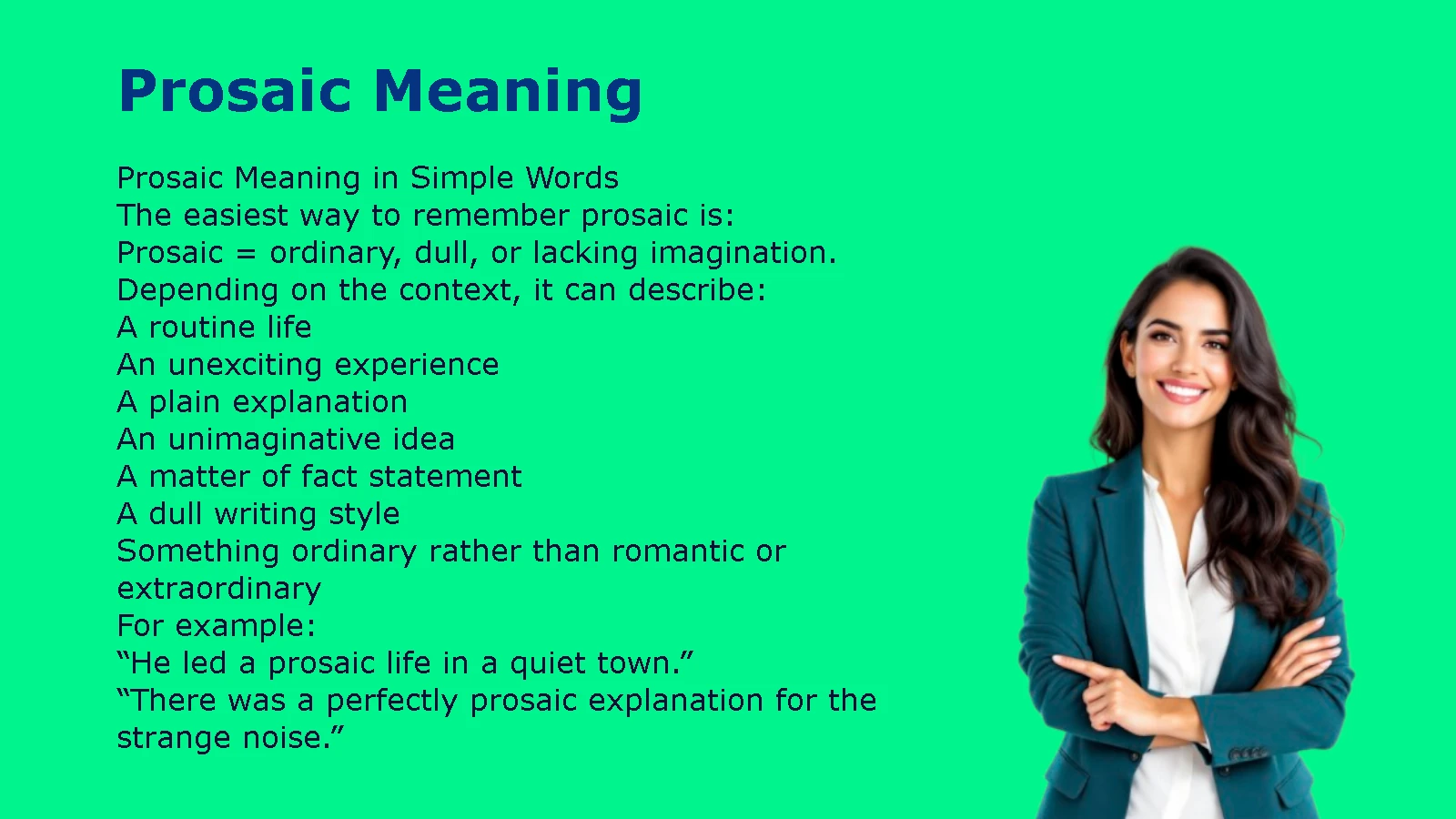
Prosaic Meaning in Simple Words
The easiest way to remember prosaic is:
Prosaic = ordinary, dull, or lacking imagination.
Depending on the context, it can describe:
- A routine life
- An unexciting experience
- A plain explanation
- An unimaginative idea
- A matter of fact statement
- A dull writing style
- Something ordinary rather than romantic or extraordinary
For example:
- “He led a prosaic life in a quiet town.”
- “There was a perfectly prosaic explanation for the strange noise.”
- “The novel’s opening felt prosaic and predictable.”
- “Her answer was practical but somewhat prosaic.”
The word often carries a mildly negative tone, especially when it describes writing, ideas, or experiences. Oxford labels the modern adjective as usually disapproving.
Prosaic Definition and Pronunciation
In American English, prosaic is pronounced:
proh-ZAY-ik
Its American pronunciation is represented as /proʊˈzeɪ.ɪk/. The stress falls on the second syllable, so the middle sound receives the strongest emphasis.
| Feature | Details |
| Word | Prosaic |
| Part of speech | Adjective |
| American pronunciation | /proʊˈzeɪ.ɪk/ |
| Simple pronunciation | proh-ZAY-ik |
| Related noun | Prose |
| Related adverb | Prosaically |
| Common tone | Neutral to mildly negative |
The word is formal enough to appear in literary criticism, essays, journalism, and serious conversation. It isn’t usually the word you’d choose when chatting casually with a friend about a boring Tuesday.
Instead of saying, “My Tuesday was prosaic,” you’d probably say, “My Tuesday was boring.”
However, if you’re describing the contrast between an exciting expectation and an ordinary reality, prosaic becomes much more useful.
Prosaic Meaning and Word Origin
The history of prosaic explains why the word has such a strong connection to plainness and ordinary expression.
The word comes from Late Latin prosaicus, which means “in prose.” Its deeper connection is the Latin word prosa, meaning prose.
Early uses of prosaic referred to something related to prose. Over time, the word developed a stronger contrast with poetry. By the 18th century, it could describe something that had the character of prose rather than the imaginative or emotional quality associated with poetry.
Eventually, its meaning expanded again.
Something that was prosaic could be ordinary, commonplace, plain, or lacking poetic beauty. Etymonline dates this broader sense of “ordinary, commonplace in style or expression, lacking poetic imagination or beauty” to the early 19th century.
How the Meaning Changed
The development can be understood in a simple progression:
prose → prose-like → plain or matter of fact → ordinary or unimaginative
Merriam-Webster notes that the earliest sense did not necessarily carry a negative meaning. It simply referred to something characteristic of prose rather than poetry. Later, the word acquired its familiar sense of something dull, unimaginative, or ordinary.
That history matters because it explains why prosaic can still appear in discussions about literature and writing.
How to Use Prosaic in a Sentence
Because prosaic is an adjective, it normally modifies a noun.
You can use it before a noun:
- a prosaic explanation
- a prosaic life
- a prosaic routine
- a prosaic style
- a prosaic existence
- a prosaic detail
You can also use it after a linking verb:
- “The explanation was prosaic.”
- “His daily routine became prosaic.”
- “The story’s ending felt prosaic.”
Prosaic Examples in Everyday English
Here are several examples that show the word in natural contexts:
- The strange event had a prosaic explanation.
- The explanation was ordinary rather than mysterious.
- She grew tired of her prosaic routine.
- Her routine had become predictable and unexciting.
- The author turned a prosaic subject into an engaging story.
- The subject itself was ordinary, but the writing made it interesting.
- His prosaic response disappointed everyone who expected a dramatic confession.
- His answer was plain and matter of fact.
- The detective discovered that the supposedly supernatural event had a prosaic cause.
- The cause was ordinary and practical.
- Their conversation remained prosaic despite the romantic setting.
- They talked about ordinary matters instead of anything romantic or exciting.
- The report contains useful information but uses a rather prosaic style.
- The writing is plain and lacks imagination.
Prosaic Examples in Different Contexts
The meaning of prosaic becomes clearer when you see how it works across different subjects.
Prosaic in Writing and Literature
In literary discussions, prosaic often describes writing that lacks imagination, beauty, emotional power, or poetic expression.
For example:
“The poem’s ideas are interesting, but several passages sound prosaic.”
This doesn’t necessarily mean the passages are written in prose. Instead, it suggests that the language feels too plain or ordinary for poetry.
A writer can also create a deliberately prosaic style. A realistic novel, for example, might use ordinary dialogue and everyday details to make characters feel believable.
So prosaic doesn’t automatically mean bad writing.
Sometimes plain language serves a purpose.
A novelist might describe someone washing dishes, paying a bill, or waiting for a bus. Those details are ordinary. Yet when placed carefully within a story, they can reveal character, create realism, or establish a particular mood.
Prosaic in Everyday Life
The word frequently describes routine experiences.
Imagine someone dreaming about traveling the world. Instead, their days consist of commuting, answering emails, buying groceries, and doing household chores.
Someone could describe that existence as prosaic.
That doesn’t mean the person’s life has no value. It simply emphasizes how ordinary and predictable it feels compared with the adventure they imagined.
Prosaic in Speech and Conversation
A conversation can also be prosaic.
Suppose two people meet at a beautiful restaurant overlooking the ocean. You might expect them to discuss love, travel, or dreams. Instead, they spend an hour discussing parking permits and grocery prices.
The conversation could fairly be called prosaic.
The setting is romantic. The conversation isn’t.
Prosaic in Art and Creativity
Artists and critics may use prosaic when discussing work that seems conventional, literal, or lacking imaginative energy.
For example:
“The painting captures an ordinary street but presents it without much creative interpretation.”
Calling the work prosaic suggests that the artist hasn’t transformed the ordinary subject into something particularly striking.
However, context matters. An artist may intentionally use ordinary subjects to make a larger point about everyday life.
Is Prosaic the Same as Boring?
Not exactly.
Boring focuses strongly on a lack of interest. Prosaic has a wider meaning. It can describe something that is ordinary, unimaginative, matter of fact, or lacking romance and poetic quality.
Compare these sentences:
- “The lecture was boring.”
- “The lecture offered a prosaic explanation of the problem.”
The first sentence directly says the lecture wasn’t interesting.
The second emphasizes that the explanation was plain and practical, perhaps in contrast to a more exciting explanation someone expected.
That’s an important distinction.
Prosaic vs. Mundane
Prosaic and mundane overlap considerably. Both can describe something ordinary or unexciting.
However, they aren’t always interchangeable.
Mundane usually emphasizes the repetitive, everyday nature of something. Prosaic can emphasize ordinary qualities as well as a lack of imagination or poetic feeling. Oxford lists mundane as a synonym in its second sense of prosaic.
| Word | Main Idea | Example |
| Prosaic | Ordinary or unimaginative | “The mystery had a prosaic explanation.” |
| Mundane | Routine and unexciting | “She was tired of her mundane routine.” |
A mundane chore is simply an everyday chore that isn’t exciting.
A prosaic explanation may be ordinary and practical, especially when contrasted with something mysterious or imaginative.
Prosaic vs. Banal
These words can both describe something unoriginal, but banal often carries a sharper criticism.
Banal suggests that something has become dull because it’s too familiar, predictable, or overused.
For example:
- “He gave a prosaic explanation.”
- “He gave a banal explanation.”
The first could mean the explanation was plain and practical.
The second suggests the explanation was unoriginal or painfully predictable.
Think of it this way:
Prosaic = plain.
Banal = tired from overuse.
That distinction makes banal especially useful when criticizing clichés or recycled ideas.
Prosaic vs. Ordinary
Ordinary is usually more neutral than prosaic.
If you say:
“She lives an ordinary life.”
You’re simply stating that her life isn’t unusual.
But:
“She lives a prosaic life.”
suggests that her life may feel dull, unimaginative, or lacking excitement.
Merriam-Webster lists ordinary, normal, usual, typical, commonplace, and average among synonyms associated with the everyday sense of prosaic.
The emotional difference is important:
| Expression | Likely Impression |
| Ordinary life | Neutral |
| Typical life | Neutral |
| Mundane life | Unexciting |
| Prosaic life | Ordinary and lacking imagination |
| Banal life | Predictable and unoriginal |
| Dull life | Uninteresting |
Is Prosaic Always Negative?
No.
Although modern dictionaries often identify a disapproving or negative sense, prosaic doesn’t always condemn what it describes. Oxford specifically marks the word as usually disapproving, while Merriam-Webster includes senses ranging from factual and prose-like to dull and ordinary.
Consider this sentence:
“The solution was prosaic but effective.”
Here, prosaic means the solution wasn’t glamorous or exciting. It doesn’t mean the solution was bad.
In fact, the ordinary solution may be exactly what works.
A detective might investigate an apparently mysterious disappearance only to discover a prosaic explanation: the person missed a train and forgot to call.
The explanation isn’t exciting.
It’s still the truth.
When Prosaic Is Neutral
The word can be relatively neutral when it contrasts ordinary reality with something more dramatic.
For example:
“The researchers looked beyond the spectacular theories and examined the more prosaic causes.”
Here, prosaic points toward practical, everyday causes rather than necessarily criticizing them.
Cambridge provides similar usage in expressions involving “more prosaic” explanations and reasons.
Prosaic Synonyms
The best synonym depends on the exact shade of meaning you want.
| Synonym | Meaning | Tone |
| Ordinary | Not unusual | Neutral |
| Mundane | Everyday and unexciting | Mildly negative |
| Dull | Lacking interest | Negative |
| Unimaginative | Lacking creative thought | Negative |
| Commonplace | Familiar and ordinary | Neutral to negative |
| Banal | Predictable or unoriginal | Negative |
| Routine | Regular and predictable | Neutral |
| Pedestrian | Lacking originality or sophistication | Negative |
| Matter of fact | Plain and factual | Usually neutral |
| Unromantic | Lacking romance or idealism | Negative or neutral |
Best Synonyms for Prosaic
- Ordinary
- Commonplace
- Typical
- Everyday
- Mundane
- Dull
- Uninteresting
- Humdrum
- Unimaginative
- Pedestrian
- Banal
- Conventional
- Matter of fact
- Factual
- Plain
- Straightforward
Choosing the right synonym makes your writing more precise.
Prosaic Antonyms
The opposite of prosaic depends on which meaning you’re using.
prosaic means ordinary, its opposite might be:
- Extraordinary
- Remarkable
- Exceptional
- Unusual
- Imaginative
- Creative
- Inventive
- Original
unromantic, alternatives include:
- Exciting
- Romantic
- Dramatic
- Inspiring
- Glamorous
- Poetic
| Prosaic | Opposite |
| Ordinary | Extraordinary |
| Dull | Exciting |
| Unimaginative | Imaginative |
| Unromantic | Romantic |
| Commonplace | Remarkable |
| Matter of fact | Poetic |
The contrast is easiest to understand through examples:
“The explanation was prosaic.”
versus:
“The explanation was remarkable.”
Or:
“The description was prosaic.”
versus:
“The description was poetic.”
Common Collocations With Prosaic
Certain combinations sound especially natural in English.
Prosaic Details
Prosaic details are ordinary, practical details that may seem less exciting than the main subject.
“The biography includes the prosaic details of his daily routine.”
Prosaic Life
A prosaic life is an ordinary or unexciting existence.
“She wanted to escape her prosaic life and travel.”
Prosaic Existence
This expression emphasizes a routine or unimaginative way of living.
“He dreamed of adventure but returned to his prosaic existence.”
Prosaic Explanation
A prosaic explanation is a plain, ordinary, or practical explanation.
“There was a prosaic explanation for the strange lights.”
This is one of the most useful contexts for the word because it often creates a contrast between mystery and reality.
Prosaic Style
A prosaic style lacks imaginative or poetic qualities.
“The article presents useful information in a clear but prosaic style.”
Prosaic Reality
This phrase contrasts ordinary reality with fantasy, expectation, or speculation.
“The prosaic reality was less exciting than the rumors.”
Prosaic Routine
A prosaic routine is predictable and ordinary.
“The excitement faded as the expedition settled into a prosaic routine.”
Prosaic vs. Prose
The similarity between these words causes confusion.
Prose is a noun.
Prosaic is an adjective.
| Word | Part of Speech | Meaning | Example |
| Prose | Noun | Ordinary written or spoken language rather than poetry | “The novel is written in prose.” |
| Prosaic | Adjective | Ordinary, unimaginative, dull, or prose-like | “The description felt prosaic.” |
The distinction becomes especially important in literary discussions.
A novel can be written entirely in prose without being prosaic.
That’s because prose is simply a form of expression. It doesn’t automatically mean dull or unimaginative.
A beautifully written novel is prose.
It isn’t necessarily prosaic.
Why This Difference Matters
Imagine two sentences describing rain.
Prose:
“Rain fell steadily against the windows throughout the afternoon.”
More poetic:
“Rain stitched silver threads across the darkened glass.”
Both sentences can appear in prose.
The first feels more prosaic because it is plain and factual.
The second uses imagery and metaphor to create a more imaginative effect.
So remember:
Prose describes the form.
Prosaic describes the quality or character.
Common Mistakes When Using Prosaic
Assuming Prosaic Only Means “Written in Prose”
This is the biggest misconception.
Although prosaic originally referred to prose, modern English commonly uses it to mean ordinary, dull, unimaginative, or lacking poetic quality.
Treating Prosaic as an Exact Synonym for Boring
The words overlap, but prosaic has more range.
A boring lecture is simply uninteresting.
A prosaic explanation might be completely useful but still plain and unexciting.
Using Prosaic for Every Ordinary Thing
Not everything ordinary needs the adjective prosaic.
Saying “a prosaic spoon” would usually sound strange unless the context specifically contrasts the spoon with something artistic, symbolic, or extraordinary.
The word works best when the ordinary quality matters to the meaning.
Confusing Prosaic With Prose
A book written in prose isn’t automatically prosaic.
A prose novel can be vivid, lyrical, imaginative, and emotionally powerful.
Prosaic in Formal and Literary Writing
Prosaic appears often in literary criticism because it provides a concise way to discuss the difference between ordinary expression and imaginative language.
A critic might describe a passage as prosaic if it feels:
- Flat
- Literal
- Unimaginative
- Matter of fact
- Conventional
- Lacking emotional intensity
- Missing poetic imagery
However, calling something prosaic doesn’t prove that it is objectively poor.
Literary criticism often involves judgments about style. A deliberately plain sentence can be effective if the writer wants realism, restraint, or emotional distance.
A Simple Literary Comparison
Consider these descriptions:
Prosaic:
“The house stood at the end of the road.”
More imaginative:
“The old house crouched at the end of the road like a forgotten animal.”
The first is clear and factual.
The second creates an image.
Neither is grammatically better. The difference lies in style and effect.
A Practical Case Study: From Dramatic to Prosaic
Imagine that a town sees a bright light moving across the night sky.
Residents speculate that it might be:
- A spacecraft
- A rare astronomical event
- A secret aircraft
- Something supernatural
The next morning, investigators discover that the light came from a weather balloon reflecting sunlight.
The explanation is prosaic.
Why?
Because the reality is ordinary compared with the dramatic theories.
This is one of the most useful patterns for understanding the word:
Expectation: mysterious and extraordinary
Reality: ordinary and practical
Description: prosaic
That contrast appears frequently in journalism, essays, literature, and everyday conversation.
Another Case Study: Prosaic Daily Life
Imagine a person who dreams about becoming an adventurer.
Instead, every weekday follows the same pattern:
- Wake up at 7 a.m.
- Commute to work.
- Answer emails.
- Attend meetings.
- Buy groceries.
- Cook dinner.
- Watch television.
- Go to bed.
Nothing about this routine is necessarily bad.
It’s simply predictable.
If the writer wants to emphasize how far the routine is from adventure, prosaic is a strong choice:
“He had grown restless with his prosaic routine.”
The adjective adds a subtle judgment. It doesn’t merely say the routine is ordinary. It suggests that the routine lacks the excitement or imagination he wants.
Prosaic in Real-World Usage
Modern dictionaries show that prosaic is still actively used in formal writing and journalism.
Cambridge gives examples involving ordinary explanations, financial demands, dangers, and everyday realities.
Merriam-Webster likewise gives examples involving ordinary life, practical obligations, and explanations that contrast with more mysterious possibilities.
That pattern reveals something important about the word:
Prosaic is often used to bring an idea back down to earth.
A rumor might be spectacular.
The truth may be prosaic.
A dream might be romantic.
Daily life might be prosaic.
A mystery might seem supernatural.
The explanation might be prosaic.
That contrast is one of the word’s strongest uses.
Quick Comparison of Prosaic and Related Words
| Word | Core Meaning | Example |
| Prosaic | Ordinary or unimaginative | “The mystery had a prosaic explanation.” |
| Mundane | Routine and unexciting | “He disliked his mundane job.” |
| Ordinary | Not unusual | “She lived an ordinary life.” |
| Banal | Predictable and unoriginal | “The speech was filled with banal phrases.” |
| Dull | Not interesting | “The presentation was dull.” |
| Commonplace | Familiar and ordinary | “The idea was commonplace.” |
| Poetic | Imaginative and expressive | “Her description was poetic.” |
| Extraordinary | Unusual or remarkable | “The discovery was extraordinary.” |
Frequently Asked Questions About Prosaic
What does prosaic mean in simple terms?
Prosaic means ordinary, dull, unimaginative, or lacking poetic quality. It can also describe something factual or associated with prose rather than poetry.
Does prosaic mean boring?
It can, but prosaic is broader than boring. It can describe something ordinary, matter of fact, unimaginative, or unromantic. Something can be prosaic without being completely boring.
What is an example of prosaic?
A simple example is:
“The mysterious event had a prosaic explanation.”
The sentence means that the event seemed mysterious but had an ordinary or practical explanation.
Is prosaic a positive or negative word?
Prosaic is usually neutral to mildly negative, depending on context. Oxford describes its common use as usually disapproving. However, it can simply describe something practical or ordinary without strongly criticizing it.
What is a synonym for prosaic?
Common synonyms include ordinary, mundane, commonplace, dull, unimaginative, banal, pedestrian, and matter of fact. The best choice depends on the specific meaning.
What is the opposite of prosaic?
Possible antonyms include poetic, imaginative, creative, exciting, extraordinary, remarkable, romantic, and dramatic.
What does prosaic mean in literature?
In literature, prosaic can describe language or writing that feels ordinary, plain, unimaginative, or lacking poetic quality. It can also describe everyday subject matter or a deliberately matter of fact style.
What is the difference between prosaic and mundane?
Both can mean ordinary and unexciting. Mundane focuses more strongly on routine and everyday life, while prosaic can also suggest a lack of imagination, poetic quality, or romance.
What is the difference between prosaic and ordinary?
Ordinary is generally neutral. Prosaic often suggests that something is not only ordinary but also lacking imagination, excitement, or poetic appeal.
What is the difference between prose and prosaic?
Prose is a noun referring to ordinary written or spoken language rather than poetry. Prosaic is an adjective meaning ordinary, unimaginative, dull, or prose-like.
How do you pronounce prosaic?
In American English, prosaic is pronounced proh-ZAY-ik, represented as /proʊˈzeɪ.ɪk/.
Can prosaic describe a person?
Yes, although it often describes a person’s mind, outlook, style, or attitude rather than the person directly.
For example:
“He has a prosaic outlook on life.”
This suggests that he tends to think in ordinary, practical, or unimaginative ways.
Is prosaic a formal word?
Yes. Prosaic is more formal than everyday words such as boring or ordinary. It works particularly well in essays, literary criticism, journalism, and thoughtful discussions about writing or ideas.
Final Takeaway: What Does Prosaic Mean?
The prosaic meaning is easiest to understand as ordinary, unimaginative, dull, or lacking poetic quality.
The word has an interesting history. It originally referred to something connected with prose, but its meaning gradually expanded as English speakers began using it to contrast plain, everyday expression with the imagination and beauty associated with poetry.
Today, prosaic is especially useful when you want to contrast the ordinary with the extraordinary.
A mysterious event can have a prosaic explanation.
A dream of adventure can collide with a prosaic routine.
A beautiful idea can become lost in prosaic language.
And an ordinary subject can become anything but prosaic when a skilled writer gives it imagination and life.
The key is context. When you need a word that means more than simply “boring” and captures the idea of something plain, commonplace, unimaginative, or matter of fact, prosaic is often the right choice.