Have you ever come across the word “inimical” and wondered what it really means? While Inimical Meaning may look complicated at first, this adjective has a simple idea behind it. It describes something that is harmful, hostile, or unfriendly toward someone or something.
Inimical means harmful or unfavorable to a person, situation, or purpose. It can also describe someone or something that is hostile or opposed to another person or thing.
Examples:
- Smoking is inimical to good health.
- His actions were inimical to the company’s goals.
The confusion is understandable. People often search for what does inimical mean, inimical meaning in a sentence, inimical definition, or how to use inimical because this formal word can have slightly different meanings depending on the context. And here’s the kicker: inimical can describe both a harmful influence and a hostile attitude.
In this guide, you’ll learn the complete Inimical Meaning, its definition, pronunciation, synonyms, antonyms, and correct usage. You’ll also discover how to use inimical in a sentence, understand its meaning in different contexts, and see clear examples that make this uncommon but useful word much easier to understand.
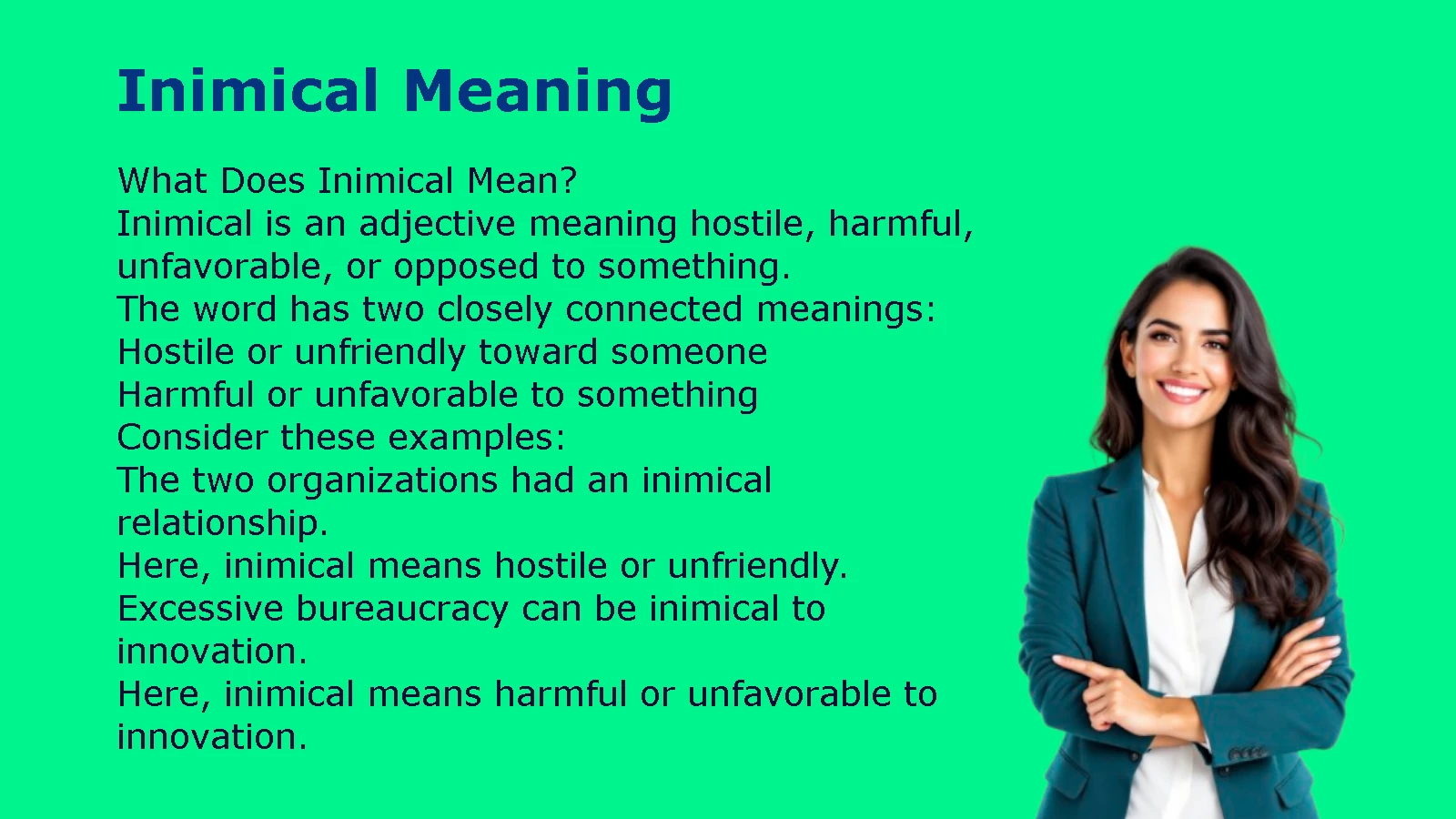
What Does Inimical Mean?
Inimical is an adjective meaning hostile, harmful, unfavorable, or opposed to something.
The word has two closely connected meanings:
- Hostile or unfriendly toward someone
- Harmful or unfavorable to something
Consider these examples:
The two organizations had an inimical relationship.
Here, inimical means hostile or unfriendly.
Excessive bureaucracy can be inimical to innovation.
Here, inimical means harmful or unfavorable to innovation.
The second use is especially common in modern formal English. Merriam Webster notes that the word can mean “not friendly” as well as having a harmful effect.
Inimical Meaning in Simple Words
In simple English, inimical means working against something.
Depending on the sentence, you can usually understand it as:
- Hostile
- Unfriendly
- Harmful
- Damaging
- Unfavorable
- Opposed
- Detrimental
A useful shortcut is to remember:
If something is inimical to a goal, it makes that goal harder to achieve.
For example:
- Lack of sleep can be inimical to concentration.
- Dishonesty is inimical to trust.
- Excessive restrictions can be inimical to creativity.
- Poor planning can be inimical to success.
The word doesn’t always suggest that someone deliberately wants to cause harm. A condition can be inimical simply because its effects work against a particular interest.
Inimical Pronunciation
Inimical is pronounced:
ih-NIM-ih-kul
The main stress falls on the second syllable: NIM.
The pronunciation is represented in dictionaries as /ɪˈnɪm.ɪ.kəl/.
Because the spelling contains several short syllables, it can look more intimidating than it sounds. Once the rhythm is familiar, the pronunciation becomes fairly straightforward.
The Two Main Meanings of Inimical
Understanding the two main senses makes the word much easier to use correctly.
Inimical Meaning: Hostile or Unfriendly
In its first sense, inimical describes someone or something that shows hostility, opposition, or ill will.
For example:
The manager’s inimical attitude made cooperation difficult.
The manager isn’t simply being quiet or indifferent. The attitude suggests hostility or opposition.
Another example:
The neighboring groups had an increasingly inimical relationship.
Here, inimical means that the relationship has become hostile or antagonistic.
This sense connects directly to the word’s historical relationship with enemy. Merriam Webster traces inimical to Late Latin inimicalis, from Latin inimicus, meaning an enemy.
Inimical Meaning: Harmful or Unfavorable
The second sense is extremely useful in formal writing.
When something is inimical to another thing, it works against it or produces an unfavorable effect.
For example:
Excessive managerial control is inimical to creative expression.
This means excessive control limits or harms creativity. Cambridge uses this same type of construction to illustrate the modern meaning of the word.
Other examples include:
- Smoking is inimical to good health.
- Corruption is inimical to public trust.
- Excessive regulation may be inimical to innovation.
- A hostile work environment is inimical to employee morale.
- Poor communication is inimical to effective teamwork.
This sense doesn’t require an actual enemy. A policy, habit, environment, or circumstance can be inimical to something.
What Does “Inimical To” Mean?
“Inimical to” means harmful or unfavorable to something, or working against it.
This is one of the most common ways you’ll encounter the word.
The basic pattern is:
something + is/was + inimical to + person, thing, goal, or principle
For example:
The new policy was inimical to small businesses.
This means the policy worked against the interests of small businesses.
Another example:
Constant interruptions are inimical to focused work.
The interruptions make focused work more difficult.
Common combinations include:
- inimical to health
- inimical to freedom
- inimical to progress
- inimical to success
- inimical to innovation
- inimical to economic growth
- inimical to creativity
- inimical to public trust
- inimical to democracy
- inimical to the environment
- inimical to human well being
- inimical to effective communication
This construction is so common that inimical to is often the first pattern worth learning.
How to Use Inimical in a Sentence
Although inimical can describe hostile people or relationships, modern formal usage frequently focuses on conditions, ideas, actions, and forces that work against something else. Merriam Webster’s usage notes also point out that contemporary English often uses the word for forces, concepts, and situations rather than simply for people.
Inimical to Health
Excessive alcohol consumption can be inimical to good health.
Here, inimical means harmful.
Inimical to Success
Procrastination can be inimical to long term success.
The idea is that procrastination works against successful outcomes.
Inimical to Freedom
Censorship can be inimical to freedom of expression.
Here, the word means opposed to or harmful to freedom of expression.
Inimical to Innovation
An organization that punishes every failed experiment may create an environment inimical to innovation.
The environment discourages experimentation and therefore works against innovation.
Inimical to the Environment
Certain industrial practices can be inimical to environmental sustainability.
The practices can produce effects that conflict with environmental goals.
Inimical Relationships
The two political factions maintained an inimical relationship for years.
Here, inimical means hostile or antagonistic, rather than simply harmful.
Inimical Examples in Sentences
Seeing the word in different contexts helps reveal its range.
| Example | Meaning of inimical |
| Excessive stress is inimical to productivity. | Harmful to |
| Corruption is inimical to public trust. | Damaging to |
| His inimical attitude discouraged cooperation. | Hostile |
| The policy proved inimical to small businesses. | Unfavorable to |
| Poor sleep can be inimical to concentration. | Harmful to |
| Their inimical relationship lasted for decades. | Hostile |
| Excessive bureaucracy may be inimical to innovation. | Restrictive or harmful to |
| The harsh climate was inimical to agriculture. | Unfavorable to |
| Dishonesty is inimical to a healthy relationship. | Harmful to |
| The proposal was inimical to the interests of workers. | Opposed or harmful to |
The examples show an important pattern: context determines the precise shade of meaning.
When inimical describes a relationship or attitude, think hostile. When it appears in the structure inimical to, think harmful, unfavorable, or opposed.
Inimical Synonyms
The best synonym depends on which sense of inimical you need.
Cambridge groups its synonyms around two major ideas: harmfulness and hostility. Its thesaurus includes words such as harmful, detrimental, injurious, destructive, hostile, antagonistic, and unfriendly.
Synonyms Meaning Harmful
- Harmful
- Damaging
- Detrimental
- Injurious
- Destructive
- Dangerous
- Deleterious
- Hurtful
- Ruinuous
- Toxic
For example:
Excessive stress is inimical to health.
can become:
Excessive stress is detrimental to health.
The meaning remains similar, although detrimental focuses more directly on harm.
Synonyms Meaning Hostile
- Hostile
- Antagonistic
- Unfriendly
- Adversarial
- Opposed
- Ill disposed
- Antipathetic
- Belligerent
- Combative
- Uncooperative
For example:
He had an inimical attitude toward his colleagues.
could become:
He had a hostile attitude toward his colleagues.
In everyday conversation, hostile is usually more natural.
Synonyms Meaning Unfavorable
- Adverse
- Unfavorable
- Negative
- Opposing
- Contrary
- Unsympathetic
- Detrimental
These alternatives work particularly well when discussing policies, circumstances, conditions, or outcomes.
Inimical Antonyms
The opposite of inimical depends on the sense being used.
If inimical means hostile, suitable antonyms include:
- Friendly
- Amiable
- Friendly
- Congenial
- Supportive
- Well disposed
If inimical means harmful or unfavorable, suitable antonyms include:
- Helpful
- Beneficial
- Advantageous
- Favorable
- Salutary
- Conducive
- Supportive
For example:
Excessive restrictions are inimical to innovation.
The opposite could be:
A flexible work environment is conducive to innovation.
Here, conducive works particularly well because it means helping to bring about a desired result.
Inimical vs. Adverse
Inimical and adverse overlap, especially when describing something harmful or unfavorable. However, they aren’t perfect substitutes.
| Word | Main idea | Common contexts | Tone |
| Inimical | Hostile, harmful, or opposed | Goals, interests, principles, relationships | Formal |
| Adverse | Harmful or unfavorable | Conditions, effects, circumstances, outcomes | Formal but common |
| Detrimental | Causing harm or damage | Health, performance, progress | Formal |
| Hostile | Actively unfriendly or antagonistic | People, groups, environments | Stronger and more direct |
Consider these sentences:
The weather was adverse.
This means the weather was unfavorable.
The policy was inimical to economic growth.
This suggests the policy worked against economic growth.
You could sometimes replace inimical with adverse, but the result may lose the sense of opposition. Inimical can suggest that something is fundamentally at odds with another interest or objective.
Inimical vs. Hostile
Both words can mean unfriendly or opposed, but hostile is much more common in everyday English.
Compare:
The government adopted a hostile position toward the proposal.
and:
The government adopted an inimical position toward the proposal.
The first sounds natural in ordinary reporting. The second sounds more formal and literary.
Hostile can also suggest active aggression or antagonism. Inimical often sounds more abstract, especially when it appears in phrases such as inimical to economic growth or inimical to public health.
Merriam Webster’s thesaurus lists hostile, adverse, antagonistic, opposed, and unfavorable among close alternatives.
Quick Difference
Hostile: openly unfriendly or aggressive.
Inimical: hostile, harmful, or fundamentally unfavorable.
So, if a person is glaring at you across a room, hostile is the natural choice. If a policy undermines innovation, inimical to innovation may be the more precise formal expression.
Inimical vs. Detrimental
Detrimental primarily means harmful or damaging.
Inimical can also mean harmful, but it has an additional sense of hostility or opposition.
Compare:
Lack of exercise can be detrimental to health.
The emphasis is on harm.
A rigid organizational structure can be inimical to innovation.
The emphasis is on the structure working against innovation.
In many formal contexts, either word may work. The choice depends on what you want to emphasize.
Choose detrimental when the central idea is damage.
Choose inimical when you want to emphasize opposition, incompatibility, or something working against a particular interest.
Inimical vs. Inimicable
These two words are easy to confuse because their spellings and meanings are closely related.
Inimical means:
- Hostile
- Harmful
- Unfavorable
- Opposed
Inimicable is also a real English adjective. Merriam Webster defines it as meaning inimical or hostile.
However, inimical is far more useful for general vocabulary and contemporary formal writing.
For example:
The policy is inimical to economic growth.
This is a standard construction.
Inimicable has a much more specialized and uncommon feel. It shouldn’t be treated as a spelling correction for inimical. They are separate words.
Is Inimical a Negative Word?
Yes. Inimical normally carries a negative meaning.
However, the exact force depends on context.
Compare:
His inimical attitude made discussion impossible.
This is strongly negative because the person is being hostile.
Now consider:
The climate was inimical to agriculture.
The climate isn’t intentionally hostile. It is simply unsuitable or unfavorable for agriculture.
That distinction matters.
Inimical does not always imply intention. A situation can be inimical without anyone deliberately trying to cause harm.
For example:
- A harsh climate can be inimical to crops.
- Poor lighting can be inimical to productivity.
- Excessive noise can be inimical to concentration.
- A rigid process can be inimical to creativity.
None of these conditions needs a motive. They simply work against the desired result.
Can Inimical Describe a Person?
Yes, but this use is less common than using inimical for an action, condition, force, policy, or abstract concept.
For example:
His inimical attitude toward his rivals was obvious.
Here, inimical describes the person’s attitude, which makes the sentence sound natural.
You can also write:
She was inimical toward the opposing group.
However, in everyday English, hostile, unfriendly, or antagonistic would usually sound more natural.
This is one reason inimical can feel unfamiliar. Modern usage frequently places it in the pattern inimical to + noun rather than using it as a simple everyday description of a person.
Inimical in Formal and Academic English
If you encounter inimical in a newspaper, research paper, legal argument, policy discussion, or academic essay, that isn’t surprising.
The word works particularly well when a writer needs to express that one factor conflicts with another.
Academic Writing
The proposed method may be inimical to long term institutional stability.
The word gives the sentence a formal tone and clearly establishes a conflict between the method and the desired outcome.
Business Writing
Excessive layers of approval can be inimical to rapid decision making.
This means too many approvals can interfere with efficient decisions.
Political Writing
Some critics argued that the proposal was inimical to individual liberty.
Here, the proposal is presented as conflicting with the principle of individual liberty.
Environmental Writing
Certain pollutants are inimical to aquatic ecosystems.
The pollutants can harm those ecosystems.
Legal Writing
The word can also appear in legal and policy contexts when an action or rule is described as harmful or inconsistent with an interest or principle.
Because inimical sounds formal, it can make a sentence feel more authoritative. Still, that doesn’t mean it should replace simpler words everywhere. Clear writing beats complicated writing.
If harmful says exactly what you mean, harmful may be the better choice.
Inimical Meaning in Different Contexts
The word becomes easier to understand when you see how it behaves in different subject areas.
Inimical to Health
When something is inimical to health, it has harmful effects on health.
Chronic sleep deprivation can be inimical to physical and mental performance.
The phrase focuses on the negative effect rather than hostility.
Inimical to Success
Something inimical to success interferes with achieving a desired result.
Poor preparation is often inimical to success.
The sentence doesn’t say that poor preparation is an enemy in a literal sense. It means poor preparation works against successful performance.
Inimical to Freedom
A rule or action can be inimical to freedom when it restricts or undermines freedom.
Excessive censorship may be inimical to freedom of expression.
The phrase is especially useful in formal discussions about rights, laws, and public policy.
Inimical to Innovation
An environment can be inimical to innovation when it discourages experimentation or new ideas.
A workplace that punishes every failed experiment can be inimical to innovation.
This example shows why context matters. The workplace isn’t literally an enemy. Its structure creates conditions that work against innovation.
Inimical to the Environment
Environmental writing frequently needs words that express harmful effects.
Certain industrial practices may be inimical to fragile ecosystems.
Here, inimical means harmful or damaging.
Inimical Relationships
When discussing relationships, inimical takes on its more direct hostile sense.
The two factions remained inimical after years of conflict.
This means the groups remained hostile toward each other.
A Practical Case Study: Understanding “Inimical to Innovation”
Imagine a company that encourages employees to propose new ideas. On paper, it sounds innovative.
However, every proposal requires six approvals. Employees must defend every failed experiment. Managers criticize unusual approaches because they prefer familiar methods. Eventually, workers stop suggesting new ideas.
In this situation, the approval system and management culture are inimical to innovation.
Notice what the sentence communicates:
- The system doesn’t necessarily intend to destroy creativity.
- It creates conditions that discourage creativity.
- The result conflicts with the company’s goal.
- Inimical captures that relationship between the condition and the goal.
A simpler version would be:
The approval system harms innovation.
A more formal version would be:
The approval system is inimical to innovation.
Both communicate the core idea. The second simply has a more formal register.
Inimical in a Sentence: Context and Tone
| Sentence | Meaning | Tone |
| Excessive noise is inimical to concentration. | Harmful to concentration | Formal |
| His inimical attitude prevented cooperation. | Hostile attitude | Formal |
| The policy was inimical to small businesses. | Unfavorable to businesses | Formal |
| Poor communication is inimical to teamwork. | Harmful to teamwork | Formal |
| The groups maintained an inimical relationship. | Hostile relationship | Formal or literary |
| The harsh environment was inimical to agriculture. | Unsuitable or harmful | Formal |
| Excessive control is inimical to creativity. | Restrictive toward creativity | Formal |
The word often becomes much easier to interpret when you identify what is being affected.
Ask:
“What is this thing working against?”
If the answer is health, freedom, creativity, growth, trust, or another goal, inimical probably means harmful or unfavorable to that thing.
Common Mistakes When Using Inimical
Mistake: Assuming Inimical Only Means Hostile
The word has a broader meaning.
The policy is inimical to economic growth.
This doesn’t mean the policy is emotionally hostile toward economic growth. It means the policy works against or harms economic growth.
Mistake: Confusing Inimical With Prose or Another Similar Looking Word
Inimical has nothing to do with inimicality as a common substitute for ordinary language, and it shouldn’t be confused with unrelated words simply because they share the prefix in.
The most useful modern pattern to remember is:
inimical to + noun
Mistake: Using “Inimical With”
When expressing that one thing works against another, inimical to is the standard construction.
Correct:
The policy is inimical to economic growth.
Less natural:
The policy is inimical with economic growth.
When learning the word, memorize the full phrase inimical to rather than the adjective in isolation.
Mistake: Treating Every Synonym as Identical
Words such as hostile, harmful, adverse, and detrimental overlap with inimical, but each has its own emphasis.
Hostile emphasizes antagonism.
Harmful emphasizes damage.
Adverse emphasizes unfavorable conditions or effects.
Detrimental emphasizes negative consequences.
Inimical can combine ideas of opposition, hostility, and harm.
Inimical Word Origin and Etymology
The history of inimical explains its modern meaning surprisingly well.
The word comes from Late Latin inimicalis, meaning “hostile,” which comes from Latin inimicus, meaning “unfriendly” or “enemy.” Merriam Webster dates the first known English use of inimical to 1573.
The Latin word inimicus contains:
- in-, meaning “not”
- amicus, meaning “friend”
So the basic historical idea is essentially “not a friend.” Etymonline traces inimical to the 1640s in its modern English history and likewise connects it to Latin inimicus.
That same Latin root also connects inimicus with the English word enemy.
The connection becomes even more interesting when you compare related English words:
| Word | Historical connection | Modern meaning |
| Inimical | From Latin inimicus | Hostile, harmful, unfavorable |
| Enemy | From Latin inimicus through French | An opponent or hostile person |
| Amicable | From Latin amicus | Friendly or peaceful |
| Amiable | Related to Latin amicus | Friendly and pleasant |
So the contrast between inimical and amicable isn’t accidental. Their histories are connected through the ideas of being an enemy and being a friend.
Related Words: Inimical, Enemy, and Enmity
These words share an important historical connection, but they don’t function the same way grammatically.
| Word | Part of speech | Meaning | Example |
| Inimical | Adjective | Hostile, harmful, or unfavorable | The policy was inimical to growth. |
| Enemy | Noun | A hostile person, group, or force | The army confronted its enemy. |
| Enmity | Noun | Deep hostility or hatred | Years of enmity divided the groups. |
Inimical
The conditions were inimical to progress.
It describes the conditions.
Enemy
The opposing army was the enemy.
It identifies a hostile person or group.
Enmity
Their long standing enmity prevented reconciliation.
It describes the hostile feeling or relationship itself.
Understanding these distinctions prevents awkward substitutions.
Is Inimical a Formal Word?
Yes. Inimical is generally considered formal. Cambridge explicitly labels it as formal.
That doesn’t mean the word is incorrect in conversation. It simply means that everyday speakers often choose simpler alternatives.
For example, a person might naturally say:
Too much stress is bad for your health.
A formal writer might say:
Excessive stress can be inimical to health.
Both are grammatically sound. The second sounds more formal and abstract.
When to Use Inimical
Use inimical when:
- You’re writing an academic essay.
- You’re discussing policy or law.
- You’re writing formal analysis.
- You want to emphasize opposition or incompatibility.
- You’re discussing abstract relationships between factors.
- The word fits the tone of the surrounding text.
Choose detrimental when you mean damaging.
Good vocabulary isn’t about choosing the longest word available. It’s about choosing the most precise word for the idea.
Frequently Asked Questions About Inimical
What does inimical mean in simple terms?
Inimical means hostile, harmful, unfavorable, or opposed to something. In the common phrase inimical to, it usually means that something works against or harms another thing.
What is an example of inimical?
Excessive bureaucracy can be inimical to innovation.
This means excessive bureaucracy can work against or limit innovation.
What is the synonym of inimical?
Depending on context, synonyms include hostile, harmful, detrimental, adverse, antagonistic, unfriendly, unfavorable, injurious, and opposed. Cambridge separates its synonyms into harmful and hostile meanings.
What is the opposite of inimical?
Common antonyms include friendly, beneficial, helpful, favorable, advantageous, supportive, and conducive.
The best choice depends on the context.
Is inimical a negative word?
Yes. Inimical normally has a negative meaning because it describes hostility, harm, opposition, or unfavorable effects.
Does inimical mean harmful?
Yes. One of its main modern meanings is harmful or limiting. This is especially common in the construction inimical to.
Does inimical mean hostile?
Yes. Inimical can mean hostile or unfriendly, especially when describing an attitude, relationship, or position.
What does “inimical to” mean?
“Inimical to” means harmful, unfavorable, or opposed to something.
For example:
Poor communication is inimical to effective teamwork.
The meaning is that poor communication works against effective teamwork.
Can you use inimical to describe a person?
Yes, but it is more commonly used in modern formal English for conditions, forces, ideas, policies, and situations. When describing a person’s attitude, hostile or unfriendly often sounds more natural.
Is inimical a formal word?
Yes. Dictionaries classify it as a formal adjective.
How do you pronounce inimical?
It is pronounced ih-NIM-ih-kul, with the main stress on NIM.
What is the difference between inimical and adverse?
Both can mean unfavorable or harmful. Adverse commonly describes unfavorable conditions or effects, while inimical can suggest that something actively works against a particular interest, goal, or principle.
Key Takeaways About Inimical
The inimical meaning is easier to remember once its two central ideas are clear.
Inimical can mean:
- Hostile
- Unfriendly
- Harmful
- Unfavorable
- Opposed
- Working against something
The phrase inimical to is especially important. It means that something is harmful or unfavorable to another person, goal, principle, or condition.
For example:
Excessive control is inimical to creativity.
In plain English:
Excessive control works against creativity.
The word usually appears in formal English, particularly in academic, legal, political, professional, and literary contexts.
Its history also provides a useful memory trick. Inimical comes from Latin inimicus, connected with the idea of an enemy or someone who is “not a friend.”
So when you see inimical to, think:
“This works against that.”
That simple idea captures the heart of the word.