Softness is one of the most comforting qualities we experience in daily life. From the gentle touch of a blanket to the smooth feel of warm food, softness brings a sense of calm, safety, and relaxation. In writing, describing this quality clearly can be difficult without the right expressions. This is where Similes for soft become extremely useful. They help writers compare softness with familiar objects and feelings, making descriptions more vivid and relatable.
Figurative language for soft allow readers to instantly imagine texture, comfort, and emotional warmth. Instead of simply saying something is soft, writers can compare it to cotton, feathers, or clouds, creating a stronger picture in the reader’s mind. This technique improves storytelling, poetry, essays, and even everyday communication by adding depth and creativity.
When used effectively, similes transform simple descriptions into engaging imagery. They help readers feel what is being described rather than just understand it. Whether you are writing about nature, emotions, objects, or human experiences, similes make your writing more expressive and memorable.
In this article, we will explore a wide range of creative similes for soft with explanations and real-life examples to help you master descriptive writing simply and enjoyably.
Importance of Similes for Soft
Similes for soft are important because they turn ordinary descriptions into rich sensory experiences. Instead of telling the reader something is soft, similes show it through familiar comparisons. This makes communication more effective, especially in storytelling, poetry, and creative writing.
They also help bridge understanding between writer and reader. When a writer compares softness to something recognizable like a feather or cloud, the reader instantly connects with the image. This strengthens emotional impact and improves clarity. In both academic and creative writing, similes for soft make language more engaging, expressive, and enjoyable to read.
Similes for Soft Examples
1. Soft like cotton
Explanation: Cotton is light and fluffy, making it a perfect symbol of softness.
Examples:
- The pillow felt soft like cotton.
- Her dress was soft like cotton against the skin.
- The toy is soft like cotton in my hands.
- This blanket is soft like cotton on a cold night.
- The fabric feels soft like cotton all day.
Best use: “This cushion is soft like cotton.”
2. Soft like a feather
Explanation: Feathers are extremely light and gentle to touch.
Examples:
- The kitten’s fur is soft like a feather.
- The pillow is soft like a feather under my head.
- His touch was soft like a feather.
- The scarf feels soft like a feather in the wind.
- The blanket is soft like a feather on my skin.
Best use: “It feels soft like a feather.”
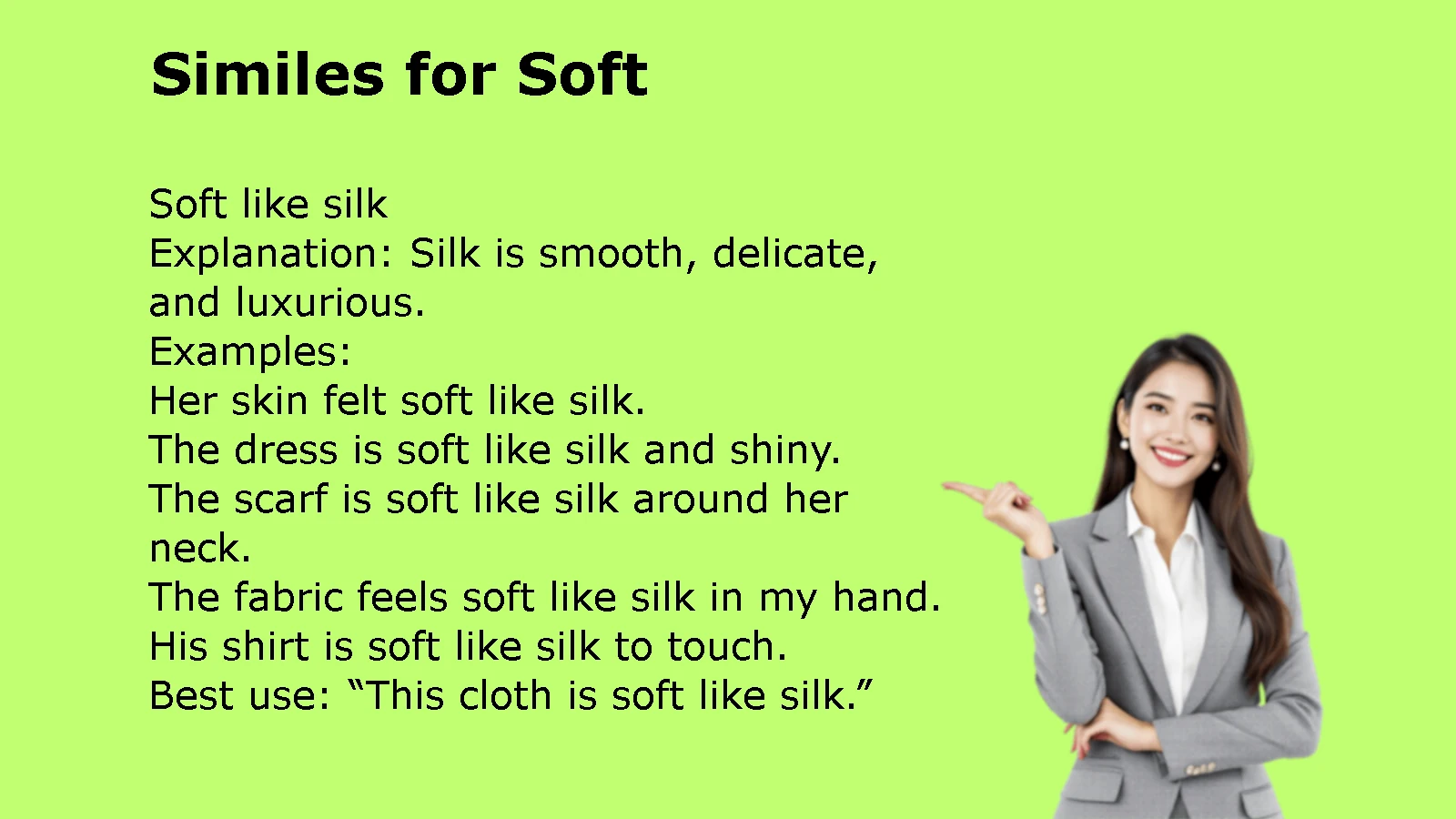
3. Soft like silk
Explanation: Silk is smooth, delicate, and luxurious.
Examples:
- Her skin felt soft like silk.
- The dress is soft like silk and shiny.
- The scarf is soft like silk around her neck.
- The fabric feels soft like silk in my hand.
- His shirt is soft like silk to touch.
Best use: “This cloth is soft like silk.”
4. Soft like a marshmallow
Explanation: Marshmallows are squishy and gentle in texture.
Examples:
- The pillow is soft like a marshmallow.
- His cheeks are soft like a marshmallow.
- The cushion feels soft like a marshmallow.
- The toy is soft like a marshmallow.
- The bed is soft like a marshmallow.
Best use: “This sofa is soft like a marshmallow.”
5. Soft like a cloud
Explanation: Clouds appear fluffy and weightless in the sky.
Examples:
- The bed feels soft like a cloud.
- Her pillow is soft like a cloud.
- The blanket is soft like a cloud at night.
- The mattress is soft like a cloud.
- The chair feels soft like a cloud.
Best use: “I feel like I’m sitting on a cloud.”
6. Soft like baby skin
Explanation: Baby skin is naturally delicate and smooth.
Examples:
- The cloth feels soft like baby skin.
- Her cheeks are soft like baby skin.
- The lotion makes skin soft like baby skin.
- The blanket is soft like baby skin.
- His hands are soft like baby skin.
Best use: “This fabric is soft like baby skin.”
7. Soft like a flower petal
Explanation: Petals are delicate and smooth in texture.
Examples:
- The dress is soft like a flower petal.
- Her skin feels soft like a petal.
- The cushion is soft like a flower petal.
- The fabric is soft like a petal in spring.
- His touch is soft like a flower petal.
Best use: “It feels soft like a petal.”
8. Soft like sponge cake
Explanation: Sponge cake is airy and fluffy.
Examples:
- The pillow is soft like sponge cake.
- The bed feels soft like sponge cake.
- The cushion is soft like sponge cake.
- Her toy is soft like sponge cake.
- The chair feels soft like sponge cake.
Best use: “This bed is soft like sponge cake.”
9. Soft like a down pillow
Explanation: Down pillows are extremely fluffy and gentle.
Examples:
- The bed is soft like a down pillow.
- The cushion feels soft like a down pillow.
- His head rests on something soft like a down pillow.
- The chair is soft like a down pillow.
- The sofa feels soft like a down pillow.
Best use: “It’s soft like a down pillow.”
10. Soft like cashmere
Explanation: Cashmere is a fine, luxurious wool.
Examples:
- The sweater feels soft like cashmere.
- Her scarf is soft like cashmere.
- The blanket is soft like cashmere.
- The fabric is soft like cashmere on skin.
- His coat is soft like cashmere.
Best use: “This sweater is soft like cashmere.”
11. Soft like butter
Explanation: Butter is smooth, creamy, and melts easily, making it a strong image of softness.
Examples:
- The warm bread is soft like butter.
- Her skin felt soft like butter in the sunlight.
- This cake is soft like butter on my tongue.
- The pillow feels soft like butter when I lie down.
- The fabric is soft like butter against my arm.
Best use: “This bread is soft like butter.”
12. Soft like jelly
Explanation: Jelly has a wobbly, smooth, and delicate texture that reflects gentle softness.
Examples:
- The toy feels soft like jelly in my hand.
- The cushion is soft like jelly when I sit on it.
- His cheeks are soft like jelly.
- The mattress feels soft like jelly.
- The dessert is soft like jelly and sweet.
Best use: “It feels soft like jelly.”
13. Soft like foam
Explanation: Foam is light, airy, and compresses easily, making it a natural softness comparison.
Examples:
- The mattress is soft like foam.
- The seat feels soft like foam.
- This pillow is soft like foam under my head.
- The sponge is soft like foam in water.
- The cushion feels soft like foam when pressed.
Best use: “The bed is soft like foam.”
14. Soft like snow
Explanation: Fresh snow is fluffy, gentle, and smooth under touch.
Examples:
- The blanket feels soft like snow.
- The pillow is soft like snow in winter.
- The carpet is soft like snow under my feet.
- Her sweater feels soft like snow.
- The cushion is soft like snow.
Best use: “It feels soft like snow.”
15. Soft like velvet
Explanation: Velvet is a rich, smooth fabric known for its deep softness and luxury.
Examples:
- The sofa is soft like velvet.
- Her dress feels soft like velvet.
- The curtains are soft like velvet.
- This pillow is soft like velvet.
- The cloth feels soft like velvet on my skin.
Best use: “This fabric is soft like velvet.”
16. Soft like a whisper
Explanation: A whisper is extremely gentle and quiet, symbolizing delicate softness.
Examples:
- Her voice is soft like a whisper.
- The wind feels soft like a whisper at night.
- His touch is soft like a whisper.
- The sound is soft like a whisper in the room.
- The music plays soft like a whisper.
Best use: “Her voice is soft like a whisper.”
17. Soft like fog
Explanation: Fog is light, smooth, and spreads gently in the air.
Examples:
- The blanket feels soft like fog around me.
- The light is soft like fog in the morning.
- Her scarf is soft like fog.
- The room feels soft like fog in silence.
- The pillow is soft like fog.
Best use: “It feels soft like fog.”
18. Soft like warm bread
Explanation: Fresh warm bread is tender, fluffy, and comforting.
Examples:
- This bread is soft like warm bread from the oven.
- The pillow feels soft like warm bread.
- Her hands are soft like warm bread dough.
- The cake is soft like warm bread.
- The cushion feels soft like warm bread.
Best use: “It is soft like warm bread.”
19. Soft like puppy fur
Explanation: Puppy fur is fluffy, gentle, and extremely soft to touch.
Examples:
- The blanket feels soft like puppy fur.
- The toy is soft like puppy fur.
- Her sweater is soft like puppy fur.
- The pillow is soft like puppy fur.
- The scarf feels soft like puppy fur.
Best use: “It feels soft like puppy fur.”
20. Soft like rabbit fur
Explanation: Rabbit fur is smooth, delicate, and naturally plush.
Examples:
- The coat is soft like rabbit fur.
- This cushion feels soft like rabbit fur.
- The toy is soft like rabbit fur.
- Her gloves are soft like rabbit fur.
- The blanket feels soft like rabbit fur.
Best use: “It is soft like rabbit fur.”
21. Soft like peach skin
Explanation: Peach skin is smooth, velvety, and delicate to the touch.
Examples:
- Her skin is soft like peach skin.
- The fabric feels soft like peach skin.
- The pillow is soft like peach skin.
- The lotion makes skin soft like peach skin.
- His cheek feels soft like peach skin.
Best use: “It feels soft like peach skin.”
22. Soft like dough
Explanation: Dough is flexible, smooth, and easily shaped.
Examples:
- The toy feels soft like dough.
- The pillow is soft like dough.
- His hands are soft like dough.
- The cushion feels soft like dough.
- The material is soft like dough.
Best use: “It feels soft like dough.”
23. Soft like moss
Explanation: Moss is naturally cushiony and gentle when walked on.
Examples:
- The forest floor is soft like moss.
- The cushion feels soft like moss.
- The ground is soft like moss under feet.
- The pillow is soft like moss.
- The seat feels soft like moss.
Best use: “It is soft like moss.”
24. Soft like fine beach sand
Explanation: Fine sand is smooth and soft when touched or walked on.
Examples:
- The beach feels soft like sand.
- The pillow is soft like fine sand.
- Her hands feel soft like sand.
- The cushion is soft like sand.
- The carpet feels soft like sand.
Best use: “It feels soft like sand.”
25. Soft like breeze
Explanation: A breeze is light, gentle, and soothing in movement.
Examples:
- Her touch is soft like breeze.
- The wind feels soft like breeze.
- His voice is soft like a breeze.
- The cloth moves softly like a breeze.
- The moment feels soft like a breeze.
Best use: “It feels soft like a breeze.”
26. Soft like a lullaby
Explanation: A lullaby is calm, soothing, and gentle in sound.
Examples:
- Her voice is soft like a lullaby.
- The music feels soft like a lullaby.
- The sound is soft like a lullaby at night.
- His tone is soft like a lullaby.
- The room feels soft like a lullaby.
Best use: “Her voice is soft like a lullaby.”
27. Soft like melted wax
Explanation: Melted wax is smooth, warm, and easily shaped.
Examples:
- The surface feels soft like melted wax.
- The toy is soft like melted wax.
- The candle wax is soft like melted wax.
- The material feels soft like melted wax.
- The cushion is soft like melted wax.
Best use: “It feels soft like melted wax.”
28. Soft like sponge foam
Explanation: Sponge foam is light, flexible, and highly compressible.
Examples:
- The mattress is soft like sponge foam.
- The pillow feels soft like sponge foam.
- The seat is soft like sponge foam.
- The cushion is soft like sponge foam.
- The toy feels soft like sponge foam.
Best use: “It is soft like sponge foam.”
29. Soft like pudding
Explanation: Pudding is creamy, smooth, and delicate in texture.
Examples:
- The dessert is soft like pudding.
- The pillow feels soft like pudding.
- The toy is soft like pudding.
- The cushion is soft like pudding.
- The texture is soft like pudding.
Best use: “It feels soft like pudding.”
30. Soft like wool
Explanation: Wool is warm, fluffy, and naturally soft in texture.
Examples:
- The sweater is soft like wool.
- The blanket feels soft like wool.
- Her scarf is soft like wool.
- The socks are soft like wool.
- The coat feels soft like wool.
Best use: “It is soft like wool.”
31. Soft like angora wool
Explanation: Angora wool is extremely fine, fluffy, and delicately soft.
Examples:
- Her sweater is soft like angora wool.
- The blanket feels soft like angora wool.
- This scarf is soft like angora wool on my neck.
- The cushion is soft like angora wool.
- The fabric feels soft like angora wool in my hands.
Best use: “It is soft like angora wool.”
32. Soft like taffy
Explanation: Taffy is stretchy, chewy, and gently soft in texture.
Examples:
- The candy feels soft like taffy.
- The toy is soft like taffy in my hands.
- His hands feel soft like taffy.
- The cushion is soft like taffy when pressed.
- The material feels soft like taffy.
Best use: “It feels soft like taffy.”
33. Soft like cotton candy
Explanation: Cotton candy is airy, fluffy, and dissolves easily, showing extreme softness.
Examples:
- The pillow feels soft like cotton candy.
- The toy is soft like cotton candy.
- Her scarf is soft like cotton candy.
- The blanket is soft like cotton candy.
- The cushion feels soft like cotton candy.
Best use: “It is soft like cotton candy.”
34. Soft like marsh grass
Explanation: Marsh grass is naturally cushiony and gentle under pressure.
Examples:
- The ground feels soft like marsh grass.
- The field is soft like marsh grass.
- The cushion is soft like marsh grass.
- The forest floor feels soft like marsh grass.
- The pillow is soft like marsh grass.
Best use: “It feels soft like marsh grass.”
35. Soft like ripe avocado
Explanation: A ripe avocado is creamy, smooth, and buttery in texture.
Examples:
- The fruit feels soft like ripe avocado.
- The cream is soft like ripe avocado.
- Her skin is soft like ripe avocado.
- The cushion is soft like ripe avocado.
- The spread feels soft like ripe avocado.
Best use: “It is soft like ripe avocado.”
36. Soft like tofu
Explanation: Tofu is smooth, delicate, and easily shaped under pressure.
Examples:
- The food feels soft like tofu.
- The pillow is soft like tofu.
- The toy is soft like tofu.
- The cushion feels soft like tofu.
- The texture is soft like tofu.
Best use: “It feels soft like tofu.”
37. Soft like custard
Explanation: Custard is creamy, smooth, and gently thick in texture.
Examples:
- The dessert is soft like custard.
- The pillow feels soft like custard.
- The toy is soft like custard.
- The cushion is soft like custard.
- The texture feels soft like custard.
Best use: “It is soft like custard.”
38. Soft like flannel
Explanation: Flannel is warm, brushed fabric known for gentle softness.
Examples:
- The shirt is soft like flannel.
- The blanket feels soft like flannel.
- Her pajamas are soft like flannel.
- The scarf is soft like flannel.
- The cloth feels soft like flannel.
Best use: “It feels soft like flannel.”
39. Soft like microfiber cloth
Explanation: Microfiber cloth is smooth, fine, and gentle on surfaces.
Examples:
- The towel feels soft like microfiber cloth.
- The pillow is soft like microfiber cloth.
- The fabric is soft like microfiber cloth.
- The cushion feels soft like microfiber cloth.
- The surface is soft like microfiber cloth.
Best use: “It is soft like microfiber cloth.”
40. Soft like a baby blanket
Explanation: Baby blankets are designed to be gentle, warm, and soothing.
Examples:
- The bed feels soft like a baby blanket.
- The pillow is soft like a baby blanket.
- The toy feels soft like a baby blanket.
- The cushion is soft like a baby blanket.
- The fabric feels soft like a baby blanket.
Best use: “It feels soft like a baby blanket.”
41. Soft like sea foam
Explanation: Sea foam is light, airy, and gently floating on water.
Examples:
- The cushion feels soft like sea foam.
- The pillow is soft like sea foam.
- The texture is soft like sea foam.
- The blanket feels soft like sea foam.
- The toy is soft like sea foam.
Best use: “It is soft like sea foam.”
42. Soft like rain mist
Explanation: Rain mist is light, gentle, and barely noticeable on the skin.
Examples:
- Her touch is soft like rain mist.
- The air feels soft like rain mist.
- The breeze is soft like rain mist.
- The moment feels soft like rain mist.
- The fabric feels soft like rain mist.
Best use: “It feels soft like rain mist.”
43. Soft like rubber
Explanation: Rubber is flexible, smooth, and slightly cushioned under pressure.
Examples:
- The toy feels soft like rubber.
- The seat is soft like rubber.
- The cushion is soft like rubber.
- The material feels soft like rubber.
- The surface is soft like rubber.
Best use: “It is soft like rubber.”
44. Soft like pillow fluff
Explanation: Pillow fluff is airy, light, and extremely gentle inside pillows.
Examples:
- The pillow feels soft like pillow fluff.
- The bed is soft like pillow fluff.
- The cushion is soft like pillow fluff.
- The toy feels soft like pillow fluff.
- The mattress is soft like pillow fluff.
Best use: “It feels soft like pillow fluff.”
45. Soft like well-worn leather
Explanation: Well-worn leather becomes smooth, flexible, and gently soft over time.
Examples:
- The chair feels soft like well-worn leather.
- The jacket is soft like well-worn leather.
- The sofa is soft like well-worn leather.
- The shoes feel soft like well-worn leather.
- The bag is soft like well-worn leather.
Best use: “It is soft like well-worn leather.”
Conclusion:
Similes for soft play an important role in making writing more vivid, expressive, and easy to imagine. Instead of using the simple word “soft,” these similes help writers create strong mental pictures by comparing softness to familiar things like cotton, clouds, feathers, or silk. This makes descriptions more engaging and enjoyable for readers.
Using similes for soft also improves creativity in writing. It allows students, writers, and content creators to express ideas in a more colorful and meaningful way. Whether you are describing an object, a feeling, or a scene, these comparisons add depth and emotion to your words.
With regular practice, similes become a natural part of your writing style. You can even create your own unique comparisons based on everyday experiences. The more you use them, the more powerful and attractive your writing becomes. Keep exploring, practicing, and experimenting with similes to make your language skills stronger and more creative.