The babushka meaning is grandmother or grandma in Russian. Written as бабушка in the Cyrillic alphabet, the word is an affectionate family term that also carries cultural associations with traditional Russian clothing, colorful nesting dolls, and older Eastern European women. Although English speakers sometimes use babushka to describe a headscarf or a traditional-looking grandmother, its original Russian meaning refers to a grandmother.
The word has several interesting connections to language and culture. Its meaning differs from similar Polish and Jewish family terms, and it is sometimes confused with Russian words for baby. You may also encounter it in expressions such as babushka doll, Babushka Lady, and references to the television comedy Brooklyn Nine-Nine.
Understanding these distinctions helps you use the word correctly without confusing its original definition with its broader cultural associations.
| Question | Answer |
| What does babushka mean in English? | Grandmother or grandma. |
| Is babushka offensive? | No. It is generally an affectionate Russian family term, although context can make it sound disrespectful. |
| Does babushka mean baby? | No. Baby is commonly translated as малыш (malysh) or ребёнок (rebyonok), depending on context. |
| What does babushka mean in Polish? | The standard Polish word for grandmother is babcia. Babuszka also appears as a borrowed or familiar form. |
| What is a babushka doll? | A popular English name for a Russian nesting doll, traditionally called a matryoshka. |
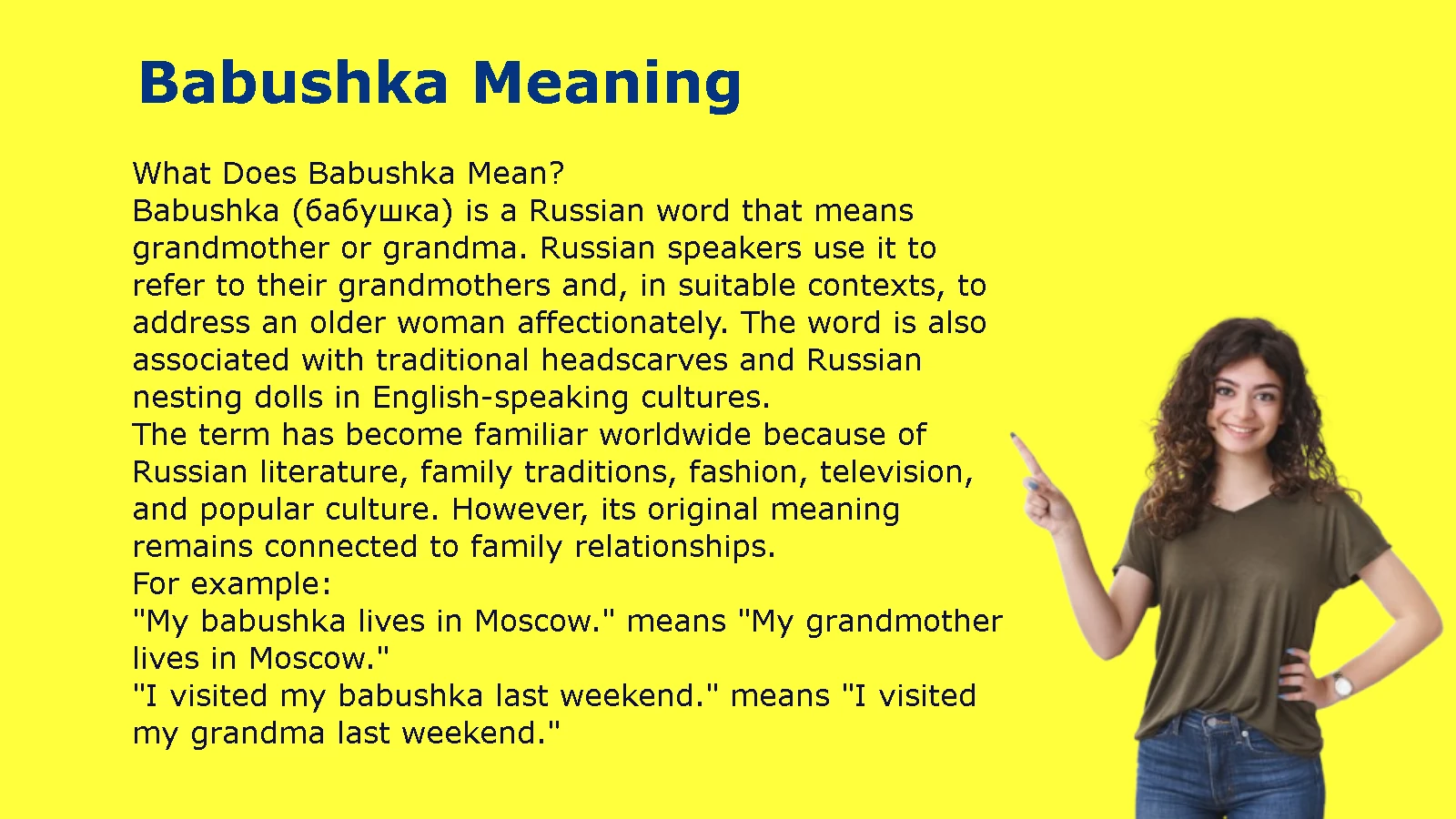
What Does Babushka Mean?
Babushka (бабушка) is a Russian word that means grandmother or grandma. Russian speakers use it to refer to their grandmothers and, in suitable contexts, to address an older woman affectionately. The word is also associated with traditional headscarves and Russian nesting dolls in English-speaking cultures.
The term has become familiar worldwide because of Russian literature, family traditions, fashion, television, and popular culture. However, its original meaning remains connected to family relationships.
For example:
- “My babushka lives in Moscow.” means “My grandmother lives in Moscow.”
- “I visited my babushka last weekend.” means “I visited my grandma last weekend.”
- “Her babushka taught her how to cook traditional Russian dishes.” refers to her grandmother.
In Russian, the word is written as бабушка. English speakers use the spelling babushka to represent its pronunciation.
Babushka Meaning in Simple Words
In simple English, babushka means grandma. It describes a person’s grandmother and often expresses affection, familiarity, and respect.
The word can also describe an older woman in a cultural or traditional setting, especially in English-language writing. However, this broader usage does not replace its original definition.
Consider these common interpretations:
| Context | Meaning |
| Russian family | Grandmother |
| Affectionate conversation | Grandma or granny |
| English fashion | Traditional headscarf |
| Russian handicrafts | Nesting doll |
| Historical reference | A woman associated with a traditional headscarf |
One important distinction is that babushka does not automatically mean an older people . Someone can use it to describe their grandmother regardless of her age or appearance.
Babushka Pronunciation and Spelling
The word babushka is pronounced approximately buh-BOOSH-kuh in English.
It has three syllables, with the main stress on the second syllable.
Its original Russian spelling is:
бабушка
Its English transliteration is:
babushka
Here is a breakdown:
| Feature | Details |
| Original spelling | бабушка |
| English spelling | Babushka |
| Language | Russian |
| Part of speech | Noun |
| Number of syllables | Three |
| English meaning | Grandmother |
| Pronunciation | buh-BOOSH-kuh |
The spelling may look unfamiliar to English speakers, but it follows a straightforward transliteration of Russian Cyrillic letters.
Is Babushka a Formal or Informal Word?
Babushka is an ordinary Russian family word. It is commonly used in everyday speech rather than being limited to formal writing.
A Russian speaker might use it when talking about a grandmother, introducing a family member, or describing someone else’s grandmother.
For example:
“My babushka makes delicious pancakes.”
This sentence sounds affectionate and personal. It communicates a family relationship rather than a formal title.
The word can also appear in descriptions of older women, but speakers should consider the relationship and tone before using it as a direct form of address.
Babushka Meaning in Russian: Origin and Cultural Significance
In Russian, бабушка (babushka) means grandmother. It is a familiar family term that reflects the important place grandparents hold in many Russian-speaking households. The word also appears in everyday conversations, children’s stories, family traditions, and cultural descriptions.
Russian culture has helped spread the word beyond its original language. English speakers now recognize babushka as a symbol of traditional grandmothers, Eastern European family life, and certain styles of headwear.
What Does Babushka Mean in Russian?
The Russian word бабушка translates directly to grandmother.
It can refer to:
- Your mother’s mother.
- Your father’s mother.
- Another person’s grandmother.
- An older woman described affectionately in an appropriate context.
Russian speakers may use the word when discussing family relationships or speaking directly about their grandparents.
Here are some useful Russian examples:
| Russian sentence | English translation |
| Моя бабушка добрая. | My grandmother is kind. |
| Я люблю свою бабушку. | I love my grandmother. |
| Бабушка живёт в Москве. | Grandma lives in Moscow. |
| Моя бабушка готовит суп. | My grandmother cooks soup. |
Notice that the Russian word changes its grammatical ending in some sentences.
For example, бабушка is the basic dictionary form, while бабушку appears in the accusative case. Russian nouns change their endings according to their grammatical roles.
This distinction matters when learning Russian because the word does not always appear in exactly the same form.
The Cultural Importance of a Russian Babushka
A babushka often represents more than a family relationship. In traditional Russian cultural imagery, grandmothers are associated with family history, home cooking, childcare, storytelling, and passing knowledge between generations.
However, not every Russian grandmother fits this traditional image. Modern Russian families have different lifestyles, occupations, and family arrangements.
Some grandmothers live close to their grandchildren and provide regular childcare. Others live independently, work, travel, or maintain busy social lives.
Common cultural associations include:
- Family traditions: Grandmothers often help preserve family customs and celebrations.
- Home cooking: Traditional dishes and family recipes frequently pass from one generation to another.
- Childcare: Some grandparents help parents raise young children.
- Storytelling: Grandmothers may share family histories and childhood memories.
- Language preservation: Older relatives sometimes help younger generations maintain their native language.
These associations explain why babushka has developed a warm cultural identity outside Russia.
Still, it is important to distinguish cultural imagery from individual identity. The word describes a family relationship, not a fixed personality or lifestyle.
Where Did the Word Babushka Come From?
Babushka comes from Russian бабушка, a diminutive form historically connected with баба (baba), a word that has referred to a woman and, in particular contexts, an older woman or grandmother.
The diminutive formation gives the word its familiar, affectionate character.
Russian uses diminutive forms extensively. Speakers can use them to communicate affection, familiarity, tenderness, or sometimes a particular attitude toward the person being discussed.
The word eventually entered English through cultural contact, literature, migration, travel, and popular descriptions of Russian and Eastern European traditions.
Today, English dictionaries and everyday speech recognize babushka as a loanword.
Is Babushka Offensive? Understanding Its Meaning and Context
Babushka is not inherently offensive. In Russian, it is a normal word for grandmother and is generally affectionate when used within a family. However, English speakers can make it sound disrespectful if they use it to mock an older woman, imitate an accent, or reinforce cultural stereotypes.
The meaning depends on who uses the word, whom they describe, and how they say it.
For example, calling your Russian grandmother babushka is usually affectionate. Calling an unfamiliar older woman a babushka because of her age or clothing may sound stereotypical.
When Is Calling Someone Babushka Respectful?
Using babushka is generally respectful when it reflects a genuine family or cultural connection.
Appropriate examples include:
- Referring to your Russian grandmother.
- Describing a grandmother in a Russian family.
- Discussing Russian family traditions.
- Explaining a traditional Russian word to English learners.
- Writing about Russian literature or cultural history.
For instance:
“My babushka taught me how to make traditional Russian dumplings.”
The sentence uses the word naturally because it describes a personal family relationship.
Another example:
“Her babushka moved to America when she was young.”
Here, the word identifies the woman’s grandmother without suggesting anything negative.
When Can Babushka Sound Offensive?
The word can become disrespectful when someone uses it to make fun of another person’s age, nationality, clothing, or appearance.
For example, imagine someone calling every older woman wearing a headscarf a babushka. That person may be relying on a cultural stereotype rather than understanding the woman’s background.
Potentially inappropriate situations include:
- Using the term to mock someone’s age.
- Referring to an unfamiliar woman as though she were a caricature.
- Using exaggerated accents to imitate Russian speakers.
- Assuming that every older Eastern European woman is Russian.
- Treating a cultural expression as an insult.
The distinction is between the word itself and the intention behind its use.
A familiar family expression can become offensive when someone uses it in a mocking or demeaning way.
Is Babushka Meaning Offensive Different in English?
Yes, English speakers sometimes interpret babushka differently from Russian speakers.
In Russian, the word has a clear family meaning. In English, it can refer to a grandmother, a traditional headscarf, or a stereotypical image of an older Eastern European woman.
This broader English usage creates opportunities for misunderstanding.
Compare these examples:
| Situation | Interpretation |
| A Russian person refers to their grandmother as babushka. | Normal and affectionate |
| A writer explains the Russian meaning of babushka. | Neutral and educational |
| Someone describes a traditional headscarf as a babushka. | Common English usage |
| Someone uses the word to ridicule an older woman. | Potentially offensive |
When in doubt, use grandmother, grandma, or the person’s preferred family title.
Does Babushka Mean Baby? Understanding the Common Misconception
No, babushka does not mean baby in Russian. It means grandmother. Russian has several different words for babies and young children, including малыш (malysh), малышка (malyshka), and ребёнок (rebyonok). Confusing these words can lead to incorrect translations and misunderstandings.
The confusion often comes from the similar appearance of babushka and malyshka when written in English letters.
However, they have different meanings and linguistic roots.
What Is Baby in Russian?
Russian has several words for baby, infant, and child. The correct choice depends on the child’s age, gender, and the context of the conversation.
Here are some common translations:
| Russian word | Transliteration | English meaning |
| Малыш | Malysh | Baby or little one |
| Малышка | Malyshka | Baby girl or little one |
| Ребёнок | Rebyonok | Child |
| Младенец | Mladenets | Infant |
| Бабушка | Babushka | Grandmother |
For example:
- Мой малыш спит. — My baby is sleeping.
- Она моя малышка. — She is my little one.
- Ребёнок играет. — The child is playing.
- Моя бабушка готовит ужин. — My grandmother is preparing dinner.
These examples demonstrate why babushka and baby-related Russian words should not be treated as interchangeable.
Babushka vs. Malyshka: What’s the Difference?
The difference becomes clearer when you compare their spelling:
- Babushka: бабушка
- Malyshka: малышка
The words have different first syllables and different meanings.
A simple memory trick can help:
- Think of babushka as a grandmother.
- Think of malyshka as a little girl or baby girl.
Why Do People Think Babushka Means Baby?
Several factors contribute to this misunderstanding.
Similar spelling: Both words end in a similar sound when transliterated into English.
Unfamiliar vocabulary: People who do not speak Russian may struggle to distinguish related-looking words.
Online misinformation: Short social media explanations sometimes repeat incorrect translations without providing linguistic context.
Cultural confusion: People may encounter babushka in films, songs, or conversations without understanding its original meaning.
The easiest way to avoid this mistake is to remember that babushka refers to a grandmother, not an infant.
What Does Babushka Mean in Polish?
In Polish, the standard everyday word for grandmother is babcia, not babushka. The Russian word babushka may be recognized because Polish and Russian are both Slavic languages, but the two languages have different vocabulary and pronunciation.
Some Polish speakers may encounter the spelling babuszka or babushka through borrowed expressions and cultural references. However, babcia remains the natural Polish family term.
Babushka vs. Babcia
Babushka and babcia share a similar meaning because both refer to grandmothers. However, they belong to different language systems.
| Feature | Babushka | Babcia |
| Language | Russian | Polish |
| Original spelling | Бабушка | Babcia |
| English meaning | Grandmother | Grandmother |
| Everyday use | Common in Russian | Common in Polish |
| Language family | Slavic | Slavic |
Polish speakers also use the word babunia as an affectionate form of grandmother.
For example:
- Moja babcia jest miła. — My grandmother is kind.
- Kocham moją babcię. — I love my grandmother.
The word changes its grammatical ending in Polish sentences, just as Russian nouns change according to grammatical case.
Do Polish People Use the Word Babushka?
Some Polish speakers recognize babushka because of historical, geographical, and cultural connections with neighboring Slavic-speaking communities.
However, recognition does not mean that it is the normal Polish word for grandmother.
In everyday Polish conversations, babcia is the appropriate choice.
If you are learning Polish, remember these basic family terms:
- Babcia = Grandmother.
- Dziadek = Grandfather.
- Mama = Mother.
- Tata = Father.
- Dziecko = Child.
Using the correct local vocabulary makes conversations sound more natural.
What Does Babushka Mean in Jewish Culture?
Babushka is not originally a specifically Jewish word. It comes from Russian, where it means grandmother. However, some Jewish families with Russian-speaking or Eastern European backgrounds may use the term because of their family language and cultural history.
Jewish communities have several traditional words for grandmother, including the Yiddish word bubbe and the Hebrew word savta.
The important distinction is that babushka belongs to Russian vocabulary rather than originating in Jewish religious or linguistic traditions.
Is Babushka a Yiddish or Hebrew Word?
No. Babushka is Russian, not originally Yiddish or Hebrew.
However, Jewish communities have lived in Russia and other Eastern European countries for generations. As a result, some families adopted vocabulary from the languages spoken around them.
Here is a useful comparison:
| Word | Language | Meaning |
| Babushka | Russian | Grandmother |
| Bubbe | Yiddish | Grandmother |
| Bubby | English-influenced Yiddish usage | Grandma |
| Savta | Hebrew | Grandmother |
| Babcia | Polish | Grandmother |
These words describe a similar family relationship, but they come from different linguistic traditions.
Do Jewish Families Use Babushka for Grandmother?
Some do, particularly families with Russian-speaking or Eastern European backgrounds.
For example, a Jewish family whose grandparents grew up speaking Russian may use babushka at home. Another family may prefer bubbe, savta, or a different family nickname.
The choice often depends on:
- The languages spoken by older generations.
- Family immigration history.
- Regional background.
- Religious and cultural traditions.
- Personal family preferences.
There is no single grandmother term used by every Jewish family.
Understanding this distinction prevents the mistaken assumption that babushka is a universal Jewish expression.
Babushka Doll Meaning: What Do Russian Nesting Dolls Symbolize?
A babushka doll is a popular English name for a Russian nesting doll, traditionally called a matryoshka. These wooden dolls fit inside one another, with each larger figure containing a smaller one. They commonly represent family, motherhood, generations, and continuity.
Their colorful designs have made them recognizable symbols of Russian folk art.
What Is a Babushka Doll?
A babushka doll is a set of hollow wooden figures that fit inside one another.
The largest doll opens to reveal a smaller figure. That figure may contain another doll, and the process continues until the smallest piece appears.
<image_group_placeholder>
</image_group_placeholder>
Traditional nesting dolls usually feature painted women wearing colorful clothing, floral patterns, and headscarves.
However, modern versions feature many different subjects, including:
- Historical Russian figures.
- Famous political leaders.
- Animals.
- Cartoon characters.
- Family members.
- Contemporary celebrities.
The number of dolls in a set varies. Some contain only a few pieces, while elaborate sets can include many nested figures.
What Does a Babushka Doll Symbolize?
People commonly associate nesting dolls with family, generations, motherhood, and continuity.
The dolls’ structure provides an easy visual comparison with family relationships: one figure contains another, creating a sequence of connected forms.
Common interpretations include:
Family and generations: The nested figures can represent different generations within a family.
Motherhood: The traditional female figures encourage associations with motherhood and family life.
Continuity: The dolls fit together as parts of a larger whole, which people often interpret as a symbol of connection.
Cultural identity: Their painted designs represent a recognizable part of Russian decorative art.
Completeness: The entire collection forms a coordinated set rather than a group of unrelated objects.
These are common symbolic interpretations, not universal rules. The meaning of a particular doll may depend on its design, artist, and cultural context.
Babushka Doll vs. Matryoshka Doll
Many English speakers call Russian nesting dolls babushka dolls. However, matryoshka is the traditional Russian name.
The distinction matters because the words have different original meanings.
| Feature | Babushka doll | Matryoshka doll |
| Common English meaning | Russian nesting doll | Russian nesting doll |
| Original Russian meaning | Grandmother | Traditional nesting doll |
| Main association | Grandmother imagery | Russian folk art |
| Traditional design | Often female figures | Often female figures |
| Accuracy | Informal English expression | Traditional name |
The first matryoshka doll appeared in Russia in the late nineteenth century. The first widely recognized set was created in 1890 by artists working in the Abramtsevo artistic circle.
The original design is associated with artist Sergey Malyutin and woodturner Vasily Zvyozdochkin.
The doll’s popularity grew as Russian decorative arts reached wider audiences.
Today, matryoshka dolls remain popular souvenirs and collectibles.
Who Is the Babushka Lady?
The Babushka Lady is the nickname given to an unidentified woman who appeared in photographs and film footage of the assassination of U.S. President John F. Kennedy on November 22, 1963, in Dallas, Texas. She became known by this name because she appeared to wear a headscarf resembling a traditional babushka.
The nickname does not establish her nationality or prove that she was a grandmother.
Why Was She Called the Babushka Lady?
The woman appeared in Dealey Plaza during the presidential motorcade.
Witnesses and investigators noticed that she wore a head covering that resembled the traditional kerchief associated with older Russian women.
English speakers often associate that style of headscarf with the word babushka.
This association eventually produced the nickname Babushka Lady.
The nickname describes her appearance rather than identifying her actual background.
What Happened to the Babushka Lady?
The woman attracted attention because she appeared to photograph or record the presidential motorcade around the time of the assassination.
Several photographs and films captured people standing in Dealey Plaza during the event. The Babushka Lady became a subject of historical interest because investigators and researchers wanted to know whether she had recorded important footage.
Her identity and the contents of any possible recording remain unresolved.
Over the years, researchers have proposed different theories about who she might have been. However, those theories should not be presented as confirmed historical facts.
Was the Babushka Lady Ever Identified?
No definitive identification has established who the Babushka Lady was.
Various individuals have been proposed as possible candidates, but speculation is not the same as verified identification.
The historical interest surrounding her comes from three main questions:
- Who was the woman?
- Did she take photographs or film the assassination?
- What happened to any possible recording?
Her nickname remains part of the historical discussion surrounding the Kennedy assassination.
What Does Babushka Mean in Brooklyn Nine-Nine?
The keyword babushka meaning Brooklyn 99 relates to searches about the word’s appearance or use in the television comedy Brooklyn Nine-Nine. The show’s dialogue or jokes should be interpreted according to their specific context, but they do not change the established Russian meaning of babushka: grandmother.
The word may appear in entertainment as a cultural reference, a humorous expression, or part of a character’s dialogue.
How Is Babushka Used in Brooklyn Nine-Nine?
When a foreign-language word appears in a comedy, its meaning may depend on the scene.
A character might use it to describe a grandmother, imitate a cultural expression, or create humor through an unfamiliar word.
The correct way to interpret a particular reference is to examine the dialogue and situation rather than assume the word has acquired a new dictionary definition.
For example, if a character calls someone babushka in reference to an older female relative, the Russian meaning remains grandmother.
If the word appears in a joke about clothing, the reference may instead involve its English association with a traditional headscarf.
Does Brooklyn Nine-Nine Change the Meaning of Babushka?
No. A television show can popularize a word or introduce it to new audiences, but it does not automatically change its original linguistic meaning.
The Russian definition remains grandmother.
Entertainment references may introduce additional associations, but those should remain separate from the established translation.
This distinction also applies to other foreign words that become popular through movies, music, and television.
How Is Babushka Used in Everyday English?
In English, babushka has several recognized uses. People may use it to describe a grandmother, a traditional headscarf, or a Russian nesting doll. The intended meaning usually becomes clear from the surrounding sentence.
The word is especially common in cultural writing, travel descriptions, fashion discussions, and conversations about Russian traditions.
Babushka as a Term for Grandmother
The most direct use refers to someone’s grandmother.
For example:
“My babushka always tells wonderful stories about her childhood.”
This sentence communicates affection and family connection.
Other examples include:
- “I spent the summer visiting my babushka in Russia.”
- “Her babushka taught her traditional cooking techniques.”
- “The children visited their babushka during the holidays.”
- “My friend’s babushka speaks Russian and Polish.”
These sentences use babushka as a family noun.
Babushka as a Headscarf
English speakers also use babushka to describe a traditional square headscarf, particularly one tied under the chin.
The association comes from images of older Russian and Eastern European women wearing such coverings.
For example:
“She tied a colorful babushka around her head before going outside.”
In this sentence, babushka refers to the garment rather than a grandmother.
The word has also appeared in fashion discussions, where designers and writers use it to describe headscarves inspired by traditional Eastern European styles.
However, a headscarf does not have to be Russian or Eastern European simply because someone describes its style as babushka-inspired.
Babushka in Modern Pop Culture
Babushka has developed a recognizable place in modern English-language culture.
Its associations appear in:
- Fashion and clothing descriptions.
- Russian-themed decorations.
- Comedy and television.
- Collectible nesting dolls.
- Travel writing.
- Family stories and cultural discussions.
The word can communicate tradition, nostalgia, family heritage, or a recognizable visual style.
Its popularity also demonstrates how a word can expand beyond its original language while retaining its basic definition.
Babushka Meaning: Examples in Sentences
Understanding the definition is easier when you see how people use the word in different situations.
The following original examples demonstrate its family, cultural, and English-language meanings.
| Example sentence | Meaning |
| My babushka lives in St. Petersburg. | My grandmother lives in St. Petersburg. |
| I learned this recipe from my babushka. | I learned it from my grandmother. |
| Her babushka tells interesting family stories. | Her grandmother tells family stories. |
| The woman wore a red babushka. | The woman wore a traditional-style headscarf. |
| I bought a set of Russian babushka dolls. | I bought Russian nesting dolls. |
| My friend’s babushka speaks three languages. | My friend’s grandmother speaks three languages. |
| The little girl visited her babushka after school. | The girl visited her grandmother. |
| The museum displayed traditional matryoshka dolls. | The museum displayed Russian nesting dolls. |
Babushka in Casual Conversations
In casual conversations, babushka usually appears when someone discusses family, childhood memories, or cultural traditions.
Examples:
“My babushka makes homemade bread every Sunday.”
“Her babushka taught her to speak Russian.”
“We visited my friend’s babushka during our trip.”
These examples show the affectionate nature of the word.
English speakers can also use it when discussing Russian culture, although the audience should understand the term.
Babushka in Written English
Writers may use babushka in several types of content:
Travel writing: To describe Russian family traditions, older relatives, or local cultural experiences.
Fiction: To create realistic dialogue involving Russian-speaking characters.
Cultural articles: To explain Russian family vocabulary and traditional clothing.
Fashion writing: To describe headscarves inspired by Eastern European styles.
Educational content: To teach readers about Russian vocabulary and cultural expressions.
When writing for a general audience, introduce the word with a short explanation if readers may not know its meaning.
For example:
“Her babushka, or grandmother, welcomed the family with a traditional Russian meal.”
This sentence provides the translation naturally without interrupting the story.
Babushka vs. Similar Russian and Eastern European Words
Babushka belongs to a larger group of family terms used across Russian and other Eastern European languages. Comparing these words helps learners understand the differences between grandmother, grandfather, baby, and traditional nesting dolls.
Some words have similar meanings because of shared linguistic history, while others simply refer to related family roles.
| Word | Language | Meaning |
| Babushka | Russian | Grandmother |
| Dedushka | Russian | Grandfather |
| Malysh | Russian | Baby or little one |
| Malyshka | Russian | Baby girl or little girl |
| Matryoshka | Russian | Traditional nesting doll |
| Babcia | Polish | Grandmother |
| Dziadek | Polish | Grandfather |
| Bubbe | Yiddish | Grandmother |
| Savta | Hebrew | Grandmother |
Babushka vs. Dedushka
Babushka means grandmother, while dedushka (дедушка) means grandfather.
Both words are common Russian family terms.
Examples:
- “My babushka lives in Moscow.”
- “My dedushka lives in Moscow.”
The first sentence refers to a grandmother, while the second refers to a grandfather.
These words are useful for anyone learning basic Russian family vocabulary.
Babushka vs. Matryoshka
Babushka means grandmother, while matryoshka refers to a traditional Russian nesting doll.
People sometimes confuse the two because both are associated with familiar images of Russian women.
However, their actual meanings differ.
Remember:
- Babushka = Grandmother.
- Matryoshka = Nesting doll.
A matryoshka doll may depict a woman wearing a traditional dress or headscarf, but the name of the object is not babushka in standard Russian.
Babushka vs. Babcia
Babushka is Russian, while babcia is Polish.
Examples:
- Russian: Моя бабушка.
- Polish: Moja babcia.
- English: My grandmother.
Both expressions describe the same family relationship.
However, using the correct word for each language makes communication more accurate and natural.
Key Takeaways: What Babushka Really Means
The word babushka has a simple original definition, but its cultural associations make it an interesting part of the English vocabulary.
Here are the most important facts to remember:
- Babushka means grandmother in Russian.
- Its original spelling is бабушка.
- It is generally an affectionate family term, not an insult.
- Babushka does not mean baby; malysh and malyshka are common baby-related Russian words.
- The standard Polish word for grandmother is babcia.
- Jewish families may use babushka because of Russian or Eastern European heritage, although bubbe and savta are also common terms.
- A babushka doll usually refers to a Russian nesting doll, traditionally called a matryoshka.
- The Babushka Lady is a nickname connected to an unidentified woman at the 1963 Kennedy assassination.
- English speakers sometimes use babushka to describe a traditional headscarf.
- References in television and entertainment do not change the word’s original Russian definition.
The best way to understand babushka is to separate its original linguistic meaning from its cultural and popular associations.
Frequently Asked Questions About Babushka Meaning
What Does Babushka Mean in English?
Babushka means grandmother or grandma in English. It comes from the Russian word бабушка. Russian speakers commonly use it when referring to their grandmothers, while English speakers also associate it with traditional headscarves and Russian nesting dolls.
Is Babushka an Offensive Word?
No, babushka is not inherently offensive. It is a normal Russian word for grandmother and is generally affectionate. However, using it to mock an older woman’s appearance, nationality, or clothing can make it sound disrespectful.
Does Babushka Mean Baby in Russian?
No. Babushka means grandmother, not baby. Russian words for baby include малыш (malysh) and малышка (malyshka). The word ребёнок (rebyonok) means child. These terms have different meanings and should not be confused.
What Does Babushka Mean in Polish?
The standard Polish word for grandmother is babcia. Babushka is the Russian equivalent. Although Polish speakers may recognize the Russian term, babcia is the natural everyday choice in Polish conversations.
What Does a Babushka Doll Symbolize?
A babushka doll usually refers to a Russian nesting doll, traditionally called a matryoshka. Its nested structure commonly represents family, generations, motherhood, and continuity. These wooden figures also serve as recognizable examples of Russian decorative folk art.
Why Is She Called the Babushka Lady?
The Babushka Lady is the nickname given to an unidentified woman who appeared in Dealey Plaza during President John F. Kennedy’s assassination on November 22, 1963. Her apparent headscarf resembled the traditional covering associated with the word babushka.
Final Thoughts on Babushka Meaning
The babushka meaning is simple: grandmother or grandma in Russian. However, the word carries several cultural associations that explain why it appears in English conversations, fashion, historical discussions, and popular entertainment.
Its meaning should not be confused with baby, Polish family terminology, or the traditional name of Russian nesting dolls. Babushka is Russian, babcia is Polish, bubbe is Yiddish, and savta is Hebrew. Each word reflects a different linguistic and cultural tradition.
The next time you encounter babushka, look at the context. It may refer to someone’s grandmother, a traditional headscarf, or a familiar cultural symbol. Understanding these differences will help you recognize the word, interpret it accurately, and use it confidently.
Want to understand more words with interesting cultural origins? Explore related language and meaning articles to discover how everyday expressions develop across different languages and communities.













