Discernment meaning refers to the ability to recognize important differences, evaluate situations carefully, and make wise decisions based on understanding, experience, and sound judgment. It helps people distinguish truth from misinformation, healthy relationships from harmful ones, and valuable opportunities from unnecessary risks. Discernment plays an important role in everyday decision-making, personal development, spirituality, relationships, and even artificial intelligence (AI).
The concept goes beyond simply knowing what is right or wrong. It involves critical thinking, self-awareness, intuition, perception, and the ability to understand information in its proper context. For example, discernment can help someone recognize a trustworthy friend, evaluate a difficult business decision, understand spiritual guidance, or question an AI-generated answer before accepting it as fact.
Although people often associate discernment with wisdom and good judgment, its meaning changes slightly depending on the situation. Understanding these differences makes it easier to apply discernment in relationships, professional environments, religious discussions, and everyday communication.
| Question | Answer |
| What does discernment mean? | Discernment means the ability to recognize differences and make thoughtful, sensible judgments. |
| What does discernment mean in a relationship? | It means evaluating someone’s character, intentions, behavior, and compatibility before making relationship decisions. |
| What is spiritual discernment? | Spiritual discernment is the ability to evaluate experiences and decisions through faith, spiritual understanding, and religious values. |
| What does discernment mean in AI? | It describes the ability to distinguish, evaluate, or recognize meaningful differences in information or AI-generated outputs. |
| What is the Polish meaning of discernment? | The closest general Polish equivalent is rozeznanie, although other translations depend on context. |
What Does Discernment Mean?
Discernment is the ability to understand, recognize, and evaluate differences between people, ideas, situations, or choices. It involves looking beyond appearances, considering available information, and reaching a thoughtful conclusion. Someone with good discernment does not accept everything immediately. Instead, they examine details, consider possible consequences, and use sound judgment before making decisions.
For example, imagine that two companies offer you similar job opportunities. One promises a high salary but provides unclear employment terms. The other offers slightly less money but has transparent policies, professional management, and opportunities for development. Discernment helps you evaluate the complete situation rather than choosing based only on the salary.
In simple terms, discernment means knowing how to recognize what matters and make sensible decisions accordingly.
Discernment Meaning in Simple Words
In everyday language, discernment means having the ability to recognize what is important, understand what is happening, and choose an appropriate response.
A person who demonstrates discernment usually pays attention to details that others might overlook. They consider different explanations instead of accepting the first impression.
For example:
- You use discernment when deciding whether online information comes from a reliable source.
- A manager demonstrates discernment when evaluating an employee’s performance fairly.
- Someone uses discernment when recognizing that a friend’s advice may not suit their circumstances.
- A person demonstrates discernment when choosing a partner based on character rather than appearance alone.
Discernment combines observation and evaluation. It does not mean constantly doubting people or situations. It means developing enough awareness to make decisions with a clear understanding of the available evidence.
Discernment Definition and Part of Speech
Discernment is an uncountable noun in English. It describes the ability or quality of making careful distinctions and reaching sensible judgments.
The related verb is discern, which means to recognize, notice, or understand something.
Consider these examples:
| Word | Part of speech | Meaning | Example |
| Discernment | Noun | The ability to judge wisely | She showed excellent discernment. |
| Discern | Verb | To recognize or understand | He could discern a difference between the two offers. |
| Discerning | Adjective | Showing good judgment | She is a discerning customer. |
| Discerningly | Adverb | In a thoughtful or perceptive manner | He selected his investments discerningly. |
You can use discernment in expressions such as:
- Exercise discernment.
- Show discernment.
- Use good discernment.
- Demonstrate sound discernment.
- Lack discernment.
- Develop better discernment.
Because discernment is generally uncountable, you would normally say, “She has excellent discernment,” rather than “She has many discernments” when describing someone’s general ability to judge well.
What Is the Difference Between Discernment, Judgment, and Intuition?
Discernment, judgment, intuition, wisdom, and critical thinking are related concepts, but they describe different mental abilities.
| Concept | Definition | Main purpose |
| Discernment | Ability to recognize meaningful differences | Evaluating situations |
| Judgment | Ability to reach a decision or conclusion | Choosing an action |
| Intuition | Immediate understanding without deliberate reasoning | Recognizing possibilities instinctively |
| Wisdom | Ability to apply knowledge and experience appropriately | Making thoughtful long-term decisions |
| Critical thinking | Careful examination of information and arguments | Testing ideas and evidence |
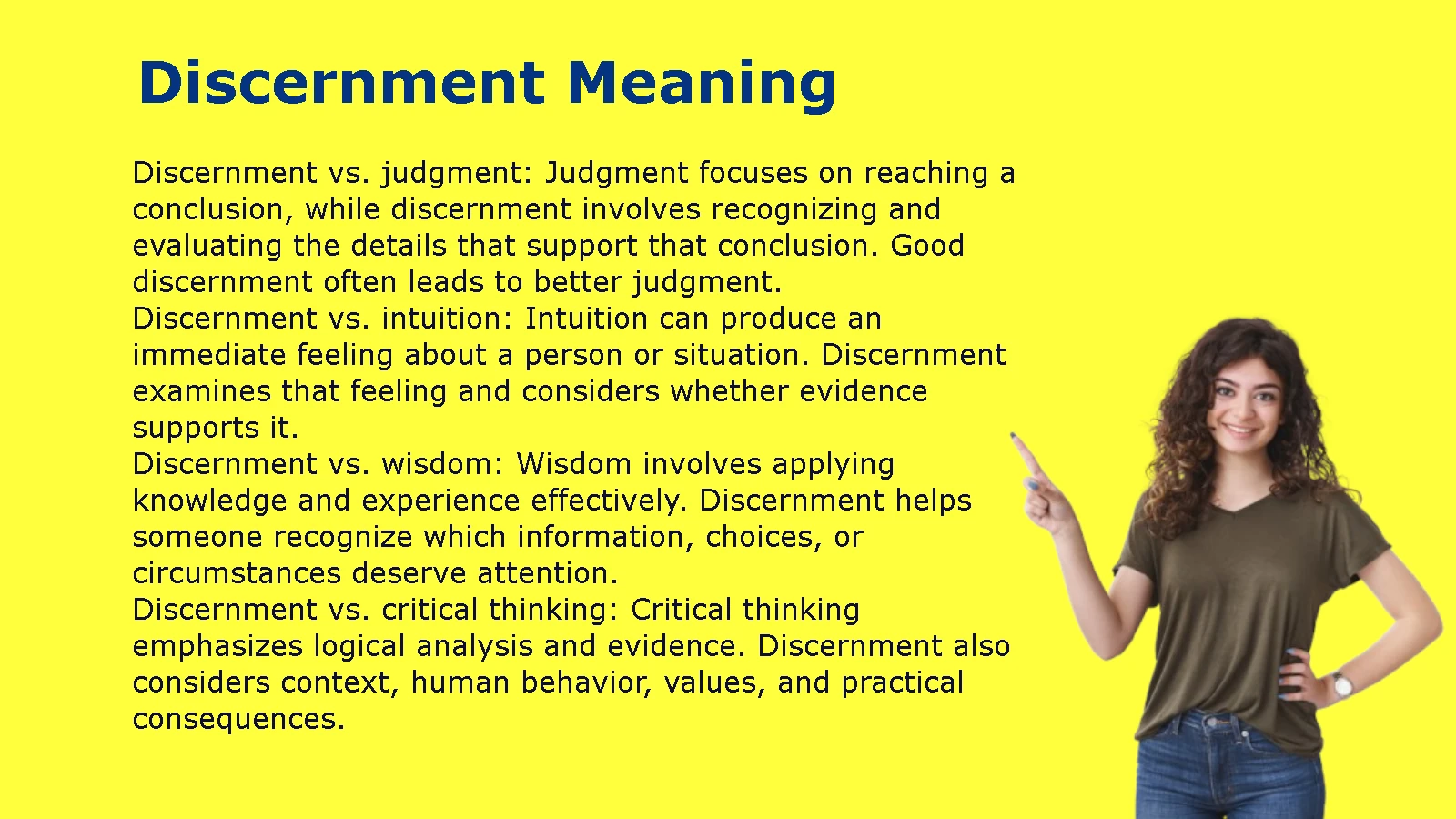
Discernment vs. judgment: Judgment focuses on reaching a conclusion, while discernment involves recognizing and evaluating the details that support that conclusion. Good discernment often leads to better judgment.
Discernment vs. intuition: Intuition can produce an immediate feeling about a person or situation. Discernment examines that feeling and considers whether evidence supports it.
For example, you might intuitively feel uncomfortable about a business proposal. Critical thinking helps you examine its financial details, while discernment helps you recognize warning signs and decide whether the opportunity deserves further consideration.
Synonyms and Antonyms of Discernment
Several English words express similar ideas, although their meanings are not always interchangeable.
Common synonyms of discernment include:
- Insight: The ability to understand something deeply.
- Perception: The ability to notice or interpret information.
- Wisdom: The ability to make sensible decisions using knowledge and experience.
- Acumen: Sharpness of judgment, especially in business or practical matters.
- Awareness: Understanding what is happening around you.
- Discrimination: The ability to recognize differences between things. In this context, it refers to distinguishing, not unfair treatment.
- Prudence: Careful consideration before taking action.
- Understanding: The ability to comprehend a situation or idea.
Common antonyms include:
- Foolishness
- Ignorance
- Indiscretion
- Naivety
- Poor judgment
- Carelessness
- Thoughtlessness
For instance, acumen works particularly well when discussing business decisions, while insight often describes a deeper understanding of people or complex situations.
What Does Discernment Mean in a Relationship?
Discernment in a relationship means the ability to evaluate someone’s character, intentions, behavior, and compatibility before making emotional or long-term commitments. It helps people recognize healthy patterns, identify potential warning signs, establish boundaries, and distinguish genuine affection from temporary attention.
Relationship discernment does not mean assuming that everyone has bad intentions. Instead, it encourages you to understand people through their consistent actions rather than relying entirely on attraction, promises, or first impressions.
Recognizing Healthy and Unhealthy Relationship Patterns
Good discernment helps you notice patterns that reveal the quality of a relationship.
Someone may appear caring during the early stages of a relationship but behave differently when disagreements arise. Another person might communicate less dramatically but consistently demonstrate respect, honesty, and reliability.
Discernment encourages you to examine behavior over time.
Healthy relationship patterns include:
- Respecting personal boundaries.
- Communicating honestly, even during difficult conversations.
- Taking responsibility for mistakes.
- Showing consistent care and consideration.
- Supporting each other’s personal development.
- Resolving disagreements without intimidation or manipulation.
Potentially unhealthy patterns include:
- Repeated dishonesty.
- Controlling behavior.
- Disrespect for personal boundaries.
- Manipulation through guilt or fear.
- Avoiding responsibility for harmful actions.
- Making promises without meaningful changes.
One mistake does not automatically define someone’s character. However, repeated behavior deserves attention.
For example, imagine that your partner forgets an important commitment. You discuss the issue, and they acknowledge their mistake. That response differs significantly from someone who repeatedly ignores your concerns and blames you whenever you raise them.
Discernment helps you recognize the difference between an isolated mistake and an established pattern.
Discernment vs. Intuition in Relationships
Intuition and discernment can work together, but they are not identical.
Intuition often produces an immediate impression. You might feel that someone is trustworthy, uncomfortable, or emotionally unavailable without knowing exactly why.
Discernment takes the next step. It encourages you to examine the person’s actions, communication habits, and consistency.
Consider this example:
You meet someone who seems extremely interested in you. They send frequent messages, make ambitious promises, and discuss a future together after only a few conversations.
Your intuition might interpret this behavior as exciting. Discernment encourages you to slow down and observe whether their actions remain consistent over time.
A useful approach is to:
- Notice your initial feelings.
- Identify the specific behavior creating those feelings.
- Look for supporting evidence.
- Consider alternative explanations.
- Make decisions without unnecessary emotional pressure.
This approach helps prevent both excessive suspicion and unrealistic expectations.
Signs Someone Has Good Discernment in a Relationship
People with good relationship discernment usually demonstrate emotional maturity and thoughtful decision-making.
Common signs include:
They evaluate character over appearance. Physical attraction may influence initial interest, but they also consider honesty, reliability, kindness, and responsibility.
They communicate directly. Rather than making assumptions, they ask questions and discuss concerns.
Good discernment also involves recognizing your own weaknesses. Personal insecurities, past experiences, and unrealistic expectations can influence how you interpret another person’s behavior.
How to Develop Discernment When Choosing a Partner
Choosing a compatible partner requires more than emotional attraction. It involves understanding whether two people share compatible values, expectations, communication styles, and long-term goals.
Here are practical ways to develop relationship discernment:
- Take your time: Allow the relationship to develop naturally instead of making major commitments too quickly.
- Observe everyday behavior: Notice how the person treats family members, friends, colleagues, and strangers.
- Discuss important values: Talk about family expectations, finances, career goals, and personal boundaries.
- Watch how they handle conflict: Disagreements reveal communication habits and emotional maturity.
- Evaluate consistency: Compare what someone says with what they regularly do.
- Maintain independence: Continue developing your interests, friendships, and personal goals.
Practical case study:
Imagine two people are interested in the same potential partner. The first focuses mainly on romantic gestures, expensive gifts, and frequent compliments. The second appreciates those gestures but also observes how the person handles responsibility, communicates during disagreements, and treats others.
The second approach demonstrates stronger discernment because it evaluates a broader picture of the person’s character.
What Is the Spiritual Discernment Meaning?
Spiritual discernment refers to the ability to evaluate thoughts, experiences, influences, and decisions through spiritual understanding, faith, and moral values. In Christianity, it often involves seeking God’s guidance, understanding biblical teachings, and distinguishing between influences that support or conflict with spiritual principles.
Spiritual discernment is not simply following emotions or accepting every experience as a spiritual message. It involves reflection, prayer, knowledge, and careful evaluation.
What Does Spiritual Discernment Mean in Christianity?
In Christianity, spiritual discernment involves seeking to understand what aligns with God’s teachings and what does not.
Christians often use discernment when evaluating decisions, interpreting religious teachings, and considering whether certain influences support their faith.
For example, someone may receive advice that promises immediate success but encourages dishonesty or exploitation. Spiritual discernment encourages that person to examine whether the advice aligns with Christian principles such as honesty, compassion, humility, and responsibility.
Several practices support Christian spiritual discernment:
- Reading and reflecting on Scripture.
- Praying for wisdom and guidance.
- Seeking advice from mature and trustworthy believers.
- Examining personal motivations.
- Considering whether a decision reflects Christian moral teachings.
- Practicing patience rather than acting impulsively.
Spiritual discernment also requires humility. A person should not assume that every personal feeling represents divine guidance.
What Is the Gift of Discernment?
In Christian theology, the gift of discernment can refer to a spiritual ability to distinguish between different spiritual influences.
The concept appears in 1 Corinthians 12:10, where Paul discusses the distinguishing of spirits among the gifts of the Holy Spirit.
Different Christian traditions interpret and emphasize this gift in different ways. Some understand it primarily as the ability to recognize whether spiritual influences align with God’s work. Others connect it with identifying misleading teachings or evaluating spiritual claims.
It is helpful to distinguish this specific religious concept from ordinary discernment.
For example:
- Everyday discernment: Recognizing whether a business opportunity is trustworthy.
- Moral discernment: Evaluating whether an action is ethical.
- Spiritual discernment: Considering whether a belief, influence, or decision aligns with one’s faith.
- The gift of discernment: A spiritual gift discussed in Christian teaching, particularly in relation to distinguishing spirits.
These concepts overlap, but they do not mean exactly the same thing.
Biblical Meaning of Discernment
The Bible connects discernment with spiritual maturity, wisdom, knowledge, and the ability to distinguish between right and wrong.
Several passages provide useful context.
Hebrews 5:14
This passage describes mature believers as people who have trained their ability to distinguish good from evil through practice.
The central lesson is that discernment develops over time. It requires learning, experience, and consistent application of spiritual principles.
Philippians 1:9–10
Paul expresses a desire for love to grow alongside knowledge and insight so believers can recognize what is excellent.
This passage connects discernment with thoughtful decisions rather than emotion alone.
1 Corinthians 12:10
Paul includes the distinguishing of spirits among the spiritual gifts.
This passage provides the biblical foundation for the Christian concept of discernment as a spiritual gift.
Together, these passages show that biblical discernment involves more than knowing religious information. It includes applying spiritual understanding to real situations.
Signs of Spiritual Discernment
Spiritual discernment can appear through a person’s attitudes, decisions, and responses to difficult situations.
Common signs include:
- A commitment to truth: The person values honesty and examines information rather than accepting every claim.
- Humility: They recognize that their understanding may be incomplete.
- Patience: They avoid rushing into important decisions.
- Moral awareness: They consider whether their actions align with their beliefs.
- Self-reflection: They examine their motivations and recognize personal weaknesses.
- Compassion: They consider how their decisions affect other people.
- A desire for wisdom: They seek understanding instead of simply looking for confirmation of existing opinions.
Spiritual discernment should not become an excuse to judge others unfairly. It should encourage personal responsibility, thoughtful behavior, and a deeper commitment to truth.
How to Develop Spiritual Discernment
Spiritual discernment develops through consistent reflection and the practical application of religious principles.
Consider these steps:
Study religious teachings: Read Scripture carefully and understand the context behind individual passages.
Make time for prayer: Use prayer to seek guidance, examine motivations, and develop patience.
Seek trustworthy advice: Discuss difficult questions with knowledgeable spiritual mentors who encourage thoughtful reflection.
Examine your intentions: Ask whether a decision comes from compassion, honesty, fear, pride, or personal ambition.
Consider the consequences: Evaluate whether an action supports your spiritual values and respects other people.
Learn from experience: Reflect on previous decisions and consider what they taught you.
A useful practice is to pause before making an important decision and ask three questions:
- Does this choice align with my spiritual values?
- Am I evaluating the situation honestly?
- Have I considered the consequences for myself and others?
These questions can make spiritual reflection more practical and consistent.
What Does Discernment Mean in AI?
Discernment in artificial intelligence generally refers to the ability to distinguish, evaluate, or recognize meaningful differences in information, inputs, patterns, or generated outputs. The term can describe different capabilities depending on the context, but it is not a single standardized technical feature shared by all AI systems.
AI systems use algorithms, statistical models, and computational methods to process information. They can classify data, identify patterns, compare inputs, and generate predictions. However, these capabilities should not automatically be treated as equivalent to human wisdom or moral discernment.
How Is Discernment Used in Artificial Intelligence?
In AI discussions, discernment can describe the ability of a system or human evaluator to distinguish between relevant and irrelevant information.
For example, an email filtering system analyzes incoming messages and classifies them as legitimate emails or potential spam. A medical AI tool may identify patterns in medical images that deserve further examination by a qualified professional.
These applications involve different forms of computational evaluation.
Common examples include:
- Pattern recognition: Identifying recurring features in large datasets.
- Classification: Assigning information to categories based on learned patterns.
- Contextual evaluation: Considering surrounding information when interpreting an input.
- Anomaly detection: Recognizing unusual patterns that differ from expected behavior.
- Output evaluation: Checking whether an AI-generated response is relevant, accurate, and appropriate.
However, an AI model does not necessarily understand the significance of these distinctions in the same way a human does.
Can Artificial Intelligence Have Human-Like Discernment?
AI can perform tasks that resemble certain aspects of human discernment, but computational performance does not automatically establish human-like understanding.
For example, an AI model may identify misleading information by comparing claims against available data. It can also detect patterns that suggest a financial transaction deserves further investigation.
However, several limitations remain.
| Human discernment | AI-based evaluation |
| Uses personal experience and contextual understanding | Processes information through computational models |
| Can reflect on personal values | Follows learned patterns and programmed objectives |
| Considers social and emotional consequences | May identify patterns without understanding their human significance |
| Can take moral responsibility | Does not independently assume human moral accountability |
| Can reconsider beliefs through reflection | Changes behavior through model updates, instructions, or new inputs |
AI systems can produce sophisticated answers without possessing human consciousness or personal experience.
This distinction matters because an AI-generated answer may sound confident while containing incorrect information. Its ability to generate convincing language does not guarantee that it has evaluated the underlying facts correctly.
Why Human Discernment Still Matters When Using AI
Human discernment remains important because AI tools can produce errors, reflect biases in their training data, or misunderstand the context of a question.
People should evaluate AI outputs before relying on them for important decisions.
For example, a small business owner might ask an AI assistant to explain a tax rule. The response may sound accurate, but the owner should still check the relevant jurisdiction, tax year, and applicable regulations before acting.
Use these practices when evaluating AI-generated information:
- Verify important factual claims using reliable primary sources.
- Check dates and contextual details.
- Look for missing assumptions.
- Identify possible bias or misleading language.
- Compare important recommendations with expert advice.
- Avoid sharing sensitive information unnecessarily.
- Take responsibility for decisions rather than treating AI outputs as unquestionable instructions.
The central distinction is simple: AI can help process information, but people must still exercise judgment and accountability.
Examples of Discernment in AI
Consider these practical situations.
Email filtering: An AI-powered email system distinguishes likely spam messages from legitimate communication based on patterns in message content and sender behavior.
Medical image analysis: A medical AI system identifies unusual features in an image and flags them for review. A healthcare professional evaluates the findings alongside the patient’s symptoms and medical history.
Content moderation: An AI tool classifies potentially harmful content. Human reviewers may need to consider cultural context, intent, and ambiguous language before making a final decision.
AI-generated research: A researcher uses an AI assistant to summarize information but checks the original studies, publication dates, and supporting evidence before including the findings in academic work.
These examples demonstrate why discernment in AI involves both computational evaluation and responsible human oversight.
What Is the Discernment Meaning in Polish?
The most common general Polish translation of discernment is rozeznanie. Depending on the sentence, other translations include wnikliwość and przenikliwość. Each word emphasizes a slightly different aspect of the English meaning, so the best translation depends on whether the context involves practical judgment, intellectual insight, or perceptiveness.
Discernment Translation in Polish
Here are several Polish equivalents and their typical uses.
| Polish word | Approximate English meaning | Common context |
| Rozeznanie | Discernment, understanding, informed judgment | General situations and decision-making |
| Wnikliwość | Insight, perceptiveness, analytical depth | Understanding complex matters |
| Przenikliwość | Sharp insight, penetrating intelligence | Recognizing hidden details |
| Osąd | Judgment | Evaluating or forming an opinion |
| Rozróżnianie | Distinguishing or differentiation | Recognizing differences |
The word rozeznanie is usually the best starting point when translating general discernment.
However, translation requires attention to the complete sentence. For example, someone who demonstrates deep insight into a complicated issue may be described using wnikliwość, while someone who makes sensible decisions based on an understanding of circumstances may demonstrate rozeznanie.
Discernment in English and Polish Example Sentences
The following examples demonstrate how the translation changes depending on context.
| English sentence | Polish translation |
| She showed great discernment. | Wykazała się dużym rozeznaniem. |
| Good discernment helps us make wise decisions. | Dobre rozeznanie pomaga nam podejmować mądre decyzje. |
| He has excellent discernment. | Wykazuje się dużą przenikliwością. |
| We need discernment when evaluating difficult situations. | Potrzebujemy rozeznania przy ocenie trudnych sytuacji. |
| Her discernment helped her recognize the problem. | Jej wnikliwość pomogła jej dostrzec problem. |
Notice that the Polish translation does not always follow the English sentence structure word for word. Natural Polish expressions often require a different grammatical construction.
When Should You Use Each Polish Translation?
Choosing the right Polish equivalent depends on the meaning you want to communicate.
Use rozeznanie when discussing someone’s general ability to understand circumstances and make informed decisions.
Example: She has good discernment.
Polish: Ma dobre rozeznanie.
Use wnikliwość when emphasizing the ability to examine something deeply and notice details that others might overlook.
Example: Her discernment helped her understand the complicated issue.
Polish: Jej wnikliwość pomogła jej zrozumieć skomplikowaną kwestię.
Use przenikliwość when describing sharp perception or an unusually strong ability to understand hidden aspects of a situation.
Example: His discernment impressed the entire team.
Polish: Jego przenikliwość zrobiła wrażenie na całym zespole.
For most general translation needs, rozeznanie is the safest starting point. More specific alternatives provide a better fit when the sentence emphasizes insight or intellectual sharpness.
How to Use Discernment in a Sentence
You can use discernment in a sentence when describing someone’s ability to recognize differences, evaluate circumstances, or make thoughtful decisions. It commonly appears with verbs such as show, exercise, demonstrate, and develop. Because it is an uncountable noun, it usually does not take the article “a” when referring to the general ability.
Simple Sentences With Discernment
Here are original examples showing how to use discernment in everyday English.
- She used discernment when choosing her business partner.
- Good discernment helps people avoid unnecessary mistakes.
- His discernment allowed him to recognize the truth.
- You need discernment to evaluate different opinions.
- Parents often use discernment when making decisions about their children’s education.
- Her ability to show discernment impressed her colleagues.
- Discernment helped him recognize that the offer was misleading.
- Developing discernment takes patience and experience.
- The teacher encouraged students to exercise discernment when researching online.
- Without discernment, people may accept unreliable advice.
These examples show that discernment works in personal, educational, professional, and social contexts.
Discernment in Professional and Academic Sentences
In professional environments, discernment often refers to the ability to evaluate information, recognize risks, and make responsible decisions.
Examples include:
- A manager must exercise discernment when evaluating employee performance.
- Financial decisions require discernment and careful planning.
- Researchers need discernment when interpreting complex findings.
- The director demonstrated excellent discernment during the negotiations.
- Good business discernment helps entrepreneurs identify realistic opportunities.
- Lawyers use professional judgment and discernment when evaluating legal arguments.
- Effective leadership requires discernment when resolving workplace conflicts.
In academic writing, the word can describe the thoughtful evaluation of evidence, arguments, or research findings.
For instance:
“The researcher demonstrated discernment by distinguishing reliable evidence from unsupported assumptions.”
This sentence communicates more than basic understanding. It shows that the researcher evaluated the quality of the available information.
Discernment in Spiritual and Relationship Sentences
Discernment also appears frequently in discussions about faith, emotional maturity, and personal relationships.
Examples include:
- Spiritual discernment helped her make a difficult decision.
- He showed discernment when choosing a lifelong partner.
- Discernment allows couples to recognize unhealthy relationship patterns.
- She used discernment before accepting the advice.
- Good spiritual discernment requires patience and reflection.
- His lack of discernment created unnecessary conflict.
- They approached the disagreement with maturity and discernment.
These sentences demonstrate how the same word can communicate different forms of thoughtful evaluation.
Common Grammar Mistakes When Using Discernment
Although discernment is relatively easy to use, some grammatical mistakes can make sentences sound unnatural.
Mistake: Treating discernment as a regular countable noun
Incorrect: She has many discernments.
Better: She has excellent discernment.
When discussing the general ability to judge wisely, use discernment as an uncountable noun.
Mistake: Using the wrong verb
Natural: She demonstrated discernment.
Natural: They developed better discernment.
These expressions work because they describe the ability as something a person demonstrates, applies, or develops.
Mistake: Confusing discernment with discern
Incorrect: He showed great discern.
Correct: He showed great discernment.
Remember that discern is a verb, while discernment is a noun.
Mistake: Using discernment when discern is more appropriate
Less natural: She had the ability of discernment the difference.
Better: She had the ability to discern the difference.
The verb discern works naturally when you want to describe the action of recognizing something.
How to Develop Better Discernment in Everyday Life
You can develop better discernment by improving your observation skills, questioning assumptions, learning from experience, and evaluating decisions carefully. The process involves separating facts from opinions, considering alternative explanations, and understanding the possible consequences of your actions.
Discernment is not necessarily an ability that someone either possesses or lacks. It can improve through consistent practice.
Pause Before Making Important Decisions
Rushed decisions often reflect immediate emotions rather than careful evaluation.
When you feel pressured to accept an offer, respond to criticism, or make a commitment, take time to understand the situation.
For example, if a company offers you an attractive investment opportunity but demands immediate payment, do not let urgency replace evaluation.
Instead:
- Identify what the decision requires.
- Ask questions about unclear details.
- Consider potential risks.
- Compare available alternatives.
- Avoid commitments you do not fully understand.
A short pause can prevent decisions that create unnecessary problems later.
Separate Facts From Assumptions
One of the strongest foundations of discernment is the ability to distinguish observable facts from personal interpretations.
Imagine that a colleague does not respond to your message.
The fact is that they have not responded. The assumption might be that they are deliberately ignoring you.
Several other explanations may exist. They might be busy, unavailable, or unaware of the message.
Before reaching a conclusion, ask:
- What do I know for certain?
- What am I assuming?
- Is there evidence supporting my interpretation?
- Are there other reasonable explanations?
This habit improves both professional and personal communication.
Learn From Previous Experiences
Experience becomes useful when you reflect on it.
Someone who repeatedly makes the same mistake without examining the reasons may gain little from experience. However, a person who studies previous decisions can recognize patterns and make better choices in the future.
For example, an entrepreneur who previously partnered with an unreliable supplier might develop a stronger evaluation process.
They may begin checking references, reviewing contract terms, and assessing delivery records before entering another agreement.
Useful reflection questions include:
- What went well?
- What warning signs did I overlook?
- Which assumptions turned out to be incorrect?
- What information would have improved my decision?
- What will I do differently next time?
This process turns experience into practical judgment.
Consider Long-Term Consequences
Good discernment requires looking beyond immediate rewards.
A decision may appear beneficial today but create difficulties later.
For example, accepting a high-paying position might seem attractive. However, if the job involves unreasonable working hours, limited development opportunities, and an unhealthy workplace culture, the long-term disadvantages may outweigh the financial benefits.
Evaluate important decisions through several dimensions:
| Factor | Question to consider |
| Financial impact | Can I afford the decision? |
| Personal values | Does it align with my principles? |
| Long-term benefits | Will it support my future goals? |
| Potential risks | What problems could develop? |
| Relationships | How might it affect other people? |
| Opportunities | What alternatives am I giving up? |
Considering multiple factors helps you make more balanced decisions.
Practice Independent Thinking
Discernment becomes difficult when people automatically accept popular opinions or follow others without evaluating the facts.
Independent thinking does not mean rejecting every suggestion. It means understanding why you agree or disagree with an idea.
You can strengthen this habit by:
- Reading different perspectives on important topics.
- Asking questions when information seems incomplete.
- Checking original sources instead of relying entirely on summaries.
- Recognizing emotional language designed to influence opinions.
- Listening to experienced people without treating them as automatically correct.
- Changing your opinion when stronger evidence becomes available.
The goal is not to disagree with everyone. It is to develop the ability to form conclusions based on thoughtful evaluation.
Why Is Discernment Important?
Discernment matters because people constantly make decisions involving incomplete information, competing priorities, and uncertain outcomes. It helps them evaluate choices, understand human behavior, recognize misleading claims, and respond to challenges more thoughtfully.
Its importance extends across personal relationships, business, education, spirituality, and technology.
It Helps You Make Better Decisions
People rarely have perfect information when making everyday decisions.
Discernment helps them identify the most relevant details, compare alternatives, and consider potential consequences.
For example, choosing a university involves more than looking at its reputation. You may also need to evaluate tuition costs, course quality, career opportunities, location, and personal interests.
Someone with good discernment considers these factors together instead of focusing on one attractive feature.
It Helps You Understand People
Human behavior can be complicated. People have different motivations, communication styles, personalities, and expectations.
Discernment helps you evaluate behavior without making immediate assumptions.
It can improve your ability to:
- Recognize genuine cooperation.
- Understand different communication styles.
- Identify repeated patterns of dishonesty.
- Establish appropriate boundaries.
- Build healthier personal and professional relationships.
This does not mean trying to read everyone’s mind. It means paying attention to observable behavior and communicating when something is unclear.
It Protects You From Misleading Information
Modern communication exposes people to large amounts of information through social media, websites, advertisements, and AI tools.
Not every claim deserves equal trust.
Discernment encourages people to question unsupported statements, examine sources, and distinguish evidence from opinion.
For example, a social media post might claim that a particular investment guarantees unusually high returns. Rather than accepting the claim, a discerning reader investigates the company, evaluates the risks, and looks for independent evidence.
This habit is especially valuable when dealing with financial, medical, legal, and other high-impact information.
It Encourages Personal and Spiritual Growth
Personal development involves recognizing your strengths, weaknesses, motivations, and habits.
Discernment supports this process by helping you examine your choices honestly.
It can encourage:
- Greater self-awareness.
- More responsible decision-making.
- Improved emotional maturity.
- Stronger personal boundaries.
- Better understanding of personal values.
- Greater consistency between beliefs and actions.
In spiritual contexts, discernment also helps people evaluate decisions through their faith and moral principles.
Ultimately, it supports a more thoughtful approach to life.
Conclusion: Why Discernment Matters in Everyday Life
Discernment means the ability to recognize meaningful differences, evaluate information, and make wise decisions. It involves more than intelligence or intuition because it requires people to consider evidence, context, experience, values, and potential consequences.
You can strengthen discernment by slowing down before important decisions, questioning assumptions, learning from experience, and considering different perspectives.
Start practicing discernment in one decision today. Examine the available facts, identify your assumptions, and consider the long-term consequences before choosing your next step. Over time, these habits can help you become a more thoughtful, confident, and responsible decision-maker.













