The esoteric meaning refers to something understood by only a small group of people who possess specialized knowledge, particular interests, or advanced understanding of a subject. It often describes hidden knowledge, obscure ideas, specialized teachings, and complex philosophical concepts that ordinary audiences may find difficult to understand.
People use the word esoteric when discussing philosophy, spirituality, science, literature, ancient traditions, and intellectual subjects. However, its meaning goes beyond simply describing something complicated. An idea can be difficult to understand without being esoteric, while an esoteric subject may be perfectly clear to someone with the right background.
Understanding the meaning of esoteric also means knowing how it differs from related words such as arcane, abstruse, opaque, obscure, and cryptic. These terms share certain meanings, but each communicates a slightly different idea. Learning their differences will help you choose the right word in conversations, academic writing, and everyday communication.
| Question | Answer |
| What does esoteric mean? | Understood by only a small group of people with specialized knowledge. |
| What is a synonym for esoteric? | Arcane, obscure, abstruse, cryptic, and recondite. |
| What is the opposite of esoteric? | Accessible, common, familiar, mainstream, and understandable. |
| What does esoteric mean when describing a person? | Someone with unusual, specialized, or niche interests and knowledge. |
| Is esoteric a positive or negative word? | It is generally neutral, although context can make it sound complimentary or critical. |
What Does Esoteric Mean?
Esoteric describes knowledge, information, interests, or subjects that only a limited group of people understand or appreciate. Such subjects often require specialized experience, background knowledge, or intellectual familiarity. The word can describe philosophical teachings, technical discussions, spiritual practices, unusual hobbies, and ideas that remain unfamiliar to most people.
For example, a discussion about advanced mathematical theories might sound esoteric to someone without a mathematics background. However, mathematicians who study those theories may find the same discussion completely understandable.
The defining feature of something esoteric is its limited audience, not necessarily its difficulty.
Consider these examples:
- Her research focuses on esoteric philosophical traditions.
- The professor introduced an esoteric theory that only a few students understood.
- He collects esoteric books about ancient civilizations.
- Their conversation covered several esoteric subjects that most visitors found unfamiliar.
In each sentence, esoteric describes something outside ordinary knowledge or mainstream interest.
Esoteric Definition in Simple Words
In simple English, esoteric means specialized, uncommon, or understood by only a few people.
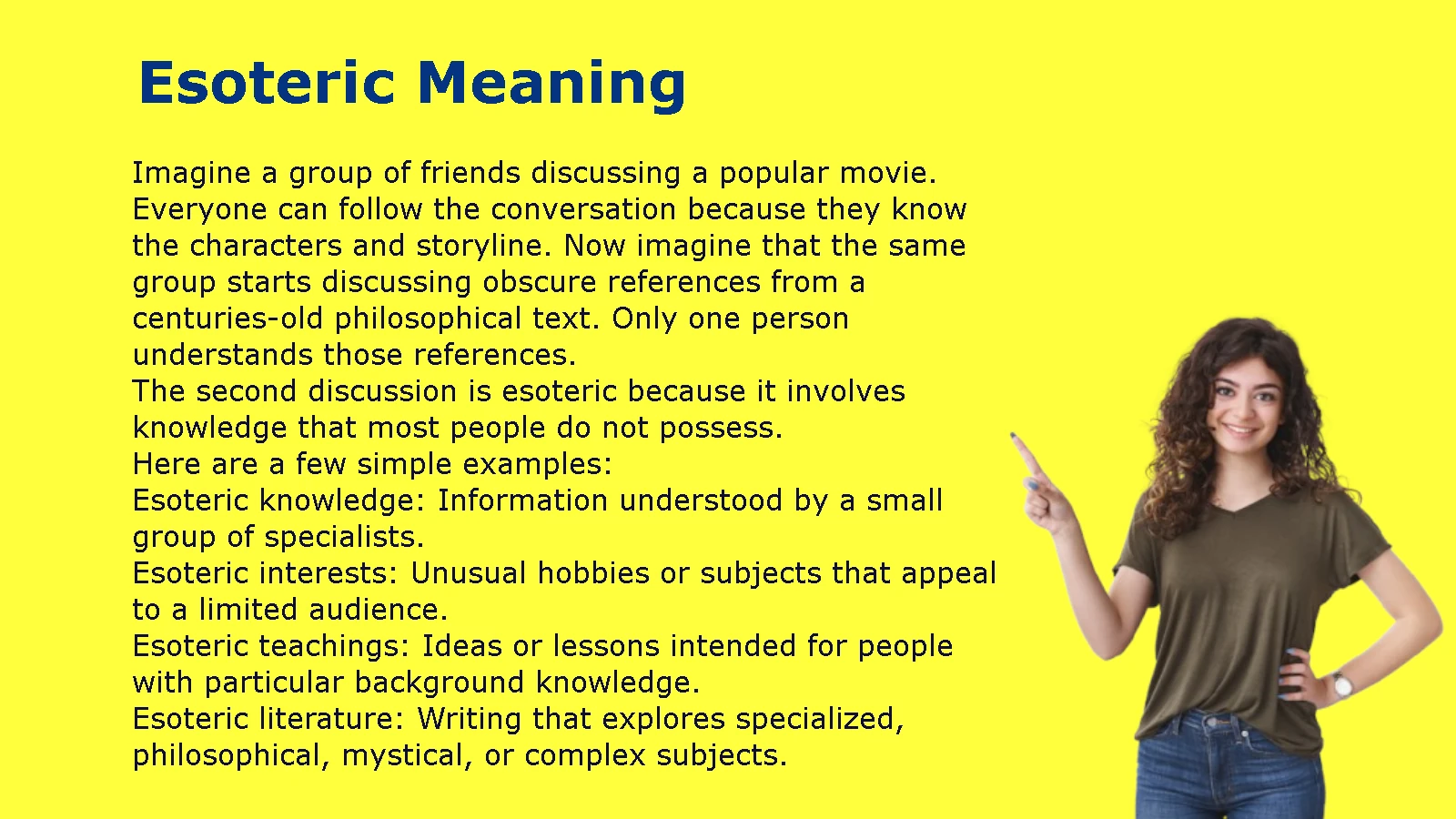
Imagine a group of friends discussing a popular movie. Everyone can follow the conversation because they know the characters and storyline. Now imagine that the same group starts discussing obscure references from a centuries-old philosophical text. Only one person understands those references.
The second discussion is esoteric because it involves knowledge that most people do not possess.
Here are a few simple examples:
- Esoteric knowledge: Information understood by a small group of specialists.
- Esoteric interests: Unusual hobbies or subjects that appeal to a limited audience.
- Esoteric teachings: Ideas or lessons intended for people with particular background knowledge.
- Esoteric literature: Writing that explores specialized, philosophical, mystical, or complex subjects.
One important distinction is that esoteric does not automatically mean secret. A book can be publicly available but still contain esoteric information because relatively few people understand its subject matter.
Esoteric Part of Speech and Pronunciation
The word esoteric functions as an adjective. It describes nouns rather than naming a person, object, or concept directly.
Its pronunciation is:
Esoteric: /ˌes.əˈter.ɪk/
The word has four syllables, with the main stress on the third syllable.
Common grammatical combinations include:
| Expression | Meaning |
| Esoteric knowledge | Specialized information |
| Esoteric philosophy | Philosophy understood by a limited audience |
| Esoteric language | Language containing specialized or unfamiliar terminology |
| Esoteric subject | A niche or specialized topic |
| Esoteric literature | Writing about uncommon or complex ideas |
| Esoteric teachings | Knowledge intended for a particular group |
| Esoteric interests | Unusual or specialized hobbies |
Grammar tip: Use esoteric before a noun when describing something.
Correct: The author studies esoteric philosophy.
Incorrect: The author studies esotericly philosophy.
The word does not normally function as an adverb. If you need to describe how someone communicates, you can use expressions such as “in an esoteric manner” or “using specialized terminology.”
The related noun is esotericism, which describes the study or practice of esoteric ideas, traditions, and teachings.
Origin and Etymology of Esoteric
The word esoteric comes from the Greek term esōterikos, meaning “belonging to the inner circle” or “more inward.”
Its historical roots connect it with teachings intended for a select group rather than the general public.
In ancient philosophical traditions, some teachers distinguished between knowledge shared openly and teachings reserved for students who had reached a particular level of understanding.
Over time, the word developed a broader meaning. It came to describe specialized knowledge, obscure intellectual subjects, mystical traditions, and ideas that require particular background knowledge.
Today, people use esoteric in several contexts:
- Philosophy: Specialized theories and abstract concepts.
- Religion: Mystical teachings and spiritual traditions.
- Science: Highly specialized technical subjects.
- Literature: Symbolic or intellectually demanding writing.
- Culture: Niche interests and uncommon references.
The original association with an inner circle remains important because it explains why the word still suggests limited accessibility.
Esoteric Meaning and Examples in Sentences
The meaning of esoteric becomes easier to understand when you examine how people use it in different situations. It can describe knowledge, conversations, interests, books, theories, and even artistic preferences.
The word often appears in formal and academic writing, but it also works in ordinary conversations when someone wants to describe an unusual or specialized subject.
Esoteric Examples in Everyday Conversations
Here are original examples showing how esoteric works in everyday English.
| Example sentence | Explanation |
| My brother has an esoteric interest in ancient maps. | His interest is unusual and appeals to a limited audience. |
| The conversation became too esoteric for me. | The discussion covered subjects the speaker did not understand. |
| She enjoys reading esoteric books about mythology. | She prefers specialized books about uncommon subjects. |
| His music collection contains several esoteric recordings. | The recordings are uncommon or appeal to niche listeners. |
| They discussed an esoteric theory during lunch. | Their conversation involved specialized knowledge. |
| The exhibition explored esoteric artistic traditions. | The exhibition presented less familiar artistic ideas. |
Notice that esoteric does not always suggest something negative. Someone might proudly describe a hobby as esoteric because it reflects their unusual interests.
Esoteric in Academic and Intellectual Contexts
Academic writers often use esoteric to describe specialized subjects that require previous knowledge or professional experience.
For example, a university lecture about quantum field theory may seem esoteric to someone unfamiliar with advanced physics. However, researchers who work in that field can understand the terminology and concepts.
Common academic applications include:
Philosophy: Esoteric philosophical teachings may explore metaphysics, consciousness, ethics, or abstract theories that require extensive background knowledge.
Science: Specialized scientific discussions can become esoteric when they involve advanced formulas, technical terminology, or narrow research questions.
Religion: Esoteric religious traditions may examine symbolic interpretations, mystical experiences, and teachings associated with particular schools of thought.
Literature: Some authors use esoteric references, symbolism, and philosophical arguments that require readers to understand historical or cultural contexts.
History: Research into obscure historical movements, ancient manuscripts, and specialized cultural practices can also involve esoteric knowledge.
A useful way to recognize this usage is to ask whether the subject requires knowledge that an average reader or listener may not possess.
How to Use Esoteric in a Sentence
You can use esoteric naturally in formal writing, academic discussions, and everyday communication.
Follow these practical guidelines:
- Use it when describing specialized knowledge or uncommon subjects.
- Place it before a noun to identify a particular quality.
- Avoid using it as a direct replacement for every word meaning complicated.
- Consider your audience before using it in casual conversations.
- Choose a simpler alternative when your readers may not recognize the word.
Compare these examples:
Formal: The researcher published an article about esoteric philosophical traditions.
Academic: The professor explained several esoteric concepts during the advanced seminar.
Casual: I like his videos, although some of the topics are pretty esoteric.
Critical: The presentation included so many esoteric references that the audience struggled to follow it.
Positive: Her esoteric knowledge of classical literature made her an excellent discussion partner.
The word changes its emotional effect according to context. It can communicate expertise and originality, but it can also suggest unnecessary complexity.
Esoteric Synonyms: 25+ Words With Similar Meanings
An esoteric synonym is a word that expresses a similar idea, such as specialized, obscure, mysterious, or understood by only a limited group of people.
However, not every synonym works in every situation. Arcane emphasizes rare or specialized knowledge, abstruse describes intellectual difficulty, and obscure often refers to something unfamiliar or little-known.
Choosing the right synonym depends on what you want to communicate.
Common Synonyms for Esoteric
Here are more than 25 useful alternatives, along with their meanings and example sentences.
| Synonym | Meaning | Example |
| Arcane | Known or understood by very few people | The manual contains arcane instructions. |
| Abstruse | Extremely difficult to understand | The article explains an abstruse theory. |
| Obscure | Little-known or not easily understood | She studies obscure historical events. |
| Cryptic | Mysterious or difficult to interpret | He left a cryptic message. |
| Mysterious | Difficult to explain or understand | The book explores mysterious traditions. |
| Enigmatic | Puzzling or difficult to interpret | His writing has an enigmatic quality. |
| Recondite | Known by only a few specialists | The professor discussed recondite subjects. |
| Occult | Related to supernatural or hidden knowledge | The novel explores occult traditions. |
| Secret | Kept from public knowledge | They discovered a secret teaching. |
| Hidden | Not easily seen or recognized | The manuscript contains hidden meanings. |
| Specialized | Intended for a particular field or group | The course covers specialized knowledge. |
| Exclusive | Limited to particular people | The club discusses exclusive intellectual interests. |
| Unfamiliar | Not previously known | The lecture introduced unfamiliar concepts. |
| Intricate | Having many complicated details | The painting contains intricate symbolism. |
| Unintelligible | Impossible or extremely difficult to understand | The explanation sounded unintelligible. |
| Concealed | Kept out of sight or knowledge | The story reveals concealed information. |
| Little-known | Not widely recognized | She researches little-known philosophers. |
| Mystical | Connected with spiritual or supernatural experiences | The text describes mystical teachings. |
| Clandestine | Secret or conducted privately | They uncovered a clandestine organization. |
| Technical | Requiring specialized knowledge | The report uses technical language. |
| Unorthodox | Different from established beliefs or practices | He proposed an unorthodox interpretation. |
| Byzantine | Extremely complicated or intricate | The regulations have a Byzantine structure. |
| Complicated | Difficult to understand or deal with | The explanation became complicated. |
| Hermetic | Closed off or difficult for outsiders to understand | The author developed a hermetic style. |
| Puzzling | Difficult to explain or interpret | The poem contains puzzling references. |
Some of these words are close synonyms, while others describe only one aspect of esoteric meaning. For example, clandestine suggests secrecy, whereas technical emphasizes specialized knowledge.
Best Esoteric Synonyms for Different Contexts
The most effective synonym depends on the specific meaning you want to express.
| Context | Recommended word | Why it fits |
| Rare intellectual knowledge | Arcane | Suggests specialized knowledge known by few |
| Difficult theories | Abstruse | Emphasizes intellectual complexity |
| Little-known subjects | Obscure | Highlights limited familiarity |
| Unclear messages | Cryptic | Focuses on difficult interpretation |
| Mysterious traditions | Occult | Connects with hidden or supernatural subjects |
| Specialized information | Technical | Emphasizes professional knowledge |
| Complex structures | Intricate | Highlights detailed complexity |
| Unusual philosophical ideas | Recondite | Suggests advanced or uncommon learning |
For example, consider the sentence:
“The professor explained an esoteric theory.”
You could replace esoteric with arcane if you want to emphasize specialized knowledge. Choose abstruse if the theory is exceptionally difficult to understand.
These differences make synonyms useful tools rather than interchangeable replacements.
Formal, Academic, and Everyday Alternatives
Different communication settings require different vocabulary.
Formal alternatives:
- Recondite
- Arcane
- Abstruse
- Hermetic
- Obscure
These words work well in scholarly writing, literary criticism, and intellectual discussions.
Academic alternatives:
- Specialized
- Technical
- Theoretical
- Complex
- Intricate
These expressions help describe knowledge that requires education or professional experience.
Everyday alternatives:
- Unusual
- Little-known
- Mysterious
- Hard to understand
- Not widely known
These phrases communicate the meaning without making a sentence sound unnecessarily formal.
For example:
Formal: The manuscript contains recondite philosophical arguments.
Everyday: The manuscript contains ideas that most people would find difficult to understand.
Both sentences communicate a similar idea, but they suit different audiences.
Esoteric Meaning Antonyms: Opposite Words
The antonyms of esoteric describe something that is familiar, widely understood, accessible, or available to the general public.
The best opposite depends on the context. If esoteric describes exclusive knowledge, accessible may be the strongest antonym. If it describes an unusual interest, mainstream may communicate the opposite more accurately.
Common Antonyms of Esoteric
Here are useful opposite words with examples.
| Antonym | Meaning | Example |
| Common | Frequently encountered | The topic is common knowledge. |
| General | Intended for a broad audience | The book provides general information. |
| Accessible | Easy to approach or understand | The author makes philosophy accessible. |
| Familiar | Already known or recognized | The examples are familiar to students. |
| Mainstream | Widely accepted or popular | The subject has mainstream appeal. |
| Ordinary | Not unusual or exceptional | They discussed ordinary everyday matters. |
| Popular | Liked or followed by many people | The subject became popular online. |
| Understandable | Easy to comprehend | Her explanation was understandable. |
| Simple | Easy to understand or use | The teacher provided a simple explanation. |
| Public | Available to everyone | The information is publicly available. |
| Clear | Easy to recognize or understand | The instructions are clear. |
| Straightforward | Direct and uncomplicated | He gave a straightforward answer. |
| Widespread | Found in many places or among many people | The practice is widespread. |
| Universal | Applying to everyone or everything | The principle has universal relevance. |
| Well-known | Recognized by many people | The author is well-known internationally. |
Esoteric vs. Accessible
Esoteric describes something understood by a limited audience, while accessible describes something that people can easily approach, use, or understand.
Consider these examples:
- The textbook contains esoteric scientific theories.
- The textbook presents scientific theories in an accessible way.
The first sentence emphasizes specialized knowledge. The second highlights how easily readers can understand the material.
An important point: accessible does not always mean simple. An advanced scientific book can remain intellectually challenging while presenting its ideas in an accessible manner.
Writers often use accessible when discussing education, communication, technology, and public information.
Esoteric vs. Mainstream
Esoteric describes niche subjects or specialized interests. Mainstream refers to ideas, activities, products, or cultural preferences that appeal to a large audience.
For example:
- An esoteric music genre may attract a small group of dedicated listeners.
- A mainstream music genre attracts a much larger audience.
The distinction also applies to entertainment, fashion, literature, hobbies, and cultural discussions.
A film about an obscure philosophical movement may have an esoteric appeal. A widely advertised superhero movie generally has mainstream appeal.
Neither term automatically describes quality. Esoteric interests are not necessarily better or more intelligent than mainstream interests. They simply attract different audiences.
What Does Esoteric Mean When Describing a Person?
When someone describes a person as esoteric, they usually mean that the individual has unusual interests, specialized knowledge, or an intellectual approach that most people may not immediately understand.
An esoteric person might enjoy studying ancient philosophies, collecting rare manuscripts, researching obscure historical events, or discussing complex scientific theories.
The word describes the person’s interests, knowledge, or communication style. It does not automatically mean that the person is antisocial, secretive, or unfriendly.
Characteristics of an Esoteric Person
Someone with an esoteric personality or interests may display several of these characteristics:
1. Specialized interests
They enjoy subjects that appeal to a relatively small audience, such as ancient languages, symbolic systems, rare literature, or advanced mathematics.
2. Uncommon knowledge
They may know unusual historical facts, philosophical theories, or technical information that most people have never encountered.
3. Intellectual curiosity
They often explore questions beyond ordinary discussions and enjoy investigating unfamiliar concepts.
4. Specialized vocabulary
They may use terminology associated with their particular interests or professional background.
5. Preference for niche subjects
They might prefer independent films, experimental music, obscure literature, or specialized academic discussions over popular entertainment.
6. Independent thinking
They may explore unconventional ideas and examine subjects from perspectives that differ from mainstream opinions.
These characteristics do not form a psychological diagnosis or a fixed personality category. They simply illustrate common ways people use the adjective.
Is Being Esoteric a Compliment or an Insult?
Calling someone esoteric can be positive, neutral, or slightly critical.
The intended meaning depends on the speaker’s tone and the situation.
| Context | Possible meaning | Example |
| Positive | Intelligent, knowledgeable, or intellectually curious | Her esoteric interests make conversations fascinating. |
| Neutral | Focused on specialized subjects | He has an esoteric knowledge of ancient literature. |
| Negative | Difficult to understand or overly complicated | His esoteric explanations confuse everyone. |
| Playful | Unusually interested in niche subjects | You have some pretty esoteric hobbies! |
Someone might appreciate being described as esoteric because the word recognizes their intellectual interests.
However, in a workplace meeting, calling an explanation esoteric might suggest that the speaker failed to communicate effectively with a general audience.
The surrounding sentence determines whether the description sounds like praise or criticism.
Esoteric Person vs. Introverted Person
Esoteric and introverted describe different characteristics.
An esoteric person has specialized interests or knowledge. An introverted person generally prefers less socially stimulating environments or needs time alone to recharge.
| Feature | Esoteric person | Introverted person |
| Main characteristic | Specialized interests or knowledge | Social energy and preferences |
| Communication | May use niche terminology | May prefer smaller conversations |
| Interests | Often unusual or specialized | Can be mainstream or niche |
| Social behavior | Can be outgoing or reserved | Often prefers quieter settings |
| Meaning | Intellectual or cultural description | Personality-related description |
A person can be both esoteric and introverted, but neither characteristic automatically implies the other.
For example, an outgoing university professor who studies obscure philosophical traditions may be described as esoteric without being introverted.
Esoteric Meaning in Slang and Modern Conversations
Esoteric is not primarily a slang word. It retains its standard English meaning in informal communication.
However, people sometimes use it casually or humorously to describe unusually specific interests, niche internet references, obscure jokes, or discussions that only a small community understands.
In modern conversations, the word often communicates that something is outside mainstream culture.
What Does Esoteric Mean on Social Media?
On social media, esoteric can describe content that appeals to a very specific audience.
For example, a meme about an obscure historical event may be funny to people who understand its background but confusing to everyone else.
Common applications include:
- Music: Describing experimental artists or niche musical styles.
- Movies: Discussing obscure films or unusual cinematic references.
- Memes: Sharing jokes that require specialized knowledge.
- Books: Talking about rare literary works or complex philosophical writing.
- Online communities: Discussing specialized topics that outsiders may not understand.
Consider this social media caption:
“My playlist has become increasingly esoteric.”
The person probably means that their music collection now contains unusual artists, obscure recordings, or genres that appeal to a limited audience.
Another example:
“That reference was so esoteric that only three people in the comments understood it.”
Here, esoteric describes a reference that requires specific background knowledge.
Is Esoteric the Same as Weird or Unusual?
No. Although the words can overlap, they express different ideas.
| Word | Meaning | Example |
| Esoteric | Understood by a limited audience | An esoteric philosophical theory |
| Weird | Strange or unusual | A weird dream |
| Unusual | Different from what is common | An unusual hobby |
| Obscure | Little-known or unfamiliar | An obscure historical reference |
| Mysterious | Difficult to explain | A mysterious disappearance |
| Niche | Appealing to a specific audience | A niche online community |
Something can be unusual without being esoteric.
For example, collecting vintage postcards might be an unusual hobby. However, studying the specialized printing techniques used in rare nineteenth-century postcards could be considered esoteric.
The difference is the level of specialized knowledge involved.
Examples of Esoteric in Casual Conversations
Here are some natural conversational examples.
Example 1
Person A: What kind of books do you enjoy?
Person B: Mostly esoteric philosophy and ancient history.
Meaning: Person B enjoys specialized subjects that do not appeal to every reader.
Example 2
Person A: I didn’t understand half of that presentation.
Person B: The speaker used some pretty esoteric terminology.
Meaning: The presentation contained specialized language that the audience found difficult to understand.
Example 3
Person A: Why do you listen to such unusual music?
Person B: I guess I have esoteric taste.
Meaning: The person enjoys niche music that is not widely popular.
These examples show how esoteric works naturally in informal conversations without becoming slang.
Esoteric Meaning in Chinese
The Chinese meaning of esoteric depends on the context. Several Chinese expressions communicate its different meanings, including specialized knowledge, profound ideas, mystery, and difficult concepts.
The most suitable translation often depends on whether esoteric describes intellectual complexity or hidden and mysterious knowledge.
Esoteric in Simplified Chinese
Here are useful Simplified Chinese translations:
| Chinese expression | Pinyin | English meaning |
| 深奥的 | shēn’ào de | Profound or difficult to understand |
| 神秘的 | shénmì de | Mysterious |
| 玄奥的 | xuán’ào de | Profound, abstruse, or mysterious |
| 秘传的 | mìchuán de | Secretly transmitted or traditionally passed down |
| 专门的 | zhuānmén de | Specialized |
Examples:
Esoteric knowledge: 深奥的知识
Esoteric teachings: 秘传的教义, when the intended meaning involves teachings passed down privately.
These translations are not perfectly interchangeable. For instance, 深奥的 emphasizes depth or difficulty, while 神秘的 emphasizes mystery.
Esoteric in Traditional Chinese
The corresponding Traditional Chinese expressions include:
| Traditional Chinese | English meaning |
| 深奧的 | Profound or difficult to understand |
| 神秘的 | Mysterious |
| 玄奧的 | Abstruse or mysterious |
| 秘傳的 | Secretly transmitted |
| 專門的 | Specialized |
The main difference between Simplified and Traditional Chinese lies in the writing system, not the underlying meaning.
Esoteric Chinese Translation Examples
These examples show how the translation changes according to context.
Example 1
English: The book explores esoteric philosophical ideas.
Simplified Chinese: 这本书探讨深奥的哲学思想。
Traditional Chinese: 這本書探討深奧的哲學思想。
Example 2
English: She studies esoteric traditions.
Simplified Chinese: 她研究神秘的传统。
Traditional Chinese: 她研究神秘的傳統。
Example 3
English: The teacher shared esoteric knowledge.
Simplified Chinese: 老师分享了深奥的知识。
Traditional Chinese: 老師分享了深奧的知識。
The best translation preserves the intended meaning instead of translating every use of esoteric with the same Chinese expression.
Related Words: Opaque, Arcane, and Abstruse Meaning
Esoteric, opaque, arcane, and abstruse are related vocabulary words, but they do not mean exactly the same thing.
Understanding their differences helps you communicate more accurately, especially in academic writing and discussions involving specialized information.
Opaque Meaning
Opaque describes something that does not allow light to pass through or something that is difficult to understand, interpret, or explain.
The word has two main meanings: a literal physical meaning and a figurative meaning.
Literal meaning:
An opaque material prevents light from passing through it.
Examples:
- The bathroom window uses opaque glass for privacy.
- The container has an opaque surface.
- The curtains are made from thick, opaque fabric.
Figurative meaning:
Opaque can describe information, language, explanations, or systems that are unclear.
Examples:
- The company’s financial report was unnecessarily opaque.
- His explanation remained opaque to the students.
- The government published an opaque set of regulations.
The important distinction is that opaque emphasizes a lack of clarity.
A subject can be esoteric because few people understand it, while an explanation can be opaque because the information itself is poorly presented.
Arcane Meaning
Arcane describes knowledge, information, or practices understood by very few people because they are specialized, uncommon, or little-known.
It is one of the closest synonyms of esoteric.
Examples:
- The researcher studies arcane religious traditions.
- The document contains arcane legal terminology.
- He has an impressive understanding of arcane historical practices.
- The book explains arcane methods used by ancient scholars.
Arcane often carries a slightly mysterious or intellectual tone.
It works especially well when discussing old knowledge, specialized systems, rare practices, and subjects outside mainstream understanding.
Esoteric vs. Arcane:
Both words can describe specialized knowledge. However, esoteric places more emphasis on the limited audience that understands something, while arcane often emphasizes the rarity or specialized nature of the knowledge itself.
Abstruse Meaning
Abstruse describes something extremely difficult to understand, particularly because it involves complicated ideas, abstract reasoning, or intellectual complexity.
It commonly appears in academic, philosophical, and scientific discussions.
Examples:
- The professor introduced an abstruse philosophical argument.
- Students struggled with the abstruse mathematical theory.
- His writing contains several abstruse references.
- The article examines abstruse questions about human consciousness.
Abstruse usually emphasizes difficulty rather than secrecy or exclusivity.
For instance, a mathematical equation may be abstruse because it requires advanced reasoning. It does not necessarily contain hidden or restricted information.
Esoteric vs. Abstruse:
Esoteric describes knowledge understood by a limited audience. Abstruse describes ideas that are especially difficult to understand.
A subject can be both esoteric and abstruse, but the two words emphasize different characteristics.
Esoteric vs. Opaque vs. Arcane vs. Abstruse
The following comparison summarizes their main differences.
| Word | Main meaning | Primary emphasis | Example |
| Esoteric | Understood by a small group | Limited audience | Esoteric knowledge |
| Opaque | Difficult to understand or unclear | Lack of clarity | Opaque explanation |
| Arcane | Known by very few people | Rare or specialized knowledge | Arcane traditions |
| Abstruse | Extremely difficult to understand | Intellectual complexity | Abstruse theories |
Consider a practical example involving a university lecture.
A professor discusses an obscure philosophical tradition that only a few specialists study.
- The subject is esoteric because relatively few people understand it.
- Its historical teachings may be arcane because they are rare and specialized.
- The philosophical arguments may be abstruse because they require complex reasoning.
- The professor’s explanation may be opaque if students cannot understand how the arguments connect.
One situation can involve all four words, but each describes a different feature.
Common Mistakes When Using Esoteric
Although esoteric is relatively straightforward, writers sometimes use it incorrectly because they confuse it with words such as mysterious, complicated, secret, and obscure.
Understanding these differences makes your writing more precise.
Confusing Esoteric With Mysterious
Mysterious describes something difficult to explain, recognize, or understand.
Esoteric describes something understood by a limited audience.
For example:
- The abandoned house had a mysterious atmosphere.
- The professor studied esoteric philosophical teachings.
The house is mysterious because its atmosphere creates uncertainty. The teachings are esoteric because they require specialized knowledge.
A mysterious subject does not automatically qualify as esoteric.
Using Esoteric When You Mean Complicated
Not everything complicated is esoteric.
A complicated instruction manual might be intended for everyone, even if its explanations are difficult.
An esoteric manual, however, may contain specialized information that only trained professionals understand.
Compare:
Incorrect choice: The recipe contains esoteric instructions.
Better choice: The recipe contains complicated instructions.
More appropriate esoteric usage: The manuscript contains esoteric instructions for a specialized historical ritual.
Choose complicated, complex, or difficult when you want to emphasize difficulty rather than limited knowledge.
Treating Esoteric as a Noun
Esoteric is an adjective, not a noun.
Correct: The researcher studies esoteric traditions.
Incorrect: The researcher studies several esoterics.
If you need a noun, consider these alternatives:
- Esotericism: The study or practice of esoteric ideas and traditions.
- Esoterica: Specialized, obscure, or unusual information and objects.
- Esoteric knowledge: The specialized knowledge itself.
For example:
“Her research focuses on Western esotericism.”
This sentence uses the noun form correctly.
Confusing Esoteric Knowledge With Secret Information
Esoteric knowledge is not necessarily confidential, restricted, or deliberately hidden.
A university may publish an advanced academic paper online. Anyone can access it, but only people with sufficient background knowledge may understand it.
That makes the material esoteric without making it secret.
Secret information, on the other hand, is deliberately kept from people who are not authorized to access it.
The difference matters:
- Esoteric: Understood by a limited audience.
- Secret: Intentionally withheld from others.
- Specialized: Intended for a particular field or group.
- Obscure: Little-known or difficult to recognize.
These distinctions help prevent unnecessary confusion in professional and academic writing.
How to Choose the Right Alternative to Esoteric
Choosing the right alternative requires understanding what you want to emphasize.
Before replacing esoteric, consider four questions:
- Is the information difficult to understand?
- Is it known by only a small group?
- Is the subject uncommon or rarely discussed?
- Does it involve hidden, mysterious, or specialized knowledge?
Your answers will help you choose a more accurate word.
Use Arcane for Rare or Specialized Knowledge
Choose arcane when describing knowledge, traditions, or practices that relatively few people understand or encounter.
Example:
“The historian specializes in arcane religious manuscripts.”
Arcane works particularly well when discussing historical systems, rare practices, specialized terminology, and traditional knowledge.
Use Abstruse for Difficult Intellectual Concepts
Choose abstruse when the main problem is that an idea requires significant intellectual effort to understand.
Example:
“The article explores abstruse questions about consciousness.”
It is especially useful in academic writing, philosophy, mathematics, and theoretical discussions.
Use Opaque for Unclear Information
Choose opaque when information lacks clarity or is difficult to interpret.
Example:
“The company’s opaque explanation raised several questions.”
This word works well when describing communication, policies, reports, writing, and explanations.
Use Obscure for Little-Known Subjects
Choose obscure when something is unfamiliar, uncommon, or not widely recognized.
Example:
“The documentary explores obscure events from medieval history.”
Obscure is a flexible alternative that works in everyday conversations and formal writing.
Use Accessible for the Opposite Meaning
Choose accessible when information is easy to understand or available to a broad audience.
Example:
“The author makes complex philosophical ideas accessible to beginners.”
Accessible is particularly useful when describing educational materials, websites, explanations, public information, and communication styles.
Practical Case Study: Choosing Between Esoteric and Its Synonyms
Imagine an editor reviewing an article about ancient philosophical teachings.
The original sentence reads:
“The researcher discovered an esoteric manuscript.”
This sentence is grammatically correct, but the editor needs to determine what the writer wants to emphasize.
Consider four possible revisions:
| Revised sentence | What it emphasizes |
| The researcher discovered an arcane manuscript. | The manuscript contains rare or specialized knowledge. |
| The researcher discovered an abstruse manuscript. | Its contents are exceptionally difficult to understand. |
| The researcher discovered an obscure manuscript. | The manuscript is little-known or unfamiliar. |
| The researcher discovered an opaque manuscript. | The manuscript’s meaning or language is unclear. |
Each alternative creates a slightly different impression.
Editorial lesson: Never select a synonym simply because a thesaurus lists it as an alternative. Choose the word that expresses the exact meaning you intend.
This approach improves clarity, avoids repetition, and makes your writing sound more natural.
Frequently Asked Questions About Esoteric Meaning
What Does Esoteric Mean in Simple Terms?
Esoteric means understood by only a small group of people who have specialized knowledge or particular interests. It commonly describes uncommon ideas, philosophical subjects, spiritual teachings, and technical information. For example, an advanced discussion about ancient symbolism may be esoteric to people unfamiliar with the subject.
What Is the Best Synonym for Esoteric?
Arcane is one of the closest synonyms for esoteric because both describe specialized or uncommon knowledge understood by relatively few people. Other alternatives include obscure, abstruse, cryptic, recondite, and mysterious. The best choice depends on whether you want to emphasize rarity, complexity, or limited understanding.
What Is the Opposite of Esoteric?
The opposite of esoteric depends on its context. Accessible, common, familiar, mainstream, and understandable are useful antonyms. Accessible works when describing information that is easy to understand, while mainstream describes something widely accepted or popular.
What Does It Mean When Someone Is Esoteric?
An esoteric person generally has unusual interests, specialized knowledge, or a preference for niche subjects. They may enjoy studying ancient philosophy, obscure literature, mystical traditions, or advanced scientific concepts. The description does not automatically mean that the person is introverted, secretive, or antisocial.
Is Esoteric a Positive or Negative Word?
Esoteric is generally a neutral word. It can sound positive when describing someone’s specialized knowledge, intellectual curiosity, or unusual interests. However, it may sound critical when someone uses it to describe an explanation that is unnecessarily complicated or difficult for an audience to understand.
What Is the Difference Between Esoteric and Arcane?
Both words describe specialized knowledge that relatively few people understand. However, esoteric emphasizes knowledge intended for or understood by a limited audience, while arcane emphasizes rare, obscure, or specialized information. They often work as synonyms, but their emphasis differs slightly.
Final Thoughts on Esoteric Meaning
The esoteric meaning goes beyond describing something mysterious or complicated. It refers to knowledge, ideas, interests, and subjects that only a relatively small group of people understand because they require specialized experience or background knowledge.
You can use esoteric to describe philosophical teachings, scientific theories, unusual hobbies, ancient traditions, and specialized literature. Its closest synonyms include arcane, abstruse, obscure, cryptic, and recondite, while useful antonyms include accessible, familiar, common, and mainstream.
Remember the differences between related words:
- Use esoteric for knowledge understood by a limited audience.
- Use arcane for rare or specialized knowledge.
- Use abstruse for exceptionally difficult ideas.
- Use opaque for unclear information.
- Use obscure for something little-known.
- Use accessible for information that is easy to understand.
The next time you encounter an unfamiliar philosophical idea, specialized discussion, or unusual subject, consider whether esoteric accurately describes it. Understanding this distinction will help you expand your vocabulary and communicate with greater precision.













