Apprehensive means feeling worried, nervous, or uncertain about something that may happen in the future. It usually describes a feeling of concern or uneasiness when you expect a difficult, unpleasant, or uncertain situation.
If you’re searching for “apprehensive meaning,” “what does apprehensive mean,” or “apprehensive definition,” you’re likely looking for its simple meaning and how to use it in a sentence. In modern English, apprehensive commonly describes someone who feels nervous or uneasy about what is going to happen. For example, you might feel apprehensive before an important exam, job interview, medical appointment, or difficult conversation.
| Question | Answer |
| What does apprehensive mean? | Feeling worried, nervous, or uneasy about something that may happen. |
| What is the meaning of apprehensive? | Having concern or anxiety about a future event or situation. |
| Is apprehensive a positive or negative word? | It usually has a negative meaning because it describes worry or uneasiness. |
| What is a synonym for apprehensive? | Anxious, worried, nervous, uneasy, concerned, or fearful. |
What Does Apprehensive Mean?
Apprehensive means worried or fearful about something that may happen.
The word often describes a feeling of uncertainty. You don’t know exactly what will happen, but you suspect that the outcome might be unpleasant, difficult, embarrassing, or dangerous.
For example:
She felt apprehensive about starting her new job.
She isn’t necessarily afraid of the job itself. Instead, she is worried about what the new experience might bring.
That distinction matters.
Someone can be excited and apprehensive at the same time. A person starting college might look forward to meeting new people while feeling apprehensive about leaving home. Someone accepting a promotion might be proud of the opportunity yet apprehensive about handling new responsibilities.
In other words, apprehensive describes uneasy anticipation.
Apprehensive Meaning in Simple Words
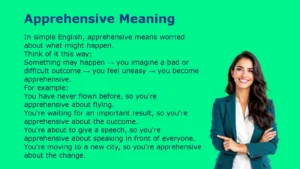
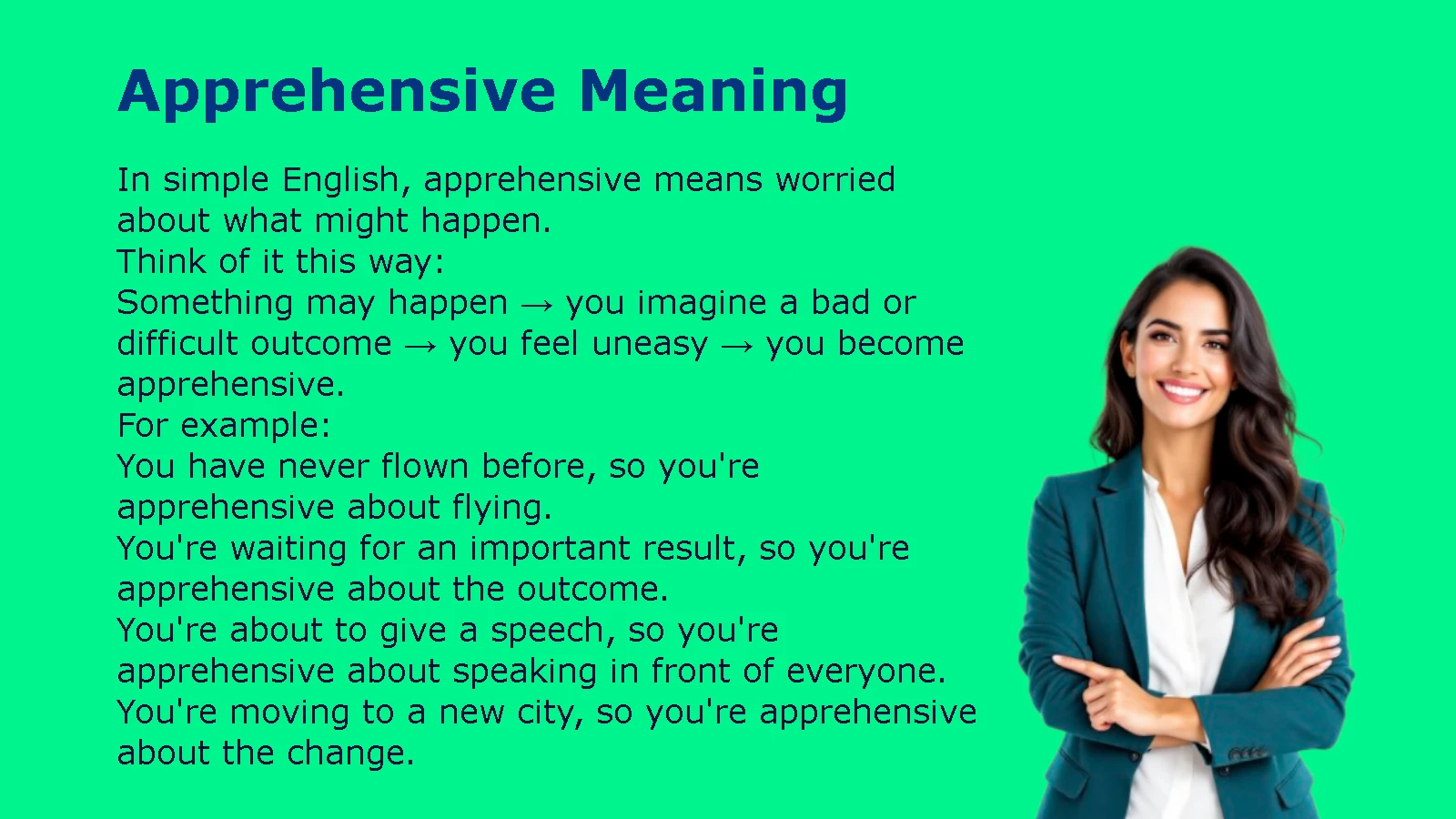
In simple English, apprehensive means worried about what might happen.
Think of it this way:
Something may happen → you imagine a bad or difficult outcome → you feel uneasy → you become apprehensive.
For example:
- You have never flown before, so you’re apprehensive about flying.
- You’re waiting for an important result, so you’re apprehensive about the outcome.
- You’re about to give a speech, so you’re apprehensive about speaking in front of everyone.
- You’re moving to a new city, so you’re apprehensive about the change.
A useful shortcut is:
Apprehensive = worried about the future.
However, it doesn’t always mean extreme fear. You might feel only slightly apprehensive or deeply apprehensive.
Apprehensive Definition and Part of Speech
Apprehensive is an adjective.
An adjective describes a person, thing, quality, or state. In this case, apprehensive describes someone’s emotional state or the appearance that reveals that state.
Consider these examples:
- He felt apprehensive before the exam.
- She gave him an apprehensive look.
- The students were apprehensive about the results.
- His apprehensive expression revealed his concern.
The word can describe both an internal feeling and an outward appearance.
Oxford gives examples such as “an apprehensive face,” “an apprehensive glance,” and “an apprehensive look.”
Related Forms of Apprehensive
Several words belong to the same word family.
| Word | Part of speech | Meaning |
| apprehensive | Adjective | Worried or fearful about what may happen |
| apprehensively | Adverb | In a worried or fearful manner |
| apprehensiveness | Noun | The state or quality of being apprehensive |
| apprehension | Noun | A feeling of worry, fear, or concern |
For example:
- Adjective: She was apprehensive.
- Adverb: She looked apprehensively at the door.
- Noun: Her apprehensiveness was obvious.
- Related noun: She felt apprehension before the announcement.
How to Pronounce Apprehensive
The US pronunciation of apprehensive is commonly represented as:
/ˌæp.rɪˈhen.sɪv/
The main stress falls on the “hen” syllable.
A simple breakdown is:
ap-ri-HEN-siv
Cambridge gives the US pronunciation as /ˌæp.rəˈhen.sɪv/ and also provides a US learner pronunciation. Oxford gives /ˌæprɪˈhensɪv/.
The word has four syllables:
ap – pre – hen – sive
Don’t let the spelling make it look more complicated than it sounds.
Apprehensive Examples in Sentences
Examples make the apprehensive definition much easier to understand because the word becomes clearer in context.
Here are natural examples:
- I felt apprehensive about my first day at the new school.
- She was apprehensive about telling her parents the news.
- He became apprehensive when the doctor asked him to return for another test.
- They were apprehensive about moving to a different city.
- The students looked apprehensive before the exam began.
- She was apprehensive that the meeting might go badly.
- He felt apprehensive about speaking in front of such a large audience.
- The long delay made everyone apprehensive.
- I was initially apprehensive about accepting the offer.
- The child looked apprehensive when he entered the unfamiliar room.
Notice the common idea running through these examples: something uncertain or potentially unpleasant lies ahead.
Everyday Examples of Apprehensive
The word fits many ordinary situations.
Imagine that your friend invites you to a party where you won’t know anyone. You might say:
“I’m a little apprehensive about going because I won’t know anyone there.”
Or suppose you’ve just moved into a new apartment and hear a strange noise at night:
“I felt apprehensive when I heard the noise.”
The feeling doesn’t have to be dramatic. Even mild uneasiness can be described as apprehension.
Workplace Examples of Apprehensive
Work situations often create apprehension because they involve uncertainty and consequences.
For example:
- She was apprehensive about presenting the proposal to the board.
- He felt apprehensive about starting his new position.
- The employees were apprehensive about the upcoming changes.
- I was apprehensive about asking my manager for a raise.
- The candidate looked apprehensive before the interview.
These examples show why apprehensive works particularly well when someone anticipates a challenging situation.
Examples About the Future
The connection with the future is one of the most important parts of the apprehensive meaning.
You can be apprehensive about:
- an upcoming exam
- a job interview
- a difficult conversation
- a medical appointment
- a long journey
- a major decision
- moving to a new place
- financial uncertainty
- a new responsibility
- an unfamiliar situation
For instance:
She was apprehensive about what the future might hold.
The sentence doesn’t say that something bad will definitely happen. It shows that she fears or worries that something bad could happen.
How to Use Apprehensive Correctly
The most useful way to learn apprehensive is to understand the sentence patterns that commonly accompany it.
Apprehensive About
Apprehensive about is one of the most useful patterns in everyday English.
Use it when you feel worried or uneasy about a situation, activity, event, or possible outcome.
Examples:
- I’m apprehensive about the interview.
- She was apprehensive about moving away from home.
- He felt apprehensive about making the decision.
- They were apprehensive about the changes.
The structure is often:
be/feel + apprehensive + about + noun or -ing form
For example:
She was apprehensive about starting college.
He felt apprehensive about the conversation.
Cambridge and Oxford both provide examples of this construction.
Apprehensive Of
You can also use apprehensive of, although this construction can sound somewhat more formal depending on the sentence.
Examples include:
- He was apprehensive of the consequences.
- She was apprehensive of what might happen next.
- They were apprehensive of the risks involved.
Oxford specifically lists both apprehensive about and apprehensive of as standard patterns.
Apprehensive That
Another useful structure is:
apprehensive that + clause
Use this when you want to state what you fear or worry may happen.
Examples:
- She was apprehensive that something might go wrong.
- He was apprehensive that the plan would fail.
- They were apprehensive that the weather might cause problems.
This structure lets you explain the reason behind the apprehension rather than simply naming the situation.
Apprehensive About vs. Apprehensive Of
Both apprehensive about and apprehensive of are grammatically acceptable, but they often have slightly different patterns and tones.
| Expression | Common use | Example |
| apprehensive about | A situation, event, activity, or future possibility | She was apprehensive about the interview. |
| apprehensive of | A person, thing, consequence, risk, or possibility | He was apprehensive of the consequences. |
| apprehensive that | A feared possibility expressed as a clause | She was apprehensive that something might go wrong. |
In everyday American English, apprehensive about is often the easiest choice.
For example, if you’re nervous about a new job, this sounds natural:
I’m apprehensive about starting my new job.
The of construction is also possible:
I’m apprehensive of the challenges ahead.
The choice depends on what follows the adjective.
Apprehensive vs. Anxious
Apprehensive and anxious overlap heavily, but they aren’t always identical.
Anxious is a broader word for worry or unease. It can describe ongoing concern, nervous anticipation, or strong worry.
Apprehensive, by contrast, often highlights concern about a particular future event or possible unpleasant outcome.
Compare:
She was anxious about her finances.
This suggests general worry about her financial situation.
She was apprehensive about meeting the new manager.
This focuses more specifically on an upcoming situation.
The distinction isn’t absolute. Native speakers can use the words in many of the same contexts. Cambridge places apprehensive among words associated with being anxious and worried.
Quick Comparison
| Word | Main idea |
| Apprehensive | Worried about what may happen |
| Anxious | Worried, uneasy, or concerned |
| Nervous | Tense or uneasy, often before an event |
| Worried | Concerned about a problem or outcome |
| Afraid | Experiencing fear |
A helpful way to remember the difference is:
Apprehensive looks ahead and worries.
Apprehensive vs. Nervous
Nervous and apprehensive are often interchangeable, especially when someone is preparing for an important event.
For example:
I feel nervous about my interview.
and
I feel apprehensive about my interview.
Both sentences work.
The difference is mostly in emphasis.
Nervous often describes physical or emotional tension. You might have shaky hands, butterflies in your stomach, or difficulty relaxing.
Apprehensive focuses more on concern about what might happen.
Consider a public speaker:
She was nervous before the speech.
This could mean she was tense because everyone was watching her.
She was apprehensive about giving the speech.
This emphasizes her concern about the speech itself or how the audience might react.
So, nervous often describes tension, while apprehensive often describes uneasy anticipation.
Apprehensive vs. Worried
Worried is one of the simplest and most common alternatives to apprehensive.
Compare:
I’m worried about tomorrow’s meeting.
I’m apprehensive about tomorrow’s meeting.
The basic meaning is similar.
However, worried sounds more conversational and direct. Apprehensive can sound slightly more formal or descriptive.
You might use worried in casual conversation:
I’m worried about the test.
You might choose apprehensive when writing:
The employees were apprehensive about the proposed changes.
Neither is inherently better. The best choice depends on the tone and context.
Apprehensive vs. Afraid
Apprehensive and afraid both relate to fear, but the emotional focus differs.
Afraid often describes fear more directly.
She was afraid of the dog.
Apprehensive usually suggests concern about something that may happen.
She was apprehensive about approaching the dog.
The first sentence emphasizes fear of the dog.
The second emphasizes the uneasy anticipation of approaching it.
Merriam-Webster notes that apprehensive suggests a state of mind involving a premonition of danger or something unpleasant, while afraid can more directly describe being filled with fear.
A Simple Way to Remember It
Think of the difference as:
Afraid: “This scares me.”
Apprehensive: “I’m worried about what might happen.”
That’s not a perfect rule for every sentence, but it captures the most useful distinction.
Synonyms for Apprehensive
There are many apprehensive synonyms, but they don’t all carry exactly the same meaning.
Common Synonyms
- worried
- anxious
- nervous
- uneasy
- concerned
- fearful
- afraid
- wary
Each word adds its own shade of meaning.
Worried is straightforward.
Anxious can suggest stronger or more sustained concern.
Nervous often describes tension before an event.
Uneasy suggests discomfort or uncertainty.
Fearful emphasizes fear.
Wary often means cautious because you suspect danger or trouble.
Stronger Alternatives
Depending on context, stronger words may include:
- frightened
- alarmed
- terrified
- distressed
- scared
These shouldn’t automatically replace apprehensive. If someone is mildly concerned about an interview, saying they are terrified changes the meaning considerably.
Merriam-Webster’s thesaurus distinguishes apprehensive from related fear words by emphasizing the anticipation of danger or an unpleasant outcome.
Antonyms of Apprehensive
The best apprehensive antonym depends on the situation.
Common opposites include:
- confident
- assured
- calm
- relaxed
- composed
- unafraid
- comfortable
- at ease
For example:
She felt apprehensive about the presentation.
The opposite idea could be:
She felt confident about the presentation.
Or:
She felt completely at ease before the presentation.
Notice that confident and calm aren’t exact opposites in every context. Someone can be calm without feeling confident. That’s why context matters.
What Is the Opposite of Apprehensive?
If you need one everyday opposite, confident often works well.
For example:
He was apprehensive about the interview.
versus:
He was confident about the interview.
However, at ease may be a better opposite when the focus is emotional comfort:
She felt apprehensive before the procedure.
She felt calm and at ease afterward.
So the most useful opposites are confident, calm, relaxed, and at ease.
Apprehensively Meaning
Apprehensively is the adverb form of apprehensive.
It means in a worried, uneasy, or fearful manner.
For example:
- She looked apprehensively at the door.
- He glanced apprehensively toward the crowd.
- The child looked apprehensively around the unfamiliar room.
- They waited apprehensively for the announcement.
Compare:
She was apprehensive.
Here, apprehensive describes her state.
She looked apprehensively at the results.
Here, apprehensively describes how she looked.
Cambridge lists apprehensively as the adverb form of apprehensive.
Apprehensiveness Meaning
Apprehensiveness is a noun meaning the state or quality of being apprehensive.
For example:
His apprehensiveness was obvious before the interview.
Another example:
Her apprehensiveness about the move gradually disappeared.
The word is less common in casual conversation than apprehensive.
In everyday speech, someone is more likely to say:
She was worried about the change.
rather than:
She showed apprehensiveness about the change.
Still, apprehensiveness is useful when you need a noun to discuss the feeling itself.
Apprehensive in Different Contexts
The meaning of apprehensive becomes especially clear when you see how naturally it fits different situations.
Apprehensive About a New Job
Starting a new job can bring excitement and uncertainty at the same time.
Maria was apprehensive about starting her new job because she didn’t know what her new team would be like.
Her apprehension doesn’t mean she dislikes the job. She may actually be excited about the opportunity.
The uncertainty creates the feeling.
Apprehensive About a Relationship
Someone may feel apprehensive when entering a new relationship or having an important conversation.
He was apprehensive about telling his partner how he really felt.
Again, the word points toward an anticipated outcome.
He doesn’t know how the conversation will go, so he worries about it.
Apprehensive About a Medical Procedure
People can also feel apprehensive before medical appointments or procedures.
She was apprehensive about the procedure but felt better after discussing it with her doctor.
Here, apprehensive describes emotional concern. It doesn’t necessarily mean extreme fear.
Apprehensive About Public Speaking
Public speaking provides a classic example.
Many students feel apprehensive about speaking in front of a large audience.
The student may imagine forgetting the speech, making a mistake, or being judged by the audience.
The anticipated possibility creates the apprehension.
Apprehensive About Change
Change often creates uncertainty.
The employees were apprehensive about the company’s new policies.
The employees don’t necessarily know that the changes will be bad. They simply worry about possible consequences.
That uncertainty is exactly where apprehensive fits.
Can Apprehensive Be Positive?
Apprehensive itself generally describes a negative or uneasy feeling.
However, a person can experience apprehension during a positive event.
For example:
She was excited about starting college but also apprehensive about leaving home.
Going to college is positive for her. Yet leaving home creates uncertainty.
The sentence therefore describes mixed emotions.
This is an important distinction. Apprehensive doesn’t mean excited, hopeful, or curious. It describes the worried side of a situation.
Does Apprehensive Mean Scared?
It can, but it usually means more than simply being scared.
Someone who is apprehensive may feel fear, but the word often emphasizes worry about a possible future event.
For example:
He was apprehensive about walking through the unfamiliar neighborhood at night.
He may be scared. However, the sentence focuses on his concern about what might happen.
Compare that with:
He was terrified when the dog suddenly attacked.
The second sentence describes immediate and intense fear.
The emotional intensity is much stronger.
Apprehensive vs. Scared at a Glance
| Word | Typical emphasis |
| Apprehensive | Uneasy anticipation |
| Scared | Fear |
| Frightened | Fear caused by a perceived threat |
| Terrified | Very strong fear |
| Worried | Concern about a possible problem |
Can Apprehensive Mean Aware or Understanding?
There is an interesting historical point here.
Modern English speakers usually understand apprehensive to mean worried or fearful about something that may happen. However, Merriam-Webster records older senses connected with understanding, perception, or awareness.
This older meaning explains why the word can occasionally appear in historical or literary writing in a way that seems strange to modern readers.
Merriam-Webster notes that Shakespeare used apprehensive in an older sense related to being capable of understanding or showing insight.
Therefore, if you encounter apprehensive in an older text, don’t automatically assume it means “worried.”
Modern vs. Older Meaning
| Meaning | Modern use |
| Worried or fearful about the future | Common and current |
| Capable of understanding or discerning | Older/literary sense |
| Aware or knowledgeable | Older or specialized usage |
For ordinary modern writing, apprehensive = worried or fearful about what may happen.
Apprehensive Word Origin
The history of apprehensive is closely connected to the idea of grasping or taking hold.
Oxford traces the word through French and Medieval Latin to the Latin verb apprehendere, meaning “seize” or “grasp.”
Merriam-Webster likewise connects apprehensive and apprehension with the Latin root prehendere, meaning “to seize.”
The older intellectual sense makes this history especially interesting. To “grasp” something could mean to understand it mentally. Over time, apprehensive developed meanings associated with anticipating something unpleasant.
So the modern emotional meaning has a long linguistic history behind it.
Common Mistakes With Apprehensive
Learning the definition isn’t enough. You also need to know how not to use the word.
Mistake: Using Apprehensive to Mean Excited
Don’t treat apprehensive as a synonym for excited.
Incorrect meaning:
I am apprehensive because I’m thrilled about my vacation.
If you mean excitement, use excited, enthusiastic, or eager.
You can, however, describe mixed emotions:
I’m excited about the vacation, but I’m apprehensive about the long flight.
That’s completely natural.
Mistake: Treating Apprehensive as a Noun
Apprehensive is an adjective.
You can say:
She is apprehensive.
But you wouldn’t normally say:
She has an apprehensive.
Instead, use:
She has apprehension.
or:
She feels apprehensive.
Mistake: Confusing Apprehensive With Apprehension
The two words are closely related but have different grammatical roles.
He was apprehensive about the test.
Here, apprehensive is an adjective.
He felt apprehension before the test.
Here, apprehension is a noun.
Mistake: Ignoring the Preposition
The common structures are:
- apprehensive about something
- apprehensive of something
- apprehensive that something may happen
For everyday writing, apprehensive about is often the most straightforward choice.
Mistake: Assuming Apprehensive Always Means Extreme Fear
It doesn’t.
Someone can be:
- slightly apprehensive
- a little apprehensive
- somewhat apprehensive
- very apprehensive
- deeply apprehensive
This shows that the intensity can vary.
For example:
I was a little apprehensive about the interview.
That sounds much less intense than:
I was deeply apprehensive about the consequences.
Oxford’s examples also show that the word can describe varying degrees of concern.
Apprehensive vs. Apprehension
The difference is simple once you identify the parts of speech.
| Word | Part of speech | Meaning | Example |
| apprehensive | Adjective | Worried or fearful about what may happen | She felt apprehensive. |
| apprehension | Noun | A feeling of worry or fear | She felt apprehension. |
Think of the relationship this way:
apprehensive = describes the person
apprehension = names the feeling
Examples:
The students were apprehensive before the exam.
The students felt apprehension before the exam.
Both sentences communicate a similar idea.
Quick Comparison of Related Words
Several words can describe worry or fear, but their emphasis isn’t exactly the same.
| Word | Main idea | Example |
| Apprehensive | Worried about what may happen | She was apprehensive about the trip. |
| Anxious | Worried or uneasy | He was anxious about the results. |
| Nervous | Tense or uneasy | She was nervous before the speech. |
| Worried | Concerned about a problem | I’m worried about the deadline. |
| Afraid | Feeling fear | He was afraid of the dark. |
| Uneasy | Uncomfortable or uncertain | She felt uneasy about the decision. |
| Wary | Cautious because of possible danger | He was wary of the stranger. |
| Confident | Certain about one’s ability or outcome | She was confident about the interview. |
The words overlap, but apprehensive has a particularly strong connection with anticipating something unpleasant.
Case Study: Understanding Apprehensive in Context
Consider a student named Daniel.
Daniel has studied for an important exam. He knows the material, but the exam carries significant consequences. The night before the test, he keeps thinking about possible mistakes.
Which word best describes his feeling?
Apprehensive works well:
Daniel felt apprehensive about the exam.
Why?
Because the exam hasn’t happened yet. Daniel is looking ahead and worrying about a possible outcome.
Now imagine that the exam begins and Daniel suddenly forgets an answer.
You could say:
Daniel became nervous when he saw the difficult question.
If he discovers that he failed the exam, you might say:
Daniel was disappointed by the result.
The vocabulary changes because the situation changes.
This illustrates the central idea behind apprehensive meaning: the word is particularly useful when uncertainty about the future creates uneasiness.
Why the Word Apprehensive Is Useful
Some words are useful because they express an idea with more precision than a basic synonym.
You could say:
I’m worried about the interview.
That’s perfectly natural.
But:
I’m apprehensive about the interview.
adds a slightly more specific sense of uneasy anticipation.
The word can also work well in formal writing:
Investors remained apprehensive about the proposed changes.
Parents were apprehensive about the new policy.
Employees expressed apprehension about the restructuring.
It allows writers to describe concern without making the emotion sound as extreme as terrified or panic-stricken.
Apprehensive Meaning in Everyday English
In everyday English, you can usually replace apprehensive with worried, nervous, or uneasy when you want a simpler word.
For example:
More direct:
I’m nervous about the interview.
More descriptive:
I’m apprehensive about the interview.
More casual:
I’m worried about the interview.
All three work. The choice depends on tone and emphasis.
If you’re writing an academic article, report, formal email, or detailed explanation, apprehensive can provide useful precision.
If you’re chatting with a friend, worried or nervous may sound more natural.
Frequently Asked Questions About Apprehensive Meaning
What does apprehensive mean in simple words?
Apprehensive means worried or uneasy about something that may happen. It often describes concern about a future event or uncertain outcome.
Does apprehensive mean nervous?
It can be similar to nervous, but the emphasis is slightly different. Nervous often describes tension before an event, while apprehensive emphasizes worry about what might happen.
Is apprehensive a positive or negative word?
Apprehensive generally has a negative or uneasy meaning. It describes worry, fear, or concern. However, someone can feel apprehensive while also experiencing positive emotions such as excitement.
What is an example of apprehensive?
A simple example is:
She was apprehensive about starting her new job.
This means she felt worried or uneasy about what might happen when she started.
What is the opposite of apprehensive?
Depending on the context, useful opposites include confident, calm, relaxed, assured, and at ease.
What is the difference between apprehensive and anxious?
Both words can describe worry. Anxious is broader and can describe general or ongoing anxiety, while apprehensive often focuses on worry about a particular future event or possible unpleasant outcome.
Is it correct to say “apprehensive about”?
Yes. Apprehensive about is a common and standard construction.
Example:
She was apprehensive about moving to a new city.
Can you say “apprehensive of”?
Yes. Apprehensive of is also correct.
Example:
He was apprehensive of the consequences.
Oxford lists both about and of as standard prepositions used with apprehensive.
What is the noun form of apprehensive?
The closely related noun is apprehension. Another noun form, apprehensiveness, refers to the quality or state of being apprehensive.
What is the adverb form of apprehensive?
The adverb is apprehensively.
Example:
She looked apprehensively at the unfamiliar building.
Does apprehensive mean scared?
It can involve fear, but it usually emphasizes worry about what may happen rather than intense immediate fear.
Can apprehensive mean aware?
Historically, yes. Merriam-Webster records an older sense related to being capable of understanding or being aware. That isn’t the usual meaning in modern everyday English.
Final Takeaway: Apprehensive Meaning
The simplest way to remember the apprehensive meaning is:
Apprehensive means worried, uneasy, or fearful about something that may happen.
The word is especially useful when uncertainty about the future creates concern. You might feel apprehensive about an interview, a difficult conversation, a major decision, a new job, an unfamiliar place, or an important event.
The most common patterns include:
- apprehensive about something
- apprehensive of something
- apprehensive that something may happen
It also helps to distinguish apprehensive from nearby words. Nervous often emphasizes tension. Worried is broader and more conversational. Afraid focuses more directly on fear. Anxious can describe a wider range of worry.
Most importantly, apprehensive doesn’t automatically mean terrified. It can describe anything from mild uneasiness to serious concern.
When you picture someone looking toward an uncertain future and thinking, “I hope this doesn’t go badly,” you’ve captured the heart of the word.