Grinds meaning depends on the context in which someone uses the word. In standard English, grinds is the third-person singular form of the verb grind or the plural of the noun, referring to crushing materials, rubbing surfaces together, or performing repetitive work. However, grinds slang, gaming grinds, Hawaiian grinds, and Irish grinds have distinct meanings. The word can describe ambition, video-game progression, delicious food, or private exam tutoring.
Quick Summary of Grinds Meaning
| Question | Answer |
| What does grinds mean in standard English? | Crushes something, creates friction, or performs repetitive work. |
| What does grinds mean in slang? | Works persistently toward money, success, or a personal goal. |
| What does grinds mean in gaming? | Repeats activities to earn XP, collect items, or unlock rewards. |
| What does grinds mean in Hawaii? | Food or a meal, often written as grindz. |
| What does grinds mean in Ireland? | Private tutoring or additional lessons, often for school examinations. |
What Does Grinds Mean in Standard English?
In standard English, grinds has two main grammatical functions. It can describe an action performed by one person or thing, or it can refer to multiple instances of grinding. The intended meaning usually involves crushing, rubbing, friction, or repetitive effort.
The word comes from the base form grind, an irregular English verb with several related meanings.
Grinds as a Verb: Crushing or Breaking Something
When someone grinds an object, they crush it into smaller pieces or particles by applying pressure and movement. This action often involves a grinder, mill, mortar, or another tool.
For example, a person might grind coffee beans before brewing coffee. A cook might grind black pepper over a meal, while a food manufacturer grinds wheat into flour.
Common examples include:
- Coffee: She grinds fresh coffee beans every morning.
- Spices: The chef grinds cumin seeds before preparing the curry.
- Grains: The machine grinds wheat into fine flour.
- Meat: The butcher grinds beef for homemade burgers.
- Pepper: He grinds black pepper over his pasta.
The process changes the size and texture of a material. However, it does not necessarily turn everything into a fine powder. Grinding can produce coarse particles, fine particles, or a consistent mixture depending on the equipment and purpose.
For instance, coarse coffee grinds suit some brewing methods, while espresso generally requires a much finer grind.
Grammar rule: Use grinds when the subject is a singular third-person noun or pronoun.
- She grinds coffee.
- He grinds spices.
- The machine grinds grain.
- It grinds slowly.
Use grind with I, you, we, and they.
- I grind coffee.
- They grind wheat.
Grinds as Physical Friction or Rubbing
Grinds can also describe movement between two surfaces that press and rub against each other.
This meaning often appears when people discuss machinery, tools, teeth, and mechanical problems.
For example, metal components may grind against each other when a machine lacks proper lubrication. A knife sharpener grinds against a blade to remove material and create a sharper edge.
Another familiar expression is grinding your teeth.
Teeth grinding, medically called bruxism, involves repeatedly clenching or rubbing the upper and lower teeth together. It can happen during sleep or while someone is awake.
Common examples include:
- The old machine grinds whenever its motor starts.
- The mechanic heard the gears grinding.
- She grinds her teeth while sleeping.
- The sharpening tool grinds the blade into shape.
The context helps distinguish ordinary friction from a mechanical problem or a physical habit.
Grinds as a Noun: Repetitive or Exhausting Work
The noun grind often describes difficult, repetitive, or monotonous work. People commonly use it when discussing employment, education, business, and everyday responsibilities.
The expression the daily grind refers to routine activities that require continuous effort.
For example:
- Working long shifts has become part of his daily grind.
- She wants a career that offers more than the usual nine-to-five grind.
- The exam grind becomes stressful during the final weeks of preparation.
This meaning does not always suggest something unpleasant. Some people use the grind positively to describe discipline, consistency, and dedication.
A student who studies every evening might call exam preparation a grind. An entrepreneur might use the same word to describe the daily effort required to build a business.
The important distinction is that the noun focuses on the work or routine itself, while the verb describes the action of grinding.
Is Grinds Singular or Plural?
Grinds can function as a singular verb or a plural noun. Its grammatical role depends on the sentence.
As a verb, it describes an action performed by a singular third-person subject. As a noun, it can refer to multiple grinding sessions, tasks, or types of ground material.
| Word | Grammatical role | Example |
| Grind | Base verb or singular noun | I grind coffee. |
| Grinds | Third-person singular verb | She grinds coffee. |
| Grinds | Plural noun | The coffee grinds are too coarse. |
| Grinding | Present participle or gerund | He is grinding coffee. |
| Ground | Simple past and past participle | She ground the beans. |
One important distinction concerns the irregular past tense. The standard past form of grind is ground, not grinded.
For example:
- Present: She grinds fresh coffee.
- Past: She ground fresh coffee yesterday.
- Present perfect: She has ground fresh coffee before.
What Does Grinds Mean in Slang and Pop Culture?
In modern slang, grinds often describes working hard, pursuing success, or consistently putting effort into a goal. It connects with expressions such as on the grind, keep grinding, and the hustle.
However, slang meanings change with context. Grinding can also describe a type of close-contact dancing, while the expression grinds my gears communicates annoyance.
Grinding as Working Hard Toward Success
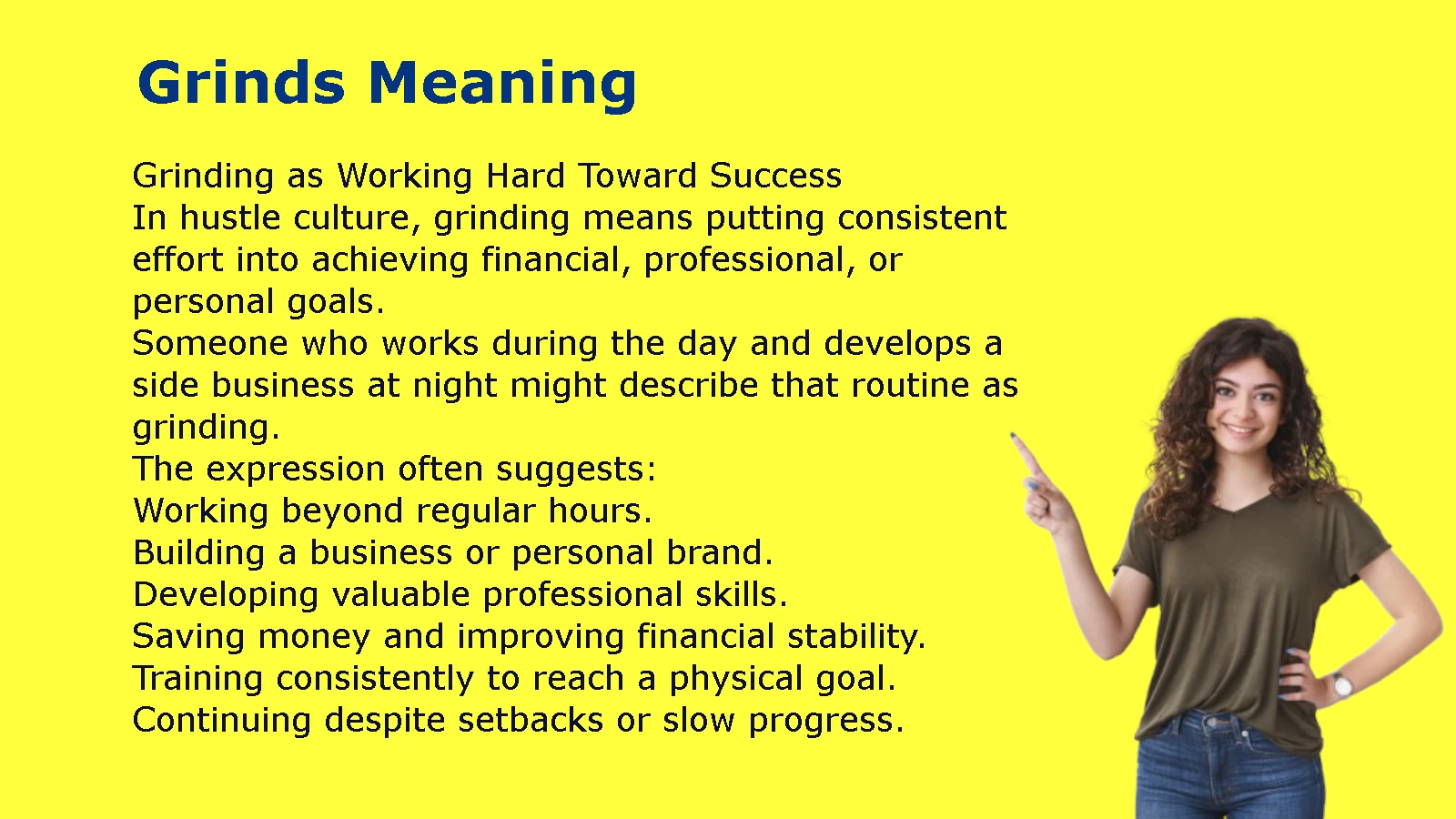
In hustle culture, grinding means putting consistent effort into achieving financial, professional, or personal goals.
Someone who works during the day and develops a side business at night might describe that routine as grinding.
The expression often suggests:
- Working beyond regular hours.
- Building a business or personal brand.
- Developing valuable professional skills.
- Saving money and improving financial stability.
- Training consistently to reach a physical goal.
- Continuing despite setbacks or slow progress.
For example:
“She grinds every evening to grow her online business.”
This sentence suggests that she invests time and effort in her business outside her normal responsibilities.
Another example:
“He’s been on the grind since graduating from college.”
This means he has consistently worked toward his professional goals since finishing his education.
Grind and hustle share similar meanings, but they have slightly different tones. Grind emphasizes sustained effort and persistence. Hustle can suggest urgency, resourcefulness, and finding opportunities.
What Does It Mean When Someone Says They Are on the Grind?
Being on the grind means staying focused on work, improvement, or a long-term objective.
People often use the phrase in motivational conversations, social media captions, and discussions about careers or personal development.
Consider these examples:
- “I’m on the grind until I reach my savings goal.”
- “She’s on the grind preparing for her professional exams.”
- “We’re on the grind building our new company.”
- “He stays on the grind even when progress feels slow.”
The phrase usually communicates determination rather than a specific type of employment.
It can describe someone studying for an examination, learning a programming language, training for a marathon, or working toward financial independence.
However, grinding does not automatically mean working productively. Someone can spend long hours on a task without making meaningful progress.
For that reason, a healthy interpretation of the expression includes both consistent effort and purposeful improvement.
Grinding as a Form of Dancing
In informal social settings, grinding can describe close-contact dancing involving rhythmic hip movements.
The dance style often involves two people moving their hips in time with music while maintaining close physical contact.
You may encounter this meaning at:
- Nightclubs.
- Dance parties.
- Music festivals.
- Social gatherings.
- Informal celebrations.
For example:
“They were grinding on the dance floor.”
Here, the word has nothing to do with employment, food, or video-game progression. It describes a particular style of dancing.
The expression is informal and can carry different social connotations depending on the people involved and the setting.
What Does Grinds My Gears Mean?
Grinds my gears is an English idiom meaning that something annoys, irritates, or frustrates someone.
The expression compares irritation to mechanical friction. Just as poorly functioning machinery can produce an unpleasant grinding sound, an irritating situation can metaphorically get under someone’s skin.
The phrase became especially recognizable through popular culture, including the animated television series Family Guy.
Examples include:
- Slow internet really grinds my gears.
- People who interrupt others constantly grind my gears.
- Traffic jams grind my gears when I’m running late.
- It grinds my gears when someone takes credit for another person’s work.
Notice the grammatical difference:
- “That noise grinds my gears.”
- “Those interruptions grind my gears.”
The verb changes according to the subject.
Similar expressions include:
- Rubs me the wrong way.
- Gets under my skin.
- Really annoys me.
What Does Grinds Mean in Gaming?
In video games, grinding means repeatedly performing the same activities to earn experience points (XP), collect resources, obtain equipment, or unlock rewards. Players often defeat the same enemies, complete similar quests, or gather materials until their characters reach a desired level or acquire specific items.
The term appears frequently in role-playing games (RPGs), massively multiplayer online games (MMOs), action games, and other progression-based titles.
For example:
“The player grinds low-level quests to earn enough gold for better equipment.”
This means the player repeats relatively easy missions to collect in-game currency.
What Is Grinding in Video Games?
Gaming grinding involves repeating actions to make progress within a game’s reward or progression system.
Unlike completing a main storyline, grinding often focuses on improving a character’s statistics, collecting valuable items, or accumulating resources.
A player might spend several hours defeating the same enemy because it drops a rare weapon. Another player might repeat daily missions to collect enough currency for a character upgrade.
Common grinding activities include:
- Defeating enemies repeatedly to gain XP.
- Completing missions to earn coins or other currency.
- Collecting materials for crafting.
- Repeating boss fights to obtain rare equipment.
- Completing daily challenges to unlock rewards.
- Practicing difficult sections to improve performance.
The main characteristic is repetition. Players perform similar actions multiple times because each attempt contributes toward a larger objective.
Common Types of Gaming Grinds
Not every grind serves the same purpose. Different games use different progression systems, so players often encounter several types of grinding.
| Type of grinding | What it means | Example |
| XP grinding | Repeating activities to gain experience points | Defeating enemies to reach level 50 |
| Loot grinding | Repeating battles to collect rare equipment | Fighting a boss for a legendary sword |
| Resource grinding | Gathering materials or currency | Collecting wood, minerals, or coins |
| Reputation grinding | Increasing standing with a group or faction | Completing missions for a particular faction |
| Skill grinding | Repeatedly practicing an ability | Improving combat or crafting skills |
| Quest grinding | Completing similar missions for rewards | Repeating daily quests for currency |
XP grinding is particularly common in games with character-leveling systems. Players repeat activities that offer experience until they unlock stronger abilities or access higher-level areas.
Loot grinding works differently. The goal is to obtain a particular item, and success may depend on random reward drops.
For example, a player might defeat the same boss 20 times without receiving the desired weapon. Each attempt offers another opportunity to obtain it.
Why Do Gamers Grind?
Game developers use progression systems to encourage players to keep playing. Grinding gives players a way to improve their characters gradually rather than receiving every reward immediately.
Several factors make grinding appealing:
Character development: Players earn experience points and unlock stronger abilities.
Better equipment: Repeated battles can provide weapons, armor, and useful items.
Achievement completion: Some players grind to complete difficult challenges or collect every available reward.
Competitive advantage: Higher levels and stronger equipment can improve performance in competitive environments.
Personal satisfaction: Reaching a difficult milestone after repeated attempts can feel rewarding.
Consider a player who starts an RPG with basic equipment. After completing missions and defeating enemies, the character gains XP, unlocks new abilities, and obtains better weapons.
The repeated work creates a visible sense of progress.
Is Grinding Good or Bad in Gaming?
Grinding can improve a gaming experience when players enjoy the activities and feel rewarded for their effort. However, excessive repetition can make a game feel tedious.
The difference usually depends on how developers balance effort, rewards, and player choice.
| Rewarding grinding | Frustrating grinding |
| Offers meaningful progression | Requires excessive repetition |
| Introduces new challenges | Repeats identical activities |
| Provides useful rewards | Offers little reward for the time spent |
| Allows different progression paths | Forces players into one repetitive activity |
| Respects the player’s time | Makes progress unnecessarily slow |
For example, a player might enjoy defeating increasingly difficult enemies because each battle introduces new mechanics.
However, repeating the same easy mission 50 times just to unlock a basic upgrade can become frustrating.
This explains why gamers sometimes use grind positively and negatively.
A player might say, “The XP grind is worth it because the new abilities are excellent.”
Another might complain, “This game has too much grinding.”
Both sentences use the same term, but their attitudes toward the experience differ.
What Does Grinds Mean in Hawaii?
In Hawaii, grinds is an informal local expression for food or a meal. It commonly appears in conversations about eating, local restaurants, plate lunches, and traditional or popular Hawaiian dishes.
The expression ono grinds refers to delicious or tasty food. You may also see the alternative spelling grindz, particularly in informal food-related writing.
This regional meaning differs significantly from the standard English definition of grinding something into smaller pieces.
Hawaiian Slang: Grinds Means Food
In Hawaiian local speech, grinds refers to something people eat or a meal they enjoy.
The word often appears in casual conversations about where to eat, what food tastes good, and which local dishes someone recommends.
For example:
- “Let’s grab some grinds after surfing.”
- “That restaurant has some ono grinds.”
- “Where can we find good local grinds?”
- “We stopped for grinds after spending the afternoon at the beach.”
In these examples, nobody is talking about physical grinding or working hard. The word simply refers to food.
The expression reflects Hawaii’s distinctive local vocabulary, which developed through cultural and linguistic influences across the islands.
Hawaiian Pidgin, also called Hawaiʻi Creole English, has its own vocabulary, pronunciation patterns, and grammatical features. Local food expressions form an important part of everyday informal communication.
What Does Ono Grinds Mean?
Ono is a Hawaiian word meaning delicious or tasty. When someone says ono grinds, they mean delicious food or a particularly satisfying meal.
For example:
“That garlic shrimp plate is ono grinds.”
This describes food that tastes especially good.
The expression can appear when people discuss:
- Local restaurants.
- Plate lunches.
- Seafood.
- Hawaiian barbecue.
- Food trucks.
- Homemade meals.
- Popular island dishes.
A visitor might hear someone recommend a restaurant because it serves excellent grinds.
Understanding the word ono also makes other Hawaiian food expressions easier to recognize.
| Expression | Meaning |
| Grinds | Food or a meal |
| Ono | Delicious or tasty |
| Ono grinds | Delicious food |
| Local grinds | Local food or meals |
| Get some grinds | Go and get something to eat |
What Does Grindz Mean?
Grindz is an informal spelling variation of grinds used in Hawaiian food-related language.
The spelling uses the letter Z instead of the S sound at the end. It gives the expression a distinctive informal appearance, particularly in food branding, restaurant names, and local references.
For example:
- “Where are the best grindz on the island?”
- “We found a great place for local grindz.”
- “The food truck serves delicious grindz.”
Both grinds and grindz communicate the food-related meaning in this context.
However, the spelling grindz is especially associated with casual local food culture rather than standard dictionary English.
Practical distinction: If someone says, “I love Hawaiian grindz,” they are probably talking about food. If someone says, “I grind coffee every morning,” they are using the standard English verb.
Examples of Hawaiian Grinds in Everyday Conversation
Here are some natural examples that demonstrate how people use the expression:
Example 1: Making plans
“Let’s find some good grinds before heading home.”
Meaning: Let’s find something delicious to eat.
Example 2: Recommending a restaurant
“That little restaurant serves the best ono grinds.”
Meaning: The restaurant serves excellent food.
Example 3: Discussing local food
“I want to try more traditional Hawaiian grinds.”
Meaning: I want to experience more local Hawaiian dishes.
Example 4: Talking about a meal
“Those plate lunches were some serious grinds.”
Meaning: The meals were especially satisfying.
What Does Grinds Mean in Ireland?
In Ireland, grinds means private tuition or additional academic lessons outside regular school classes. Students commonly take grinds to improve their understanding of subjects, prepare for examinations, and receive more individual attention.
The expression is particularly familiar in discussions about secondary education and the Leaving Certificate, Ireland’s major school-leaving examination.
This regional meaning has little connection with the standard English expressions daily grind or grinding coffee.
Irish Grinds Meaning: Private Tutoring and Extra Lessons
In Irish English, a grind is an additional lesson that a student receives from a private tutor or teacher.
Unlike ordinary classroom instruction, grinds often provide more focused attention on a particular subject or academic difficulty.
Students may arrange lessons individually or in small groups. Some tutors work independently, while others teach through established grinds schools or educational centers.
Common subjects include:
- Mathematics.
- English.
- Biology.
- Chemistry.
- Physics.
- History.
- Geography.
- Irish.
For example:
“She takes maths grinds every Saturday.”
This means she attends additional mathematics lessons outside her normal school timetable.
Another example:
“My brother gives English grinds to secondary school students.”
Here, gives grinds means provides private academic tutoring.
The expression is widely understood in Ireland, even though people in other English-speaking countries might use terms such as private tutoring, extra lessons, or supplementary tuition.
What Are Leaving Cert Grinds?
Leaving Cert grinds are additional lessons that help students prepare for Ireland’s Leaving Certificate examinations.
The Leaving Certificate is a major qualification generally taken toward the end of secondary education. Students study different subjects and complete examinations that contribute to their final results.
Because these results can influence access to further education and university courses, many students seek extra academic support.
Leaving Cert grinds commonly focus on:
Understanding difficult topics: A tutor explains challenging concepts that students may not fully understand in regular classes.
Exam preparation: Lessons cover examination formats, question types, and effective revision methods.
Practice questions: Students work through problems and previous examination papers to strengthen their knowledge.
Time management: Tutors help students organize revision schedules and allocate time to different subjects.
Individual feedback: Students receive guidance on mistakes and areas that need improvement.
For example, a student struggling with algebra might take weekly mathematics grinds to practice equations and understand the methods required to solve examination questions.
Another student might take English grinds to improve essay structure, comprehension, and written analysis.
How Are Grinds Used in Irish English?
The word appears in several everyday expressions connected with education.
| Irish expression | Meaning |
| Take grinds | Receive private tutoring |
| Give grinds | Provide private lessons |
| Maths grinds | Additional mathematics tuition |
| Leaving Cert grinds | Private lessons for Leaving Certificate preparation |
| English grinds | Additional English lessons |
| Private grinds | Individually arranged tutoring |
Consider these examples:
- “I have maths grinds tomorrow afternoon.”
- “She gives grinds to Leaving Cert students.”
- “He needs biology grinds before his final exams.”
- “My parents arranged private grinds for me.”
- “The student improved after taking weekly English grinds.”
The expressions take grinds and give grinds are especially useful to understand.
A student takes grinds because they receive additional instruction. A tutor gives grinds because they provide that instruction.
How Irish Grinds Differ From Standard English Grinding
The two meanings become easier to understand when you compare their grammatical and cultural contexts.
| Feature | Standard English grind | Irish grinds |
| Meaning | Repetitive work or physical grinding | Private academic lessons |
| Typical setting | Work, daily routines, machinery | Schools and education |
| Common expression | The daily grind | Leaving Cert grinds |
| Example | He works hard at his daily grind. | She takes maths grinds. |
| Main purpose | Describes effort or an action | Provides additional education |
The difference is regional rather than grammatical alone.
In both cases, the plural form grinds is correct. However, the intended meaning depends on the surrounding words and the speaker’s location.
Grinds vs. Grind: What’s the Difference?
Grind and grinds share the same root word, but they perform different grammatical functions. Grind is the base verb and can also function as a noun. Grinds is either the third-person singular present-tense verb or the plural form of the noun.
Understanding this distinction helps prevent common grammar mistakes.
Grinds as a Verb
Use grinds when a singular third-person subject performs the action.
Examples:
- She grinds fresh coffee beans.
- He grinds spices before cooking.
- The machine grinds wheat into flour.
- The engine grinds when it starts.
- My brother grinds every evening to improve his gaming rank.
The subject determines whether you use grind or grinds.
Compare:
- I grind coffee every morning.
- You grind coffee every morning.
- She grinds coffee every morning.
- They grind coffee every morning.
Only the third-person singular subject takes the additional S.
Grinds as a Plural Noun
The plural noun grinds can refer to multiple grinding sessions, tasks, or instances of ground material.
Examples:
- The coffee grinds are too coarse for this machine.
- Different spice grinds produce different textures.
- The laboratory recorded several grinding processes.
- His daily grinds involve several repetitive tasks.
In these sentences, grinds does not describe an action performed by a singular subject. It names multiple things or activities.
Grind as a Base Verb and Noun
The word grind has several grammatical uses.
As a verb, it describes an action:
- I grind coffee beans.
- They grind wheat for flour.
- We grind through difficult assignments.
As a noun, it describes an activity or routine:
- The daily grind can become exhausting.
- Exam preparation is a long grind.
- Building a business requires patience and consistent effort.
The following table summarizes the differences.
| Word | Part of speech | Meaning | Example |
| Grind | Base verb | Crush or work repeatedly | I grind coffee. |
| Grind | Noun | Repetitive or difficult work | The daily grind is tiring. |
| Grinds | Singular verb form | Performs the grinding action | She grinds coffee. |
| Grinds | Plural noun | Multiple grinding activities or materials | The coffee grinds are coarse. |
| Grinding | Verb form/gerund | The ongoing action | He is grinding coffee. |
| Ground | Past tense/past participle | Completed grinding action | She ground the beans. |
Remember: Ground is the standard past tense of grind. It is not grinded in ordinary standard English.
Frequently Asked Questions About Grinds Meaning
What Is the Past Tense of Grind?
The standard past tense of grind is ground. The past participle is also ground. For example, “She grinds coffee every morning” becomes “She ground coffee yesterday.” Although grinded sometimes appears in informal or specialized contexts, ground is the accepted form in standard English.
Is Grinds a Positive or Negative Slang Word?
Grinds is generally positive when it describes dedication, ambition, and consistent hard work. However, it can sound negative when someone describes exhausting routines or repetitive gaming activities. The meaning depends on context. In expressions such as on the grind, it usually communicates determination and persistence.
| Context | Synonyms |
| Crushing materials | Crushes, pulverizes, mills, crushes into powder |
| Physical friction | Rubs, scrapes, abrades |
| Hard work | Toils, labors, hustles, works tirelessly |
| Gaming | Farms, repeats, levels up |
| Annoyance | Irritates, frustrates, aggravates |
Choose a synonym that preserves the original meaning rather than replacing grinds with a word that only sounds similar.
What Does Grinding Mean in a Relationship?
Grinding in a relationship can refer to close-contact dancing involving rhythmic hip movements. The expression may also appear in conversations about physical attraction or intimate behavior. Its precise meaning depends on the situation, the people involved, and how they use the term.
Does Grinds Mean Food in Hawaii?
Yes. In Hawaiian local slang, grinds refers to food or a meal. The expression ono grinds means delicious food, while grindz is a common informal spelling variation. People use these expressions when discussing local restaurants, plate lunches, and other meals.
Why Do Irish Students Take Grinds?
Irish students take grinds to receive additional academic instruction outside their regular school classes. Private tutors help them understand difficult subjects, practice examination questions, and prepare for important assessments. Leaving Certificate students commonly take mathematics, English, and science grinds to strengthen their academic performance.
How to Identify the Correct Meaning of Grinds
Because grinds has several meanings, the surrounding words provide the best clues. You can usually identify the intended definition by looking at the subject, activity, and location.
Here is a simple way to interpret the word.
| Sentence | Correct interpretation | Context |
| She grinds fresh coffee. | Crushes coffee beans | Standard English |
| He grinds every night to build his business. | Works persistently | Modern slang |
| I need to grind for XP. | Repeats game activities | Gaming |
| Let’s get some grinds. | Get something to eat | Hawaii |
| She takes maths grinds. | Receives private lessons | Ireland |
| That constant noise grinds my gears. | Annoys someone | Idiom |
A Practical Example: One Word, Five Different Meanings
Imagine five people using the word grinds in different conversations.
- A coffee enthusiast: “She grinds fresh beans before making espresso.” The word describes crushing coffee beans.
- An entrepreneur: “He grinds every day to grow his business.” It describes consistent effort toward success.
- A gamer: “I need to grind before the next tournament.” It describes repeating activities to improve a character or earn rewards.
- A Hawaiian resident: “Let’s find some good grinds.” It refers to food.
- An Irish student: “I have chemistry grinds tomorrow.” It refers to additional academic lessons.
This comparison demonstrates why searching for a word’s meaning requires more than one dictionary definition. Regional vocabulary, internet culture, and specialist terminology can give familiar words entirely different meanings.
The best way to understand grinds is to consider the context, not just the spelling.
Conclusion: What Does Grinds Mean?
The meaning of grinds changes depending on the situation, language variety, and subject being discussed.
In standard English, it describes crushing materials, creating friction, or performing repetitive work. In modern slang, it often represents ambition and persistent effort. Gamers use grinding to describe repeating activities for XP, resources, and rewards.
The regional meanings are equally interesting. In Hawaii, grinds refers to food, while in Ireland, it means private tutoring or additional academic lessons. Expressions such as ono grinds, Leaving Cert grinds, and on the grind help identify these different uses.
When you encounter the word, look at the surrounding sentence to determine its intended meaning.
Want to understand more English words, slang expressions, and regional vocabulary? Explore related word-meaning guides to expand your vocabulary and recognize how everyday English changes across different communities.













