The hee meaning depends on the context, but in informal English, “hee” commonly represents a light, high-pitched laugh or a playful expression of amusement. People use it in text messages, online conversations, and casual writing to communicate laughter, excitement, embarrassment, or a teasing reaction. However, the spelling can also create confusion when people encounter it in Korean, Thai, Old English discussions, or word games such as Scrabble.
Understanding the word requires looking beyond its basic definition. Its use in texting slang, Korean romanization, historical English, and Scrabble dictionaries involves different linguistic rules. It is also worth distinguishing “hee” from oui, the French word for yes, mi, a musical note and Spanish pronoun, spiff, an informal term associated with sales incentives, and yew, the name of an evergreen tree.
| Question | Answer |
| What does hee mean? | It commonly represents a light, playful, or high-pitched laugh. |
| What does hee mean in chat? | It usually communicates amusement, giggling, or a playful reaction. |
| Does hee mean yes? | No. It is not a standard English word for yes. |
| What does hee mean in Korean? | It can represent a Korean name syllable, but its meaning depends on the Hangul characters. |
| Is hee a Scrabble word? | Its validity depends on the official word list being used. |
| Does hee mean a tree? | No. The established English name for the evergreen tree is “yew.” |
What Does Hee Mean?
Hee is an informal written expression that commonly represents a short, light, or high-pitched laugh. People use it to communicate amusement, playful excitement, embarrassment, or a mischievous reaction. Unlike conventional words with fixed dictionary definitions, its interpretation often depends on the speaker’s tone and the surrounding conversation.
The expression belongs to a group of written sounds called interjections and onomatopoeic expressions. These forms represent spontaneous sounds, emotions, or reactions rather than describing physical objects or actions.
For example:
- “Hee! That was funny.”
- “I finally got the surprise gift. Hee!”
- “Hee hee, you didn’t expect that, did you?”
In these examples, the expression communicates a lighthearted reaction rather than a formal statement.
Hee Definition in Simple English
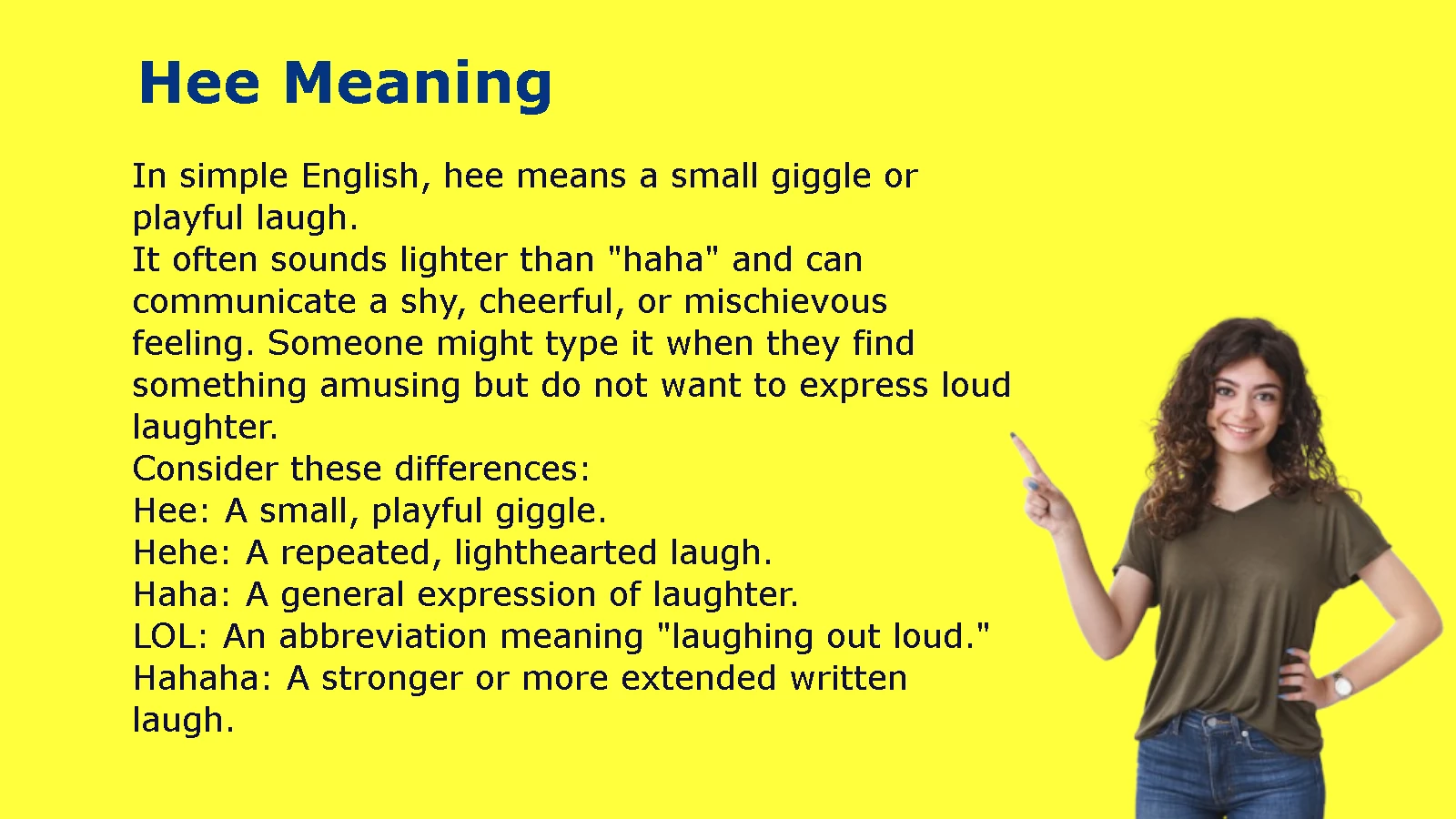
In simple English, hee means a small giggle or playful laugh.
It often sounds lighter than “haha” and can communicate a shy, cheerful, or mischievous feeling. Someone might type it when they find something amusing but do not want to express loud laughter.
Consider these differences:
- Hee: A small, playful giggle.
- Hehe: A repeated, lighthearted laugh.
- Haha: A general expression of laughter.
- LOL: An abbreviation meaning “laughing out loud.”
- Hahaha: A stronger or more extended written laugh.
The differences are not strict grammatical rules. People use these expressions differently depending on their personality, communication style, and relationship with the reader.
What Does Hee Mean in Different Contexts?
The meaning of “hee” can change depending on where and how someone uses it.
| Context | Possible meaning | Example |
| Casual conversation | Light laughter | “Hee, that sounds funny.” |
| Text messaging | Playful amusement | “Hee, I knew you’d say that.” |
| Flirty conversation | Shy or teasing reaction | “Hee, you’re making me blush.” |
| Children’s writing | A giggling sound | “Hee hee! Let’s play.” |
| Creative writing | A distinctive laugh | “Hee!” she giggled. |
| Social media | A playful response | “Hee, that’s adorable!” |
The most important distinction is that “hee” does not communicate one universal emotion. It can suggest happiness, embarrassment, amusement, or teasing depending on the situation.
Hee vs. Hehe vs. Haha
Although these expressions all relate to laughter, they create slightly different impressions.
| Expression | Meaning | Common tone |
| Hee | Short, light giggle | Shy or playful |
| Hehe | Soft, repeated laughter | Mischievous or friendly |
| Haha | General laughter | Casual and friendly |
| Hahaha | Extended laughter | Strong amusement |
| LOL | Internet abbreviation for laughter | Informal and conversational |
For example, imagine that a friend tells you an embarrassing story.
- “Hee” might suggest a small, restrained giggle.
- “Hehe” might communicate playful teasing.
- “Haha” would be a more general reaction.
- “LOL” would be a typical digital response.
Practical writing tip: Choose the expression that matches the emotion you want to communicate. “Hee” works well in playful writing, but “haha” is generally more familiar in everyday English messaging.
Hee Meaning in Chat and Text Messages
The hee meaning in chat usually relates to giggling, amusement, or a playful reaction. People type it when they want to sound cheerful, shy, teasing, or slightly mischievous. It can also soften a message that might otherwise sound too serious or direct.
Unlike abbreviations such as BRB (be right back) and IMO (in my opinion), “hee” does not have a fixed expanded form. It functions more like a written sound.
For example:
Person A: I saved you the last piece of cake.
Person B: Hee! You’re the best.
Here, the expression communicates happiness and appreciation.
What Does Hee Mean When Someone Texts You?
When someone sends you “hee,” they are often expressing a small laugh or playful emotion.
However, you should consider the entire message before deciding what the sender means.
Here are some common interpretations:
- Amusement: The sender finds something funny.
- Shyness: The sender feels slightly embarrassed or bashful.
- Playfulness: The sender wants to create a lighthearted atmosphere.
- Excitement: The sender is happy about something.
- Teasing: The sender is joking with you.
- Affection: The sender wants to make a conversation feel warm or friendly.
For example, if someone says, “Hee, I knew you would remember,” they probably express happiness or playful appreciation.
If someone writes, “Hee, you look funny in that picture,” the expression may soften a teasing comment.
Does Hee Mean Flirting?
Hee can sound flirtatious, but it does not automatically indicate romantic interest. People sometimes use it to communicate shyness, playful affection, or amusement during romantic conversations. However, the surrounding words, relationship, and conversational pattern matter more than the expression itself.
Consider these examples:
| Message | Possible interpretation |
| “Hee, you’re so sweet.” | Warm or affectionate |
| “Hee, stop making me blush.” | Possibly flirtatious |
| “Hee, that’s hilarious.” | Friendly amusement |
| “Hee, you’re funny.” | Playful appreciation |
| “Hee, I missed you.” | Affectionate, potentially romantic |
A single “hee” cannot establish someone’s romantic intentions.
Look for other signals, such as consistent interest, personal compliments, thoughtful questions, and efforts to continue the conversation.
Example: If a friend regularly sends playful messages but never expresses romantic interest, “hee” probably reflects their normal communication style rather than flirting.
Hee Meaning on Social Media
On social platforms, “hee” works as a short emotional response.
People may use it in:
- Instagram comments.
- TikTok replies.
- Facebook conversations.
- WhatsApp messages.
- Discord chats.
- Gaming communities.
- Online fan communities.
Its tone depends on the content being discussed.
For example, someone might comment “Hee, so cute!” beneath a picture of a puppy. Another person might write “Hee hee, that was unexpected” after watching a funny video.
The expression can also appear in playful captions and fictional dialogue.
However, it is not a universal social media abbreviation. Some users understand it immediately, while others may find it unfamiliar.
Examples of Hee in Conversations
The following examples show how people might naturally use the expression.
Example 1: Expressing happiness
Person A: I bought your favorite chocolate.
Person B: Hee! Thank you so much.
Meaning: The sender expresses happiness and appreciation.
Example 2: Playful teasing
Person A: You forgot your umbrella again.
Person B: Hee, I guess I’m not very organized.
Meaning: The sender responds with lighthearted embarrassment.
Example 3: Showing excitement
Person A: Your birthday surprise is ready.
Person B: Hee! I can’t wait.
Meaning: The expression communicates excitement.
Example 4: Friendly laughter
Person A: I accidentally wore two different socks today.
Person B: Hee hee, nobody probably noticed.
Meaning: The sender finds the situation amusing.
Example 5: Romantic conversation
Person A: You looked really nice today.
Person B: Hee, you’re making me shy.
Meaning: The sender may be responding affectionately or flirtatiously.
Example 6: Responding to a joke
Person A: My cat thinks it owns the entire house.
Person B: Hee, cats really behave like that.
Meaning: The sender expresses amusement and agreement.
Example 7: Sharing good news
Person A: I passed my driving test!
Person B: Hee! I knew you could do it.
Meaning: The expression communicates happiness and encouragement.
When Should You Avoid Using Hee?
Although “hee” works in casual conversations, it is not suitable for every situation.
Avoid using it in:
- Formal business emails.
- Academic assignments.
- Professional reports.
- Serious discussions.
- Legal or official communication.
- Messages involving sensitive personal matters.
For instance, responding “Hee!” to a serious message about someone’s difficult experience could sound dismissive.
In professional communication, use clear expressions such as “I’m pleased to hear that,” “That’s wonderful news,” or “Thank you for sharing.”
Hee Meaning in Korean
The hee meaning in Korean depends on how the sound appears in the original Korean writing system, called Hangul. The Roman letters “hee” can represent the Korean syllable 희 in certain names and transliterations. However, the syllable’s meaning depends on the specific Korean name characters and naming tradition.
This distinction matters because Korean names often combine syllables associated with particular meanings.
For example, a Korean name containing “hee” may communicate a positive concept depending on the underlying Hanja characters, the Chinese characters traditionally used in some Korean names.
The Roman spelling alone does not provide enough information to determine the exact meaning.
Is Hee a Korean Word or Name?
Yes, “Hee” can appear as a romanized element in Korean names.
One common Hangul representation is 희.
This syllable appears in Korean given names, including names that use combinations of two syllables.
However, Korean names do not always have one fixed meaning based on pronunciation alone.
For example:
- A name containing 희 may use a Hanja character associated with joy.
- Another name may use a different character with a different meaning.
- Some modern Korean names use native Korean naming conventions rather than Hanja-based interpretations.
Therefore, two people with names that contain the same romanized syllable may have different intended meanings.
Important distinction: The Roman spelling “Hee” does not establish a single Korean definition. You need the original Hangul spelling and, where relevant, the intended Hanja characters.
Hee vs. Korean Words for Yes
One common misunderstanding involves confusing “hee” with Korean expressions of agreement.
Korean speakers commonly use 네 (ne) and 예 (ye) to say yes.
Both expressions communicate agreement or an affirmative response, although their use can vary with formality and conversational style.
| Korean expression | Romanization | English meaning |
| 네 | Ne | Yes |
| 예 | Ye | Yes |
| 아니요 | Aniyo | No |
| 맞아요 | Majayo | That’s right |
| 그래요 | Geuraeyo | Okay / That’s so |
For example:
Question: 지금 가요? (Jigeum gayo?)
Meaning: Are you going now?
Answer: 네. (Ne.)
Meaning: Yes.
“Hee” should not be substituted for these standard affirmative expressions.
How to Understand Hee in Korean Conversations
If you encounter “hee” in a Korean conversation, first determine whether the speaker uses it as a name, a romanized syllable, or an informal sound representation.
Consider these three possibilities:
1. A personal name
Someone may use “Hee” as part of their romanized Korean name.
2. A transliteration
A person may write a Korean syllable using English letters. Different romanization practices can create variations in spelling.
3. A sound expression
Someone may use English-style written laughter while communicating in Korean.
The surrounding sentence and original Korean script help identify the intended meaning.
Hee Meaning in Old English
The phrase hee meaning Old English often creates confusion because historical English spelling differs considerably from modern spelling. The modern expression “hee,” commonly used to represent laughter, should not automatically be treated as an established Old English word with the same meaning.
Old English was the earliest recorded stage of the English language, spoken and written approximately between 450 and 1100 CE. Its grammar, vocabulary, pronunciation, and writing conventions differed from modern English.
To understand historical forms, you must examine the original spelling and the period in which a text appeared.
Was Hee Used in Old English?
“Hee” is not the standard modern spelling of the Old English third-person masculine singular pronoun.
The Old English pronoun hē meant “he” in modern English.
It referred to a male person or subject in a sentence.
For example, the modern sentence:
“He is a teacher.”
Uses the pronoun “he” as its subject.
Old English used related historical forms, including hē, within a grammatical system that also distinguished other pronouns by case.
The spelling “hee” may appear in later historical or dialectal writing, but that does not establish it as a standard Old English word.
Historical Meaning and Evolution of Hee
The written representation of laughter has changed throughout the development of English.
Modern writers use expressions such as:
- Hee
- Hee-hee
- Ha
- Haha
- Hehe
- Ho ho
These forms imitate sounds people make when laughing.
Linguists describe this type of expression as onomatopoeia, which refers to words or expressions that imitate sounds.
For example:
- “Buzz” imitates the sound of an insect.
- “Tick-tock” represents the sound of a clock.
- “Boom” imitates a loud impact.
- “Hee-hee” represents a light or high-pitched laugh.
The exact spelling of laughter can vary between writers, cultures, and historical periods.
A historical text containing a similar spelling does not necessarily use the expression in the same way modern internet users do.
Hee vs. He in Historical English
The distinction between “hee” and “he” is especially important when researching older English texts.
| Feature | Hee | He |
| Modern use | Informal laughter expression | Personal pronoun |
| Common function | Represents a sound or reaction | Identifies a male subject |
| Part of speech | Interjection when used as laughter | Pronoun |
| Example | “Hee! That’s funny.” | “He is my brother.” |
| Historical connection | Requires examination of the specific text | Directly related to Old English hē |
Do not confuse a modern expressive spelling with a historical grammatical form.
Does Hee Mean Yes?
No, “hee” is not a standard English word meaning yes. In ordinary English conversations, it generally represents laughter or a playful sound. However, similar-looking spellings can represent different expressions in other languages, which may explain why people sometimes associate “hee” with an affirmative response.
The distinction between spelling and pronunciation is important.
A word written in Roman letters may represent a completely different sound or meaning when transliterated from another writing system.
Why Do People Think Hee Means Yes?
Several factors can create this misunderstanding.
1. Similar-sounding foreign words
People may hear a foreign-language response and write it using an approximate English spelling.
2. Unfamiliar pronunciation
Someone unfamiliar with a language may misinterpret an affirmative response.
3. Informal online spelling
Internet users sometimes create personal spellings for sounds and reactions.
4. Contextual misunderstanding
A person might type “hee” after agreeing with something. The expression may communicate amusement rather than agreement.
For example:
Person A: Do you want to come with us?
Person B: Hee, that sounds fun!
Here, the actual affirmative meaning comes from “that sounds fun,” not from “hee.”
Words That Actually Mean Yes in Different Languages
Many languages have their own affirmative expressions.
| Language | Word for yes | Notes |
| English | Yes | Standard affirmative response |
| French | Oui | Common French word for yes |
| Korean | 네 (ne) | Common affirmative response |
| Korean | 예 (ye) | Another affirmative response |
| Spanish | Sí | Means yes |
| German | Ja | Means yes |
| Italian | Sì | Means yes |
| Japanese | はい (hai) | Common polite affirmative response |
| Portuguese | Sim | Means yes |
| Thai | ใช่ (chai) | Commonly means yes or correct |
These examples demonstrate why context matters when interpreting unfamiliar expressions.
Hee Meaning in Thai
The hee meaning in Thai cannot be established reliably from the Roman spelling alone. Thai uses its own writing system, and its pronunciation depends on consonants, vowels, tone marks, and syllable structure.
A Roman spelling such as “hee” may represent an approximate sound rather than a standardized Thai word.
This matters because two Thai words that look similar when written in English letters may have different spellings, tones, and meanings.
Is Hee a Thai Word?
There is no single established Thai definition that you can safely assign to the Roman spelling “hee” without identifying the original Thai script.
Thai is a tonal language. Its five lexical tones are:
- Mid tone.
- Low tone.
- Falling tone.
- High tone.
- Rising tone.
A change in tone can change a word’s meaning even when other pronunciation features remain similar.
For this reason, writing a Thai word using English letters can create ambiguity.
For example, someone might hear a Thai expression and write “hee” because it sounds close to that spelling. Another listener may use a different transliteration.
The original Thai spelling is necessary for accurate interpretation.
How Context Changes the Meaning of Thai Words
When interpreting a possible Thai expression, consider three factors.
1. Original spelling
Thai consonants and vowel combinations help establish the actual word.
2. Tone
The tone can distinguish otherwise similar-sounding expressions.
3. Sentence context
A word may function differently depending on whether someone uses it as a noun, verb, adjective, or conversational expression.
For example, a short sound heard in a casual conversation might be a complete word, part of a longer word, or simply a vocal reaction.
Practical tip: If someone sends you “hee” and says it is Thai, ask them to provide the Thai spelling. That is the most reliable way to identify its meaning.
Hee Meaning in Scrabble
The hee meaning in Scrabble involves a different question from its everyday English definition: whether the letter combination is accepted as a playable word under the applicable official word list.
Scrabble players cannot assume that every familiar expression, sound, abbreviation, or slang term qualifies as a valid move.
The game uses recognized word lists to determine which letter combinations players can legally place on the board.
Is Hee a Valid Scrabble Word?
You should verify “HEE” against the exact word list used in your game before treating it as playable.
Two major references are:
- NWL (NASPA Word List): Used in competitive North American Scrabble.
- Collins Scrabble Words (CSW): Used in many international English-language Scrabble competitions.
These lists do not always contain identical words.
The fact that “hee” appears in informal writing or a general dictionary does not automatically establish its tournament validity.
For an accurate result, check the current official list for your region or the word-checking system used by your game.
How Many Points Is Hee Worth?
The standard English-language Scrabble letter values are:
| Letter | Point value |
| H | 4 |
| E | 1 |
| E | 1 |
| Total | 6 |
HEE: Base letter score
Words You Can Play Instead of Hee
If you want to play a short word involving similar letters, consider checking alternatives such as:
| Word | General meaning |
| He | A masculine pronoun |
| Eh | An expression of surprise or uncertainty |
| Eye | The organ used for vision |
| Her | A feminine pronoun |
| See | To perceive with the eyes |
| The | A common English article |
Check each alternative against your game’s active word list before playing.
Is Hee Related to a Tree?
“Hee” is not the standard English name for a tree. However, searches for hee meaning tree may come from confusion with yew, which is the name of an evergreen tree belonging to the genus Taxus.
Yew trees have a long history in gardens, landscapes, and cultural traditions. Their dense foliage and longevity make them distinctive among evergreen trees.
The two spellings have different meanings and should not be treated as interchangeable.
Hee vs. Yew: Are They the Same?
No. “Hee” and “yew” are different words.
| Feature | Hee | Yew |
| Meaning | Informal laughter expression | Evergreen tree or shrub |
| Word category | Interjection when used as laughter | Noun |
| Pronunciation | Commonly /hiː/ | /juː/ |
| Common context | Texting and playful writing | Botany, gardening, and symbolism |
| Example | “Hee, that’s funny!” | “A yew grows in the garden.” |
Although both are short English spellings, they represent different sounds.
“Hee” starts with an H sound, while “yew” starts with a Y sound.
What Does Yew Mean?
Yew refers to an evergreen tree or shrub belonging to the genus Taxus. Yews have needle-like leaves, red fleshy seed coverings called arils, and often grow slowly.
Yew trees have several notable characteristics:
- Evergreen foliage: They retain their leaves throughout the year.
- Long lifespan: Some specimens survive for many centuries.
- Dense growth: Their branches and foliage can form thick hedges.
- Red arils: Their seeds sit inside distinctive red, fleshy coverings.
- Historical significance: People have planted yews in churchyards, gardens, and historic landscapes.
Yews also require caution because many parts of the plant contain toxic compounds called taxine alkaloids. Their seeds are especially important to keep away from children and pets.
Yew Symbolism and Cultural Meaning
Yew trees often symbolize:
- Longevity.
- Endurance.
- Immortality.
- Death and remembrance.
- Renewal and continuity.
Their long lifespans and evergreen appearance contribute to these associations.
In some European traditions, yews appear in historic burial grounds and churchyards. Their presence has helped connect them with remembrance and the passage of time.
The word “yew” also has a separate connection to the phrase “you” because the two words are homophones in English.
For example:
- “The yew tree is very old.”
- “You should visit the garden.”
They sound alike but have different meanings and spellings.
Hee Meaning Examples in Everyday English
The easiest way to understand “hee” is to examine how it works in complete sentences.
Unlike ordinary nouns and verbs, expressive sounds often communicate emotion through tone and punctuation.
A short “hee!” can sound excited, while “hee hee” may suggest a longer or more mischievous giggle.
Hee Used to Express Laughter
People can use “hee” to represent a light laugh.
Examples:
- “Hee! That joke caught me off guard.”
- “Hee hee, I can’t stop laughing.”
- “I saw your funny picture. Hee!”
- “Hee, that was a clever idea.”
In each example, the expression replaces a short laugh that someone might make while speaking.
Hee Used in Playful Conversations
The expression can also make casual communication feel warmer.
Examples:
- “Hee, you always know what to say.”
- “Hee, I think you are right.”
- “Hee hee, that was a good surprise.”
- “Hee, I wasn’t expecting that!”
These messages sound informal and friendly.
However, the meaning depends on the relationship between the speakers. A playful message between close friends may sound different from the same message sent to a professional contact.
Hee Used in Informal Writing
Writers sometimes use expressive sounds to make fictional dialogue feel more natural.
For example:
“Hee hee! You should have seen your face when the lights went out,” Emma said.
The expression helps communicate the character’s playful personality.
In creative writing, such sounds can also distinguish characters.
A character who frequently uses “hee hee” might appear mischievous or childish, while another who uses “haha” might sound more casual.
Writers should avoid repeating the same laugh expression too often. Mixing dialogue, facial expressions, and physical reactions creates more believable scenes.
When Should You Avoid Using Hee?
“Hee” is best suited to informal communication.
Avoid using it when you need a clear, professional, or serious tone.
| Situation | Better choice |
| Business email | “Thank you for the update.” |
| Academic writing | Explain the idea directly |
| Professional chat | “That’s great news.” |
| Serious conversation | Respond with empathy |
| Casual messaging | “Hee!” can work |
| Creative dialogue | Use it when it suits the character |
The goal is not to avoid expressive language altogether. Instead, choose words that match the situation.
Common Misunderstandings About Hee
People sometimes confuse “hee” with other words because it is short and has several possible interpretations across languages and informal communication.
Understanding these differences prevents incorrect translations and spelling assumptions.
Is Hee the Same as Hey?
No. “Hee” and “hey” have different meanings and functions.
Hey is an interjection commonly used to attract someone’s attention, greet someone, or express surprise.
Hee commonly represents a light laugh or playful sound.
| Word | Meaning | Example |
| Hee | Light laughter | “Hee, that’s funny!” |
| Hey | Greeting or attention-getter | “Hey, how are you?” |
Pronunciation also differs.
“Hee” generally has a long E sound, while “hey” has a different vowel sound.
Does Hee Have a Universal Meaning?
No. Its interpretation changes across languages and communication settings.
This is why language identification matters.
A word written in English letters does not necessarily belong to English.
Is Hee a Formal English Word?
“Hee” is primarily an informal expression.
People use it in:
- Text messages.
- Social media comments.
- Creative dialogue.
- Informal conversations.
- Personal notes.
It is not a suitable replacement for conventional vocabulary in formal reports or professional documents.
Is Hee a Word or Just a Sound?
“Hee” can function as a written interjection that represents a sound.
This makes it similar to expressions such as “aha,” “oops,” and “hmm.”
Such expressions can have recognized linguistic functions even when they do not behave like ordinary nouns, adjectives, or verbs.
The important distinction is that a sound expression can be meaningful without having a conventional dictionary definition identical to an ordinary word.
Related Word Meanings: Oui, Mi, Spiff, and Yew
The searches surrounding “hee meaning” may also lead readers to other short words, especially when they explore unfamiliar expressions, language translations, or dictionary definitions.
However, these words have separate meanings and deserve individual explanations.
Oui Definition and Meaning
Oui is the French word for yes.
It is one of the most common French affirmative expressions and appears in everyday conversations, questions, and formal responses.
Oui Oui Chérie Typography Poster posters & prints by casa cartissi – Printler
Examples:
- “Oui, je comprends.” — Yes, I understand.
- “Oui, merci.” — Yes, thank you.
- “Oui, bien sûr.” — Yes, of course.
Unlike “hee,” which commonly represents laughter in informal English, “oui” has a clear and established meaning in French.
The distinction is useful when comparing short expressions across languages.
Mi Meaning
Mi has several meanings depending on the language and subject.
In Spanish, mi means my when used as a possessive adjective.
For example:
- Mi casa means my house.
- Mi libro means my book.
- Mi amigo means my friend.
In music, mi is the third syllable in the traditional solfège sequence:
Do, Re, Mi, Fa, Sol, La, Ti.
It represents the third scale degree in the basic major-scale solfège system.
The word can therefore appear in language learning, grammar, and music education.
Spiff Meaning
Spiff is an informal English word with several uses, especially in business and sales environments.
In sales terminology, a spiff commonly refers to a short-term incentive or bonus that motivates employees to sell a particular product or reach a specific target.
For example, a retailer might offer sales staff an additional payment for selling a featured product during a promotional campaign.
Other uses include:
- A special sales bonus.
- A performance-based incentive.
- An informal expression associated with looking smart or stylish, as in “spiff up.”
The intended meaning depends on the sentence.
Yew Meaning
Yew is the common name for evergreen trees and shrubs in the genus Taxus.
The word appears in botanical descriptions, gardening discussions, historical writing, and cultural symbolism.
Yew trees are known for their long lives, dense foliage, and distinctive red arils.
Unlike “hee,” which usually represents laughter in informal writing, “yew” is a standard botanical noun.
Practical Case Study: How Context Changes the Meaning of Hee
Consider three people who encounter the same expression in different situations.
Case 1: A messaging conversation
A person receives this message:
“Hee, I finally finished my exams!”
The natural interpretation is a playful or happy reaction. The expression adds excitement to the announcement.
Case 2: A Korean name
Someone sees “Hee” in a Korean person’s romanized name.
In this case, interpreting it as laughter would be incorrect. It may represent the Hangul syllable 희, and its intended name meaning depends on the relevant characters.
Case 3: A word game
A Scrabble player tries to place H-E-E on the board.
The question is no longer about laughter. The player needs to establish whether the word appears in the game’s accepted word list.
These examples demonstrate an important language principle: the same spelling can serve different purposes depending on its linguistic environment.
Before assigning a meaning, identify the language, original spelling, and context.
Frequently Asked Questions About Hee Meaning
What does hee mean in texting?
“Hee” usually represents a small giggle or playful laugh in text messages. People use it to express amusement, happiness, shyness, or teasing. Its exact tone depends on the conversation and the relationship between the people communicating.
Does hee mean yes in any language?
“Hee” is not a standard English word for yes. French uses “oui,” while Korean commonly uses “네” (ne) and “예” (ye). Similar-looking Roman spellings can create confusion when people interpret words from different languages.
What does hee mean in Korean?
“Hee” can represent the Korean syllable 희 in romanized names. Its meaning depends on the underlying Hangul and, where applicable, the Hanja characters chosen for the name. It does not automatically mean yes.
Is hee an Old English word?
“Hee” is not the standard modern spelling of the Old English masculine pronoun hē, which corresponds to modern “he.” Historical spellings must be interpreted within their specific period and textual context.
Is hee a valid Scrabble word?
Scrabble validity depends on the official word list used in the game. Players should check the current NASPA Word List or Collins Scrabble Words list, depending on their region. Its theoretical letter score is six points.
Does hee mean a type of tree?
No. “Hee” is not the standard English name of a tree. The word “yew” refers to evergreen trees and shrubs in the genus Taxus. The two words have different spellings, pronunciations, and meanings.
What is the difference between hee and hehe?
“Hee” usually represents a short, light giggle, while “hehe” represents repeated laughter. Both are informal expressions, and people often use them interchangeably depending on their writing style.
Is hee a real English word?
“Hee” is used as an informal written expression representing laughter. It can function as an interjection in sentences, although it is not a conventional replacement for standard vocabulary in formal writing.
Conclusion: Understanding the Meaning of Hee
The hee meaning is primarily connected to light laughter, playful amusement, and expressive communication in informal English. People use it in text messages, social media comments, and casual conversations to communicate emotions that might otherwise require a facial expression or spoken laugh.
However, context makes a significant difference.
In Korean romanization, “Hee” may represent a syllable used in personal names. In historical English discussions, it should not be confused with the Old English pronoun hē. It also does not mean yes in standard English, and it is not the established name of a tree.
Remember these distinctions:
- Hee: An informal expression of light laughter.
- Oui: The French word for yes.
- Mi: A Spanish possessive word and a musical syllable.
- Spiff: An informal term associated with sales incentives and other uses.
- Yew: An evergreen tree in the genus Taxus.
When you encounter an unfamiliar short expression, look at its language, spelling, and surrounding sentence before deciding what it means.
Want to understand another unfamiliar word? Explore related word meanings, language expressions, spelling differences, and everyday slang to build a stronger vocabulary and communicate with greater confidence.













