Kenning means a figurative expression or compound phrase used in place of a simple noun or name, especially in Old English and Old Norse poetry. A kenning often describes something indirectly by combining two words or ideas, such as “whale road” for the sea.
If you’re searching for “kenning meaning,” “what does kenning mean,” or “kenning definition,” you’re likely looking for its simple meaning and how it is used in poetry. Kennings are especially common in Anglo Saxon and Norse literature, where poets used creative descriptions to make ordinary objects and ideas sound more vivid. For example, “sky candle” can be used as a kenning for the sun.
| Question | Answer |
|---|---|
| What does kenning mean? | A figurative expression that describes something indirectly. |
| What is the meaning of kenning? | A creative phrase used instead of a simple noun or name. |
| What is an example of a kenning? | “Whale road” is a kenning for the sea. |
| Where are kennings commonly used? | They are especially common in Old English and Old Norse poetry. |
| What is a synonym for kenning? | Figurative expression, metaphor, or descriptive phrase. |
What Does Kenning Mean?
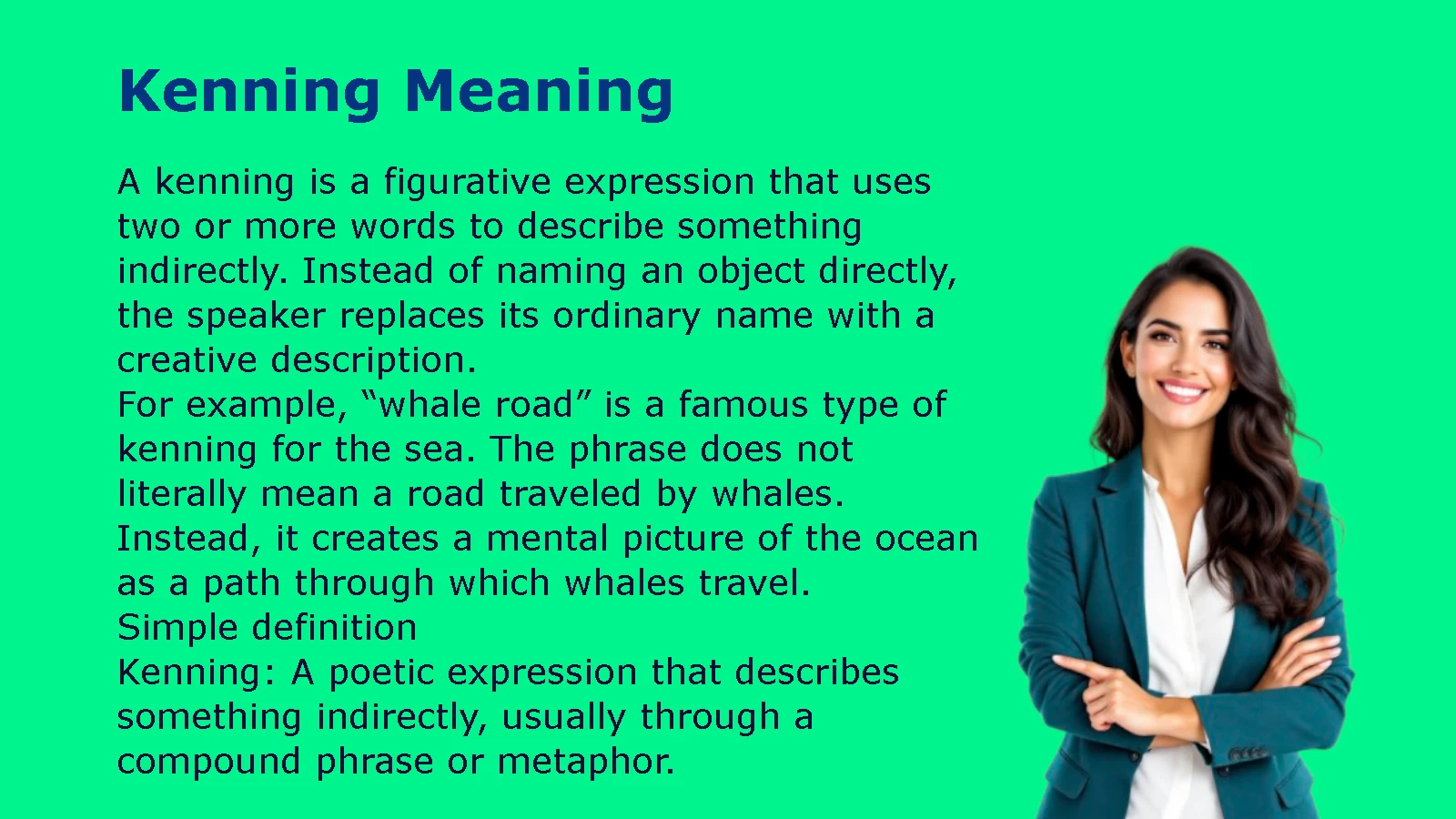
A kenning is a figurative expression that uses two or more words to describe something indirectly. Instead of naming an object directly, the speaker replaces its ordinary name with a creative description.
For example, “whale road” is a famous type of kenning for the sea. The phrase does not literally mean a road traveled by whales. Instead, it creates a mental picture of the ocean as a path through which whales travel.
Simple definition
Kenning: A poetic expression that describes something indirectly, usually through a compound phrase or metaphor.
Examples at a glance
- whale road = sea
- sky candle = sun
- wave horse = ship
- battle sweat = blood
- word hoard = vocabulary or language
The meaning becomes clear through the relationship between the words rather than through a literal interpretation.
Kenning Definition
The kenning definition can be understood as a figurative compound expression used in place of an ordinary noun.
Kennings are especially famous in Anglo Saxon literature, where poets used them to make descriptions more vivid. They also appear in Old Norse poetry and other Germanic poetic traditions.
The technique allowed poets to describe familiar things in fresh and imaginative ways.
For instance:
Whale road → sea
The ocean is not literally a road. Yet the expression makes sense because the sea serves as a route for whales.
What kind of word is kenning?
Kenning is a noun.
You can use it when discussing a particular figurative expression or the poetic technique itself.
“Whale road” is a kenning for the sea.
The poet uses several kennings in the poem.
The plural form is kennings.
Kenning Meaning in Simple English
In simple English, a kenning is a creative way of naming something without saying its usual name.
Imagine you want to describe a ship. Instead of simply saying “ship,” you might call it a wave horse because it moves across waves like a horse moves across land.
That is the basic idea behind a kenning:
ordinary thing → creative description → hidden meaning
The reader has to connect the two ideas.
For example:
wave horse → ship
A horse travels across land, while a ship travels across waves. The comparison gives the object a more imaginative identity.
What Is the Origin of Kenning?
The word kenning comes from a term related to Old Norse, where the technique was known as a form of figurative expression. The English word is connected with an old root meaning to know or recognize.
Kennings became particularly important in Old English and Old Norse poetry.
Anglo Saxon poets used them extensively because their poetry relied heavily on vivid imagery, alliteration, metaphor, and compact descriptions.
One of the best known examples appears in Beowulf, an Old English epic poem. The poem contains numerous poetic compounds and indirect descriptions that help create its distinctive style.
Kennings in Beowulf
Beowulf is one of the most important works associated with kennings in English literature.
The poem uses imaginative expressions to describe people, objects, and places. One well known example is:
whale road = sea
Other expressions found in Old English poetry can describe objects through their function, appearance, or relationship to something else.
These expressions served more than a decorative purpose. They helped poets create strong images while fitting the rhythmic and alliterative patterns of the poetry.
Why did Old English poets use kennings?
Kennings offered several advantages:
- They created vivid mental images.
- They made familiar objects sound mysterious.
- They added poetic beauty.
- They supported alliteration and rhythm.
- They allowed poets to avoid repetitive wording.
- They encouraged readers to interpret the imagery.
- They made oral poetry more memorable.
As a result, kennings became an important feature of Germanic poetic tradition.
Common Kenning Examples
Here are several examples that demonstrate how kennings work.
| Kenning | Meaning | Why it works |
| Whale road | Sea | Whales travel across the sea |
| Wave horse | Ship | A ship moves over waves |
| Sky candle | Sun | The sun shines like a candle in the sky |
| Battle sweat | Blood | Blood is produced during battle |
| Word hoard | Vocabulary or language | Words are imagined as valuable stored objects |
| Ring giver | King or lord | A generous ruler gives rings or treasure |
| Battle light | Sword | A sword can shine during battle |
| Earth hall | Grave | A grave can be imagined as a dwelling beneath the earth |
| Bone house | Body | The body contains the bones |
| Life house | Body | The body houses a person’s life |
Not every creative compound is automatically a traditional kenning. The expression needs to function as an indirect description of another thing.
Kenning Examples in Modern English
Although kennings are strongly associated with ancient poetry, the basic technique can still appear in modern creative writing.
A writer might describe a:
- laptop as a screen desk
- car as a road runner
- phone as a pocket speaker
- coffee as a morning fuel
- book as a knowledge door
- rain as a sky shower
- snow as a winter blanket
These modern expressions may resemble kennings because they replace an ordinary name with an imaginative compound description.
However, traditional literary kennings have a stronger connection to established poetic traditions.
Types of Kennings
Kennings can take several forms depending on how the indirect description works.
1. Metaphorical kenning
A metaphorical kenning compares one thing to another.
Wave horse = ship
The ship is compared to a horse because both can travel along a path.
2. Descriptive kenning
This type highlights a characteristic or function.
Sky candle = sun
The sun is described through its brightness and position in the sky.
3. Possessive or relational kenning
Some kennings identify something through its relationship with another thing.
Ring giver = king
The expression identifies a ruler through the traditional act of giving rings or treasure.
4. Compound kenning
Many traditional kennings are compact compounds made from two nouns or related words.
whale road
word hoard
bone house
These combinations create a new poetic image without directly naming the subject.
How Do You Identify a Kenning?
A simple method can help you recognize one.
Step 1: Look for an unusual expression
Ask whether the phrase seems to describe something without naming it directly.
Step 2: Find the literal images
Break the expression into its individual ideas.
For whale road, you have:
- whale
- road
Step 3: Connect the images
Ask what thing could reasonably connect the two concepts.
Whales travel through the sea, and the sea can function like a road.
Step 4: Identify the hidden noun
The answer is:
whale road = sea
That indirect naming is what makes the phrase a kenning.
Kenning vs Metaphor
A kenning and a metaphor are closely related, but they are not exactly the same.
A metaphor directly compares one thing with another:
The sea is a road.
A kenning can turn that comparison into a compact expression:
Whale road
The kenning often works as a substitute for the ordinary noun rather than simply making a comparison.
| Kenning | Metaphor |
| Usually a compact indirect expression | Broader figurative comparison |
| Often replaces a noun | Can describe relationships between ideas |
| Common in traditional poetry | Common throughout everyday language and literature |
| Often uses compound expressions | Can appear in many grammatical forms |
So, a kenning can be metaphorical, but not every metaphor is a kenning.
Kenning vs Metonymy
These terms can also be confused.
Metonymy replaces a word with something closely associated with it.
For example:
The crown announced a new policy.
Here, the crown represents the monarch or monarchy.
A kenning usually creates a more imaginative, indirect description.
Ring giver = king
The phrase does not simply substitute an associated object. It creates a poetic description based on a characteristic relationship.
How to Use Kenning in a Sentence
Because kenning is a noun, several sentence structures work naturally.
Example 1
“Whale road” is a famous kenning for the sea.
Example 2
The poet uses several kennings to describe the natural world.
Example 3
Students identified the kenning and explained its hidden meaning.
Example 4
This passage contains a traditional Anglo Saxon kenning.
Example 5
The writer uses kennings to make the poem more vivid.
You can also discuss the technique itself:
Kennings are a distinctive feature of much Old English poetry.
Why Are Kennings Important?
Kennings show how poets can make ordinary objects feel new.
Consider the difference between these descriptions:
The ship crossed the sea.
and:
The wave horse crossed the whale road.
The first sentence communicates information clearly. The second creates an entire image. Suddenly, the ship becomes an animal and the sea becomes a path.
That imaginative quality explains why kennings remain useful when studying ancient poetry.
Kennings can help writers:
- create vivid imagery
- avoid repetition
- make descriptions memorable
- encourage interpretation
- compress complex ideas into short phrases
- give ordinary objects a fresh identity
Common Characteristics of Kennings
Traditional kennings often share several features.
They are indirect. The object is not named in the usual way.
They are imaginative. The expression creates a mental picture.
They are compact. A few words can replace an ordinary noun.
They are often metaphorical. The description usually depends on comparison.
They can be culturally specific. Understanding the historical context can make the meaning much easier to recognize.
They are strongly associated with poetry. Old English and Old Norse poetry are particularly famous for this technique.
Common Mistakes With Kennings
Mistake 1: Thinking every metaphor is a kenning
A metaphor is a broad literary device. A kenning is a more specific form of indirect poetic naming.
Therefore, the two terms should not be treated as exact synonyms.
Mistake 2: Assuming a kenning must be ancient
Traditional kennings come from older poetic traditions, but modern writers can create expressions that use the same basic technique.
However, a newly invented metaphorical phrase is not necessarily a traditional historical kenning.
Mistake 3: Taking the phrase literally
A phrase such as whale road does not describe an actual road.
The reader needs to interpret the relationship between the words.
Mistake 4: Confusing kenning with simple description
A phrase such as blue ocean is descriptive, but it does not hide the ordinary name of the thing.
A phrase such as whale road indirectly refers to the sea, which gives it the distinctive quality of a kenning.
Why Are Kennings Used in Poetry?
Poetry often depends on imagery, sound, rhythm, and compact language. Kennings support all four.
An ordinary noun may communicate a basic fact, while a kenning can suggest an entire scene.
For example:
sea
gives you a direct noun.
whale road
gives you a picture of whales moving across a vast watery path.
That difference is especially powerful in oral poetry, where memorable and vivid expressions can help listeners follow and remember the verse.
Frequently Asked Questions About Kenning
What does kenning mean?
A kenning is a figurative expression that describes something indirectly instead of using its ordinary name. Traditional kennings are especially common in Old English and Old Norse poetry.
What is a kenning in simple terms?
A kenning is a creative nickname or indirect description for something. For example, “whale road” is a kenning for the sea because whales travel across it.
What is an example of a kenning?
“Whale road” is one of the best known examples. It refers to the sea by imagining the sea as a road traveled by whales.
What is the purpose of a kenning?
Kennings make language more vivid and memorable. They allow poets to describe ordinary things creatively while adding imagery and deeper associations to their writing.
Is a kenning a metaphor?
A kenning is often metaphorical, but the terms are not identical. A metaphor is a broad type of figurative comparison, while a kenning is a specific indirect poetic expression, often used as a substitute for a noun.
Where did kennings originate?
Kennings are strongly associated with Old Norse and Old English poetic traditions. They became an important feature of Germanic poetry and are particularly well known from works such as Beowulf.
What is the plural of kenning?
The plural of kenning is kennings.
For example:
The poem contains several kennings.
Is “whale road” a kenning?
Yes. “Whale road” is a traditional example of a kenning for the sea. The expression indirectly describes the sea as a route traveled by whales.
What is a modern example of a kenning?
A creative expression such as “pocket speaker” for a phone can resemble a modern kenning because it indirectly describes the object through one of its characteristics or functions.
What is the difference between a kenning and a metaphor?
A metaphor makes a figurative comparison, while a kenning usually provides a compact indirect name for something. Kennings often rely on metaphor, so the two concepts overlap.
Why are kennings important in Beowulf?
Kennings contribute to the vivid imagery and distinctive poetic style of Beowulf. They allow the poet to describe familiar objects indirectly and make the language more memorable and expressive.
Final Thoughts
The kenning meaning is simple once you understand the basic idea: a kenning is an imaginative, indirect expression used instead of an ordinary name.
Traditional examples such as “whale road” for the sea show how a few carefully chosen words can create a powerful mental image. The technique is especially important in Old English and Old Norse poetry, including Beowulf.
When you encounter an unusual phrase in an old poem, ask yourself what ordinary object it might be replacing. That hidden connection is often the key to understanding a kenning.