Unceasing means continuing without stopping, ending, or being interrupted. It describes something that happens constantly or keeps going for a long time without a break.
If you’re searching for “unceasing meaning,” “what does unceasing mean,” or “unceasing definition,” you’re likely looking for its simple meaning and how to use it in a sentence. In modern English, unceasing is commonly used to describe actions, sounds, efforts, movements, or situations that continue continuously without stopping. For example, “The unceasing rain flooded the streets” means the rain continued without a break.
| Question | Answer |
|---|---|
| What does unceasing mean? | Continuing without stopping or interruption. |
| What is the meaning of unceasing? | Constant, continuous, or never ending. |
| Is unceasing a positive word? | It can be positive or negative depending on the context. |
| What is a synonym for unceasing? | Continuous, constant, incessant, endless, or perpetual. |
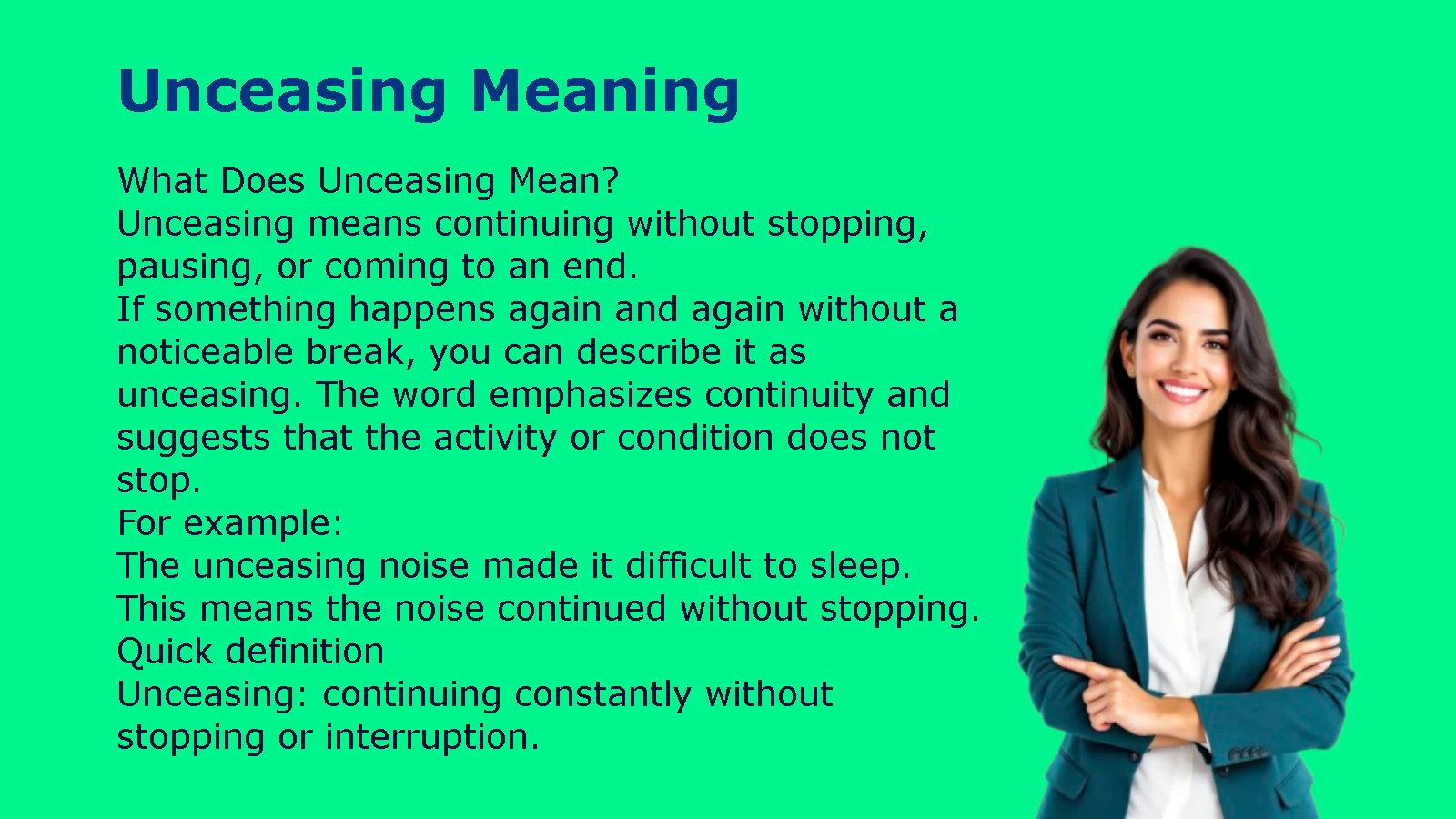
What Does Unceasing Mean?
Unceasing means continuing without stopping, pausing, or coming to an end.
If something happens again and again without a noticeable break, you can describe it as unceasing. The word emphasizes continuity and suggests that the activity or condition does not stop.
For example:
The unceasing noise made it difficult to sleep.
This means the noise continued without stopping.
Quick definition
Unceasing: continuing constantly without stopping or interruption.
Part of speech: Adjective
Pronunciation: /ʌnˈsiː.sɪŋ/
Base verb: cease
Related words: ceaseless, continual, constant, uninterrupted
The prefix un means “not,” while ceasing comes from the verb cease, meaning “to stop.” So, the basic idea behind unceasing is literally “not stopping.”
Unceasing Definition
The unceasing definition is something that continues without stopping or interruption.
The word is often used for actions, conditions, sounds, efforts, or events that continue over a period of time.
For example:
- unceasing rain = rain that does not stop
- unceasing effort = effort that continues constantly
- unceasing noise = noise that continues without a break
- unceasing pain = pain that does not go away
- unceasing activity = activity that keeps going
The word does not necessarily mean something happens every second in a literal sense. It can also emphasize that something happens persistently or repeatedly with little or no interruption.
Unceasing vs temporary
Something unceasing is presented as continuous, while something temporary lasts for only a limited period.
For example:
Her unceasing dedication helped the team succeed.
The sentence emphasizes that her dedication continued consistently.
Unceasing Meaning in Simple English
In simple English, unceasing means “never stopping.”
Imagine a clock ticking all day and night without taking a break. You could describe its ticking as unceasing.
Another easy example is rain:
The unceasing rain flooded the streets.
The rain continued for a long time without stopping.
A simple way to remember the word is:
Unceasing = continuing and never stopping.
The word is formed from un + ceasing, so its meaning is closely connected to the idea of not ceasing.
What Does Unceasingly Mean?
Unceasingly is the adverb form of unceasing. It means continuously, constantly, or without stopping.
For example:
The machine operated unceasingly throughout the night.
This means the machine continued operating without stopping.
Compare the two forms:
| Word | Part of speech | Meaning |
| Unceasing | Adjective | Continuing without stopping |
| Unceasingly | Adverb | In a continuous or nonstop way |
| Cease | Verb | To stop |
| Ceasing | Verb/adjective form | Stopping or coming to an end |
Examples of unceasingly
- The workers continued unceasingly until the project was finished.
- The river flowed unceasingly through the valley.
- She worked unceasingly to improve the organization.
- The machine ran unceasingly for several hours.
- His determination continued unceasingly despite the setbacks.
Unceasingly is less common in everyday conversation than unceasing, but it can work well in formal, literary, or descriptive writing.
Unceasing Examples
Seeing the word in different contexts makes its meaning easier to understand.
1. Unceasing rain
The unceasing rain kept the streets empty.
The rain continued for a long time without stopping.
2. Unceasing effort
Her unceasing effort eventually led to success.
Her effort remained consistent and did not stop.
3. Unceasing noise
The unceasing noise from the construction site was frustrating.
The noise continued without a meaningful break.
4. Unceasing pain
He sought medical help because of his unceasing pain.
The pain continued and did not provide relief.
5. Unceasing activity
The city showed unceasing activity throughout the weekend.
The city remained active continuously.
6. Unceasing movement
The unceasing movement of the waves created a peaceful rhythm.
The waves kept moving without stopping.
7. Unceasing support
Her family gave her unceasing support during the difficult period.
Her family continued supporting her consistently.
8. Unceasing demand
The company struggled to meet the unceasing demand for its products.
Demand remained consistently high.
9. Unceasing curiosity
His unceasing curiosity led him to explore new subjects.
His curiosity continued and did not fade.
10. Unceasing determination
Her unceasing determination helped her overcome repeated challenges.
She continued to pursue her goal without giving up.
Unceasing in a Sentence
Here are several natural unceasing sentence examples:
- The unceasing rain caused several roads to close.
- His unceasing dedication impressed everyone on the team.
- The unceasing noise made concentration difficult.
- She showed unceasing patience with the children.
- The river’s unceasing flow shaped the landscape over time.
- Their unceasing efforts eventually produced results.
- The city was filled with unceasing activity.
- The athlete’s unceasing determination inspired her teammates.
- We were tired of the unceasing interruptions.
- The scientist continued his unceasing search for answers.
The word is particularly natural before nouns such as effort, activity, noise, rain, support, determination, movement, pressure, demand, and pain.
How to Use Unceasing
Because unceasing is an adjective, it normally comes before a noun or after a linking verb.
Before a noun
This is the most common structure:
unceasing effort
For example:
The team made an unceasing effort to improve the service.
After a linking verb
You can also use the word after verbs such as be, seem, remain, or appear.
The pressure seemed unceasing.
Her enthusiasm remained unceasing.
This structure focuses on the condition itself rather than directly modifying a noun.
Common collocations with unceasing
Some natural combinations include:
- unceasing effort
- unceasing work
- unceasing activity
- unceasing noise
- unceasing rain
- unceasing pressure
- unceasing demand
- unceasing support
- unceasing determination
- unceasing struggle
- unceasing movement
- unceasing pain
- unceasing attention
- unceasing devotion
- unceasing progress
- unceasing activity
These combinations are especially common in formal, descriptive, and literary writing.
Unceasing Synonyms
Several words have meanings close to unceasing, but each has a slightly different emphasis.
| Synonym | Meaning | Example |
| Continuous | Happening without interruption | Continuous rain caused flooding. |
| Constant | Happening or existing consistently | She faced constant pressure. |
| Ceaseless | Never stopping | The ceaseless noise was distracting. |
| Uninterrupted | Not broken or interrupted | We enjoyed uninterrupted sleep. |
| Incessant | Continuing repeatedly, often annoyingly | The incessant noise was irritating. |
| Perpetual | Continuing for a very long or seemingly endless time | The machine seemed to be in perpetual motion. |
| Persistent | Continuing despite difficulty or resistance | He made persistent efforts to improve. |
| Endless | Seemingly having no end | They faced endless delays. |
| Continual | Happening repeatedly, often with short breaks | The continual interruptions were frustrating. |
Unceasing vs ceaseless
Unceasing and ceaseless are very close in meaning.
Both describe something that does not stop.
unceasing effort
ceaseless effort
In many situations, they can be used interchangeably. However, ceaseless can sound more literary or emphatic.
So, unceasing is usually the safer choice when you want to emphasize continuity without suggesting annoyance.
Unceasing vs continuous
Continuous is a broader and more neutral term. It often describes something that proceeds without interruption.
Unceasing puts stronger emphasis on not stopping.
continuous rainfall
unceasing rainfall
Both can work, but unceasing creates a stronger impression of persistence.
Unceasing Antonyms
The opposite of unceasing is something that stops, pauses, or occurs only occasionally.
Useful antonyms include:
- ceasing
- intermittent
- occasional
- sporadic
- temporary
- interrupted
- discontinuous
- limited
- finite
- stopping
For example:
The unceasing rain finally stopped.
Here, the opposite condition is one in which the rain ceases.
Another example:
Instead of unceasing activity, the area experienced occasional activity.
Unceasing vs intermittent
These words are almost opposites in many contexts.
Unceasing means continuing without stopping.
Intermittent means stopping and starting at intervals.
Compare:
The unceasing rain lasted all afternoon.
The intermittent rain stopped and started throughout the afternoon.
Is Unceasing a Positive or Negative Word?
Unceasing is neutral by itself. Its emotional meaning depends on the noun it describes.
It can describe something positive:
unceasing support
So, the word does not automatically mean good or bad. It simply emphasizes that something continues without stopping.
Is Unceasing the Same as Constant?
Unceasing and constant are similar, but they are not always identical.
Constant can mean something remains steady or happens repeatedly over time.
Unceasing specifically emphasizes that something does not stop or pause.
For example:
She felt constant pressure.
This means pressure was consistently present.
She experienced unceasing pressure.
This creates a stronger impression that the pressure never let up.
The distinction is subtle, and the words can overlap in many contexts.
Unceasing vs Endless
Unceasing means something continues without stopping, while endless suggests that something seems to have no end.
For example:
The unceasing rain continued throughout the night.
This focuses on the rain not stopping.
The endless road stretched toward the horizon.
This focuses on the road appearing to have no end.
Something can be unceasing without literally being endless. It may eventually stop after a long period.
Unceasing vs Perpetual
Perpetual often suggests something that continues for an extremely long time or appears to continue indefinitely.
Unceasing focuses more directly on the absence of interruption.
For example:
The machine’s unceasing operation lasted for twelve hours.
This emphasizes that it did not stop during those twelve hours.
The machine appeared to be in perpetual motion.
This suggests motion that seems to continue indefinitely.
Common Mistakes With Unceasing
1. Thinking unceasing means “very frequent”
Something can happen frequently without being unceasing.
For example, a person who calls you ten times a day is calling frequently, but the calls are not literally unceasing because there are breaks between them.
Unceasing emphasizes continuity.
2. Confusing unceasing with occasional
These ideas are very different.
- Unceasing = does not stop
- Occasional = happens sometimes
3. Confusing unceasing with incessant
The words are close, but incessant often carries a negative tone.
unceasing support sounds positive or neutral.
incessant complaints usually sounds negative.
4. Using unceasing as a verb
Unceasing is not normally used as the main verb.
Incorrect:
The rain unceasing all night.
Correct:
The rain continued unceasingly all night.
Or more naturally:
The rain was unceasing throughout the night.
5. Confusing unceasing with ceasing
These words have opposite meanings.
- unceasing = continuing without stopping
- ceasing = stopping or coming to an end
The prefix un changes the meaning.
Unceasing Word Family
Understanding related forms can make the word easier to remember.
| Word | Part of speech | Meaning |
| Cease | Verb | To stop |
| Ceasing | Verb/adjective | Stopping or coming to an end |
| Unceasing | Adjective | Not stopping |
| Unceasingly | Adverb | Without stopping |
| Ceaseless | Adjective | Never stopping |
| Ceaselessly | Adverb | Without stopping |
The central idea behind all these words is stopping or continuing.
Frequently Asked Questions About Unceasing
What does unceasing mean?
Unceasing means continuing without stopping or interruption. It describes something that keeps happening or remains present without a meaningful break, such as unceasing rain, unceasing effort, or unceasing noise.
What is the simple meaning of unceasing?
The simple meaning of unceasing is “never stopping.” If something continues without a pause or interruption, you can describe it as unceasing.
What is the synonym of unceasing?
Common synonyms include ceaseless, continuous, constant, uninterrupted, incessant, perpetual, persistent, and endless. The best choice depends on the context and the tone you want.
What is the opposite of unceasing?
Common opposites include intermittent, occasional, sporadic, interrupted, temporary, and ceasing. An intermittent activity stops and starts, while an unceasing activity continues without stopping.
Is unceasing a positive word?
Unceasing is neutral. It can describe positive things such as unceasing support or dedication, as well as negative things such as unceasing pain or noise.
What does unceasingly mean?
Unceasingly means continuously or without stopping. It is the adverb form of unceasing. For example, “The river flowed unceasingly” means the river continued flowing without interruption.
How do you use unceasing in a sentence?
Use unceasing as an adjective, usually before a noun. For example: “Her unceasing efforts helped the organization succeed.” You can also use it after a linking verb: “The noise seemed unceasing.”
Is unceasing the same as constant?
They are similar, but unceasing places greater emphasis on something not stopping, while constant can also mean something that remains steady or consistently present.
Is unceasing the same as incessant?
They are close in meaning, but incessant often has a negative or irritating tone. Unceasing is more neutral and can describe positive qualities such as support, love, effort, or dedication.
What is an example of unceasing?
“The unceasing rain caused the river to rise.” In this sentence, unceasing means the rain continued without stopping.
What is the difference between unceasing and endless?
Unceasing emphasizes that something does not stop, while endless emphasizes that something seems to have no end. Something can be unceasing for a period without literally continuing forever.
What does unceasing effort mean?
Unceasing effort means continuous effort that does not stop. It suggests persistent work, dedication, or determination toward a goal.
Final Thoughts
The word unceasing means continuing without stopping or interruption. It is an adjective used to describe things that remain continuous, persistent, or nonstop.
Remember the easiest definition:
Unceasing = never stopping.
The related adverb unceasingly means “without stopping,” while words such as ceaseless, continuous, constant, and uninterrupted can often serve as synonyms.
Whether you are describing unceasing effort, unceasing rain, unceasing support, unceasing noise, or unceasing activity, the core idea remains the same: something keeps going without a break.