Have you ever had something good happen unexpectedly and thought, “I got lucky!” That’s where Lucky Break Meaning comes into play. This common phrase describes a sudden piece of good fortune that helps you succeed, especially when you didn’t expect it.
A lucky break means an unexpected opportunity or fortunate event that gives you an advantage. It often refers to a chance that helps someone achieve a goal, get noticed, solve a problem, or improve their situation.
Examples:
- Getting that job was a lucky break for her.
- The young actor got his lucky break when a famous director noticed him.
The confusion is understandable. People often search for what does lucky break mean, lucky break meaning in English, lucky break meaning in a sentence, or what is a lucky break because the phrase doesn’t literally refer to breaking something. Instead, it points to a fortunate chance or opportunity that can change things for the better. And here’s the kicker: sometimes one small stroke of luck can open a much bigger door.
In this guide, you’ll learn the complete Lucky Break Meaning, its definition, pronunciation, origin, correct usage, and examples in sentences. You’ll also discover lucky break meaning in conversation, common synonyms, and the difference between lucky break, stroke of luck, and other expressions for good fortune.
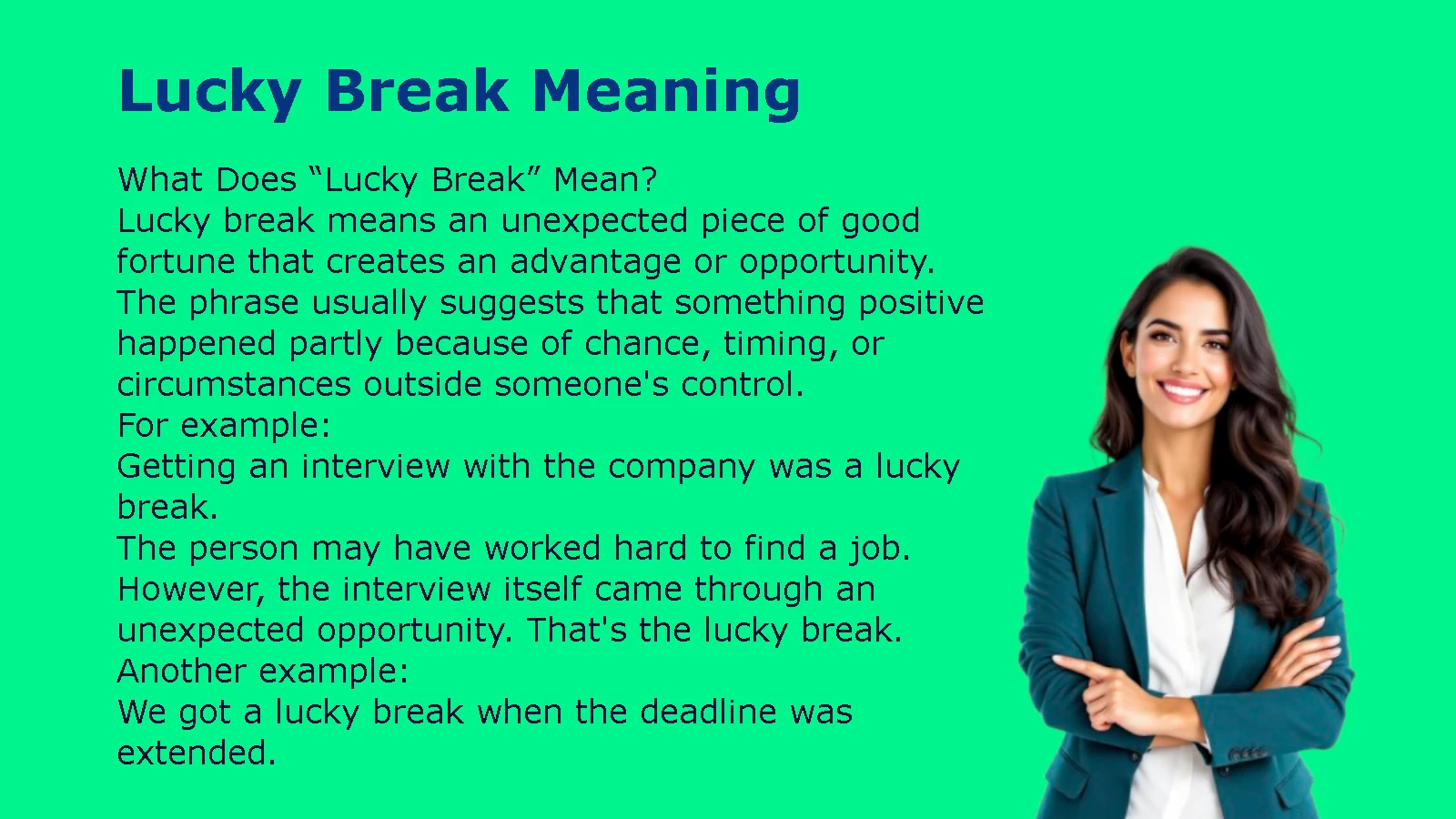
What Does “Lucky Break” Mean?
Lucky break means an unexpected piece of good fortune that creates an advantage or opportunity.
The phrase usually suggests that something positive happened partly because of chance, timing, or circumstances outside someone’s control.
For example:
Getting an interview with the company was a lucky break.
The person may have worked hard to find a job. However, the interview itself came through an unexpected opportunity. That’s the lucky break.
Another example:
We got a lucky break when the deadline was extended.
The extended deadline gave the group more time. It wasn’t necessarily something they planned, but it worked in their favor.
Simple definition of lucky break
A lucky break is an unexpected fortunate event or opportunity that helps someone succeed or improves their situation.
The expression can refer to an opportunity, a helpful coincidence, favorable timing, or an event that produces a surprisingly good result.
Wiktionary similarly describes lucky break as a stroke of luck, especially one that can help propel someone toward success or fame.
Lucky Break Meaning in Simple Words
In simple English, a lucky break is when something unexpectedly goes your way.
Think of it as a door opening at exactly the right moment.
You might have been working toward a goal for months. Then, suddenly, someone offers you an opportunity you didn’t expect. That opportunity becomes your lucky break.
For example:
- You meet a hiring manager by chance and get an interview.
- A publisher discovers your writing.
- A customer unexpectedly places a large order.
- A competitor makes a mistake that gives your team an advantage.
- You receive a scholarship after another student declines it.
- A difficult deadline gets extended at the perfect time.
In each case, chance creates an opening.
That doesn’t mean the person did nothing to deserve the opportunity. Often, hard work puts someone in a position where a lucky break can actually matter.
What Is the Meaning of “Lucky Break” in English?
The phrase has two important ideas built into it:
| Part | Meaning |
| Lucky | Fortunate or favorable |
| Break | An opportunity, advantage, or favorable change |
| Lucky break | An unexpected opportunity or favorable event |
The word break has several meanings in English. Here, it isn’t about breaking an object or taking a rest.
Merriam Webster lists a noun sense of break as a stroke of luck, particularly good luck. It also gives break the meaning of a favorable or opportune situation.
That’s why the phrase makes sense even though its literal words can seem confusing.
Is “Lucky Break” an Idiom?
Yes. Lucky break is an English idiom and noun phrase.
Its meaning isn’t simply the literal combination of lucky and break. The word break takes a figurative meaning related to chance, opportunity, or favorable circumstances.
Compare these two sentences:
She took a break from work.
Here, break means a period of rest.
She finally got a lucky break.
Here, break means an unexpected opportunity or favorable event.
The second use is figurative.
This is also why English learners can find expressions such as lucky break, big break, and catch a break confusing. The word break changes meaning depending on the context.
Examples of “Lucky Break” in a Sentence
The easiest way to understand the lucky break meaning is to see how people use it.
Career examples
Getting that interview was a lucky break after months of job hunting.
Her lucky break came when a senior editor noticed her portfolio.
He got a lucky break when the company created a new position.
In career contexts, the phrase often describes an opportunity that can help someone move forward.
Entertainment examples
Landing that role was his lucky break in Hollywood.
The young singer got a lucky break when a producer heard her perform.
That television appearance became her lucky break.
Entertainment is a particularly common setting for the expression because careers in acting, music, and writing often depend on opportunities that can arrive unexpectedly. Cambridge’s usage examples include actors and artists waiting for or receiving a lucky break.
Business examples
Finding that investor was a lucky break for the startup.
The company got a lucky break when a major retailer agreed to carry its product.
An unexpected referral gave the small business a lucky break.
Here, the phrase emphasizes an event that creates an advantage.
Education examples
Receiving the scholarship was a lucky break for her family.
Getting into the program after another student withdrew was a lucky break.
Meeting that professor turned out to be a lucky break.
Everyday examples
We got a lucky break when the rain stopped before the outdoor ceremony.
Finding my wallet before leaving the airport was a lucky break.
The extra hour gave us a lucky break.
Not every lucky break needs to be dramatic. Sometimes a small change in circumstances can make a big difference.
What Does “Get a Lucky Break” Mean?
Get a lucky break means to receive or experience an unexpected piece of good fortune.
The phrase often appears after someone has faced difficulty, uncertainty, or repeated disappointment.
For example:
After months of rejection, Maya finally got a lucky break when a publisher accepted her proposal.
The sentence suggests that Maya worked toward her goal but eventually received an unexpected opportunity.
Common patterns include:
- get a lucky break
- got a lucky break
- getting a lucky break
- get your lucky break
- finally get a lucky break
- give someone a lucky break
- wait for a lucky break
Collins examples include constructions such as “I got a bit of a lucky break” and references to someone getting their lucky break.
What Does “My Lucky Break” Mean?
My lucky break refers to the particular fortunate event or opportunity that helped someone.
For example:
My lucky break came when a recruiter found my old portfolio.
The speaker identifies a specific event as the turning point.
You can also use the phrase when telling a personal story:
I had been looking for work for months. Then I met an old colleague at a conference. That was my lucky break.
The expression works well here because it turns an ordinary event into the moment that changed the speaker’s circumstances.
How to Use “Lucky Break” Correctly
Because lucky break is a countable noun, you normally use an article or another determiner with the singular form.
Common correct patterns
- a lucky break
- the lucky break
- my lucky break
- his lucky break
- her lucky break
- their lucky break
- that lucky break
- one lucky break
For example:
She needed a lucky break.
That was the lucky break he had been waiting for.
Her lucky break came unexpectedly.
They finally got their lucky break.
The plural form is lucky breaks.
Some successful careers begin with several lucky breaks.
Common Collocations With “Lucky Break”
A collocation is a group of words that commonly appear together. Learning these combinations can make your English sound much more natural.
| Collocation | Example |
| get a lucky break | She finally got a lucky break. |
| have a lucky break | We had a lucky break. |
| catch a lucky break | The team caught a lucky break late in the game. |
| a lucky break came | A lucky break came when the buyer called. |
| a lucky break helped | The lucky break helped him recover. |
| a career lucky break | The opportunity became a career lucky break. |
| wait for a lucky break | Many performers wait for a lucky break. |
| a much needed lucky break | The extra funding was a much needed lucky break. |
| another lucky break | Another lucky break changed the outcome. |
| a major lucky break | The contract was a major lucky break. |
Cambridge identifies lucky break as a commonly used collocation and provides examples involving artists, actors, and favorable circumstances.
Lucky Break vs. Stroke of Luck
These expressions are close, but they don’t always emphasize the same thing.
A stroke of luck focuses on the fortunate event itself.
A lucky break often emphasizes the advantage or opportunity created by that good fortune.
| Expression | Main idea | Example |
| Lucky break | Unexpected opportunity or favorable event | Getting the audition was a lucky break. |
| Stroke of luck | Fortunate event or coincidence | Finding the missing document was a stroke of luck. |
| Good fortune | General state of being fortunate | Her success came through hard work and good fortune. |
| Good luck | Favorable circumstances or a wish for success | Good luck with your interview. |
Consider this distinction:
Finding the investor was a stroke of luck.
This emphasizes the fortunate coincidence.
Finding the investor was a lucky break for the company.
This emphasizes how the event gave the company an important advantage.
The meanings overlap, so either expression can sometimes work. The context determines which one sounds more precise.
Lucky Break vs. Big Break
Lucky break and big break are especially easy to confuse.
A big break is a major opportunity, often one that launches or significantly advances someone’s career.
A lucky break emphasizes unexpected good fortune.
| Phrase | Focus |
| Lucky break | Luck and favorable circumstances |
| Big break | A major opportunity or breakthrough |
| Lucky big break | A major opportunity that also resulted from luck |
For example:
Getting a small speaking role was a lucky break.
The role came unexpectedly and helped the actor.
Landing the lead role in a major film was her big break.
The second sentence focuses on the importance of the opportunity.
A big break can also be a lucky break. However, not every lucky break is a big break.
An extra week to finish a project could be a lucky break. It probably wouldn’t qualify as a career defining big break.
Lucky Break vs. Lucky Chance
Lucky chance and lucky break both involve favorable circumstances, but lucky break is more established as an English expression.
A lucky chance usually emphasizes the chance itself.
A lucky break often suggests that the chance creates an opening or advantage.
Compare:
By a lucky chance, I happened to meet her at the airport.
Meeting her at the airport was a lucky break because she offered me a job.
The first sentence focuses on the coincidence.
The second focuses on the opportunity that came from it.
Lucky Break vs. Good Fortune
Good fortune is broader than lucky break.
Good fortune can describe a person’s overall favorable circumstances:
She enjoyed good fortune throughout her career.
A lucky break usually refers to a specific event:
Her lucky break came when a major publisher accepted her first book.
In other words, good fortune can be a long running condition, while a lucky break is usually a particular fortunate event or opportunity.
Lucky Break Synonyms
Several expressions can replace lucky break, depending on the context.
Closest synonyms
- stroke of luck
- good break
- fortunate opportunity
- piece of good fortune
- fortunate turn of events
- lucky chance
- lucky strike
However, these aren’t perfect substitutes in every sentence.
More formal alternatives
If you’re writing a formal report, academic paper, or business document, you might prefer:
- fortunate opportunity
- unexpected advantage
- favorable development
- fortuitous opportunity
- favorable turn of events
For example:
Conversational:
Getting that referral was a lucky break.
More formal:
The referral provided an unexpected advantage.
The first sounds warmer and more conversational. The second sounds more professional and analytical.
What Is the Opposite of “Lucky Break”?
The most direct opposite is bad break.
A bad break describes an unfortunate event or circumstance that puts someone at a disadvantage.
Other possible opposites include:
- stroke of bad luck
- misfortune
- setback
- unfortunate turn of events
- unlucky break
For example:
Getting injured before the championship was a bad break for the athlete.
This mirrors the structure of lucky break but reverses the outcome.
The contrast becomes particularly clear in sports:
The team got a lucky break when the opposing player missed the penalty.
versus:
The team suffered a bad break when its goalkeeper was injured.
Can “Lucky Break” Describe a Career Opportunity?
Yes. Career opportunities are one of the clearest contexts for lucky break.
Someone might describe an unexpected introduction, job offer, audition, promotion, or discovery as a lucky break.
For example:
Her lucky break came when a hiring manager noticed her work online.
The internship was a lucky break that helped him enter the industry.
Getting that first client was a lucky break for the young consultant.
The phrase works particularly well when preparation and chance meet.
A person might spend years developing a skill. Then, one unexpected opportunity finally puts that skill in front of the right person.
The opportunity is the lucky break. The preparation makes it possible to use it.
Can “Lucky Break” Be Used in Business?
Absolutely.
Businesses often use lucky break when an unexpected development improves their position.
Examples include:
- An unexpected major customer
- A valuable referral
- A sudden increase in demand
- An investor discovering the company
- A competitor leaving a market
- A favorable partnership
- An unexpected media mention
- A supplier offering better terms
For example:
The small company got a lucky break when a national retailer placed its first large order.
The order isn’t merely good news. It represents an unexpected opportunity that could help the business grow.
Can “Lucky Break” Describe a Negative Event?
Normally, no.
The phrase lucky break carries a positive meaning. It describes something that benefits the person or group being discussed.
However, an event can be unfortunate for one person and a lucky break for another.
For example:
The competitor’s cancellation turned into a lucky break for our company because we received the contract instead.
The cancellation itself wasn’t fortunate for the competitor. It became fortunate for the other company.
This idea appears in Cambridge’s corpus examples as well. One example describes one person’s unlucky event becoming another person’s lucky break.
That distinction matters. The expression describes the benefit created by the circumstances, not necessarily an event that was universally positive.
Is “Lucky Break” Formal or Informal?
Lucky break is natural in everyday English and generally has a conversational, neutral tone.
You can use it in:
- Conversations
- Interviews
- Articles
- News writing
- Sports commentary
- Business stories
- Personal essays
- Informal professional communication
For highly formal writing, another expression may fit better.
Casual
I got a lucky break and found the perfect apartment.
Neutral
The company received a lucky break when demand increased unexpectedly.
More formal
The unexpected increase in demand provided a significant advantage.
There’s nothing wrong with lucky break in professional writing. The choice depends on the tone and audience.
“Lucky Break” in American English
In American English, lucky break is widely understandable and natural.
You’ll commonly encounter it when people talk about:
- Careers
- Sports
- Entertainment
- Business
- Competition
- Unexpected opportunities
- Personal success
The phrase also connects with another common expression: catch a break.
For example:
We finally caught a break.
This can mean that circumstances finally became favorable after a period of difficulty.
The more specific phrase lucky break makes the role of luck clearer.
Why Does “Break” Mean an Opportunity?
The key to understanding the phrase is the figurative meaning of break.
English uses break in many ways that have nothing to do with physically breaking something.
For example:
- break a record = exceed a previous record
- take a break = rest
- break free = escape
- break through = overcome an obstacle
- get a break = receive favorable treatment or an advantage
- get a big break = receive an important opportunity
Merriam Webster specifically lists break as a stroke of luck and as a favorable or opportune situation.
That figurative sense explains why lucky break feels natural to native speakers.
What Does “Give Someone a Lucky Break” Mean?
This construction deserves some care.
Give someone a break can mean giving them an opportunity, showing leniency, or treating them more favorably.
However, give someone a lucky break is less common than give someone a break or someone gets a lucky break.
For example:
The manager gave her a break by letting her apply without the usual experience.
More naturally, when luck itself is responsible, you might say:
She got a lucky break when the manager noticed her application.
The second sentence makes the role of chance clearer.
Lucky Break in Different Contexts
The expression can shift slightly depending on the situation.
| Context | What the lucky break usually means |
| Career | Unexpected job or professional opportunity |
| Entertainment | Discovery, role, audition, or career launching opportunity |
| Business | Unexpected customer, deal, investor, or advantage |
| Sports | Favorable bounce, call, mistake, or circumstance |
| Education | Scholarship, admission opportunity, or helpful connection |
| Travel | Unexpected assistance or favorable change |
| Everyday life | A fortunate event that solves or improves a problem |
The central idea remains the same: something unexpectedly favorable happens.
Lucky Break in Sports
Sports provide an especially clear example because chance can influence outcomes even when athletes prepare intensely.
Imagine a soccer team that is losing 1–0. In the final minute, the opposing goalkeeper makes an unusual mistake and the team scores.
You could say:
That mistake was a lucky break for the team.
The team still needed to take advantage of the opportunity. The favorable circumstance simply gave it a chance.
The same idea applies to:
- A favorable bounce
- An unexpected deflection
- An opponent’s mistake
- A fortunate call
- Sudden weather changes
- An unexpected opening
In sports, a lucky break doesn’t necessarily mean the team didn’t earn the final result. It means chance played a helpful role.
Lucky Break in Entertainment
Entertainment provides another classic setting.
An unknown actor might perform at a small venue. Someone connected to a major production happens to be there, notices the performance, and recommends the actor for an audition.
That opportunity could become the actor’s lucky break.
The important point is that the actor’s talent and preparation still matter. Luck simply creates the opening.
Cambridge’s examples specifically show lucky break in contexts involving actors and artists.
Lucky Break in Everyday Conversation
The expression doesn’t always need a dramatic story.
You can use it for ordinary situations:
We got a lucky break when the mechanic found the problem quickly.
I had a lucky break because someone turned in my lost phone.
Getting an earlier appointment was a lucky break.
The phrase adds a sense of relief and gratitude.
It often carries the feeling of:
Things could have gone badly, but somehow they worked out.
That’s one reason it sounds so natural in storytelling.
A Simple Case Study: How a Lucky Break Works
Consider a fictional job seeker named Alex.
Alex applies for dozens of positions but receives no offers. One afternoon, Alex attends a professional event simply to learn more about the industry.
There, Alex starts talking with someone who works at a company that isn’t currently advertising the position Alex wants.
The conversation leads to an introduction. The introduction leads to an interview. The interview leads to a job.
The entire sequence might be described as a lucky break.
But notice the full picture:
Preparation + opportunity + timing = lucky break
Without preparation, the opportunity might have gone nowhere.
Without the unexpected meeting, Alex might not have received the opportunity.
That’s the subtle meaning behind the expression. Luck opens the door, but someone still has to walk through it.
Common Mistakes With “Lucky Break”
Mistake: Using it for every success
Not every successful outcome is a lucky break.
She studied hard and passed the exam.
That’s normal success based primarily on preparation.
She passed the exam because the material she reviewed appeared heavily on the test.
That could be described as a lucky break if chance played a meaningful role.
Mistake: Treating “break” as a literal object
In lucky break, break doesn’t mean something physically breaking.
It refers to an opportunity or favorable turn.
Mistake: Assuming the opportunity must be huge
A lucky break doesn’t have to transform someone’s life.
An unexpected extension on a deadline can be a lucky break.
So can a career changing opportunity.
Mistake: Assuming luck means no effort
A lucky break often happens after considerable effort.
A musician may practice for years before someone important happens to hear a performance.
The chance encounter is the lucky break. The years of preparation still matter.
Lucky Break Examples for English Learners
Here are more natural examples showing different uses:
- She got a lucky break when the company reopened the application process.
- That unexpected referral was a lucky break.
- The team caught a lucky break in the final seconds.
- Getting that scholarship was a lucky break for him.
- Her lucky break came after a chance meeting with a producer.
- We had a lucky break when the storm changed direction.
- Finding a buyer so quickly was a lucky break.
- He needed a lucky break to get his career moving again.
- The extra funding gave the project a lucky break.
- Their lucky break came at exactly the right time.
- The young writer finally got a lucky break.
- A lucky break helped the small business survive its first year.
- Getting the last available seat was a lucky break.
- The athlete got a lucky break after the referee reversed the call.
- Meeting her future business partner was a lucky break.
How to Respond When Someone Says “I Got a Lucky Break”
If someone tells you, “I got a lucky break,” they’re usually sharing good news or explaining how something unexpectedly worked out.
Natural responses include:
- That’s great!
- I’m glad it worked out.
- Sounds like perfect timing.
- You really caught a break.
- That’s an amazing opportunity.
- Good for you!
- Sometimes you just need a little luck.
- What happened?
The best response depends on the conversation.
If someone is excited, celebrate with them. If they’re telling a story, ask what happened next.
Frequently Asked Questions About Lucky Break Meaning
What is the simple meaning of “lucky break”?
A lucky break is an unexpected fortunate event or opportunity that gives someone an advantage.
Is “lucky break” positive or negative?
Lucky break is positive. It describes circumstances that benefit someone or improve a situation.
Is “lucky break” an idiom?
Yes. Lucky break is an English idiom in which break has a figurative meaning connected with luck and opportunity.
What is another word for “lucky break”?
Common alternatives include stroke of luck, good break, fortunate opportunity, piece of good fortune, and fortunate turn of events.
What is the opposite of “lucky break”?
The closest opposite is bad break. Other alternatives include misfortune, setback, and stroke of bad luck.
What does “get a lucky break” mean?
Get a lucky break means to experience or receive an unexpected opportunity or favorable event.
What does “my lucky break” mean?
My lucky break refers to a specific fortunate event or opportunity that benefited the speaker.
Is “lucky break” the same as “big break”?
Not exactly. A lucky break emphasizes unexpected good fortune, while a big break emphasizes a major opportunity. One event can be both.
Is “lucky break” the same as “stroke of luck”?
They’re very similar. Stroke of luck emphasizes fortunate chance, while lucky break often emphasizes the advantage or opportunity created by that chance.
Can “lucky break” describe a job opportunity?
Yes. For example:
Getting the interview was a lucky break.
The expression works especially well when the opportunity arrives unexpectedly.
Can “lucky break” be used in formal writing?
Yes, although it has a conversational feel. In highly formal writing, expressions such as fortunate opportunity or unexpected advantage may fit better.
Does a lucky break mean someone didn’t work hard?
No. It only means that luck or favorable circumstances played a meaningful role. Someone can work extremely hard and still get a lucky break.
Final Takeaway: Lucky Break Meaning
The lucky break meaning is simple once you understand the figurative use of break.
A lucky break is an unexpected fortunate event, opportunity, or turn of circumstances that gives someone an advantage. It can help someone land a job, advance a career, win a competition, grow a business, solve a problem, or simply avoid a difficult outcome. Collins defines it as a fortunate and unexpected turn of events, while Merriam Webster connects break with both good luck and favorable opportunity.
The phrase is closely related to stroke of luck, good fortune, and big break, but each expression has its own emphasis.
The easiest way to remember it is this:
A lucky break is when chance opens a door in your favor.
And when that door opens, what you do next is up to you.