“Good catch” means noticing, finding, or correcting something that someone else might have missed. It is a common informal phrase used to praise someone for spotting a mistake, problem, detail, or potential issue.
If you’re searching for “good catch meaning,” “what does good catch mean,” or “good catch definition,” you’re likely looking for its simple meaning and how to use it in a sentence. In everyday English, good catch is often used to compliment someone who pays attention and notices something important. It can also have a literal meaning when someone successfully catches an object, such as a ball.
| Question | Answer |
|---|---|
| What does good catch mean? | It means noticing or correcting something that someone else missed. |
| What is the meaning of good catch? | A way to praise someone for spotting an important detail or mistake. |
| Is good catch a compliment? | Yes, it is usually a positive way to praise someone’s attention or quick thinking. |
| What is a synonym for good catch? | Nice observation, good spot, well noticed, or good eye. |
What Does “Good Catch” Mean?
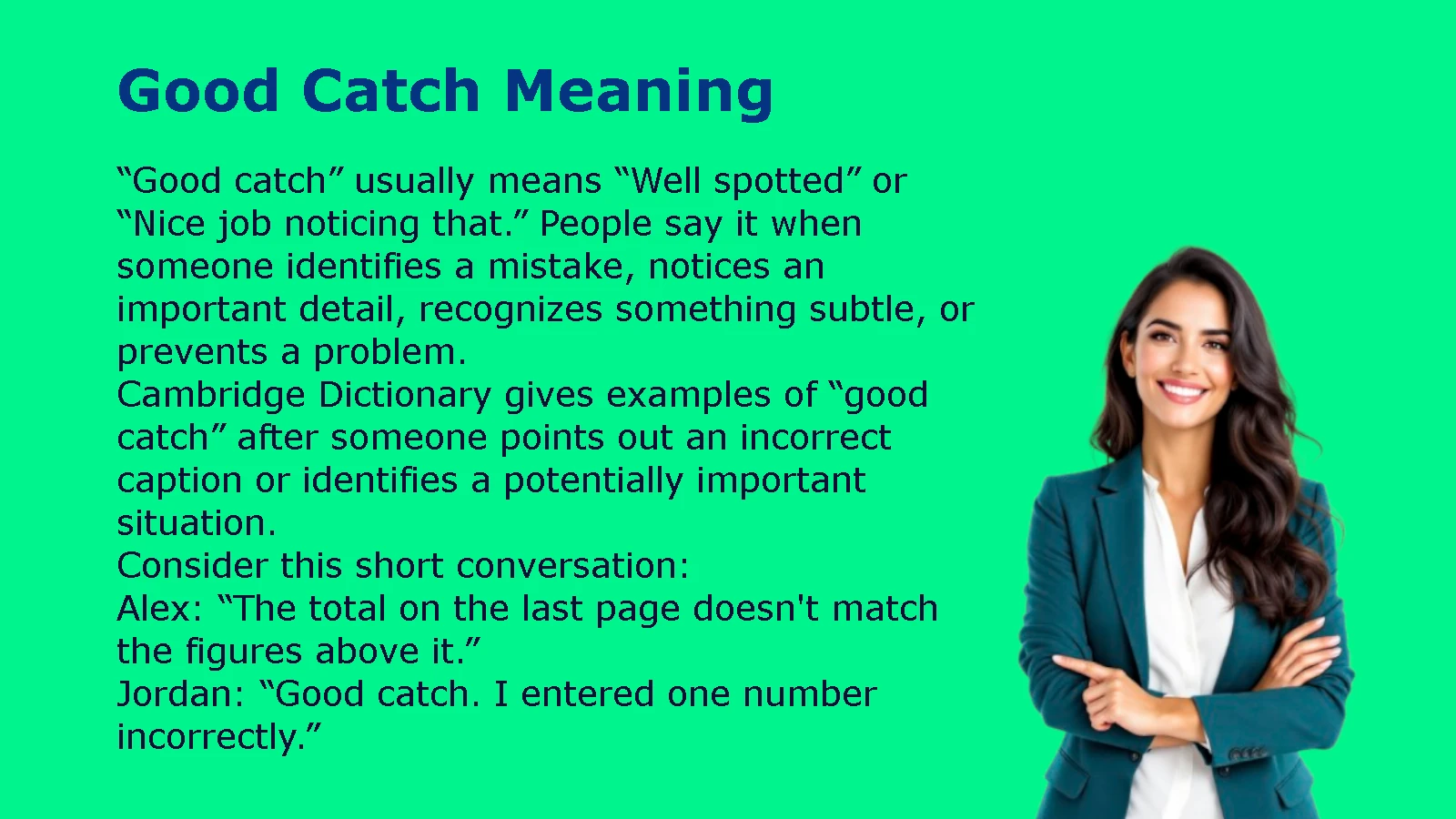
“Good catch” usually means “Well spotted” or “Nice job noticing that.” People say it when someone identifies a mistake, notices an important detail, recognizes something subtle, or prevents a problem.
Cambridge Dictionary gives examples of “good catch” after someone points out an incorrect caption or identifies a potentially important situation.
Consider this short conversation:
Alex: “The total on the last page doesn’t match the figures above it.”
Jordan: “Good catch. I entered one number incorrectly.”
Jordan uses “good catch” to recognize Alex’s attention to detail.
The phrase carries a small but meaningful compliment. It tells someone, in effect:
- You noticed something I missed.
- That was worth pointing out.
- You prevented a possible problem.
- You were paying attention.
- Nice work spotting that.
“Good Catch” Means More Than Finding a Mistake
Although people often use the expression when someone discovers an error, a mistake isn’t required.
You can say “good catch” when someone notices a connection, clue, pattern, detail, or opportunity that isn’t immediately obvious.
For example:
Maya: “The two paintings use the same symbol in the background.”
Chris: “Good catch. I hadn’t noticed that.”
Nothing was necessarily wrong with the paintings. Chris simply noticed something subtle.
That distinction matters because learners sometimes assume that “good catch” always means “you found my mistake.” It doesn’t.
It can simply mean “You noticed something valuable or easy to overlook.”
The Main Meanings of “Good Catch”
The phrase has several related meanings. They all share the basic idea of catching something before it gets away or goes unnoticed.
Good Catch for Noticing a Mistake
This is one of the most common figurative uses.
When someone finds a typo, incorrect number, missing word, wrong date, or other error, “Good catch!” praises that person for noticing it.
For example:
- “Good catch! The meeting is actually on Thursday.”
- “Good catch. I wrote the wrong address.”
- “That’s a good catch. The formula was missing a value.”
- “Good catch on the typo in the headline.”
- “Thanks. Good catch!”
The phrase works especially well because mistakes can be easy to overlook. Someone has effectively caught the error before it caused trouble.
This is why the expression appears naturally in workplaces, classrooms, editing conversations, software discussions, and everyday chats.
Good Catch for Spotting an Important Detail
You can also use “good catch” when someone notices something that isn’t necessarily wrong.
Imagine a friend watching a movie and noticing a small reference to an earlier scene.
“Good catch. I completely missed that.”
Here, the speaker praises the friend’s observation.
Similarly:
“Good catch on the date. The event page does say Friday.”
The person didn’t necessarily correct a major error. They simply noticed a detail that mattered.
Good Catch in Sports
The literal meaning is much more straightforward.
A catch is the act of successfully taking hold of something that has been thrown or hit through the air. In sports such as baseball and cricket, a catch can have a direct effect on the game. Cambridge Dictionary includes this sports meaning and gives examples involving baseball and football.
For example:
- “That was a good catch!”
- “He made a good catch in the outfield.”
- “What a good catch!”
- “She made a difficult catch near the sideline.”
In this context, “good catch” praises physical skill rather than observation.
Good Catch as a Desirable Romantic Partner
There is another established meaning that can surprise English learners.
When someone says:
“He’s a good catch.”
they can mean that he would be a desirable romantic partner.
Likewise:
“She’s a great catch.”
This usually suggests that the person has qualities that make them attractive as a potential partner. Those qualities might include kindness, intelligence, reliability, personality, attractiveness, career success, or other traits.
The Free Dictionary’s idiom entry lists “a good catch” as a person considered an excellent or ideal romantic partner.
This meaning is different from “Good catch!”
Compare these two sentences:
| Sentence | Meaning |
| “Good catch!” | You noticed something important. |
| “He’s a good catch.” | He’s a desirable romantic partner. |
The tiny difference in structure changes the meaning dramatically.
Why Does “Good Catch” Mean “You Noticed Something”?
The figurative meaning becomes easier to understand when you think about the basic idea of catching.
When you physically catch a ball, you prevent it from falling or escaping. In figurative language, you can also catch an error, clue, detail, or problem before it gets overlooked.
For example:
Physical:
“You caught the ball.”
Figurative:
“You caught the mistake.”
The second sentence doesn’t mean you grabbed the mistake with your hands. It means you noticed it.
That figurative idea appears in ordinary English expressions involving catching something with your attention. Cambridge Dictionary also provides the example “Thanks for pointing out … Good catch!” in its entry for catch.
The metaphor is simple: your attention catches something before it gets away.
Is “Good Catch” an Idiom?
Yes, “good catch” can function as an idiomatic expression when it has a figurative meaning.
The literal use is easy to understand. Someone catches a ball, and the catch is good.
The figurative use is different. You aren’t physically catching an error or observation. You’re recognizing someone’s ability to notice something.
For example:
“Good catch. I didn’t notice the missing decimal point.”
Here, “catch” means something like discovery, observation, or identification.
However, the phrase doesn’t have a completely unrelated meaning. Its figurative sense grows naturally from the literal idea of catching something.
That’s what makes the expression easy to understand once you see the connection.
How to Use “Good Catch” Correctly
The easiest way to use “good catch” is as a short standalone response.
“Good Catch!” as a Standalone Expression
You can simply say:
“Good catch!”
This works when the context already makes the meaning clear.
For example:
Sam: “The invoice says $1,800, but the spreadsheet says $1,080.”
Taylor: “Good catch!”
The short response is enough.
“Good Catch on…” for a Specific Detail
You can identify exactly what someone noticed by using “good catch on.”
Examples:
- “Good catch on that typo.”
- “Good catch on the incorrect date.”
- “Good catch on the missing attachment.”
- “Good catch on that number.”
- “Good catch on the duplicate entry.”
This pattern is especially useful in workplace and team conversations.
“That Was a Good Catch”
You can also use the longer form:
“That was a good catch.”
This often sounds slightly more reflective than the quick “Good catch!”
For example:
“That was a good catch. We could have sent the report with the wrong figures.”
The longer version lets you explain why the observation mattered.
“Thanks for Catching That”
Sometimes you want to emphasize gratitude.
“Thanks for catching that.”
This is extremely natural when someone identifies a problem for you.
Compare:
- “Good catch!” — short praise
- “Thanks for catching that.” — appreciation
- “Good catch. Thanks for pointing it out.” — praise plus thanks
All three can work in similar situations.
“Good Catch” Examples in Everyday English
The best way to understand the phrase is to see how it behaves in real situations.
Example: Finding a Typo
Emma: “There is a spelling mistake in the second paragraph.”
Liam: “Good catch. I’ll fix it.”
Here, Liam praises Emma for noticing an error.
Example: Finding a Wrong Date
Nora: “The invitation says June 18, but the event is June 19.”
Ben: “Good catch. I’ll change it before we send it.”
The phrase acknowledges a potentially important mistake.
Example: Finding a Missing Detail
Ava: “The form doesn’t ask for the customer’s phone number.”
Mark: “Good catch. We need that field.”
Ava has noticed an omission rather than a spelling mistake.
Example: Spotting Something Subtle
Jake: “That character appears in the first scene too.”
Mia: “Good catch. I didn’t notice him the first time.”
Again, there isn’t necessarily an error. Mia is praising Jake’s observation.
Example: A Sports Catch
“The center fielder jumped at the wall and made a good catch.”
This is the literal meaning. The player physically caught the ball.
Example: A Relationship
“Your sister is a good catch. She’s smart, funny, and kind.”
Here, the phrase describes a person as a desirable romantic partner.
“Good Catch” in the Workplace
“Good catch” fits naturally into many workplace conversations, especially informal team communication.
People commonly use it when reviewing:
- reports
- spreadsheets
- presentations
- emails
- schedules
- invoices
- code
- contracts
- designs
- data
- project plans
For example:
“Good catch on the duplicate customer record.”
Or:
“Good catch. The deadline in the presentation doesn’t match the project schedule.”
In a team environment, this phrase can do more than praise someone. It can reinforce careful work.
A person who hears “good catch” after finding a problem knows that their attention prevented an issue from moving further down the line.
A Workplace Case Study
Imagine a marketing team preparing a product announcement.
One employee reviews the final draft and notices that the launch date says September 18. The approved schedule says September 19.
She points it out before publication.
The team lead responds:
“Good catch. We would’ve had to correct the announcement after publishing.”
That response recognizes two things:
- She paid attention to a small detail.
- Her observation prevented a larger problem.
This is exactly where “good catch” shines.
Is “Good Catch” Formal or Informal?
“Good catch” is generally informal and conversational.
It’s perfectly natural in:
- text messages
- team chats
- casual emails
- meetings
- conversations with coworkers
- classroom discussions
- conversations with friends
However, a highly formal document may call for a different expression.
For example, instead of writing:
“Good catch on the discrepancy.”
in a formal report, you might write:
“Thank you for identifying the discrepancy.”
Or:
“Thank you for bringing this issue to our attention.”
The choice depends on your audience.
| Setting | Natural choice |
| Text message | Good catch! |
| Team chat | Good catch on that number. |
| Casual workplace conversation | Good catch. |
| Formal email | Thanks for pointing that out. |
| Formal report | Thank you for identifying the discrepancy. |
| Academic writing | This observation identifies an important discrepancy. |
The phrase isn’t grammatically wrong in formal communication. It simply has a conversational flavor.
“Good Catch” vs. “Nice Catch”
“Good catch” and “nice catch” overlap heavily, but they aren’t always used in exactly the same way.
When someone spots an error, both can work:
“Good catch. The date is wrong.”
“Nice catch. The date is wrong.”
When someone physically catches a ball, both also work:
“Good catch!”
“Nice catch!”
The difference is mostly one of tone.
“Nice catch” can sound especially natural when praising a physical catch or a quick observation.
“Good catch” is extremely common when someone discovers an error or important detail.
Both are natural expressions.
“Good Catch” vs. “Good Eye”
These expressions are similar because both can praise someone’s ability to notice things.
However, there is a subtle difference.
“Good catch” usually emphasizes the thing someone successfully noticed.
“Good eye” emphasizes the person’s ability to see or recognize details.
Compare:
“Good catch. The price on the final page is wrong.”
“Good eye. You noticed the tiny signature in the corner.”
The first focuses on catching a potential problem.
The second focuses more directly on perceptiveness.
Other Useful Alternatives
Depending on the situation, you can also say:
- Nice find.
- Well spotted.
- Good observation.
- Good point.
- Thanks for pointing that out.
- Thanks for catching that.
- Nice job spotting that.
- Great observation.
- Excellent find.
- You noticed that quickly.
Don’t treat these as perfect synonyms. Each carries a slightly different tone.
“Good Catch” vs. “Good Job”
“Good job” is broader than “good catch.”
You can say “good job” after almost any successful task:
“Good job on the presentation.”
But “good catch” usually connects specifically to noticing, identifying, finding, or physically catching something.
Compare:
“Good job.”
Broad praise for successful work.
“Good catch.”
Praise for noticing, identifying, or catching something.
If someone finds a hidden error in your spreadsheet, “good catch” tells them exactly what they did well.
What Does “Good Catch” Mean in Texting?
In texting, “good catch” usually means:
“Nice job noticing that.”
It can be especially useful because the phrase is short and friendly.
For example:
A: “Your message says Tuesday, but you told me Wednesday earlier.”
B: “Good catch 😂”
Or:
A: “The link you sent has an extra letter in it.”
B: “Oh wow, good catch!”
The tone can range from professional to playful depending on the conversation.
Can “Good Catch” Be Sarcastic?
Yes. Tone and context can change the meaning of almost any short compliment.
Someone might say:
“Good catch.”
sincerely after you notice an important problem.
But a sarcastic speaker could say the same words after someone notices something extremely obvious.
For example:
“Good catch. The sign literally says ‘Closed.’”
The words appear positive, but the situation makes the sarcasm clear.
In written communication, sarcasm can be difficult to detect because you can’t hear the speaker’s voice or see their facial expression.
So, when communicating professionally, use “good catch” sincerely and avoid relying on sarcasm.
What Does “A Good Catch” Mean When Talking About a Person?
This is one of the most important distinctions to understand.
“A good catch” can describe someone who is considered a desirable romantic partner.
For example:
“He’s a good catch.”
This could suggest that he is kind, successful, intelligent, attractive, dependable, or has other qualities that make him appealing as a partner.
The phrase doesn’t have to refer only to physical attractiveness.
Someone might say:
“She’s a good catch because she’s thoughtful, reliable, and incredibly funny.”
The expression can therefore describe a person’s overall appeal as a potential partner.
Why This Meaning Can Cause Confusion
Compare these:
“Good catch!”
and
“He’s a good catch.”
The first usually praises an action or observation.
The second describes a person.
That tiny grammatical difference is important.
| Expression | Meaning |
| Good catch! | Nice job noticing or catching something. |
| That was a good catch. | The catch was successful or impressive. |
| He’s a good catch. | He’s a desirable romantic partner. |
| She’s quite a catch. | She’s considered highly desirable as a partner. |
The romantic meaning is well established in English dictionaries and idiom references.
Can “Good Catch” Mean a Good Find?
Yes, in some contexts, “good catch” can refer to finding something valuable or worthwhile.
For example:
“That vintage jacket was a good catch.”
Here, the speaker means the person found or obtained something valuable.
However, “good find” is usually more natural when you’re specifically talking about discovering an item.
For example:
“That’s a good find.”
sounds more straightforward than:
“That’s a good catch.”
The latter can work, but the exact meaning depends heavily on context.
Common Mistakes With “Good Catch”
Understanding what not to do can make the expression much easier to use.
Mistake: Assuming It Always Means a Mistake
Someone can say “good catch” even when nothing is wrong.
“Good catch. I never noticed that hidden detail.”
The person noticed something interesting, not necessarily an error.
Mistake: Confusing “Good Catch” With “Good Catch!”
The punctuation isn’t the main issue. Context matters more.
“Good catch!” often works as a quick reaction.
“That was a good catch.” works as a complete statement about an action or observation.
Mistake: Confusing It With “A Good Catch”
Don’t assume:
“She’s a good catch.”
means:
“She noticed something well.”
It means she is considered a desirable romantic partner.
Mistake: Using It Everywhere Instead of “Good Job”
“Good catch” has a narrower meaning.
If someone finishes a difficult project, saying “good catch” would sound strange unless they caught or noticed something specific.
Use:
“Good job on the project.”
instead.
Use:
“Good catch on that error.”
when the person identified something.
What Is the Opposite of “Good Catch”?
There isn’t one fixed opposite expression.
The best choice depends on what was missed.
If someone failed to notice an error, you might say:
- “You missed that.”
- “That slipped through.”
- “We overlooked that.”
- “Nobody caught it.”
- “We didn’t spot it in time.”
If someone fails to catch a ball, you might simply say:
- “He missed the catch.”
- “She dropped it.”
- “That was a difficult catch.”
English doesn’t have one universal opposite of “good catch” because the phrase covers several different situations.
Frequently Asked Questions About “Good Catch”
What does “good catch” mean in simple words?
“Good catch” means “Nice job noticing that” or “Well spotted.” It can also describe a successful physical catch.
Is “good catch” a compliment?
Yes. “Good catch” is normally a positive expression. It praises someone’s attention, observation, quick thinking, or physical skill.
Can I say “good catch” when someone finds a mistake?
Yes. This is one of its most common figurative uses.
“Good catch. I didn’t notice the typo.”
Does “good catch” mean “good job”?
Sometimes, but the meanings aren’t identical. “Good job” is much broader. “Good catch” specifically highlights something someone noticed, found, or caught.
Is “good catch” formal?
It’s generally informal and conversational. It’s natural in everyday speech and casual workplace communication. A more formal setting may call for phrases such as “Thank you for pointing that out” or “Thank you for identifying the issue.”
What does “he’s a good catch” mean?
It means he is considered a desirable romantic partner. The phrase can refer to qualities such as personality, character, intelligence, attractiveness, reliability, or success.
What does “good catch” mean in sports?
It means someone successfully caught a ball or another object, often in a way that required skill.
Can “good catch” be sarcastic?
Yes. Tone and context can make the phrase sarcastic. In normal use, however, it is sincere praise.
What are some synonyms for “good catch”?
Depending on the context, you can use:
- Nice catch
- Good eye
- Nice find
- Well spotted
- Good observation
- Good point
- Thanks for catching that
- Thanks for pointing that out
- Great catch
- Excellent find
Quick Reference: Good Catch Meaning
| Context | Meaning | Example |
| Finding a mistake | You noticed an error | “Good catch. The total was wrong.” |
| Spotting a detail | You noticed something others missed | “Good catch. I missed that reference.” |
| Workplace review | You identified a possible problem | “Good catch on the duplicate entry.” |
| Sports | You caught something successfully | “That was a good catch!” |
| Finding something valuable | You found something worthwhile | “That was a good catch at the store.” |
| Dating | Someone is a desirable partner | “He’s a good catch.” |
Final Thoughts on “Good Catch” Meaning
“Good catch” is a short expression with several closely related meanings. Most often, it praises someone for noticing something important, especially an error, missing detail, or problem that could have gone unnoticed.
You can also use it literally when someone makes a successful catch in sports or another physical activity. In a different grammatical structure, “a good catch” can describe someone who would make a desirable romantic partner.
The easiest way to remember the main figurative meaning is this:
If someone catches something that others might have missed, you can say, “Good catch!”
Think of it like catching a ball. The ball is moving quickly, and someone gets there in time. In conversation, the “ball” might be a typo, a missing number, a hidden detail, or a useful observation.
So when someone points out a problem before it becomes a bigger problem, “Good catch!” is often exactly the right response.