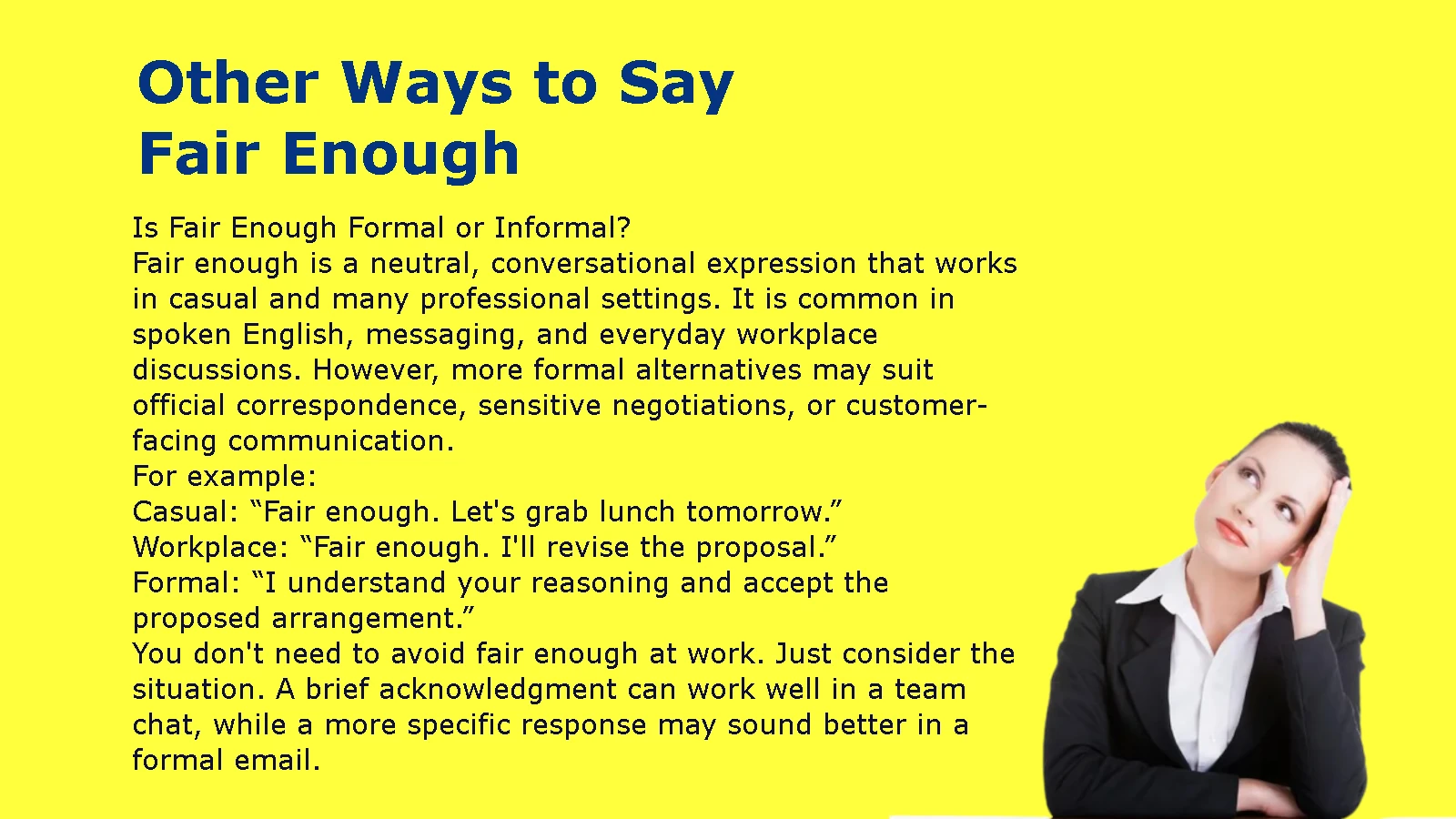
“Other ways to say fair enough” include that makes sense, fair point, that’s reasonable, I see your point, and that works for me. Each expression communicates a slightly different kind of agreement, understanding, or acceptance. The best choice depends on whether you want to acknowledge someone’s opinion, accept a decision, respond to an explanation, or keep a conversation friendly.
The phrase fair enough is common in everyday English, workplace conversations, text messages, and online discussions. People use it to recognize that another person’s reasoning is understandable, even when they don’t completely agree. However, tone matters: a friendly “Fair enough!” can sound cooperative, while a flat “Fair enough.” may feel distant or dismissive.
This guide explains the meaning of fair enough, its most useful synonyms, casual slang alternatives, and examples of fair enough in a sentence. You’ll also learn when the phrase sounds rude, how to translate it naturally into Tagalog, and how to choose an alternative that fits your situation.
What Does “Fair Enough” Mean?
Fair enough means that something is reasonable, understandable, or acceptable under the circumstances. People often use it to acknowledge another person’s explanation, opinion, decision, or excuse without necessarily agreeing with every detail. The phrase can express genuine agreement, polite acceptance, or reluctant acknowledgment, depending on the context.
For example, if a friend cancels dinner because they feel exhausted after work, you might reply, “Fair enough. We can meet another day.” Your response shows that you understand the reason and accept the change of plans.
However, fair enough doesn’t always mean complete agreement. You might accept someone’s explanation while maintaining a different opinion.
How Fair Enough Expresses Agreement or Acceptance
The expression performs several conversational functions.
- Acknowledging a reasonable point: “Fair enough. I hadn’t thought about it that way.”
- Accepting a decision: “Fair enough. I’ll follow the new schedule.”
- Understanding an excuse: “Fair enough. You had a lot going on this week.”
- Compromising: “Fair enough. Let’s split the cost.”
- Ending a disagreement peacefully: “Fair enough. We can agree to disagree.”
The key distinction is that understanding doesn’t always mean agreement. You can recognize why someone made a decision without believing it was the best decision.
For instance:
Person A: “I prefer taking the train because driving through traffic takes too long.”
Person B: “Fair enough, but I still prefer driving.”
B acknowledges the reasoning while keeping a different preference.
Fair Enough vs. “That’s Fair” vs. “That Makes Sense”
These expressions overlap, but they don’t always communicate the same message.
| Expression | Meaning | Best situation |
| Fair enough | That is reasonable or acceptable | Acknowledging a decision or explanation |
| That’s fair | That seems just or reasonable | Recognizing a balanced argument or compromise |
| That makes sense | I understand the reasoning | Responding to an explanation |
| Fair point | Your argument has merit | Acknowledging a valid argument |
| I agree | I share your opinion | Expressing direct agreement |
| Sounds good | I accept the suggestion | Confirming a plan |
| I see your point | I understand your perspective | Responding to a different opinion |
Is Fair Enough Formal or Informal?
Fair enough is a neutral, conversational expression that works in casual and many professional settings. It is common in spoken English, messaging, and everyday workplace discussions. However, more formal alternatives may suit official correspondence, sensitive negotiations, or customer-facing communication.
For example:
- Casual: “Fair enough. Let’s grab lunch tomorrow.”
- Workplace: “Fair enough. I’ll revise the proposal.”
- Formal: “I understand your reasoning and accept the proposed arrangement.”
You don’t need to avoid fair enough at work. Just consider the situation. A brief acknowledgment can work well in a team chat, while a more specific response may sound better in a formal email.
Other Ways to Say Fair Enough
The best alternatives to fair enough depend on what you want to communicate. Some phrases emphasize understanding, others show agreement, and a few indicate that you’re willing to accept a situation even if it isn’t ideal.
Here are useful alternatives organized by tone and purpose.
Polite Ways to Say Fair Enough
Use these expressions when you want to acknowledge someone’s reasoning without sounding dismissive.
| Alternative | Meaning | Example |
| That’s understandable | I can understand your situation | “That’s understandable. Take the time you need.” |
| I can understand that | Your reason makes sense to me | “I can understand that. You’ve had a busy week.” |
| That’s reasonable | Your suggestion seems acceptable | “That’s reasonable. Let’s use your approach.” |
| I see your point | I understand your argument | “I see your point about the additional cost.” |
| That makes sense | I understand the logic | “That makes sense. We should check the figures first.” |
| I can appreciate that | I recognize your concern or perspective | “I can appreciate that. The change affects everyone.” |
That’s understandable works particularly well when someone explains a personal difficulty. It acknowledges their circumstances rather than simply accepting a decision.
For example:
Coworker: “I won’t be able to finish the report today because two urgent requests came in.”
You: “That’s understandable. Send it tomorrow morning instead.”
By contrast, that’s reasonable works well when evaluating a proposal, price, deadline, or compromise. It suggests that the arrangement meets an acceptable standard.
Casual Ways to Say Fair Enough
These expressions fit everyday conversations with friends, relatives, classmates, and familiar coworkers.
| Alternative | Tone | Example |
| Fair point | Casual and thoughtful | “Fair point. I missed that detail.” |
| Makes sense | Relaxed and natural | “Makes sense. I’ll take the earlier train.” |
| That’s fair | Friendly and neutral | “That’s fair. You did most of the work.” |
| Got it | Brief and direct | “Got it. I’ll meet you there.” |
| I hear you | Understanding and empathetic | “I hear you. That sounds frustrating.” |
| Sounds good | Positive and cooperative | “Sounds good. See you at six.” |
| No worries | Reassuring and informal | “No worries. We can reschedule.” |
Although these phrases often replace fair enough, their meanings differ slightly.
For example, got it confirms that you’ve received or understood information. It doesn’t necessarily mean you agree with it. Similarly, sounds good generally signals a positive response to a suggestion rather than a neutral acknowledgment of someone’s reasoning.
Choose the expression that reflects your actual reaction.
Professional Ways to Say Fair Enough
In professional communication, your response should make it clear whether you understand an explanation, approve a proposal, or accept an instruction.
These alternatives work well in emails, meetings, project discussions, and conversations with clients.
- Understood. Use it to acknowledge instructions or information.
- That seems reasonable. Use it when evaluating a proposal.
- I agree with that assessment. Use it when you genuinely share someone’s judgment.
- That works for me. Use it to accept a schedule or arrangement.
- I can accept that. Use it to communicate acceptance, especially during a negotiation.
- I understand your reasoning. Use it when acknowledging someone’s explanation.
- That approach sounds appropriate. Use it when discussing a proposed method or solution.
- I appreciate the clarification. Use it when someone explains a confusing issue.
For example, imagine a colleague proposes moving a meeting from Monday to Wednesday because several team members will be unavailable.
You could reply:
“Fair enough. Wednesday works for me.”
For a more formal email, you might write:
“I understand the scheduling constraints. Wednesday works for me, and I’ll update my calendar accordingly.”
The second response identifies the practical next step. That added detail makes professional communication clearer.
Ways to Say Fair Enough When You Partly Agree
Sometimes you understand someone’s argument but don’t completely share their conclusion. In these situations, you need a phrase that acknowledges their perspective without pretending to agree.
Try these alternatives:
- I see where you’re coming from.
- I can see that.
- That’s a valid point.
- I hadn’t considered that.
- I can appreciate that perspective.
- You make a good point.
- I understand why you’d think that.
Consider this example:
Person A: “We should spend more money on advertising because our competitors are getting more attention.”
B: “I see where you’re coming from, but I’d like to review our current conversion rate first.”
B recognizes the argument without agreeing to spend more money immediately.
This approach is useful in meetings, negotiations, and disagreements. It keeps the conversation open while allowing you to explain your own position.
One important distinction: “I hadn’t considered that” specifically suggests that someone has introduced an idea you hadn’t previously thought about. Don’t use it if you’ve already considered and rejected the argument.
Ways to Say Fair Enough When Accepting a Decision
Use these alternatives when you want to accept a plan, ruling, change, or outcome.
| Alternative | What it communicates | Example |
| That works for me | Agreement with an arrangement | “That works for me. Let’s start at nine.” |
| I can live with that | Acceptance despite some reservations | “I can live with that price.” |
| I understand your decision | Recognition of someone’s choice | “I understand your decision to postpone the launch.” |
| That’s acceptable | Formal or neutral acceptance | “That’s acceptable, provided we finish by Friday.” |
| Sounds good to me | Positive acceptance | “Sounds good to me. I’ll book the room.” |
| I’ll go along with that | Willingness to follow a decision | “I’ll go along with that plan for now.” |
The phrase I can live with that often suggests that the outcome isn’t perfect but remains tolerable. It can sound humorous, reluctant, or mildly dissatisfied.
For instance:
“Would you be okay with moving the meeting to 7:30 a.m.?”
“I can live with that, although I’d prefer a later start.”
This response communicates acceptance without hiding your preference.
Quick Comparison of Fair Enough Synonyms
The following table helps you choose a synonym based on the message you want to convey.
| If you want to… | Say… |
| Show understanding | “That makes sense.” |
| Acknowledge a good argument | “Fair point.” |
| Accept a decision | “I understand.” |
| Agree to a plan | “That works for me.” |
| Sound considerate | “That’s understandable.” |
| Remain professional | “Understood.” |
| Accept an imperfect outcome | “I can live with that.” |
| Express genuine agreement | “I agree with that.” |
| Recognize someone’s feelings | “I hear you.” |
| End a minor disagreement | “That’s fair.” |
Remember that synonyms aren’t always interchangeable. “I agree” communicates stronger agreement than “fair enough,” while “I hear you” emphasizes listening and understanding.
Fair Enough Synonyms in Slang
People often search for a fair enough synonym in slang because they want a response that sounds natural in text messages, online conversations, or casual speech.
Slang can make your response feel relaxed and familiar. However, expressions vary by age, region, and social group. Some also communicate stronger enthusiasm or indifference than fair enough.
Popular Slang Alternatives to Fair Enough
Here are several informal expressions and examples of how people use them.
| Slang expression | Typical meaning | Example |
| Bet | Okay, agreed, or understood | “Meet me at eight.” “Bet.” |
| Valid | Reasonable or understandable | “I need a quiet weekend.” “Valid.” |
| True | I agree that something is correct | “That place is expensive.” “True.” |
| Aight | All right or okay | “I’ll text you later.” “Aight.” |
| Say less | I understand; no further explanation needed | “I’ll bring food.” “Say less.” |
| That’s real | That feels genuine or understandable | “Work has been exhausting.” “That’s real.” |
| No cap | Honestly or without exaggeration | “That was the best meal I’ve had all year, no cap.” |
These expressions can overlap with fair enough, but they don’t all mean the same thing.
Bet often communicates agreement or confirmation. Valid acknowledges that a feeling or argument is reasonable. Say less suggests that the speaker understands and doesn’t need more explanation. True usually signals agreement with a statement.
For example:
Friend A: “I’m staying home tonight. I’m too tired to go out.”
Friend B: “Valid. Let’s hang out this weekend instead.”
Here, “valid” recognizes the friend’s decision as understandable.
When to Use Slang Instead of Fair Enough
Slang works best when you know the other person understands your conversational style.
Use it in situations such as:
- Texting friends about weekend plans.
- Reacting to a funny or relatable social media post.
- Agreeing with someone in a casual group chat.
- Acknowledging a friend’s personal preference.
- Responding to familiar people in an informal setting.
For example:
Friend: “I’m saving money, so I’m skipping the concert.”
You: “Valid. Tickets are expensive anyway.”
The reply feels casual and supportive.
However, slang may not fit a client email, job interview, formal complaint, or sensitive workplace discussion. In those situations, “That makes sense” or “I understand” usually communicates the same basic acknowledgment more clearly.
Which Slang Alternatives Sound Natural in Text Messages?
The best expression depends on what the other person said.
- Someone explains a decision: “Valid.”
- Someone proposes a plan: “Bet.”
- Someone makes a correct observation: “True.”
- Someone says something relatable: “That’s real.”
- Someone explains a simple arrangement: “Aight.”
- Someone offers to handle something: “Say less.”
Example conversation
Maya: “I’m not ordering food tonight. I’m trying to save money.”
Chris: “Valid. I’ll cook something at home too.”
This response acknowledges the reasoning and adds a related decision.
Now consider a different conversation:
Maya: “I’ll send you the address before we leave.”
Chris: “Bet.”
Here, “bet” confirms the arrangement. It doesn’t evaluate whether Maya’s reasoning is fair.
Slang Alternatives That Can Sound Dismissive or Sarcastic
Some short responses may sound uninterested when the conversation requires empathy.
For example:
Friend: “I’ve been feeling overwhelmed with work lately.”
Response A: “Valid. That sounds like a lot.”
Response B: “Aight.”
The first response acknowledges the friend’s feelings. The second might sound indifferent, depending on their relationship and the surrounding conversation.
The same issue can occur with fair enough. A short acknowledgment may close the discussion when the other person wants emotional support.
When someone shares a serious concern, try “I can understand why you’re feeling that way” or “I hear you. Do you want to talk about it?”
These expressions communicate more than simple acceptance.
Fair Enough in a Sentence: Examples for Everyday Situations
Examples make it easier to understand how fair enough works in real conversations. The expression usually appears as a response to an explanation, opinion, request, or decision.
It can stand alone, begin a sentence, or connect to another thought.
Fair Enough in Casual Conversations
Here are natural examples from everyday life.
Example: Accepting a change of plans
- Alex: “Can we meet tomorrow instead? Something came up.”
- Jamie: “Fair enough. Tomorrow works for me.”
Understanding a preference
- Sam: “I don’t like crowded restaurants.”
- Riley: “Fair enough. We can find somewhere quieter.”
Example: Acknowledging a reason
- Taylor: “I didn’t watch the show because I wasn’t interested in the trailer.”
- Jordan: “Fair enough. It isn’t everyone’s kind of show.”
Example: Recognizing a reasonable concern
- Morgan: “I’d rather walk. Parking downtown is expensive.”
- Casey: “Fair enough. Walking will save us some money.”
In each example, the speaker acknowledges the other person’s reasoning without making the conversation unnecessarily complicated.
Fair Enough in Text Messages and Online Chats
In texting, fair enough often serves as a brief acknowledgment. It can keep the conversation moving without requiring a long reply.
Example: Canceling a plan
“Sorry, I need to cancel tonight. I’m feeling sick.”
“Fair enough. Rest up, and we’ll meet another time.”
Example: Accepting an explanation
“I didn’t reply earlier because I was in class.”
“Fair enough. Hope class went well.”
Example: Agreeing to a compromise
“Can we meet halfway instead of coming all the way to my place?”
“Fair enough. Send me a location.”
Example: Responding to a preference
“I’d rather watch a comedy than a horror movie.”
“Fair enough. Let’s pick something funny.”
Punctuation can influence the perceived tone. “Fair enough!” often sounds enthusiastic, while “Fair enough.” can sound neutral or slightly cold in a conversation where the other person expects warmth.
Neither punctuation mark automatically determines the meaning. The relationship, previous messages, and conversational context matter too.
Fair Enough at Work
At work, fair enough can acknowledge a reasonable explanation or accept a change. However, it helps to add a practical next step when the discussion involves responsibilities or deadlines.
Example: Revised deadline
Manager: “We need an extra day to review the final figures.”
Employee: “Fair enough. I’ll move the submission deadline to Thursday.”
Example: Project feedback
Colleague: “I think we should simplify the opening section because it takes too long to get to the main point.”
You: “Fair point. I’ll tighten the introduction and keep the supporting details.”
Example: Meeting schedule
Team lead: “Let’s move the meeting to the afternoon so everyone can attend.”
You: “That works for me. I’ll update the calendar invitation.”
Notice that the third response uses an alternative rather than repeating fair enough. It makes the speaker’s acceptance clear and identifies the next step.
Fair Enough During Disagreements
Fair enough can help you acknowledge a reasonable argument without escalating a disagreement.
Example: Different opinions
Ava: “I think public transport is better because it reduces the number of cars on the road.”
Noah: “Fair enough. I still prefer driving when I need to carry heavy things.”
Example: Budget discussion
Liam: “We should choose the cheaper option because the two products offer similar features.”
Emma: “That’s a fair point. Let’s compare their warranties before deciding.”
Example: Different priorities
Olivia: “I’d rather spend money on travel than buy a new phone.”
Ethan: “Fair enough. We all prioritize different things.”
In disagreements, the expression works because it separates acknowledgment from agreement. You can respect someone’s reasoning without abandoning your own position.
Fair Enough When Accepting Plans or Excuses
The phrase also works when someone explains why they cannot meet a request or follow an original plan.
Example: A friend declines an invitation
“I’m going to skip the party. I need some time to recharge.”
“Fair enough. Take care of yourself.”
Example: A delayed delivery
“The shipment is late because the supplier sent the wrong item.”
“Fair enough. Please let me know when the replacement arrives.”
Example: A family arrangement
“We need to leave earlier because the roads might be busy.”
“Fair enough. I’ll be ready by seven.”
The phrase doesn’t mean that every excuse is automatically justified. It simply indicates that you find the explanation understandable or accept the situation for the moment.
If the delay creates a serious problem, you can acknowledge the reason while still setting expectations:
“Fair enough. Please send me the revised delivery date today so I can update the customer.”
That response is understanding without giving up accountability.
Is “Fair Enough” Rude?
Fair enough is not inherently rude. It usually communicates that you understand or accept someone’s reasoning. However, the phrase can sound dismissive when delivered coldly, used to end an important discussion, or paired with sarcastic language. Your tone, relationship with the other person, and the surrounding conversation determine how the response feels.
When Fair Enough Sounds Polite and Reasonable
The expression usually sounds polite when you use it to acknowledge a legitimate concern, accept a decision, or agree to a reasonable compromise.
For example:
- “Fair enough. I understand why you chose that option.”
- “Fair enough! Let’s try your suggestion.”
- “Fair enough. We can discuss it again tomorrow.”
- “Fair enough. Thanks for explaining.”
These responses show that the speaker has considered the other person’s explanation.
Fair enough also helps prevent minor disagreements from becoming unnecessary arguments. Instead of challenging every detail, you acknowledge what makes sense and move toward a practical solution.
When Fair Enough Sounds Cold, Dismissive, or Passive-Aggressive
The phrase may sound rude when it appears to shut down a conversation or dismiss someone’s feelings.
Consider these examples:
Neutral: “Fair enough. I’ll send the revised file tomorrow.”
Dismissive: “Fair enough. Whatever.”
Reluctant: “Fair enough, if that’s what you want.”
Sarcastic: “Oh, fair enough. Because that makes perfect sense.”
The words alone don’t always reveal the speaker’s intention. Facial expressions, voice, timing, and previous disagreements can change the interpretation.
For example, if someone spends several minutes explaining a serious concern and receives only a flat “Fair enough,” they may feel that the listener hasn’t taken the issue seriously.
In that situation, a more specific response would help:
“I understand why you’re upset. Let me think about what we can do to fix this.”
How Tone of Voice and Punctuation Affect Its Meaning
The same phrase can express several different attitudes.
| Version | Possible impression | Example context |
| “Fair enough!” | Warm or enthusiastic | Accepting a friend’s suggestion |
| “Fair enough.” | Neutral or reserved | Acknowledging an explanation |
| “Fair enough, I suppose.” | Reluctant | Accepting an imperfect compromise |
| “Fair enough, whatever.” | Dismissive | Ending an argument impatiently |
| “Well, fair enough.” | Reflective or hesitant | Considering someone’s reasoning |
These interpretations are possibilities, not fixed rules. A period doesn’t automatically make a message rude, and an exclamation mark doesn’t guarantee sincerity.
If you want to avoid misunderstandings in text messages, add a short explanation.
Instead of writing:
“Fair enough.”
Try:
“Fair enough. I understand why you made that choice.”
The second message makes your intention easier to read.
How to Respond When Someone Says Fair Enough
Your response should depend on what you think the other person means.
If they sound agreeable, continue with the plan. If they seem upset or reluctant, give them room to explain.
- If they accept your suggestion: “Great. I’ll take care of the next step.”
- If they acknowledge your point: “I’m glad that makes sense.”
- If they sound uncertain: “Does that work for you, or would you prefer another option?”
- If they seem dismissive: “I want to make sure we’re on the same page. Is there anything else you’d like to discuss?”
- If they accept a compromise: “Thanks for meeting me halfway.”
Avoid assuming that fair enough always signals annoyance. Some people simply prefer short, direct responses.
More Considerate Alternatives to Fair Enough
When the conversation involves emotions, conflict, or an important decision, use a phrase that communicates more specific understanding.
| Situation | Considerate alternative |
| Someone explains a personal difficulty | “I understand. That sounds difficult.” |
| A colleague raises a concern | “That’s a valid concern.” |
| A friend declines an invitation | “No worries. We can find another time.” |
| Someone disagrees with you | “I see where you’re coming from.” |
| A person explains a decision | “I understand why you chose that.” |
| A customer raises an issue | “I understand your concern. Let’s see how we can resolve it.” |
The main principle is simple: match the depth of your response to the importance of the conversation. A quick acknowledgment works for a minor scheduling change. A sensitive personal issue may deserve a more thoughtful reply.
What Does Fair Enough Mean in Tagalog?
In Tagalog, fair enough doesn’t have one exact translation for every situation. The best equivalent depends on whether you mean “I understand,” “That’s reasonable,” “Okay, that’s acceptable,” or “That will do.” Choosing the right phrase requires attention to the speaker’s intention and the formality of the conversation.
Common Tagalog Translations of Fair Enough
Here are several useful translations and their typical meanings.
| Tagalog expression | Approximate English meaning | Typical use |
| Sige, ayos lang. | Okay, that’s fine. | Accepting a plan or change |
| Naiintindihan ko. | I understand. | Acknowledging an explanation |
| Makatuwiran naman. | That’s reasonable. | Evaluating an argument or decision |
| Pwede na. | That will do; it’s acceptable. | Accepting something that is sufficient |
| Tama ka naman. | You do have a point; you’re right. | Acknowledging someone’s correctness |
| Sige, naiintindihan ko. | Okay, I understand. | Accepting an explanation |
These expressions are related, but they aren’t interchangeable in every situation.
For example, naiintindihan ko focuses on understanding. It doesn’t necessarily mean that you agree or accept the decision. Pwede na can imply that something is good enough, although it may also suggest that the result isn’t ideal.
Meanwhile, makatuwiran naman emphasizes that an idea or decision is reasonable.
Choosing the Right Tagalog Translation for the Context
Use the expression that reflects your intended message.
If a friend cancels plans because they have a family commitment, you could say:
“Ah, sige, ayos lang. Sa ibang araw na lang tayo magkita.”
Approximate meaning: “Oh, okay, that’s fine. Let’s meet another day.”
If a coworker explains why a deadline needs to change, you might say:
“Naiintindihan ko. I-adjust natin ang schedule.”
Approximate meaning: “I understand. Let’s adjust the schedule.”
If someone presents a reasonable argument, you could respond:
“Makatuwiran naman ang sinabi mo.”
Approximate meaning: “What you said is reasonable.”
The right translation depends on the conversational purpose, not just the English words.
Examples of Fair Enough in English and Tagalog
Example: Accepting a change of plans
English:
“Fair enough. We can meet next week instead.”
Tagalog:
“Sige, ayos lang. Sa susunod na linggo na lang tayo magkita.”
Example: Understanding a reason
English:
“Fair enough. I understand why you couldn’t come.”
Tagalog:
“Naiintindihan ko kung bakit hindi ka nakapunta.”
Example: Acknowledging a reasonable point
English:
“Fair enough. That’s a reasonable argument.”
Tagalog:
“Makatuwiran naman ang argumento mo.”
These translations convey similar ideas, but their exact tone varies with the relationship, setting, and regional speech patterns.
What Does the Fair Enough Meme Mean?
A fair enough meme usually expresses reluctant agreement, acceptance of an unexpected explanation, or the realization that someone has made a reasonable point. The humor often comes from a situation that seems strange at first but becomes understandable after someone explains it.
The phrase works well as a reaction because it can communicate several attitudes in just two words.
Why Fair Enough Works as a Meme Reaction
Many memes rely on a quick change in perspective. Someone makes a surprising statement, provides an unexpected explanation, and the other person accepts it with “fair enough.”
For example:
Person A: “Why did you leave the party so early?”
Person B: “The host started playing the same song for the fifth time.”
A: “Fair enough.”
The joke depends on the listener recognizing the reason as understandable, even if it is slightly ridiculous.
Fair enough memes may also communicate:
- Reluctant acceptance of an inconvenient situation.
- Agreement with an unexpectedly logical argument.
- A humorous response to an awkward explanation.
- Recognition that someone has a point.
- Acceptance of a decision that cannot easily be changed.
How People Use Fair Enough Memes in Online Conversations
People commonly use reaction memes to respond to social posts, jokes, comments, and group-chat conversations.
Imagine someone posts:
“I don’t need an alarm because my responsibilities wake me up at 5 a.m.”
A fair enough reaction can acknowledge the joke without requiring a longer reply.
Another example:
“My weekend plans are canceled because my blanket is too comfortable.”
A fair enough reaction suggests that the excuse is amusingly understandable.
The expression can be funny because it treats an unusual reason as if it were a completely ordinary argument.
What Makes a Fair Enough Reaction Funny?
The humor usually comes from a contrast between an unexpected situation and a calm response.
Three elements often make the reaction work:
- Unexpected reasoning: Someone gives an unusual explanation.
- Recognizable logic: The explanation makes sense within the situation.
- Understated acceptance: The reply acknowledges the reasoning without overreacting.
The phrase isn’t limited to memes. The same understated humor appears in ordinary conversations when someone accepts an excuse that is strange but difficult to challenge.
Is There a Movie Called Fair Enough?
People searching for fair enough movie may be looking for a film with that exact title, a movie quote, or a phrase used in a scene. These are different searches, so it’s important to establish which film or reference they mean before assigning a specific plot or release date.
How to Identify a Movie Listed as Fair Enough
If you’re looking for a particular movie, try to identify it using another detail, such as:
- An actor’s name.
- A scene or memorable line.
- The approximate release year.
- The streaming service where you saw it.
- A poster, character name, or plot detail.
These clues can help distinguish a film title from a general phrase used in dialogue.
How to Distinguish Movie Searches From the Phrase’s Meaning
If you’re looking for the expression rather than a film, the key meaning remains the same: fair enough communicates that something seems reasonable, understandable, or acceptable.
For example, a character might say “Fair enough” after another character explains a decision. In that scene, the phrase would function as conversational dialogue rather than necessarily referring to a movie title.
Avoid assuming that every search containing fair enough relates to a specific film. Search context matters, and a title should be verified before adding film-specific facts.
Fair Enough vs. Similar Expressions
Understanding related phrases helps you choose the right response instead of treating every synonym as identical.
Fair Enough vs. Fair Point
Fair enough generally acknowledges that a situation or decision is reasonable or acceptable.
Example:
Person A: “We should leave earlier because traffic gets worse after five.”
Person B: “Fair point. Let’s leave at four.”
Here, fair point recognizes the strength of the argument.
Now consider:
Person A: “I can’t stay late because I have another commitment.”
Person B: “Fair enough. We’ll finish tomorrow.”
Fair enough acknowledges the reason and accepts the situation.
Fair Enough vs. Makes Sense
Makes sense means that you understand the logic or explanation behind something. Fair enough often goes a step further by indicating that you accept the explanation or decision.
For example:
- “Makes sense. The earlier train avoids rush hour.”
- “Fair enough. We’ll take the earlier train.”
The first response emphasizes understanding. The second more clearly accepts the arrangement.
However, people often use the expressions interchangeably in casual conversations.
Fair Enough vs. I Agree
I agree directly states that you share someone’s opinion. Fair enough can acknowledge the person’s reasoning without indicating complete agreement.
Example:
Person A: “We should postpone the launch until the software passes testing.”
Person B: “Fair enough. I’d still like to review the schedule.”
Person B accepts the reasoning but may not agree with every detail.
Compare that with:
“ I agree. We should postpone the launch until testing is complete.”
This response expresses direct agreement with the proposal.
Use I agree when you want to make your position unmistakable.
Fair Enough vs. Whatever
These expressions can have very different tones.
Fair enough generally acknowledges a reasonable explanation or accepts a decision. Whatever can communicate indifference, frustration, or unwillingness to continue a discussion.
For example:
Person A: “I’d rather watch a documentary tonight.”
Person B: “Fair enough. Let’s find one.”
The response is cooperative.
Now consider:
Person A: “I’d rather watch a documentary tonight.”
Person B: “Whatever.”
Depending on the context, the second response may sound annoyed or uninterested.
Although people sometimes use whatever casually, it is not a reliable synonym for fair enough when you want to sound polite.
Fair Enough vs. Sounds Good
Sounds good usually expresses positive acceptance of a suggestion or plan. Fair enough is more neutral and can acknowledge reasoning without showing enthusiasm.
For example:
- “Let’s meet for lunch at noon.” — “Sounds good!”
- “I can’t meet today because I have an appointment.” — “Fair enough.”
The first response confirms a plan positively. The second accepts an explanation.
You can use sounds good when you genuinely welcome a suggestion. Choose fair enough when you mainly want to acknowledge that the situation is reasonable.
How to Choose the Best Alternative to Fair Enough
Choosing an alternative becomes easier when you identify what you want your response to accomplish. Are you agreeing with an opinion, accepting a decision, showing empathy, or ending a disagreement? Each purpose calls for a slightly different expression.
Choose Based on Your Relationship With the Other Person
Your relationship influences how direct or formal your response should sound.
With friends, expressions such as “fair point,” “valid,” and “makes sense” often feel natural.
With colleagues, “that works for me,” “understood,” and “that’s reasonable” communicate acceptance clearly.
For example, if a customer asks to change an appointment, “Fair enough” may be understandable, but “Of course. We can reschedule for a time that suits you” communicates greater willingness to help.
The goal isn’t to use formal language everywhere. It’s to choose a tone that fits the relationship.
Match the Phrase to the Situation
Think about the kind of response you need.
| Situation | Recommended phrase | Why it works |
| Someone gives a logical explanation | That makes sense | Acknowledges the reasoning |
| Someone makes a strong argument | Fair point | Recognizes the argument’s validity |
| Someone changes a meeting time | That works for me | Confirms acceptance |
| Someone shares a personal concern | I can understand that | Shows consideration |
| A manager gives instructions | Understood | Confirms receipt of information |
| Someone proposes a compromise | That’s reasonable | Evaluates the arrangement |
| A friend cancels plans | No worries | Reassures them |
| You accept an imperfect outcome | I can live with that | Signals qualified acceptance |
This approach also prevents you from using a response that sounds stronger or weaker than you intend.
Decide Whether You Want to Agree, Acknowledge, or Compromise
These three purposes are related, but they aren’t identical.
Agreeing means you share the other person’s opinion.
“I agree that we should review the proposal again.”
Acknowledging means you recognize the person’s reasoning or perspective.
“I see your point about the budget.”
Compromising means you accept an arrangement that may not be your first choice.
“I can live with that deadline if we reduce the scope.”
Before replying, ask yourself what you actually mean. A precise expression can prevent misunderstandings, especially during workplace discussions and negotiations.
Avoid Alternatives That Suggest Disinterest or Reluctance
Some expressions can communicate more than you intend.
For example, “whatever” may sound indifferent, while “I suppose” can suggest hesitation. “I can live with that” may imply that the arrangement isn’t ideal.
If you want to sound genuinely supportive, choose a clearer response.
Instead of:
“Fine, I guess.”
Try:
“That’s reasonable. Let’s go with that option.”
Instead of:
“Whatever works.”
Try:
“That works for me. Thanks for coordinating.”
Small wording changes can make a conversation feel more respectful without making your response unnecessarily long.
Frequently Asked Questions About Fair Enough
What Is the Best Synonym for Fair Enough?
The best synonym depends on your intention. Use “that’s reasonable” to accept a proposal, “makes sense” to acknowledge an explanation, “fair point” to recognize a valid argument, or “that works for me” to agree to an arrangement. Each phrase emphasizes a different kind of acceptance or understanding.
Is Fair Enough a Positive or Negative Response?
Fair enough is generally neutral and often positive because it acknowledges that something is reasonable or acceptable. However, it can sound reluctant, cold, or dismissive when delivered sarcastically or used to end a discussion. Context and tone determine the impression it creates.
Does Fair Enough Mean I Agree?
Not necessarily. Fair enough often means that you understand or accept someone’s reasoning, even if you don’t completely agree with their opinion. For example, “Fair enough, but I still prefer the other option” acknowledges a valid point while maintaining a different position.
What Does Fair Enough Mean in Texting?
In texting, fair enough is a short acknowledgment of someone’s explanation, decision, or change of plans. It can mean “I understand,” “That’s reasonable,” or “Okay, I accept that.” Adding a sentence such as “No worries, we’ll meet tomorrow” makes your response warmer and more specific.
Is Fair Enough British Slang?
Fair enough is particularly associated with British and Irish conversational English, but people also use and understand it in other varieties of English. It is better described as an informal conversational expression than as slang exclusive to Britain.
What Is a Casual Way to Say Fair Enough?
Casual alternatives include “fair point,” “makes sense,” “that’s fair,” “valid,” and “true.” Use “fair point” to acknowledge a good argument, “makes sense” to show understanding, and “valid” to recognize a reasonable opinion or feeling. The best choice depends on the context.
Conclusion: Choose the Right Way to Say Fair Enough
The best other way to say fair enough depends on the message you want to send. “That makes sense” emphasizes understanding, “fair point” recognizes a good argument, “that’s reasonable” evaluates a proposal, and “that works for me” confirms acceptance of a plan.
You can also choose a casual alternative such as “valid” or “bet” when you’re talking with friends. In professional settings, expressions such as “understood,” “I understand your reasoning,” and “that seems reasonable” may communicate your position more clearly.













