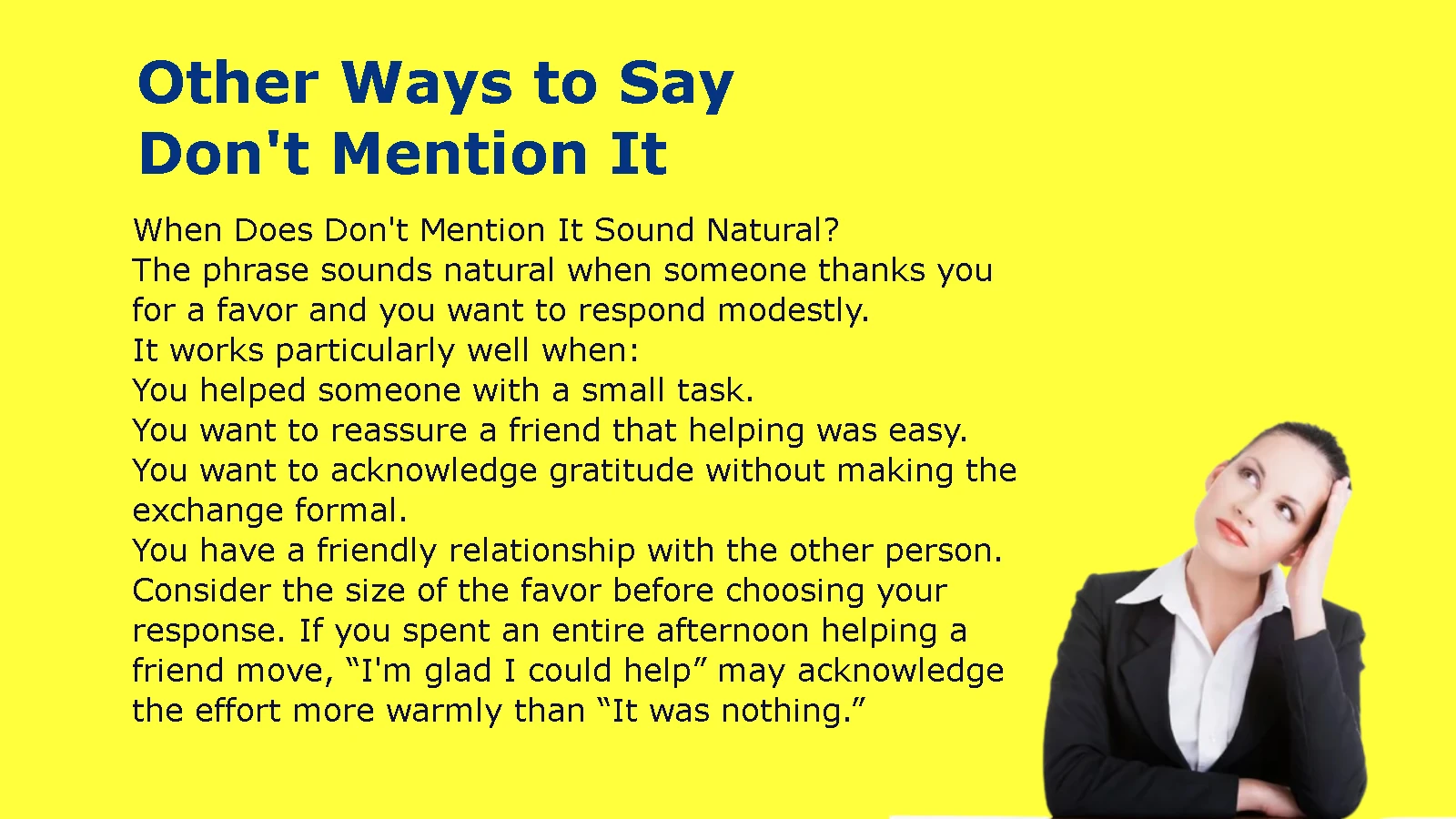
Other ways to say don’t mention it include you’re welcome, no problem, my pleasure, happy to help, and think nothing of it. Each expression responds to gratitude in a slightly different way, so the best choice depends on your relationship with the person, the size of the favor, and the situation.
Whether you’re replying to a friend, writing a professional email, or learning how to say don’t mention it in Japanese, French, Spanish, Korean, or Irish, the right expression can make your response sound more natural. Understanding the difference between don’t mention it and not to mention also helps you avoid a common English usage mistake.
What Does Don’t Mention It Mean?
Don’t mention it is a polite expression people use to respond to someone’s thanks. It means that the favor, help, or kindness was no trouble and that the other person doesn’t need to thank you. The phrase usually sounds friendly and modest, although its tone depends on the conversation.
For example:
“Thank you for helping me carry those boxes.”
“Don’t mention it. I’m happy to help.”
In this exchange, the speaker uses the phrase to acknowledge the thanks without making the favor seem like a big deal.
Don’t Mention It as a Response to Thank You
People commonly use don’t mention it after someone expresses gratitude. It works when you’ve helped a person, shared useful information, or done a small favor.
Here are a few examples:
- “Thanks for explaining the assignment.” “Don’t mention it. Glad I could help.”
- “I appreciate you giving me a ride.” “Don’t mention it. I was heading that way anyway.”
- “Thank you for covering my shift.” “Don’t mention it. I’d be happy to return the favor.”
- “Thanks for bringing me lunch.” “Don’t mention it. I know you had a busy day.”
The expression often communicates modesty. Instead of focusing on the effort you made, you reassure the other person that helping them was worthwhile or easy.
However, context matters. If you spent several hours helping someone with a difficult task, saying don’t mention it might unintentionally minimize your effort. A warmer response, such as “I’m glad I could help,” may sound more sincere.
The Difference Between Don’t Mention It and You’re Welcome
Both phrases respond to gratitude, but they can create slightly different impressions.
You’re welcome is a standard response to thanks. It works in almost any situation, from casual conversations to professional exchanges.
Don’t mention it places more emphasis on the idea that the favor was no trouble. It can sound modest, reassuring, or slightly old-fashioned, depending on the speaker and setting.
| Expression | Meaning | Best situation |
| You’re welcome | Acknowledges someone’s thanks | Almost any situation |
| Don’t mention it | Suggests the favor was no trouble | Friendly conversations |
| No problem | Indicates that helping wasn’t inconvenient | Casual conversations |
| My pleasure | Shows that helping was enjoyable or welcome | Polite and professional exchanges |
| Happy to help | Expresses willingness and friendliness | Work and everyday situations |
For example, after a colleague thanks you for sharing a document, “You’re welcome” is neutral and professional. “Don’t mention it” also works, but “Happy to help” may sound more natural in a modern workplace.
When Does Don’t Mention It Sound Natural?
The phrase sounds natural when someone thanks you for a favor and you want to respond modestly.
It works particularly well when:
- You helped someone with a small task.
- You want to reassure a friend that helping was easy.
- You want to acknowledge gratitude without making the exchange formal.
- You have a friendly relationship with the other person.
Consider the size of the favor before choosing your response. If you spent an entire afternoon helping a friend move, “I’m glad I could help” may acknowledge the effort more warmly than “It was nothing.”
In professional settings, my pleasure, you’re very welcome, and I’m glad I could assist may fit better. They communicate the same general sentiment while maintaining a polished tone.
25+ Other Ways to Say Don’t Mention It
The best alternatives to don’t mention it depend on what you want to communicate. Some expressions sound casual, others show warmth, and a few work particularly well in professional conversations.
Common Everyday Alternatives
These expressions work in ordinary conversations with friends, relatives, classmates, and coworkers.
You’re welcome
This is the most versatile alternative. It acknowledges someone’s thanks without adding unnecessary meaning.
Example: “Thanks for lending me your notes.” “You’re welcome. I hope they help.”
No problem
Use this when you want to communicate that helping someone wasn’t inconvenient.
Example: “Thanks for picking up my package.” “No problem. I was going past the office anyway.”
No worries
This relaxed expression reassures someone that they haven’t caused trouble.
Example: “Sorry for asking you to explain that again. Thanks!” “No worries. It’s easy to get confused.”
Not at all
This polite phrase suggests that the favor was no trouble. It can sound more formal than “no problem.”
Example: “Thank you for taking the time to meet with me.” “Not at all. I’m glad we could talk.”
Of course
Use this when helping someone feels natural or expected.
Example: “Thanks for helping me study.” “Of course. We’re in this together.”
Anytime
This friendly response suggests that you’re willing to help again.
Example: “Thanks for watching my dog.” “Anytime! He’s always welcome here.”
Don’t give it a second thought
This phrase reassures someone that they don’t need to worry about the favor or feel indebted to you.
Example: “I really appreciate you staying late to help.” “Don’t give it a second thought. We got the job done.”
Warm and Friendly Alternatives
Choose these expressions when you want your response to feel more personal.
Happy to help
This phrase communicates that you willingly helped and don’t regret the effort.
Example: “Thanks for helping me prepare for the interview.” “Happy to help. You’re going to do great.”
It was nothing
Use this when the favor was genuinely small. However, avoid it when the other person is thanking you for a major effort because it can sound dismissive.
Example: “Thanks for holding the elevator.” “It was nothing.”
Glad I could help
This response acknowledges the person’s gratitude while emphasizing the positive result.
Example: “Thanks for fixing the spreadsheet.” “Glad I could help. The numbers look much better now.”
Think nothing of it
This is a slightly more traditional expression that means the other person shouldn’t feel obligated to thank you.
Example: “I appreciate you checking on my parents.” “Think nothing of it. They’re wonderful people.”
It’s all good
This casual phrase works when you want to communicate that everything is fine.
Example: “Thanks for waiting while I finished the call.” “It’s all good.”
My pleasure
This warm expression suggests that helping was enjoyable or personally rewarding.
Example: “Thank you for showing me around the office.” “My pleasure. I hope you settle in quickly.”
Polite and Professional Alternatives
When responding to clients, managers, customers, or business partners, choose wording that sounds courteous without becoming stiff.
You’re very welcome
This is a slightly warmer version of “you’re welcome.”
Example: “Thank you for sending the updated proposal.” “You’re very welcome. Let me know if you need anything else.”
It was my pleasure
This phrase works well when you want to emphasize that you were happy to provide assistance.
Example: “Thank you for taking the time to explain the process.” “It was my pleasure.”
I’m glad I could assist
This is a polished option for professional emails and formal exchanges.
Example: “Thank you for helping us resolve the issue.” “I’m glad I could assist.”
Happy to be of help
This expression sounds professional while retaining a friendly tone.
Example: “We appreciate your guidance during the transition.” “Happy to be of help.”
The pleasure was mine
Use this when someone thanks you after a meeting, conversation, or shared experience.
Example: “Thank you for meeting with our team.” “The pleasure was mine. I enjoyed hearing about your plans.”
I’m pleased I could help
This communicates satisfaction with the outcome and works in polite professional exchanges.
Example: “Thank you for helping us meet the deadline.” “I’m pleased I could help.”
Casual Alternatives for Texts and Messages
Short expressions often sound more natural in text messages than formal replies.
No big deal
Use this when you want to show that a favor was minor.
Example: “Thanks for sending me the address.” “No big deal!”
Don’t sweat it
This informal phrase reassures someone that they don’t need to worry.
Example: “Sorry I asked you to print another copy. Thanks!” “Don’t sweat it.”
You got it
This upbeat response works well after someone thanks you for completing a request.
Example: “Thanks for picking up coffee.” “You got it!”
All good!
Use this when you want a short, relaxed response.
Example: “Thanks for saving me a seat.” “All good!”
No worries at all
This warmer variation of “no worries” makes the reassurance more explicit.
Example: “Thanks for helping me with the presentation.” “No worries at all.”
Anytime!
This is particularly useful when you want to show that you’re happy to help again.
Example: “Thanks for sharing your study guide.” “Anytime!”
Alternatives That Reassure Someone
Sometimes the other person feels awkward about accepting help. In that case, a reassuring expression can be more appropriate than a simple “you’re welcome.”
You don’t need to thank me
Use this when you want to make the person feel comfortable, especially if you’re close to them.
Example: “I don’t know how to thank you for helping me through this.” “You don’t need to thank me. I’m here for you.”
Really, it was nothing
This phrase communicates modesty, but use it only when it accurately reflects the situation.
Example: “Thank you for bringing my forgotten keys.” “Really, it was nothing.”
There’s no need to mention it
This is a close variation of the original phrase. It suggests that the favor doesn’t require further acknowledgment.
Example: “Thank you for helping me organize the files.” “There’s no need to mention it. I’m glad we got everything sorted.”
I was happy to do it
This sounds sincere because it focuses on your willingness rather than the size of the favor.
Example: “Thank you for spending the afternoon helping me move.” “I was happy to do it.”
I’d do the same for you
This response emphasizes mutual support and works especially well among friends, family members, and trusted coworkers.
Example: “Thanks for helping me when I was overwhelmed.” “I’d do the same for you.”
Best Alternatives to Don’t Mention It by Situation
Choosing a phrase by situation helps you sound more natural. A response that works with a close friend may feel too casual in a client email, while formal wording may sound distant in a personal conversation.
What to Say When a Friend Thanks You
With friends, you can use relaxed expressions that show warmth without making the conversation feel formal.
Good options include:
- “No worries!”
- “Anytime!”
- “Of course!”
- “Don’t sweat it.”
- “Happy to help.”
- “I’d do the same for you.”
Example conversation
Friend: “Thanks for helping me study last night. I would’ve been lost without you.”
You: “Of course! Anytime you need help, just ask.”
This response acknowledges the thanks and reinforces your willingness to help again. You don’t need a formal phrase because the relationship already establishes a sense of familiarity.
If the favor involved significant effort, you can also say, “I’m glad I could be there for you.” This sounds more personal than “It was nothing.”
What to Say in a Professional Email
Professional responses should acknowledge gratitude while keeping the exchange focused and courteous.
Useful options include:
- “You’re very welcome.”
- “My pleasure.”
- “I’m glad I could help.”
- “Happy to assist.”
- “I’m pleased we could resolve this.”
- “I’m glad the information was useful.”
Example email
Subject: Re: Updated Project Documents
“Thank you for sending the revised files so quickly.”
“You’re very welcome. I’m glad I could help move the project forward.”
This response sounds professional without being overly formal. It also connects your assistance to the result.
For a customer or client, you could write:
“It’s my pleasure. Please let me know if you need any further assistance.”
However, don’t add a long sentence every time someone thanks you. A simple “You’re very welcome” is often enough for a routine exchange.
What to Say When Someone Thanks You for a Big Favor
When someone expresses gratitude for a major favor, choose a response that acknowledges the importance of the situation.
Consider these alternatives:
- “I’m really glad I could help.”
- “You don’t owe me anything.”
- “I’m happy I could be there for you.”
- “I’d do it again without hesitation.”
- “I’m glad things worked out.”
- “You would have done the same for me.”
For example:
Friend: “Thank you for helping me move all weekend. I couldn’t have done it alone.”
You: “I’m really glad I could help. I hope you’re settling into the new place.”
This response recognizes the effort without dismissing the friend’s gratitude.
By contrast, “It was nothing” might sound insincere if you spent two days carrying furniture. You can be modest without pretending the favor required no effort.
What to Say When Someone Apologizes
A response to an apology serves a different purpose from a response to thanks. You usually want to reassure the person that the problem is resolved or that you don’t hold the mistake against them.
Useful expressions include:
- “No worries.”
- “It’s okay.”
- “Don’t worry about it.”
- “It’s all right.”
- “We’re good.”
- “No harm done.”
Example:
Coworker: “Sorry I sent the wrong attachment. Thanks for catching it.”
You: “No worries. I’ve got the correct version now.”
Here, “no worries” addresses the inconvenience rather than merely responding to gratitude.
Be careful with “don’t mention it.” Although people may understand what you mean, “it’s okay” or “no worries” usually sounds more natural when someone apologizes.
What to Say in a Text Message
Text messages usually benefit from concise, conversational wording.
| Situation | Natural response |
| A friend thanks you for a ride | “Anytime!” |
| Someone thanks you for sharing notes | “No problem!” |
| A coworker thanks you for a quick favor | “Happy to help.” |
| Someone apologizes for a delay | “No worries.” |
| A family member thanks you for cooking | “Of course!” |
| Someone appreciates your emotional support | “I’m always here for you.” |
Match your punctuation to the relationship. “Anytime!” sounds enthusiastic, while “You’re welcome.” feels more neutral. Neither is automatically better; the goal is to sound like yourself.
Formal vs. Informal Alternatives to Don’t Mention It
The tone of an expression matters as much as its meaning. When choosing an alternative, consider the relationship, the setting, and the amount of effort involved.
Which Alternatives Work Best in Formal Situations?
Use expressions that sound courteous and composed without feeling distant.
Good choices include:
- “You’re very welcome.”
- “My pleasure.”
- “It was my pleasure.”
- “I’m glad I could assist.”
- “I’m pleased I could help.”
These phrases fit professional correspondence, customer service, interviews, business meetings, and formal introductions.
For example, after a client thanks you for explaining a complicated process, you could say, “My pleasure. I’m glad the explanation helped.”
The response sounds polished while remaining human.
Which Alternatives Sound Most Natural Among Friends?
Informal expressions work best when the relationship allows a relaxed tone.
Consider:
- “No problem.”
- “No worries.”
- “Anytime.”
- “Of course.”
- “Don’t sweat it.”
- “All good.”
For example, a friend might say, “Thanks for grabbing my jacket.”
You could answer, “No worries. I saw it on the chair.”
A formal response such as “I’m pleased I could assist” would probably sound unnatural in this situation because it creates unnecessary distance.
Which Expressions Should You Avoid in Professional Settings?
Some phrases are perfectly acceptable in everyday English but may not fit every workplace.
“Don’t sweat it” is informal and may sound too relaxed in a formal client exchange.
“No big deal” can unintentionally minimize the importance of the request or the other person’s appreciation.
“It was nothing” may sound dismissive after a substantial favor.
“You got it” works well with familiar colleagues but may be too casual for certain business relationships.
This doesn’t mean you must avoid every informal phrase at work. Many teams use “no problem” and “no worries” naturally. Consider the organization’s communication style before deciding.
Comparison Table: Which Phrase Should You Choose?
| Expression | Tone | Best situation | Example |
| You’re welcome | Neutral | Almost any setting | “You’re welcome. Glad it helped.” |
| My pleasure | Warm, polished | Professional or personal | “My pleasure. It was great working with you.” |
| No problem | Casual, friendly | Everyday conversations | “No problem. I had time.” |
| Happy to help | Friendly, professional | Workplace exchanges | “Happy to help with the report.” |
| Anytime | Casual, reassuring | Friends and repeat favors | “Anytime! Just let me know.” |
| Not at all | Polite | Courteous conversations | “Not at all. It was easy to arrange.” |
| I was happy to do it | Sincere | Meaningful favors | “I was happy to do it. Don’t worry.” |
| I’m glad I could assist | Formal | Clients and professional emails | “I’m glad I could assist with the request.” |
How to Say Don’t Mention It in Other Languages
The English expression don’t mention it doesn’t always translate word for word into another language. Languages use their own conventional responses to gratitude, and the most natural choice may depend on formality, culture, and the relationship between speakers.
The expressions below communicate a similar general sentiment. They don’t all carry exactly the same meaning in every context.
How to Say Don’t Mention It in Japanese
A common Japanese expression used to respond to thanks is どういたしまして (dō itashimashite), which means “you’re welcome.”
For example:
Person A: “手伝ってくれてありがとう。”
Thank you for helping me.
Person B: “どういたしまして。”
You’re welcome.
Japanese also uses other responses that express modesty or suggest that the favor was no trouble.
いえいえ (ie ie) is a casual, modest response that can mean something like “not at all” or “no, no.” People often use it to downplay praise or gratitude in everyday conversation.
In a more formal situation, the appropriate response may differ according to the relationship and the favor. Japanese politeness relies heavily on context, so avoid assuming that one expression fits every interaction.
How to Say Don’t Mention It in French
Two common French responses to gratitude are de rien and je vous en prie.
De rien means “you’re welcome” and works in many everyday situations.
Example:
Person A: “Merci pour ton aide.”
Thanks for your help.
Person B: “De rien!”
You’re welcome!
Je vous en prie is a more formal or polite response. It is useful when addressing someone formally or maintaining a courteous tone.
Example:
“Merci beaucoup pour votre aide.”
“Je vous en prie.”
The French expression il n’y a pas de quoi is another option. It communicates that there is no need to thank the speaker and often comes close to the meaning of “don’t mention it.”
Choose the phrase based on the relationship. “De rien” is a practical everyday choice, while “je vous en prie” may fit a more formal exchange.
How to Say Don’t Mention It in Spanish
Two useful Spanish alternatives are de nada and no hay de qué.
De nada is the standard, widely understood equivalent of “you’re welcome.”
Example:
Person A: “Gracias por ayudarme.”
Thanks for helping me.
Person B: “De nada.”
You’re welcome.
No hay de qué conveys the idea that there is no need to thank the speaker.
Example:
“Muchas gracias por tu ayuda.”
“No hay de qué.”
Both expressions work in many Spanish-speaking contexts. Regional preferences may vary, and the choice between informal and formal language also depends on how you address the other person.
You may also hear con gusto, which means “with pleasure” or “gladly” in many contexts. It can sound especially natural when you want to emphasize that you were happy to help.
How to Say Don’t Mention It in Korean
A common Korean response to thanks is 아니에요 (anieyo). Depending on context, it can convey modesty, reassurance, or a sense that the favor was no trouble.
Example:
Person A: “도와줘서 고마워요.”
Thank you for helping me.
Person B: “아니에요.”
You’re welcome; it was nothing.
Korean also uses 천만에요 (cheonmaneyo), traditionally translated as “you’re welcome.” However, its naturalness depends on the context, and it may sound less conversational than other responses in some modern everyday exchanges.
Because Korean has different levels of politeness, you should consider the other person’s age, status, and your relationship. A response appropriate for a close friend may not suit a customer or senior colleague.
How to Say Don’t Mention It in Irish
Irish, also called Gaeilge, has its own expressions for responding to gratitude. One useful expression is Ná habair é, which literally means “don’t say it” and can convey a sentiment similar to “don’t mention it.”
For example:
Person A: “Go raibh maith agat as an gcabhair.”
Thank you for the help.
Person B: “Ná habair é.”
Don’t mention it.
Another Irish expression associated with responding to thanks is Fáilte romhat, commonly translated as “you’re welcome.” The appropriate form can depend on the number and gender of the people being addressed and on the context.
If you’re learning Irish for everyday conversation, focus on complete expressions rather than translating English words individually. That approach helps you learn how speakers actually respond to gratitude.
How to Choose the Right Translation
Use this quick comparison as a starting point.
| Language | Expression | Approximate English meaning |
| Japanese | どういたしまして (dō itashimashite) | You’re welcome |
| French | De rien | You’re welcome |
| French | Je vous en prie | You’re welcome; please |
| Spanish | De nada | You’re welcome |
| Spanish | No hay de qué | There’s no need to thank me |
| Korean | 아니에요 (anieyo) | Not at all; you’re welcome |
| Irish | Ná habair é | Don’t mention it |
| Irish | Fáilte romhat | You’re welcome |
These are useful starting points, not exact one-to-one translations. The best expression depends on whether you’re responding to a small favor, a formal act of assistance, or a personal gesture.
Don’t Mention It vs. Not to Mention
Don’t mention it and not to mention look similar, but they serve different grammatical purposes. The first usually responds to gratitude, while the second introduces an additional fact or emphasizes another point. Understanding this distinction helps you choose the right phrase in conversation and writing.
What Does Not to Mention Mean?
Not to mention is a linking expression that introduces another relevant point. It often emphasizes an additional difficulty, benefit, expense, or consideration.
For example:
“The apartment is expensive, not to mention far from work.”
The speaker means that the apartment is expensive and is also far from work.
More examples include:
- “She works full-time, not to mention raising two children.”
- “The trip was long, not to mention exhausting.”
- “The restaurant has excellent food, not to mention friendly service.”
- “The project requires time, not to mention money.”
Notice that “not to mention” doesn’t respond to gratitude. It adds information to a statement.
What to Say Instead of Not to Mention
Choose a replacement based on the relationship between the two ideas.
Besides
Use this to introduce an additional point.
Example: “Besides being expensive, the laptop is difficult to repair.”
In addition to
This phrase works well in formal and informational writing.
Example: “In addition to its high price, the laptop requires a separate software subscription.”
As well as
Use this when you want to connect related details.
Example: “The role requires strong writing skills as well as attention to detail.”
Let alone
This phrase emphasizes that an additional task or condition is even more difficult or unlikely.
Example: “I barely have time to cook dinner, let alone prepare a meal for ten people.”
To say nothing of
This is a more formal expression used to add another significant point.
Example: “The project requires extensive research, to say nothing of the editing.”
On top of that
This conversational phrase adds another point, often one that makes a situation more difficult or more impressive.
Example: “The train was delayed, and on top of that, it started raining.”
These expressions aren’t always interchangeable. “Besides” often adds information, while “let alone” emphasizes a stronger degree or a more demanding example.
Don’t Mention It vs. No Mention
Don’t mention it is a complete expression that usually responds to thanks.
Example: “Thanks for the recommendation.” “Don’t mention it.”
No mention is a noun phrase used in sentences about whether something was discussed, included, or referred to.
Example: “There was no mention of a deadline in the email.”
Here are more examples:
- “The report makes no mention of additional fees.”
- “There was no mention of the meeting being postponed.”
- “The agreement contains no mention of travel expenses.”
You generally wouldn’t use “no mention” as a standalone response to someone saying thank you.
If you’re looking for a polite response, use you’re welcome, no problem, or my pleasure. If you’re describing missing information, “no mention of” may be appropriate.
Common Mistakes When Using Alternatives to Don’t Mention It
Even a familiar expression can sound awkward when you use it in the wrong context. Pay attention to the meaning, tone, and relationship behind the exchange.
Using No Problem in Every Situation
“No problem” is common in casual conversation and many workplaces. However, it may sound too informal in a particularly formal exchange.
For example:
Client: “Thank you for resolving the billing issue.”
Possible response: “You’re very welcome. I’m glad we could resolve it.”
This response acknowledges the client’s appreciation and emphasizes the result. “No problem” would also be understood, but the more polished option may fit the situation better.
You don’t need to eliminate “no problem” from your vocabulary. Simply recognize when a more formal response suits the audience.
Confusing Responses to Thanks With Responses to Apologies
A person who thanks you and a person who apologizes are doing different things.
When someone says “Thank you,” they express gratitude. When someone says “I’m sorry,” they acknowledge a mistake or inconvenience.
Compare these examples:
Responding to thanks
“Thanks for waiting.”
“You’re welcome.”
Responding to an apology
“Sorry I’m late.”
“No worries. Let’s get started.”
Some expressions, such as “no worries,” work in both situations. Others, including “my pleasure,” usually respond more naturally to gratitude than to an apology.
Choosing a Phrase That Minimizes Someone’s Effort
Phrases such as “It was nothing” and “Don’t mention it” can communicate modesty. However, they may accidentally make someone feel that their gratitude is unnecessary.
Imagine a colleague thanks you for staying late to help complete an important report. Saying “It was nothing” might minimize the time you spent.
A more thoughtful response would be:
“I’m glad I could help. We made good progress.”
This acknowledges the work without making the other person feel indebted.
Translating Idioms Word for Word
Literal translation often fails because languages use different conventional responses.
For example, the natural response to gratitude in one language may translate literally as “not at all” or “please,” even though its conversational meaning is closer to “you’re welcome.”
When learning another language, consider:
- The expression native speakers commonly use.
- Whether the setting is formal or informal.
- How the phrase sounds in a complete conversation.
- Whether the expression responds to thanks, an apology, or a request.
Learning a phrase in context is more useful than memorizing a direct word-for-word equivalent.
How to Choose the Best Alternative
You don’t need to memorize every synonym. A simple decision process will help you choose a response that sounds appropriate and sincere.
Consider Your Relationship With the Person
Think about whether you’re speaking to a friend, family member, coworker, customer, or stranger.
With a close friend, “Anytime!” may sound natural. With a client, “You’re very welcome” may be a better fit.
For example:
- Friend: “No worries. Anytime!”
- Coworker: “Happy to help.”
- Client: “You’re very welcome. Please let me know if you need anything else.”
- Family member: “Of course. I’m always here for you.”
The relationship doesn’t determine every word you use, but it provides a useful starting point.
Match the Tone to the Situation
Consider whether you want your response to sound casual, warm, neutral, or formal.
Use no problem for a relaxed exchange, my pleasure for a courteous response, and I’m glad I could assist for a more formal interaction.
When you’re uncertain, “You’re welcome” is a safe choice because it works across a wide range of situations.
Consider the Size of the Favor
A small favor doesn’t need an elaborate response. If you hold a door open for someone, “No problem” or “You’re welcome” is enough.
For a meaningful favor, choose language that acknowledges the person’s gratitude without dismissing the effort.
For example:
“Thank you for helping me prepare for my job interview.”
“I’m glad I could help. I hope it goes well!”
The second response recognizes the importance of the event and keeps the exchange warm.
Keep Your Response Natural and Brief
A good response to thanks doesn’t need to be complicated. Most conversations call for one short sentence.
Use this simple framework:
- Small favor: “No problem.”
- Everyday thanks: “You’re welcome.”
- Professional assistance: “Happy to help.”
- Meaningful favor: “I’m glad I could be there for you.”
- Future help: “Anytime.”
The aim isn’t to find the most impressive synonym. It’s to respond in a way that fits the moment.
Frequently Asked Questions
What Is the Best Alternative to Don’t Mention It?
“You’re welcome” is one of the most versatile alternatives to “don’t mention it.” It works in personal, academic, and professional conversations. Choose “my pleasure” when you want to sound especially courteous, or “no problem” when a casual response feels more natural.
Is It Professional to Say No Problem?
Yes, “no problem” is widely used in many professional settings, especially among colleagues. However, “you’re welcome,” “my pleasure,” or “I’m glad I could assist” may suit formal client communication better. Match your wording to the workplace culture and the relationship.
Is Don’t Mention It the Same as You’re Welcome?
Both expressions can respond to gratitude, but they have slightly different emphases. “You’re welcome” acknowledges someone’s thanks, while “don’t mention it” suggests that the favor was no trouble and doesn’t require special acknowledgment. Both are generally understood as polite responses.
What Can I Say Instead of Don’t Mention It in an Email?
You can use “You’re very welcome,” “My pleasure,” “Happy to help,” or “I’m glad I could assist.” For example, after a client thanks you for providing a report, you might write, “You’re very welcome. I’m glad the information was useful.”
How Do You Say Don’t Mention It in Japanese, French, or Spanish?
In Japanese, どういたしまして (dō itashimashite) means “you’re welcome.” In French, de rien is a common response to thanks. Each language has other options depending on formality and context.
What Is the Difference Between Don’t Mention It and Not to Mention?
“Don’t mention it” usually responds to gratitude, while “not to mention” introduces additional information or emphasizes another point. For example, “Thanks for your help” can receive the response “Don’t mention it.” In “The trip was expensive, not to mention exhausting,” the phrase adds another detail.
Conclusion: Choose an Expression That Fits the Moment
There are many natural ways to say don’t mention it, from everyday expressions such as “no problem” and “anytime” to polished alternatives such as “my pleasure” and “I’m glad I could assist.”
The best choice depends on your audience, the favor, and the tone you want to convey. A short, sincere response usually works better than an elaborate phrase that doesn’t fit the conversation.
Remember to distinguish don’t mention it from not to mention. The first responds to gratitude, while the second adds information or emphasis. When translating the expression into another language, choose a natural conversational equivalent instead of translating each word literally.













