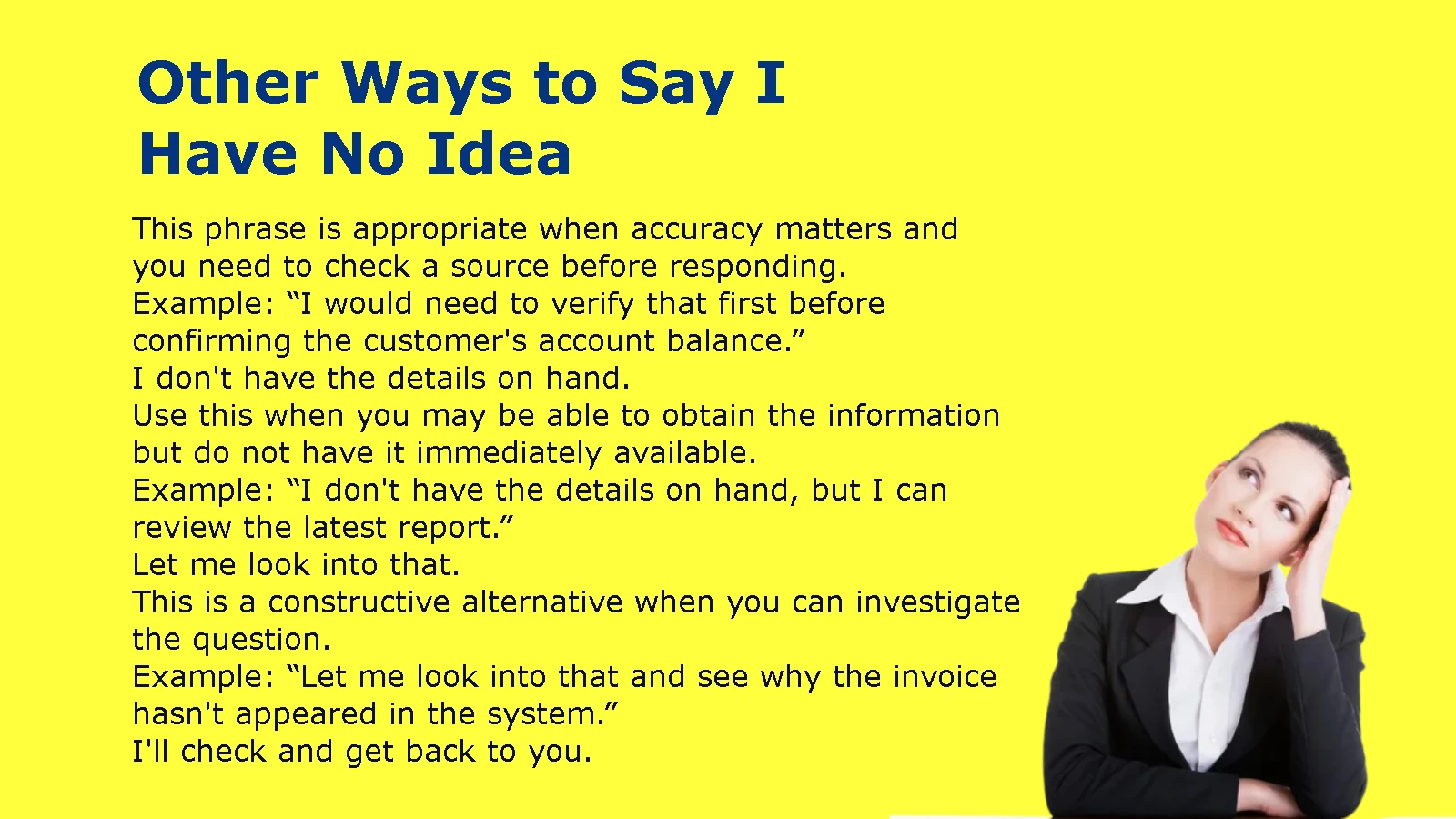
Other ways to say “I have no idea” can help you express uncertainty more clearly in everyday conversations, professional emails, meetings, and academic writing. Instead of repeating “I don’t know,” you can use phrases such as “I’m not certain,” “I would need to verify that,” “I don’t have that information,” or “I’ll look into it.” The best choice depends on whether you lack knowledge, need more information, or want to communicate uncertainty politely.
Understanding the difference between I have no idea, I have no clue, I’m unsure, and I’m unaware also helps you choose the right words for each situation. Some expressions sound relaxed and conversational, while others communicate professionalism, caution, or a willingness to find an answer.
This guide covers more than 35 alternatives, explains their meanings, and provides original examples you can use in emails, workplace conversations, and everyday situations.
What Does “I Have No Idea” Mean?
“I have no idea” means that you do not know something or cannot provide an answer based on the information available to you. People use this expression when they lack knowledge, cannot explain a situation, or have no reasonable way to guess the answer.
For example, if someone asks, “Why did the website stop working?” and you have not investigated the problem, you might respond, “I have no idea.”
The phrase can communicate different shades of meaning depending on the situation:
- Lack of knowledge: You do not know the answer.
- Uncertainty: You cannot confidently explain what happened.
- Surprise: Something unexpected has occurred.
- Confusion: You cannot understand a situation or its cause.
Is “I Have No Idea” Formal or Informal?
“I have no idea” is a neutral, everyday expression. You can use it with friends, family members, coworkers, and acquaintances. However, it can sound blunt in formal situations, particularly when someone expects you to provide information.
Consider these examples:
- Casual: “I have no idea where Jake put the keys.”
- Workplace: “I’m not sure where the updated file is saved.”
- Formal: “I would need to review the records before confirming the file’s location.”
All three statements communicate a lack of knowledge. The difference lies in how much context, courtesy, and professionalism each one conveys.
In a workplace setting, you do not need to pretend to know everything. A better approach is to acknowledge what you do not know and explain how you can find the answer.
“I Have No Idea” vs. “I Have No Clue”
Both expressions mean that you do not know something, but they differ slightly in tone.
“I have no idea” works in a wider range of situations. It can sound neutral, surprised, or emphatic, depending on how you say it.
“I have no clue” usually sounds more conversational and informal. It often emphasizes that you have no useful information or cannot make an informed guess.
| Expression | Meaning | Typical tone | Example |
| I have no idea | I don’t know the answer | Neutral | I have no idea why the meeting was canceled. |
| I have no clue | I have no useful information | Informal | I have no clue where he went. |
| I’m not sure | I lack certainty | Polite and neutral | I’m not sure which version is correct. |
| I’m uncertain | I cannot determine something confidently | More formal | I’m uncertain about the proposed deadline. |
| I can’t confirm | I cannot verify something | Professional | I can’t confirm the figures yet. |
Use whichever expression fits the relationship, setting, and amount of uncertainty involved.
35+ Other Ways to Say “I Have No Idea”
The best synonym for “I have no idea” depends on what you want to communicate. Some alternatives express complete ignorance, while others acknowledge uncertainty or offer a way to find the answer.
Common and Natural Alternatives
These expressions work well in everyday conversations, informal messages, and many ordinary workplace discussions.
1. I don’t know.
This is the simplest and most direct alternative. It works in almost any casual situation, although it may sound abrupt without additional context.
Example: “I don’t know when the package will arrive, but I can check the tracking page.”
2. I have no clue.
Use this phrase when you have absolutely no information about something. It sounds relaxed and conversational.
Example: “I have no clue how the printer started working again.”
3. I’m not sure.
This phrase is useful when you lack certainty but might have a partial answer or need to check a detail.
Example: “I’m not sure whether the store closes at eight or nine.”
4. I couldn’t tell you.
This expression means you cannot provide the requested information. Its tone can sound neutral, friendly, or dismissive, depending on delivery.
Example: “I couldn’t tell you who changed the schedule because I wasn’t there.”
5. Your guess is as good as mine.
Use this when you and the other person have roughly the same information and neither of you can make a reliable guess.
Example: “Why is the delivery taking so long?” “Your guess is as good as mine.”
6. I haven’t the slightest idea.
This expression emphasizes that you have no idea at all. It can sound emphatic, slightly dramatic, or humorous.
Example: “I haven’t the slightest idea how they solved that puzzle so quickly.”
7. I can’t say for certain.
This is useful when you want to avoid making an unsupported claim. It leaves room for possibilities without presenting a guess as a fact.
Example: “I can’t say for certain whether the repair will take one day or two.”
8. I don’t have an answer.
This phrase directly acknowledges that you cannot answer the question right now.
Example: “I don’t have an answer yet, but I’m reviewing the available information.”
Polite Ways to Say “I Have No Idea”
Polite alternatives help you acknowledge uncertainty without making the other person feel dismissed. They work especially well when someone expects an explanation or needs your assistance.
9. I’m afraid I don’t know.
This is a courteous way to admit that you cannot provide an answer. Here, “I’m afraid” expresses regret rather than literal fear.
Example: “I’m afraid I don’t know which department handles that request.”
10. I’m not entirely sure.
Use this phrase when you want to express uncertainty without sounding overly negative or abrupt.
Example: “I’m not entirely sure whether the new policy applies to contractors.”
11. I don’t have that information right now.
This response explains that the information is currently unavailable to you. It does not suggest that you will never be able to find it.
Example: “I don’t have that information right now, but I can check our records.”
12. That’s something I’d need to check.
This is a helpful alternative when you can potentially find the answer by reviewing documents, contacting someone, or checking a system.
Example: “That’s something I’d need to check before giving you an accurate date.”
13. I wish I could tell you.
This phrase expresses a friendly or sympathetic inability to answer. It works best in informal or moderately relaxed conversations.
Example: “I wish I could tell you when the renovation will finish, but the contractor hasn’t confirmed the date.”
14. I’m unable to say at this point.
This sounds more formal than “I don’t know.” Use it when you cannot make a reliable statement because the necessary details remain unclear.
Example: “I’m unable to say at this point whether the proposal will receive approval.”
Stronger Expressions for Complete Uncertainty
Sometimes, you want to emphasize that you have no information whatsoever. These expressions are useful in casual conversation, storytelling, and humorous situations.
15. I haven’t the faintest idea.
This emphasizes a complete lack of knowledge and is similar to “I haven’t the slightest idea.”
Example: “I haven’t the faintest idea why the lights keep flickering.”
16. I don’t have the foggiest idea.
This informal expression communicates total uncertainty, often with a humorous or exaggerated tone.
Example: “I don’t have the foggiest idea how to assemble this bookshelf.”
17. I haven’t a clue.
This is a shorter, conversational way to say you do not know something.
Example: “I haven’t a clue which train we need to catch.”
18. I couldn’t begin to guess.
Use this when you cannot even make a reasonable estimate.
Example: “I couldn’t begin to guess how many people attended the event.”
19. I wouldn’t know where to start.
This phrase suggests that you lack the knowledge or starting point needed to solve a problem.
Example: “If someone asked me to repair that engine, I wouldn’t know where to start.”
Alternatives for Written Communication
Written communication often benefits from precise language. Instead of saying “I have no idea” in an email, you can explain exactly what you cannot confirm.
20. I don’t have enough information to answer.
Use this when the available facts do not support a reliable answer.
Example: “I don’t have enough information to answer the question about next quarter’s costs.”
21. I can’t confirm that at the moment.
This is useful when someone asks you to verify a claim, date, number, or decision.
Example: “I can’t confirm that at the moment because the final report is still under review.”
22. I haven’t been able to determine the answer.
This phrase indicates that you have tried to establish the facts but have not reached a conclusion.
Example: “I haven’t been able to determine the cause of the error from the current logs.”
23. I don’t have a definitive answer yet.
Use this when the answer remains unresolved but may become available later.
Example: “I don’t have a definitive answer yet, as we’re waiting for feedback from the supplier.”
24. The information isn’t currently available to me.
This phrase focuses on access to information rather than personal ability.
Example: “The information isn’t currently available to me, so I’ll need to consult the finance team.”
How to Say “I Have No Idea” Professionally
A professional alternative should communicate uncertainty honestly while keeping the conversation productive. In workplace situations, you can often improve your response by identifying the missing information and explaining what you will do next.
For example, instead of saying, “I have no idea when the report will be ready,” you could say, “I need to confirm the remaining steps before I can provide a reliable completion date.”
The second response does not hide your uncertainty. It explains why you cannot answer yet.
Professional Alternatives for Workplace Conversations
Use these expressions when speaking with colleagues, supervisors, clients, or customers.
I’m not certain about that.
This works when you want to acknowledge uncertainty without making an unsupported claim.
Example: “I’m not certain about the revised deadline, so I’ll check the project schedule.”
I would need to verify that first.
This phrase is appropriate when accuracy matters and you need to check a source before responding.
Example: “I would need to verify that first before confirming the customer’s account balance.”
I don’t have the details on hand.
Use this when you may be able to obtain the information but do not have it immediately available.
Example: “I don’t have the details on hand, but I can review the latest report.”
Let me look into that.
This is a constructive alternative when you can investigate the question.
Example: “Let me look into that and see why the invoice hasn’t appeared in the system.”
I’ll check and get back to you.
This works when you need time to find an answer and can realistically follow up.
Example: “I’ll check the delivery status and get back to you this afternoon.”
Formal Alternatives for Emails and Business Writing
Formal emails benefit from clear, specific language. Choose a phrase that accurately describes what you know, what you lack, and whether you can take further action.
| Professional phrase | Best use | Example |
| I would need to confirm the details. | When verification is necessary | I would need to confirm the details before approving the request. |
| I don’t have that information available at present. | When information is unavailable | I don’t have that information available at present, but I’ll review the relevant records. |
| I’m unable to provide a definitive answer at this stage. | When a decision remains unresolved | I’m unable to provide a definitive answer at this stage because the review is ongoing. |
| I’ll investigate and follow up. | When further research is possible | I’ll investigate the discrepancy and follow up with my findings. |
| I don’t want to speculate without confirming the facts. | When guessing could cause confusion | I don’t want to speculate without confirming the facts with the relevant team. |
Example of a professional email:
Subject: Clarification on the Project Timeline
Hi Jordan,
I don’t have a confirmed completion date at the moment. I need to verify the remaining tasks with the project team before sharing a timeline.
I’ll review the latest schedule and send you an update by Thursday afternoon.
Best,
Alex
This email acknowledges the information gap, explains the next step, and sets a specific expectation. It sounds more helpful than simply writing, “I have no idea when the project will finish.”
How to Say “I Have No Idea” in a Meeting
Meetings often require quick responses, even when you have not prepared for a particular question. You can handle these moments professionally without pretending to know something you do not.
Use this three-part framework:
- Acknowledge the question: Show that you understand what the person wants to know.
- State the limitation: Explain which detail you cannot confirm.
- Offer a next step: Describe how you will investigate or obtain the answer, if possible.
For example:
A manager asks, “Why did customer complaints increase last week?”
You could respond:
“That’s a good question. I haven’t reviewed last week’s complaint data yet, so I can’t identify the cause confidently. I’ll compare the latest figures with the previous week’s results and share what I find.”
This response demonstrates responsibility without inventing an explanation.
However, do not promise a follow-up if you cannot deliver one. If another person owns the information, say, “I don’t have those figures, but the operations team may be able to confirm them.”
Professional Alternatives in Real Situations
The most effective response depends on the information gap.
| Situation | Less effective response | More professional response |
| A client asks about a deadline | I have no idea. | I’ll confirm the timeline and get back to you. |
| A colleague asks for an unfamiliar figure | No clue. | I don’t have that figure on hand, but I can check. |
| A manager asks about an unresolved issue | I don’t know what happened. | I haven’t established the cause yet. |
| A customer asks about a policy | I’m not sure. | I’d like to verify the policy before giving you an answer. |
| Someone raises an unfamiliar topic in a meeting | Beats me. | I’d need to review that before commenting. |
| A team member asks about an unapproved decision | No idea yet. | The decision hasn’t been confirmed, so I can’t provide a final answer. |
Practical example: Imagine that a customer asks whether an order will arrive before Friday. You have not received the shipping confirmation.
Saying “I have no idea” communicates uncertainty but offers no help. Saying “I can’t confirm the delivery date until the carrier updates the tracking information” explains the limitation. If you can check again later, you can add, “I’ll review the status tomorrow morning.”
The important difference is not fancy vocabulary. It’s giving the other person an accurate understanding of the situation.
“I Have No Idea” Synonyms by Situation
Not every alternative communicates the same message. The right expression depends on whether you have no knowledge, incomplete information, or a possible answer that still needs verification.
When You Simply Don’t Know Something
Use these expressions when you genuinely cannot answer a question.
- I don’t know: The most direct and general option.
- I have no clue: An informal expression that emphasizes a lack of knowledge.
- I couldn’t tell you: A conversational way to say you cannot provide the answer.
- I’m unable to answer that: A more formal statement of inability.
Example: “I couldn’t tell you who left the package outside because I arrived after everyone else.”
When You’re Uncertain but Have a Possible Answer
Sometimes, you have an idea but cannot be certain that it is correct.
- I’m not sure: You lack confidence in the answer.
- I can’t say for certain: You cannot guarantee that your answer is accurate.
- I believe so, but I’d need to check: You have a tentative answer that needs verification.
- I can’t confirm that yet: You lack the evidence needed to verify a claim.
Example: “I believe the training starts at ten, but I’d need to check the calendar.”
These expressions are more accurate than “I have no idea” when you possess some relevant information.
When You Lack the Necessary Information
Use these alternatives when you cannot answer because you lack access to relevant details or have not gathered enough evidence.
- I don’t have enough information.
- I’m not familiar with the details.
- I haven’t looked into that yet.
- I don’t have access to those details.
Example: “I don’t have enough information to explain the cost difference between the two proposals.”
Be precise about the reason. Saying you lack access to information is different from saying you have not reviewed it yet.
When You Want to Sound Polite and Helpful
These phrases move the conversation toward a solution rather than ending it with uncertainty.
- Let me find out.
- I’ll look into it.
- That’s a good question; let me check.
- I’ll see what I can confirm.
Example: “That’s a good question. Let me check the latest guidance so I can give you an accurate answer.”
Use these alternatives only when you can genuinely take the next step. Otherwise, explain who might have the information or what remains unresolved.
When You Want to Express Surprise or Confusion
Some situations call for a stronger emotional response rather than a neutral statement of uncertainty.
- I have absolutely no idea.
- That’s beyond me.
- I’m completely stumped.
- I wouldn’t even know where to begin.
Example: “I’m completely stumped by this riddle. Every answer I’ve tried has been wrong.”
These expressions can sound natural among friends. In formal communication, however, a phrase such as “I haven’t determined the cause yet” usually communicates the same limitation more precisely.
“I Don’t Know” Synonyms and Their Differences
The phrase “I don’t know” has several alternatives, but they are not always interchangeable. Understanding their differences helps you avoid misleading someone or choosing wording that does not fit the situation.
I Don’t Know vs. I’m Not Sure
“I don’t know” usually means you cannot provide an answer. “I’m not sure” indicates uncertainty and leaves open the possibility that you have a tentative answer.
Examples:
- “I don’t know which employee approved the request.” You lack the answer.
- “I’m not sure which employee approved the request.” You may have an idea, but you cannot confirm it.
Choose “I’m not sure” when you have partial knowledge. Use “I don’t know” when you cannot provide the information.
I Don’t Know vs. I’m Unaware
“I’m unaware” means you do not know about a particular fact, event, or circumstance. It often focuses on whether information has reached you.
Examples:
- “I don’t know why the meeting was canceled.” You cannot explain the reason.
- “I’m unaware of any changes to the meeting schedule.” You have not received information about changes.
In professional writing, “I’m not aware of any changes” often sounds more natural than “I’m unaware of any changes.”
I Don’t Know vs. I’m Unsure
“I’m unsure” expresses doubt or uncertainty. It does not necessarily mean you lack all relevant knowledge.
Examples:
- “I don’t know which application the company selected.”
- “I’m unsure whether this application meets the company’s requirements.”
The first statement identifies a missing answer. The second indicates uncertainty about a specific judgment.
I Don’t Know vs. I Can’t Confirm
“I can’t confirm” means you cannot verify that a statement is accurate. You may suspect it is true, but you lack sufficient evidence.
For example:
“I can’t confirm that the shipment has arrived because the tracking system hasn’t updated.”
This phrase works particularly well in customer service, business communication, reporting, and situations where accuracy matters.
I Don’t Know vs. I’m Not Familiar With That
“I’m not familiar with that” means you lack experience or knowledge about a subject, process, tool, or topic.
For example:
“I’m not familiar with the new reporting software, so I’ll need to review its documentation.”
This sounds more specific than “I have no idea.” It identifies the area in which you lack knowledge without suggesting that you cannot learn the answer.
What Does “I Have No Clue” Mean?
“I have no clue” means that you have no useful knowledge or understanding of something. It is an informal expression commonly used when someone asks a question that you cannot answer or presents a problem you cannot solve.
For example, if a friend asks, “Who sent us this anonymous invitation?” you might respond, “I have no clue.”
The phrase is closely related to “I have no idea,” but it often sounds more casual and emphatic.
“I Have No Clue” Examples in Sentences
Here are examples from different situations.
Everyday conversation:
“I have no clue where I left my headphones. I’ve checked every room.”
School or university:
“I have no clue how to solve the final equation, so I’ll ask the teacher to explain it.”
Workplace conversation:
“I have no clue why the dashboard isn’t loading. Have you checked the server status?”
Planning an event:
“I have no clue how many guests will attend because several people haven’t replied.”
Solving a mystery:
“I have no clue who changed the password, but the system log might help us find out.”
Notice that the phrase works naturally in casual settings. For a formal report, however, you might replace it with “The cause has not yet been determined.”
Is “I Have No Clue” Rude?
No. “I have no clue” is not inherently rude, but its effect depends on context, delivery, and the expectations of the person asking the question.
Among friends, it can sound completely normal:
“Do you know where we’re eating tonight?”
“I have no clue. Let’s pick somewhere nearby.”
In a customer meeting, the same phrase may sound too casual or dismissive:
“Do you know why our payment hasn’t been processed?”
“I haven’t identified the cause yet, but I’ll review the transaction details.”
The second response acknowledges the problem and suggests a practical next step. It is better suited to a situation where the other person needs help rather than a casual reaction.
How to Choose the Best Alternative to “I Have No Idea”
Choosing the right phrase requires more than finding a synonym. Think about your audience, the information you have, and whether you can take action to resolve the uncertainty.
Match Your Wording to the Situation
Use this quick guide to select an expression.
| Situation | Recommended phrase | Why it works |
| Talking with friends | I have no clue. | Relaxed and conversational |
| Answering a workplace question | I’m not certain. | Neutral and professional |
| Writing a formal email | I would need to verify that. | Emphasizes accuracy |
| Waiting for missing information | I don’t have that information yet. | Explains the current limitation |
| Responding to an unverified claim | I can’t confirm that. | Avoids unsupported statements |
| Offering to investigate | Let me look into that. | Moves toward a solution |
| Explaining unfamiliar material | I’m not familiar with that topic. | Identifies a specific knowledge gap |
| Discussing an unresolved problem | I haven’t determined the cause yet. | Describes the status accurately |
A good rule is to choose the most precise expression that matches what you actually know. If you have a possible answer, say you are unsure. If you need to verify a fact, say so.
Avoid Sounding Unprepared at Work
You do not need to conceal uncertainty to sound competent. In many professional situations, an unsupported answer creates more problems than an honest admission that you need to check something.
Try this practical framework:
State what you know. Give the information you can support.
Identify what remains unclear. Explain the missing fact or unresolved issue.
Offer a next step. Check the records, consult the appropriate person, or review the available evidence.
Set a realistic expectation. If you can follow up, specify when the other person can expect an update.
For example:
A customer asks why their subscription was charged twice.
A weak response would be, “I have no idea why that happened.”
A stronger response would be, “I can see that two charges appear on the account, but I haven’t confirmed why they occurred. I’ll review the billing records and explain the next steps once I’ve verified the transactions.”
The second response separates known facts from an unresolved cause. It also shows ownership without promising a particular outcome before checking the evidence.
Avoid These Common Mistakes
Even a good synonym can create confusion if you use it incorrectly.
Using slang in a formal email
Phrases such as “beats me” and “I don’t have the foggiest idea” can sound too casual in a business setting.
Better choice: “I haven’t been able to determine the answer yet.”
Confusing uncertainty with lack of awareness
“I’m unsure whether the policy changed” means you cannot confirm whether a change occurred. “I’m unaware of any policy changes” means you have no knowledge of such changes.
Neither phrase proves that the policy did or did not change.
Promising to investigate without following through
“Let me look into it” creates an expectation that you will take action. Do not use it as a polite way to end a conversation if you have no intention or ability to investigate.
Better choice: “I don’t have that information, but the support team may be able to confirm it.”
Guessing when accuracy matters
Guessing can be harmless when choosing a restaurant. It can be risky when discussing money, deadlines, legal requirements, safety procedures, or customer records.
Better choice: “I don’t have enough verified information to answer that accurately.”
Synonyms for “Not Ideal,” “Unsure,” and “Unaware”
The expressions “not ideal,” “unsure,” and “unaware” relate to different ideas. Although they can appear in similar conversations, they are not direct synonyms for “I have no idea.”
- Not ideal describes something that is less than desirable.
- Unsure describes uncertainty or doubt.
- Unaware describes a lack of knowledge about a particular fact or situation.
- I have no idea directly communicates that you do not know an answer.
These distinctions matter when you are choosing words for an article, email, report, or conversation.
Synonyms for “Not Ideal”
“Not ideal” means that a situation, choice, result, or condition is less desirable than you would prefer. It does not mean that you lack knowledge.
Useful synonyms include:
- Less than ideal: Not as good as hoped.
- Not optimal: Not the best available option for a particular goal.
- Unsatisfactory: Failing to meet expectations or requirements.
- Inconvenient: Causing difficulty or disruption.
- Suboptimal: Below the best possible or desired level.
- Far from perfect: Having noticeable shortcomings.
Examples:
“The proposed meeting time is inconvenient for the overseas team.”
“The current process is less than ideal because employees must enter the same information twice.”
“The results were unsatisfactory because the product failed to meet the agreed requirements.”
Choose a synonym based on the problem. “Inconvenient” emphasizes difficulty, while “unsatisfactory” suggests that something has failed to meet a standard.
Synonyms for “Unsure”
“Unsure” means uncertain about a fact, decision, outcome, or course of action.
Common alternatives include:
- Uncertain: Not confident about what is true or likely to happen.
- Doubtful: Inclined to question whether something is true or will succeed.
- Hesitant: Reluctant or slow to act because of uncertainty.
- Undecided: Not having made a choice.
- Unconvinced: Not persuaded that a claim or argument is correct.
- Not certain: A direct, neutral alternative to “unsure.”
Examples:
“I’m uncertain whether the revised plan will meet our deadline.”
“She was hesitant to approve the proposal without reviewing the costs.”
“I’m unconvinced that this change will improve customer satisfaction.”
These words express different forms of uncertainty. A person can be undecided between two options without doubting the facts. Someone who is unconvinced may understand the argument but disagree with its evidence.
Synonyms for “Unaware”
“Unaware” means not knowing about a particular fact, event, or condition.
Possible alternatives include:
- Uninformed: Lacking relevant information.
- Not informed about: Not having received or learned specific details.
- Not familiar with: Lacking knowledge or experience with a subject.
- Ignorant of: Lacking knowledge of something; this can sound harsh depending on context.
- Not conscious of: Not noticing or recognizing something, depending on the context.
Examples:
“I was unaware that the meeting time had changed.”
“The new employee was uninformed about the updated procedure.”
“I’m not familiar with the company’s revised approval process.”
Use unaware when you did not know something existed or had happened. Use unsure when you know about the matter but cannot determine the answer confidently.
When Should You Use Each Word?
| Expression | Core meaning | Best context | Example |
| I have no idea | You don’t know the answer | Direct questions | I have no idea who submitted the form. |
| Unsure | You lack certainty | Decisions or uncertain facts | I’m unsure whether we should postpone the launch. |
| Unaware | You lack knowledge of a fact or event | Updates and information gaps | I was unaware of the schedule change. |
| Not ideal | Something is less than desirable | Evaluating a situation | The short notice is not ideal for the team. |
For example, suppose a meeting gets moved to another day, and you have not received the update. You might say, “I was unaware of the change.” If you received the new schedule but cannot remember the date, “I’m unsure of the date” is more accurate. If the new time conflicts with your other commitments, “The new time isn’t ideal” expresses your concern.
Choosing the correct expression makes your message clearer and more natural.
Frequently Asked Questions
What Is a Professional Way to Say “I Have No Idea”?
Professional alternatives include “I’d need to verify that,” “I don’t have that information available,” “I’m not certain,” and “I haven’t determined the cause yet.” If you can investigate the question, explain your next step. For example, “I’ll review the records and follow up with an accurate answer.”
What Is the Best Synonym for “I Have No Idea”?
“I don’t know” is the closest general synonym for “I have no idea.” Other alternatives include “I have no clue,” “I’m not sure,” and “I can’t say for certain.” Choose “I’m not sure” when you have partial knowledge and “I don’t know” when you cannot provide an answer.
What Does “I Have No Clue” Mean?
“I have no clue” means that you have no useful knowledge or understanding of something. It is an informal expression that people use in everyday conversations. For example, “I have no clue why the computer keeps restarting” means the speaker cannot explain the problem.
How Do You Say “I Don’t Know” Politely in an Email?
A polite email can acknowledge the question, explain what you cannot confirm, and offer a reasonable next step.
Example:
“Thank you for checking. I don’t have the confirmed details at the moment, so I’d like to verify the information before responding. I’ll follow up once I have an accurate answer.”
This approach sounds helpful without pretending that you already know the answer.
Is “I Have No Idea” Unprofessional?
No. “I have no idea” is not inherently unprofessional. However, it may sound abrupt when a client, manager, or customer expects a detailed response. In these situations, “I haven’t confirmed that yet” or “I’d need to verify the details” may communicate the same uncertainty more constructively.
What Is Another Word for Being Unsure or Unaware?
Uncertain, doubtful, and hesitant can describe different forms of being unsure. Uninformed, not informed about, and not familiar with can describe a lack of awareness or knowledge. For example, “I’m uncertain about the deadline” expresses doubt, while “I was unaware of the deadline change” indicates that you did not know about the update.
Conclusion
Knowing other ways to say “I have no idea” helps you communicate more naturally, politely, and professionally. Expressions such as “I don’t know,” “I’m not sure,” “I would need to verify that,” and “I don’t have enough information to answer” all express uncertainty, but each fits a different situation.
For casual conversations, “I have no clue” or “your guess is as good as mine” may sound natural. In professional emails and meetings, phrases such as “I can’t confirm that yet” and “I’ll check and get back to you” can communicate uncertainty while keeping the conversation productive.
Remember that clear communication matters more than complicated vocabulary. Choose words that accurately describe what you know, avoid guessing when facts matter, and offer a next step when you can.













