PD meaning depends on where you encounter the abbreviation. In medicine, PD can mean Parkinson’s disease or pupillary distance, while in education it commonly stands for professional development. In banking, PD refers to probability of default, and on chargers, it usually means USB Power Delivery. The meaning changes with the context.
PD is a widely used abbreviation across healthcare, education, law, technology, business, finance, product labeling, and everyday conversations. Understanding the words around PD helps you identify the correct definition without confusing unrelated terms.
| Question | Answer |
| What does PD mean? | PD is an abbreviation with multiple meanings depending on context. |
| What does PD mean medically? | It may refer to Parkinson’s disease, pupillary distance, or other medical terms. |
| What does PD mean in education? | PD commonly means professional development. |
| What does PD mean on a charger? | PD usually stands for USB Power Delivery. |
| What does PD mean in banking? | PD commonly means probability of default. |
What Does PD Mean?
PD is an abbreviation that represents different words depending on the industry, conversation, or document. Common meanings include Parkinson’s disease, professional development, public defender, police department, Power Delivery, and probability of default. There isn’t one universal definition, so the surrounding context determines which meaning applies.
The abbreviation appears in professional documents, text messages, technical specifications, educational programs, medical records, and legal discussions.
Common Meanings of PD at a Glance
| Context | Meaning of PD | Explanation |
| Medical | Parkinson’s disease | A neurological condition affecting movement and other functions |
| Eye care | Pupillary distance | The measurement between the pupils of the eyes |
| Education | Professional development | Training and learning for educators |
| Law | Public defender | A lawyer who represents eligible defendants unable to afford private counsel |
| Law enforcement | Police department | A local or regional law enforcement organization |
| Technology | Power Delivery | A charging protocol used by compatible USB devices |
| Company | Professional development or product development | Employee training or product-related work |
| Banking | Probability of default | The estimated likelihood of a borrower defaulting |
| Relationship | Context-dependent | An informal abbreviation whose meaning depends on the conversation |
| Products | Manufacturer- or product-specific | A label abbreviation that may refer to different product details |
Why Does PD Have So Many Meanings?
PD has so many meanings because organizations and industries create abbreviations to make communication faster. Healthcare professionals, teachers, engineers, bankers, lawyers, and employees often use the same letters to describe entirely different concepts.
For example, a teacher may use PD when discussing a training session, while a bank analyst may use PD when assessing credit risk. Someone buying a laptop charger may encounter PD on a product specification sheet.
The context matters more than the abbreviation itself.
PD is an abbreviation rather than one universally recognized acronym. Depending on how people pronounce and use it, it may also be described as an initialism.
PD Meaning in Medical Terms
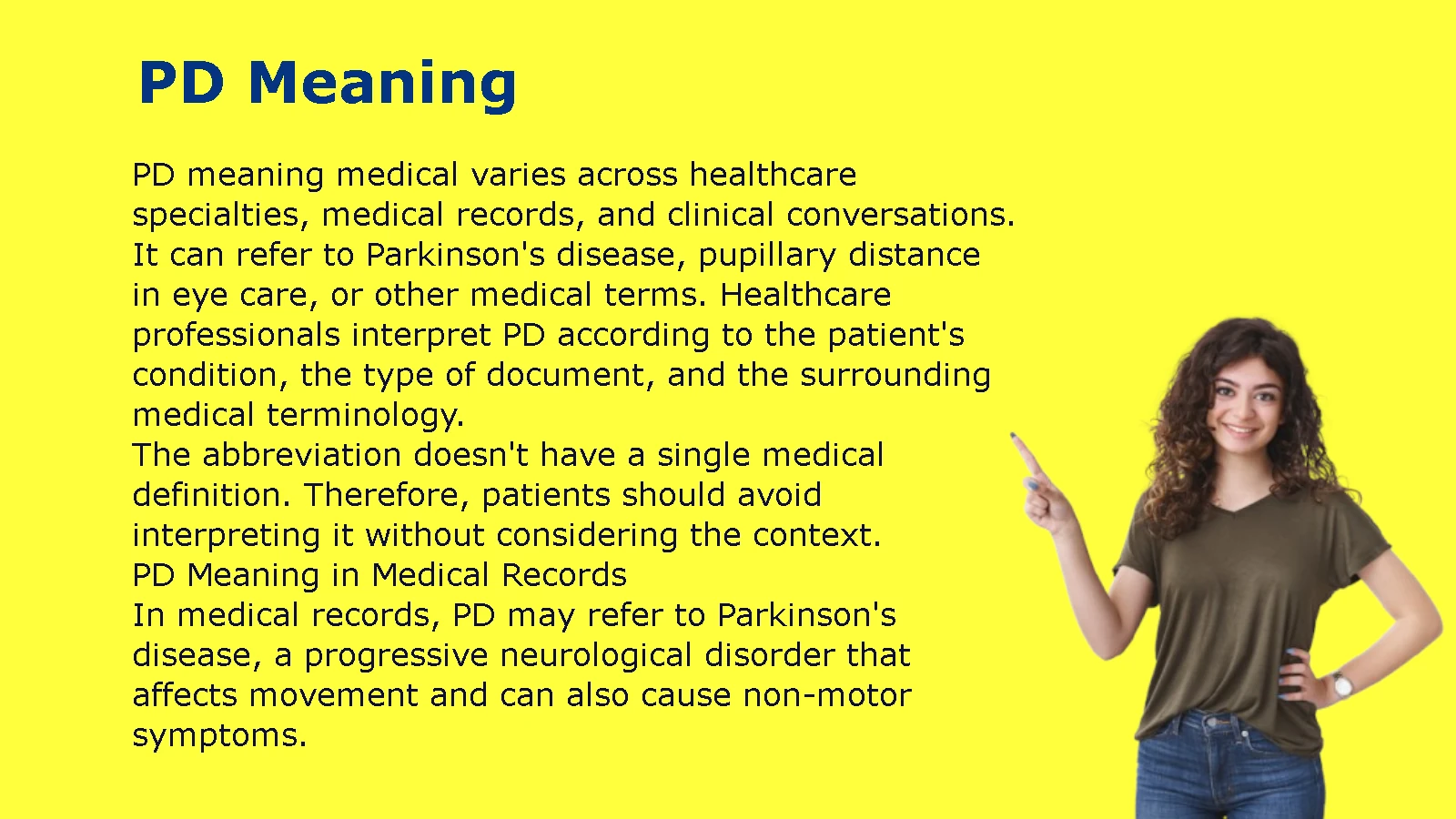
PD meaning medical varies across healthcare specialties, medical records, and clinical conversations. It can refer to Parkinson’s disease, pupillary distance in eye care, or other medical terms. Healthcare professionals interpret PD according to the patient’s condition, the type of document, and the surrounding medical terminology.
The abbreviation doesn’t have a single medical definition. Therefore, patients should avoid interpreting it without considering the context.
PD Meaning in Medical Records
In medical records, PD may refer to Parkinson’s disease, a progressive neurological disorder that affects movement and can also cause non-motor symptoms.
Parkinson’s disease develops when certain brain cells that produce dopamine become damaged or lost. Dopamine helps regulate movement, coordination, and several other functions.
Common symptoms of Parkinson’s disease include:
- Resting tremor: Shaking that often begins in one hand or another part of the body.
- Bradykinesia: Slowness of movement that can make daily tasks more difficult.
- Muscle rigidity: Stiffness that can affect movement and comfort.
- Balance difficulties: Problems with stability and coordination, particularly as the condition progresses.
Example: If a neurologist’s note mentions PD alongside tremor, rigidity, or movement difficulties, the abbreviation may refer to Parkinson’s disease.
However, PD can have other meanings in medical settings. Its interpretation may depend on the specialty and document.
PD Meaning in Eye Care
In optometry, PD stands for pupillary distance. It measures the distance between the centers of your pupils, usually in millimeters. Opticians use this measurement to position prescription lenses correctly in front of your eyes.
Pupillary distance matters because prescription lenses work best when their optical centers align appropriately with your eyes. An incorrect measurement can cause discomfort, visual distortion, or difficulty using glasses, particularly with stronger prescriptions.
There are two common ways to measure PD:
- Binocular PD: The total distance between the centers of both pupils.
- Monocular PD: The distance from the bridge of the nose to the center of each pupil separately.
Example: A glasses prescription may list a PD of 62 mm. That number represents the measured distance between the pupils when using a binocular measurement.
Some prescriptions include separate measurements for the right and left eyes. These measurements help opticians position lenses more precisely, especially when the eyes aren’t perfectly symmetrical.
How to Understand PD in a Medical Report
The easiest way to understand PD in a medical report is to examine the nearby words and the medical specialty.
| Medical context | Possible meaning | Clue |
| Neurology | Parkinson’s disease | Tremor, rigidity, movement disorders |
| Optometry | Pupillary distance | Eyeglasses, lenses, prescription |
| Medical research | Specialty-specific abbreviation | Study terminology or clinical discussion |
If you see PD on a medical report, consider these steps:
- Read the sentence containing the abbreviation.
- Identify the specialty or department.
- Look for nearby symptoms, measurements, or diagnoses.
- Ask your healthcare provider if the meaning remains unclear.
Medical abbreviations can be ambiguous. Don’t use an abbreviation alone to diagnose yourself or interpret a medical condition.
PD Meaning in Education
PD meaning in education commonly refers to professional development. Professional development includes training, workshops, educational courses, mentoring, and other activities that help teachers and school staff improve their knowledge, teaching skills, and professional abilities.
Schools, colleges, universities, and educational organizations use PD to support teacher development and improve educational practices.
What Is Professional Development (PD)?
Professional development is the ongoing process of improving professional skills, knowledge, and abilities through structured learning and practical experience.
In education, PD helps teachers adapt to changing curricula, new technologies, classroom challenges, and student needs. It can involve formal training or collaborative learning with other educators.
Common professional development activities include:
- Teacher training workshops
- Classroom management seminars
- Educational technology training
- Curriculum planning
- Subject-specific training
- Leadership programs
- Mentoring and peer observation
- Continuing education courses
For example, a school may organize a PD session to teach educators how to use digital learning platforms, assess student progress, or support students with different learning needs.
Examples of PD in Schools
Schools use professional development in several ways.
| PD activity | Purpose |
| Technology training | Help teachers use digital tools and classroom software |
| Classroom management | Improve student engagement and behavior management |
| Curriculum workshops | Develop lesson plans and improve curriculum delivery |
| Leadership training | Prepare educators for administrative roles |
| Assessment training | Improve tests, grading, and student feedback |
| Inclusive education | Help teachers support students with diverse learning needs |
A professional development day may take place before the school year begins, during a scheduled school day, or throughout the academic year.
For example, teachers might spend an afternoon learning how to design better assessments, followed by classroom implementation and peer feedback.
Why Is PD Important for Teachers?
Professional development allows teachers to improve their teaching methods and respond to changes in education.
It can help educators:
- Improve classroom instruction.
- Learn new teaching strategies.
- Understand curriculum updates.
- Develop leadership skills.
- Use technology more effectively.
- Improve student engagement.
- Address classroom challenges.
Practical example: A teacher who struggles to engage students during online lessons might attend a PD workshop on interactive learning tools. After the training, the teacher could introduce quizzes, discussion boards, and collaborative exercises to improve participation.
Effective PD should go beyond attendance. Teachers benefit more when training includes practical activities, follow-up support, feedback, and opportunities to apply what they learn.
PD Meaning in Law
PD meaning law can refer to a public defender or police department, depending on the legal or law-enforcement context. A public defender is a lawyer who represents eligible defendants who cannot afford private counsel, while PD often abbreviates police department in law-enforcement documents and everyday communication.
These meanings are different, even though both appear in legal or criminal justice discussions.
PD Meaning as Public Defender
A public defender is an attorney who represents eligible people facing criminal charges when they cannot afford to hire a private lawyer.
Public defender systems help provide legal representation to qualifying defendants. The rules governing eligibility and appointment vary by jurisdiction.
A public defender may:
- Represent clients in criminal proceedings.
- Explain charges and legal rights.
- Negotiate plea agreements.
- Prepare cases for trial.
- Challenge evidence.
- Advise clients about legal options.
- Represent clients during court hearings.
Example: If someone writes, “The defendant met with the PD before the hearing,” PD may mean public defender.
In this context, PD refers to the lawyer rather than the police.
PD Meaning as Police Department
PD also commonly stands for police department. People use this abbreviation when referring to a local law-enforcement agency.
Police departments investigate crimes, respond to emergencies, enforce laws, conduct patrols, and provide other public safety services.
Examples include:
- NYPD — New York City Police Department
- LAPD — Los Angeles Police Department
- SPD — Seattle Police Department or other police departments using the same initials, depending on the city
The abbreviation PD often appears in news stories, addresses, social media posts, community announcements, and official communications.
Example: “Contact your local PD if you witness the incident.”
Here, PD refers to the police department.
How to Identify the Legal Meaning of PD
The surrounding sentence usually reveals whether PD refers to a public defender or a police department.
| Example | Meaning | Explanation |
| “The PD argued that the evidence was insufficient.” | Public defender | A lawyer making a legal argument |
| “The PD responded to the emergency call.” | Police department | A law-enforcement agency responding to an incident |
| “She contacted the PD after the incident.” | Police department | A person contacting local law enforcement |
| “He requested a PD for his case.” | Public defender | A request for legal representation, depending on the jurisdiction |
If you encounter PD in a court document, legal conversation, or news report, check whether the sentence describes legal representation or police activity.
PD Meaning in a Charger
PD meaning in a charger is usually Power Delivery, specifically USB Power Delivery (USB PD). USB PD is a charging standard that allows compatible devices, chargers, and cables to negotiate suitable power levels. It supports flexible power delivery for smartphones, tablets, laptops, and other electronics.
A PD charger can provide more power than many traditional USB chargers, depending on its specifications and the device’s compatibility.
What Does PD Charger Mean?
A PD charger is a charger that supports USB Power Delivery, a standard developed for USB charging systems.
USB PD allows compatible devices to negotiate power with the charger. Instead of relying on one fixed power output, the charging system can select a supported power level based on the connected device and charging conditions.
USB PD commonly works through USB-C connections, although the connector alone doesn’t guarantee that a charger or device supports Power Delivery.
A USB-C charger may support PD, another charging protocol, or limited charging capabilities. Always check the product specifications.
How Does USB Power Delivery Work?
USB Power Delivery works through communication between compatible charging equipment and the connected device.
The process generally follows these steps:
- Connection: You connect a compatible device to a PD charger using an appropriate cable.
- Communication: The charger and device communicate to determine supported power options.
- Negotiation: The device requests an appropriate power level.
- Power delivery: The charger supplies power within the agreed limits.
- Adjustment: The charging system may adjust power as charging conditions change.
USB PD supports different voltage and current combinations, depending on the standard version and equipment.
USB PD 3.0 commonly supports power levels up to 100 watts, while USB PD 3.1 introduced Extended Power Range (EPR), enabling compatible equipment to support up to 240 watts. Actual charging power depends on the charger, cable, and device.
For example, a laptop capable of accepting 65 watts may charge using a compatible 100-watt PD charger. The laptop doesn’t automatically receive the full 100 watts just because the charger supports it.
PD Charger vs. Regular Charger
| Feature | PD charger | Traditional USB charger |
| Charging protocol | USB Power Delivery | May use older or different charging protocols |
| Power negotiation | Compatible devices negotiate supported power | May have limited or different negotiation capabilities |
| Power output | Can support higher power, depending on specifications | Often lower, but varies |
| Compatibility | Works with supported devices and cables | Depends on the charging standard |
| Common devices | Smartphones, tablets, laptops | Phones and smaller electronics |
| Charging flexibility | Supports different power configurations | May offer fewer supported configurations |
A PD charger can be useful if you want one charging adapter for multiple devices, such as a phone, tablet, and laptop.
However, a PD charger isn’t automatically faster than every other charger. Some manufacturers use their own charging technologies, and charging speeds depend on device compatibility.
Is a PD Charger Safe for Your Phone or Laptop?
A compatible PD charger is generally safe to use with a device that supports USB Power Delivery, provided the charger and cable meet appropriate safety and compatibility requirements.
The device negotiates a supported power level rather than simply receiving the maximum power advertised by the charger.
For example:
- A phone that supports 20W charging may use less than the maximum power available from a 100W charger.
- A laptop that supports 65W charging can use a compatible higher-rated PD charger.
- A lower-wattage charger may charge a laptop slowly or may not supply enough power during heavy use.
Before buying a charger, check:
- The device’s supported charging standard.
- The charger wattage.
- Cable power capabilities.
- The charger’s safety certifications and quality.
- The manufacturer’s charging recommendations.
Buying tip: Look for a reputable charger with the correct power rating, rather than choosing a product solely because it advertises a high wattage.
PD Meaning in a Company
PD commonly stands for professional development or product development in business settings. Professional development relates to employee learning and career growth, while product development involves creating, testing, improving, and launching products.
PD Meaning as Professional Development in a Company
In a company, professional development refers to activities that help employees improve their skills, knowledge, and performance.
Businesses invest in professional development to improve productivity, support employee growth, and prepare workers for new responsibilities.
Common corporate PD activities include:
- Leadership and management training.
- Communication and presentation workshops.
- Technical training.
- Employee mentorship.
- Career development programs.
- Industry certifications.
- Sales training.
- Customer service training.
For example, an employee working in customer service might attend a professional development program to improve conflict resolution, communication, and customer satisfaction skills.
A company may also organize PD programs to prepare employees for promotions or leadership positions.
PD Meaning as Product Development
PD can also stand for product development in companies that manufacture goods, develop software, or create commercial services.
Product development involves turning an idea into a product that customers can use. It often includes research, planning, design, testing, manufacturing, and launch.
A typical product development process includes:
| Stage | Description |
| Idea generation | Identify customer problems and potential solutions |
| Research | Study customer needs, competitors, and market opportunities |
| Design | Develop product concepts and specifications |
| Prototype | Build an early version for testing |
| Testing | Evaluate quality, performance, usability, and reliability |
| Launch | Introduce the product to customers |
| Improvement | Update the product based on feedback and performance |
Example: A technology company may assign its PD team to develop a new wireless accessory. In that situation, PD refers to product development rather than employee training.
How Companies Use PD
Companies use PD in different departments and business situations.
| Department or context | Possible PD meaning |
| Human resources | Professional development |
| Product management | Product development |
| Engineering | Product development or project-specific terminology |
| Employee training | Professional development |
| Business planning | Department-specific abbreviation |
If you encounter PD in an employment contract, company email, project report, or meeting, check the department and the surrounding sentence before interpreting it.
PD Meaning on Products
PD meaning on products depends on the product category, manufacturer, packaging, and technical specifications. It may refer to Power Delivery on compatible electronics or another manufacturer-defined abbreviation. PD doesn’t have a universal meaning on product labels, so buyers should check the product description or instructions.
What Does PD Mean on a Product Label?
Product labels often contain abbreviations to describe technical specifications, manufacturing details, features, or compatibility.
Manufacturers may use abbreviations to make packaging more compact or to communicate product information quickly.
PD may appear on:
- Electronic accessories.
- Charging adapters.
- Technical equipment.
- Product specification sheets.
- Packaging and labels.
- Manufacturer documentation.
The meaning depends on the item itself.
For example, a USB-C charger displaying PD may indicate that it supports USB Power Delivery. However, a label on another type of product could use PD for an entirely different purpose.
PD on Electronics and Accessories
In electronics, PD commonly refers to Power Delivery when the product is a compatible charger, power bank, charging cable specification, or electronic accessory.
A power bank that supports USB PD may charge compatible phones, tablets, or laptops at different power levels.
When checking an electronic product, look for details such as:
- USB PD compatibility.
- USB-C output.
- Supported wattage.
- Charging voltage.
- Supported current.
- Compatible devices.
Don’t assume every USB-C accessory supports PD. The connector shape and charging protocol are separate specifications.
How to Identify PD on a Product
Use these steps to identify the meaning of PD on a product:
- Check the product category: A charger or power bank is more likely to use PD for Power Delivery.
- Read the specification sheet: Manufacturers often define technical abbreviations in product documentation.
- Look at nearby terms: Words such as watts, USB-C, voltage, and charging indicate a technical meaning.
- Review the instruction manual: Product manuals explain manufacturer-specific abbreviations.
- Contact the manufacturer: Ask for clarification if the label remains ambiguous.
Understanding the product context prevents you from assuming that PD means the same thing across unrelated items.
PD Meaning in Banking
PD meaning in banking commonly stands for probability of default. Probability of default is a credit-risk measure that estimates the likelihood that a borrower will fail to meet financial obligations over a specified period. Banks, lenders, and financial institutions use PD when evaluating borrowers and managing credit risk.
What Is Probability of Default (PD)?
Probability of default is an estimate of the likelihood that a borrower will default on a financial obligation within a defined period, often one year for certain credit-risk assessments.
Banks use PD as part of their credit risk analysis. The estimate may depend on a borrower’s financial condition, credit history, income, debt, industry, economic conditions, and other factors.
PD is commonly expressed as a percentage.
For example:
- 1% PD: A relatively low estimated probability of default under the model’s assumptions.
- 5% PD: A higher estimated default probability.
- 20% PD: A substantially higher estimated probability of default.
These percentages are hypothetical examples, not universal lending classifications.
Probability of default doesn’t guarantee that a borrower will or won’t default. It represents a risk estimate based on available information and a defined methodology.
How Banks Use PD
Financial institutions use probability of default for several purposes.
| Application | How PD helps |
| Credit assessment | Estimate the risk of lending to a borrower |
| Loan pricing | Help determine interest rates and risk-based pricing |
| Risk management | Identify and monitor risky loans |
| Credit portfolios | Analyze risk across groups of borrowers |
| Regulatory calculations | Support certain regulatory capital approaches |
| Financial forecasting | Estimate potential credit losses |
PD is often used alongside other credit-risk measures, including:
- LGD (Loss Given Default): The estimated percentage of exposure a lender loses after a borrower defaults, taking recoveries into account.
- EAD (Exposure at Default): The estimated amount exposed to loss when a borrower defaults.
These measures help financial institutions assess credit risk more comprehensively.
PD Example in Banking
Imagine a bank evaluates a hypothetical business loan.
The bank estimates the borrower has a 3% probability of default over the next year.
This means the bank’s model estimates a 3% chance of default within the specified period under its assumptions. It doesn’t mean the borrower will definitely default, nor does it guarantee that the borrower will remain financially healthy.
The bank may combine this PD estimate with other information, such as loan exposure, expected recoveries, financial statements, and economic conditions.
Simple interpretation: A higher PD generally indicates greater estimated credit risk, while a lower PD generally indicates lower estimated credit risk, assuming the measures are comparable.
PD Meaning in a Relationship
PD meaning in a relationship doesn’t have one universally accepted definition. In relationship conversations, dating messages, social media, or text exchanges, PD may be a personal, community-specific, or informal abbreviation. The sender’s message and conversational context are the best clues to its intended meaning.
What Does PD Mean in Relationship Chats?
People use abbreviations in relationship conversations to save time, communicate casually, or refer to shared experiences.
However, PD isn’t a universally established relationship abbreviation with one consistent meaning across texting platforms or social groups.
Its interpretation may depend on:
- The topic of the conversation.
- The sender’s habits.
- The social group.
- The platform.
- Nearby words or emojis.
- Previous messages.
Example: If someone sends “What does PD mean?” in a dating conversation, the abbreviation can’t be interpreted reliably without additional context.
Rather than assigning a random slang meaning, examine the complete message and how the sender normally communicates.
How to Understand PD in a Relationship Message
If you encounter PD in a romantic conversation, consider the following:
- Read the entire message rather than focusing on the abbreviation.
- Check whether the conversation involves plans, personal feelings, dating, or another topic.
- Look for a similar abbreviation the sender used previously.
- Ask the sender what they mean if the message remains unclear.
Abbreviations in personal conversations can be highly context-dependent. The same letters may mean different things to different people.
How to Identify the Correct Meaning of PD
The best way to identify the correct meaning of PD is to examine the surrounding words, document, industry, or conversation. Because PD has several meanings, context usually provides the strongest clue. A medical report, school schedule, charger label, banking document, and text message may use the same abbreviation differently.
Check the Context
Start by identifying where you encountered PD.
| Where you saw PD | Meaning to investigate |
| Medical report | Medical terminology or diagnosis |
| School calendar | Professional development |
| Court document | Public defender or legal terminology |
| Police report | Police department |
| Charger packaging | Power Delivery |
| Bank document | Probability of default |
| Company email | Professional development or product development |
| Product label | Product-specific terminology |
| Text message | Informal or context-dependent meaning |
The document or conversation often narrows the possible meanings immediately.
Look at the Words Around PD
Nearby words can help you identify the abbreviation more accurately.
For example:
- PD + tremor + movement: May refer to Parkinson’s disease.
- PD + teachers + training: Likely refers to professional development.
- PD + court + attorney: May refer to a public defender.
- PD + USB-C + watts: Likely refers to Power Delivery.
- PD + credit + borrower: Likely refers to probability of default.
These contextual clues are more useful than searching for the abbreviation alone.
Avoid Assuming One Meaning
PD doesn’t mean the same thing in every situation. Assuming a single definition can create confusion, especially in medical, financial, legal, or technical documents.
When the meaning isn’t obvious:
- Check the complete sentence.
- Read the surrounding paragraph.
- Identify the industry or document type.
- Review the official documentation.
- Ask the relevant professional or sender.
Understanding the context is the most reliable way to interpret abbreviations accurately.
Frequently Asked Questions About PD Meaning
What is the most common meaning of PD?
PD has no single universal meaning. Common interpretations include professional development in education, Power Delivery in electronics, Parkinson’s disease in medicine, and probability of default in banking. The intended meaning depends on where the abbreviation appears.
What does PD stand for in medical terms?
PD may refer to Parkinson’s disease, pupillary distance, or other medical terminology depending on the specialty and document. In neurology, it commonly refers to Parkinson’s disease, while in optometry, it often means pupillary distance.
What does PD mean on a charger?
PD usually means Power Delivery, a USB charging standard that allows compatible devices and chargers to negotiate supported power levels. USB PD can support fast charging for compatible smartphones, tablets, laptops, and other electronics.
What does PD mean in banking?
PD commonly stands for probability of default in banking. It estimates the likelihood that a borrower will fail to meet financial obligations within a specified period and helps lenders assess credit risk.
What does PD mean in education?
PD commonly means professional development in education. It includes teacher training, workshops, continuing education, mentoring, and other activities that help educators improve their professional knowledge and skills.
What does PD mean in law?
PD may mean public defender or police department, depending on the context. A public defender is a lawyer who represents eligible defendants, while a police department is a law-enforcement agency.
Conclusion
PD is an abbreviation with multiple meanings across medicine, education, law, electronics, banking, business, product labeling, and personal conversations. Its meaning depends on the context in which someone uses it.
The most common interpretations include Parkinson’s disease in certain medical contexts, professional development in education and workplaces, public defender or police department in legal and law-enforcement settings, Power Delivery on compatible chargers, and probability of default in banking.
Understanding the surrounding words helps you identify the correct meaning without confusing unrelated definitions.
Whenever you encounter PD in a document, message, product specification, or professional conversation, check the context first. That simple step will help you interpret the abbreviation accurately.













