Professional ways to say I need your input include “I would appreciate your perspective,” “I’d value your feedback,” and “I would welcome your suggestions.” These expressions help you request opinions, advice, insights, and recommendations without sounding demanding. The best phrase depends on whether you need general input, expert guidance, constructive feedback, or specific suggestions.
In professional communication, choosing the right words can make your requests sound more respectful and collaborative. Expressions such as I need your advice, please share your thoughts, and please let us know your thoughts serve slightly different purposes. Understanding these differences helps you write clearer business emails, communicate effectively with colleagues, and invite useful contributions from clients, managers, and team members.
| Question | Answer |
| What is a professional way to say I need your input? | I would appreciate your perspective or I would value your feedback. |
| What does I need your input mean? | It means asking someone for their ideas, opinions, knowledge, or suggestions. |
| What is the difference between advice and advise? | Advice is a noun, while advise is a verb. |
| What does seeking your advice mean? | It means asking someone for guidance or recommendations. |
| What is another way to say please share your thoughts? | Could you share your perspective or I would welcome your feedback. |
35+ Professional Ways to Say I Need Your Input
Professional alternatives to “I need your input” allow you to request someone’s opinion while maintaining a polite and respectful tone. You can use these expressions in business emails, team meetings, project discussions, and client conversations. Some phrases request general ideas, while others specifically invite expert recommendations or constructive feedback.
The following alternatives cover different levels of formality and workplace situations.
Formal Ways to Say I Need Your Input
Formal expressions work best when communicating with senior colleagues, managers, executives, clients, or industry experts. They show respect for the recipient’s knowledge and make your request sound thoughtful.
Here are some suitable alternatives:
| Professional phrase | Example sentence |
| I would appreciate your input on this matter. | I would appreciate your input on this matter before we finalize the proposal. |
| I would value your perspective on this. | Given your experience, I would value your perspective on this decision. |
| Your insights would be greatly appreciated. | Your insights would be greatly appreciated as we evaluate the new strategy. |
| I would welcome your professional opinion. | I would welcome your professional opinion regarding the proposed changes. |
| I would be grateful for your recommendations. | I would be grateful for your recommendations on the next steps. |
| Could you provide your thoughts on this matter? | Could you provide your thoughts on this matter before Friday? |
| I would appreciate your guidance on this issue. | I would appreciate your guidance on how to approach this situation. |
| Your expertise would be valuable here. | Your expertise would be valuable here as we assess the potential risks. |
Best choice: “I would appreciate your input on this matter” works in most formal business situations because it communicates respect without sounding unnecessarily complicated.
Polite and Professional Ways to Ask for Input
You don’t always need highly formal language to sound professional. In everyday workplace communication, natural and courteous expressions often produce better responses.
Consider these alternatives:
- Could you please share your thoughts? This is a polite way to invite someone’s opinion.
- I would love to hear your perspective. Use this when you want an open and friendly discussion.
- Would you mind sharing your feedback? This works well when asking someone to review your work.
- I would appreciate hearing your opinion. Use it when the recipient’s viewpoint matters to your decision.
- Your feedback would be very helpful. This communicates that you value the person’s contribution.
- Could I get your thoughts on this? A natural option for colleagues and familiar business contacts.
- I would welcome any suggestions you may have. Use this when you want practical ideas or improvements.
- I’d value your input before moving forward. This works when you need someone’s contribution before taking action.
For example, instead of writing, “I need your input on the presentation,” you could say:
“I would appreciate your feedback on the presentation before I share it with the client.”
The revised sentence explains what you need and why the recipient’s response matters.
Professional Ways to Ask for Input in Emails
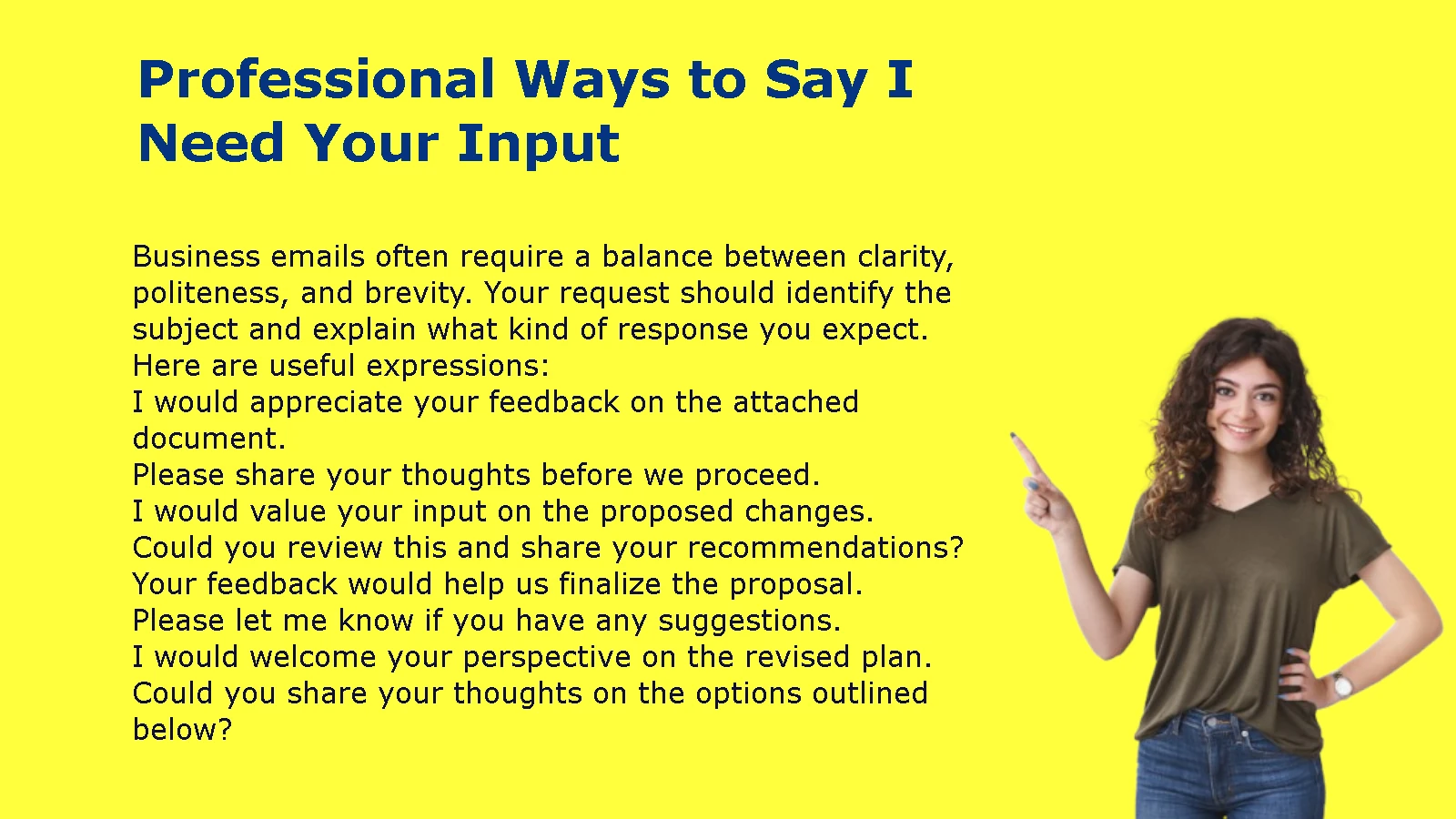
Business emails often require a balance between clarity, politeness, and brevity. Your request should identify the subject and explain what kind of response you expect.
Here are useful expressions:
- I would appreciate your feedback on the attached document.
- Please share your thoughts before we proceed.
- I would value your input on the proposed changes.
- Could you review this and share your recommendations?
- Your feedback would help us finalize the proposal.
- Please let me know if you have any suggestions.
- I would welcome your perspective on the revised plan.
- Could you share your thoughts on the options outlined below?
Notice the difference between a vague request and a specific one.
Vague: “Please provide your input.”
Specific: “Could you review the budget estimates and share your thoughts on the proposed cost reductions?”
The second request gives the recipient a clear task. It also increases the likelihood of receiving a useful response instead of a general acknowledgment.
Short and Natural Alternatives for Workplace Conversations
Short expressions work particularly well in meetings, instant messages, and conversations with familiar colleagues.
Try these options:
| Alternative | Best situation |
| What’s your take on this? | Informal team discussion |
| What do you think? | General opinion |
| I’d like your opinion. | Direct conversation |
| Any thoughts on this? | Quick workplace message |
| I’d value your input. | Collaborative discussion |
| How would you approach this? | Problem-solving |
| What would you recommend? | Decision-making |
| Does this approach make sense to you? | Reviewing an idea |
For example, imagine that your team is discussing a new marketing campaign. Instead of asking everyone to provide formal feedback, you could simply say:
“What’s your take on this campaign idea?”
This encourages an open discussion without making the conversation feel like a formal review.
Professional Ways to Ask for Input From Experts or Senior Colleagues
When requesting input from someone with more experience, acknowledge their expertise without using excessive flattery.
These expressions are particularly useful:
- Given your experience, I’d value your insights.
- I would appreciate your expert perspective.
- Could you offer your professional assessment?
- I would welcome your recommendations on the next steps.
- Your expertise would be valuable in this discussion.
- I’d appreciate your guidance before making a decision.
- Could I get your perspective on the potential challenges?
Example:
“Given your experience managing similar projects, I would appreciate your perspective on the proposed timeline.”
This sentence explains why you selected that person and what you want them to contribute.
What Does “I Need Your Input” Mean?
“I need your input” means that you want someone to contribute their ideas, opinions, knowledge, or suggestions about a particular subject. People commonly use this expression when they need another person’s perspective before making a decision, completing a project, or moving forward with a plan.
In professional environments, input represents a contribution that helps improve understanding or guide an outcome. It doesn’t necessarily mean that the recipient must make the final decision.
For example:
“I need your input on the new employee training program.”
This means the speaker wants the recipient to share ideas, recommendations, or relevant experience that could improve the program.
What Does Input Mean in Professional Communication?
In workplace communication, input refers to information or ideas contributed by another person or group.
It can include several types of contributions:
- Opinions: Personal views about a proposal or situation.
- Suggestions: Ideas for improving an existing plan.
- Expertise: Specialized knowledge that helps solve a problem.
- Feedback: Comments about the quality or effectiveness of something.
- Recommendations: Suggested actions based on experience or analysis.
- Information: Relevant facts that support a decision.
For instance, a project manager might request input from the design team before approving a new website layout.
The designers could contribute information about usability, accessibility, visual consistency, and technical limitations. Their input helps the manager make a more informed decision.
This is why the expression frequently appears in collaborative environments.
Is “I Need Your Input” Professional or Too Direct?
Yes, “I need your input” is grammatically correct and professional. However, its tone depends on the relationship between the sender and recipient, as well as the surrounding context.
The phrase sounds direct because it emphasizes what the speaker needs. That’s not necessarily negative. Direct communication can be useful when working with familiar colleagues or discussing urgent tasks.
However, a softer expression may work better when communicating with clients, senior managers, or people outside your immediate team.
Compare these examples:
| Direct expression | Softer alternative |
| I need your input on this. | I would appreciate your input on this. |
| Tell me what you think. | Could you share your thoughts? |
| I need your advice. | I would value your guidance. |
| Give me your feedback. | I’d appreciate your feedback. |
The second versions sound more courteous because they frame the request as an invitation rather than a demand.
Examples of “I Need Your Input” in Sentences
Here are original examples showing how to use the expression in different situations.
Workplace project:
“I need your input on the proposed changes to our internal reporting process.”
Business proposal:
“Before submitting the proposal, I need your input on the projected expenses.”
Team meeting:
“I need your input on how we can improve communication between departments.”
Client communication:
“I need your input regarding the design preferences for the upcoming campaign.”
Academic assignment:
“I need your input on the research questions before I complete the final draft.”
Management decision:
“I need your input on whether we should extend the current project deadline.”
Each example asks for a contribution related to a specific subject. This makes the request easier to understand and answer.
What Does “I Need Your Advice” Mean?
“I need your advice” means that you want someone to guide you, recommend an appropriate action, or help you make a decision. People use this expression when they value another person’s judgment, experience, or knowledge. It is common in personal conversations, workplace discussions, and professional emails.
Unlike general input, advice usually involves guidance about what someone should do.
For example:
“I need your advice on handling this client complaint.”
The speaker isn’t simply asking for an opinion about the complaint. They want guidance on the best way to handle it.
What Does Seeking Your Advice Mean?
Seeking your advice means actively asking someone for guidance, recommendations, or direction.
The expression often appears in professional communication when someone wants to benefit from another person’s experience.
Examples include:
- “I’m seeking your advice on how to manage this project more efficiently.”
- “She is seeking your advice before accepting the new position.”
- “We are seeking your advice regarding the proposed business expansion.”
- “I am seeking your guidance on the next stage of development.”
- “He contacted his former manager, seeking advice about the promotion.”
The expression can sound more formal than “I need your advice.”
For example:
“I need your advice on this issue.”
Compared with:
“I am seeking your advice regarding this matter.”
Both sentences communicate the same basic request, but the second sounds more formal and deliberate.
When to use it: Choose “seeking your advice” when communicating with mentors, consultants, experienced professionals, or senior colleagues.
Is “I Need Your Advice” Formal or Informal?
“I need your advice” works in both formal and informal communication. Its suitability depends on the situation and your relationship with the recipient.
In everyday conversations, it sounds natural and straightforward.
In professional communication, you can use a slightly more polished version when addressing someone in a senior position or someone you don’t know well.
| Expression | Tone | Example |
| I need your advice. | Direct | I need your advice about this decision. |
| I would appreciate your advice. | Polite | I would appreciate your advice on the proposed changes. |
| I would value your guidance. | Respectful | I would value your guidance before proceeding. |
| May I seek your advice? | Formal | May I seek your advice regarding this matter? |
| Could you advise me? | Professional | Could you advise me on the best approach? |
A useful distinction is that requesting advice usually implies that you want help deciding what to do. If you only want someone’s reaction, “I’d appreciate your thoughts” may be more appropriate.
I Need Your Advice or Advise: Which Is Correct?
The correct expression is “I need your advice.”
Advice is a noun that refers to guidance, recommendations, or suggestions. Advise is a verb that means to recommend or guide someone.
Although the two words sound similar, they have different grammatical functions.
| Word | Part of speech | Meaning | Correct example |
| Advice | Noun | Guidance or recommendation | I need your advice on this matter. |
| Advise | Verb | To recommend or guide | Please advise me on the next steps. |
Remember this simple rule:
- Use advice when referring to the guidance itself.
- Use advise when describing the act of giving guidance.
Correct: I would appreciate your advice about the new policy.
Incorrect: I would appreciate your advise about the new policy.
Correct: Could you advise me on how to proceed?
Incorrect: Could you advice me on how to proceed?
One additional grammar point matters: advice is an uncountable noun in standard English.
Therefore, write:
- Some advice
- A piece of advice
- A useful piece of advice
- Several pieces of advice
Avoid writing “an advice” or “two advices.”
Advice vs. Advise: More Examples
These examples show how the words function in different sentences.
Using advice:
- My manager gave me helpful advice about improving productivity.
- I would appreciate your advice before signing the agreement.
- Her advice helped us avoid an unnecessary expense.
- We received valuable advice from an experienced consultant.
Using advise:
- I would advise you to review the contract carefully.
- Please advise us if the delivery date changes.
- Our consultant will advise the team on compliance requirements.
- The manager advised everyone to submit their reports early.
Understanding this distinction helps you write professional emails without making a common grammar mistake.
What Does “Please Let Me Know Your Thoughts” Mean?
“Please let me know your thoughts” means that you are politely asking someone to share their opinion, reaction, or feedback about a particular subject. People commonly use the expression in emails, meetings, business discussions, and collaborative projects when they want to understand another person’s perspective.
The phrase leaves room for different kinds of responses. The recipient might agree, disagree, suggest improvements, or raise concerns.
For example:
“Please let me know your thoughts on the revised project timeline.”
This request invites the recipient to review the timeline and explain their opinion.
When Should You Say “Please Let Me Know Your Thoughts”?
Use this expression when you want someone to respond with an opinion rather than necessarily provide a detailed recommendation.
It works particularly well in these situations:
Reviewing a document:
“Please let me know your thoughts on the updated proposal.”
Discussing a business decision:
“I’ve outlined three possible approaches. Please let me know your thoughts.”
Requesting feedback on creative work:
“Please let me know your thoughts on the revised website design.”
Inviting comments from a team:
“We’ve shared the new schedule with everyone. Please let us know your thoughts.”
Following up after a meeting:
“After reviewing the meeting notes, please let me know your thoughts on the suggested action items.”
The expression is flexible because it doesn’t restrict the recipient to one type of response.
Professional Synonyms for “Please Let Us Know Your Thoughts”
When communicating with a group, “please let us know your thoughts” is a polite and natural expression. However, repeating it in every email can make your writing sound predictable.
Here are some professional alternatives:
| Alternative | Example |
| We would appreciate hearing your feedback. | We would appreciate hearing your feedback on the proposed changes. |
| Please share your perspective with us. | Please share your perspective with us before the meeting. |
| We welcome your comments and suggestions. | We welcome your comments and suggestions on the new policy. |
| We would love to hear your opinion. | We would love to hear your opinion on the revised design. |
| Kindly share your thoughts on this matter. | Kindly share your thoughts on this matter by Thursday. |
| Your feedback would be valuable to our team. | Your feedback would be valuable to our team as we finalize the strategy. |
| Please let us know what you think. | Please let us know what you think about the updated proposal. |
| We would value your recommendations. | We would value your recommendations before approving the budget. |
The best option depends on the response you expect.
For general opinions, use “Please share your perspective with us.”
For a decision that requires professional judgment, use “We would value your recommendations.”
Please Let Me Know Your Thoughts vs. Please Let Us Know Your Thoughts
Both expressions ask someone to share an opinion. The main difference is the speaker’s point of view.
“Please let me know your thoughts” uses “me” because one individual is requesting a response.
“Please let us know your thoughts” uses “us” because the request represents a group, company, or team.
Compare these examples:
- Individual email: “I’ve attached the revised document. Please let me know your thoughts.”
- Team email: “We’ve attached the revised document. Please let us know your thoughts.”
- Manager speaking personally: “I would appreciate your feedback on the new schedule.”
- Department speaking collectively: “We would appreciate your feedback on the new schedule.”
Choose the pronoun that accurately represents the person or group requesting the response.
What Does “Please Share Your Thoughts” Mean?
“Please share your thoughts” means that you are inviting someone to communicate their opinions, ideas, reactions, or perspectives about a particular topic. It is a polite expression that encourages discussion and allows the recipient to respond freely without requiring a specific recommendation.
The phrase works well in professional emails, brainstorming sessions, group discussions, and project reviews.
For example:
“Please share your thoughts on the proposed changes to our customer service process.”
This tells the recipient that their opinion matters and encourages them to contribute ideas.
When to Use “Please Share Your Thoughts”
You can use this expression in situations where open discussion is useful.
Brainstorming sessions: Invite team members to contribute fresh ideas.
“Please share your thoughts on how we can make the campaign more engaging.”
Team discussions: Encourage colleagues to express different viewpoints.
“Before we finalize the schedule, please share your thoughts.”
Business proposals: Request reactions to a proposed strategy.
“Please share your thoughts on the investment options outlined in the proposal.”
Creative reviews: Ask for opinions about a design, presentation, or written document.
“Please share your thoughts on the latest version of the presentation.”
Strategic planning: Encourage people to identify opportunities and potential challenges.
“Please share your thoughts on the proposed expansion into new markets.”
The expression is particularly effective when you want multiple people to contribute rather than simply approve a decision.
Professional Alternatives to “Please Share Your Thoughts”
You can use several expressions to communicate the same idea while adjusting the tone and purpose.
- Could you share your perspective? A polite request for an individual viewpoint.
- I would love to hear your opinion. A friendly invitation to discuss an idea.
- Please let me know your feedback. A direct request for comments or evaluation.
- I’d appreciate your insights. A suitable expression when requesting knowledgeable observations.
- What are your thoughts on this proposal? A clear question about a specific subject.
- We welcome your suggestions. A useful phrase when inviting practical improvements.
- I would value your input on this matter. A professional request for contributions.
- Could you offer your perspective on the issue? A respectful way to request another viewpoint.
For example, consider the following email:
“Hello Sarah,
I’ve attached the updated marketing plan for your review. Could you share your perspective on the proposed advertising channels?
Your insights would help us finalize the strategy.
Best regards,
Michael”
This message explains the subject, asks a focused question, and shows why the recipient’s contribution matters.
Other Ways to Say “Please Share Your Thoughts and Suggestions If Any”
The expression “please share your thoughts and suggestions if any” is understandable, but it can sound slightly wordy.
You can make it more natural by using one of these alternatives:
- Please share any feedback or recommendations you may have.
- We would welcome your thoughts and suggestions.
- Feel free to suggest any improvements.
- Please let us know if you have any additional ideas.
- I would appreciate any comments or recommendations.
- Your suggestions would be helpful as we move forward.
- Please share any ideas that could improve the current approach.
- We welcome any additional feedback you would like to provide.
Adding suggestions makes the request more action-oriented.
For example, “Please share your thoughts” invites general opinions. However, “Please share your thoughts and suggest any improvements” specifically encourages the recipient to identify ways to make something better.
The second version is particularly useful when reviewing documents, proposals, designs, and business processes.
Input vs. Advice vs. Feedback vs. Thoughts: What’s the Difference?
Input, advice, feedback, thoughts, suggestions, insights, and perspectives all relate to communication, but they don’t mean exactly the same thing. Each expression requests a different kind of contribution. Choosing the right word helps recipients understand what you expect from them.
| Expression | What you’re requesting | Best situation |
| Input | Ideas, contributions, or information | Collaborative projects |
| Advice | Guidance or recommendations | Decisions and problems |
| Feedback | Evaluation or constructive criticism | Reviewing work |
| Thoughts | General opinions or reactions | Open discussions |
| Suggestions | Specific ideas for improvement | Problem-solving |
| Insights | Knowledgeable observations or analysis | Expert discussions |
| Perspective | Someone’s individual viewpoint | Strategic decisions |
When to Ask for Input Instead of Advice
Ask for input when you want someone to contribute ideas, information, or opinions to a shared task.
Ask for advice when you want someone to recommend what you should do.
For example:
“I’d appreciate your input on the new hiring process.”
This invites the recipient to contribute ideas about the process.
“I’d appreciate your advice on which candidate to select.”
This asks the recipient to help you make a specific decision.
The distinction matters because requesting input doesn’t necessarily mean you expect the recipient to recommend one particular option.
When to Ask for Feedback Instead of Thoughts
Use feedback when you want someone to evaluate something or identify areas for improvement.
Use thoughts when you want a broader opinion or reaction.
For example:
“Please share your thoughts on the new presentation.”
This invites general comments about the presentation.
“Please provide feedback on the presentation’s structure and clarity.”
This asks the recipient to evaluate two specific aspects.
Feedback often has a more evaluative purpose, while thoughts leave more room for open discussion.
When to Ask for Suggestions Instead of Recommendations
Suggestions are possible ideas or improvements. Recommendations are usually more considered proposals about what someone believes you should do.
For example:
“I’d welcome any suggestions for improving the onboarding process.”
This invites different ideas from the team.
“I would appreciate your recommendation on the best onboarding platform.”
This asks someone to identify the most suitable option.
Use suggestions when you want several possibilities. Use recommendations when you want guidance toward a particular choice.
How to Ask for Someone’s Input Professionally in an Email
A professional email requesting input should explain what you need, identify the subject, and make it easy for the recipient to respond.
A useful structure includes:
- Subject: Clearly identify the topic.
- Greeting: Address the recipient appropriately.
- Context: Briefly explain the situation.
- Request: State what kind of input, advice, or feedback you need.
- Deadline: Mention a response date when necessary.
- Closing: Thank the recipient for their time.
Here are complete examples you can adapt.
Email Example: Asking a Manager for Input
Use this template when you need your manager’s opinion about a project, decision, or workplace issue.
Subject: Request for Your Input on the Project Plan
Hello [Manager’s Name],
I’ve prepared the initial project plan and would appreciate your input before we move forward.
Could you review the proposed timeline and resource allocation? I’d particularly value your perspective on whether the current schedule is realistic.
Your feedback will help us make any necessary adjustments before the project begins.
Thank you for your time.
Best regards,
[Your Name]
Why this works: The email identifies the subject, specifies what the manager should review, and explains how their input will be used.
Email Example: Requesting Feedback From a Colleague
This version works when you want a teammate to review your work.
Subject: Feedback on the Updated Report
Hi [Colleague’s Name],
I’ve completed the latest version of the report and would appreciate your feedback.
Could you take a look at the findings and let me know if anything needs clarification or improvement?
Your perspective would be helpful before I submit the final version.
Thanks for your help.
Best,
[Your Name]
Why this works: The message feels collaborative rather than demanding. It also gives the colleague a clear area to review.
Email Example: Seeking Advice From a Senior Professional
Use a respectful tone when asking someone with more experience for guidance.
Subject: Request for Your Advice on a Career Decision
Dear [Recipient’s Name],
I hope you’re doing well.
I’m currently considering a new professional opportunity and would greatly appreciate your advice.
Given your experience in this field, I would value your perspective on the potential benefits and challenges of this decision.
If your schedule allows, I’d be grateful for an opportunity to discuss this with you.
Thank you for considering my request.
Kind regards,
[Your Name]
Why this works: The message acknowledges the recipient’s experience and makes a respectful request without assuming they have unlimited time.
Email Example: Asking a Client to Share Their Thoughts
Client communication should sound courteous, clear, and focused on the client’s needs.
Subject: Your Thoughts on the Proposed Design
Hello [Client’s Name],
We’ve completed the latest design revisions based on our previous discussion.
Please share your thoughts on the updated version, particularly the layout, color scheme, and overall presentation.
Your feedback will help us ensure that the final design meets your expectations.
We look forward to hearing from you.
Best regards,
[Your Name]
Why this works: The email identifies specific elements for review and connects the client’s feedback to the final outcome.
Email Example: Requesting Suggestions Before a Deadline
When a deadline matters, communicate it clearly without making the request sound aggressive.
Subject: Suggestions Needed for the Final Project Plan
Hi Team,
We’re preparing to finalize the project plan and would welcome any additional thoughts or suggestions.
Please review the current draft and share any recommended changes by Thursday afternoon. This will give us enough time to incorporate useful feedback before submission.
Thank you for your cooperation.
Best,
[Your Name]
Why this works: It explains the deadline and gives recipients a clear reason to respond on time.
How to Choose the Right Professional Expression
The best professional phrase depends on three factors: formality, the type of response you need, and your relationship with the recipient.
A phrase that works perfectly in a team chat might sound too casual in a formal client email. Similarly, asking for advice when you actually need feedback can produce an unhelpful response.
Use the following framework to select the right expression.
Choose Your Phrase Based on Formality
Different situations require different levels of formality.
| Communication style | Recommended phrase | Suitable situation |
| Highly formal | I would appreciate your professional assessment. | Executive communication |
| Formal | I would value your perspective on this matter. | Senior colleagues |
| Neutral | I’d appreciate your input. | Everyday workplace emails |
| Friendly | I’d love to hear your thoughts. | Familiar colleagues |
| Casual | What’s your take on this? | Team conversations |
Avoid using complicated language simply to sound professional. Clear wording usually communicates respect more effectively.
Choose Your Phrase Based on the Response You Need
Before sending a request, consider what you want the recipient to provide.
| Your objective | Best expression |
| General opinion | Could you share your thoughts? |
| Constructive criticism | I’d appreciate your feedback. |
| Expert guidance | I would value your advice. |
| Creative ideas | I’d welcome your suggestions. |
| Detailed analysis | Could you share your insights? |
| Individual viewpoint | I’d appreciate your perspective. |
| Final decision support | What would you recommend? |
For example, if you want a colleague to identify weaknesses in your presentation, ask for feedback rather than general thoughts.
However, if you want to understand whether the overall concept makes sense, asking for their perspective may be more appropriate.
Choose Your Phrase Based on the Recipient
Your relationship with the recipient also influences your word choice.
Manager or executive
Use respectful, focused expressions.
- I would appreciate your guidance on this matter.
- I’d value your perspective before we proceed.
- Could you provide your recommendations?
Colleague or team member
Choose collaborative language.
- What are your thoughts on this?
- I’d appreciate your input.
- Do you have any suggestions?
Client or business partner
Keep the tone courteous and professional.
- We would welcome your feedback.
- Please share your thoughts on the proposed changes.
- Your recommendations would be greatly appreciated.
Mentor or industry expert
Acknowledge their knowledge and experience.
- Given your experience, I’d value your advice.
- I would appreciate your expert perspective.
- Could I seek your guidance on this decision?
How to Make Your Request Polite Without Sounding Vague
Politeness shouldn’t make your message unclear. A professional request should still communicate exactly what you need.
Follow these practical steps:
Use courteous language.
Words such as “could,” “would,” and “appreciate” help soften requests.
Instead of: “Review this document.”
Write: “Could you review this document and share your feedback?”
Specify the subject.
Avoid asking for input without explaining what you want reviewed.
Instead of: “I need your thoughts.”
Write: “I’d appreciate your thoughts on the proposed changes to our pricing structure.”
Explain why their input matters.
A short explanation gives the recipient context.
For example:
“Your experience with customer onboarding would help us identify potential issues before implementation.”
Set a reasonable deadline.
When you need a response by a particular date, communicate it directly.
For example:
“Could you share your feedback by Wednesday so we can finalize the report on Thursday?”
Express appreciation.
A brief thank-you makes the request feel considerate.
For example:
“Thank you for taking the time to review this. I appreciate your input.”
Common Mistakes When Asking for Input or Advice
Even when you choose the correct expression, the way you use it can affect how your message sounds. Avoid these common mistakes to make your professional communication clearer and more effective.
Using “Advice” and “Advise” Incorrectly
This is one of the most common grammar mistakes.
Incorrect: “I need your advise on the proposal.”
Correct: “I need your advice on the proposal.”
Incorrect: “Please advice me on the next steps.”
Correct: “Please advise me on the next steps.”
Remember that advice is a noun, while advise is a verb.
Making Your Request Sound Too Demanding
A direct request isn’t always inappropriate, but it can sound abrupt when you don’t provide context.
Compare:
“Send me your feedback today.”
“I would appreciate your feedback by the end of today so we can finalize the report.”
The second version communicates the same deadline while explaining why the response matters.
Asking for Feedback Without Specifying the Subject
A vague request forces the recipient to guess what you want them to review.
For example:
“Please provide your feedback.”
This could refer to the entire project, a particular document, or one specific decision.
A clearer version would be:
“Please provide your feedback on the budget estimates, particularly the proposed reductions in operating costs.”
Specific requests save time and often produce more useful answers.
Using Overly Formal Language in Everyday Conversations
Professional communication doesn’t require unnecessarily complicated words.
For example:
“I would be most appreciative if you could furnish me with your considered opinion.”
This sounds unnecessarily elaborate for an ordinary workplace discussion.
A more natural alternative is:
“I’d appreciate your thoughts on this.”
The second version is shorter, clearer, and easier to understand.
Repeating the Same Requesting Phrase in Every Email
Using “Please let me know your thoughts” in every message can make your writing repetitive.
Vary your expressions according to the response you need:
- Requesting ideas: I’d welcome your suggestions.
- Requesting evaluation: I’d appreciate your feedback.
- Requesting guidance: I would value your advice.
- Requesting analysis: Could you share your insights?
- Requesting an opinion: I’d love to hear your perspective.
This approach improves variety without making your writing sound unnatural.
Quick Reference: Professional Ways to Request Input, Advice, and Thoughts
If you need to choose an expression quickly, use this reference table.
| What you need | Recommended expression | Tone |
| General input | I’d appreciate your input on this. | Professional |
| Expert opinion | I’d value your perspective. | Formal |
| Personal guidance | I would appreciate your advice. | Respectful |
| Constructive feedback | Your feedback would be helpful. | Professional |
| Suggestions | I’d welcome any suggestions. | Polite |
| General thoughts | Could you share your thoughts? | Conversational |
| Detailed analysis | Could you provide your insights? | Formal |
| Final recommendation | What would you recommend? | Direct |
| Review of a document | I’d appreciate your comments on the attached document. | Professional |
| Team contribution | We welcome everyone’s input. | Collaborative |
| Approval before proceeding | I’d value your thoughts before we move forward. | Polite |
| Strategic guidance | I would appreciate your professional assessment. | Formal |
Real-World Case Study: Choosing the Right Request
Consider a marketing manager preparing to launch a new advertising campaign.
The manager needs contributions from three different people:
From the design team:
“I’d appreciate your input on the proposed campaign visuals.”
The manager wants creative ideas and practical contributions.
From the marketing director:
“I would value your advice on the recommended advertising budget.”
The manager wants guidance from someone with decision-making experience.
From the client:
“Please share your thoughts on the revised campaign presentation.”
The manager wants the client’s reaction and approval before proceeding.
Although all three requests relate to the same campaign, each expression serves a different purpose.
This example demonstrates why choosing a phrase based on the expected response is more effective than using synonyms interchangeably.
Conclusion: Choose the Right Way to Ask for Someone’s Input
Professional ways to say “I need your input” include “I would appreciate your perspective,” “I’d value your feedback,” and “I would welcome your suggestions.” Each expression helps you communicate respectfully while making your request sound more natural.
However, the best phrase depends on what you need from the recipient. Use input when you want ideas or contributions, advice when you need guidance, feedback when you want an evaluation, and thoughts when you want a general opinion.
Pay attention to your audience, communication style, and purpose before choosing an expression. When writing business emails, make your request specific, explain why the response matters, and include a reasonable deadline when necessary.
Ready to improve your professional communication? Choose one of these alternatives in your next email or workplace conversation. A clear, thoughtful request can encourage better collaboration, more useful feedback, and stronger professional relationships.
Frequently Asked Questions
What Is a Professional Way to Say “I Need Your Input”?
A professional way to say “I need your input” is “I would appreciate your perspective on this matter.” Other suitable alternatives include “I’d value your feedback,” “I would welcome your suggestions,” and “Could you share your thoughts?” Choose an expression based on the formality of the situation and the type of response you need.
What Does “I Need Your Input” Mean in an Email?
In an email, “I need your input” means that the sender wants the recipient to contribute ideas, opinions, suggestions, or relevant information. The request usually relates to a project, proposal, decision, or workplace issue. It indicates that the recipient’s contribution could help improve the outcome.
Is It Correct to Say “I Need Your Advice” or “I Need Your Advise”?
“I need your advice” is correct because advice is a noun referring to guidance or recommendations. Advise is a verb meaning to guide or recommend. For example, write “I need your advice” but “Please advise me on the next steps.”
What Is the Difference Between Seeking Your Advice and Asking for Your Input?
Seeking your advice means asking someone for guidance or a recommendation about what to do. Asking for input is broader because it invites opinions, ideas, information, or suggestions. You seek advice when you need direction and request input when you want someone to contribute to a discussion or decision.
How Do You Politely Ask Someone to Share Their Thoughts?
You can politely ask someone to share their thoughts by saying, “Could you please share your perspective?” Other options include “I’d appreciate hearing your opinion,” “I would welcome your feedback,” and “What are your thoughts on this proposal?” Adding a specific subject makes the request clearer.
What Is Another Way to Say “Please Let Us Know Your Thoughts”?
You can say “We would welcome your feedback,” “Please share your perspective with us,” or “We would appreciate your recommendations.” These expressions work well in professional emails, team announcements, and client communication. Use “feedback” when you want an evaluation and “recommendations” when you need practical guidance.