Other ways to say history include the past, chronicle, record, account, annals, heritage, legacy, background, and historical narrative. However, the best alternative depends on what you want to describe. Some words refer to past events, while others describe written records, cultural traditions, or the development of civilizations.
Whether you are writing an IELTS essay, preparing an academic assignment, describing world history, or improving your everyday vocabulary, choosing the right history synonym can make your sentences more precise and engaging. This guide explores more than 45 alternatives, including formal expressions, academic vocabulary, nine-letter words, slang, and antonyms. You will also learn the difference between related terms such as historical, historic, chronicle, heritage, and antiquity.
| Question | Answer |
| What is the best synonym for history? | Past, chronicle, record, account, and historical narrative are common alternatives. |
| What is another word for history or the past? | Earlier times, bygone days, former times, and previous events. |
| What are good history synonyms for IELTS? | Historical account, chronology, heritage, historical development, and documented record. |
| What is a nine-letter synonym for history? | Chronicle is a nine-letter word that describes a record of events. |
| What is the opposite of history? | Future is the closest contextual opposite when history refers to past events. |
What Are the Best Synonyms for History?
The best synonyms for history include past, chronicle, record, account, annals, heritage, background, and historical narrative. These words describe different aspects of what happened before the present. For example, a chronicle records events in chronological order, while heritage refers to traditions and cultural practices inherited from earlier generations.
The word you choose should reflect your intended meaning rather than simply replace history wherever it appears.
History Synonyms With Meanings and Example Sentences
Understanding a synonym requires more than memorizing its definition. You should also know how it behaves in a sentence.
The following examples show how to use some of the most useful alternatives naturally.
| Synonym | Meaning | Example sentence |
| Past | Earlier events or experiences | We can learn valuable lessons from the past. |
| Chronicle | A chronological record | The author chronicles the development of the ancient kingdom. |
| Heritage | Inherited culture and traditions | The museum preserves the country’s cultural heritage. |
| Annals | Historical records | The discovery became an important event in the annals of science. |
| Legacy | Something inherited from previous generations | The civilization left a remarkable architectural legacy. |
| Archive | A collection of preserved records | Researchers examined the national archive. |
| Account | A description of an event | Her account of the revolution included several eyewitness details. |
| Timeline | A chronological sequence | The documentary presents a timeline of major political changes. |
| Narrative | A connected description of events | The historian challenged the traditional narrative. |
| Antiquity | Ancient times | Several objects from antiquity remain on display. |
| Memoir | A personal account of experiences | His memoir describes life during the war. |
| Retrospect | Looking back at earlier events | In retrospect, the decision changed the country’s future. |
| Tradition | A custom passed through generations | The ceremony reflects a centuries-old tradition. |
| Evolution | Gradual development | The evolution of modern technology has changed communication. |
| Provenance | The documented origin of something | The painting’s provenance helped establish its authenticity. |
Consider the sentence, “The history of this building is fascinating.”
You could rewrite it in several ways:
- The past of this building reveals interesting details.
- The historical record of this building contains valuable information.
- The architectural heritage of this building reflects an earlier era.
- The story behind this building is fascinating.
Each alternative emphasizes something different. The historical record focuses on evidence, heritage highlights cultural value, and story makes the sentence more conversational.
Other Ways to Say History in Different Contexts
The right history synonym depends on the subject, audience, and purpose of your writing. Academic discussions often require precise expressions such as historical documentation or chronology. Casual conversations work better with simpler alternatives, including the past and the old days. Literary writing may benefit from terms such as saga, annals, and bygone era.
Other Words for History in Academic Writing
Academic writing requires accurate vocabulary that communicates ideas without exaggeration. Instead of repeating history throughout an essay, you can use expressions that describe the particular aspect of the past you are discussing.
Useful academic alternatives include:
- Historical account: A detailed description of past events.
- Historical record: Documented evidence about something that happened.
- Chronology: The arrangement of events according to their dates.
- Historical development: Changes that occurred over a particular period.
- Historical documentation: Written evidence and supporting records.
- Retrospective analysis: An examination of earlier events from a later perspective.
- Historical narrative: An explanation of how events unfolded.
- Cultural heritage: Traditions and practices inherited from previous generations.
Example:
Basic: The history of industrial development shows many changes.
Improved: The historical development of industry reveals significant changes in production methods, technology, and employment patterns.
Another example:
Basic: Researchers studied the history of the region.
Improved: Researchers examined the historical records and archaeological evidence of the region.
These alternatives make academic writing more specific because they explain what researchers actually examine.
Other Ways to Say History in Everyday Conversation
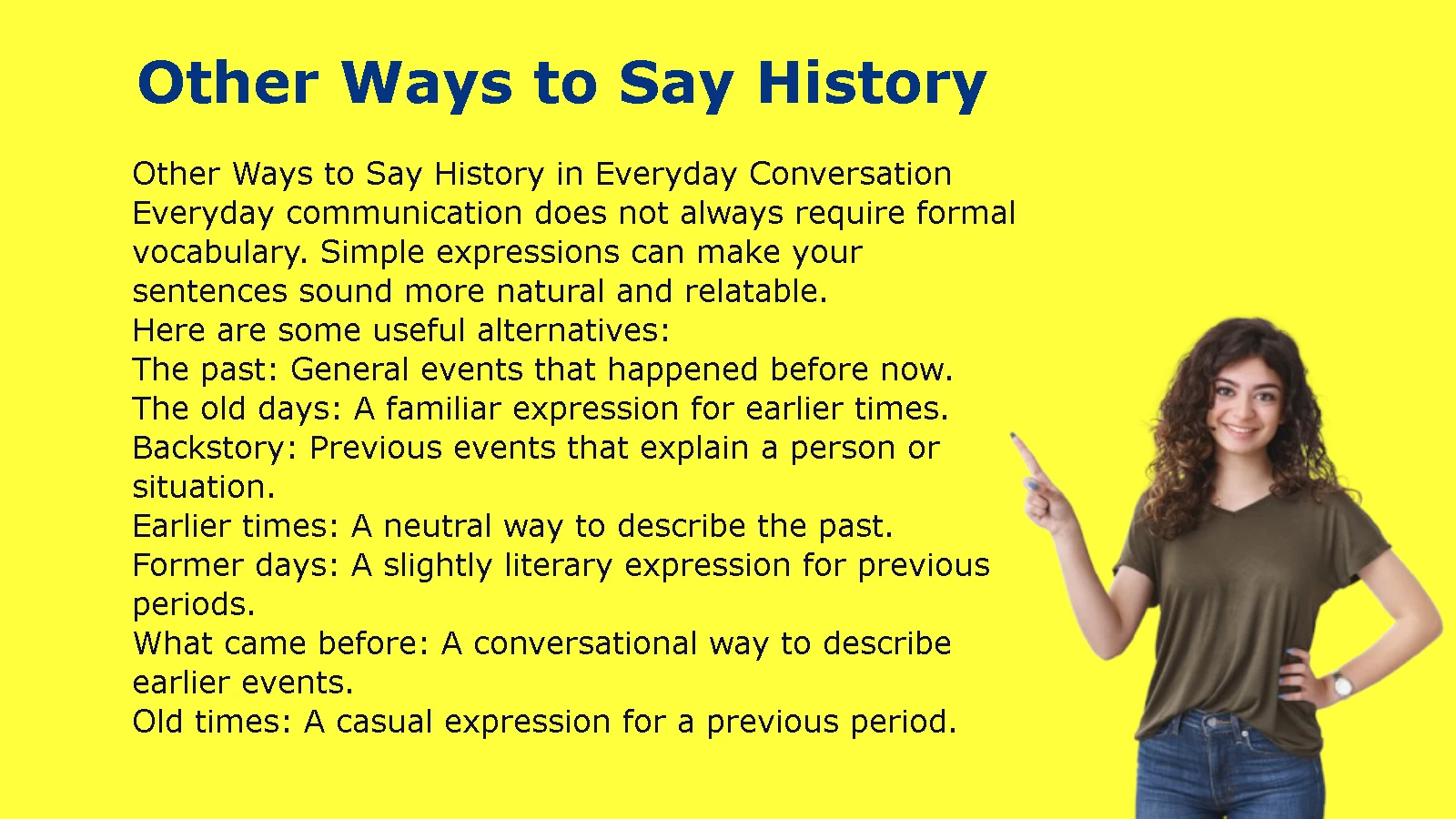
Everyday communication does not always require formal vocabulary. Simple expressions can make your sentences sound more natural and relatable.
Here are some useful alternatives:
- The past: General events that happened before now.
- The old days: A familiar expression for earlier times.
- Backstory: Previous events that explain a person or situation.
- Earlier times: A neutral way to describe the past.
- Former days: A slightly literary expression for previous periods.
- What came before: A conversational way to describe earlier events.
- Old times: A casual expression for a previous period.
Examples:
- I enjoy reading about the old days.
- Nobody knows the complete backstory of the abandoned building.
- We should understand what came before before making judgments.
- My grandfather often talks about earlier times.
- The documentary explores the past of our hometown.
Formal and Professional Synonyms for History
Formal alternatives work well in business reports, academic research, museum descriptions, and professional documents.
| Formal expression | Best context | Example |
| Historical documentation | Research and evidence | The team reviewed the historical documentation. |
| Historical background | Reports and explanations | The proposal includes the historical background of the project. |
| Recorded account | Documented events | The recorded account provides useful details. |
| Chronological record | Events arranged by date | The department maintains a chronological record of decisions. |
| Historical archive | Preserved documents | The researcher accessed the historical archive. |
| Historical development | Long-term changes | The report examines the historical development of the industry. |
A useful writing principle is to choose the most specific expression available. If you mean written evidence, use historical documentation. If you mean the circumstances that explain a situation, choose historical background.
Literary and Poetic Alternatives for History
Writers sometimes want language that creates a stronger emotional or imaginative effect. Literary alternatives can make descriptions of the past feel more vivid.
Consider these expressions:
- Annals: Suggests an extensive record of important events.
- Saga: Emphasizes a long and eventful story.
- Chronicle: Creates the impression of a detailed historical account.
- Bygone era: Refers to a distant or romanticized period.
- Legacy: Highlights the lasting influence of earlier generations.
- Remembrance: Focuses on memories and the act of remembering.
- Yesteryear: A poetic expression for a time in the past.
Examples:
- The castle stands as a reminder of a bygone era.
- Generations preserved the family’s legacy.
- The novel tells a dramatic saga of war and survival.
- These monuments remain part of the nation’s historical annals.
History Synonyms for IELTS and Academic Writing
Good history synonyms for IELTS include historical account, chronology, historical development, cultural heritage, documented record, and past events. These expressions help candidates communicate ideas with greater precision in Writing Task 1, Writing Task 2, and academic discussions. However, vocabulary variety alone does not guarantee a higher score. Each alternative must fit the meaning and grammar of the sentence.
Best Academic Synonyms for History
IELTS candidates should focus on vocabulary that communicates clear ideas. Replacing every occurrence of history with an advanced word can make an essay sound unnatural.
Here are some useful choices:
| Academic synonym | Meaning | Suitable IELTS context |
| Historical account | Description of past events | Discussing historical information |
| Historical record | Documented evidence | Supporting an argument with evidence |
| Chronology | Sequence of events | Explaining developments over time |
| Heritage | Inherited culture and traditions | Discussing national identity |
| Historical development | Changes across a period | Explaining social or economic change |
| Evolution | Gradual transformation | Discussing long-term progress |
| Background | Previous circumstances | Introducing a historical issue |
| Retrospective analysis | Examination of past events | Evaluating earlier decisions |
| Cultural legacy | Lasting influence of a culture | Discussing traditions and society |
| Historical documentation | Written evidence | Research and preservation topics |
For example, if your essay discusses the influence of earlier civilizations on modern society, historical development and cultural legacy may be more precise than repeatedly using history.
History Synonyms for IELTS Writing Task 1 and Task 2
Writing Task 1 and Task 2 require different approaches to vocabulary.
In Academic Writing Task 1, candidates often describe diagrams, maps, processes, or changes over time. Expressions such as historical development, previous period, and chronological progression can help when the visual information concerns earlier changes.
In Writing Task 2, you may discuss education, cultural preservation, national identity, or the influence of previous generations.
Consider these examples:
Task 1 example:
Basic: The chart shows the history of population growth in the region.
Improved: The chart illustrates the historical development of the region’s population over the period shown.
Task 2 example:
Basic: History should be taught in every school.
Improved: Schools should teach students about past events and their influence on modern society.
Another example:
Basic: History helps people understand their culture.
Improved: Studying cultural heritage and historical development helps people understand the origins of their traditions.
Example Sentences Using History Synonyms in IELTS Writing
Here are additional sentence transformations that demonstrate how to improve vocabulary without changing the original meaning.
| Basic sentence | Improved academic sentence |
| History teaches us many lessons. | The study of past events provides valuable lessons for future generations. |
| The history of the country is interesting. | The nation’s historical development is fascinating. |
| We should understand history. | We should examine historical records to understand societal change. |
| History affects modern society. | Historical developments continue to shape modern society. |
| History is important for children. | Learning about previous generations helps children understand their cultural heritage. |
| History shows how cities change. | Historical records reveal how urban environments have evolved. |
Common Mistakes When Using History Synonyms in IELTS
Advanced vocabulary only improves your writing when you use it correctly. Avoid these common mistakes:
Using heritage when you mean historical evidence: Heritage usually describes inherited culture, traditions, or valued possessions. It does not automatically mean a written record.
Replacing history with chronology: Chronology describes the order of events, not the complete study or interpretation of the past.
Using complicated vocabulary unnecessarily: A clear word such as past may communicate your point better than a less familiar expression.
Confusing historic and historical: Historical generally means related to the past, while historic often describes something especially important in history.
Repeating synonyms without considering context: Using chronicle, annals, and record in every paragraph will not improve an essay if the words do not fit the intended meaning.
A practical approach is to prioritize accuracy first, then vocabulary variety.
Another Word for History or the Past
Another word for history or the past includes earlier times, former days, bygone era, previous events, antiquity, yesteryear, and retrospect. These expressions describe different periods or experiences that came before the present. Some are suitable for academic writing, while others work better in storytelling and casual conversations.
Synonyms for the Past
The past can refer to a person’s experiences, previous events, or an entire historical period.
Here are useful alternatives:
| Alternative | Meaning | Example sentence |
| Earlier times | A period before the present | Life was different in earlier times. |
| Former days | Previous periods | The town has changed greatly since its former days. |
| Bygone days | Times that have passed | The photographs remind us of bygone days. |
| Previous events | Things that happened earlier | Previous events influenced the final decision. |
| Antiquity | The distant ancient past | Ancient Greek philosophy shaped many ideas from antiquity. |
| Yesteryear | A time in the past | The museum displays vehicles from yesteryear. |
| Retrospect | Looking back at earlier experiences | In retrospect, the experience taught us patience. |
| Old times | A familiar earlier period | They enjoyed talking about the old times. |
| Former era | A previous historical period | The palace reflects the style of a former era. |
Not all these terms have the same tone. Yesteryear often sounds nostalgic, while previous events is neutral and suitable for professional writing.
Alternative Expressions for Historical Events
When describing specific events, you can use more precise expressions than the general word history.
Examples include:
- Past occurrences: Events that happened previously.
- Recorded events: Occurrences preserved in written or digital records.
- Previous developments: Earlier changes or progress.
- Significant milestones: Important achievements or turning points.
- Historical episodes: Individual events within a broader historical period.
- Major developments: Important changes that affected a situation.
- Earlier incidents: Events that took place before another event.
Example sentences:
- The museum preserves evidence of important past occurrences.
- Several significant milestones shaped the country’s political system.
- Researchers examined the recorded events surrounding the discovery.
- These historical episodes changed the direction of the conflict.
History vs. Past vs. Heritage vs. Legacy
These four words are closely related, but they describe different ideas.
| Word | Definition | Main emphasis | Example |
| History | The study and record of past events | Events and their interpretation | History explains how societies developed. |
| Past | Everything that happened before now | Earlier time | We cannot change the past. |
| Heritage | Culture, traditions, and possessions inherited from earlier generations | Inheritance and identity | The festival celebrates our heritage. |
| Legacy | Something lasting that previous people or events leave behind | Continuing influence | The scientist left a valuable legacy. |
A simple way to remember the difference is to think about what each word emphasizes.
- History explains what happened.
- Past identifies when something happened.
- Heritage describes what generations inherit.
- Legacy describes what remains or continues to influence later generations.
History Synonyms With 9 Letters
Two useful nine-letter words associated with history are chronicle and antiquity. Chronicle describes a record of events, often arranged in chronological order. Antiquity refers to ancient times or the distant past. Both connect closely to history, but neither replaces it naturally in every sentence.
Nine-Letter Words Related to History
| Word | Letter count | Meaning | Example |
| Chronicle | 9 | A record of events | The book chronicles the empire’s rise. |
| Antiquity | 9 | Ancient times | The sculpture dates back to antiquity. |
These are the strongest candidates for the nine-letter search query.
A few related words deserve clarification:
- Recollect: Nine letters, meaning to remember something. It relates to personal memories rather than serving as a synonym for history.
- Historical: Ten letters, meaning connected with the past.
- Retrospect: Ten letters, referring to looking back at earlier events.
This distinction matters because a word can relate to history without being a direct synonym.
How to Use Nine-Letter History Synonyms in Sentences
Chronicle
- The documentary chronicles the development of modern transportation.
- Historians discovered a chronicle describing the ancient settlement.
- Her book provides a detailed chronicle of the political movement.
Antiquity
- Several Greek structures have survived since antiquity.
- The museum contains valuable objects from antiquity.
- Philosophical ideas from antiquity continue to influence modern thought.
Use chronicle when you mean a record or account. Choose antiquity when referring to ancient times.
History Synonyms in Slang and Informal English
Informal alternatives for history include the old days, backstory, old times, the past, old news, and throwback. These expressions make conversations sound more relaxed, but they do not all carry the same meaning. Some describe previous experiences, while others refer to outdated information or nostalgic memories.
Casual Ways to Say History
Here are common expressions for informal situations:
| Expression | Meaning | Example |
| The old days | A previous period, often remembered fondly | My parents often talk about the old days. |
| Backstory | Earlier events that explain something | What’s the backstory behind this building? |
| The past | Previous events or experiences | We should leave the past behind. |
| Old times | An earlier period | We spent the evening remembering old times. |
| What came before | Earlier events or circumstances | Understanding what came before explains the problem. |
| Yesteryear | A nostalgic expression for the past | The film captures the fashion of yesteryear. |
Backstory deserves special attention because it commonly appears in conversations about people, fictional characters, organizations, and events.
For example:
- The movie reveals the hero’s backstory.
- Before criticizing the decision, understand the company’s backstory.
- Every historical building has a story behind its construction.
Slang Expressions Related to History
Some informal expressions have meanings connected to the past without acting as direct synonyms.
Ancient history: Something that happened so long ago that it no longer seems relevant.
Example: That argument is ancient history now.
Old news: Information that people already know or consider outdated.
Example: The announcement is old news to local residents.
Been there, done that: An expression used when someone has already experienced something.
Example: I have tried that approach before. Been there, done that.
Throwback: A reference to something from an earlier period.
Example: This photograph is a throwback to our school days.
These expressions work well in conversations, social media captions, and informal writing. Avoid them in formal research papers unless the context specifically requires casual language.
Example Sentences Using Informal History Alternatives
- The documentary takes viewers back to the old days.
- I finally learned the backstory of the famous photograph.
- Their disagreement is now ancient history.
- That hairstyle is a throwback to the 1990s.
- The company considers its early struggles part of the past.
World History Synonyms
World history can also be described as global history, human history, the history of civilization, or the historical development of societies. These expressions examine events and developments across different countries, cultures, and civilizations. The most suitable alternative depends on whether you are discussing global connections, human development, or particular historical periods.
Alternative Terms for World History
| Alternative | Meaning | Example sentence |
| Global history | The study of events and connections across the world | Global history explores interactions between civilizations. |
| Human history | The collective history of humankind | Human history includes the development of societies and technology. |
| History of civilization | The development of organized human societies | The history of civilization reveals major social transformations. |
| World heritage | Cultural and natural places valued by humanity | The site is part of our shared world heritage. |
| Global historical record | Documented events from different parts of the world | Researchers compared the global historical record. |
| International history | Historical relationships between countries | International history examines diplomacy and conflict. |
Notice that world heritage is not a direct synonym for world history. It describes cultural and natural inheritance that has significance beyond one country.
Synonyms for Different Areas of World History
World history covers several specialized subjects. Each field has its own terminology.
Ancient history: Studies early civilizations, societies, political systems, and cultures.
Medieval history: Examines the period commonly called the Middle Ages.
Modern history: Studies more recent historical developments, although its exact time boundaries vary by academic context.
Cultural history: Explores beliefs, customs, art, traditions, and everyday life.
Political history: Focuses on governments, political movements, leaders, and institutions.
Social history: Examines how ordinary people lived and how societies changed.
Economic history: Studies production, trade, markets, wealth, and economic systems over time.
Example Sentences Using World History Alternatives
- Global history helps students understand how civilizations influenced one another.
- The course examines the history of civilization from early settlements to modern societies.
- Human history includes major developments in agriculture, communication, and technology.
- Political history explains how governments and institutions evolved.
- The museum presents an overview of ancient and medieval history.
Synonyms for Historical
Synonyms for historical include historic, ancient, archival, traditional, past, antiquarian, and period-related. However, these alternatives have different meanings. Historical generally describes something connected with the past, while historic often describes an event or achievement that has special importance.
Common Synonyms for Historical
| Synonym | Meaning | Example |
| Historic | Important in history | The agreement was a historic achievement. |
| Past | Related to an earlier period | Past events influenced the decision. |
| Ancient | Belonging to a very distant period | Researchers studied ancient architecture. |
| Archival | Related to preserved records | The journalist examined archival photographs. |
| Traditional | Based on customs passed through generations | The ceremony follows traditional practices. |
| Antiquarian | Concerned with old objects and historical artifacts | The antiquarian collection contains rare manuscripts. |
| Former | Previously existing or occupying a position | The former capital remains historically significant. |
| Period-related | Connected with a particular era | The museum displays period furniture. |
Historical vs. Historic: What’s the Difference?
Historical means connected with the past or the study of past events. Historic usually means important or significant in history.
| Historical | Historic |
| Describes something related to history | Describes something with major historical importance |
| Can refer to ordinary past events | Usually emphasizes significance |
| Historical document | Historic agreement |
| Historical research | Historic victory |
| Historical building | Historic event |
Examples:
- The museum contains historical documents from the eighteenth century.
- The signing of the agreement was a historic moment.
- Researchers examined the historical background of the conflict.
- The country celebrated a historic achievement.
A useful rule is that every historic event belongs to history, but not every historical event deserves to be called historic.
Example Sentences Using Synonyms for Historical
- The university preserves several archival documents from the early twentieth century.
- The city protects its ancient monuments.
- Researchers studied the country’s former political system.
- The exhibition explores traditional customs from different communities.
- The museum displays antiquarian objects collected over several generations.
History Antonyms and Opposite Words
History does not have one perfect antonym because it can describe the study of past events, a written record, or the past itself. However, future is its closest contextual opposite when history refers to earlier events. Other alternatives include present, tomorrow, prospect, novelty, and forecast, depending on the intended meaning.
Common Antonyms of History
| Antonym | Meaning | Example sentence |
| Future | Time that has not yet happened | We must prepare for the future. |
| Present | The current time | The present differs greatly from the past. |
| Tomorrow | The day after today or an imagined future | Tomorrow may bring new opportunities. |
| Prospect | A possible future situation | The economic prospects look promising. |
| Forecast | A prediction about future events | The forecast suggests further growth. |
| Novelty | Something new or unfamiliar | The invention introduced a novelty to the industry. |
| Innovation | A new idea, method, or development | Innovation can transform traditional industries. |
| Contemporary | Belonging to the present period | Contemporary architecture differs from ancient design. |
These words are contextual opposites rather than exact dictionary antonyms.
For example, future contrasts with past, while innovation may contrast with tradition. The appropriate opposite depends on the particular meaning of history in your sentence.
History Synonyms and Antonyms Table
This comparison makes it easier to understand how related words and opposites work.
| Word | Synonyms | Contextual antonyms |
| History | Past, chronicle, record, account | Future, prospect |
| Historical | Historic, archival, ancient | Modern, contemporary |
| Past | Former times, bygone days, yesteryear | Present, future |
| Tradition | Heritage, custom, legacy | Innovation, novelty |
| Ancient | Old, antiquated, antique | Modern, recent |
| Former | Previous, earlier, preceding | Current, present, future |
History Synonym and Antonym Examples in Sentences
Understanding synonyms and antonyms becomes easier when you compare them in complete sentences.
History and future
- Synonym: We should study the past to understand social change.
- Antonym: We should plan for the future to achieve progress.
Historical and contemporary
- Synonym: The museum displays historic buildings and artifacts.
- Antonym: The exhibition also features contemporary architectural designs.
Tradition and innovation
- Synonym: The community protects its cultural heritage.
- Antonym: The company encourages technological innovation.
Former and current
- Synonym: The previous government introduced several reforms.
- Antonym: The current government has adopted a different approach.
Chronicle Meaning and Its Connection to History
A chronicle is a factual account of events recorded in the order they happened. It often describes important developments across a particular period, including political changes, wars, discoveries, and social events. Chronicles are closely associated with history because they preserve information that helps later generations understand the past.
What Does Chronicle Mean?
The noun chronicle refers to a record or account of events, usually arranged in chronological order.
For example:
- The historian discovered a chronicle describing the ancient kingdom.
- The book provides a detailed chronicle of the war.
- Local records chronicle the town’s development over several centuries.
Chronicle can also function as a verb. To chronicle something means to record or describe its development over time.
Example:
The documentary chronicles the transformation of the city from a small settlement into a major commercial center.
Word forms:
| Form | Word |
| Singular noun | Chronicle |
| Plural noun | Chronicles |
| Verb | Chronicle |
| Third-person singular | Chronicles |
| Past tense | Chronicled |
| Present participle | Chronicling |
The word comes from a historical tradition of recording events according to time. It shares a linguistic connection with chronology and chronological, which also relate to time and sequence.
Chronicle vs. History vs. Historical Account
These expressions overlap, but they are not identical.
| Term | Meaning | Main purpose |
| Chronicle | A record of events in chronological order | Preserving a sequence of events |
| History | The study and interpretation of past events | Explaining what happened and why |
| Historical account | A description or explanation of past events | Presenting information about an earlier period |
| Annals | Historical records, often arranged by year | Documenting events over time |
Imagine a researcher examining the development of an ancient city.
A chronicle might list the city’s founding, major battles, changes in leadership, and important construction projects in chronological order.
A historical account might explain these events and describe their significance.
A study of the city’s history could go further by investigating political systems, trade, cultural influences, and the reasons behind its development.
This distinction shows why choosing the correct term matters.
Examples of Chronicle in Sentences
Here are examples from different writing contexts:
Historical writing:
The manuscript chronicles the expansion of the ancient empire.
Academic writing:
The researcher used local archives to create a chronicle of economic development.
Everyday conversation:
The family photograph album chronicles several generations of celebrations.
Literary writing:
The novel is a moving chronicle of friendship, hardship, and personal growth.
How to Choose the Right Synonym for History
Choose a history synonym by identifying what you want to describe. Use past for earlier events, chronicle for a chronological account, heritage for inherited culture, and historical record for documented evidence. A precise alternative communicates your intended meaning without making the sentence unnecessarily complicated.
Choose Based on Context
Use the following guide to select the most suitable expression.
| Writing situation | Recommended synonym | Why it works |
| Academic essay | Historical account | Clearly describes an explanation of past events |
| Casual conversation | The past | Simple and natural |
| Cultural discussion | Heritage | Highlights inherited traditions and identity |
| Historical research | Historical record | Emphasizes documented evidence |
| Literary writing | Saga | Creates a narrative effect |
| Chronological description | Chronicle | Emphasizes the order of events |
| Personal experiences | Memoir | Focuses on someone’s life and memories |
| Ancient civilizations | Antiquity | Refers to ancient historical periods |
| Family background | Ancestry or genealogy | Describes family origins |
| Long-term changes | Evolution or development | Highlights gradual transformation |
Avoid These Common Synonym Mistakes
A synonym may look appropriate but still change the meaning of a sentence.
Mistake: Using heritage as a replacement for every meaning of history.
Incorrect: The heritage of the war lasted five years.
Better: The history of the war spans five years.
Heritage describes inherited culture or traditions, not simply the duration of an event.
Mistake: Confusing chronicle with chronology.
A chronicle is an account of events. Chronology is the order in which events happened.
Correct examples:
- The author wrote a chronicle of the revolution.
- The researcher established the chronology of the revolution.
Mistake: Using antiquity for recent events.
Antiquity generally refers to the ancient past. It is unsuitable when discussing a recent political development or a modern historical event.
Mistake: Using legacy when you mean evidence.
Legacy describes something that remains influential or is passed down. A historical record provides documented information.
Mistake: Treating historical and historic as identical.
A historical document relates to the past. A historic document may be especially important because of its influence or significance.
A Practical Example: Improving a Repetitive Paragraph
Consider this paragraph:
“The history of the city is interesting. Its history includes several wars. The history of its buildings also shows how the city developed.”
The repeated word makes the writing less engaging. You can improve it by selecting alternatives according to context.
Improved version:
“The city’s past is fascinating. Its historical record includes several wars, while the architectural heritage of its buildings reveals how the urban landscape developed over time.”
The revised paragraph uses more precise vocabulary without adding unnecessary complexity.
This is the best way to approach synonym selection: understand the original meaning, identify the intended emphasis, and choose an alternative that fits naturally.
Frequently Asked Questions About History Synonyms
What Is the Best Synonym for History?
The best general synonyms for history are past, record, chronicle, account, and historical narrative. Use past when discussing earlier events, record when referring to documented information, and chronicle when describing events in chronological order. Historical account is another strong option for academic and professional writing.
What Is Another Word for History or the Past?
Common alternatives include earlier times, former days, bygone days, antiquity, yesteryear, previous events, and the old days. The past is the simplest general alternative, while antiquity specifically refers to ancient periods. Yesteryear is more nostalgic and often appears in literary or conversational writing.
What Are Some Advanced Synonyms for History for IELTS?
Useful academic alternatives include historical account, chronology, historical development, cultural heritage, historical documentation, and retrospective analysis. For IELTS, choose expressions that match the subject of your essay. For example, use historical development when discussing social change and cultural heritage when discussing inherited traditions.
What Is a Nine-Letter Synonym for History?
Chronicle is a nine-letter word that describes a record of events, often arranged in chronological order. Antiquity also has nine letters and refers to ancient times. Chronicle is the closer alternative when you mean a historical record, while antiquity describes a particular period of the past.
What Is the Opposite of History?
Future is the closest contextual opposite of history when history refers to past events. Present is another contrasting term because it describes the current time. However, history has no single universal antonym, so the appropriate opposite depends on the sentence.
What Is the Difference Between History and Chronicle?
History is the study, interpretation, and record of past events. A chronicle is a particular type of account that records events in chronological order. A historical study may explain causes, consequences, and broader developments, while a chronicle primarily documents what happened and when.
Conclusion: Choose the Right Words to Describe History
Finding other ways to say history is not simply about collecting similar words. It is about choosing vocabulary that communicates the correct meaning. Past, chronicle, record, account, heritage, legacy, and historical narrative all relate to history, but each highlights a different aspect of earlier events.
For academic writing and IELTS essays, prioritize expressions such as historical development, chronology, and historical documentation. In everyday conversations, simpler alternatives like the past, old times, and backstory sound more natural. When discussing ancient civilizations, antiquity is a useful choice, while chronicle works well for a documented sequence of events.
Before replacing history in a sentence, consider whether you mean an earlier period, a written record, an inherited tradition, or the lasting influence of previous generations.
Ready to improve your vocabulary? Choose five synonyms from this guide and use each in an original sentence. Practicing them in context will help you write more clearly, avoid repetition, and select the right expression for every situation.