Professional ways to say keep me in the loop include “Please keep me informed,” “Please keep me updated,” “Kindly keep me apprised,” and “Please include me in future correspondence.” These alternatives help you request relevant information without sounding too casual or demanding.
The best expression depends on your workplace relationship, communication channel, and reason for requesting updates. In professional emails, keep me informed, keep me updated, and include me in future correspondence work well when discussing projects, business decisions, and future emails. Meanwhile, keep me posted suits friendly conversations with colleagues, while keep me apprised communicates a more formal tone.
This guide explains professional alternatives, keep you in the loop expressions, thank-you synonyms, email examples, and the grammar behind keep me in the loop on or about. You’ll also learn how to say keep in touch professionally when you want to maintain a business relationship.
Quick Answers: Professional Ways to Say Keep Me in the Loop
| Question | Answer |
| What is a professional way to say keep me in the loop? | Please keep me informed or updated. |
| How do you politely ask to be included in future emails? | Please include me in future correspondence. |
| What does thanks for keeping me in the loop mean? | It expresses appreciation for someone sharing relevant information and updates. |
| Should you say keep me in the loop on or about? | Both are correct. Use on for a specific topic or project and about to introduce information or developments. |
| How do you say keep in touch professionally? | I look forward to staying in contact or maintaining communication. |
What Does Keep Me in the Loop Mean?
Keep me in the loop means to continue sharing relevant information, updates, decisions, or developments with someone so they remain informed about a particular situation. In professional communication, it usually means including someone in important discussions or notifying them when something changes.
For example, a manager might tell an employee, “Please keep me in the loop on the client’s feedback.” The manager wants to receive updates about the client’s responses without necessarily participating in every conversation.
The Meaning of Keep Me in the Loop in Professional Communication
The expression describes an ongoing exchange of information. It suggests that someone should remain aware of developments rather than learn about them after everything has happened.
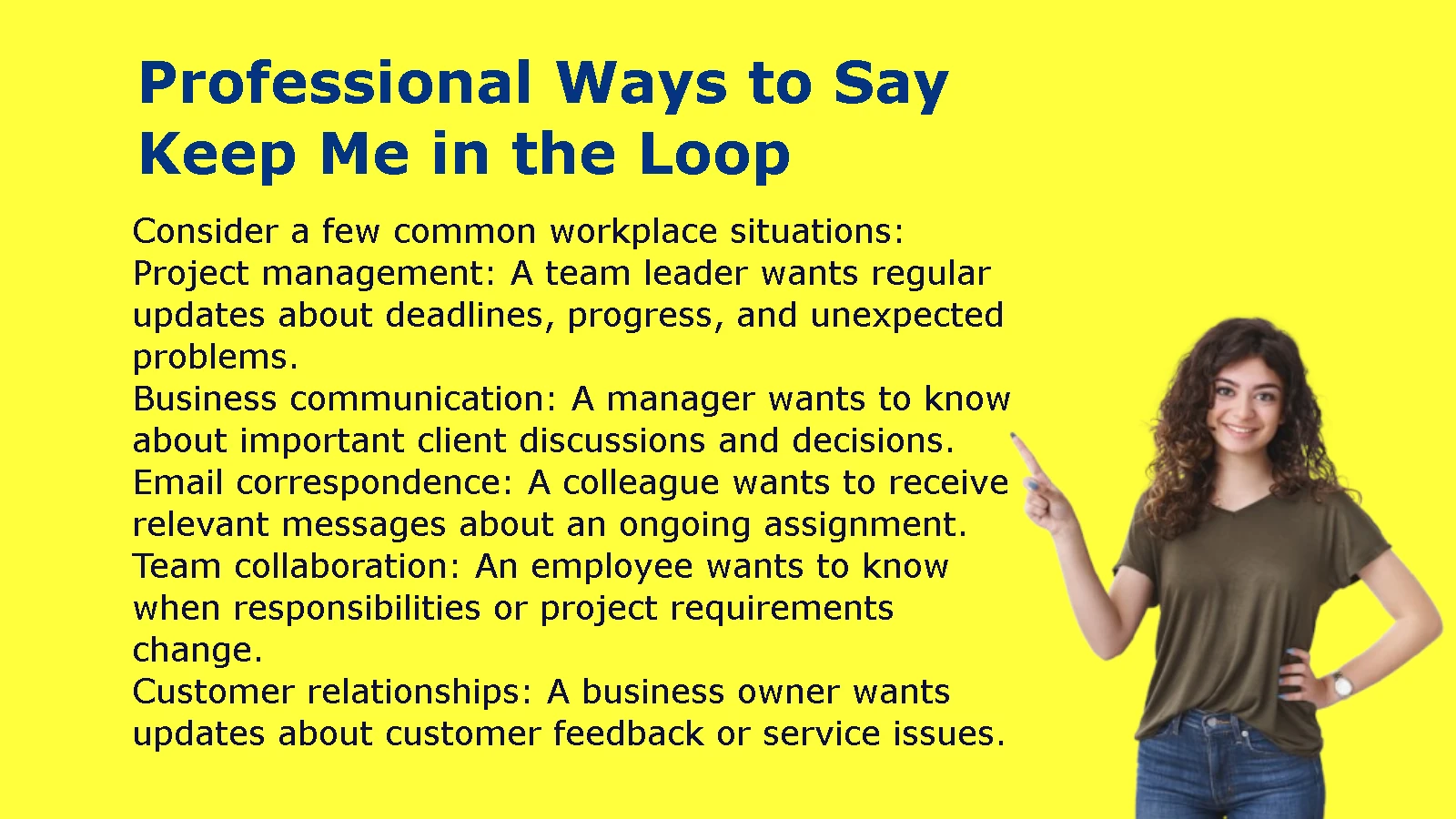
Consider a few common workplace situations:
- Project management: A team leader wants regular updates about deadlines, progress, and unexpected problems.
- Business communication: A manager wants to know about important client discussions and decisions.
- Email correspondence: A colleague wants to receive relevant messages about an ongoing assignment.
- Team collaboration: An employee wants to know when responsibilities or project requirements change.
- Customer relationships: A business owner wants updates about customer feedback or service issues.
The phrase doesn’t necessarily mean someone wants to receive every message. Usually, they want information that affects their responsibilities, decisions, or interests.
When Should You Use This Expression at Work?
You can use “keep me in the loop” when you need ongoing information about something that matters to your work.
For example:
- When you’re managing a project but another employee handles daily communication.
- When you’re waiting for a client’s approval.
- When your manager makes decisions that affect your responsibilities.
- When a colleague communicates with an external business partner on your behalf.
- When you’re temporarily away from a project but still need important updates.
Practical example:
“Please keep me in the loop about any changes to the delivery schedule so I can adjust our team’s workload.”
This sentence identifies the information you need and explains why it matters.
Is Keep Me in the Loop Professional or Too Casual?
Yes, keep me in the loop is appropriate for most professional conversations. It has a friendly, collaborative tone that works well with colleagues, managers, and familiar clients.
However, some situations call for more formal language.
| Situation | Recommended expression | Tone |
| Writing to a close colleague | Keep me posted | Friendly |
| Requesting project updates | Keep me updated | Neutral |
| Writing to senior management | Please keep me informed | Formal |
| Requesting business correspondence | Include me in future correspondence | Formal |
| Communicating with a client | Please share any relevant updates | Polite |
| Discussing important developments | Keep me apprised | Very formal |
The key is to match your wording to the relationship. A simple phrase can communicate professionalism without making an ordinary email sound unnecessarily complicated.
25+ Professional Ways to Say Keep Me in the Loop
The best professional alternatives to keep me in the loop communicate your request clearly while respecting the other person’s time. Some phrases emphasize regular updates, while others request inclusion in emails, meetings, or business discussions.
Use the following alternatives according to your situation.
Formal Ways to Say Keep Me in the Loop
These expressions work well when communicating with senior managers, executives, clients, business partners, or people you don’t know well.
1. Please keep me informed.
This is a direct and professional alternative. It works when you want someone to share relevant information as a situation develops.
Example: “Please keep me informed about the progress of the contract negotiations.”
2. Please keep me updated.
Use this phrase when you expect new information over time. It sounds polite without being overly formal.
Example: “Please keep me updated on the recruitment process.”
3. Kindly keep me apprised.
“Apprised” means informed about a situation. This expression suits formal business correspondence, particularly when discussing important developments.
Example: “Kindly keep me apprised of any changes to the proposed agreement.”
4. Please share any relevant updates.
This alternative makes your request more specific. It tells the recipient that you want information related to a particular matter, not every minor development.
Example: “Please share any relevant updates regarding the upcoming merger.”
5. I would appreciate being kept informed.
This wording softens your request and expresses courtesy. It works especially well when communicating with senior colleagues or external partners.
Example: “I would appreciate being kept informed about the final approval.”
6. Please include me in future correspondence.
Use this expression when you want someone to include you in relevant email conversations or written business communications.
Example: “Please include me in future correspondence concerning the revised proposal.”
7. Please ensure I receive any important updates.
This phrase emphasizes the importance of receiving information that could affect your work.
Example: “Please ensure I receive any important updates about the project’s implementation.”
8. Keep me abreast of developments.
“Abreast” means up to date or informed about current developments. This phrase has a formal business tone.
Example: “Please keep me abreast of developments concerning the new partnership.”
Polite and Friendly Professional Alternatives
These phrases work well with coworkers, familiar clients, team members, and business contacts.
9. Please keep me posted.
This is one of the most natural alternatives. It works in emails, instant messages, and everyday workplace conversations.
Example: “Please keep me posted once the supplier confirms the delivery date.”
10. Let me know if anything changes.
Use this when you don’t need regular updates but want to hear about significant changes.
Example: “The current schedule works for me. Let me know if anything changes.”
11. Please keep me in the know.
This friendly expression suggests that you want to remain aware of important information.
Example: “Please keep me in the know about the team’s upcoming plans.”
12. I’d appreciate staying updated.
This alternative sounds courteous and collaborative. It works well when someone else manages a process that affects your responsibilities.
Example: “I’d appreciate staying updated as the application moves through the approval process.”
13. Feel free to share any updates with me.
This wording gives the recipient flexibility. It sounds less demanding than a direct instruction.
Example: “Feel free to share any updates with me after the client meeting.”
14. Please let me know how things progress.
Use this when you want to hear about the development of an ongoing situation.
Example: “Please let me know how things progress with the website redesign.”
15. Keep me updated as things develop.
This phrase works when circumstances may change over time.
Example: “Keep me updated as things develop with the new supplier agreement.”
Professional Alternatives for Emails and Business Correspondence
When you specifically want someone to share emails or include you in written discussions, choose wording that identifies the communication you expect.
16. Please copy me on future emails.
This is a clear request to receive copies of relevant email messages.
Example: “Please copy me on future emails regarding the client onboarding process.”
17. Please include me in relevant email threads.
This expression works when several people are discussing an issue through email.
Example: “Please include me in relevant email threads about the upcoming product launch.”
18. I’d appreciate being included in future discussions.
Use this when you want to participate in conversations that involve decisions or responsibilities relevant to your role.
Example: “I’d appreciate being included in future discussions about the marketing budget.”
19. Please forward any relevant updates.
This is appropriate when someone receives information that you may need but aren’t included in the original communication.
Example: “Please forward any relevant updates from the legal department.”
20. Keep me informed of any new developments.
This expression is useful when you expect significant changes or new information.
Example: “Keep me informed of any new developments regarding the acquisition.”
Professional Alternatives for Projects and Team Updates
These expressions work particularly well in project management, team coordination, and operational communication.
21. Please share regular progress updates.
This phrase establishes an expectation of ongoing communication.
Example: “Please share regular progress updates so we can monitor the implementation schedule.”
22. Keep me informed of the project’s progress.
Use this when you want information about milestones, deadlines, and completed tasks.
Example: “Keep me informed of the project’s progress, especially as we approach the launch date.”
23. Please let me know about any significant changes.
This alternative avoids unnecessary communication while making sure important developments reach you.
Example: “Please let me know about any significant changes to the approved budget.”
24. I’d appreciate updates as we move forward.
This wording sounds collaborative and works well when several people share responsibility for a project.
Example: “I’d appreciate updates as we move forward with the website migration.”
25. Please keep me informed of any developments that may affect the timeline.
This is a specific, professional request. It explains exactly which updates matter.
Example: “Please keep me informed of any developments that may affect the timeline for the product release.”
Short and Natural Alternatives for Workplace Conversations
Sometimes a short expression communicates your message better than a formal sentence.
| Alternative | Example |
| Keep me posted | Keep me posted after the meeting. |
| Let me know what’s happening | Let me know what’s happening with the proposal. |
| Keep me updated | Keep me updated on the latest figures. |
| Fill me in on any changes | Fill me in on any changes before Friday. |
| Let me know how it goes | Let me know how it goes with the client. |
These expressions work best when you already have an established professional relationship.
How to Say Keep You in the Loop Professionally
When you want to tell someone that you’ll share updates with them, use expressions such as I’ll keep you informed, I’ll keep you updated, or I’ll share any important developments. These alternatives communicate responsibility and reassure the recipient that they won’t miss relevant information.
The wording should reflect the situation. A client may appreciate a formal commitment, while a coworker may prefer a short, friendly message.
Formal Ways to Tell Someone You’ll Keep Them Updated
Use these expressions when communicating with clients, managers, senior colleagues, or business partners.
- I’ll keep you informed of any developments. This works when the situation may change and the recipient needs timely information.
- I’ll share updates as they become available. Use this when you don’t control when new information arrives.
- I’ll make sure you’re aware of any important changes. This communicates responsibility for sharing significant information.
- I’ll keep you apprised of the situation. This is a more formal alternative for business correspondence.
- I’ll provide regular updates on our progress. This works when you can commit to a predictable update schedule.
- I’ll include you in any relevant discussions. Use this when the recipient should participate in future conversations.
For example:
“Thank you for your feedback. I’ll keep you informed of any developments as we work toward finalizing the agreement.”
This sentence acknowledges the recipient’s input and establishes a clear expectation for future communication.
Friendly Ways to Promise Someone Regular Updates
You don’t need formal language in every workplace conversation. These alternatives sound natural when speaking with familiar colleagues or team members.
- I’ll keep you posted.
- I’ll let you know how things progress.
- I’ll keep you updated along the way.
- I’ll share any news as soon as I have it.
- I’ll let you know when I hear something.
- I’ll fill you in once we have more details.
Example:
“Thanks for helping with the presentation. I’ll keep you posted once the client reviews the final version.”
This sounds friendly while maintaining a professional tone.
Examples of Using Keep You in the Loop in Professional Emails
Here are four examples showing how to promise updates in different business situations.
Example 1: Updating a manager
Subject: Project Progress
“Hi Sarah,
The team has completed the initial review, and we’re now working on the remaining revisions. I’ll keep you informed of any important developments and share the final report once it’s ready.
Best regards,
James”
Example 2: Communicating with a client
Subject: Update on Your Request
“Hello Michael,
We’ve received your request and are reviewing the available options. I’ll keep you updated as we make progress and let you know once we have a confirmed timeline.
Best regards,
Daniel”
Example 3: Communicating with a colleague
“Hi Alex,
I’m waiting for confirmation from the supplier. I’ll keep you posted as soon as I receive their response.
Thanks!”
Example 4: Following up on a business decision
“Hello Team,
The management team is still reviewing the proposed changes. I’ll share any important updates as soon as a decision has been made.
Kind regards,
Emily”
Notice that each message explains what information the recipient can expect. This makes the commitment more useful than simply saying you’ll keep someone in the loop.
How to Ask Someone to Keep You in the Loop in Future Emails
If you want someone to include you in future emails, make your request specific and courteous. Please include me in future correspondence is a formal option, while please CC me on relevant emails is more direct when you want copies of particular messages.
The best wording depends on whether you need general updates, copies of emails, or an invitation to participate in ongoing discussions.
Polite Ways to Request Inclusion in Future Emails
Consider these alternatives when asking someone to include you in future correspondence:
| Professional expression | Best situation |
| Please include me in future correspondence. | Formal business communication |
| I’d appreciate being copied on relevant emails. | Ongoing email discussions |
| Please CC me on any updates related to this matter. | Specific projects or issues |
| Kindly keep me included in future communications. | Formal workplace requests |
| Please add me to the email thread. | Existing conversations |
| I’d appreciate receiving future updates directly. | Important announcements |
| Please ensure I’m included in relevant discussions. | Decisions involving your responsibilities |
Example:
“Please include me in future correspondence regarding the revised contract so I can stay informed about any changes.”
This sentence explains why you want to receive future emails.
How to Ask Someone to CC You on Relevant Emails
CC stands for carbon copy. When someone adds your email address to the CC field, you receive a copy of the message without necessarily being its primary recipient.
Ask to be CC’d when you need visibility into a conversation but don’t need to lead it.
For example:
“Could you please CC me on future emails with the design team? I’d like to stay informed about the revisions and approval process.”
You can also use:
- Please copy me on emails related to the project.
- Could you add me to the ongoing email thread?
- Please CC me when communicating with the supplier.
- I’d appreciate receiving copies of important correspondence.
- Please include me in emails concerning the revised schedule.
A useful distinction: Asking someone to CC you is more specific than asking them to keep you informed. A colleague can keep you updated through a summary or conversation without forwarding every email.
Professional Email Examples Requesting Future Updates
Example 1: Project correspondence
SUBJECT: PROJECT COMMUNICATION
“Hi Daniel,
Could you please include me in future emails concerning the website redesign? I’d like to stay informed about important decisions and upcoming deadlines.
Thank you for your help.
Best regards,
Olivia”
Example 2: Client correspondence
SUBJECT: CLIENT UPDATES
“Hello Mark,
I’d appreciate being copied on future correspondence with the client, particularly messages concerning the revised requirements and delivery schedule.
Thank you for keeping me informed.
Best,
Rachel”
Example 3: Internal team discussions
“Hi Team,
Please include me in relevant email threads about the upcoming campaign. This will help me coordinate our content schedule and avoid missing important changes.
Thanks!”
Example 4: Business decisions
“Dear Michael,
Could you please ensure I’m included in future communications regarding the proposed partnership? I’d appreciate receiving any updates that may affect our planning.
Kind regards,
Andrew”
Thanks for Keeping Me in the Loop: Meaning and Professional Alternatives
Thanks for keeping me in the loop means that you appreciate someone sharing relevant information, providing updates, or including you in important conversations. It acknowledges their effort to keep you informed and shows that you value their communication.
The expression works in professional emails, workplace conversations, project discussions, and business relationships. It sounds friendly, appreciative, and generally less formal than “Thank you for keeping me informed.”
What Does Thanks for Keeping Me in the Loop Mean?
When someone says “Thanks for keeping me in the loop,” they’re expressing gratitude for receiving information that helps them understand an ongoing situation.
For example:
“Thanks for keeping me in the loop about the client’s revised requirements. I’ll update the proposal accordingly.”
The speaker appreciates receiving the information and explains how they’ll use it.
The expression can communicate several things:
- Appreciation: You recognize that someone took the time to share information.
- Awareness: You now understand what’s happening.
- Collaboration: You value being included in relevant discussions.
- Professional courtesy: You acknowledge someone’s effort to communicate.
- Responsiveness: You can act on the information you’ve received.
It doesn’t necessarily mean that the sender shared every detail. The phrase usually refers to information relevant to the recipient.
15 Professional Ways to Say Thanks for Keeping Me in the Loop
If you want to avoid repeating the same expression, choose an alternative that matches the information you received.
| Alternative | Example |
| Thank you for keeping me informed. | Thank you for keeping me informed about the revised timeline. |
| I appreciate the updates. | I appreciate the updates regarding the new proposal. |
| Thanks for keeping me updated. | Thanks for keeping me updated on the hiring process. |
| Thank you for sharing this information. | Thank you for sharing this information with the team. |
| I appreciate you keeping me posted. | I appreciate you keeping me posted about the client meeting. |
| Thanks for including me in the discussion. | Thanks for including me in the discussion about the budget. |
| I appreciate being kept informed. | I appreciate being kept informed of the latest developments. |
| Thank you for the timely updates. | Thank you for the timely updates on the project. |
| Thanks for keeping me abreast of developments. | Thanks for keeping me abreast of developments concerning the contract. |
| I appreciate your communication. | I appreciate your communication throughout this process. |
| Thank you for the heads-up. | Thank you for the heads-up about the schedule change. |
| Thanks for bringing this to my attention. | Thanks for bringing this issue to my attention. |
| I appreciate the clarification. | I appreciate the clarification regarding the new requirements. |
| Thank you for the continued updates. | Thank you for the continued updates as we approach the deadline. |
| Thanks for making sure I was informed. | Thanks for making sure I was informed before the meeting. |
Some expressions have slightly different meanings. For instance, thank you for the heads-up usually acknowledges advance notice about something, while thanks for bringing this to my attention acknowledges information that someone has specifically highlighted.
Examples of Thanking Someone for Keeping You Informed
Here are practical examples you can adapt to your own workplace communication.
Example 1: Thanking a manager
“Thank you for keeping me informed about the restructuring plans. I appreciate receiving these updates as the process moves forward.”
Example 2: Thanking a coworker
“Thanks for keeping me posted on the project. Your updates have helped me coordinate my tasks more effectively.”
Example 3: Thanking a client
“Thank you for sharing the latest information. I appreciate your communication and look forward to working through the next steps.”
Example 4: Thanking a business partner
“I appreciate you keeping me abreast of the recent developments. Thank you for ensuring I had the necessary information before our discussion.”
Example 5: Thanking someone for an email update
“Thanks for including me in the email thread. This gives me a better understanding of the decisions and outstanding tasks.”
Is Thanks for Keeping Me in the Loop Formal or Informal?
The expression is neutral to friendly. It works in many professional settings, but its conversational style makes it more suitable for familiar workplace relationships than highly formal correspondence.
Compare these options:
| Expression | Formality | Appropriate use |
| Thanks for keeping me in the loop. | Neutral | Colleagues and familiar clients |
| Thank you for keeping me informed. | Formal | Managers and business partners |
| I appreciate the updates. | Neutral | General workplace emails |
| Thank you for your continued communication. | Very formal | Clients and official correspondence |
| Thanks for keeping me posted. | Friendly | Teammates and coworkers |
A good rule is to use “thanks” when the relationship is familiar and “thank you” when you want a slightly more formal tone.
Keep Me in the Loop Sentence Examples for Professional Situations
The phrase keep me in the loop works in different sentence structures depending on whether you’re requesting information, discussing responsibilities, or asking for updates. You can use it in emails, meetings, project discussions, and everyday workplace conversations.
The following examples show how to use it naturally without making your message sound demanding.
Keep Me in the Loop Examples for Workplace Emails
Use these sentences when you need someone to share important information through email.
- Please keep me in the loop regarding any changes to the project schedule.
- I’d appreciate it if you could keep me in the loop about the client’s feedback.
- Please keep me in the loop as the approval process moves forward.
- Could you keep me in the loop on any important decisions?
- I’d like to stay informed, so please keep me in the loop about future developments.
- Please keep me in the loop if you receive any updates from the management team.
- I’d appreciate being kept in the loop throughout the negotiation process.
Writing tip: When possible, identify the specific information you want. “Please keep me in the loop about the revised budget” communicates more than “Please keep me in the loop.”
Keep Me in the Loop Examples for Project Management
Project communication often involves several people handling different responsibilities. You may need updates without participating in every task.
These examples work well in project-related conversations:
- Please keep me in the loop about any delays that could affect the launch date.
- Keep me in the loop on the progress of the development team.
- Please let me know if the project requirements change.
- I’d appreciate regular updates as we approach the next milestone.
- Keep me informed about any issues that require management approval.
- Please share important updates about the implementation schedule.
- Let me know if the team identifies any risks that could affect delivery.
Practical scenario:
Imagine you’re managing a product launch. Your design team handles the visual materials, while the marketing team manages promotional content. You don’t need to receive every design revision, but you do need to know when the final artwork gets approved.
You could write:
“Please keep me in the loop on any major design approvals or changes that could affect the launch schedule.”
This request establishes a clear communication boundary. Your colleagues know which developments require your attention.
Keep Me in the Loop Examples for Meetings and Team Discussions
Use these sentences when you want to remain aware of discussions, decisions, and action items.
- Please keep me in the loop about any decisions made during the meeting.
- I’d appreciate being included in discussions concerning the new workflow.
- Keep me updated on any changes to our team’s responsibilities.
- Please share the meeting notes if any decisions affect my department.
- Let me know if the discussion results in any changes to the original plan.
- Please keep me informed about the next steps after the review.
You can also use a softer approach:
“Since these decisions may affect my team’s workload, I’d appreciate being included in the relevant discussions.”
This explains why your participation matters instead of simply asking to receive more information.
Keep Me in the Loop Examples for Clients and Business Partners
When communicating with clients or external partners, your wording should sound courteous and clear.
Consider these examples:
For an ongoing client project:
“Please keep me in the loop regarding any changes to the project requirements so we can adjust our deliverables accordingly.”
For a business partnership:
“I’d appreciate being kept informed of any developments that may affect our partnership.”
For a service agreement:
“Please let me know if there are any updates to the proposed terms or implementation schedule.”
For a pending decision:
“Please keep me informed once your team has reached a decision. I’ll be happy to discuss the next steps.”
These examples show that professional communication works best when your request connects to a specific business need.
Keep Me in the Loop On or About: Which Is Correct?
Both keep me in the loop on and keep me in the loop about are grammatically correct. The preposition “on” commonly introduces a specific subject, project, or issue, while “about” introduces information or developments concerning something.
In everyday professional English, the two expressions often overlap. You can use either in many situations without changing the basic meaning.
When to Use Keep Me in the Loop On
Use on when referring to a specific topic, assignment, project, or matter.
Examples:
- Please keep me in the loop on the new marketing campaign.
- Keep me in the loop on the budget review.
- I’d appreciate updates on the recruitment process.
- Please keep me in the loop on the client’s latest feedback.
- Let me know if anything changes on the development side.
The preposition “on” connects the request directly to the subject.
Professional email example:
“Hi Daniel,
Please keep me in the loop on the supplier negotiations, particularly if the proposed pricing or delivery terms change.
Best regards,
Alex”
Here, “on the supplier negotiations” identifies the specific business matter.
When to Use Keep Me in the Loop About
Use about when introducing information, events, circumstances, or developments that someone wants to know.
Examples:
- Please keep me in the loop about any changes to the schedule.
- I’d appreciate updates about the new hiring requirements.
- Keep me in the loop about the client’s concerns.
- Please let me know about any developments that affect the agreement.
- Could you keep me informed about the revised project scope?
“About” often feels natural when the sentence focuses on information rather than a named project.
Professional email example:
“Hello Sarah,
I’d appreciate it if you could keep me in the loop about any changes to the delivery schedule. This will help us coordinate the remaining tasks.
Thank you,
Michael”
Keep Me in the Loop On vs. About: Comparison Table
| Feature | Keep me in the loop on | Keep me in the loop about |
| Main use | Identifying a topic or subject | Identifying information or developments |
| Tone | Neutral and professional | Neutral and professional |
| Common context | Projects, tasks, issues | Changes, news, circumstances |
| Example | Keep me in the loop on the campaign. | Keep me in the loop about campaign updates. |
| Grammar | Correct | Correct |
Which one should you choose?
Neither preposition is universally better. Choose the one that makes your sentence sound natural and communicates the subject clearly.
For example:
- “Keep me in the loop on the negotiations” sounds natural.
- “Keep me in the loop about the latest negotiation updates” also sounds natural.
The difference is mainly one of context and phrasing, not a strict grammatical rule.
Common Grammar Mistakes to Avoid
Although the expression is straightforward, a few mistakes can make your writing less polished.
Mistake 1: Using an incomplete request
Incorrect: “Please keep me in the loop.”
This isn’t grammatically incorrect, but it may lack context when the recipient doesn’t know which matter you’re discussing.
Better: “Please keep me in the loop about the revised project requirements.”
Mistake 2: Confusing keep me and keep you
The pronoun depends on who needs the information.
- Keep me in the loop: You’re asking someone to update you.
- Keep you in the loop: You’re promising to update someone else.
Examples:
“Please keep me in the loop about the new schedule.”
“I’ll keep you in the loop about the new schedule.”
Mistake 3: Using too many unnecessary words
Wordy: “I would like to kindly request that you please make sure to keep me informed about any and all updates.”
Better: “Please keep me informed of any important updates.”
A shorter sentence usually sounds more confident and professional.
Mistake 4: Treating every update as equally important
Asking someone to forward every message can create unnecessary email traffic.
Better: “Please include me in emails involving important decisions or changes to the project scope.”
This makes your expectations clear without adding unnecessary work.
How to Say Keep in Touch Professionally
Professional alternatives to keep in touch include “I look forward to staying in contact,” “Let’s stay connected,” and “I hope we can maintain communication.” These expressions help you maintain workplace relationships, build professional networks, and continue conversations after a project or meeting ends.
However, keep in touch and keep me in the loop don’t mean exactly the same thing. One focuses on maintaining a relationship; the other focuses on receiving relevant information.
Formal Alternatives to Keep in Touch
Use these expressions when writing to clients, senior professionals, business partners, or people you have recently met.
| Professional alternative | Example |
| I look forward to staying in contact. | I look forward to staying in contact after the conference. |
| I hope we can remain in touch. | I hope we can remain in touch as your business grows. |
| Please feel free to reach out anytime. | Please feel free to reach out anytime if you need assistance. |
| I look forward to future correspondence. | I look forward to future correspondence regarding the partnership. |
| Let’s maintain communication. | Let’s maintain communication as we work through the next phase. |
| I would welcome the opportunity to stay connected. | I would welcome the opportunity to stay connected after this project. |
These phrases work particularly well at the end of emails because they express interest in future communication without demanding a response.
Friendly Professional Alternatives to Keep in Touch
You can use a warmer tone when communicating with colleagues, former coworkers, or professional contacts you know well.
- Let’s stay connected.
- I’d love to stay in touch.
- Feel free to reach out.
- I hope we can keep in contact.
- Let’s keep the conversation going.
- Don’t hesitate to get in touch.
- It would be great to stay connected.
Example:
“It was great working with you on this project. I’d love to stay in touch and hear about your future work.”
This sounds natural and helps maintain a professional relationship.
Keep in Touch vs. Keep Me in the Loop: What’s the Difference?
Although both expressions involve communication, they serve different purposes.
| Comparison | Keep in touch | Keep me in the loop |
| Main meaning | Maintain communication | Share relevant information |
| Main purpose | Preserve a relationship | Maintain awareness |
| Typical context | Networking and professional relationships | Projects and business updates |
| Communication frequency | Occasional or ongoing | When relevant developments occur |
| Example | Let’s keep in touch after the conference. | Keep me in the loop about the contract. |
Consider this scenario:
“Let’s keep in touch.”
Later, you work together on a campaign and need information about its progress. You would say:
“Please keep me in the loop about the campaign’s performance.”
The first expression maintains the connection. The second ensures that you receive information relevant to your work.
Examples of Using Keep in Touch in Professional Emails
Example 1: Networking after a conference
“Hello David,
It was a pleasure meeting you at the conference. I enjoyed our conversation about digital marketing and would love to stay in touch.
Best regards,
Emma”
Example 2: Staying connected with a former coworker
“Hi James,
I really enjoyed working with you. I hope we can stay connected and share updates about our professional journeys.
All the best,
Sophia”
Example 3: Maintaining a client relationship
“Dear Mr. Wilson,
Thank you for the opportunity to work with your team. I look forward to staying in contact and exploring opportunities for future collaboration.
Kind regards,
Daniel”
Example 4: Following a business meeting
“Hi Rachel,
Thank you for the productive discussion. Let’s stay connected as we consider the next steps for the partnership.
Best,
Michael”
How to Choose the Right Professional Alternative
Choosing the right phrase involves more than replacing one expression with another. Consider your relationship with the recipient, the information you need, and how often you expect communication.
A phrase that works in a quick message to a teammate may sound too casual in an email to a new client.
Choose Based on the Level of Formality
Use this comparison to match your wording to the situation.
| Communication level | Recommended expressions | Example recipient |
| Very formal | Kindly keep me apprised; I would appreciate being kept informed | Executives, senior clients |
| Formal | Please keep me informed; please include me in future correspondence | Managers, external partners |
| Neutral | Please keep me updated; share any relevant updates | Colleagues, clients |
| Friendly | Keep me posted; let me know how it goes | Familiar coworkers |
| Casual professional | Fill me in; keep me in the know | Close teammates |
Don’t assume that complicated wording always sounds more professional. Clear and courteous language usually works better than unnecessary formality.
Choose Based on the Communication Situation
Different situations require different kinds of updates.
| Situation | Best expression | Why it works |
| Requesting project updates | Please keep me updated on the project’s progress. | Establishes an expectation of ongoing updates |
| Requesting email copies | Please CC me on relevant correspondence. | Identifies the specific communication needed |
| Communicating with a manager | I’d appreciate being kept informed. | Sounds respectful |
| Following a client decision | Please let me know once a decision has been made. | Identifies a clear update trigger |
| Discussing project risks | Keep me informed of any issues that may affect delivery. | Focuses on important developments |
| Networking | I look forward to staying in contact. | Maintains the relationship |
| Thanking a colleague | I appreciate you keeping me posted. | Acknowledges their communication |
Avoid Sounding Demanding When Requesting Updates
A request can sound demanding when it gives the recipient an instruction without explaining its purpose or considering their workload.
For example:
“Keep me updated on everything.”
This is vague and may create an unnecessary communication burden.
A better approach is:
“Please share any significant updates that could affect the delivery schedule.”
The improved version identifies the information that matters.
Follow these practical steps:
- Provide context: Explain which project, discussion, or issue you’re referring to.
- Be specific: Identify the type of information you need.
- Respect the recipient’s time: Request relevant updates instead of every minor detail.
- Use polite language: Words such as “please,” “could you,” and “I’d appreciate” soften requests.
- Set expectations: If you need regular updates, mention a reasonable frequency.
For example:
“Could you please send me a brief update every Friday on the project’s progress? I’d like to review any outstanding issues before the following week.”
This request is specific, actionable, and easy to understand.
Common Mistakes When Using Keep Me in the Loop
Even a familiar workplace expression can become ineffective when you use it without considering the context.
Using the phrase when you need a specific action
If you need someone to send a report, asking them to keep you in the loop may not be clear enough.
Better: “Please send me the updated report once the review is complete.”
Requesting every email unnecessarily
Being included in every message can overwhelm your inbox and make important updates harder to identify.
Better: “Please include me in correspondence involving major decisions or changes to the project.”
Repeating the same expression too frequently
Using “keep me in the loop” several times in one email can make your writing sound repetitive.
Instead, vary your wording:
“Please keep me informed about the initial review. I’d also appreciate updates once the team finalizes its recommendations.”
Using overly formal language with familiar coworkers
“Kindly keep me apprised of all forthcoming developments” may sound unnatural in a quick team conversation.
Better: “Please keep me posted.”
Failing to explain why you need updates
A recipient may not understand why you need to receive particular information.
Better: “Please keep me informed about the supplier’s response so I can finalize the purchasing schedule.”
The strongest workplace requests connect communication to a clear responsibility or decision.
Frequently Asked Questions
What Is a Professional Way to Say Keep Me in the Loop?
The most common professional alternatives are “Please keep me informed,” “Please keep me updated,” and “Please keep me apprised.” For email communication, “Please include me in future correspondence” is also appropriate. Choose the expression that best matches your relationship with the recipient and the information you need.
Is Keep Me in the Loop Appropriate for a Professional Email?
Yes. “Keep me in the loop” is appropriate for most workplace emails because it sounds collaborative and straightforward. It works well with coworkers, managers, and familiar clients. For more formal correspondence, consider “Please keep me informed” or “I would appreciate being kept updated.”
How Do You Politely Ask Someone to Keep You Updated?
Use courteous expressions such as “I’d appreciate it if you could keep me updated” or “Please let me know about any significant developments.” You can also explain why you need the information: “Please keep me informed of any schedule changes so I can coordinate the remaining tasks.”
What Does Thanks for Keeping Me in the Loop Mean?
It means you appreciate someone sharing relevant information and ensuring you remain aware of an ongoing situation. The expression acknowledges their communication and shows that you value receiving updates. It works in professional emails, project discussions, and everyday workplace conversations.
Should I Say Keep Me in the Loop On or About?
Both are correct. Use “on” when referring to a particular topic, project, or issue, such as “Keep me in the loop on the marketing campaign.” Use “about” when introducing information or developments, such as “Keep me in the loop about any changes to the campaign.”
What Is the Difference Between Keep in Touch and Keep Me in the Loop?
“Keep in touch” means maintaining communication and preserving a relationship. “Keep me in the loop” means sharing relevant information so someone remains informed about a specific situation. Use the first for networking and professional relationships and the second for workplace updates and ongoing projects.
Conclusion: Choose the Right Professional Way to Say Keep Me in the Loop
Knowing different professional ways to say keep me in the loop helps you communicate more clearly, maintain workplace relationships, and request information without sounding demanding.
The best alternative depends on what you want to achieve:
- Use please keep me informed for formal workplace communication.
- Choose please keep me updated for ongoing project developments.
- Say please keep me posted when communicating with familiar colleagues.
- Use please include me in future correspondence when requesting email updates.
- Choose thank you for keeping me informed when acknowledging someone’s communication.
- Say I look forward to staying in contact when maintaining professional relationships.
Remember that effective business communication isn’t about choosing the most complicated words. It’s about expressing your expectations clearly, respecting other people’s time, and sharing the right information with the right people.
The next time you write a workplace email, choose an expression that matches your relationship with the recipient and the information you need. A clear, thoughtful request can make collaboration easier and prevent important updates from getting overlooked.