Other ways to say nuance include subtlety, distinction, refinement, variation, shade, qualification, and connotation. These words help describe small but effective meaning, expression, interpretation, or context. However, the best nuance synonym depends on what you want to communicate, whether you’re writing an academic paper, discussing cultural differences, or explaining a complex idea.
A nuance can change how someone interprets a statement without changing its basic meaning. In research, it may describe an important qualification or contextual distinction. In cultural discussions, it can refer to social subtleties, traditions, and differences in communication. Understanding these alternatives helps you choose more precise language.
| Question | Answer |
| What is the closest synonym for nuance? | Subtlety is one of the closest synonyms. |
| What are five synonyms for nuance? | Subtlety, distinction, refinement, variation, and shade. |
| What is an academic synonym for nuance? | Differentiation, qualification, distinction, or refinement. |
| What are cultural nuance synonyms? | Cultural distinctions, social subtleties, and cultural variations. |
| What is the opposite of nuance? | Oversimplification, bluntness, and uniformity can express contrasting ideas. |
What Does Nuance Mean?
Nuance means a small but meaningful difference in meaning, expression, feeling, or interpretation. It describes details that people might overlook but that can change how they understand something. Nuance often appears in language, research, literature, cultural discussions, and professional communication, where accurate interpretation matters.
The word usually refers to something subtle rather than an obvious difference. For example, two people might agree about a subject but express different attitudes toward it. Those slight differences in their opinions represent nuances.
Simple Definition of Nuance
In simple terms, a nuance is a fine detail or subtle difference that adds depth to an idea.
Consider these examples:
- Two statements can communicate the same basic message but carry different emotional nuances.
- A writer may use a particular word to introduce a positive or negative nuance.
- A researcher may identify nuances in participants’ responses that reveal different experiences.
- A cultural practice may have a nuance that outsiders do not immediately understand.
Think of nuance as the extra layer of meaning behind an idea. It helps you understand not only what someone says but also how they mean it.
Nuance in Different Contexts
The meaning of nuance changes slightly depending on the subject.
| Context | Meaning of nuance | Example |
| Everyday conversation | A subtle difference in expression | Her response had a defensive nuance. |
| Academic writing | A qualification or fine distinction | The study highlights nuances in the findings. |
| Research | A detail that affects interpretation | Researchers identified nuances in participants’ experiences. |
| Culture | A subtle social or traditional difference | The greeting carries cultural nuances. |
| Literature | An underlying feeling or shade of meaning | The dialogue contains a romantic nuance. |
| Business | A detail that affects decisions or communication | The negotiation involved several financial nuances. |
Understanding these contexts helps you avoid choosing a synonym that changes your intended meaning.
Nuance Examples in Sentences
Here are some original examples showing how people use nuance in different situations.
- Communication: Her explanation included a subtle nuance that changed the meaning of the entire conversation.
- Education: The teacher explained the nuances between formal and informal English.
- Research: The interviews revealed important nuances in how employees experienced workplace changes.
- Culture: Understanding cultural nuances can prevent misunderstandings during international negotiations.
- Literature: The author used emotional nuances to make the main character more believable.
- Business: Successful negotiations often depend on recognizing nuances in the other party’s expectations.
- Psychology: The counselor paid attention to nuances in the client’s language and behavior.
These examples show that nuance often involves more than a simple difference. It adds depth, precision, or context to an explanation.
50+ Other Ways to Say Nuance: Synonyms With Examples
There are many ways to say nuance, but not every alternative communicates exactly the same idea. Some words describe small differences, while others emphasize hidden meanings, qualifications, or specific details.
The following alternatives cover everyday conversations, academic writing, research, cultural discussions, and professional communication.
Common Synonyms for Nuance
These are some of the most useful alternatives when you want to describe a subtle difference or a small detail that affects meaning.
| Synonym | Meaning | Example sentence |
| 1. Subtlety | A delicate or difficult-to-notice detail | The subtlety of her argument made it more persuasive. |
| 2. Distinction | A difference between two things | There is an important distinction between confidence and arrogance. |
| 3. Refinement | A small improvement or precise adjustment | The latest refinement made the explanation clearer. |
| 4. Shade | A slight difference in meaning or feeling | His words carried a shade of disappointment. |
| 5. Variation | A difference or change in form | The research identified variations in customer behavior. |
| 6. Difference | A way in which things are not alike | The difference between the proposals was surprisingly small. |
| 7. Delicacy | A quality requiring careful attention | The delicacy of the subject demanded thoughtful language. |
| 8. Complexity | The quality of having several connected parts | The novel explores the complexity of human relationships. |
| 9. Qualification | A condition that limits or modifies a statement | She added a qualification to make her argument more accurate. |
| 10. Fine point | A small but meaningful detail | The editor noticed a fine point in the author’s explanation. |
| 11. Subtle difference | A slight distinction | A subtle difference in tone changed the message. |
| 12. Particularity | A specific or distinctive feature | The particularity of the regional dialect interested the linguist. |
| 13. Intricacy | A complicated or detailed feature | The intricacy of the design impressed the reviewers. |
| 14. Fineness | A quality of precision or delicate detail | The fineness of the description brought the scene to life. |
| 15. Gradation | A gradual change between levels or qualities | The painting uses gradations of color to create depth. |
Best choices: Subtlety, distinction, shade, and variation are particularly useful when you want a close alternative to nuance.
However, refinement and complexity work better when you want to emphasize precision or the layered nature of an idea.
Academic and Formal Synonyms for Nuance
Academic writing often requires more precise vocabulary than everyday communication. Words such as qualification, differentiation, and specification can help explain complicated arguments without relying on the same term repeatedly.
| Synonym | Meaning | Example sentence |
| 16. Differentiation | The process of identifying differences | The analysis focuses on the differentiation between the two theories. |
| 17. Qualification | A limitation or condition attached to an argument | The author included a qualification to avoid an overly broad conclusion. |
| 18. Elaboration | Additional detail that develops an idea | The second chapter provides an elaboration of the original argument. |
| 19. Specification | A precise statement of details | The specification of research conditions improved accuracy. |
| 20. Precision | Exactness in meaning or expression | Scientific writing requires precision when describing results. |
| 21. Sophistication | A high level of complexity or refinement | The theory demonstrates considerable sophistication. |
| 22. Modulation | A controlled variation in tone or intensity | The speaker’s modulation conveyed uncertainty. |
| 23. Interpretation | An explanation of meaning | Her interpretation revealed another dimension of the text. |
| 24. Connotation | An associated meaning or emotional suggestion | The word carries a negative connotation in this context. |
| 25. Implication | A suggested or indirect meaning | His statement had an implication that the audience quickly recognized. |
Important distinction: Not all academic alternatives are interchangeable. For example, precision describes exactness, whereas connotation describes an associated meaning. Qualification modifies a statement, while differentiation identifies how two things differ.
Choose the word that reflects the specific relationship you want to explain.
Contextual and Descriptive Synonyms
Sometimes, a single word cannot communicate the full meaning of nuance. In these situations, descriptive expressions can provide a more natural replacement.
| Synonym or phrase | Meaning | Example sentence |
| 26. Distinction in meaning | A difference between interpretations | The distinction in meaning becomes clear when we examine the complete passage. |
| 27. Shade of meaning | A slight difference in interpretation | The phrase carries a different shade of meaning in formal writing. |
| 28. Subtle variation | A small change in a quality | The experiment revealed a subtle variation in temperature. |
| 29. Fine distinction | A small but important difference | The professor explained a fine distinction between the concepts. |
| 30. Underlying difference | A less obvious difference | The underlying difference concerns how each group defines success. |
| 31. Slight variation | A minor change | A slight variation in wording produced a different response. |
| 32. Delicate distinction | A subtle difference requiring careful attention | The debate centered on a delicate distinction in interpretation. |
| 33. Hidden implication | An indirect meaning that is not immediately obvious | Her comment contained a hidden implication about the decision. |
| 34. Minor differentiation | A small distinction between categories | The report included minor differentiation between the groups. |
| 35. Subtle characteristic | A small but distinctive quality | The subtle characteristic made the painting recognizable. |
These phrases work particularly well when writing for readers who may not understand more specialized vocabulary.
Additional Alternatives for Nuance
The following words describe different aspects of subtle meaning, complexity, and interpretation. They can replace nuance in specific contexts, although some are broader related terms rather than direct synonyms.
| Synonym | Meaning | Example sentence |
| 36. Aspect | One part of a subject | We examined another aspect of the problem. |
| 37. Facet | One particular side of something complex | Trust is an important facet of successful teamwork. |
| 38. Dimension | An additional level or feature | The discussion introduced a new dimension to the debate. |
| 39. Element | A component of a larger subject | Humor adds an unexpected element to the conversation. |
| 40. Feature | A distinctive characteristic | This feature separates the two approaches. |
| 41. Detail | A small piece of information | One overlooked detail changed the interpretation. |
| 42. Intrinsic difference | A difference that belongs naturally to something | The intrinsic difference between the materials affects their performance. |
| 43. Complexity | A condition involving multiple connected factors | The analysis considers the complexity of social behavior. |
| 44. Subtext | An indirect meaning beneath the explicit message | The dialogue contains a subtext of jealousy. |
| 45. Undertone | An underlying feeling or suggestion | Her response had an undertone of frustration. |
| 46. Overtones | Additional associations or suggestions | The announcement carried political overtones. |
| 47. Connotation | An associated emotional or cultural meaning | The term has a positive connotation in this discussion. |
| 48. Subdivision | A smaller section within a larger category | The classification includes several subdivisions. |
| 49. Variation in tone | A slight change in emotional expression | The variation in tone made the speaker sound uncertain. |
| 50. Layer of meaning | An additional level of interpretation | The final paragraph introduces another layer of meaning. |
| 51. Qualification | A condition that limits a general statement | His conclusion needs one important qualification. |
| 52. Fine-grained distinction | A highly detailed difference | The study makes a fine-grained distinction between the responses. |
Quick Comparison of the Best Nuance Synonyms
Choosing the right word becomes easier when you compare its meaning and typical application.
| Word | What it emphasizes | Best context |
| Subtlety | A delicate, barely noticeable quality | General writing |
| Distinction | A difference between ideas | Comparisons |
| Refinement | Precision or improvement | Professional writing |
| Variation | A change or difference | Research |
| Qualification | A limitation to an argument | Academic writing |
| Connotation | An associated meaning | Language and literature |
| Undertone | An underlying emotion | Communication |
| Facet | One part of a complex subject | Analysis |
| Subtext | An indirect message | Literature |
| Gradation | A gradual difference | Art and scientific descriptions |
For most everyday situations, subtlety and distinction are strong choices. Academic writers may prefer qualification or differentiation, while literary writers often benefit from undertone, subtext, and connotation.
Nuance Synonyms and Examples in Different Contexts
The best nuance synonym depends on the subject you’re discussing. A word that works in a casual conversation may sound unsuitable in a research paper. Similarly, a term used to describe cultural differences may not fit a scientific explanation.
Nuance Synonyms for Everyday Conversations
In everyday conversations, people generally use simple words to describe subtle differences. You don’t need complicated vocabulary to explain a small change in meaning or feeling.
Useful alternatives include:
- Subtlety: A small detail that requires attention.
- Difference: A way two things are not alike.
- Shade: A slight variation in meaning or feeling.
- Detail: A specific piece of information.
- Variation: A small change in something.
- Undertone: An underlying emotion or suggestion.
Examples:
- Original: There was a nuance in the way she answered the question.
- Alternative: There was a subtlety in the way she answered the question.
- Original: His comment had an interesting nuance.
- Alternative: His comment carried an unusual undertone.
- Original: I noticed a nuance between their opinions.
- Alternative: I noticed a slight difference between their opinions.
These alternatives make ordinary communication more natural without changing the main message.
Nuance Synonyms for Academic Writing
Academic writing requires clarity, precision, and careful interpretation. Researchers and students often need to describe differences that may appear small but have a meaningful effect on an argument.
The following alternatives work particularly well:
| Academic synonym | Appropriate use | Example |
| Differentiation | Separating concepts | The study emphasizes differentiation between the two models. |
| Qualification | Limiting a claim | This conclusion requires an additional qualification. |
| Distinction | Comparing ideas | The author makes a distinction between correlation and causation. |
| Refinement | Improving an explanation | The revised framework introduces a refinement of the original theory. |
| Specification | Providing precise details | Further specification of the variables improves the analysis. |
| Connotation | Examining associated meanings | The term has a different connotation in political discourse. |
| Interpretation | Explaining evidence | An alternative interpretation offers another perspective. |
Example of academic improvement:
Basic sentence:
“The study discusses the nuances of student motivation.”
More precise sentence:
“The study examines subtle distinctions in student motivation across different learning environments.”
The revised version tells readers what kind of nuances the study investigates. It also makes the research focus more specific.
Nuance Synonyms in Research
In research, nuance describes subtle differences in evidence, participant experiences, interpretations, or relationships between variables. Suitable alternatives include contextual variation, interpretive distinction, qualification, complexity, and underlying difference.
Researchers should choose terms that accurately represent their findings rather than using a sophisticated synonym simply to make their writing sound academic.
Useful research alternatives:
- Contextual variation
- Interpretive distinction
- Qualifying factor
- Subtle difference
- Underlying complexity
- Fine-grained distinction
- Thematic variation
- Analytical differentiation
Examples in research writing:
- Qualitative research: “The interviews revealed subtle differences in how participants described workplace pressure.”
- Literature review: “The review identifies important distinctions between earlier and more recent interpretations.”
- Data analysis: “The results demonstrate variations in customer preferences across age groups.”
- Social research: “The findings highlight contextual factors that influence community participation.”
- Scientific discussion: “The interpretation requires a qualification because the sample includes a limited population.”
Practical research example
Imagine a researcher interviews 100 employees about remote work.
A general finding might state:
“Employees prefer working from home.”
However, a more detailed analysis may reveal that:
- Some employees value flexibility more than reduced commuting time.
- Others struggle with communication and isolation.
- Parents may prioritize schedule control.
- New employees may prefer in-person guidance.
These findings reveal important nuances in employee preferences.
Calling them contextual variations or differences in employee experiences gives readers a clearer understanding of the evidence.
Cultural Nuance Synonyms
Cultural nuances are subtle differences in traditions, communication styles, social expectations, values, and everyday behavior. They can influence how people interpret words, gestures, relationships, and professional interactions.
Useful cultural nuance synonyms include:
- Cultural distinctions
- Social subtleties
- Cultural variations
- Contextual differences
- Cultural intricacies
- Social conventions
- Traditional differences
- Cultural characteristics
- Behavioral differences
- Cross-cultural distinctions
Examples:
- Original: International businesses must understand cultural nuances before entering new markets.
- Alternative: International businesses must understand cultural distinctions before entering new markets.
- Original: The film captures the nuances of regional traditions.
- Alternative: The film captures the subtleties of regional traditions.
- Original: Cultural nuances influence how people interpret gestures.
- Alternative: Cultural differences influence how people interpret gestures.
Real-world example:
Consider a business meeting involving people from different countries.
A short pause after a question might indicate careful consideration in one setting. In another, the same pause might suggest uncertainty or discomfort.
Interpreting that pause without considering its cultural context could lead to a misunderstanding.
This is why social subtleties, cultural distinctions, and communication differences are useful alternatives when discussing cross-cultural interactions.
Contextual Nuances Synonyms
Contextual nuances refer to subtle differences that become clear when you consider the circumstances surrounding an idea, statement, action, or event.
Useful alternatives include:
- Situational differences
- Contextual variations
- Subtle distinctions
- Underlying implications
- Circumstantial factors
- Interpretive differences
- Environmental influences
- Situational subtleties
Examples:
- The contextual nuances of the statement become clear when we examine the previous conversation.
- Situational differences explain why the same response may produce different reactions.
- The report explores underlying implications that influence the final decision.
- Environmental influences can change how people interpret an experience.
- Contextual variations affect the meaning of certain expressions.
A practical way to understand contextual nuance is to compare the same sentence in two situations.
Consider the statement: “That’s interesting.”
- In a genuine conversation, it may express curiosity.
- During a disagreement, it may communicate skepticism.
- In a formal presentation, it may simply acknowledge new information.
The words remain identical, but their meaning changes with context.
Important Nuance Synonyms: Better Ways to Express Significant Differences
An important nuance is a subtle detail that has a meaningful effect on how someone understands an idea, argument, or situation. You can express it using phrases such as significant distinction, critical qualification, meaningful variation, and essential consideration.
Alternatives for an Important Nuance
These expressions work well when you want to emphasize that a small detail deserves attention.
| Alternative | Meaning | Example |
| Significant distinction | An important difference | There is a significant distinction between the two approaches. |
| Critical subtlety | A delicate detail that affects understanding | The report highlights a critical subtlety in the findings. |
| Essential qualification | A necessary condition or limitation | The argument requires an essential qualification. |
| Key differentiation | An important separation between concepts | The research establishes a key differentiation between the groups. |
| Meaningful variation | A difference that affects interpretation | The results show meaningful variation across regions. |
| Important distinction | A difference worth recognizing | The author makes an important distinction between the terms. |
| Relevant consideration | A factor that deserves attention | Cost remains a relevant consideration in the decision. |
| Significant qualification | An important limitation to a statement | The conclusion includes a significant qualification. |
Formal Ways to Say an Important Nuance
If you’re writing a report, research paper, business proposal, or professional email, these expressions can communicate importance without sounding informal.
- A significant qualification
- A critical distinction
- An important consideration
- A key contextual factor
- A meaningful differentiation
- A fundamental difference
- An essential detail
- A relevant distinction
- A substantial variation
- A notable characteristic
Examples in formal writing:
- Original: There is an important nuance in the research findings.
- Alternative: The research findings contain a significant qualification.
- Original: We should consider the important nuances before making a decision.
- Alternative: We should examine the key contextual factors before making a decision.
- Original: The author introduces an important nuance to the argument.
- Alternative: The author introduces a critical distinction to the argument.
The replacement should reflect the intended meaning. A qualification limits a claim, while a distinction separates two concepts. Neither automatically means the same thing as an important nuance.
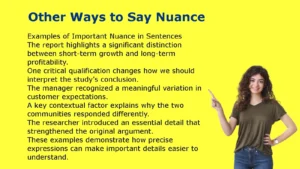
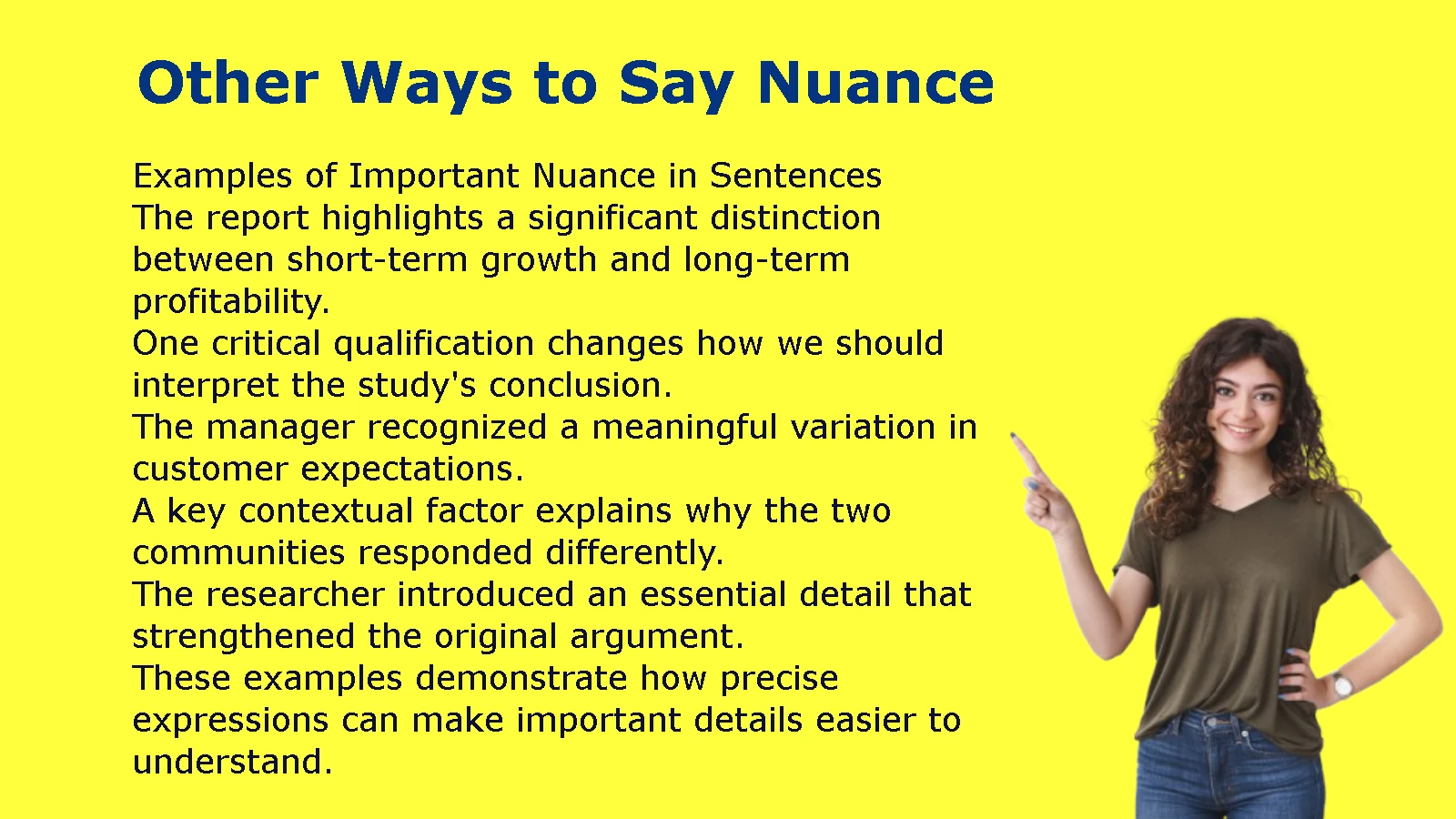
Examples of Important Nuance in Sentences
- The report highlights a significant distinction between short-term growth and long-term profitability.
- One critical qualification changes how we should interpret the study’s conclusion.
- The manager recognized a meaningful variation in customer expectations.
- A key contextual factor explains why the two communities responded differently.
- The researcher introduced an essential detail that strengthened the original argument.
These examples demonstrate how precise expressions can make important details easier to understand.
Nuance Synonyms and Antonyms
Nuance has several synonyms, but its antonyms generally describe qualities that remove subtlety, reduce complexity, or ignore meaningful differences.
Understanding both sides helps you choose more accurate language.
What Are the Best Synonyms for Nuance?
The closest alternatives depend on the sentence.
| Synonym | When to use it |
| Subtlety | When describing a delicate or barely noticeable detail |
| Distinction | When comparing two ideas or concepts |
| Refinement | When describing greater precision |
| Shade | When discussing a slight difference in meaning or feeling |
| Variation | When identifying differences between examples |
| Qualification | When adding a limitation to a statement |
| Connotation | When describing an associated meaning |
| Undertone | When explaining an underlying feeling |
| Subtext | When discussing an indirect message |
| Gradation | When describing gradual changes |
For general writing, subtlety is often the easiest replacement. However, distinction may be more accurate when comparing two concepts, while qualification works better when discussing limitations in an argument.
What Are the Antonyms of Nuance?
There is no single perfect antonym for nuance. However, several words express contrasting ideas, particularly when someone ignores subtle differences or presents a complicated subject too simply.
| Antonym | Meaning | Example |
| Obviousness | The quality of being immediately clear | The obviousness of the answer left little room for interpretation. |
| Simplicity | The absence of complexity | The explanation focused on simplicity rather than detailed interpretation. |
| Bluntness | Direct expression without delicacy | His bluntness removed any subtlety from the conversation. |
| Generalization | A broad statement that overlooks individual differences | The generalization ignored important differences between participants. |
| Uniformity | The absence of meaningful variation | The policy imposed uniformity across different departments. |
| Oversimplification | Making a complex subject seem too simple | The summary relied on oversimplification. |
| Coarseness | A lack of refinement or delicacy | The coarseness of the description weakened the message. |
| Explicitness | The quality of being directly expressed | The writer chose explicitness instead of indirect suggestion. |
| Vagueness | A lack of clear or precise meaning | The vagueness of the statement confused readers. |
Important: Some of these words are contextual opposites rather than strict dictionary antonyms. For example, explicitness contrasts with indirect meaning, while uniformity contrasts with variation. Choose the opposite that fits the specific meaning of nuance in your sentence.
Nuance vs. Subtlety vs. Distinction
| Word | Definition | Main emphasis | Example |
| Nuance | A small but meaningful difference or layer of meaning | Depth and interpretation | The speech contains emotional nuances. |
| Subtlety | A delicate quality that is not immediately obvious | Fineness or delicacy | The subtlety of the performance impressed the audience. |
| Distinction | A recognizable difference between things | Separation or comparison | There is a distinction between the two methods. |
Nuance often describes a layer of meaning that requires careful interpretation.
Subtlety emphasizes how delicate or difficult to notice something is.
Distinction focuses on identifying how two things differ.
Consider this example:
- Nuance: The conversation contains several emotional nuances.
- Subtlety: The conversation reveals the subtlety of their relationship.
- Distinction: The conversation establishes a distinction between friendship and romantic interest.
All three sentences are correct, but each communicates a slightly different idea.
How to Use Nuance and Its Synonyms in Sentences
Using a synonym correctly requires more than finding a similar word in a dictionary. You must consider the sentence’s purpose, surrounding information, and intended meaning.
The following examples show how to select alternatives in different writing situations.
Nuance in Professional Communication
Professional communication often involves negotiations, feedback, workplace decisions, and customer relationships. Small differences in wording can affect how people interpret a message.
Useful alternatives include distinction, consideration, qualification, variation, and refinement.
Examples:
- Original: There are several nuances in the client’s expectations.
- Alternative: There are several important distinctions in the client’s expectations.
- Original: The proposal needs more nuance.
- Alternative: The proposal needs greater refinement.
- Original: We should consider the nuances of the agreement.
- Alternative: We should consider the relevant qualifications of the agreement.
- Original: The manager recognized a nuance in the employee’s feedback.
- Alternative: The manager recognized an underlying concern in the employee’s feedback.
Practical workplace example
Imagine a company negotiating a contract with a supplier.
Both parties agree on the price, but they have different expectations about delivery schedules, product quality, and payment deadlines.
Calling these details contractual distinctions or important qualifications helps identify the specific issues that require attention.
This is more useful than simply saying that the agreement contains nuances.
Nuance in Academic and Research Writing
Academic writers use nuance to communicate complexity without making unsupported generalizations.
When you describe a study, distinguish between its findings, limitations, interpretations, and implications.
Before:
“The study reveals several nuances in how people respond to advertising.”
After:
“The study identifies variations in consumer responses across different demographic groups.”
Another example:
Before:
“The author’s argument contains an interesting nuance.”
After:
“The author’s argument introduces an important qualification that challenges the broader assumption.”
Notice that the revised sentences explain exactly what the nuance involves.
Useful writing practices include:
- Use distinction when comparing theories or concepts.
- Use qualification when limiting a general statement.
- Use variation when describing differences in observations.
- Use connotation when examining the meanings associated with words.
- Use interpretation when explaining what evidence suggests.
- Use refinement when describing improvements to an existing argument.
Nuance in Literature and Creative Writing
Writers use nuance to develop believable characters, communicate emotions, and create deeper meanings.
A character may express happiness while hiding disappointment. A description may sound positive but contain an undertone of criticism.
Words such as subtext, undertone, connotation, shade, and gradation work especially well in literary analysis.
Examples:
- The author’s use of subtext reveals the character’s hidden frustration.
- A subtle undertone of sadness runs throughout the chapter.
- The phrase carries a different connotation when spoken by the antagonist.
- The dialogue contains shades of meaning that become clearer later in the story.
- The gradual gradation of emotion makes the final scene more convincing.
Creative writing example
Consider a character who tells another person, “I’m glad you came.”
The statement may communicate genuine happiness. However, the character’s expression, previous relationship, and surrounding events could introduce disappointment, sarcasm, or uncertainty.
These additional layers create emotional depth.
A writer can use subtext to describe the hidden message, undertone to describe the emotional quality, and connotation to explain the associations carried by the words.
Nuance in Cultural Discussions
Cultural discussions require careful vocabulary because similar actions may carry different meanings across communities.
A greeting, gesture, phrase, or social convention may communicate respect in one setting but familiarity or disrespect in another.
Useful alternatives include:
- Cultural distinctions
- Social conventions
- Behavioral differences
- Regional variations
- Traditional practices
- Cross-cultural differences
- Social subtleties
Examples:
- The researcher examined regional variations in family traditions.
- Understanding social conventions improves communication between international teams.
- The documentary explores cultural distinctions between neighboring communities.
- Different interpretations of gestures reveal important cross-cultural differences.
When writing about culture, avoid treating an entire country or community as if everyone shares identical customs. Describe the specific community, situation, or practice instead.
Common Mistakes When Using Nuance Synonyms
Even closely related words can create problems when writers use them without checking their meanings.
Understanding these mistakes helps you maintain clarity and accuracy.
Treating Every Synonym as Interchangeable
Subtlety, implication, distinction, and variation do not mean exactly the same thing.
For example:
- “The subtlety of the argument” emphasizes its delicate details.
- “The distinction in the argument” emphasizes a difference.
- “The implication of the argument” emphasizes what the argument suggests.
- “The variation in the argument” emphasizes a change or difference.
Replacing nuance with the wrong word can change the meaning of your sentence.
How to avoid this mistake: Identify whether you’re describing a difference, an underlying message, a small detail, or a qualification before choosing an alternative.
Using Informal Words in Academic Writing
Some alternatives work better in casual communication than in formal research.
For example, “shade” can work in literary or conversational writing, but it may sound imprecise in a scientific report.
Instead of writing:
“The results show different shades in the responses.”
Consider:
“The results demonstrate variations in participant responses.”
The second sentence communicates the research finding more directly.
Confusing Nuance With a Simple Difference
A difference does not always represent a nuance.
For example, a red car and a blue car have an obvious difference in color. However, a slight change in the emotional tone of a sentence may represent a nuance.
Nuance usually involves a smaller distinction or an additional layer of meaning.
Remember:
- Difference identifies how things are not alike.
- Nuance explains a subtle or meaningful distinction.
- Subtlety emphasizes the delicate nature of a detail.
Overusing Complex Vocabulary
Using sophisticated words does not automatically improve writing.
For example:
“The interpretive differentiation demonstrates contextual complexity.”
This may sound unnecessarily complicated if you simply mean:
“The meaning changes depending on the situation.”
Choose the clearest word that communicates your intended meaning.
Good writing depends on precision, not on using the longest or most academic-sounding alternative.
How to Choose the Best Synonym for Nuance
The right synonym should preserve the original meaning while making your sentence more precise and natural.
Use the following framework whenever you want to replace nuance.
Consider the Context
First, identify the subject you’re discussing.
Ask yourself:
- Am I describing a difference between two ideas?
- Am I explaining an indirect meaning?
- Am I discussing cultural practices?
- Am I describing research findings?
- Am I emphasizing a small detail?
For example, cultural distinction may work well in a discussion about traditions, while qualification may be more appropriate when discussing an academic argument.
Identify the Type of Difference
Next, determine what kind of detail you want to communicate.
| What you want to express | Best alternative |
| A delicate detail | Subtlety |
| A difference between concepts | Distinction |
| A small change | Variation |
| An associated meaning | Connotation |
| An indirect message | Subtext |
| An underlying feeling | Undertone |
| A limitation to a claim | Qualification |
| A precise improvement | Refinement |
| A gradual change | Gradation |
| One part of a complex subject | Facet |
This approach prevents you from choosing synonyms based only on their surface similarity.
Match the Writing Tone
Your audience also affects your word choice.
| Writing style | Recommended alternatives |
| Casual | Difference, detail, shade |
| Professional | Distinction, consideration, refinement |
| Academic | Differentiation, qualification, specification |
| Scientific | Variation, gradation, precision |
| Literary | Subtext, undertone, connotation |
| Cultural | Social subtleties, cultural distinctions |
For example, a research paper may benefit from the word differentiation, while a casual conversation may sound more natural with subtlety.
Check Whether the Replacement Preserves the Original Meaning
Before finalizing your sentence, read it again with the new word.
Consider:
Original: “The researcher explored the nuances of the participants’ experiences.”
Possible replacement: “The researcher explored the variations in the participants’ experiences.”
The replacement works if the researcher specifically examined differences between experiences.
However, if the researcher explored hidden emotional meanings, subtleties or underlying complexities might communicate the intended meaning more accurately.
A simple editing checklist can help:
- Does the replacement communicate the same basic idea?
- Does it fit the subject?
- Does it suit the audience?
- Does it improve clarity?
- Does it avoid unnecessary complexity?
If the answer to these questions is yes, the synonym is likely appropriate.
Frequently Asked Questions About Nuance Synonyms
What Is the Closest Synonym for Nuance?
Subtlety is often the closest synonym for nuance because both words describe small or delicate differences that may not be immediately obvious. However, distinction, shade, and variation can also work depending on the sentence. Use subtlety when emphasizing a fine detail and distinction when comparing two ideas.
What Are Five Synonyms for Nuance?
Five common synonyms for nuance are:
- Subtlety
- Distinction
- Refinement
- Variation
- Shade
Each word emphasizes a different aspect of subtle meaning. Subtlety describes a delicate detail, distinction identifies a difference, and variation highlights a change.
What Is a More Academic Word for Nuance?
Differentiation, qualification, distinction, and refinement are useful academic alternatives. Differentiation works when separating concepts, qualification adds a limitation to an argument, and refinement describes greater precision. Select the term that accurately represents the point you’re making.
What Are Cultural Nuance Synonyms?
Cultural nuance synonyms include cultural distinctions, social subtleties, cultural variations, social conventions, and cross-cultural differences. These expressions describe subtle differences in traditions, communication, social expectations, and behavior. For example, cultural distinctions can explain why the same gesture carries different meanings in different communities.
What Is the Opposite of Nuance?
There is no single exact opposite of nuance. However, oversimplification, bluntness, uniformity, and generalization express contrasting ideas. Oversimplification ignores complexity, bluntness removes delicacy from expression, and generalization overlooks individual differences.
How Do You Use Nuance in a Sentence?
Use nuance when describing a subtle difference or an additional layer of meaning. For example, “The author’s explanation captures the nuances of human behavior.” You could also write, “The research identifies subtle distinctions in how participants respond to change.”
Conclusion: Choose the Right Nuance Synonym for Clearer Writing
Finding other ways to say nuance is about choosing words that communicate the exact meaning you intend. Although subtlety, distinction, refinement, variation, and shade are common alternatives, each has a different purpose.
For academic writing, consider differentiation, qualification, and specification. When discussing culture, use cultural distinctions, social subtleties, or contextual differences. For literature and creative writing, subtext, undertone, and connotation can communicate deeper meanings.
The most effective approach is to consider your context before replacing the word. A precise synonym makes your writing clearer, more natural, and easier to understand.
Ready to improve your vocabulary? Start using these alternatives in your everyday conversations, academic assignments, and professional writing. Choose the word that best preserves your intended meaning rather than simply selecting the most sophisticated option.