Other ways to say profound include deep, meaningful, significant, insightful, substantial, consequential, far-reaching, transformative, and thought-provoking. The best alternative depends on whether you want to describe intellectual depth, emotional intensity, great importance, or a lasting effect. Choosing the right synonym makes your writing more precise, engaging, and natural.
The word profound describes something that goes beyond the ordinary or surface level. It can express a deep understanding, a powerful emotional experience, a significant discovery, or an influence that changes someone’s perspective. However, not every synonym fits every situation. For example, insightful works well when describing an observation, while far-reaching better describes consequences that extend beyond their immediate context.
Whether you’re writing an academic paper, preparing a professional report, expressing profound gratitude, or describing a profound impact, this guide offers more than 55 alternatives with definitions, original sentence examples, and practical usage advice.
| Question | Answer |
| What is another word for profound? | Deep, meaningful, significant, insightful, substantial, or consequential. |
| What is a formal synonym for profound? | Substantial, consequential, far-reaching, pivotal, or fundamental. |
| What is another way to say profound impact? | Far-reaching impact, transformative influence, lasting effect, or significant influence. |
| What is the opposite of profound? | Shallow, superficial, trivial, insignificant, or meaningless. |
| What does so profound mean? | It describes something exceptionally deep, meaningful, important, or emotionally powerful. |
What Does Profound Mean?
Profound means having great depth, importance, intensity, or significance. It describes something that affects people deeply, reveals an important understanding, or produces consequences beyond the immediate situation. The word can refer to intellectual ideas, emotional experiences, personal changes, and influential discoveries.
For example, a profound observation reveals something that ordinary thinking might overlook. A profound loss describes intense grief, while a profound discovery can change how researchers understand a subject.
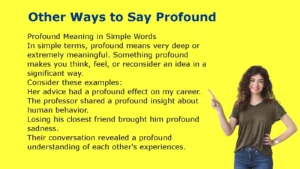
Profound Meaning in Simple Words
In simple terms, profound means very deep or extremely meaningful. Something profound makes you think, feel, or reconsider an idea in a significant way.
Consider these examples:
- Her advice had a profound effect on my career.
- The professor shared a profound insight about human behavior.
- Losing his closest friend brought him profound sadness.
- Their conversation revealed a profound understanding of each other’s experiences.
Notice how the meaning changes slightly in each sentence. The first describes influence, the second describes understanding, and the third expresses emotional intensity.
Profound can therefore communicate several related ideas:
- Intellectual depth: An idea that demonstrates exceptional understanding.
- Emotional intensity: A feeling that is especially strong.
- Great importance: Something that carries considerable significance.
- Lasting influence: An experience or event that changes future decisions.
- Deep meaning: Something that encourages reflection or reveals an important truth.
What Does So Profound Mean?
The expression so profound emphasizes the exceptional depth or importance of something. It suggests that an idea, experience, statement, or feeling goes beyond what someone normally encounters.
For example:
- The professor’s explanation was so profound that it changed how students approached the subject.
- Her final words were so profound that everyone remained silent.
- The documentary presented such a profound message about human responsibility.
The word so strengthens the description. It tells readers that the subject has an unusually powerful quality.
Profound as an Adjective
Profound is an adjective. It modifies nouns by describing their depth, importance, or intensity.
| Expression | What it describes |
| Profound knowledge | Extensive understanding of a subject |
| Profound impact | A powerful influence or effect |
| Profound sadness | Extremely deep sorrow |
| Profound insight | An important or penetrating observation |
| Profound gratitude | Deep appreciation |
| Profound change | A fundamental transformation |
| Profound implications | Important potential consequences |
| Profound question | A question that encourages deep thought |
Examples:
- The experience profoundly changed her outlook.
- I am profoundly grateful for your support.
- His research profoundly influenced modern thinking.
How to Choose From the Profound Synonyms List
Not every alternative communicates the same idea. Before replacing profound, identify the quality you want to emphasize.
For instance:
- Choose deep when describing understanding, thought, or emotion.
- Choose significant when emphasizing importance.
- Choose insightful when describing an observation or explanation.
- Choose consequential when focusing on results or outcomes.
- Choose transformative when describing major change.
- Choose poignant when expressing emotional depth.
- Choose substantial when describing considerable importance or extent.
A simple substitution can change the tone of a sentence. The right synonym preserves the intended meaning while making the writing more precise.
Other Ways to Say Profound in Different Contexts
The phrase you’re replacing matters just as much as the synonym itself. A word that works for a profound discovery might sound unnatural when describing gratitude or sadness.
These context-specific alternatives help you communicate the intended meaning more accurately.
Other Ways to Say Profound Impact
A profound impact describes an influence that produces significant, meaningful, or lasting changes. Depending on the situation, you can replace it with far-reaching impact, transformative influence, lasting effect, or significant influence.
| Alternative phrase | Meaning | Example |
| Far-reaching impact | Influence extending across many areas | The invention had a far-reaching impact on communication. |
| Transformative impact | Influence that creates major change | The scholarship had a transformative impact on her future. |
| Lasting impact | An effect that continues over time | His mentorship left a lasting impact on the team. |
| Significant influence | An important effect on something | Education has a significant influence on social development. |
| Powerful effect | A strong or noticeable result | The campaign had a powerful effect on public awareness. |
| Major influence | An important contributing factor | Her early experiences had a major influence on her writing. |
| Substantial impact | A considerable effect | The investment made a substantial impact on local employment. |
| Life-changing effect | An influence that changes someone’s life | The opportunity had a life-changing effect on his career. |
| Defining influence | An influence that shapes identity or direction | Her teacher became a defining influence in her life. |
| Lasting impression | An effect that remains in someone’s memory | The performance made a lasting impression on the audience. |
Practical example:
Original: The new educational program had a profound impact on disadvantaged students.
Alternative: The new educational program had a transformative impact on disadvantaged students.
The replacement emphasizes the changes produced by the program rather than simply describing their importance.
Other Ways to Say Profound Effect
A profound effect refers to a strong or significant result produced by an action, event, experience, or decision.
Here are useful alternatives:
| Alternative | Example |
| Significant effect | The treatment produced a significant effect on recovery rates. |
| Lasting effect | Childhood experiences can have a lasting effect on adult behavior. |
| Transformative effect | The training had a transformative effect on employee performance. |
| Powerful influence | The book exerted a powerful influence on modern literature. |
| Considerable consequence | The decision had considerable consequences for the organization. |
| Dramatic change | The new strategy brought about a dramatic change in productivity. |
| Far-reaching result | The investigation produced far-reaching results. |
| Noticeable influence | Regular practice had a noticeable influence on his confidence. |
Effect vs. impact: These words overlap, but they have slightly different uses. Effect usually emphasizes the result of something, while impact often highlights the force or influence behind that result.
For example, a new policy may have a significant impact on employees and produce measurable effects on workplace productivity.
Other Ways to Say Profound Implications
Profound implications refers to important potential consequences that may influence future decisions, events, or outcomes.
In academic and professional writing, you can use these alternatives:
- Far-reaching implications
- Significant consequences
- Serious repercussions
- Major ramifications
- Long-term consequences
- Wide-ranging effects
- Substantial implications
- Important considerations
- Fundamental consequences
- Extensive ramifications
| Original phrase | Alternative | Example |
| Profound implications | Far-reaching implications | The discovery has far-reaching implications for medical research. |
| Profound implications | Significant consequences | The decision could have significant consequences for the industry. |
| Profound implications | Major ramifications | The proposed changes may have major ramifications for employees. |
| Profound implications | Long-term consequences | The policy could create long-term consequences for future generations. |
| Profound implications | Wide-ranging effects | The findings reveal wide-ranging effects on public health. |
Writing tip: Use ramifications when you want to emphasize the possible consequences of an action. Choose implications when discussing what a finding, decision, or statement suggests.
Other Ways to Say Profoundly Shaped
The phrase profoundly shaped describes something that strongly influenced the development, identity, behavior, or direction of a person or organization.
Consider these alternatives:
| Alternative phrase | Example |
| Fundamentally influenced | Her childhood experiences fundamentally influenced her personality. |
| Deeply transformed | The experience deeply transformed his perspective. |
| Significantly changed | Technology significantly changed the way businesses operate. |
| Greatly influenced | His mentor greatly influenced his professional development. |
| Fundamentally altered | The discovery fundamentally altered scientific understanding. |
| Strongly molded | Her upbringing strongly molded her values. |
| Played a defining role in | The university played a defining role in his career. |
| Helped shape | Early education helped shape her intellectual interests. |
| Radically changed | The invention radically changed modern communication. |
Example in context:
Original: The industrial revolution profoundly shaped modern society.
Alternative: The industrial revolution fundamentally transformed modern society.
The second version emphasizes structural change rather than simply describing a powerful influence.
Other Ways to Say Profound Sadness
Profound sadness describes an extremely deep feeling of sorrow, grief, or emotional pain. The right replacement depends on whether you’re discussing personal loss, disappointment, heartbreak, or a difficult experience.
| Alternative phrase | Meaning | Example |
| Deep sorrow | Strong sadness | She felt deep sorrow after losing her grandmother. |
| Overwhelming grief | Grief that feels difficult to manage | The family experienced overwhelming grief after the tragedy. |
| Intense sadness | Very strong unhappiness | He struggled with intense sadness following the separation. |
| Heartbreaking sorrow | Painful emotional sadness | The story describes the heartbreaking sorrow of a family separated by war. |
| Profound grief | Deep emotional suffering | The community shared a sense of profound grief. |
| Deep emotional pain | Strong internal distress | The betrayal caused deep emotional pain. |
| Crushing sadness | Extremely heavy sadness | She described the experience as a period of crushing sadness. |
| Unbearable sorrow | Grief that feels extremely difficult to endure | His sudden departure brought unbearable sorrow. |
| Deep anguish | Severe emotional suffering | The decision caused deep anguish among family members. |
| Intense heartache | Strong emotional pain | Their separation left him with intense heartache. |
Important distinction: Grief usually relates to loss, while anguish describes severe mental or emotional suffering. Heartache often communicates sadness connected with relationships or personal disappointment.
Choose the expression that best reflects the situation instead of using the strongest possible word every time.
Other Ways to Say Profound Gratitude
Profound gratitude means feeling an exceptionally deep sense of appreciation for someone’s kindness, generosity, assistance, or support.
If you want to express sincere appreciation without repeating the same phrase, consider these alternatives:
- Deep gratitude
- Immense appreciation
- Heartfelt thanks
- Sincere appreciation
- Overwhelming gratitude
- Genuine thankfulness
- Deep appreciation
- Eternal gratitude
- Boundless appreciation
- Unreserved thanks
| Alternative phrase | Example |
| Deep gratitude | I have deep gratitude for everyone who supported my education. |
| Immense appreciation | We have immense appreciation for your continued assistance. |
| Heartfelt thanks | Please accept my heartfelt thanks for your generosity. |
| Sincere appreciation | I would like to express my sincere appreciation for your guidance. |
| Overwhelming gratitude | The opportunity filled me with overwhelming gratitude. |
| Genuine thankfulness | Her message expressed genuine thankfulness for the team’s efforts. |
| Deep appreciation | We hold deep appreciation for your commitment. |
| Eternal gratitude | I will always have eternal gratitude for your kindness. |
Other Ways to Say Profoundly Grateful
If you want to replace profoundly grateful, you can use these expressions:
- Deeply appreciative
- Extremely thankful
- Truly grateful
- Immensely thankful
- Genuinely appreciative
- Forever grateful
- Overwhelmingly thankful
- Sincerely grateful
Examples:
- Original: I am profoundly grateful for your support.
- Alternative: I am deeply appreciative of your support.
- Original: We are profoundly grateful for your generosity.
- Alternative: We are immensely thankful for your generosity.
- Original: I feel profoundly grateful for this opportunity.
- Alternative: I feel genuinely appreciative of this opportunity.
For professional emails, sincere appreciation and deeply appreciative usually sound natural. For personal messages, heartfelt thanks and forever grateful can communicate greater emotional warmth.
Other Ways to Say Profound Insight
A profound insight is an observation or understanding that reveals something important about a subject. It often helps people recognize connections, question assumptions, or see a problem from a different perspective.
Here are useful alternatives:
| Alternative phrase | Example |
| Deep understanding | Her research demonstrated a deep understanding of social behavior. |
| Valuable perspective | The discussion offered a valuable perspective on leadership. |
| Remarkable observation | He made a remarkable observation about the results. |
| Penetrating analysis | The report provided a penetrating analysis of the economic problem. |
| Exceptional perception | Her exceptional perception helped identify the underlying issue. |
| Important revelation | The investigation led to an important revelation. |
| Thoughtful interpretation | His thoughtful interpretation changed the direction of the discussion. |
| Significant discovery | The experiment resulted in a significant discovery. |
| Valuable finding | The study produced a valuable finding for future research. |
| Illuminating perspective | The interview offered an illuminating perspective on the subject. |
For research papers, valuable insight, significant finding, and important observation often sound more precise than repeatedly using profound insight.
Formal and Academic Synonyms for Profound
Formal and academic writing requires words that communicate specific meanings without exaggerating a claim. Although profound can work in scholarly writing, alternatives such as substantial, significant, consequential, fundamental, and far-reaching may provide greater precision.
Profound Synonyms for Academic Writing
The best formal alternatives depend on the subject and the claim being made.
| Formal synonym | Best use | Example |
| Substantial | Considerable size or importance | The study identified substantial differences between the groups. |
| Significant | Important or statistically meaningful, depending on context | The researchers observed a significant improvement. |
| Consequential | Producing important results | The policy introduced consequential changes. |
| Far-reaching | Influencing multiple areas | The findings have far-reaching implications. |
| Fundamental | Relating to essential principles | The research challenges a fundamental assumption. |
| Transformative | Producing major change | The intervention produced transformative results. |
| Pivotal | Essential to an outcome | The experiment provided pivotal evidence. |
| Seminal | Highly influential in establishing a field or idea | The paper became a seminal contribution to the discipline. |
| Rigorous | Thorough and methodologically careful | The researchers used a rigorous analytical approach. |
| Substantive | Meaningful rather than superficial | The review identified substantive differences in the arguments. |
Profound Synonym in Research
When writing a research paper, choose an alternative that accurately describes your evidence.
For example, the expression profound effect may sound impressive, but it doesn’t explain what the researchers actually observed.
Compare these sentences:
Original: The intervention had a profound effect on student performance.
More precise: The intervention produced a substantial improvement in student performance.
Original: The study revealed profound insights into consumer behavior.
More precise: The study provided valuable insights into consumer behavior.
Original: The findings have profound implications for future research.
More precise: The findings have far-reaching implications for future research.
The improved versions communicate the intended meaning without relying on vague intensity.
One important distinction concerns the word significant. In statistical research, statistically significant has a specific technical meaning. It should not replace profound simply because both words can express importance.
Profound Synonyms for Professional Communication
Business reports, presentations, proposals, and workplace emails benefit from precise language.
Consider these replacements:
| Common expression | Professional alternative |
| Profound impact on the company | Significant influence on company performance |
| Profound changes | Fundamental organizational changes |
| Profound understanding | Comprehensive understanding |
| Profound effect on productivity | Substantial effect on productivity |
| Profound implications | Far-reaching business implications |
| Profound insight | Valuable business insight |
| Profound improvement | Significant improvement |
Professional example:
Instead of writing, “The new management strategy had a profound impact on the organization,” consider:
“The new management strategy produced substantial improvements in operational efficiency.”
The revised sentence tells readers what actually changed. This approach makes professional communication more informative and credible.
Stronger Alternatives When You Mean Very Great
Sometimes, people use profound when they simply mean something is exceptionally large, intense, or important.
In these situations, consider:
- Immense
- Enormous
- Tremendous
- Extraordinary
- Monumental
- Exceptional
- Overwhelming
- Unprecedented
- Colossal
- Massive
Examples:
- The organization made tremendous progress during the year.
- The discovery represented a monumental achievement.
- The project required an immense amount of effort.
- The company experienced unprecedented growth.
Remember that these words describe magnitude or degree, not necessarily intellectual depth. An immense building is very large, but that doesn’t make it profound.
Profound Synonyms by Tone and Intensity
The tone of your sentence determines which alternative sounds most natural. A word that works in an academic paper may feel overly formal in a personal message.
Use the following categories to narrow your choices.
Mild or Moderate Alternatives
These words communicate importance or thoughtfulness without suggesting an extraordinary level of intensity.
- Meaningful
- Thoughtful
- Noteworthy
- Considerable
- Insightful
- Reflective
- Valuable
- Significant
Example: Her thoughtful comments helped the team understand the issue.
Strong and Powerful Alternatives
Choose these words when something produces major changes or carries exceptional importance.
- Immense
- Monumental
- Transformative
- Far-reaching
- Momentous
- Consequential
- Extraordinary
- Overwhelming
Example: The invention represented a transformative development in communication technology.
Intellectual and Thought-Based Alternatives
These expressions work when describing knowledge, reasoning, analysis, or understanding.
- Philosophical
- Perceptive
- Enlightening
- Penetrating
- Reflective
- Thought-provoking
- Illuminating
- Insightful
Example: The professor delivered an enlightening explanation of the theory.
Emotional and Personal Alternatives
Use these words when describing feelings, relationships, personal experiences, or emotional responses.
- Heartfelt
- Moving
- Poignant
- Deeply felt
- Affecting
- Touching
- Stirring
- Emotionally powerful
Example: Her heartfelt message reminded everyone of the importance of friendship.
Comparing Profound Synonyms by Intensity
| Word | Intensity | Best context |
| Meaningful | Moderate | Personal experiences and relationships |
| Insightful | Moderate to strong | Ideas and observations |
| Significant | Moderate to strong | Importance and research |
| Substantial | Strong | Results and measurable changes |
| Far-reaching | Strong | Long-term consequences |
| Immense | Very strong | Size, degree, and magnitude |
| Monumental | Very strong | Major achievements and events |
| Transformative | Very strong | Fundamental changes |
| Poignant | Strong | Emotional experiences |
| Momentous | Very strong | Historically important events |
Profound Antonyms: What Are the Opposite Words?
The opposite of profound depends on the meaning you’re trying to express. When profound describes intellectual depth, its antonym may be shallow or superficial. When it describes importance, insignificant or trivial may work better. For emotional intensity, mild or weak can communicate the opposite.
Common Antonyms of Profound
| Antonym | Meaning | Example sentence |
| Shallow | Lacking depth | His understanding of the subject was shallow. |
| Superficial | Concerned only with surface details | The report offered a superficial analysis. |
| Trivial | Having little importance | They spent hours discussing trivial matters. |
| Insignificant | Not important or noticeable | The change had an insignificant effect on performance. |
| Unimportant | Lacking considerable importance | The committee dismissed the unimportant details. |
| Ordinary | Not unusual or exceptional | The presentation contained ordinary observations. |
| Frivolous | Lacking seriousness | The discussion shifted toward frivolous topics. |
| Minor | Small in importance or extent | The adjustment produced only minor changes. |
| Meaningless | Having no clear significance | The statement seemed meaningless without context. |
| Limited | Restricted in extent or scope | The investigation offered limited understanding. |
| Superficial | Lacking careful thought or detail | Her response was superficial rather than analytical. |
| Insipid | Lacking interest or depth | The article presented an insipid argument. |
Profound Synonym vs. Antonym
The following comparison shows how opposite words change a sentence’s meaning.
| Profound synonym | Profound antonym |
| Deep | Shallow |
| Meaningful | Meaningless |
| Significant | Insignificant |
| Important | Trivial |
| Insightful | Superficial |
| Substantial | Minor |
| Far-reaching | Limited |
| Intense | Mild |
| Consequential | Inconsequential |
| Thought-provoking | Uninteresting |
How to Choose the Correct Opposite of Profound
Avoid assuming that one antonym works in every situation.
For example:
Intellectual depth
- Profound: The author presented a profound argument.
- Opposite: The author presented a superficial argument.
Importance
- Profound: The discovery had profound significance.
- Opposite: The discovery had little significance.
Emotional intensity
- Profound: She experienced profound sadness.
- Opposite: She experienced mild sadness.
Understanding
- Profound: The student demonstrated profound knowledge.
- Opposite: The student demonstrated limited understanding.
The correct antonym should oppose the specific meaning of profound in your original sentence.
Profound in a Sentence: 20+ Examples
Seeing profound in a sentence helps you understand how the word works in different situations. It can describe discoveries, feelings, relationships, personal experiences, and important ideas.
Profound in Everyday Sentences
- Her conversation with the older people woman gave her a profound appreciation for life.
- The experience had a profound influence on his future decisions.
- His simple words carried a profound meaning.
- Traveling to another country gave me a profound understanding of different cultures.
- The friendship created a profound connection between the two families.
- Her decision to forgive him reflected a profound sense of compassion.
- The book encouraged readers to consider some profound questions about happiness.
in Academic and Professional Sentences
- The researchers discovered a profound relationship between environmental conditions and plant growth.
- The new findings may have profound implications for future medical treatments.
- Her investigation offered profound insights into consumer behavior.
- The professor explained the theory with profound clarity.
- The policy introduced profound changes to the organization’s structure.
- The experiment revealed a profound difference between the two approaches.
- The research made a profound contribution to the understanding of human development.
Profound in Emotional and Literary Sentences
- He experienced profound sadness after losing someone close to him.
- Her heartfelt letter expressed profound gratitude for the support she received.
- The film explored the profound emotional consequences of separation.
- His poetry often reflects profound thoughts about identity and belonging.
- The memorial service created a moment of profound silence.
- Their reunion brought a profound sense of relief and happiness.
- The novel examines the profound relationship between memory and identity.
How to Use Profound Naturally
When writing your own sentences, remember these practical rules:
- Use profound before a noun: profound influence, profound understanding, profound sadness.
- Use profoundly to modify a verb or adjective: profoundly changed, profoundly moving, profoundly grateful.
- Avoid using profound when a simpler adjective communicates the meaning more accurately.
- Don’t confuse intellectual depth with numerical size or physical magnitude.
For example, “The building was profound” sounds unnatural unless you’re using the word in an unusual figurative context. “The building was enormous” is more appropriate if you’re describing its size.
How to Choose the Best Synonym for Profound
Choosing the right synonym requires more than finding a word with a similar dictionary definition. You should consider the subject, audience, intended meaning, and tone of your sentence.
A useful approach involves identifying what profound actually describes before replacing it.
Consider the Meaning You Want to Communicate
Start by identifying the main quality of the original expression.
| Intended meaning | Recommended alternatives |
| Intellectual depth | Insightful, perceptive, penetrating |
| Importance | Significant, consequential, pivotal |
| Emotional depth | Poignant, moving, heartfelt |
| Magnitude | Immense, tremendous, substantial |
| Long-term influence | Lasting, enduring, far-reaching |
| Major change | Transformative, fundamental, transformational |
| Deep understanding | Enlightening, reflective, thoughtful |
For example, consider the sentence:
“Her research produced profound results.”
This sentence doesn’t tell readers whether the results were important, unexpected, extensive, or intellectually valuable.
A more specific alternative could be:
- Her research produced significant results.
- Her research revealed unexpected findings.
- Her research offered valuable insights.
- Her research introduced far-reaching changes.
Each version communicates a different idea.
Match the Synonym to Your Audience
Your audience influences how formal or expressive your word choice should be.
For academic readers
Use substantial, significant, consequential, fundamental, and far-reaching. These words communicate importance without adding unnecessary emotional emphasis.
For business professionals
Consider influential, transformative, pivotal, valuable, and meaningful. These alternatives work well in presentations, reports, and strategic discussions.
For general readers
Deep, powerful, meaningful, and life-changing are usually easy to understand.
For personal and creative writing
Choose poignant, heartfelt, moving, touching, and deeply meaningful when describing emotions or relationships.
Avoid Common Synonym Mistakes
Some words share a general meaning but cannot replace profound in every sentence.
Here are common mistakes to avoid:
Using immense when you mean intellectually deep
Incorrect: The professor provided an immense explanation of the theory.
Better: The professor provided an insightful explanation of the theory.
Using significant when you mean emotionally moving
Less effective: Her speech was significant.
More precise: Her speech was deeply moving.
Using impactful when you need a precise academic description
Less precise: The study produced impactful findings.
More precise: The study produced substantial findings.
Using deep in every sentence
Repeatedly writing deep understanding, deep sadness, deep gratitude, and deep impact can make an article sound repetitive.
Consider alternatives such as insightful understanding, profound grief, heartfelt appreciation, and far-reaching influence.
Replace Profound Without Changing Your Original Meaning
Follow this simple three-step editing method:
Step 1: Identify what profound describes.
Is it an idea, feeling, discovery, effect, or experience?
Step 2: Determine the intended meaning.
Decide whether you want to communicate intellectual depth, emotional intensity, importance, or magnitude.
Step 3: Select a precise replacement.
Choose an alternative that preserves the original meaning and suits your audience.
Consider these before-and-after examples:
| Original sentence | Improved sentence |
| The discovery had a profound impact on medicine. | The discovery had a transformative impact on medicine. |
| Her research provided profound insights into behavior. | Her research provided valuable insights into behavior. |
| I feel profoundly grateful for your kindness. | I feel deeply appreciative of your kindness. |
| The decision had profound implications for the company. | The decision had far-reaching implications for the company. |
| His speech expressed profound sadness. | His speech conveyed deep sorrow. |
The goal isn’t to replace every occurrence of profound. Sometimes, the original word is already the clearest and most effective choice.
Frequently Asked Questions About Profound Synonyms
What Is the Best Synonym for Profound?
The best synonyms for profound include deep, significant, meaningful, insightful, substantial, and consequential. Deep works when describing intellectual or emotional depth, while significant emphasizes importance. Insightful is particularly suitable for observations and explanations. Choose the alternative that matches the intended meaning.
What Is a More Formal Word for Profound?
Formal alternatives include substantial, consequential, significant, far-reaching, fundamental, and pivotal. These words work well in research papers, business reports, professional presentations, and academic discussions. However, the best choice depends on whether you’re describing importance, influence, or intellectual depth.
What Is Another Word for Profound Impact?
Other ways to say profound impact include far-reaching impact, transformative influence, lasting effect, significant influence, substantial impact, and powerful effect. Use transformative impact when something produces major changes and lasting impact when its influence continues over time.
What Is the Opposite of Profound?
The most common antonyms of profound are shallow, superficial, trivial, insignificant, meaningless, and inconsequential. Shallow describes a lack of depth, while insignificant describes something that has little importance. The correct opposite depends on the context.
What Does It Mean When Something Is So Profound?
When something is so profound, it means that it has exceptional depth, meaning, importance, or emotional intensity. A profound statement may change someone’s perspective, while a profound experience may leave a lasting emotional impression.
Can Significant and Profound Be Used Interchangeably?
Sometimes, but they don’t have exactly the same meaning. Significant emphasizes importance or noticeable influence, whereas profound can also describe exceptional intellectual depth or emotional intensity. For example, a significant improvement may be measurable, while a profound experience may deeply change someone’s outlook on life.
Conclusion: Choose the Right Alternative to Profound
Finding the best other ways to say profound depends on the meaning you want to communicate. Words such as deep, insightful, meaningful, and thought-provoking describe intellectual depth. Alternatives such as significant, consequential, substantial, and far-reaching emphasize importance or influence. Meanwhile, poignant, heartfelt, and moving work better when describing emotions.
For academic writing, consider substantial, fundamental, and consequential. In professional communication, significant, transformative, and influential often sound natural. When expressing personal feelings, deep gratitude, heartfelt appreciation, and profound sadness can communicate the intended emotion more effectively.
The most important writing principle is to choose precision over complexity. Don’t replace profound simply to use a different word. Select an alternative that makes your meaning clearer and gives readers a better understanding of your message.
Next time you use profound, ask yourself what you really mean: deep, important, powerful, or emotionally moving. The answer will help you choose the right word.