Have you ever come across the word underwriting and wondered what it actually means? Underwriting can sound confusing because its meaning changes slightly depending on whether you’re talking about insurance, loans, investments, or financial services.
Underwriting generally means the process of evaluating risk before deciding whether to provide financial protection, approve a loan, or support an investment. An underwriter reviews information such as finances, applications, property details, or potential risks and then helps determine the terms, conditions, coverage, or amount involved.
Examples:
- The insurance company is underwriting the policy after reviewing the applicant’s information.
- The bank’s underwriting process determines whether the borrower qualifies for the loan.
The confusion is understandable. People often search for underwriting meaning, what does underwriting mean, underwriting definition, or what is an underwriter because the term appears in several financial contexts. Although the basic idea stays the same, the specific process can vary depending on the industry.
In this guide, you’ll learn the complete underwriting meaning, including its definition, pronunciation, origin, types, and examples. You’ll also discover how underwriting works in insurance, loans, mortgages, and investments, along with simple examples to help you understand the term clearly.
What Does Underwriting Mean?
Underwriting is the process of evaluating risk and determining whether a financial institution should accept that risk and under what terms.
An underwriter may review financial records, credit information, property details, application documents, claims history, or other information relevant to the transaction.
The outcome isn’t always a simple yes or no. Depending on the situation, underwriting can result in:
- Approval
- Approval with conditions
- A request for additional information
- Modified terms
- A higher premium or interest rate
- Declining the application or transaction
For example, when you apply for a mortgage, the lender doesn’t simply look at your requested loan amount. The underwriting process can involve reviewing your financial information and determining whether you can reasonably repay the loan and whether the property provides adequate collateral. Federal mortgage rules also require creditors to make a reasonable, good-faith determination of a consumer’s ability to repay covered residential mortgage loans.
Underwriting Definition
A straightforward definition is:
Underwriting is the process of evaluating financial risk before accepting an application, providing coverage or credit, or participating in a financial transaction.
The word can mean slightly different things depending on where you encounter it.
| Context | What underwriting generally evaluates |
| Insurance | Risk of loss or claims |
| Banking | Credit and financial risk |
| Loans | Borrower’s ability and likelihood to repay |
| Mortgages | Borrower and property risk |
| Investment banking | Risk and distribution of a securities offering |
| Business | Financial and operational risk |
| Real estate | Property, financing, income, expenses, and investment risk |
So, if someone says “my application is in underwriting,” the precise meaning depends on what they’re applying for.
What Is an Underwriter?
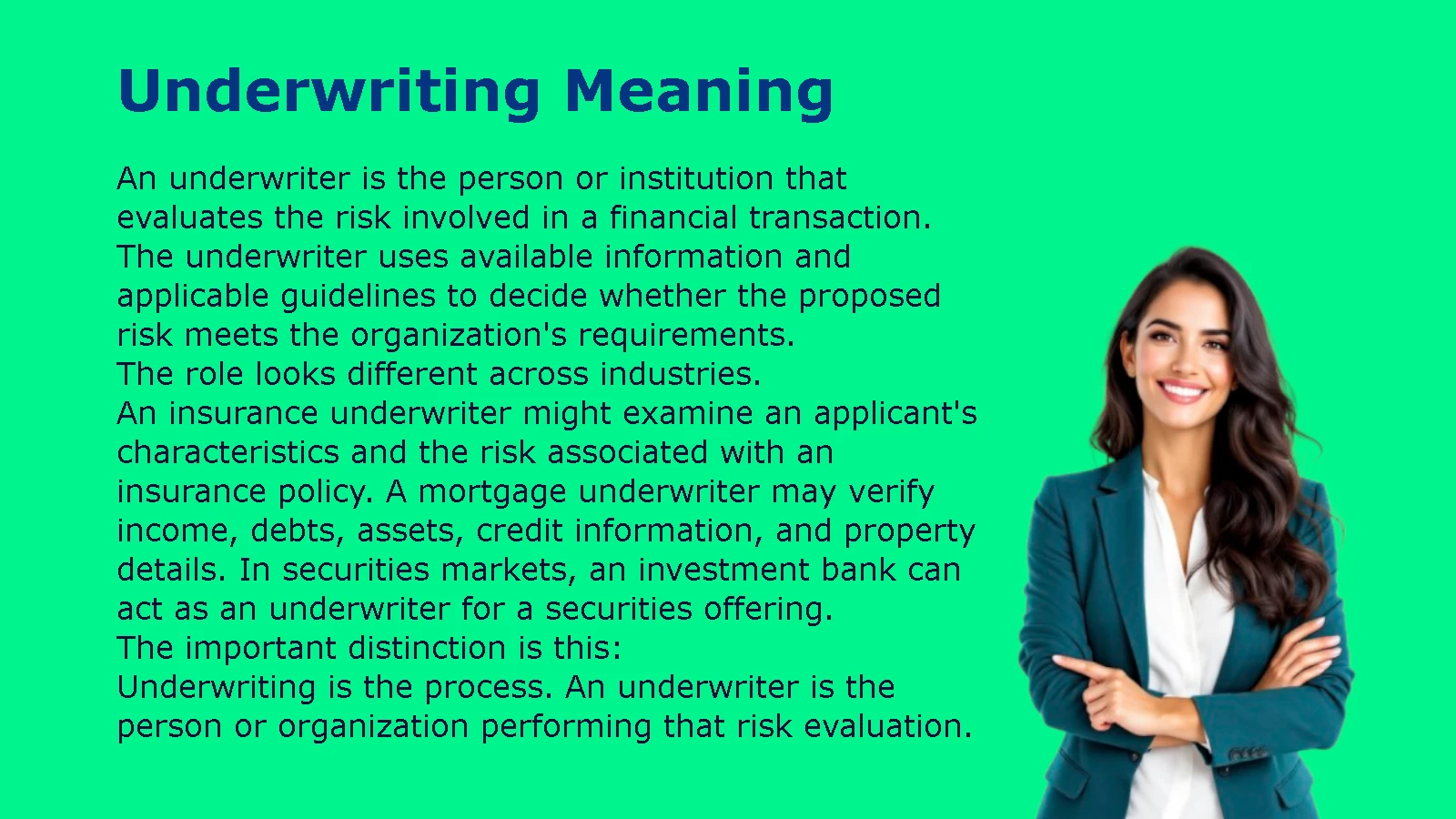
An underwriter is the person or institution that evaluates the risk involved in a financial transaction.
The underwriter uses available information and applicable guidelines to decide whether the proposed risk meets the organization’s requirements.
The role looks different across industries.
An insurance underwriter might examine an applicant’s characteristics and the risk associated with an insurance policy. A mortgage underwriter may verify income, debts, assets, credit information, and property details. In securities markets, an investment bank can act as an underwriter for a securities offering.
The important distinction is this:
Underwriting is the process. An underwriter is the person or organization performing that risk evaluation.
How Does Underwriting Work?
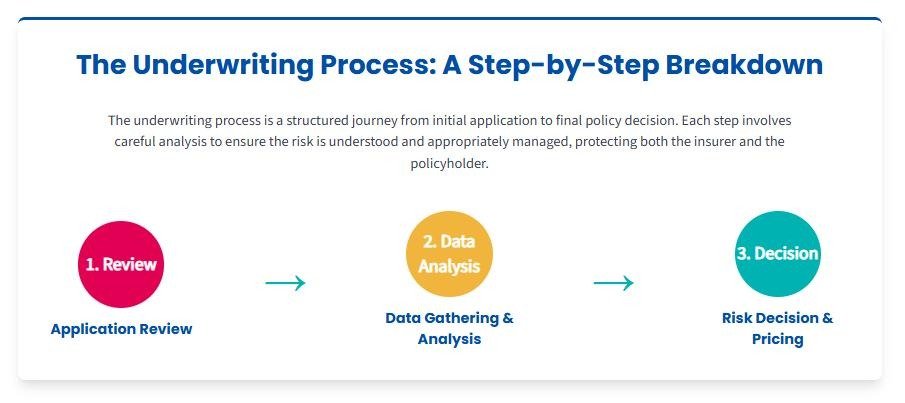
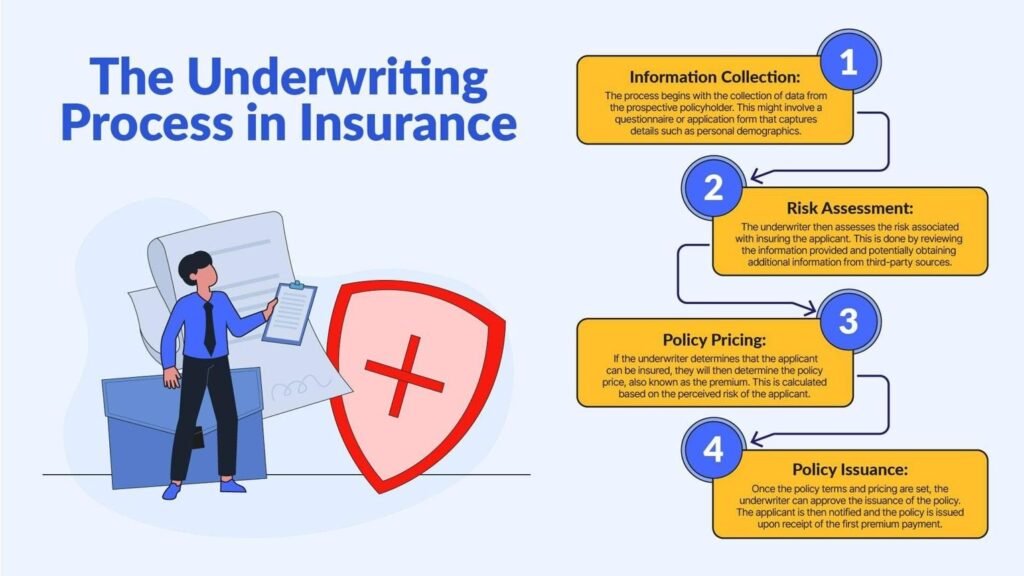
Although underwriting procedures vary, most follow the same broad pattern.
5
Application or Transaction Begins
First, someone seeks a financial product or enters a transaction that requires risk assessment.
That could mean:
- Applying for life insurance
- Applying for a mortgage
- Requesting a business loan
- Financing an investment property
- Issuing corporate bonds or shares
The information required depends on the transaction.
Information Is Reviewed
The underwriter then examines information relevant to the risk.
A mortgage review can include financial and property information. With insurance, the relevant details depend on the type of policy being evaluated. In a securities offering, attention shifts to the issuer and the proposed offering.
The goal isn’t simply to collect paperwork. The information helps the underwriter determine whether the proposed transaction fits the applicable risk standards.
Risk Is Assessed
This is the heart of underwriting.
The underwriter asks questions such as:
- How likely is a loss or default?
- How large could that loss be?
- Does the applicant meet the relevant requirements?
- Can the borrower repay the debt?
- Does the collateral support the transaction?
- Does the proposed insurance risk fit the insurer’s guidelines?
- Does the securities offering make sense under the applicable underwriting arrangement?
Terms Are Determined
Risk assessment can influence the terms of a transaction.
Depending on the product, this may affect:
- Interest rate
- Insurance premium
- Coverage
- Loan amount
- Loan conditions
- Collateral requirements
- Fees
- Securities offering structure
A Decision Is Made
The final outcome can vary.
An application might receive approval, conditional approval, a request for more documentation, modified terms, or a denial.
Being in underwriting does not automatically mean you’re approved. It means the risk is being evaluated.
Underwriting Meaning in Finance
In finance, underwriting broadly refers to the evaluation and acceptance of financial risk.
Financial institutions use underwriting when they need to determine whether a person, company, property, or securities transaction meets established requirements.
The term therefore covers more than one activity. Loan underwriting evaluates repayment and credit risk. Securities underwriting deals with raising capital through securities. Insurance underwriting evaluates the risk associated with providing coverage.
This broader financial meaning explains why you may encounter searches such as:
- Underwriting meaning in finance
- Underwriting meaning in banking
- Underwriting meaning in loans
- Underwriting meaning in investment banking
They’re related concepts, but they aren’t identical.
Why Is Underwriting Important in Finance?
Money carries risk.
A lender risks losing money when a borrower fails to repay. An insurer risks paying claims that cost more than expected. An investment bank involved in a securities offering may take on different forms of transaction or distribution risk.
Underwriting gives the institution a structured way to evaluate those risks before committing resources.
Good underwriting doesn’t eliminate risk. It helps an institution understand and manage it.
Underwriting Meaning in Banking
In banking, underwriting generally involves evaluating whether a customer or business meets the requirements for a financial product, particularly credit.
A bank may examine information such as:
- Income
- Employment
- Credit history
- Existing debt
- Assets
- Cash flow
- Loan amount
- Collateral
- Financial statements
The exact factors depend on the type of financial product.
For example, a small-business loan may require detailed business financial information, while a consumer loan may rely more heavily on the borrower’s personal financial and credit profile.
Underwriting in Bank Loans
Suppose you apply for a $30,000 personal loan.
The bank has a simple financial concern: Will the borrower repay the money according to the agreed terms?
To answer that question, the lender may evaluate your income, existing obligations, credit history, requested amount, and other relevant information.
The underwriter then compares the application with the lender’s requirements.
That process can lead to approval, different terms, additional documentation, or denial.
Underwriter vs. Loan Officer
These roles often get confused.
A loan officer generally works with borrowers and helps originate loans. An underwriter evaluates whether the loan meets the lender’s applicable risk and eligibility criteria.
The distinction matters because the person helping you with your application isn’t necessarily the person making the underwriting decision. CFPB regulations specifically distinguish activities such as communicating with borrowers from making an underwriting decision about whether a borrower qualifies for a loan.
Underwriting Meaning in Insurance
Insurance underwriting has a different focus from loan underwriting.
Instead of primarily asking whether someone can repay borrowed money, the insurer is evaluating the likelihood and potential cost of an insured loss.
The insurer collects information about the risk and uses its underwriting rules to determine whether and on what terms it will provide coverage.
Depending on the insurance product, underwriting can affect:
- Whether coverage is offered
- Premium
- Coverage limits
- Deductibles
- Conditions
- Exclusions
The factors considered vary significantly between insurance products.
What Does an Insurance Underwriter Do?
An insurance underwriter evaluates information relevant to the policy being considered.
For example, an underwriter working with an auto policy may consider information about the driver and vehicle. A property insurer may examine characteristics of the property and its location. Life insurance underwriting can involve information about the applicant’s age, health, and other relevant risk factors.
The underwriter’s objective is to determine whether the risk fits the insurer’s guidelines and how the policy should be structured.
Examples of Insurance Underwriting
Life insurance: The insurer evaluates information relevant to mortality risk and the requested coverage.
Auto insurance: The insurer evaluates information relevant to the likelihood and potential cost of vehicle-related claims.
Homeowners insurance: The insurer evaluates property-related risks and other information relevant to potential claims.
Business insurance: The insurer evaluates risks associated with the company’s operations, property, employees, and other relevant exposures.
The exact criteria aren’t universal. Different insurers and products use different underwriting standards.
Underwriting Meaning in Loans
Loan underwriting is the process of evaluating a borrower’s credit and financial risk before a lender commits to the loan.
The central question is straightforward:
Does this borrower meet the lender’s requirements and appear able to repay the debt under the proposed terms?
A lender may consider:
- Credit history
- Income
- Employment
- Existing debt
- Assets
- Loan amount
- Loan purpose
- Collateral
- Cash flow
- Financial statements for business borrowers
The lender doesn’t necessarily weigh every factor equally. The relevant criteria depend on the loan type and lender.
What Do Loan Underwriters Check?
Consider a borrower applying for a $250,000 mortgage.
The lender needs more than the requested amount. It needs evidence that the borrower can support the debt and that the property and transaction meet applicable requirements.
The review may involve:
- Income verification
- Employment information
- Credit history
- Existing debts
- Assets and available funds
- Property information
- Loan amount and structure
- Relevant underwriting requirements
For residential mortgage lending, federal regulations define underwriting as part of the broader mortgage origination process.
Mortgage Underwriting: What Does It Mean?
Mortgage underwriting deserves special attention because the lender evaluates both the borrower and the property.
The borrower needs to demonstrate financial capacity to repay the mortgage. The property also matters because it serves as collateral for the loan.
The CFPB explains that a mortgage is an agreement in which the lender has rights to the property if the borrower doesn’t repay the borrowed money according to the loan terms.
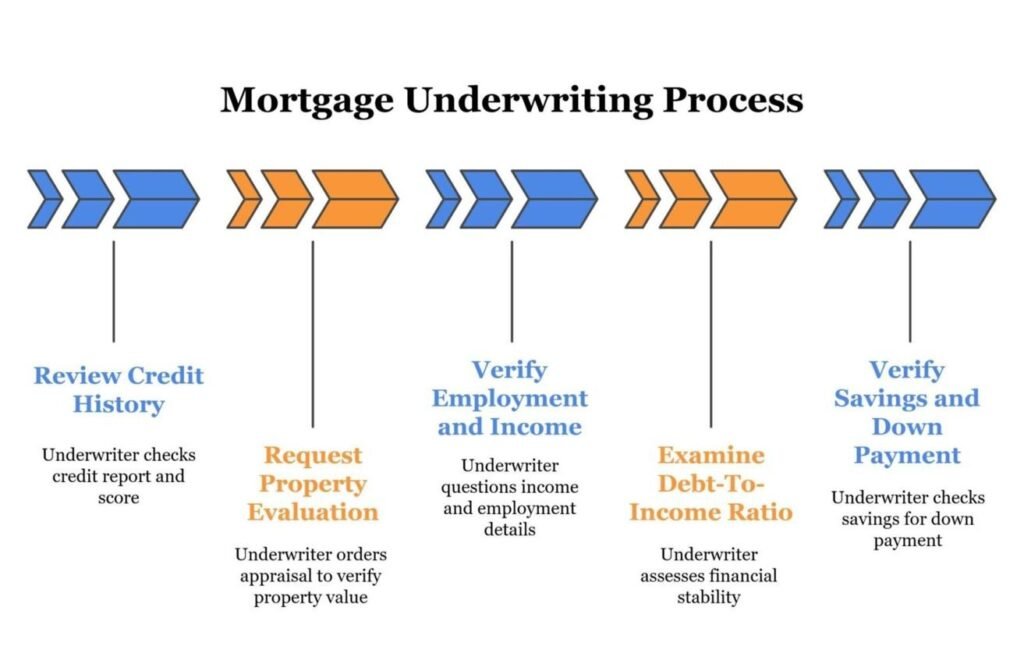
What Does a Mortgage Underwriter Check?
A mortgage underwriter may review:
- Income
- Employment
- Debts
- Credit information
- Assets
- Down payment funds
- Property value
- Property documentation
- Loan amount
- Loan-to-value relationship
- Other relevant underwriting requirements
The exact process varies by lender and mortgage product.
What Happens During Mortgage Underwriting?
A simplified mortgage underwriting process looks like this:
Application → Document collection → Verification → Risk assessment → Conditions or additional documentation → Underwriting decision → Closing
Underwriting isn’t the same thing as closing.
Mortgage origination can include application processing, underwriting, funding, and other administrative services. The CFPB also identifies underwriting as a specific component of the mortgage origination process.
Mortgage Underwriting Example
Imagine that Jordan applies for a mortgage to purchase a $400,000 home.
Jordan has:
- A steady income
- Existing monthly debt
- A specific amount available for the down payment
- A documented credit history
The lender reviews Jordan’s financial information and evaluates the property and proposed mortgage.
If the information satisfies the lender’s requirements, the lender may approve the application. If something needs clarification, the underwriter may request additional documents before making a final decision.
That’s mortgage underwriting in action.
Underwriting Meaning in Investment Banking
In investment banking, underwriting has a distinctly different meaning.
Here, underwriting can involve helping a company or other issuer raise capital by selling securities to investors.
An investment bank may help structure, price, market, and distribute a securities offering. Depending on the agreement, the underwriter may also assume a particular level of financial risk.
This is why securities underwriting shouldn’t be confused with mortgage or insurance underwriting.
How Investment Banking Underwriting Works
Consider a company that wants to raise capital by issuing securities.
The basic process may look like this:
Issuer → Investment bank/underwriters → Investors
The underwriters can help evaluate the offering and facilitate its distribution.
The specific arrangement determines how much risk the underwriter takes.
Firm Commitment Underwriting
Under a firm commitment arrangement, the underwriter agrees to purchase the securities from the issuer and then distribute them to investors.
This can expose the underwriter to the risk that it won’t be able to resell the securities at the expected price.
The SEC distinguishes arrangements in which underwriters commit to take and pay for the securities from best efforts arrangements in which they take and pay for securities they are able to sell.
Best Efforts Underwriting
Under a best efforts arrangement, the underwriter agrees to use its efforts to sell the securities but generally doesn’t make the same commitment to purchase the entire offering itself.
That changes the risk allocation.
In simple terms:
| Arrangement | Basic idea | Who bears more unsold-offering risk? |
| Firm commitment | Underwriter purchases the securities from the issuer | Generally the underwriter |
| Best efforts | Underwriter seeks to sell securities without the same purchase commitment | Generally the issuer |
The actual agreement can contain additional terms and conditions, so these definitions shouldn’t be treated as a substitute for the transaction documents.
Underwriting Meaning in Business
Businesses encounter underwriting when they seek financing, purchase certain types of insurance, or raise capital through securities.
For example, a company seeking a business loan may undergo underwriting based on financial statements, cash flow, debt obligations, credit history, collateral, and other relevant information.
The lender wants to understand whether the business can support the proposed debt.
Business Loan Underwriting
A business lender might examine:
- Revenue
- Profitability
- Cash flow
- Existing debt
- Business credit
- Owner or guarantor information when relevant
- Assets
- Collateral
- Loan purpose
- Financial projections where appropriate
Cash flow often matters because a profitable company can still struggle to make debt payments if its cash isn’t available when payments are due.
Corporate Securities Underwriting
Businesses can also use underwriting when raising capital through securities.
Instead of asking, “Can this individual repay a loan?”, the transaction focuses on the issuer, the securities, the offering, investor demand, and the structure of the underwriting arrangement.
That makes securities underwriting fundamentally different from ordinary consumer loan underwriting.
Underwriting Meaning in Real Estate
In real estate, underwriting can refer to more than one type of analysis.
Mortgage underwriting focuses on whether a borrower and property satisfy the requirements for a mortgage.
Real estate investment underwriting focuses on whether a property makes financial sense as an investment.
That distinction is important.
Real Estate Loan Underwriting
For a mortgage or other property-backed loan, the lender may consider:
- Borrower’s income
- Existing debts
- Credit history
- Down payment
- Property value
- Loan amount
- Loan-to-value ratio
- Property documentation
- Repayment ability
The property matters because it can serve as collateral.
Real Estate Investment Underwriting
An investor analyzing an apartment building may approach underwriting differently.
Suppose a property costs $2 million and generates annual rental revenue of $180,000.
The investor can’t simply look at the $180,000 figure and call the property profitable. Operating expenses, vacancies, maintenance, taxes, insurance, financing costs, capital expenditures, and other factors affect the property’s actual economics.
A basic investment underwriting model might examine:
| Metric | Example |
| Purchase price | $2,000,000 |
| Annual gross rental income | $180,000 |
| Operating expenses | $70,000 |
| Net operating income | $110,000 |
| Financing costs | Depends on loan |
| Cash flow after debt | Depends on financing |
| Expected exit value | Depends on assumptions |
This is investment underwriting, not the same process as a bank deciding whether to approve a mortgage.
What Factors Do Underwriters Consider?
There isn’t one universal underwriting checklist.
The relevant information depends on the product, institution, transaction, and applicable rules.
| Factor | Insurance | Loans & Mortgages | Securities |
| Credit history | Product-dependent | Often important | Relevant in some contexts |
| Income | Sometimes | Often important | Issuer’s financial performance |
| Existing debt | Sometimes | Important | Issuer liabilities |
| Assets | Product-dependent | Often relevant | Issuer assets |
| Property information | Property insurance | Important for mortgages | Usually not the same role |
| Claims history | Often relevant | Usually not central | Not generally central |
| Financial statements | Important for some business policies | Important for business lending | Often important |
| Collateral | Product-dependent | Important when applicable | Depends on transaction |
| Cash flow | Business insurance | Important for business lending | Important to issuer analysis |
One of the biggest mistakes is assuming that every underwriter uses the same formula.
Underwriting is context-specific.
Underwriting vs. Approval
These terms sound similar, but they describe different things.
Underwriting is the evaluation process.
Approval is a decision that can result from that process.
For example, when a mortgage application enters underwriting, the lender is evaluating the application. That does not automatically mean the mortgage has received final approval.
A lender may still request:
- Bank statements
- Proof of income
- Employment verification
- Explanations for unusual transactions
- Additional property documents
- Other information needed to complete the review
The CFPB’s mortgage regulations recognize underwriting as part of the loan origination process rather than treating it as synonymous with the entire mortgage transaction.
Common Underwriting Terms You Should Know
Underwriter
A person or institution that evaluates the risk of a proposed transaction.
Underwriting Guidelines
Rules or criteria used to determine whether a particular risk meets the organization’s requirements.
Risk Assessment
The process of identifying and evaluating the likelihood and potential impact of a financial loss or other unfavorable outcome.
Conditional Approval
An approval that depends on satisfying specified requirements or conditions.
Credit Risk
The risk that a borrower or other obligated party won’t meet its financial obligations.
Collateral
An asset that can secure a debt and provide protection to the lender if the borrower defaults, subject to the applicable agreement and law.
Loan-to-Value Ratio
The relationship between the amount of a property-backed loan and the value of the property.
For example, a $240,000 mortgage on a $300,000 property has an 80% loan-to-value ratio.
Debt-to-Income Ratio
A ratio that compares debt obligations with income and is commonly used in consumer lending and mortgage analysis.
Premium
The amount charged for an insurance policy.
Securities Underwriting
The process through which an investment bank or other financial institution helps facilitate the issuance and distribution of securities.
What Does It Mean When an Application Is in Underwriting?
If someone tells you “your application is in underwriting,” it generally means the application has reached the risk-review stage.
The underwriter may be checking whether the information provided is accurate and whether the application satisfies the relevant criteria.
The application may move through several stages:
- Application submitted
- Documents collected
- Information verified
- Risk assessed
- Questions or conditions addressed
- Decision made
- Closing or policy issuance, where applicable
The phrase itself doesn’t tell you whether the application will be approved.
That’s why “in underwriting” isn’t the same as “approved.”
What Happens If an Underwriter Finds a Problem?
A problem doesn’t always lead directly to rejection.
The response depends on what the issue is and how significant it is.
An underwriter may:
- Request additional documentation
- Ask for clarification
- Verify information through another source
- Apply a condition
- Change applicable terms
- Decline the application
For example, suppose a mortgage applicant reports income that doesn’t match the documentation supplied.
The underwriter may request clarification or additional records. The application could continue once the discrepancy is resolved.
Another situation may be more serious. If an applicant doesn’t satisfy a fundamental eligibility requirement, the lender may decline the application.
Underwriting is about evaluating the complete risk picture, not simply finding one imperfect detail.
Underwriting Examples
Insurance Underwriting Example
Alex applies for homeowners insurance.
The insurer reviews information about the property and other factors relevant to the policy. The insurer then evaluates the potential risk and determines whether the property fits its underwriting criteria.
If it does, the insurer can offer coverage under specified terms.
The process is underwriting because the insurer is evaluating the risk before accepting the insurance obligation.
Loan Underwriting Example
Maria applies for a $20,000 personal loan.
The lender reviews her income, existing obligations, credit information, requested amount, and other relevant information.
The lender compares the application with its lending standards.
If Maria meets those requirements, the lender may approve the loan. If the lender needs additional information, the application may remain under review.
That’s loan underwriting.
Mortgage Underwriting Example
David wants to buy a $350,000 home.
He applies for a mortgage and provides financial and property information.
The lender evaluates David’s ability to repay the loan and reviews the property because the home serves as collateral for the mortgage.
The lender may require additional documentation before reaching its decision.
This illustrates why mortgage underwriting evaluates both the borrower and the property.
Investment Banking Underwriting Example
A company wants to raise capital by issuing securities.
An investment bank agrees to participate in the offering under a particular underwriting arrangement.
The bank helps facilitate the transaction and distributes the securities to investors according to the agreement.
If the arrangement is a firm commitment, the underwriter can take on greater risk because of its commitment to purchase the securities from the issuer. Under a best-efforts arrangement, the underwriter doesn’t make the same purchase commitment.
Why Is Underwriting Important?
Underwriting exists because financial decisions involve uncertainty.
A lender doesn’t know with absolute certainty whether a borrower will repay. An insurer doesn’t know exactly how many claims a policyholder will make. An investment bank doesn’t know precisely how investors will respond to a securities offering.
Underwriting gives institutions a framework for making those decisions.
It can help:
- Measure risk
- Set appropriate terms
- Control potential losses
- Evaluate applicants consistently
- Determine eligibility
- Support responsible lending
- Structure financial transactions
In mortgage lending, for example, the ability-to-repay framework requires creditors to make a reasonable, good-faith determination that a consumer can repay a covered residential mortgage according to its terms.
The broader lesson is simple: underwriting turns raw information into a structured risk decision.
Frequently Asked Questions About Underwriting
What does underwriting mean in simple terms?
Underwriting means checking and evaluating risk before accepting a financial obligation or transaction. A lender uses it to evaluate a borrower. An insurer uses it to evaluate an insurance risk. An investment bank may use it when facilitating a securities offering.
What does an underwriter do?
An underwriter reviews relevant information, evaluates risk, applies applicable criteria, and helps determine whether a transaction should proceed and under what terms.
What does underwriting mean in finance?
In finance, underwriting generally means evaluating and accepting financial risk associated with lending, insurance, securities offerings, or other financial transactions.
What does underwriting mean in banking?
In banking, underwriting commonly refers to evaluating whether a borrower or transaction meets the bank’s lending and risk requirements.
What does underwriting mean in insurance?
Insurance underwriting means evaluating the risk associated with providing insurance coverage. The assessment can influence eligibility, pricing, coverage, and policy terms.
What does underwriting mean in loans?
Loan underwriting is the process of evaluating a borrower’s financial and credit risk before a lender commits to providing the loan.
What does underwriting mean in investment banking?
In investment banking, underwriting can refer to the process of helping an issuer sell securities to investors. The underwriter’s financial commitment and risk depend on the underwriting arrangement.
What does underwriting mean in real estate?
In real estate, underwriting can mean evaluating a property-backed loan or analyzing a property’s expected financial performance as an investment.
Does underwriting mean I am approved?
No. Being in underwriting means the application or transaction is being evaluated. Approval may come later if the relevant requirements are satisfied.
Can an underwriter deny an application?
Yes. If the application doesn’t meet applicable requirements or the assessed risk falls outside the institution’s criteria, the application may be declined.
Why does underwriting require so many documents?
Documents allow the underwriter to verify information and assess the relevant risk. For example, mortgage underwriting can involve information about the borrower’s finances and the property.
What happens after underwriting?
The next step depends on the product. A transaction may move toward approval and closing, policy issuance, funding, or securities distribution. An underwriter may also request additional information or decline the transaction.
Key Takeaway: What Does Underwriting Mean?
Underwriting means evaluating risk before committing to a financial transaction or obligation.
The basic idea remains consistent even though the application changes by industry.
- Insurance underwriting evaluates the risk of providing coverage.
- Loan underwriting evaluates a borrower’s credit and repayment risk.
- Mortgage underwriting evaluates the borrower and the property securing the loan.
- Banking underwriting evaluates financial and credit risk associated with lending.
- Investment banking underwriting helps facilitate securities offerings and can involve the underwriter taking on specific distribution or purchase risks.
- Business underwriting evaluates financial and operational information relevant to financing or other risk-bearing transactions.
- Real estate underwriting can evaluate either property financing or the financial viability of an investment.
The easiest way to remember the term is this:
Underwriting is the risk-checking process that happens before a financial institution or underwriter commits to a transaction.
That one idea connects all the major meanings of underwriting, from an insurance policy and personal loan to a mortgage and a corporate securities offering.













