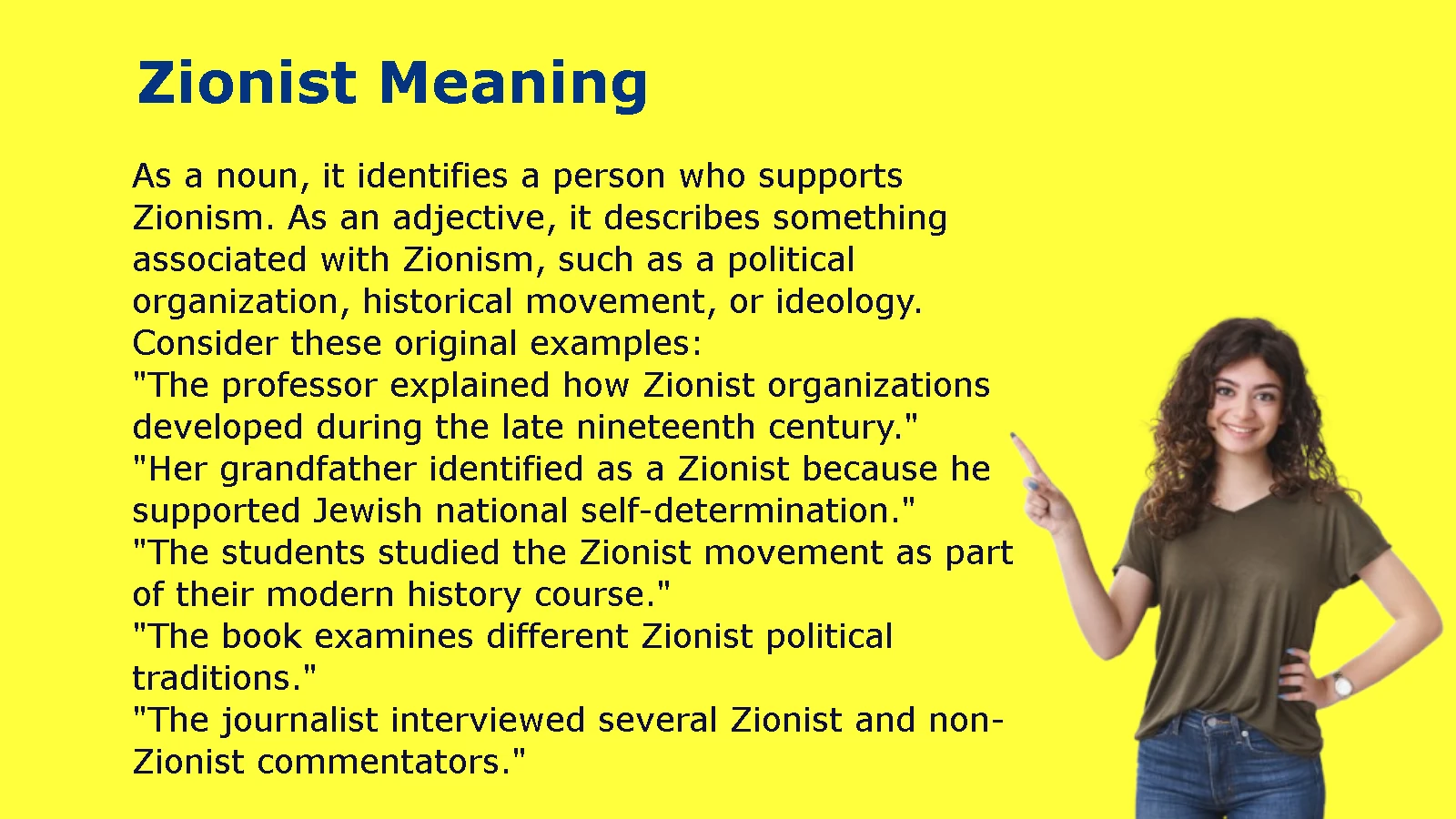
The Zionist meaning refers to a person who supports Zionism, a political and national movement centered on the Jewish people’s right to self-determination in their historic homeland, particularly through a national home in the Land of Israel. The term has historical, religious, cultural, and political meanings that have evolved over time.
A Zionist is someone who supports Zionism, while Zionism is the movement or ideology itself. The word comes from Zion, an ancient name associated with Jerusalem and the Jewish people’s historical connection to the land. Today, people use the term in discussions about Jewish identity, Israeli statehood, Palestinian rights, nationalism, religion, and the Israeli-Palestinian conflict.
Understanding the Zionist meaning requires more than a dictionary definition. You also need to understand how modern Zionism developed, why some people support it, why others oppose it, and how the word differs from Judaism and Israeli nationality.
| Question | Answer |
| What does Zionist mean? | A person who supports Zionism and Jewish national self-determination in the historic Land of Israel. |
| What is Zionism? | A Jewish national movement that developed into a political movement for a Jewish homeland and state. |
| Is being a Zionist good or bad? | People disagree based on their political, historical, religious, and ethical perspectives. |
| What does Christian Zionist mean? | A Christian who supports Zionism, often because of particular interpretations of biblical teachings. |
| What does Zionist mean in Arabic? | صهيوني (ṣahyūnī) generally means Zionist; الصهيونية means Zionism. |
What Does Zionist Mean?
A Zionist is a person who supports Zionism, a movement that advocates Jewish national self-determination in the historic Land of Israel. Modern political Zionism developed during the late 19th century and sought to establish a secure national home for Jewish people. Today, the term can describe people with different religious, cultural, and political beliefs.
The word can function as both a noun and an adjective. Its exact meaning in a conversation depends on the speaker, historical period, and political context.
Zionist Meaning in Simple Words
In simple words, a Zionist is someone who believes that Jewish people should have the right to a national homeland in their historic homeland, particularly in the area now known as Israel.
Think of Zionism as a movement connected to national identity and self-determination. A person who supports that movement may identify as a Zionist.
For example:
- A person who supports Jewish national self-determination in Israel may identify as a Zionist.
- A historian studying the Zionist movement examines its political and cultural development.
- A Jewish person who does not support Zionism does not automatically lose their Jewish identity.
Simple definition: A Zionist supports the idea that Jewish people have a right to national self-determination in their historic homeland.
However, not every Zionist shares the same political beliefs. Some support particular Israeli government policies, while others strongly criticize them. Some approach Zionism through religion, while others understand it mainly as a national or political movement.
Zionist Meaning in English With an Example
In English, Zionist is both a noun and an adjective.
As a noun, it identifies a person who supports Zionism. As an adjective, it describes something associated with Zionism, such as a political organization, historical movement, or ideology.
Consider these original examples:
- “The professor explained how Zionist organizations developed during the late nineteenth century.”
- “Her grandfather identified as a Zionist because he supported Jewish national self-determination.”
- “The students studied the Zionist movement as part of their modern history course.”
- “The book examines different Zionist political traditions.”
- “The journalist interviewed several Zionist and non-Zionist commentators.”
Notice that the word does not automatically describe someone’s position on every political issue involving Israel.
For example, someone may support Israel’s continued existence while opposing settlement expansion or criticizing a particular government. Another person may support Zionism for religious reasons rather than political nationalism.
What Is the Difference Between Zionist and Zionism?
Zionist and Zionism are closely related, but they do not mean exactly the same thing. Zionism refers to the movement or ideology, while a Zionist is a person who supports it.
| Word | Part of speech | Meaning | Example |
| Zion | Noun | An ancient name associated with Jerusalem and broader Jewish historical and religious traditions | Zion appears in biblical literature. |
| Zionism | Noun | A Jewish national movement and its associated political ideas | Zionism developed as a modern political movement. |
| Zionist | Noun | A person who supports Zionism | He identifies as a Zionist. |
| Zionist | Adjective | Connected with or supportive of Zionism | The organization studied Zionist history. |
| Anti-Zionist | Noun/adjective | A person or position opposed to Zionism | The speaker described herself as anti-Zionist. |
An easy way to remember the distinction is:
- Zion is the historical name.
- Zionism is the movement or ideology.
- Zionist is a supporter or something related to that movement.
What Is Zionism? Understanding the Meaning and Ideology
Zionism is a Jewish national movement that supports the Jewish people’s right to self-determination in their historic homeland. Modern political Zionism developed in the late 19th century, drawing on Jewish historical connections to the land, national aspirations, and concerns about antisemitism and persecution.
The movement eventually contributed to the establishment of the State of Israel in 1948. However, Zionism has never represented just one political or religious viewpoint.
The Definition of Zionism
Zionism is a form of Jewish nationalism focused on Jewish national identity, self-determination, and a homeland in the historic Land of Israel.
Its central ideas include:
- National self-determination: The belief that Jewish people should have the ability to determine their political future.
- Historical connection: Recognition of the longstanding Jewish religious, cultural, and historical relationship with the land.
- National identity: The idea that Jewish identity includes a shared national dimension for many Jewish communities, alongside religious and cultural dimensions.
- Security: The pursuit of a place where Jewish people could exercise political independence and protect their communities.
- Cultural development: The revival and development of Hebrew language, literature, education, and Jewish cultural institutions.
Zionism developed different political traditions. Some supporters emphasized diplomacy and international recognition. Others focused on labor movements, religious teachings, cultural revival, or settlement.
These differences explain why two Zionists can support the same general idea of Jewish national self-determination while disagreeing about borders, religion, Palestinian rights, settlements, and government policies.
When Did Zionism Begin?
The roots of Jewish attachment to Zion are ancient, but modern political Zionism emerged during the late 19th century.
Jewish communities had maintained religious, cultural, and historical connections to Jerusalem and the Land of Israel for centuries. Prayers, religious writings, and cultural traditions preserved the hope of return.
However, modern political Zionism developed within a different historical environment. European nationalism, antisemitism, discrimination, and organized political movements influenced its growth.
Important developments include:
- 1881–1882: Pogroms and anti-Jewish violence in the Russian Empire contributed to organized Jewish migration and national movements.
- 1896: Theodor Herzl published Der Judenstaat (The Jewish State), presenting a political argument for a Jewish national state.
- 1897: Herzl organized the First Zionist Congress in Basel, Switzerland.
- 1917: Britain issued the Balfour Declaration, expressing support for a national home for the Jewish people in Palestine.
- 1947: The United Nations General Assembly adopted Resolution 181, recommending the partition of Palestine into separate Jewish and Arab states.
- 1948: Israel declared independence and became a state.
The First Zionist Congress was particularly important because it helped turn different Jewish national aspirations into a more organized international political movement. <sup>(Historical background: United Nations and National Library of Israel.)</sup>
Who Was Theodor Herzl?
Theodor Herzl (1860–1904) was an Austro-Hungarian Jewish journalist and political activist widely recognized as a founder of modern political Zionism.
Herzl became concerned about antisemitism in Europe and argued that Jewish communities needed political self-determination rather than relying entirely on assimilation or protection from other governments.
His 1896 book, The Jewish State, presented his argument for establishing a Jewish national state. In 1897, he organized the First Zionist Congress in Basel.
Herzl’s importance comes from several contributions:
- He helped organize Zionism as an international political movement.
- He encouraged diplomatic efforts to secure support for a Jewish national home.
- He helped establish institutions that gave the movement a more coordinated structure.
- He brought together supporters from different Jewish communities and political traditions.
Herzl died in 1904, more than four decades before Israel declared independence. His political work nevertheless became an important part of modern Zionist history.
Why Did Zionism Develop?
Zionism emerged from several connected historical, political, and cultural circumstances. No single event explains the movement’s development.
1. Antisemitism and persecution
Jewish communities experienced discrimination, exclusion, pogroms, and violence in different parts of Europe. Some Jewish thinkers concluded that political independence could provide greater security than depending on other states.
2. European nationalism
During the 19th century, national movements spread across Europe. Different communities sought national identity, political representation, and independent states.
Jewish intellectuals also debated whether Jewish people should pursue national self-determination.
3. Historical and religious connections
Jerusalem and the Land of Israel hold deep significance in Jewish religious texts, prayers, traditions, and collective memory.
For many Zionists, these connections supported the idea of a modern Jewish homeland.
4. Cultural revival
Some Zionists wanted to strengthen Jewish culture through education, literature, Hebrew language development, and new cultural institutions.
5. Political independence
Many supporters believed that a Jewish national home would allow Jewish communities to exercise political control over their future.
These motivations were not identical for every supporter. Some emphasized religion, others nationalism, and others the need for safety from antisemitism.
How Did Zionism Lead to the Establishment of Israel?
The establishment of Israel resulted from decades of political organizing, migration, international diplomacy, conflict, and major changes in world politics.
Understanding the timeline helps explain why Zionism remains connected to different historical experiences.
| Year | Historical development | Significance |
| 1896 | Herzl publishes The Jewish State | Advances a modern political argument for Jewish statehood. |
| 1897 | First Zionist Congress | Organizes the international Zionist movement. |
| 1917 | Balfour Declaration | Britain expresses support for a Jewish national home in Palestine. |
| 1922 | British Mandate for Palestine receives League of Nations approval | Establishes the international framework for British administration. |
| 1947 | UN General Assembly Resolution 181 | Recommends partition into Jewish and Arab states. |
| May 14, 1948 | Israel declares independence | Establishes the State of Israel. |
The Balfour Declaration was an important diplomatic milestone, but it did not independently establish a Jewish state. Britain administered Palestine under the Mandate system, while Jewish and Arab communities pursued competing national aspirations.
In November 1947, the United Nations recommended partition. Jewish political leadership accepted the plan, while Arab Palestinian leadership and surrounding Arab states rejected it. Violence escalated, and war followed Israel’s declaration of independence in May 1948.
For Jewish communities, Israel’s establishment represented the achievement of a long-standing national aspiration and the creation of a state after centuries of persecution.
For Palestinians, the 1948 war brought mass displacement and loss of homes and communities, an experience known as the Nakba, meaning catastrophe in Arabic.
Both historical experiences are necessary to understand the continuing debate about Zionism. <sup>(Historical timeline: United Nations, Question of Palestine; United States Holocaust Memorial Museum.)</sup>
Is Being a Zionist Good or Bad?
Whether being a Zionist is considered good or bad depends on a person’s political, historical, religious, and ethical perspective. Supporters often emphasize Jewish national self-determination, historical connection, and security. Critics often focus on Palestinian displacement, competing national claims, and the consequences of particular Zionist policies and political projects.
The term does not provide enough information to judge an individual’s complete political beliefs.
Why Do Some People Support Zionism?
Supporters of Zionism generally see it as an expression of Jewish national self-determination.
Their arguments often include the following points:
Jewish self-determination
Supporters believe Jewish people should have the same general opportunity for national self-determination that other peoples claim.
Historical connection to the land
Jewish religious texts, historical records, archaeological evidence, and cultural traditions document a longstanding relationship between Jewish communities and the Land of Israel.
Protection from persecution
The history of antisemitism, including the Holocaust, strengthens the argument among many supporters that Jewish communities need political independence and security.
Cultural and national identity
Some supporters view Israel as a center for Jewish language, culture, education, and national identity.
Political independence
Supporters may argue that a Jewish state gives Jewish people the ability to make decisions about their collective future.
These arguments reflect common pro-Zionist perspectives, although individual supporters may prioritize different reasons.
Why Do Some People Oppose Zionism?
Criticism of Zionism comes from different political, religious, and historical positions. It is not one unified movement with a single explanation.
Common arguments include:
Palestinian displacement
Many critics focus on the displacement of Palestinian Arabs during the 1948 war and the continuing consequences for Palestinian refugees and their descendants.
Palestinian self-determination
Critics argue that Jewish national aspirations should not override Palestinian rights to political independence, equality, and self-determination.
Nationalism and state structure
Some opponents object to the idea of a state organized around a particular national or religious identity. Others advocate a different political arrangement that provides equal rights to everyone living in the territory.
Israeli government policies
Some people use anti-Zionist language when criticizing occupation, settlement expansion, restrictions on Palestinian movement, military actions, or other policies.
However, criticism of these policies does not automatically mean someone rejects Zionism. Many Zionists also criticize Israeli government decisions.
Religious objections
Some Jewish religious groups oppose political Zionism because they interpret Jewish return to the land or the establishment of a Jewish state through particular religious teachings.
These disagreements demonstrate why it is important to examine the specific argument rather than assuming that every critic shares the same motivation.
Is Zionism the Same as Supporting Everything Israel Does?
No. Supporting Zionism does not automatically mean supporting every Israeli government, military decision, law, or political leader.
A person may support Israel’s continued existence as a Jewish national homeland while opposing specific government policies.
For example:
- A Zionist may support a negotiated two-state solution.
- Another Zionist may oppose settlement expansion.
- A religious Zionist may prioritize religious traditions.
- A secular Zionist may approach Jewish statehood through national identity.
- A Zionist may strongly criticize the conduct of a particular Israeli administration.
The distinction matters because support for a country’s existence and support for its government’s actions are separate political positions.
The same principle applies to other countries. Supporting the existence of a country does not require agreeing with every decision its government makes.
Can Someone Be Jewish Without Being a Zionist?
Yes. Jewish identity and Zionist political beliefs are not identical.
Judaism is a religion, while Jewish identity can also involve ancestry, culture, history, community, and shared traditions. Zionism is a national and political movement.
Jewish people hold different positions on Zionism, including:
- Zionist: Supports Jewish national self-determination in the historic Land of Israel.
- Non-Zionist: Does not identify with or actively support Zionism.
- Anti-Zionist: Opposes Zionism for political, religious, ethical, or other reasons.
Some Jewish communities support Zionism as part of their religious or national identity. Others reject political Zionism or disagree with particular forms of it.
It is inaccurate to assume that every Jewish person holds the same political beliefs.
Is Criticism of Zionism the Same as Antisemitism?
Not automatically. Antisemitism means prejudice, hostility, or discrimination against Jewish people because they are Jewish. Criticism of Zionism concerns a political movement or its ideas.
However, political language can become antisemitic when it uses anti-Jewish stereotypes, holds Jewish people collectively responsible for a government’s actions, or targets people because of their Jewish identity.
Consider these examples:
| Statement or behavior | How to understand it |
| Criticizing a specific Israeli government policy | Political criticism |
| Opposing settlement expansion | Political criticism |
| Debating whether a nation-state should have a particular constitutional structure | Political debate |
| Blaming all Jewish people for Israeli military actions | Collective blame based on Jewish identity |
| Using classic antisemitic stereotypes against Jewish people | Antisemitism |
| Threatening a Jewish person because of their identity or perceived political beliefs | Antisemitic hostility |
The important distinction is between criticizing ideas, institutions, and government actions and targeting Jewish people as a group.
People also disagree about where certain forms of anti-Zionist rhetoric cross that boundary. Careful analysis requires examining the actual words, context, and behavior rather than applying a label automatically.
What Is the Meaning of a Christian Zionist?
A Christian Zionist is a Christian who supports Zionism, often because of religious interpretations of the Bible and beliefs about the Jewish people’s relationship with the Land of Israel. Christian Zionism is especially associated with some Protestant evangelical communities, although supporters come from different Christian traditions.
Unlike Jewish Zionism, which developed from Jewish national and historical experiences, Christian Zionism often draws on Christian theology and interpretations of biblical prophecy.
Christian Zionist Meaning in Simple Words
In simple words, a Christian Zionist is a Christian who believes that supporting the Jewish people’s connection to Israel is important because of their religious understanding of the Bible.
Some Christian Zionists believe that the establishment and continued existence of Israel have special significance in God’s relationship with the Jewish people.
Their beliefs may include:
- The biblical covenant between God and Abraham.
- The historical importance of the land in the Old Testament.
- The belief that Jewish people retain a special relationship with the land.
- Interpretations of biblical prophecy involving Israel.
- Religious reasons for supporting the modern State of Israel.
Not all Christians interpret these teachings in the same way. Many Christians support Israel for political or humanitarian reasons without identifying as Christian Zionists.
Why Do Some Christians Support Zionism?
Christian Zionism often develops from particular interpretations of biblical passages.
1. The covenant with Abraham
Some Christian Zionists interpret God’s covenant with Abraham as evidence of a continuing relationship between the Jewish people and the land.
2. Biblical prophecy
Certain evangelical traditions interpret the establishment of Israel in 1948 and later historical developments as events connected to biblical prophecy.
3. Religious history
Jerusalem and the surrounding region hold central importance in Christianity because of their connection to the life and ministry of Jesus.
4. Political and humanitarian support
Some Christian Zionists also support Israel because they view it as a place of Jewish safety and national independence.
5. Evangelical theology
Some evangelical Christians connect their support for Israel with beliefs about the return of Jesus, the end times, and the future of biblical history.
Christian Zionism is not a single uniform doctrine. Different churches and individuals interpret these ideas differently.
Is Christian Zionism the Same as Jewish Zionism?
No. Both can support Jewish national self-determination and Israel, but their motivations may differ.
| Feature | Jewish Zionism | Christian Zionism |
| Main supporters | Jewish individuals and organizations | Christian individuals and organizations |
| Main motivation | Jewish national identity, self-determination, history, and security | Christian theology, biblical interpretation, and religious beliefs |
| Historical development | Modern political movement developed in the 19th century | Developed through different Christian theological traditions |
| Religious connection | May be religious or secular | Based on Christian beliefs |
| Political involvement | Varies widely | Varies widely |
A Jewish Zionist may support the movement because of Jewish national identity without holding religious beliefs. A Christian Zionist may support Israel because of a particular interpretation of Christian scripture.
Zionist Meaning in Different Languages
The word Zionist has equivalents in Arabic, Chinese, Farsi, and Russian. These translations generally refer to someone who supports Zionism, but their connotations can differ depending on political context, media usage, and the speaker’s perspective.
The following translations distinguish the person from the ideology.
Zionist Meaning in Arabic (صهيوني)
In Arabic, Zionist is commonly written as:
صهيوني
Pronunciation: Ṣahyūnī
The word for Zionism is:
الصهيونية
Pronunciation: Aṣ-ṣahyūniyyah
The term refers to a person who supports Zionism, the Jewish national movement associated with establishing and maintaining a Jewish national home in the historic Land of Israel.
Examples:
- صهيوني = Zionist
- صهيونية = Zionism
- معادٍ للصهيونية = Anti-Zionist (masculine form)
- الحركة الصهيونية = The Zionist movement
Arabic example:
“درس الطالب تاريخ الحركة الصهيونية.”
English translation: “The student studied the history of the Zionist movement.”
In Arabic-language political discussions, the word may carry strong political connotations. Its intended meaning should therefore be understood from the surrounding sentence.
Zionist Meaning in Chinese (犹太复国主义者)
In Simplified Chinese, Zionist is commonly translated as:
犹太复国主义者
The word for Zionism is:
犹太复国主义
The translation combines the ideas of Jewish identity, national restoration, and political ideology.
Examples:
- 犹太复国主义者 = Zionist
- 犹太复国主义 = Zionism
- 反犹太复国主义者 = Anti-Zionist
- 犹太复国主义运动 = Zionist movement
Chinese example:
“他研究了犹太复国主义运动的历史。”
English translation: “He studied the history of the Zionist movement.”
This translation makes the Jewish national dimension explicit, which helps distinguish Zionism from other movements associated with the historical name Zion.
Zionist Meaning in Farsi (صهیونیست)
In Farsi, also known as Persian, Zionist is commonly written as:
صهیونیست
The word for Zionism is:
صهیونیسم
Examples:
- صهیونیست = Zionist
- صهیونیسم = Zionism
- ضد صهیونیست = Anti-Zionist
- جنبش صهیونیستی = Zionist movement
Persian example:
“او درباره تاریخ جنبش صهیونیستی مطالعه میکند.”
English translation: “He studies the history of the Zionist movement.”
Persian speakers may encounter these words in political news, historical writing, religious discussions, and commentary about the Middle East.
The term’s tone can vary considerably between academic, journalistic, and political settings.
Zionist Meaning in Russian (сионист)
In Russian, Zionist is written as:
сионист
The word for Zionism is:
сионизм
Examples:
- Сионист = Zionist
- Сионизм = Zionism
- Антисионист = Anti-Zionist
- Сионистское движение = Zionist movement
Russian example:
“Он изучает историю сионистского движения.”
English translation: “He studies the history of the Zionist movement.”
Russian uses grammatical gender and case endings, so the exact form may change depending on the sentence.
For example, сионист is the masculine singular form, while сионистка is the feminine singular form.
Zionist Translation Comparison Table
| Language | Zionist | Zionism |
| English | Zionist | Zionism |
| Arabic | صهيوني | الصهيونية |
| Chinese (Simplified) | 犹太复国主义者 | 犹太复国主义 |
| Farsi | صهیونیست | صهیونیسم |
| Russian | сионист | сионизм |
These are common equivalents, not substitutes for contextual interpretation. Political terminology can carry different associations across languages, so translators should consider the audience and subject matter.
What Does Zion Mean?
Zion is an ancient biblical name associated with Jerusalem. Over time, it developed into a broader religious, cultural, and symbolic reference to the Jewish people’s historic homeland.
The word predates modern political Zionism by many centuries. Modern Zionists adopted this historical term to express the movement’s connection to Jewish national identity and the Land of Israel.
What Is Mount Zion?
Mount Zion is a hill in Jerusalem with historical and religious importance.
The name Zion appears in the Hebrew Bible and is associated with Jerusalem, the City of David, and Jewish religious traditions.
Over time, Zion became more than a geographical name. It developed into a symbol of:
- Jerusalem and its religious significance.
- Jewish historical identity.
- The idea of return to the ancestral homeland.
- Hope and spiritual connection.
- Jewish cultural and national continuity.
Zion also appears in Christian religious traditions and has symbolic meanings in some other religious contexts.
Is Zion the Same as Israel?
No. Zion and Israel have related but different meanings.
Zion is an ancient religious and historical term associated with Jerusalem and, more broadly, the Jewish homeland.
Israel can refer to the modern State of Israel, the ancient Kingdom of Israel, or the biblical name associated with the Jewish people.
| Term | Meaning |
| Zion | Ancient name associated with Jerusalem and a wider Jewish homeland symbol |
| Jerusalem | Historic city with major Jewish, Christian, and Muslim religious significance |
| Israel | Modern country and a name with ancient historical and biblical uses |
| Land of Israel | Historical and religious geographical expression |
| Zionism | Modern Jewish national movement |
The terms overlap in historical and religious discussions, but they are not interchangeable in every context.
How Is Zion Connected to Zionism?
The word Zion gave modern Zionism its name.
Jewish religious traditions had preserved the importance of Zion and Jerusalem for generations. Modern political Zionists adopted this symbolism to connect their national aspirations with Jewish history and cultural memory.
The connection can be understood in three stages:
- Ancient meaning: Zion developed as a name associated with Jerusalem.
- Religious and cultural meaning: Jewish traditions preserved Zion as a symbol of historical connection and hope.
- Modern political meaning: Zionism adopted the name to describe a movement supporting Jewish national self-determination in the historic homeland.
This historical relationship explains why Zionism is not simply a modern political word. It draws on a much older religious and cultural vocabulary.
Common Misconceptions About Zionists and Zionism
Political discussions often use Zionist, Jewish, Israeli, and Zionism as though they mean the same thing. They do not.
Understanding the differences helps prevent inaccurate statements and makes discussions about the Middle East more precise.
Are All Jewish People Zionists?
No. Jewish people hold different political, religious, and philosophical positions.
Some strongly identify with Zionism. Others do not identify with the movement, while some actively oppose political Zionism.
Jewish identity can involve religion, ancestry, culture, community, and shared history. It does not automatically determine someone’s political position.
Are All Zionists Jewish?
No. Although modern Zionism developed as a Jewish national movement, non-Jewish people can also support it.
Christian Zionists are one prominent example. Some Christians support Israel because of religious interpretations of biblical history and prophecy.
Other non-Jewish supporters may approach Zionism through political, historical, or philosophical arguments.
Therefore, being a Zionist does not necessarily mean someone is Jewish.
Does Zionism Mean Supporting the Israeli Government?
No. Zionism and support for a particular government are different things.
A Zionist can oppose the policies of an Israeli prime minister, criticize military actions, or support changes to the country’s political system.
Likewise, someone who supports the existence of Israel may disagree with specific Zionist political traditions.
Always examine what a person actually believes instead of assuming that the label explains their entire political position.
Are Zionism and Judaism the Same Thing?
No. Judaism is a religion and a broader Jewish cultural and historical tradition. Zionism is a national and political movement.
The two can overlap, but they are not interchangeable.
| Judaism | Zionism |
| A religion and cultural-historical tradition | A national and political movement |
| Includes religious beliefs and practices | Focuses on Jewish national self-determination |
| Has diverse religious traditions | Has diverse political and ideological traditions |
| Jewish identity does not require political Zionism | Zionist identity does not necessarily require religious observance |
A person can practice Judaism without supporting Zionism. Similarly, a secular Jewish person may support Zionism without being religious.
Are Zionism and Israeli Nationality Interchangeable?
No. Israeli nationality, citizenship, and Zionist political identity describe different things.
An Israeli citizen may be Jewish, Muslim, Christian, Druze, or belong to another community. Not every Israeli citizen identifies as a Zionist.
Likewise, someone living outside Israel may identify as a Zionist without holding Israeli citizenship.
Consider three separate concepts:
- Israeli: Connected to Israel through citizenship or national identity.
- Jewish: Connected to Jewish religion, ancestry, culture, or community.
- Zionist: Someone who supports Zionism.
These identities can overlap, but they do not automatically describe the same people.
How to Use Zionist in a Sentence
The word Zionist appears in historical writing, political discussions, academic research, journalism, and religious commentary.
Its grammatical function depends on how you use it.
Zionist as a Noun
When used as a noun, Zionist identifies a person who supports Zionism.
Examples:
- “The Zionist attended a conference about Jewish history.”
- “Several Zionists participated in the political discussion.”
- “The historian interviewed a Zionist activist.”
- “She described herself as a Zionist during the debate.”
The plural form is Zionists.
Zionist as an Adjective
When used as an adjective, Zionist describes something connected to Zionism.
Examples:
- Zionist movement
- Zionist ideology
- Zionist organization
- Zionist history
- Zionist political thought
- Zionist literature
Sentence examples:
- “The museum displayed documents from the early Zionist movement.”
- “The researcher examined Zionist political ideas.”
- “The documentary explored different Zionist organizations.”
Neutral and Contextual Examples of Zionist
The word can appear in different types of writing.
| Context | Example sentence |
| Historical | The First Zionist Congress took place in Basel in 1897. |
| Academic | The researcher compared different Zionist political traditions. |
| Religious | Some Christian Zionist groups interpret Israel through biblical prophecy. |
| Political | The speaker discussed Zionist perspectives on national self-determination. |
| Journalistic | The report examined disagreements among Zionist organizations. |
| Educational | Students learned the difference between Zionism and Judaism. |
Writing tip: Use Zionist when you mean a supporter of Zionism or something associated with the movement. Do not use it as a substitute for Jewish, Israeli, or Israeli government unless the context supports that meaning.
Zionist vs. Anti-Zionist vs. Non-Zionist
These three terms describe different relationships with Zionism. Understanding their differences is particularly useful when reading political news and discussions about Israel.
What Does Pro-Zionist Mean?
Pro-Zionist describes a person, organization, or position that supports Zionism.
A pro-Zionist person may support Jewish national self-determination, Israel’s continued existence, or particular political interpretations of Zionism.
However, the label does not tell you whether someone supports a specific Israeli government policy.
For example, a person may be pro-Zionist while supporting negotiations with Palestinians and opposing settlement expansion.
What Does Anti-Zionist Mean?
Anti-Zionist describes a person or position that opposes Zionism.
People oppose Zionism for different reasons. Some object to nationalism based on religious or ethnic identity. Others emphasize Palestinian rights, historical displacement, or alternative political arrangements.
Some anti-Zionist arguments focus on replacing Israel’s current constitutional structure with a different system. Others reject Jewish national self-determination in the region.
It is important to examine the specific argument rather than assuming that every anti-Zionist shares the same beliefs.
Anti-Zionism also does not automatically establish whether someone is antisemitic. However, anti-Zionist rhetoric can become antisemitic when it uses anti-Jewish stereotypes, targets Jewish people collectively, or treats Jewish individuals as responsible for actions they did not commit.
What Does Non-Zionist Mean?
Non-Zionist generally describes someone who does not identify with or actively support Zionism.
This position differs from anti-Zionism.
A non-Zionist may not consider Zionism central to their identity or political beliefs. They may also avoid taking a position on the movement itself.
For example, a Jewish person may focus on religious practice, community, or cultural identity without adopting a political position on Zionism.
Comparison of Zionist, Anti-Zionist, and Non-Zionist
| Term | General meaning | Main position |
| Zionist | Supports Zionism | Supports Jewish national self-determination in the historic homeland |
| Pro-Zionist | Expresses support for Zionism | Favors Zionist principles or goals |
| Anti-Zionist | Opposes Zionism | Rejects Zionism or its political principles |
| Non-Zionist | Does not identify with or support Zionism | Does not actively align with the movement |
| Christian Zionist | Supports Zionism through Christian religious or political beliefs | Often connects support for Israel with biblical interpretation |
A Practical Example: Understanding the Difference
Imagine a discussion involving three people.
- Person A supports Israel’s continued existence as a Jewish national homeland and identifies as a Zionist.
- Person B supports equal political rights for everyone in the region but opposes Zionism as a national movement.
- Person C is Jewish but does not identify with Zionism and prefers to focus on religious and cultural life.
These individuals have different positions. Their Jewish identity, political beliefs, and relationship with Zionism should not be treated as interchangeable.
This example illustrates why understanding the meaning of each term matters more than relying on labels alone.
Conclusion: Understanding the True Zionist Meaning
The Zionist meaning refers to a person who supports Zionism, a Jewish national movement centered on Jewish self-determination in the historic Land of Israel. The term developed from the ancient name Zion and became associated with modern political nationalism during the late 19th century.
However, Zionist and Zionism do not have just one political interpretation. Some people emphasize Jewish identity, historical connections, and security, while critics focus on Palestinian displacement, competing national claims, and political consequences.
Remember these essential distinctions:
- Zion is an ancient name associated with Jerusalem.
- Zionism is a Jewish national movement.
- Zionist describes a person who supports that movement.
- Christian Zionism refers to Christian support for Zionism, often based on biblical interpretations.
- Anti-Zionism means opposition to Zionism.
- Non-Zionism means not identifying with or actively supporting the movement.
Understanding these differences helps you read historical documents, follow political discussions, and use the word accurately in everyday English.
If you encounter the term Zionist in a news report, academic article, or political conversation, consider the speaker’s context and the specific ideas being discussed. That approach will help you understand the word without confusing Jewish identity, Israeli citizenship, religious belief, and political ideology.
Frequently Asked Questions About Zionist Meaning
What does Zionist mean in simple words?
A Zionist is someone who supports the Jewish people’s right to national self-determination in their historic homeland, particularly through a national home in Israel. The word comes from Zion, an ancient name associated with Jerusalem. Zionism is the movement, while a Zionist is someone who supports it.
Is being a Zionist good or bad?
People have different opinions about Zionism. Supporters emphasize Jewish self-determination, historical connections, and security. Critics focus on Palestinian displacement, competing national claims, and the effects of political policies. The term alone does not establish someone’s complete political or ethical position.
What is the difference between Zionist and Zionism?
Zionism is a Jewish national movement supporting Jewish self-determination in the historic Land of Israel. A Zionist is a person who supports that movement. For example, Zionism is an ideology, while someone who identifies with it may call themselves a Zionist.
What does Christian Zionist mean?
A Christian Zionist is a Christian who supports Zionism, often because of particular interpretations of biblical teachings. Some believe the Jewish people’s relationship with Israel has continuing religious significance. Christian Zionists are especially associated with certain evangelical traditions, although their beliefs and political positions vary.
What does Zionist mean in Arabic?
Zionist in Arabic is commonly written as صهيوني (ṣahyūnī). Zionism is written as الصهيونية (aṣ-ṣahyūniyyah). These words appear in Arabic historical, religious, and political discussions about the Jewish national movement and its relationship with Israel.
Can someone be Jewish but not Zionist?
Yes. Jewish identity and Zionism are different concepts. Judaism is a religion and a broader cultural and historical tradition, while Zionism is a national and political movement. Some Jewish people support Zionism, others oppose it, and some do not identify with it.













