Other ways to say so far include thus far, until now, up to this point, to date, as of now, and up until now. The best alternative depends on whether you’re describing time, completed work, research progress, personal experiences, or physical distance. Academic writers often prefer “thus far” or “to date,” while professionals use “progress made to date” and “work completed so far.”
The phrase so far describes something that has happened, developed, or remained true from the beginning of a period until the present. Understanding its synonyms, antonyms, grammatical function, and contextual differences helps you choose more precise expressions in essays, business reports, emails, and everyday conversations.
| Question | Answer |
| What is the best synonym for so far? | Thus far, until now, and up to this point. |
| What is a formal way to say so far? | Thus far, to date, and up to the present. |
| What is an academic synonym for so far? | Thus far or to date, depending on context. |
| What is another way to say work done so far? | Work completed to date or progress made so far. |
| What is the opposite of so far? | From now on or going forward, when referring to time. |
What Does So Far Mean?
So far means up to the present time or the current stage of an activity, situation, or process. It describes how much progress someone has made or what has happened within a period that has not necessarily ended. For example, “We have completed three chapters so far” means three chapters are complete up to now.
The expression usually connects past events with the present. It allows you to discuss progress without suggesting that an activity has finished.
Consider these examples:
- We have received 50 applications so far.
- The research has produced promising results so far.
- So far, everything has gone according to plan.
- I have enjoyed the course so far.
In each sentence, the speaker describes something that began earlier and continues to matter in the present.
So Far Meaning in Everyday English
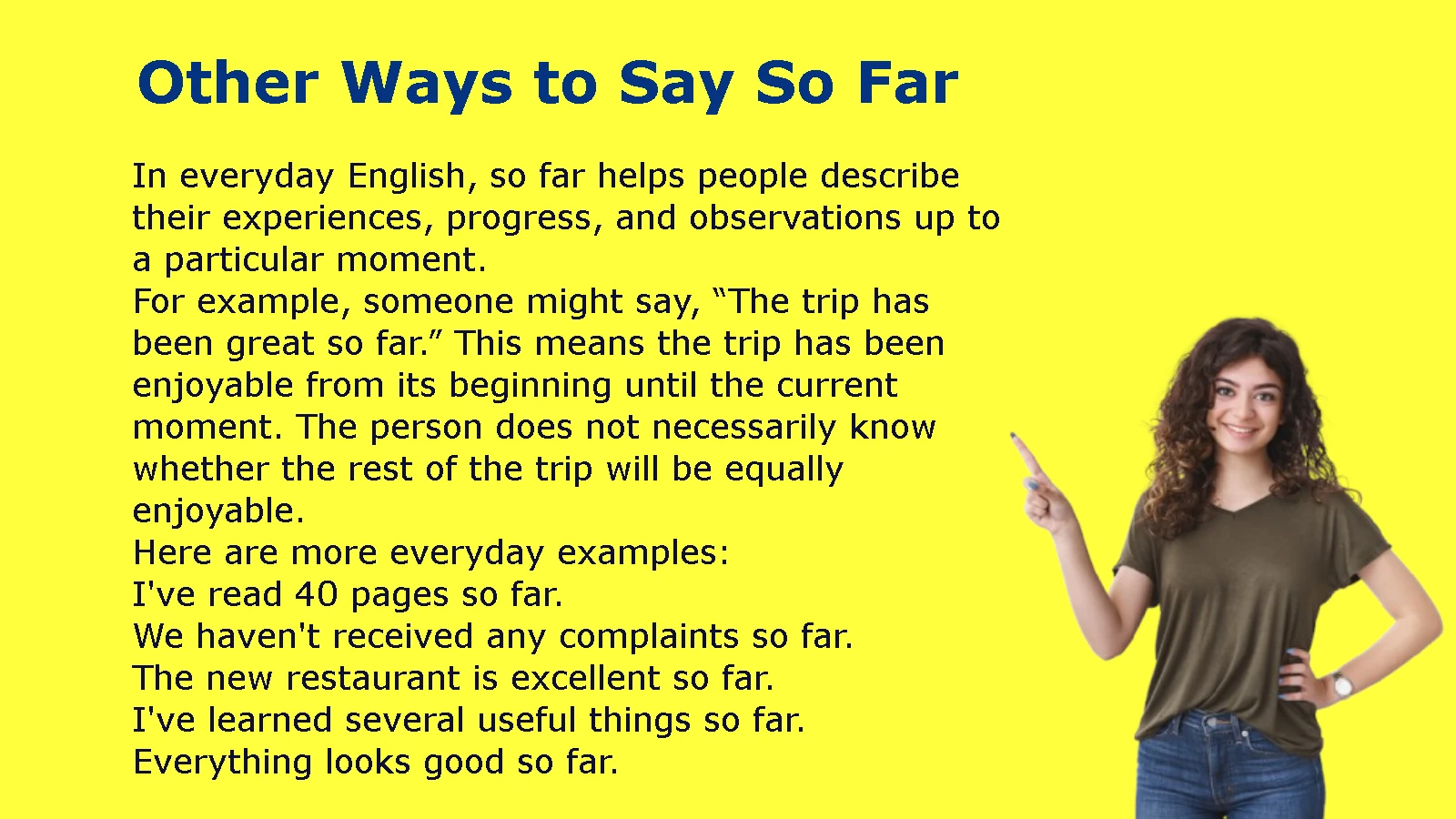
In everyday English, so far helps people describe their experiences, progress, and observations up to a particular moment.
For example, someone might say, “The trip has been great so far.” This means the trip has been enjoyable from its beginning until the current moment. The person does not necessarily know whether the rest of the trip will be equally enjoyable.
Here are more everyday examples:
- I’ve read 40 pages so far.
- We haven’t received any complaints so far.
- The new restaurant is excellent so far.
- I’ve learned several useful things so far.
- Everything looks good so far.
The phrase also appears in questions:
- How many assignments have you completed so far?
- What do you think of the new job so far?
- Have you made any progress so far?
These questions invite someone to describe developments up to the present.
How to Use So Far in a Sentence
You can place so far at the beginning or end of a sentence. Its position depends on emphasis and sentence structure.
At the beginning:
- So far, the project has stayed within budget.
- So far, we haven’t identified any major problems.
- So far, the students have performed well.
At the end:
- We have completed four tasks so far.
- The treatment has worked well so far.
- I’ve enjoyed working with the team so far.
In questions:
- How much money have you saved so far?
- What have you learned so far?
- How many people have responded so far?
The present perfect tense often appears with “so far” because it connects completed or ongoing developments with the present.
For example:
- Correct: I have completed five lessons so far.
- Less natural for this meaning: I completed five lessons so far.
The second sentence may work in certain contexts, but the present perfect usually provides the clearest construction when the period continues to the present.
Is So Far Formal or Informal?
So far is suitable for both formal and informal English. However, some alternatives sound more polished in academic papers, research reports, and professional documents.
For example:
| Expression | Tone | Best context |
| So far | Neutral | Everyday and general writing |
| Thus far | Formal | Academic and professional writing |
| To date | Formal | Reports and research |
| Until now | Neutral | General communication |
| Up to this point | Neutral | Explanations and discussions |
| As of this writing | Formal | Articles and research reports |
You do not need to avoid “so far” in formal writing. The expression is grammatically correct and widely understood. However, choosing a more specific alternative can improve the tone and precision of your writing.
So Far vs. Thus Far: What’s the Difference?
So far and thus far communicate almost the same meaning: up to the present time or stage. The main difference involves tone. “So far” sounds more conversational and neutral, while “thus far” generally sounds more formal and traditional.
Compare these sentences:
- So far, the experiment has produced positive results.
- Thus far, the experiment has produced positive results.
Both sentences communicate the same information. The second simply has a more formal tone.
Use “so far” in everyday conversations and general communication. Choose “thus far” when you want a slightly more formal style.
35+ Other Ways to Say So Far
The best synonyms for so far include thus far, until now, up to now, to date, and up until this point. However, these alternatives do not always fit every situation. Some describe time, others emphasize progress, and a few work better in academic or professional communication.
The following expressions offer different ways to communicate the same general idea.
Common Synonyms for So Far
These alternatives work in most everyday situations. They are useful when you want to avoid repeating “so far” while keeping your meaning clear.
| Synonym | Meaning | Example |
| Thus far | Up to the present | Thus far, the plan has worked. |
| Until now | Up to this moment | Until now, nobody has complained. |
| Up to now | From the past to the present | Up to now, we’ve received 20 orders. |
| To date | Up to the current date | To date, the company has hired 15 employees. |
| Up until this point | Through the present stage | Up until this point, everything has gone well. |
| As of now | At the present moment | As of now, we have no further updates. |
| As yet | Until the present time | No decision has been made as yet. |
| At this point | At the current stage | At this point, we need more information. |
| Up till now | Until the present | Up till now, the results have been positive. |
| To this point | Up to the current stage | To this point, the investigation has revealed little. |
Example in context:
Original: We have completed 60% of the project so far.
Alternative versions:
- We have completed 60% of the project to date.
- We have completed 60% of the project up to this point.
- We have completed 60% of the project thus far.
- We have completed 60% of the project until now.
The first three sound natural in project updates. The last one is understandable, although “until now” can sometimes suggest a change or interruption, so it is not always the best replacement.
Formal and Professional Alternatives to So Far
Professional writing often benefits from expressions that identify a specific stage, achievement, or period.
Here are some useful options:
| Formal alternative | Best use | Example |
| To date | Progress reports | To date, we have completed the initial assessment. |
| Thus far | Research findings | Thus far, the findings support our hypothesis. |
| Up to the present | Formal explanations | Up to the present, no major changes have occurred. |
| As of this writing | Articles and reports | As of this writing, the investigation remains ongoing. |
| To this stage | Project updates | To this stage, the team has met its targets. |
| At the current stage | Business communication | At the current stage, additional testing is required. |
| In the period elapsed | Formal analysis | In the period elapsed, performance has improved. |
Some expressions work better than others depending on the sentence.
For example, “to date” is particularly useful when reporting measurable achievements. “Thus far” works well when discussing research findings or developments. “As of this writing” establishes the date or point at which an observation was accurate.
Avoid using overly complicated alternatives simply to make your writing sound academic. Clear language usually communicates expertise more effectively.
Casual and Conversational Alternatives to So Far
When speaking with friends, colleagues, or family members, you can use relaxed alternatives.
- Up till now: Up till now, everything has been fine.
- Until this moment: Until this moment, I hadn’t noticed anything unusual.
- Up to this point: Up to this point, we’ve had a great time.
- At the moment: At the moment, things are going well.
- As things stand: As things stand, we’re on schedule.
- So far, so good: The new system is working well so far.
- For now: For now, everything seems to be working.
Notice that “at the moment” and “for now” do not always mean exactly the same thing as “so far.” They describe the current situation rather than necessarily summarizing everything that has happened since the beginning.
Use them when the context supports that meaning.
Short and Concise Alternatives to So Far
Sometimes a shorter expression makes a sentence easier to read.
| Alternative | Meaning | Example |
| Yet | Up to the present, usually in questions or negatives | We haven’t received a response yet. |
| Currently | At the present time | We currently have 12 active projects. |
| Presently | At or around the present time | The system is presently undergoing testing. |
| Hitherto | Until now; formal or literary | Hitherto, the method had remained effective. |
| To date | Up to the current date | To date, sales have increased. |
Be careful with “yet.” It often appears in negative sentences and questions, so it cannot replace “so far” in every positive statement.
For instance:
- Natural: We haven’t finished the report yet.
- Natural: We have completed three sections so far.
- Less natural: We have completed three sections yet.
Likewise, “hitherto” is relatively uncommon in everyday English. It may sound appropriate in historical, legal, or highly formal writing, but “thus far” is often a more accessible choice.
Academic Synonyms for So Far
Academic synonyms for so far include thus far, to date, up to this point, as of this writing, and to the present. These expressions help researchers and students discuss findings, explain research progress, and describe developments without relying on conversational wording.
The best choice depends on what you want to communicate. A research paper discussing accumulated evidence may benefit from “to date,” while a discussion of an ongoing experiment may use “thus far.”
Formal Alternatives for Academic Writing
Here are some of the most useful academic alternatives:
| Academic synonym | Meaning and usage | Example |
| Thus far | Up to the current stage | Thus far, the evidence supports the proposed theory. |
| To date | Up to the present date | To date, researchers have identified three major patterns. |
| Up to this point | Through the current stage | Up to this point, the analysis has produced consistent results. |
| To the present | Continuing until now | To the present, the issue remains unresolved. |
| As of this writing | At the time the paper was written | As of this writing, no additional findings have emerged. |
| Hitherto | Until now | Hitherto, the model had not been tested under these conditions. |
| At this stage | At the current point in a process | At this stage, further investigation is necessary. |
A useful academic writing tip: Choose an alternative that identifies the type of information you are presenting.
- Use to date for accumulated research, publications, and documented results.
- Use thus far for ongoing investigations and developing arguments.
- Use up to this point when discussing the progression of an explanation.
- Use as of this writing when the accuracy of information depends on the date of publication.
- Use hitherto when a formal or historical tone genuinely suits the subject.
How to Replace So Far in Research Papers
Academic writing often describes research that has not reached its final stage. You might discuss the evidence collected, the studies published, or the limitations discovered during an investigation.
Replacing “so far” with a more precise expression can make these discussions clearer.
Consider these examples:
| Original sentence | Academic alternative |
| We have found three possible explanations so far. | Thus far, we have identified three possible explanations. |
| Researchers have published several studies so far. | Researchers have published several studies to date. |
| The evidence has been limited so far. | Up to this point, the available evidence has remained limited. |
| No clear relationship has emerged so far. | To date, no clear relationship has emerged. |
| We have examined five different theories so far. | We have examined five different theories thus far. |
The replacement should preserve the original meaning. For instance, “to date” works naturally when discussing publications or research output. “At this stage” is better when explaining what researchers should do next.
Academic Examples Using Thus Far and To Date
The following original examples demonstrate how these expressions work in different academic contexts.
Research papers:
- Thus far, the collected data indicate a positive relationship between the two variables.
- To date, researchers have examined the effects of this intervention in three major populations.
- Up to this point, the study has identified several limitations in the existing methodology.
Literature reviews:
- To date, relatively few studies have investigated this particular relationship.
- Thus far, published research has focused primarily on short-term outcomes.
- The available literature has provided limited evidence up to this point.
Classroom discussions:
- Thus far, the students have demonstrated a strong understanding of the topic.
- Up to this point, the lesson has covered the fundamental principles of grammar.
- The class has completed four units to date.
These alternatives allow you to communicate research progress without making every paragraph sound repetitive.
Which Academic Synonym Sounds Most Natural?
Thus far and to date are generally the strongest choices for academic writing.
However, the most natural option depends on your sentence.
- Research findings: Thus far, the findings support the hypothesis.
- Published research: To date, 25 relevant studies have been identified.
- A developing argument: Up to this point, the discussion has focused on economic factors.
- Current research limitations: At this stage, additional evidence is required.
Avoid replacing every instance of “so far” with “thus far.” Repetition can make academic writing sound mechanical. Vary your vocabulary according to the meaning of each sentence.
Professional Ways to Say Work Done So Far
Professional alternatives to work done so far include work completed to date, progress made to date, achievements so far, completed tasks, and work accomplished up to this point. These expressions are useful in project reports, business emails, performance reviews, and workplace meetings.
The right expression should tell readers whether you are describing completed tasks, measurable achievements, ongoing progress, or outstanding responsibilities.
Alternatives for Describing Project Progress
When discussing a project, “so far” can refer to several different things:
- Tasks already completed.
- Milestones achieved.
- Progress toward a deadline.
- Problems identified.
- Work that remains unfinished.
Here are professional alternatives for each situation:
| Professional expression | When to use it | Example |
| Progress made to date | General project progress | The progress made to date has been encouraging. |
| Work completed to date | Finished tasks | The work completed to date includes the initial assessment. |
| Current project status | Overall project condition | The current project status is on schedule. |
| Achievements to date | Measurable accomplishments | Our achievements to date include three successful launches. |
| Completed milestones | Finished project stages | We have reached all completed milestones within the expected timeframe. |
| Work accomplished so far | General completed work | The work accomplished so far meets our initial objectives. |
| Current progress | Present development | Current progress indicates that we can meet the deadline. |
These phrases are particularly useful when communicating with managers, clients, stakeholders, and team members.
Professional Expressions for Completed Work
Sometimes, you want to emphasize what a team has already accomplished rather than simply describe its current status.
In that situation, use expressions such as:
- Tasks completed: We have finished all priority tasks.
- Deliverables submitted: All requested deliverables have been submitted to date.
- Milestones achieved: The team has achieved four major milestones.
- Work finalized: The initial documentation has been finalized.
- Completed activities: The completed activities include testing, review, and implementation.
- Accomplishments to date: Our accomplishments to date reflect consistent progress.
Each expression communicates a slightly different idea.
For example, “tasks completed” refers to finished assignments, while “milestones achieved” highlights important stages in a larger project.
Ways to Say Progress Made So Far in Business Reports
Business reports require language that communicates progress clearly and objectively.
Instead of writing:
“We have done a lot of work so far.”
You could write:
“Our team has completed the initial research, finalized the project requirements, and finished the first testing phase.”
The second version provides measurable information. It tells the reader exactly what has happened.
Consider these additional examples:
| General wording | More professional wording |
| We have done a lot so far. | We have made substantial progress to date. |
| This is what we have finished so far. | The following tasks have been completed to date. |
| We are doing well so far. | The project remains on track at this stage. |
| We haven’t done much so far. | Several planned activities remain outstanding. |
| Here is our work so far. | Here is an overview of the work completed to date. |
| Things are going well so far. | Current performance remains consistent with our objectives. |
Practical recommendation: When writing a professional progress report, follow a simple three-part structure:
- Completed work: Explain what the team has finished.
- Current progress: Describe what is happening now.
- Remaining work: Identify outstanding tasks and upcoming milestones.
This approach gives readers a complete picture rather than a vague statement about progress.
Examples for Emails, Meetings, and Workplace Updates
Your choice of wording may also depend on the communication channel.
In a professional email:
Original: Here is what we have done so far.
Improved: Here is an overview of the work completed to date.
In a project meeting:
Original: We have made good progress so far.
Improved: We have met our initial milestones and remain on schedule.
In a client update:
Original: Everything has gone well so far.
Improved: All completed project stages have met the agreed requirements.
In a performance review:
Original: These are my achievements so far.
Improved: These are my key accomplishments during the review period.
In a team message:
Original: This is our progress so far.
Improved: Here is our current progress and the remaining work.
So Far Meaning and Examples in Sentences
So far describes developments, experiences, or actions that extend from the beginning of a period to the present. It commonly appears in the present perfect tense, although it can also appear in other sentence structures when the context supports them.
These examples show how to use the expression naturally.
So Far in Everyday Conversations
- I’ve enjoyed every part of the vacation so far.
- We haven’t experienced any problems so far.
- The new movie has been interesting so far.
- I’ve met several friendly people so far.
- Everything has gone according to plan so far.
In these examples, “so far” describes an experience that remains ongoing.
So Far in Academic Writing
- The available research has produced encouraging results so far.
- We have examined several explanations so far.
- The collected evidence has supported the original argument so far.
- Researchers have identified two major limitations so far.
- The study has revealed a consistent pattern so far.
For a more formal tone, you can replace the expression with “thus far” or “to date” where appropriate.
So Far in Professional Communication
- The marketing team has completed three campaigns so far.
- We have received positive feedback from clients so far.
- The department has reduced operating costs so far.
- Our team has reached two important milestones so far.
- The project has remained within budget so far.
These sentences work in reports, presentations, and workplace conversations.
So Far When Describing Progress
- I’ve completed six chapters so far.
- We have finished most of the initial planning so far.
- The development team has resolved 12 technical issues so far.
- She has completed three training modules so far.
- The company has opened four new locations so far.
Notice how each sentence includes a measurable achievement. This makes “so far” more informative.
So Far When Talking About Experiences
- This has been the best year of my career so far.
- I’ve never experienced anything like this so far.
- The journey has been more enjoyable than I expected so far.
- We’ve learned several valuable lessons so far.
- This is the most challenging assignment I’ve received so far.
Writing tip: When comparing experiences, “so far” often indicates that the speaker’s experience is still developing. It leaves room for future events to change the overall assessment.
Thus Far Meaning and How to Use It
Thus far means up to the present time, moment, or stage of a particular activity. It is a formal alternative to “so far” and commonly appears in academic papers, professional reports, formal discussions, and written explanations.
For example, “Thus far, the investigation has uncovered no significant evidence” means the investigation has not found significant evidence up to the current point.
The expression combines “thus,” meaning in this way or to this extent, with “far,” which helps convey the extent of progress or time.
What Does Thus Far Mean?
The phrase thus far communicates that something has happened or remained true from an earlier point until now.
It can describe:
- Research progress: Thus far, the findings have supported the original hypothesis.
- Business developments: Thus far, the company has achieved its quarterly targets.
- Personal experiences: Thus far, the experience has exceeded my expectations.
- Ongoing investigations: Thus far, investigators have found no evidence of misconduct.
- Learning progress: Thus far, students have completed four lessons.
The expression does not necessarily mean that an activity has finished. It simply describes the situation at the current stage.
Is Thus Far More Formal Than So Far?
Yes. Thus far generally sounds more formal than so far, although both expressions have the same basic meaning.
Writers often choose “thus far” when discussing research, evidence, formal arguments, and professional developments.
Compare the following examples:
| So far | Thus far |
| We have completed three stages so far. | We have completed three stages thus far. |
| The results look promising so far. | The results look promising thus far. |
| No problems have appeared so far. | No problems have appeared thus far. |
| The research has produced useful findings so far. | The research has produced useful findings thus far. |
Both versions are grammatically correct.
However, “thus far” may sound unnecessarily formal in a casual conversation. If you’re speaking with friends or sending a quick message, “so far” is usually the more natural choice.
Thus Far in a Sentence: 10 Examples
Here are ten original sentences demonstrating how to use “thus far” in different contexts.
- Thus far, the research has confirmed several important assumptions.
- The company has maintained steady growth thus far.
- Thus far, no significant errors have appeared in the system.
- The students have completed five assignments thus far.
- Our investigation has revealed no additional information thus far.
- The project has remained within its allocated budget thus far.
- Thus far, the evidence has failed to establish a clear connection.
- The treatment has produced encouraging results thus far.
- We have received 35 applications thus far.
- The negotiations have progressed smoothly thus far.
These examples show that the expression works with research, business, education, investigations, and general observations.
Thus Far vs. So Far vs. To Date
Although these expressions overlap, they have slightly different tones and practical uses.
| Expression | Main emphasis | Tone | Example |
| So far | Progress or experience up to now | Neutral | We have completed two stages so far. |
| Thus far | Developments up to the current stage | Formal | Thus far, the evidence remains consistent. |
| To date | Accumulated progress or results | Formal and professional | To date, we have completed 20 projects. |
Here is a useful way to remember the differences:
- Choose so far for everyday communication.
- Choose thus far for formal explanations and academic discussions.
- Choose to date for measurable achievements, records, and accumulated results.
When Should You Use Thus Far?
Use “thus far” when you want to communicate progress or developments in a formal tone.
It works particularly well in:
Academic research: Thus far, the literature has identified several limitations.
Business reports: Thus far, the department has achieved its operational objectives.
Formal presentations: Thus far, our analysis has focused on three major factors.
News and analytical writing: Thus far, the investigation has not produced a definitive answer.
Avoid using it simply to make a sentence sound sophisticated. The goal is clear communication, not complicated vocabulary.
What Is Another Word for So Far Away?
Synonyms for so far away include distant, remote, far-off, far removed, a long way away, and out of reach. These expressions describe physical or figurative distance rather than the passage of time.
This distinction matters because “so far” and “so far away” can have different meanings.
For example:
- So far, we have completed three assignments. (Progress)
- The airport is so far away. (Distance)
You should choose distance-related alternatives when describing locations, objects, people, or situations that seem physically or figuratively distant.
Synonyms for So Far Away
| Synonym | Meaning | Example |
| Distant | Far from a particular place | The distant village is surrounded by mountains. |
| Remote | Far from populated areas | They live in a remote location. |
| Far-off | Located at a considerable distance | We could see a far-off mountain range. |
| A long way away | At a great distance | The nearest town is a long way away. |
| Far removed | Separated physically or conceptually | His current lifestyle is far removed from his childhood. |
| Out of reach | Too distant or inaccessible | The island seemed out of reach. |
| Far-flung | Spread across distant locations | The organization operates in far-flung regions. |
| Isolated | Separated from other places or people | They settled in an isolated community. |
| Remote from | Distant from something | The property is remote from the city center. |
| Miles away | At a considerable distance | Their house is miles away from ours. |
Formal Alternatives for Describing Distance
When describing geographical locations or physical separation in formal writing, consider these alternatives:
- Geographically distant: The research station is geographically distant from the main campus.
- Located remotely: The facility is located remotely from major population centers.
- Far removed from: The region is far removed from the country’s commercial districts.
- At a considerable distance: The settlement lies at a considerable distance from the nearest highway.
- Widely separated: The two research facilities are widely separated.
These expressions work in travel writing, geographical descriptions, academic discussions, and professional reports.
Casual Expressions for Something Far Away
Everyday English offers several natural ways to describe distance.
- A long way off
- Miles away
- Way out there
- Far away from here
- Quite a distance away
- On the other side of town
- Out in the middle of nowhere
Examples:
- Their new house is a long way off.
- The shopping center is miles away from here.
- We could see the lights of a distant city.
- That restaurant is quite a distance away.
- My grandparents live way out there.
Choose the expression that matches the situation. “In the middle of nowhere” suggests isolation, while “miles away” simply emphasizes distance.
Examples of So Far Away in Sentences
Here are additional examples showing how distance-related alternatives work:
- The nearest hospital is quite a distance away.
- Their vacation home is located in a remote mountain village.
- The destination seemed far-off when we first started traveling.
- Her new office is far removed from the city center.
- The island is geographically distant from the mainland.
- We could barely see the far-flung coastline.
- The nearest gas station is miles away.
- The village remains isolated from major transportation routes.
Important distinction: Do not use “distant” or “remote” as replacements for “so far” when discussing time or progress. These words describe separation, not how much of an activity has happened.
What Are the Antonyms of So Far?
The antonyms of so far depend on its intended meaning. When discussing time, expressions such as from now on, going forward, henceforth, and in the future describe what happens after the present. When discussing distance, alternatives such as “nearby” and “close” express the opposite idea.
There is no single universal antonym because “so far” has more than one meaning.
Opposite Expressions for Time
These expressions shift the focus from past-to-present developments toward future events.
| Antonym or contrasting expression | Meaning | Example |
| From now on | Beginning at the present moment | From now on, we will submit weekly reports. |
| Going forward | In the future | Going forward, the team will follow a new process. |
| Henceforth | From this point onward | Henceforth, all applications must be submitted online. |
| In the future | At a later time | In the future, we may introduce additional services. |
| Starting now | Beginning immediately | Starting now, we will monitor performance daily. |
| Hereafter | From this time onward | Hereafter, the revised rules will apply. |
These expressions are useful when explaining new decisions, future responsibilities, or changes in a process.
Example comparison:
- So far, employees have worked remotely.
- From now on, employees will follow a hybrid schedule.
The first sentence describes an arrangement that has existed up to the present. The second introduces what will happen next.
Opposite Expressions for Distance
When “so far” describes physical distance, use words that communicate closeness.
| Opposite expression | Meaning | Example |
| Nearby | Not far away | The pharmacy is nearby. |
| Close | A short distance away | The school is close to our house. |
| Within reach | Near enough to access | The destination is within reach. |
| Adjacent | Directly next to something | The parking lot is adjacent to the building. |
| Close by | At a nearby location | There is a supermarket close by. |
| A short distance away | Not far from a location | The station is a short distance away. |
For example:
- The airport is so far away.
- The airport is relatively close.
The second sentence communicates the opposite distance relationship.
Opposite Expressions for Progress and Completion
When someone uses “so far” to describe completed work, the contrasting language often focuses on unfinished responsibilities.
Useful expressions include:
- Not yet: The final report has not been completed yet.
- Still pending: Three project approvals are still pending.
- Yet to be completed: Two major tasks are yet to be completed.
- Outstanding tasks: The team still has four outstanding tasks.
- Remaining work: The remaining work includes testing and documentation.
- Unfinished: Several sections remain unfinished.
Consider this example:
“So far, we have completed eight out of ten tasks.”
A contrasting sentence could be:
“Two tasks are still pending.”
The second sentence shifts attention from completed progress to unfinished work.
Examples of So Far Antonyms in Sentences
- So far, the company has operated locally. Going forward, it plans to expand internationally.
- We have followed the original schedule until now. From now on, we will use an updated timeline.
- The restaurant is so far away. The alternative location is nearby.
- Most assignments have been completed to date. Three remain outstanding.
- The old policy applied until now. Henceforth, the revised policy will take effect.
Remember that these are contextual opposites rather than exact dictionary antonyms. Select the expression according to whether you are discussing time, distance, or progress.
How to Choose the Best Synonym for So Far
Choosing the best synonym for so far depends on your audience, writing style, and intended meaning. An expression that sounds natural in a casual conversation may feel too informal in a research paper. Similarly, a formal alternative may make a simple email unnecessarily complicated.
Use the following guidelines to select the most appropriate expression.
For Academic Essays and Research Papers
Academic writing benefits from precise language that communicates findings, developments, and research progress.
Consider these alternatives:
- Thus far: For discussing findings and ongoing research.
- To date: For describing published studies and accumulated evidence.
- Up to this point: For explaining the development of an argument.
- At this stage: For identifying the current phase of research.
- Hitherto: For formal or historical discussions.
Example:
Instead of writing, “Researchers have identified several limitations so far,” write:
“Researchers have identified several limitations to date.”
For Business Emails and Project Reports
Professional communication should emphasize completed tasks, measurable progress, and upcoming responsibilities.
Use these alternatives:
- Work completed to date
- Progress made so far
- Achievements to date
- Current project status
- Completed milestones
- Work accomplished up to this point
Example:
Instead of writing, “Here is what we have completed so far,” write:
“Here is an overview of the work completed to date.”
This version sounds more polished and gives the reader a clear indication of what the document contains.
For Casual Conversations
Everyday communication does not require complicated vocabulary. Choose simple expressions that people naturally use when speaking.
Good options include:
- Until now
- Up to now
- Up till now
- Up to this point
- So far, so good
Example:
“So far, I’ve enjoyed the new job.”
Alternative:
“Up to now, I’ve really enjoyed the new job.”
Both sound natural in everyday English.
For Describing Distance
When talking about geographical locations, physical separation, or figurative distance, choose expressions such as:
- Distant
- Remote
- Far-off
- Miles away
- A long way away
- Far removed
Example:
“The nearest airport is so far away.”
Alternative:
“The nearest airport is a considerable distance from here.”
The second version is more suitable for formal descriptions.
For Discussing Progress and Achievements
When reporting accomplishments, focus on the actual work rather than using a general expression.
| Intended meaning | Best alternative |
| Completed assignments | Tasks completed to date |
| General development | Progress made so far |
| Business achievements | Achievements to date |
| Current project condition | Current project status |
| Research findings | Findings thus far |
| Unfinished responsibilities | Outstanding tasks |
| Future developments | Going forward |
A useful writing principle is to replace vague progress statements with specific information.
For example:
“We have made good progress so far.”
A more informative version would be:
“We have completed the initial research, approved the project requirements, and finished the first testing phase.”
The second sentence gives readers concrete information instead of asking them to interpret what “good progress” means.
Frequently Asked Questions About So Far
What Is the Best Synonym for So Far?
The best synonyms for so far include thus far, until now, up to now, to date, and up to this point. “Thus far” works well in formal writing, while “until now” and “up to now” sound natural in everyday communication. Choose the expression that fits your sentence.
What Is a More Academic Way to Say So Far?
Thus far and to date are two excellent academic alternatives. Use “thus far” when discussing research findings or developments. Choose “to date” when describing accumulated studies, published evidence, or measurable research progress.
Does Thus Far Mean the Same as So Far?
Yes. Thus far and so far generally mean up to the present time or current stage. However, “thus far” sounds more formal, while “so far” is more common in everyday English. Both expressions work in academic and professional writing when used appropriately.
Is So Far Formal or Informal?
“So far” is a neutral expression that works in both formal and informal communication. You can use it in emails, conversations, reports, and general writing. However, alternatives such as “thus far” and “to date” may sound more polished in academic papers and professional documents.
What Is Another Way to Say Work Done So Far?
Professional alternatives include work completed to date, progress made to date, achievements so far, completed tasks, and work accomplished up to this point. “Work completed to date” is particularly useful in project reports, while “achievements to date” emphasizes measurable accomplishments.
What Is the Opposite of So Far?
The opposite depends on the context. For time, use expressions such as from now on, going forward, henceforth, and in the future. For physical distance, use “nearby,” “close,” or “within reach.” When discussing incomplete work, use “pending” or “yet to be completed.”
Conclusion: Choose the Right Alternative to So Far
The best alternative to so far depends on what you want to communicate. Expressions such as thus far, until now, up to this point, and to date work well when discussing time and progress. Academic writers often prefer formal alternatives, while professionals benefit from expressions such as “work completed to date” and “progress made so far.”
When describing distance, choose words such as “distant,” “remote,” or “far-off.” When discussing future developments, use “going forward” or “henceforth.”
Before replacing “so far,” consider three things:
- Meaning: Are you discussing time, distance, experience, or progress?
- Audience: Are you writing for an academic, professional, or general audience?
- Tone: Should your sentence sound conversational, neutral, or formal?
The most effective writing does not rely on complicated vocabulary. It uses the right expression in the right context.
Next step: Review your sentence, identify what “so far” communicates, and select an alternative that preserves your intended meaning while making your writing clearer and more natural.