Other ways to say think outside the box include think creatively, think differently, break the mold, challenge conventional thinking, explore new possibilities, and approach things from a different perspective. These expressions describe creative thinking, innovative problem-solving, and unconventional ideas that go beyond familiar methods. Whether you’re writing a professional email, participating in a brainstorming session, or encouraging someone to find a fresh solution, the right alternative can make your message more precise and engaging.
Thinking outside the box involves more than simply having unusual ideas. It means questioning assumptions, practicing lateral thinking, exploring different perspectives, and finding original ways to solve problems. Some expressions work better in business communication, while others suit casual conversations, academic writing, and creative projects.
| Question | Answer |
| What is another way to say think outside the box? | Think creatively, think differently, break the mold, or challenge conventional thinking. |
| What does think outside the box mean? | It means approaching a situation with original ideas instead of relying on traditional methods. |
| What is a professional way to say think outside the box? | Use innovative thinking, explore alternative approaches, or challenge established practices. |
| Is lateral thinking the same as thinking outside the box? | They are closely related, but lateral thinking is a specific approach to solving problems through indirect ideas. |
| What is a synonym for creative thinking? | Imaginative thinking, innovative thinking, original thinking, and divergent thinking. |
What Does Think Outside the Box Mean?
Thinking outside the box means approaching a problem, situation, or challenge in an unconventional way. Instead of relying on familiar methods, you question existing assumptions and consider possibilities that others might overlook. The expression describes creativity, open-mindedness, and the ability to develop original solutions.
For example, a company struggling with declining sales might lower its prices to attract customers. However, an employee who suggests offering personalized products or creating a subscription service is thinking outside the box.
The idea is simple: don’t limit yourself to the solutions that everyone already knows.
Think Outside the Box Meaning in Simple Words
In simple terms, thinking outside the box means thinking differently to discover better or more interesting solutions.
Imagine that you need to cross a river, but the usual bridge is closed. Rather than waiting for it to reopen, you consider other possibilities, such as finding another crossing point or arranging a boat.
You aren’t following the usual approach. You’re looking for a different way to achieve the same goal.
The expression often describes people who:
- Question traditional methods.
- Generate original ideas.
- Consider unusual possibilities.
- Find creative solutions to difficult problems.
- Look at situations from different perspectives.
- Challenge assumptions that others accept without question.
Thinking outside the box doesn’t mean rejecting every traditional method. Sometimes the established approach works perfectly well. The goal is to recognize when another option might produce a better result.
Origin and History of the Expression
The expression “think outside the box” became widely associated with creative problem-solving during the twentieth century.
It is often connected to the nine-dot puzzle, a classic brain teaser in which someone must connect nine dots arranged in a three-by-three grid using four straight lines without lifting the pen.
The puzzle challenges people to draw lines beyond the imaginary boundaries surrounding the dots. Many people initially assume that they must remain within the square arrangement, even though the instructions never impose that restriction.
This puzzle illustrates the central idea behind the expression: people sometimes create limitations in their minds that don’t actually exist.
The phrase later gained popularity in business, education, management, and professional development as organizations began emphasizing creativity and innovation.
Think Outside the Box Meaning and Example
The phrase can describe both a person’s approach to a challenge and the solution they develop.
Here are some practical examples:
- Workplace: Our manager encouraged the team to think outside the box when developing the new marketing campaign.
- Education: The teacher asked students to think outside the box instead of memorizing traditional answers.
- Business: The startup survived a difficult financial period by thinking outside the box and introducing a new service.
- Everyday life: We thought outside the box and turned an unused bedroom into a small home office.
- Technology: The development team thought outside the box and created a simpler way for customers to access the platform.
In each example, the expression highlights an alternative approach rather than a routine response.
What Does Thinking Outside of the Box Mean?
“Thinking outside the box” and “thinking outside of the box” have the same basic meaning.
The difference comes down to wording rather than meaning. Both expressions describe unconventional or creative thinking.
| Expression | Meaning | Usage |
| Thinking outside the box | Considering unconventional ideas | Common in American English |
| Thinking outside of the box | Considering unconventional ideas | Also correct and widely understood |
| Think outside the box | Give yourself permission to consider new approaches | Common as an instruction |
| Out-of-the-box thinking | A noun phrase describing unconventional thinking | Common in professional writing |
For example:
- The team needs to start thinking outside the box.
- The team needs to start thinking outside of the box.
Both sentences communicate the same idea. You can choose either version according to your writing style.
35+ Other Ways to Say Think Outside the Box
There are many alternatives to “think outside the box,” but not all of them communicate exactly the same idea. Some emphasize imagination, others highlight innovation, and a few encourage people to question established practices.
The following expressions offer useful alternatives for conversations, professional writing, presentations, and brainstorming sessions.
Think Creatively
Think creatively means using imagination and original ideas to approach a situation or solve a problem.
It’s one of the closest and most natural alternatives to think outside the box. You can use it in professional, educational, and everyday situations.
Example: Our design team needs to think creatively to develop a product that stands out from competing brands.
Think Differently
Think differently means considering an alternative perspective instead of automatically following familiar patterns.
This expression works especially well when you want someone to reconsider their assumptions.
Example: If we want better results, we need to think differently about how we serve our customers.
Break the Mold
Break the mold means doing something in a completely different way from what people traditionally expect.
It’s particularly useful when describing people, businesses, products, or creative projects that challenge established standards.
Example: The new restaurant broke the mold by introducing an unusual dining experience.
Challenge Conventional Thinking
Challenge conventional thinking means questioning commonly accepted ideas, practices, or beliefs.
This phrase sounds professional and analytical, making it suitable for business meetings, academic discussions, and strategic planning.
Example: Successful entrepreneurs often challenge conventional thinking when developing new business models.
Look at Things from a Different Perspective
This expression means examining a situation through another person’s viewpoint or considering an alternative interpretation.
It’s useful when a problem seems difficult because everyone involved approaches it in the same way.
Example: Before rejecting the proposal, try looking at things from a different perspective.
Take an Unconventional Approach
Take an unconventional approach means choosing a method that differs from established or traditional practices.
The expression works particularly well in professional and academic writing.
Example: The company took an unconventional approach to employee training by replacing long presentations with practical workshops.
Push the Boundaries
To push the boundaries means going beyond accepted limits, expectations, or traditional standards.
It often describes ambitious people who want to improve existing methods or explore new possibilities.
Example: The engineering team continues to push the boundaries of renewable energy technology.
Explore New Possibilities
This phrase means considering opportunities or solutions that haven’t been explored before.
It’s a positive, encouraging alternative that works well in brainstorming sessions and collaborative projects.
Example: Let’s explore new possibilities before deciding which marketing strategy to use.
Think Beyond Traditional Limits
Thinking beyond traditional limits means refusing to let established practices restrict your ideas.
It encourages people to consider whether existing rules and methods still serve their purpose.
Example: The architects thought beyond traditional limits when designing the environmentally friendly building.
Come Up with Fresh Ideas
This expression means developing new, original, or interesting suggestions.
It’s more conversational than many professional alternatives, making it suitable for everyday discussions and workplace brainstorming.
Example: We need to come up with fresh ideas to make our next advertising campaign more memorable.
Approach Things Differently
To approach things differently means changing your usual method or considering another way to achieve a particular result.
It’s a practical alternative when an existing strategy isn’t producing the desired outcome.
Example: Our current sales strategy isn’t working, so we should approach things differently.
Question the Status Quo
Question the status quo means examining existing conditions, traditions, or practices instead of accepting them automatically.
This phrase frequently appears in discussions about leadership, organizational improvement, and social change.
Example: Great leaders aren’t afraid to question the status quo when existing policies prevent progress.
Be Innovative
Being innovative means introducing new ideas, methods, or improvements that create value.
Unlike simply thinking differently, innovation often involves putting an idea into practice.
Example: The business needs to be innovative if it wants to remain competitive in a changing market.
Use Your Imagination
This expression encourages someone to use their creativity to consider possibilities beyond ordinary expectations.
It’s especially useful when speaking to children, students, designers, and creative professionals.
Example: Use your imagination to turn this empty space into something practical and beautiful.
Find an Unusual Solution
Finding an unusual solution means resolving a problem through an approach that people might not immediately consider.
The phrase works well when discussing complicated situations that require original thinking.
Example: The mechanic found an unusual solution that repaired the equipment without replacing its expensive components.
Break Away from Tradition
To break away from tradition means moving beyond established customs or methods and adopting a different approach.
It can describe changes in business, education, art, fashion, and personal decisions.
Example: The school decided to break away from tradition by introducing project-based learning.
Take a Fresh Look
Taking a fresh look means reconsidering something with an open mind instead of relying on previous judgments.
This expression is useful when reviewing an old project or reconsidering a decision.
Example: Let’s take a fresh look at the proposal and see whether we can improve its original design.
Think Beyond the Obvious
This phrase means considering possibilities that aren’t immediately apparent.
It’s particularly useful in research, problem-solving, and analytical discussions.
Example: Good investigators think beyond the obvious when examining complicated cases.
Be an Original Thinker
An original thinker develops ideas independently rather than simply repeating familiar opinions or following popular approaches.
This expression describes a person’s thinking ability rather than one specific action.
Example: Her ability to question assumptions makes her an original thinker in the research department.
Reimagine the Possibilities
To reimagine the possibilities means considering how something could work in a completely different or improved way.
It’s common in creative industries, product development, technology, and business strategy.
Example: The design team reimagined the possibilities of small living spaces by creating multifunctional furniture.
Look Beyond the Ordinary
This expression encourages people to recognize opportunities and ideas that go beyond everyday expectations.
It’s useful when discussing creativity, personal development, and artistic projects.
Example: The photographer looks beyond the ordinary and finds beauty in overlooked places.
Try a New Angle
Trying a new angle means examining a challenge from a different direction or using another method to solve it.
It’s a natural, conversational expression.
Example: We’ve tried the same solution several times, so let’s try a new angle.
Embrace Unconventional Ideas
To embrace unconventional ideas means being willing to consider suggestions that differ from familiar beliefs or practices.
This phrase works well in collaborative environments where people need to feel comfortable sharing unusual suggestions.
Example: The company encourages employees to embrace unconventional ideas during product development.
Develop an Inventive Approach
An inventive approach involves using imagination and practical thinking to develop an original method.
It is especially useful when describing technical solutions or creative work.
Example: The research team developed an inventive approach to reducing material waste.
Go Against the Grain
To go against the grain means acting or thinking differently from what most people expect or accept.
It often describes someone who doesn’t automatically follow popular opinions or established trends.
Example: The entrepreneur went against the grain by launching a product in a market that competitors had ignored.
Rethink the Problem
Rethinking a problem means examining its underlying causes and considering whether you’re asking the right question.
Sometimes the difficulty isn’t finding a solution. It’s understanding the problem correctly.
Example: Instead of hiring more employees, we should rethink the problem and examine why the current process takes so long.
Use Creative Problem-Solving
Creative problem-solving means combining imagination, reasoning, and experimentation to find effective solutions.
It emphasizes the process of solving a challenge rather than simply generating interesting ideas.
Example: The operations manager used creative problem-solving to reduce delivery delays without increasing the budget.
Think Outside Conventional Limits
This phrase encourages people to question restrictions that might prevent them from considering alternative possibilities.
It works in discussions about innovation, design, and organizational change.
Example: The product developers were encouraged to think outside conventional limits when designing the next generation of devices.
Discover New Approaches
Discovering new approaches means identifying alternative methods that could improve an existing process or solve a difficult challenge.
Example: The teachers worked together to discover new approaches to making science lessons more engaging.
Be Open to New Ideas
Being open to new ideas means listening to unfamiliar suggestions without immediately dismissing them.
It’s an important expression for teamwork, leadership, and collaboration.
Example: A successful project manager must be open to new ideas from every member of the team.
Connect Unrelated Ideas
Connecting unrelated ideas means combining concepts from different subjects or experiences to develop something original.
This technique often produces interesting results in design, advertising, research, and entrepreneurship.
Example: The designer connected ideas from architecture and nature to create a distinctive furniture collection.
Break Free from Old Patterns
Breaking free from old patterns means abandoning repetitive habits or methods that no longer produce useful results.
Example: The marketing department decided to break free from old patterns and experiment with interactive campaigns.
Take an Innovative Direction
Taking an innovative direction means choosing a new course of action that introduces improvements or fresh opportunities.
Example: The company took an innovative direction by replacing traditional customer support with a personalized digital service.
See Things in a New Light
Seeing something in a new light means developing a different understanding of a familiar situation.
This expression is particularly useful when new information changes your perspective.
Example: The customer interviews helped us see the product’s weaknesses in a new light.
Dare to Be Different
To dare to be different means having the confidence to make choices that don’t follow popular expectations.
It often describes people who value originality and aren’t afraid to experiment.
Example: The clothing brand encourages young designers to dare to be different.
Best Ways to Say Think Outside the Box in Different Situations
The best alternative depends on your audience, purpose, and communication style. A phrase that sounds natural during a brainstorming meeting might feel too casual in a formal business report.
Choose an expression that communicates your intended meaning without making your message unnecessarily complicated.
Professional Ways to Say Think Outside the Box
Professional communication benefits from clear expressions that demonstrate creativity and strategic thinking.
Consider these alternatives:
- Explore alternative approaches: Consider different methods before choosing a solution.
- Challenge conventional thinking: Question established ideas and assumptions.
- Develop innovative solutions: Create practical improvements or new methods.
- Consider different perspectives: Examine an issue from several viewpoints.
- Identify new opportunities: Recognize possibilities that others may overlook.
- Adopt a fresh perspective: Reconsider an existing situation with an open mind.
Example:
Instead of writing:
“We need employees who can think outside the box.”
You could write:
“We need employees who can challenge conventional thinking and develop innovative solutions.”
The second version communicates the desired abilities more clearly.
Business and Workplace Alternatives
In business communication, the expression often relates to innovation, efficiency, competition, and strategic planning.
Here are some useful alternatives:
| Alternative | Best business application |
| Develop innovative strategies | Business planning |
| Challenge existing processes | Operational improvement |
| Explore new opportunities | Market research |
| Rethink traditional methods | Organizational development |
| Find creative solutions | Project management |
| Introduce fresh perspectives | Team collaboration |
| Identify unconventional opportunities | Entrepreneurship |
Example: Rather than saying, “Our team must think outside the box,” a manager could say, “Let’s explore new strategies to improve customer retention.”
This gives employees a clearer direction.
Creative and Academic Alternatives
Creative and academic writing often requires expressions that describe imagination, originality, and intellectual exploration.
Useful alternatives include:
- Think imaginatively.
- Develop original ideas.
- Explore different interpretations.
- Apply divergent thinking.
- Consider unconventional possibilities.
- Challenge established theories.
- Experiment with new concepts.
Example: The researchers applied divergent thinking to explore alternative explanations for the experimental results.
Casual and Conversational Alternatives
In everyday conversations, simple expressions usually sound more natural than formal business terminology.
Try these:
- Think differently.
- Try something new.
- Look at it another way.
- Get creative.
- Come up with something fresh.
- Try a different approach.
- Don’t follow the usual path.
Example:
“Instead of ordering the same food again, let’s try something different tonight.”
This communicates the idea without sounding overly formal.
Positive and Encouraging Alternatives
When motivating someone, choose expressions that encourage experimentation without making the person feel criticized.
Some useful options include:
- Let your imagination run wild.
- Don’t be afraid to experiment.
- Explore every possibility.
- Give your ideas a chance.
- Be bold with your ideas.
- Look beyond the obvious.
- Don’t limit your creativity.
Example: Don’t worry about finding the perfect answer immediately. Let your imagination run wild and explore a few possibilities first.
Think Outside the Box Synonyms: Which Expression Should You Use?
Although many expressions can replace “think outside the box,” they don’t all describe the same type of thinking.
Understanding their differences helps you choose more accurate language.
Think Creatively vs. Think Differently
Both expressions encourage people to move beyond familiar ideas, but their emphasis differs.
Think creatively focuses on producing original or imaginative ideas. Think differently focuses on changing your perspective or considering another approach.
| Expression | Main emphasis | Example |
| Think creatively | Original ideas | Think creatively when designing the campaign. |
| Think differently | Alternative perspectives | Think differently about the problem. |
Use “think creatively” when you want someone to generate ideas. Choose “think differently” when you want them to reconsider their usual approach.
Lateral Thinking vs. Creative Thinking
Lateral thinking is a specific problem-solving approach that explores indirect possibilities.
Creative thinking is broader. It includes imagination, originality, experimentation, and the ability to generate new concepts.
For example, a designer might use creative thinking to imagine a new product. Lateral thinking could help identify an unexpected way to manufacture it.
Innovative Thinking vs. Unconventional Thinking
Innovative thinking focuses on developing new ideas or improvements that can create practical value.
Unconventional thinking focuses on considering methods or perspectives that differ from established practices.
A person can think unconventionally without developing a useful innovation. Innovation generally requires an idea that can produce a meaningful improvement.
Example:
- Innovative thinking: Developing a more efficient delivery system.
- Unconventional thinking: Suggesting that deliveries should use a completely different distribution method.
Critical Thinking vs. Out-of-the-Box Thinking
Critical thinking and out-of-the-box thinking are related, but they serve different purposes.
Out-of-the-box thinking involves considering original or unconventional possibilities.
For example, a business analyst might use critical thinking to identify why sales have declined and creative thinking to develop alternative solutions.
The two approaches work well together because original ideas still need careful evaluation.
Imaginative Thinking vs. Original Thinking
Imaginative thinking involves creating mental pictures, possibilities, or scenarios that may not currently exist.
Original thinking involves developing ideas that show independence and novelty.
An imaginative person might picture a completely different type of classroom. An original thinker might develop a practical teaching method that hasn’t been widely used.
What Is Lateral Thinking and How Does It Relate to Thinking Outside the Box?
Lateral thinking is a problem-solving approach that explores indirect, unconventional, or unexpected possibilities instead of following only familiar logical patterns. It encourages people to question assumptions, change perspectives, and make unusual connections. Thinking outside the box is a broader expression that includes lateral thinking and other forms of creative problem-solving.
Lateral Thinking Meaning
The term lateral thinking is associated with Edward de Bono, who developed the concept to describe an approach to thinking that moves beyond conventional patterns.
Traditional problem-solving often follows a direct path:
- Identify the problem.
- Examine available information.
- Follow a logical sequence.
- Select the most reasonable solution.
Lateral thinking introduces additional possibilities.
Instead of accepting the original assumptions, you might change the question, reverse the situation, or consider an unusual connection.
For example, imagine a restaurant has difficulty attracting customers during weekday afternoons.
A conventional response might involve reducing menu prices.
A lateral-thinking approach might suggest:
- Offering short cooking workshops.
- Turning the space into a coworking area.
- Hosting local community events.
- Creating an afternoon subscription for nearby offices.
These ideas approach the same problem from different directions.
Examples of Lateral Thinking in Everyday Life
Lateral thinking can help with everyday challenges that don’t have one obvious solution.
Example: Organizing a small room
Instead of purchasing a larger storage cabinet, you could use vertical shelves, multifunctional furniture, and hidden storage.
Example: Saving time while cooking
Rather than preparing every meal from scratch, you could prepare ingredients in advance and use them in several different recipes.
Example: Improving student participation
Instead of asking students to answer more questions, a teacher could introduce group challenges, demonstrations, or practical activities.
Each solution changes the approach rather than simply repeating the existing method.
Lateral Thinking vs. Creative Thinking
| Feature | Lateral thinking | Creative thinking |
| Main purpose | Find indirect solutions | Generate original ideas |
| Approach | Challenge assumptions and patterns | Use imagination and originality |
| Focus | Alternative problem-solving paths | New concepts and possibilities |
| Application | Difficult challenges | Art, business, education, and design |
| Relationship | A specific thinking approach | A broader creative process |
Lateral thinking is one way to practice creative thinking, but the terms aren’t interchangeable in every situation.
How to Use Lateral Thinking to Solve Problems
You can practice lateral thinking through a simple framework.
Step 1: Question the original problem
Ask whether you’re solving the actual problem or simply responding to its symptoms.
Step 2: Challenge assumptions
Identify the rules or beliefs you’re treating as permanent. Some might be unnecessary.
Step 3: Reverse the situation
Consider what would happen if you approached the challenge from the opposite direction.
Step 4: Make unusual connections
Borrow ideas from unrelated industries, experiences, or subjects.
Step 5: Test practical solutions
Choose promising ideas and evaluate whether they work in the real world.
This method helps turn unusual thoughts into useful solutions.
Creative Thinking Synonyms and Related Expressions
Creative thinking describes the ability to generate original ideas, recognize new possibilities, and develop interesting solutions. Several related expressions emphasize different aspects of this ability.
Imaginative Thinking
Imaginative thinking involves creating mental pictures, exploring possibilities, and considering situations beyond immediate experience.
Example: The children used imaginative thinking to design a fictional city with environmentally friendly buildings.
Innovative Thinking
Innovative thinking involves developing new ideas, methods, or improvements that offer practical value.
Example: Innovative thinking helped the company redesign its customer service process.
Original Thinking
Original thinking means developing ideas independently instead of simply repeating familiar opinions or established approaches.
Example: Her original thinking helped the research team identify a different explanation for the results.
Inventive Thinking
Inventive thinking emphasizes resourcefulness and the ability to develop clever solutions.
Example: Inventive thinking allowed the technician to repair the machine using available materials.
Divergent Thinking
Divergent thinking is the process of generating several possible answers or solutions to an open-ended question.
For example, if someone asks how to reuse an empty glass jar, divergent thinking might produce ideas such as:
- A flower vase.
- A storage container.
- A candle holder.
- A decorative lamp.
- A homemade pencil organizer.
The purpose is to explore many possibilities rather than settle on the first answer.
Visionary Thinking
Visionary thinking involves imagining future possibilities and developing ideas around long-term goals.
Example: The founder demonstrated visionary thinking by recognizing the potential of remote services before they became widely adopted.
Abstract Thinking
Abstract thinking involves considering concepts, patterns, relationships, and ideas that aren’t limited to concrete objects or immediate experiences.
Example: Abstract thinking helped the students understand how different economic systems influence society.
Another Word for Thinking: Related Words and Expressions
The word “thinking” has several alternatives, but the most suitable replacement depends on the intended meaning.
Sometimes it refers to reasoning. In other situations, it describes reflection, imagination, or careful consideration.
| Word | Meaning | Example |
| Reasoning | Using logic to reach a conclusion | Her reasoning helped resolve the disagreement. |
| Reflection | Carefully considering an experience or idea | A little reflection changed his decision. |
| Consideration | Thinking carefully about something | The proposal deserves further consideration. |
| Contemplation | Deep or thoughtful examination | He spent the afternoon in contemplation. |
| Analysis | Examining information in detail | Their analysis revealed several problems. |
| Imagination | Creating ideas or mental pictures | Imagination plays an important role in storytelling. |
| Brainstorming | Generating several ideas | The team started brainstorming new solutions. |
Reasoning
Reasoning involves using information, logic, and evidence to reach a conclusion.
Example: Clear reasoning helped the manager select the most effective strategy.
Reflection
Reflection means thinking carefully about something that happened or considering an idea in greater depth.
Example: After some reflection, she decided to change her career direction.
Consideration
Consideration means examining an option or situation before making a decision.
Example: The committee gave serious consideration to the alternative proposal.
Contemplation
Contemplation describes deep, often extended thought about an idea, situation, or question.
Example: The writer spent several hours in contemplation before completing the final chapter.
Analysis
Analysis involves breaking information into smaller parts to understand its meaning, structure, or significance.
Example: A detailed analysis of customer feedback revealed opportunities for improvement.
Imagination
Imagination allows people to picture possibilities that don’t currently exist or to develop new concepts.
Example: The architect used imagination to transform an ordinary building design into something distinctive.
Brainstorming
Brainstorming is a collaborative or individual technique for generating multiple ideas without immediately judging them.
Example: The marketing team organized a brainstorming session to develop a fresh advertising concept.
Examples of Thinking Outside the Box in Real-Life Situations
Thinking outside the box becomes easier to understand when you examine how people apply it in practical situations.
The following examples show how unconventional thinking can improve decisions, solve problems, and create opportunities.
Thinking Outside the Box in Business
Businesses often face challenges involving competition, customer satisfaction, expenses, and changing market conditions.
A company that relies only on familiar strategies may struggle when customer expectations change.
Example: A small clothing business
Imagine a small clothing store competing against large online retailers.
Instead of trying to compete entirely on price, the owner introduces personalized clothing recommendations, local designer collaborations, and custom fitting appointments.
This strategy creates a different customer experience.
The business isn’t simply selling clothing. It’s offering something that larger competitors might not provide as easily.
Practical lesson: Look for value that customers cannot easily find elsewhere.
Thinking Outside the Box in Education
Teachers can use creative thinking to make lessons more engaging and help students understand complicated subjects.
Example: Teaching mathematics
Instead of explaining every mathematical concept through textbook exercises, a teacher introduces a classroom activity involving shopping budgets.
Students calculate discounts, compare prices, and manage imaginary expenses.
This approach connects abstract mathematical ideas to everyday experiences.
Practical lesson: Change the learning method when the traditional approach doesn’t produce meaningful engagement.
Thinking Outside the Box in Everyday Life
Everyday challenges often require small adjustments rather than expensive or complicated solutions.
Example: Making better use of limited space
A family living in a small apartment might struggle with storage.
Instead of moving to a larger home, they introduce multifunctional furniture, wall-mounted shelves, and storage compartments beneath the beds.
The result is a more organized living space without increasing their expenses.
Practical lesson: Reconsider how you use existing resources before purchasing something new.
Thinking Outside the Box in Problem-Solving
Some problems continue because people repeatedly apply the same solution without investigating the underlying cause.
Example: Reducing workplace delays
A company notices that employees regularly miss project deadlines.
The initial response might be to increase working hours.
However, a closer examination reveals that employees spend too much time waiting for approvals.
The company simplifies its approval process and assigns decision-making authority to project leaders.
This improves efficiency without increasing working hours.
Practical lesson: Identify the actual source of a problem before selecting a solution.
Thinking Outside the Box in Creative Projects
Creative projects often benefit from combining ideas, techniques, and influences from different areas.
Example: Developing a unique advertising campaign
A marketing team wants to promote a new product.
Rather than creating another conventional advertisement, the team develops an interactive online challenge that encourages customers to participate and share their experiences.
The campaign creates engagement by making the audience part of the experience.
Practical lesson: Consider how different creative formats can work together to make an idea more memorable.
How to Think Outside the Box: 7 Practical Techniques
Thinking outside the box isn’t an ability reserved for artists, inventors, or entrepreneurs. You can develop it by changing how you approach everyday decisions and complicated challenges.
These techniques provide a practical starting point.
Question Your Existing Assumptions
Assumptions can restrict creativity because they make familiar methods seem like the only available options.
When facing a challenge, write down the beliefs influencing your decisions.
Then ask:
- Is this assumption actually true?
- Does the situation require this particular method?
- What would happen if I removed this limitation?
- Are there alternative ways to achieve the same result?
For example, a business owner might assume that increasing sales requires attracting more customers. However, improving repeat purchases could produce better results without increasing advertising expenses.
Look at Problems from Different Perspectives
A problem can look completely different depending on who experiences it.
Consider a delayed delivery. A customer might see poor service, while a warehouse employee might identify inventory problems and a manager might recognize inefficient scheduling.
Collecting these perspectives helps you understand the entire situation.
Try asking people with different responsibilities how they would approach the same challenge.
Brainstorm Without Judging Ideas
People often reject unusual suggestions before examining their potential.
Brainstorming works better when you temporarily separate idea generation from evaluation.
Try this simple exercise:
- Choose one clearly defined problem.
- Write down as many possible solutions as you can.
- Avoid judging ideas while generating them.
- Combine suggestions that share useful features.
- Evaluate the strongest options afterward.
The goal isn’t to implement every idea. It’s to explore more possibilities before making a decision.
Combine Unrelated Concepts
Some of the most interesting ideas emerge when people connect concepts from different subjects.
For example, a restaurant might borrow the subscription model used by digital services. A school might use elements of game design to improve student participation.
Ask yourself:
- What can this industry learn from another industry?
- Can two existing ideas work together?
- Is there a useful method that people in this field haven’t considered?
Combining unrelated concepts can reveal opportunities that conventional brainstorming might miss.
Learn from Different Industries
Exposure to different industries helps expand your understanding of how people solve problems.
A business owner might learn about customer loyalty from hospitality companies, workflow management from manufacturing, or communication strategies from education.
You don’t need to copy another industry’s methods exactly.
Instead, identify the underlying principle and adapt it to your own situation.
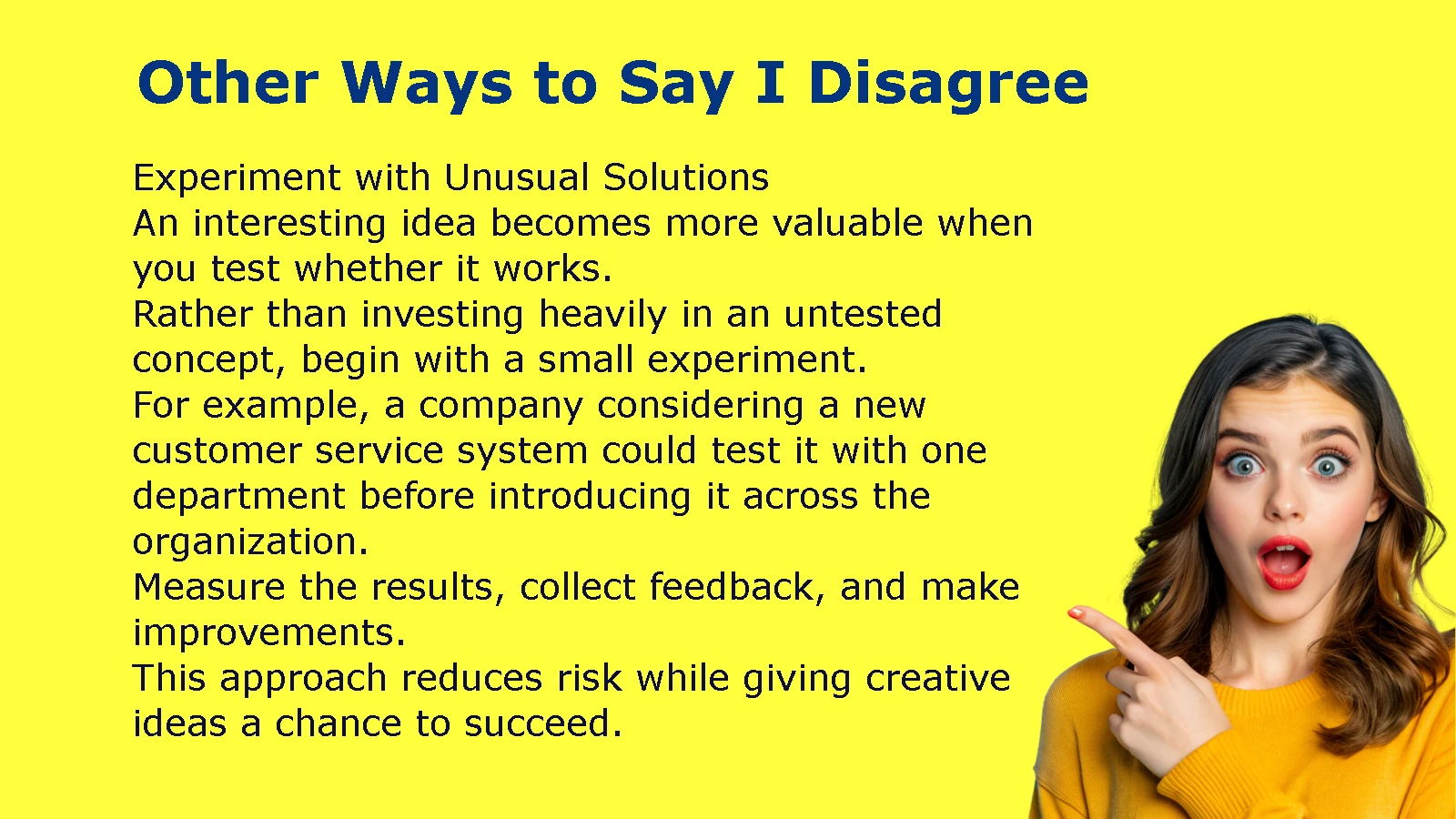
Experiment with Unusual Solutions
An interesting idea becomes more valuable when you test whether it works.
Rather than investing heavily in an untested concept, begin with a small experiment.
For example, a company considering a new customer service system could test it with one department before introducing it across the organization.
Measure the results, collect feedback, and make improvements.
This approach reduces risk while giving creative ideas a chance to succeed.
Challenge Yourself to Try Something New
Regularly changing small habits can help you become more comfortable with unfamiliar approaches.
You might:
- Learn a skill outside your profession.
- Read about an unfamiliar subject.
- Try a different method of organizing your work.
- Ask someone with a different background for advice.
- Experiment with a new creative activity.
- Solve an everyday problem without using your usual method.
These activities expose you to different perspectives and encourage flexible thinking.
Common Mistakes When Using Think Outside the Box
Although the expression encourages creativity, people sometimes misunderstand its meaning or use it in situations where a more precise phrase would work better.
Confusing Creativity with Random Thinking
Thinking outside the box doesn’t mean suggesting unusual ideas without considering their purpose.
A creative solution should still address the actual problem.
For example, replacing a company’s entire computer system with an unrelated technology might sound unconventional, but it won’t help if the proposed system creates more complications.
Better approach: Combine original ideas with practical evaluation.
Using Professional Expressions in Casual Conversations
Some alternatives sound unnecessarily formal in everyday communication.
For example, saying “We should challenge conventional thinking regarding tonight’s dinner” sounds unnatural.
A simpler expression such as “Let’s try something different tonight” communicates the same general idea more naturally.
Better approach: Match your vocabulary to your audience and situation.
Overusing the Phrase in Business Writing
“Think outside the box” has become common in professional communication.
Repeated use can make writing sound vague because the expression doesn’t explain what kind of creativity or action someone should demonstrate.
Instead of writing:
“We need to think outside the box to improve our operations.”
Try:
“We need to examine our existing workflow and identify more efficient ways to complete routine tasks.”
The second sentence gives readers a clearer objective.
Assuming Every Unconventional Idea Is Effective
An unusual idea isn’t automatically a good idea.
It still needs to meet practical requirements, address the intended problem, and produce measurable value.
For example, a company might develop an interesting advertising campaign that attracts attention but fails to generate sales.
Better approach: Evaluate creative solutions according to their effectiveness, cost, feasibility, and long-term impact.
Frequently Asked Questions
What Is Another Way to Say Think Outside the Box?
Another way to say think outside the box is think creatively, think differently, break the mold, or challenge conventional thinking. You can also use phrases such as explore new possibilities, approach things from a different perspective, and develop innovative solutions. Choose an expression that matches your audience and situation.
What Does Thinking Outside the Box Mean?
Thinking outside the box means considering original ideas and unconventional approaches instead of relying entirely on familiar methods. It involves questioning assumptions, exploring alternative possibilities, and finding creative ways to solve problems. People commonly use the expression in business, education, teamwork, and everyday conversations.
What Is a Professional Way to Say Think Outside the Box?
Professional alternatives include develop innovative solutions, challenge conventional thinking, explore alternative approaches, and consider different perspectives. These expressions work well in business meetings, presentations, professional emails, and reports because they explain the type of thinking or action expected.
Is Lateral Thinking the Same as Thinking Outside the Box?
Lateral thinking and thinking outside the box are closely related, but they aren’t exactly the same. Lateral thinking is a specific problem-solving approach that uses indirect ideas and unconventional connections. Thinking outside the box is a broader expression that describes creative and unconventional thinking in general.
What Is a Synonym for Creative Thinking?
Common synonyms and related expressions for creative thinking include imaginative thinking, innovative thinking, original thinking, inventive thinking, and divergent thinking. Each expression highlights a slightly different ability, from generating original ideas to exploring multiple possible solutions.
What Is the Opposite of Thinking Outside the Box?
The opposite of thinking outside the box includes conventional thinking, rigid thinking, narrow-minded thinking, and following established patterns. These expressions describe approaches that rely heavily on familiar ideas and traditional methods rather than exploring unconventional possibilities.
Conclusion: Choose the Right Way to Say Think Outside the Box
Finding other ways to say think outside the box can make your writing more natural, precise, and engaging. Expressions such as think creatively, challenge conventional thinking, break the mold, and explore new possibilities help communicate different aspects of originality and innovation.
The best choice depends on what you want to express. Use professional alternatives when discussing business strategies, conversational phrases when speaking with friends, and more specific terms such as lateral thinking or divergent thinking when discussing problem-solving methods.
Remember that thinking outside the box isn’t simply about being different. It’s about recognizing possibilities, questioning assumptions, and finding solutions that work