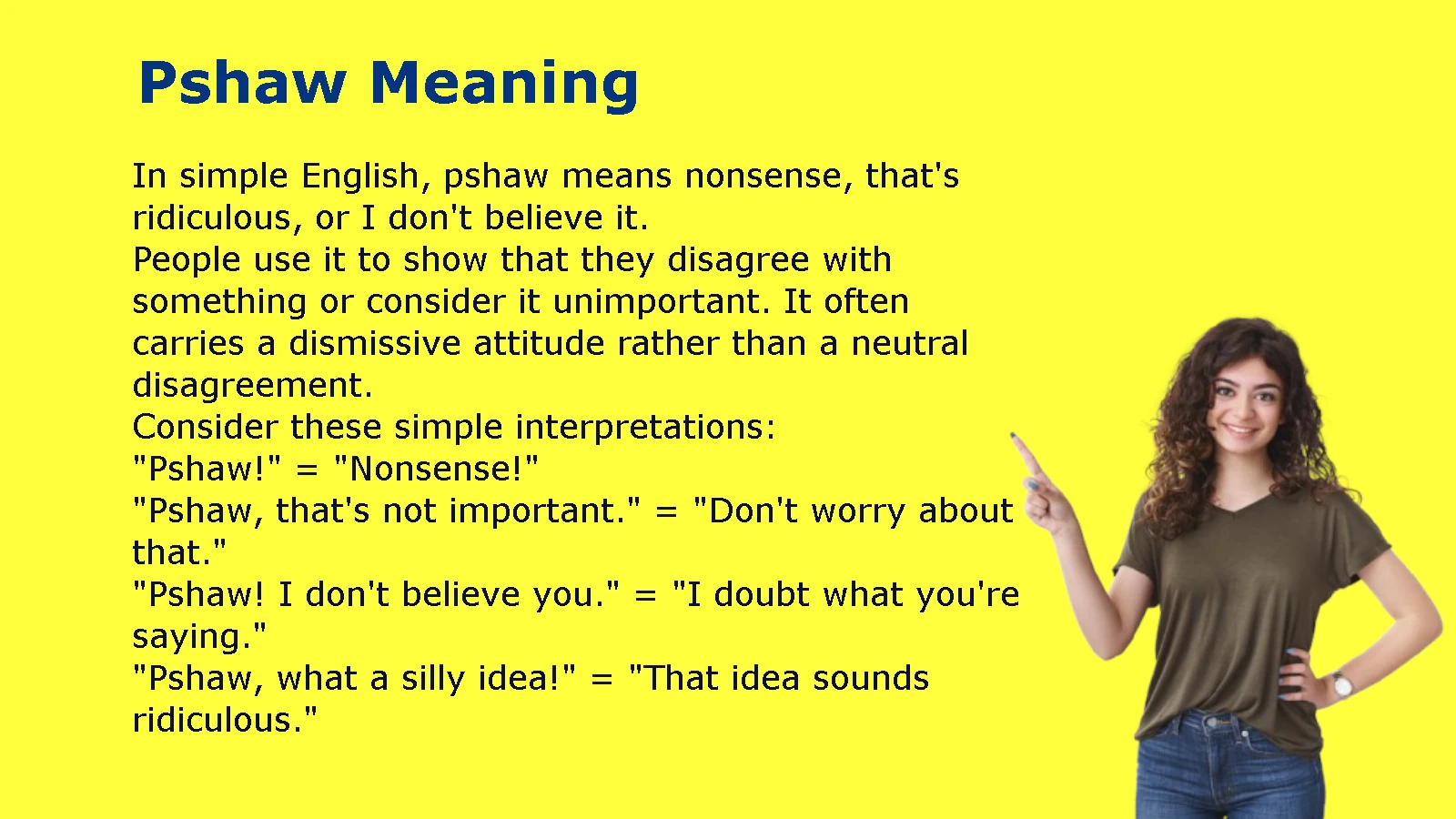
The pshaw meaning refers to an expression of disbelief, dismissal, impatience, or mild contempt. People use this unusual English interjection to reject an idea, show that they consider something foolish, or express doubt about a statement. It often communicates the same feeling as saying “nonsense!” or “oh, come on!”
The word pshaw has an interesting history in English vocabulary. Although it appears less often in modern conversations, readers may encounter it in older books, historical fiction, literary dialogue, and humorous writing. Understanding its pronunciation, origin, synonyms, grammatical role, and contextual usage helps you recognize its tone and use it correctly. It also attracts attention from word-game enthusiasts because it contains five letters.
| Question | Answer |
| What does pshaw mean? | An expression of disbelief, dismissal, impatience, or contempt. |
| How do you pronounce pshaw? | It is pronounced as one syllable, commonly represented as /pʃɔː/. |
| What part of speech is pshaw? | It is an interjection. |
| What is a synonym for pshaw? | Nonsense, bah, poppycock, balderdash, and rubbish. |
| Is pshaw a slang word? | It is primarily an old-fashioned interjection rather than modern slang. |
What Does Pshaw Mean?
Pshaw is an interjection that expresses disbelief, impatience, disdain, or dismissal. Someone might say it when they consider an idea ridiculous, reject an exaggerated claim, or want to show that something does not deserve serious attention. Its tone can range from playful disagreement to open contempt, depending on the situation.
For example:
“Pshaw! You don’t need to worry about such a small mistake.”
In this sentence, the speaker dismisses another person’s concern as unnecessary.
The expression can also communicate skepticism:
“Pshaw! I don’t believe a word of that story.”
Here, the speaker questions the truth of what someone has said.
Unlike ordinary words that describe an emotion, pshaw performs an emotional reaction. It allows a speaker to communicate an attitude without explaining it in several sentences.
Pshaw Meaning in Simple Words
In simple English, pshaw means nonsense, that’s ridiculous, or I don’t believe it.
People use it to show that they disagree with something or consider it unimportant. It often carries a dismissive attitude rather than a neutral disagreement.
Consider these simple interpretations:
- “Pshaw!” = “Nonsense!”
- “Pshaw, that’s not important.” = “Don’t worry about that.”
- “Pshaw! I don’t believe you.” = “I doubt what you’re saying.”
- “Pshaw, what a silly idea!” = “That idea sounds ridiculous.”
The exact meaning changes with the speaker’s tone.
A person might use pshaw jokingly when a friend exaggerates a small problem. Another person might use it more sharply to reject an argument.
Example:
“You’re the best player in the entire neighborhood,” Mark said.
“Pshaw! I still have plenty to learn,” Daniel replied.
Daniel uses the expression to dismiss the compliment modestly. He does not necessarily reject the statement angrily.
Pshaw as an Interjection
An interjection is a word or short expression that communicates a sudden emotion, reaction, or feeling. Interjections often stand independently and do not follow the usual grammatical structure of a sentence.
Examples include:
- Wow!
- Ouch!
- Alas!
- Bravo!
- Bah!
- Pshaw!
Pshaw belongs to this grammatical category because it expresses an immediate reaction rather than naming an object, person, or action.
You can place it at the beginning of a sentence or use it independently.
Examples:
- Pshaw! That explanation makes no sense.
- Pshaw, I expected something much better.
- “Pshaw!” she said, waving away his concerns.
- He responded with a quiet pshaw and changed the subject.
The word does not need an object to complete its meaning. Its emotional force comes from the context and the speaker’s delivery.
Is Pshaw a Positive or Negative Expression?
Pshaw generally carries a negative or dismissive tone, but it does not always express hostility.
Its meaning depends on the situation:
| Context | Intended meaning | Emotional tone |
| Rejecting an idea | That’s nonsense | Dismissive |
| Questioning a claim | I don’t believe that | Skeptical |
| Responding to a compliment | Oh, stop exaggerating | Playful |
| Showing irritation | That’s ridiculous | Annoyed |
| Rejecting a concern | It’s not worth worrying about | Reassuring or dismissive |
For example, a parent might say, “Pshaw! There’s nothing to be afraid of,” to reassure a nervous child.
However, a person might say, “Pshaw! That’s the worst suggestion I’ve heard,” to criticize an idea.
The expression is therefore not automatically rude or insulting. Its effect depends on the relationship between speakers, the situation, and the delivery.
Pshaw Pronunciation: How to Say Pshaw
The word pshaw is generally pronounced as one syllable, with a sound that resembles “shaw” preceded by a brief /p/ sound. Its unusual spelling can confuse readers because the letters do not follow the pronunciation patterns found in many common English words.
The pronunciation is commonly represented in IPA as /pʃɔː/ in British-style transcription. The vowel may vary across English accents.
Phonetic Spelling of Pshaw (IPA)
The International Phonetic Alphabet (IPA) provides a way to represent speech sounds independently of ordinary spelling.
A common British-style transcription of pshaw is:
/pʃɔː/
You can understand the pronunciation by breaking it into two sound elements:
- /p/: A short voiceless sound made by closing your lips and releasing air.
- /ʃ/: The sound at the beginning of “shoe” or “shut.”
- /ɔː/: A long vowel sound found in words such as “thought” in many British accents.
The initial consonant sequence can feel unusual because the /p/ and /ʃ/ sounds occur together.
The pronunciation remains one syllable. You do not pronounce each written letter separately.
Is Pshaw Pronounced as One Syllable?
Yes. Pshaw has one syllable.
Although its spelling contains five letters, the word forms a single spoken unit.
Compare it with these other one-syllable English words:
| Word | Syllables |
| Pshaw | 1 |
| Shaw | 1 |
| Bah | 1 |
| Nonsense | 2 |
| Balderdash | 3 |
| Poppycock | 3 |
The word’s unusual consonant combination makes it look more complicated than it sounds.
When speaking, keep the expression short and avoid inserting an extra vowel between the initial sounds.
Common Pronunciation Mistakes
People unfamiliar with pshaw sometimes struggle to pronounce it because its spelling looks different from its spoken form.
Common mistakes include:
- Pronouncing each letter separately.
- Adding an unnecessary vowel between the initial consonants.
- Treating the word as two syllables.
- Assuming the pronunciation must follow the sound of the letter combination “ps” in every English word.
The easiest approach is to treat pshaw as one expressive exclamation rather than attempting to pronounce every letter independently.
Pshaw Origin and Etymology
The word pshaw developed as an expressive English interjection. Its spelling represents a vocal reaction associated with disbelief, contempt, or impatience. Like other exclamations, it reflects the sounds people make when reacting emotionally rather than following a conventional sentence structure.
Its history is closely connected with older forms of expressive English speech.
Where Did the Word Pshaw Come From?
Pshaw belongs to a group of English expressions that imitate spontaneous human reactions.
People often communicate emotions through short sounds before forming complete sentences. For example:
- “Bah!” can express annoyance or contempt.
- “Oh!” can communicate surprise.
- “Hush!” can demand silence.
- “Pshaw!” can dismiss an idea or express disbelief.
The word’s form reflects this expressive function.
Historical English writing used pshaw to represent a speaker’s reaction when someone made a claim that seemed unreasonable, exaggerated, or unworthy of attention.
Unlike many English nouns and verbs, pshaw does not describe a physical object or a specific action. Its purpose is primarily emotional and conversational.
When Did Pshaw First Appear in English?
Pshaw has a long history in English usage, with historical records dating back several centuries. Older literary and written material helps show how speakers and writers used the expression to represent dismissal and disbelief.
It became particularly recognizable as a dramatic interjection in older dialogue and storytelling.
Writers could use it to communicate a character’s personality without lengthy descriptions.
For example:
“Pshaw! I have heard better excuses than that.”
This short reaction tells readers that the speaker considers the excuse unconvincing.
Historical writing also used expressions like pshaw to give dialogue a distinctive conversational character. Such expressions helped reproduce the speech patterns and attitudes associated with different periods.
How Has the Meaning of Pshaw Changed Over Time?
The central meaning of pshaw has remained relatively stable. It continues to express dismissal, disbelief, or contempt.
However, its familiarity and frequency have changed.
| Period or context | Typical use |
| Older English writing | Expressing disbelief, contempt, or impatience |
| Historical dialogue | Representing a character’s emotional reaction |
| Traditional literature | Adding emphasis or dramatic personality |
| Modern humorous writing | Creating an old-fashioned or theatrical effect |
| Contemporary conversation | Occasional playful or dismissive expression |
Today, people are more likely to say “nonsense,” “come on,” or “I don’t believe that” in everyday conversations.
Pshaw survives because it offers a distinctive tone that ordinary expressions sometimes lack.
A modern writer might deliberately use it to make a character sound theatrical, old-fashioned, sarcastic, or humorous.
Pshaw Meaning in Slang and Modern Conversations
The pshaw meaning in slang generally relates to dismissing something as foolish, exaggerated, or unbelievable. However, pshaw is more accurately classified as an old-fashioned interjection than as contemporary slang.
Its informal character makes it suitable for expressive dialogue, but its historical associations distinguish it from modern internet slang and youth vocabulary.
Is Pshaw Considered Slang?
Pshaw is not primarily a modern slang word.
Slang usually consists of informal expressions associated with particular social groups, communities, generations, or cultural settings.
Examples include:
- “Busted” for caught or discovered.
- “Ghosted” for suddenly ending communication.
- “Salty” for annoyed or resentful.
- “Flex” for showing off.
Pshaw serves a different purpose. It is an established English interjection that expresses an emotional reaction.
It can appear in informal speech, but that does not automatically make it slang.
A more accurate classification is:
| Feature | Description |
| Part of speech | Interjection |
| Register | Informal and expressive |
| Historical character | Old-fashioned |
| Main function | Expressing disbelief or dismissal |
| Modern popularity | Relatively uncommon |
| Typical setting | Literature, humorous dialogue, occasional conversation |
When someone searches for pshaw meaning slang, they usually want to know what the expression communicates in casual language.
The simplest explanation is that it means something like “nonsense!” or “I don’t take that seriously!”
How People Use Pshaw in Conversations
Pshaw can communicate several related attitudes.
1. Expressing disbelief
A speaker can use pshaw to show that a claim sounds unbelievable.
Example:
“Pshaw! You expect me to believe that you finished the entire project in ten minutes?”
The speaker doubts the statement.
2. Dismissing an argument
Someone may use it when they consider another person’s reasoning weak or unreasonable.
Example:
“Pshaw, your argument ignores the most important part of the problem.”
The expression dismisses the argument rather than accepting it.
3. Showing mild irritation
Pshaw can communicate annoyance when someone continues discussing an issue that the speaker considers unimportant.
Example:
“Pshaw! We’ve already discussed this matter several times.”
4. Responding modestly to praise
The expression can also sound playful when someone rejects an exaggerated compliment.
Example:
“You’re the smartest person in the office.”
“Pshaw! I just know where to find the right information.”
Here, the speaker uses pshaw to respond modestly.
Is Pshaw Still Used Today?
Yes, although it is relatively uncommon in ordinary modern conversations.
Most people use more familiar expressions such as “come on,” “nonsense,” “that’s ridiculous,” or “I doubt it.”
However, pshaw remains useful in several situations:
- Historical fiction: Writers use it to give dialogue an older-fashioned character.
- Humorous writing: It can make a reaction sound exaggerated or theatrical.
- Literary dialogue: Authors use it to communicate a character’s attitude quickly.
- Creative storytelling: It can help establish a character’s personality.
- Playful conversation: Speakers can use it to reject a friend’s exaggerated claim.
For example, a character in a historical novel might say:
“Pshaw! I have no intention of surrendering my position.”
The expression immediately establishes a confident and dismissive attitude.
In a modern office conversation, however, “That’s nonsense” would usually sound more natural.
Pshaw Synonyms: 15+ Words and Expressions With Similar Meanings
Several English words and expressions share meanings with pshaw, especially when speakers want to express disbelief, impatience, contempt, or dismissal.
However, not every synonym works in every situation. Some sound playful, others sound harsh, and a few carry distinctly old-fashioned associations.
Common Synonyms for Pshaw
Here are useful alternatives:
| Synonym | Meaning | Tone |
| Nonsense | Something unreasonable or untrue | Dismissive |
| Balderdash | Foolish or meaningless talk | Humorous |
| Rubbish | Something considered untrue or worthless | Dismissive |
| Poppycock | Nonsense or foolish talk | Playful |
| Bah | An expression of contempt or annoyance | Dismissive |
| Humbug | Deception, nonsense, or insincere behavior | Critical |
| Bosh | Foolish or meaningless talk | Old-fashioned |
| Fiddlesticks | An expression of disbelief or annoyance | Playful |
| Absurd | Completely unreasonable | Critical |
| Ridiculous | Deserving disbelief or mockery | Strong |
| Hogwash | Nonsense or misleading claims | Informal |
| Baloney | Something untrue or foolish | Informal |
| Preposterous | Extremely unreasonable | Formal |
| Twaddle | Silly or meaningless talk | Old-fashioned |
| Drivel | Foolish or meaningless speech | Critical |
| Rubbish talk | Speech considered nonsensical | Dismissive |
These alternatives share a general sense of rejection, but they differ in grammatical function and intensity.
For example, nonsense can identify an idea as unreasonable, while bah functions more like an emotional exclamation.
Formal and Informal Alternatives to Pshaw
Choosing an appropriate alternative depends on your audience and communication style.
Formal alternatives:
- Absurd
- Preposterous
- Unreasonable
- Unconvincing
- Implausible
These expressions work better in professional discussions, academic writing, and serious arguments.
Example:
“The claim that the project requires no planning is completely unreasonable.”
Informal alternatives:
- Nonsense
- Rubbish
- Baloney
- Hogwash
- That’s ridiculous
These expressions work well in everyday conversations.
Example:
“Come on! That’s complete nonsense.”
Playful or old-fashioned alternatives:
- Poppycock
- Balderdash
- Fiddlesticks
- Bosh
- Bah
These words can create a humorous or theatrical effect.
Example:
“Poppycock! Nobody could finish that much work in five minutes.”
Pshaw vs. Bah vs. Nonsense
Although these expressions can communicate similar feelings, they are not interchangeable in every sentence.
| Expression | Main meaning | Best use |
| Pshaw | Disbelief, contempt, or dismissal | Expressive reaction |
| Bah | Annoyance, disdain, or rejection | Short emotional exclamation |
| Nonsense | Something unreasonable or untrue | Rejecting an idea or claim |
Pshaw vs. bah
Both are interjections. However, bah often communicates a sharper expression of contempt or annoyance.
Example:
“Bah! I have no patience for these excuses.”
Pshaw vs. nonsense
Nonsense can function as a noun, while pshaw functions as an interjection.
Example:
“Pshaw! That’s nonsense.”
The first word expresses the speaker’s reaction. The second identifies what the speaker considers unreasonable.
Pshaw vs. poppycock
Both can sound old-fashioned and humorous. However, poppycock directly refers to foolish or meaningless talk, while pshaw expresses a reaction to it.
Example:
“Pshaw! What a load of poppycock!”
Understanding these differences helps you choose an expression that matches your intended tone.
Pshaw in a Sentence: Examples of Everyday Usage
The easiest way to understand an unfamiliar word is to examine it in different contexts.
Pshaw usually appears at the beginning of an exclamation or sentence. It can also appear in dialogue after a speaker reacts to another person’s statement.
The following original examples demonstrate its different uses.
Simple Sentences Using Pshaw
Here are 15 examples of pshaw in a sentence:
- Pshaw! You are worrying about nothing.
- Pshaw, that story sounds completely unbelievable.
- “Pshaw!” she exclaimed, dismissing his concerns.
- Pshaw! I can handle this problem myself.
- He responded with a quiet pshaw and returned to his book.
- Pshaw! Nobody believes that ridiculous excuse.
- “Oh, pshaw,” my grandmother said when I praised her cooking.
- Pshaw, there is no reason to make such a fuss.
- The old gentleman muttered, “Pshaw! What nonsense.”
- Pshaw! I have seen much worse problems than this.
- She waved her hand and said, “Pshaw, that’s hardly worth discussing.”
- Pshaw! You make the situation sound far more difficult than it is.
- His response was a simple pshaw followed by an amused smile.
- Pshaw! I refuse to believe that everyone has forgotten the meeting.
- “Pshaw!” he replied, brushing aside the suggestion.
Notice that the expression does not always communicate anger. It can express humor, modesty, skepticism, or mild annoyance.
Pshaw in Dialogue and Conversations
Dialogue makes the emotional meaning of pshaw easier to understand.
Conversation 1: Expressing disbelief
Anna: “I heard that Peter finished the entire assignment in five minutes.”
James: “Pshaw! That sounds impossible.”
James uses pshaw to express doubt about the claim.
Conversation 2: Dismissing a minor concern
Mother: “I’m worried that the guests won’t like the decorations.”
Daughter: “Pshaw! Everyone will love them.”
The daughter uses the expression to dismiss an unnecessary worry.
Conversation 3: Responding to a compliment
Daniel: “You gave an excellent presentation today.”
Robert: “Pshaw! I made several mistakes.”
Robert uses the expression to respond modestly to praise.
Conversation 4: Rejecting an argument
Teacher: “Some people believe that reading is no longer important.”
Student: “Pshaw! Reading remains one of the best ways to develop knowledge.”
The student uses pshaw to reject an opinion.
These examples demonstrate how the same word can express different emotions without changing its basic meaning.
Pshaw in Literature and Creative Writing
Pshaw can add personality to fictional dialogue.
Because it sounds old-fashioned, writers can use it to establish a particular atmosphere or make a character’s speech distinctive.
For example:
“You’re afraid of a little rain?” the captain asked.
“Pshaw! I’ve sailed through storms far worse than this.”
The response makes the character sound confident and dismissive.
Writers can use pshaw to develop several character traits:
- Confidence: A character dismisses a challenge without hesitation.
- Pride: Someone rejects criticism because they consider it unimportant.
- Humor: A character uses exaggerated expressions for comic effect.
- Old-fashioned manners: The word helps establish a historical setting.
- Skepticism: A character questions an unbelievable claim.
However, writers should avoid overusing it. Repeating an uncommon interjection in every conversation can make dialogue sound unnatural.
One carefully placed pshaw can communicate more personality than several sentences of explanation.
Pshaw Meaning in Oxford Dictionary and Other Dictionaries
People searching for the pshaw meaning Oxford Dictionary generally want a reliable definition, pronunciation, and grammatical classification.
Pshaw is an established English interjection. Its dictionary meaning centers on expressing disbelief, contempt, impatience, or dismissal.
Dictionary entries help readers distinguish its basic meaning from the particular emotion it communicates in different situations.
Pshaw Meaning According to Oxford Dictionary
The relevant dictionary sense of pshaw is an exclamation expressing disbelief, contempt, or impatience.
In practical terms, it communicates a reaction similar to:
- “Nonsense!”
- “That’s ridiculous!”
- “I don’t believe it!”
- “Oh, come on!”
The important distinction is that pshaw does not simply mean that something is false. It expresses the speaker’s attitude toward an idea, statement, or situation.
For example:
“Pshaw! I have heard that excuse before.”
The speaker communicates skepticism and dismissal.
When researching an Oxford Dictionary entry, pay attention to three details:
- Part of speech: Pshaw functions as an interjection.
- Definition: Its meaning relates to disbelief, impatience, and contempt.
- Usage: Its old-fashioned character helps explain why it appears more often in literary or expressive writing than in everyday speech.
A dictionary-style explanation should focus on these established meanings rather than treating pshaw as a new internet expression.
Pshaw Dictionary Definition and Part of Speech
A dictionary entry generally provides information that helps readers understand how a word functions.
For pshaw, the most important grammatical details are:
| Dictionary feature | Information |
| Headword | Pshaw |
| Part of speech | Interjection |
| Main meaning | An expression of disbelief or contempt |
| Related meaning | Dismissal or impatience |
| Pronunciation | Commonly /pʃɔː/ |
| Usage character | Old-fashioned and expressive |
An interjection usually stands outside the grammatical structure of a sentence.
Consider:
“Pshaw! That is a terrible idea.”
The word pshaw does not serve as the subject, verb, or object. Instead, it introduces the speaker’s emotional reaction.
You can remove it without changing the basic grammatical structure:
“That is a terrible idea.”
However, removing pshaw also removes the expressive emphasis.
Is Pshaw an Archaic or Obsolete Word?
Pshaw is best described as old-fashioned or uncommon, rather than automatically labeling it obsolete.
These terms have different meanings:
| Term | Meaning |
| Old-fashioned | Less common in current everyday language |
| Archaic | Belonging mainly to an earlier stage of language |
| Obsolete | No longer generally used |
| Rare | Used infrequently |
| Literary | More common in written or creative contexts |
Pshaw remains understandable to readers familiar with older English expressions.
Writers can still use it intentionally in modern literature, humorous dialogue, and historical fiction.
For example:
“Pshaw! I won’t let a little criticism discourage me.”
This sentence remains understandable even though the expression may sound unusual in everyday conversation.
Its continued presence in dictionaries and literary usage makes it a useful word to recognize.
Pshaw in Wordle: Is Pshaw a Wordle Word?
The search for pshaw wordle or pshaw meaning wordle usually comes from someone encountering the unusual five-letter spelling in a word puzzle.
Pshaw contains five letters and is a recognized English expression. However, a word’s dictionary status does not automatically guarantee that a particular Wordle version accepts it as a guess or includes it in its official answer list.
Is Pshaw a Valid Word?
Yes. Pshaw is a recognized English word.
Its spelling consists of five letters:
| Position | Letter |
| 1 | P |
| 2 | S |
| 3 | H |
| 4 | A |
| 5 | W |
The word functions as an interjection rather than a conventional noun or verb.
This distinction matters because word games use their own accepted-word lists.
A word can appear in a general dictionary but still fail a particular game’s validation rules.
Therefore, recognizing pshaw as an English word does not establish that every version of Wordle accepts it.
Does Pshaw Appear as a Wordle Answer?
There is an important difference between three things:
- A word that appears in an English dictionary.
- A word accepted as a possible guess.
- A word included in the official daily answer list.
These categories do not always overlap.
Wordle uses a controlled vocabulary rather than accepting every word that exists in English.
Its answer list and accepted-guess list serve different purposes. A valid guess does not necessarily become a daily solution.
For that reason, you should check the current game’s response rather than assuming pshaw is an official Wordle answer.
Why Do People Search for Pshaw in Wordle?
Pshaw attracts attention because its spelling looks unusual.
Several characteristics make it interesting to word-game players:
- It contains five letters, matching Wordle’s standard answer length.
- Its initial consonant combination is uncommon.
- Its spelling may look unfamiliar to people who know only its spoken form.
- It is an established but relatively uncommon English expression.
For example, someone who encounters P-S-H-A-W in a word puzzle may search for its meaning to determine whether it represents a genuine English word.
Knowing unusual vocabulary can help you recognize possible words, but you should still rely on the game’s accepted-word rules.
How to Remember and Use the Word Pshaw Correctly
Learning a word involves more than memorizing its definition. You also need to understand when it sounds natural and when another expression would communicate your message more clearly.
Pshaw is relatively easy to remember once you connect it with its main purpose: dismissing something you consider foolish, exaggerated, or unbelievable.
Easy Memory Trick for Pshaw
Think of pshaw as the verbal equivalent of waving away an idea.
Imagine someone telling you:
“You will never finish this small task.”
You might respond:
“Pshaw! I can finish it easily.”
The expression communicates that you reject the other person’s doubt.
A simple memory association is:
Pshaw = A dismissive reaction to something you consider nonsense.
Remember these three connected meanings:
- Disbelief: “I don’t believe that.”
- Dismissal: “That’s not worth worrying about.”
- Contempt: “That’s ridiculous.”
This association will help you recognize pshaw in books, conversations, and word puzzles.
When Should You Use Pshaw?
Pshaw works best when you want to create an expressive, slightly theatrical, or old-fashioned tone.
Consider using it in these situations:
1. Historical dialogue
A character in a story set in an earlier period might use pshaw to make the conversation feel consistent with the setting.
2. Humorous conversations
You can use it playfully when someone exaggerates a problem or makes an unbelievable statement.
3. Creative writing
The expression helps establish a character who speaks dramatically or dismisses other people’s concerns.
4. Expressing mild disbelief
It works when you want to communicate skepticism without using harsh language.
5. Responding modestly
A character can use pshaw to brush aside an exaggerated compliment.
The key is to match the expression with the speaker’s personality and the situation.
When Should You Avoid Using Pshaw?
Although pshaw is a legitimate English word, it may not fit every communication setting.
Avoid using it when clarity and a natural modern tone matter more than expressive style.
For example:
- Business emails: “I disagree with this proposal” sounds more professional.
- Academic writing: “The argument lacks sufficient evidence” communicates a clearer criticism.
- Technical explanations: “The claim is inaccurate” is more precise.
- Formal presentations: “That assumption is unreasonable” sounds more appropriate.
- Everyday instructions: “Don’t worry about it” is more natural than pshaw.
Compare these examples:
Old-fashioned: “Pshaw! That explanation is ridiculous.”
Modern: “That explanation doesn’t make sense.”
Both communicate disagreement, but the second sounds more natural in most contemporary settings.
Choose pshaw when you want its distinctive personality. Choose a direct alternative when your main goal is straightforward communication.
Frequently Asked Questions About Pshaw
What Does Pshaw Mean in Simple English?
Pshaw means nonsense, that’s ridiculous, or I don’t believe it. It is an interjection that expresses disbelief, impatience, contempt, or dismissal. People use it to reject an idea, question an exaggerated claim, or show that they consider something unimportant.
How Do You Pronounce Pshaw?
Pshaw is pronounced as one syllable. A common British-style IPA transcription is /pʃɔː/. Its initial consonant sounds like the beginning of “shoe,” preceded by a brief /p/ sound. The spelling does not require you to pronounce each letter separately.
What Is Another Word for Pshaw?
Common synonyms include nonsense, bah, poppycock, balderdash, rubbish, humbug, bosh, fiddlesticks, hogwash, and baloney. The best alternative depends on the intended tone. For example, nonsense works in everyday speech, while poppycock creates a more playful, old-fashioned effect.
Is Pshaw a Slang Word?
Pshaw is primarily an old-fashioned English interjection rather than modern slang. It expresses disbelief, impatience, or contempt. Although speakers can use it informally, its historical and literary associations distinguish it from contemporary slang expressions.
What Is the Origin of Pshaw?
Pshaw developed as an expressive English interjection that represents a vocal reaction of disbelief, dismissal, or contempt. It has appeared in English writing for centuries and became recognizable in older dialogue and literature. Its form reflects the sound and emotional character of an exclamation.
Is Pshaw a Valid Wordle Word?
Pshaw is a recognized five-letter English word. However, dictionary recognition does not guarantee acceptance in Wordle. The game maintains its own accepted-guess and answer lists, so a word may be legitimate English vocabulary without appearing as an official daily solution.
Conclusion: Understanding the Meaning and Use of Pshaw
The pshaw meaning centers on disbelief, dismissal, impatience, and mild contempt. This unusual English interjection allows speakers to reject an idea or express skepticism through a short, memorable exclamation.
Although pshaw sounds old-fashioned today, it remains useful in literary dialogue, historical fiction, humorous writing, and expressive conversations. Its one-syllable pronunciation, distinctive spelling, and recognizable emotional tone make it an interesting addition to English vocabulary.
Remember these key points:
- Pshaw is an interjection.
- It expresses disbelief, contempt, impatience, or dismissal.
- It is pronounced as one syllable.
- Its common synonyms include nonsense, bah, poppycock, and balderdash.
- It is better described as an old-fashioned expression than modern slang.
- Its five-letter spelling makes it relevant to word-game searches, but dictionary validity does not guarantee Wordle acceptance.
Whether you encountered pshaw in a book, a conversation, or a word puzzle, you can now recognize its meaning and understand how writers use it.
Next step: Expand your English vocabulary by exploring related expressions, unusual interjections, and other words that communicate disbelief or disagreement.













