Unyielding means firm, determined, and unwilling to change, give in, or become weaker. It is often used to describe a person, attitude, rule, belief, or force that remains strong and does not bend under pressure.
If you’re searching for “unyielding meaning,” “what does unyielding mean,” or “unyielding definition,” you’re likely looking for its simple meaning and how to use it in a sentence. In modern English, unyielding can describe someone who refuses to change their position or something that cannot be easily bent, moved, or weakened. Depending on the context, it can suggest either admirable determination or stubbornness.
| Question | Answer |
|---|---|
| What does unyielding mean? | Firm, determined, and unwilling to give in or change. |
| What is the meaning of unyielding? | Something or someone that remains firm despite pressure. |
| Is unyielding a positive word? | Usually, when it describes determination, strength, or persistence. |
| What is a synonym for unyielding? | Firm, resolute, inflexible, steadfast, stubborn, or rigid. |
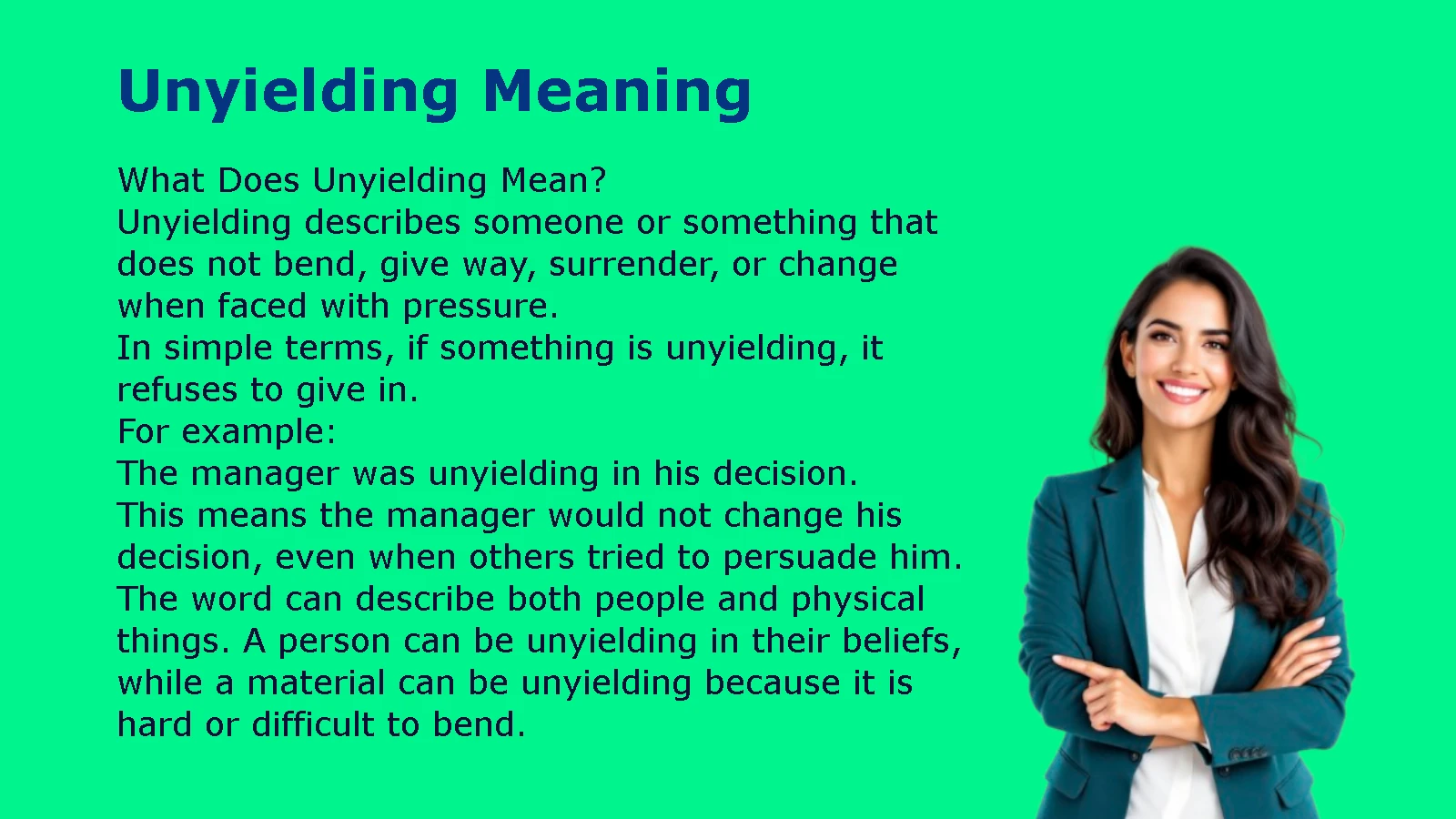
What Does Unyielding Mean?
Unyielding describes someone or something that does not bend, give way, surrender, or change when faced with pressure.
In simple terms, if something is unyielding, it refuses to give in.
For example:
The manager was unyielding in his decision.
This means the manager would not change his decision, even when others tried to persuade him.
The word can describe both people and physical things. A person can be unyielding in their beliefs, while a material can be unyielding because it is hard or difficult to bend.
Quick definition
Unyielding: refusing to change, bend, weaken, or give in to pressure.
Part of speech: Adjective
Pronunciation: /ʌnˈjiːl.dɪŋ/
Related verb: yield
Opposite: yielding
Examples
- She remained unyielding despite the criticism.
- His unyielding determination helped him succeed.
- The metal was unyielding and difficult to bend.
- They faced unyielding opposition from the committee.
The exact meaning depends on context, but the central idea is always resistance to change or pressure.
Unyielding Definition
The word unyielding is formed from un + yielding.
The prefix un often gives a word the meaning of “not,” while yielding means giving way, surrendering, bending, or accepting something.
Therefore, unyielding literally suggests not yielding or not giving way.
It can have several related meanings.
1. Refusing to change
When a person is unyielding, they may refuse to change their opinion, decision, demand, or position.
The politician remained unyielding on the issue.
The person refused to change their position.
2. Strongly determined
Unyielding can describe someone who continues pursuing a goal without giving up.
Her unyielding determination impressed everyone.
Here, the word suggests persistence and strength.
3. Physically hard or inflexible
The word can also describe something that does not bend or move easily.
The frozen ground was unyielding beneath his boots.
The ground was hard and resistant.
4. Difficult to overcome
An obstacle, opposition, or problem can also be unyielding.
The team faced unyielding resistance.
The resistance did not weaken or disappear.
Unyielding Meaning in Simple English
In simple English, unyielding means “not giving in.”
Imagine pushing against a heavy locked door. You push harder, but the door does not move. The door is unyielding.
The same idea applies to people.
If you ask someone to change their mind several times and they refuse every time, that person may be described as unyielding.
A simple way to remember the word is:
Unyielding = refusing to give way.
Depending on the situation, this can be a positive quality or a negative one.
For example:
His unyielding determination helped him finish the race.
Here, unyielding is positive.
But:
Her unyielding attitude made compromise impossible.
Here, it has a negative sense because the person refuses to compromise.
What Does Unyielding Mean When Describing a Person?
When unyielding describes a person, it usually means that the person is firm, determined, stubborn, or unwilling to change their position.
For example:
He was unyielding during the negotiations.
This means he refused to give in to the other side.
The word can suggest strength and determination, but it can also suggest stubbornness.
Positive meaning
She showed unyielding courage during the crisis.
Here, unyielding suggests admirable strength and determination.
Negative meaning
His unyielding attitude frustrated his coworkers.
Here, it suggests that he was too stubborn or unwilling to compromise.
So, whether unyielding sounds positive or negative depends heavily on the noun and context.
Unyielding Examples
Here are examples showing how the word works in different situations.
1. Unyielding determination
Her unyielding determination helped her complete the difficult project.
She refused to give up even when the project became challenging.
2. Unyielding attitude
His unyielding attitude made it difficult to reach an agreement.
He was unwilling to change his position or compromise.
3. Unyielding opposition
The proposal faced unyielding opposition from local residents.
The opposition remained strong and did not weaken.
4. Unyielding support
Her family gave her unyielding support throughout the competition.
Their support remained constant.
5. Unyielding courage
The firefighter showed unyielding courage during the rescue.
The firefighter remained brave despite danger.
6. Unyielding material
The old metal was unyielding and difficult to shape.
The metal resisted bending or changing form.
7. Unyielding ground
The dry ground was unyielding beneath the shovel.
The ground was hard and would not easily break apart.
8. Unyielding rules
The school maintained unyielding rules about attendance.
The rules were strict and were not easily changed.
9. Unyielding belief
She held an unyielding belief in the value of education.
Her belief remained strong despite disagreement.
10. Unyielding resistance
The workers encountered unyielding resistance to the proposed changes.
The resistance remained strong and persistent.
Unyielding in a Sentence
The following sentences show common uses of unyielding:
- She remained unyielding in her decision.
- His unyielding determination inspired the entire team.
- The company faced unyielding pressure from competitors.
- The stone was unyielding beneath the hammer.
- They encountered unyielding opposition to the plan.
- Her unyielding confidence helped her overcome the challenge.
- The teacher was unyielding about classroom rules.
- He showed unyielding loyalty to his friends.
- The ground became unyielding after weeks without rain.
- Their unyielding commitment eventually produced results.
The word works particularly well with nouns related to determination, resistance, pressure, opposition, support, courage, commitment, loyalty, rules, and beliefs.
How to Use Unyielding
Unyielding is an adjective, so it usually appears before a noun or after a linking verb.
Before a noun
This is one of the most common structures.
unyielding determination
unyielding resistance
After a linking verb
You can also use unyielding after verbs such as be, remain, seem, appear, and become.
She remained unyielding.
His position was unyielding.
The material seemed unyielding.
They became unyielding during the negotiations.
Common patterns
Some useful sentence patterns include:
Subject + be + unyielding
The committee was unyielding.
Subject + remain + unyielding
She remained unyielding despite the pressure.
Unyielding + noun
His unyielding determination impressed everyone.
Unyielding in + noun
She was unyielding in her opposition.
These patterns make the word natural in both everyday and formal writing.
Common Collocations With Unyielding
A collocation is a group of words that naturally appear together.
Common combinations with unyielding include:
- unyielding determination
- unyielding resolve
- unyielding resistance
- unyielding opposition
- unyielding support
- unyielding commitment
- unyielding courage
- unyielding loyalty
- unyielding belief
- unyielding pressure
- unyielding attitude
- unyielding stance
- unyielding demand
- unyielding discipline
- unyielding rules
- unyielding strength
- unyielding material
- unyielding surface
- unyielding ground
Some of these combinations are more figurative, while others describe physical properties.
Is Unyielding Positive or Negative?
Unyielding can be either positive or negative depending on the context.
When it describes qualities such as determination, courage, loyalty, or commitment, it usually has a positive meaning.
Her unyielding determination helped her achieve her goal.
When it describes stubbornness, opposition, demands, or an unwillingness to compromise, it can sound negative.
His unyielding attitude prevented the two sides from reaching an agreement.
So, the word itself is not inherently positive or negative.
Positive uses
- unyielding courage
- unyielding determination
- unyielding loyalty
- unyielding commitment
- unyielding support
- unyielding resolve
Negative or critical uses
- unyielding stubbornness
- unyielding opposition
- unyielding demands
- unyielding attitude
- unyielding refusal
Unyielding Synonyms
The best synonym depends on whether you are describing determination, stubbornness, resistance, or physical hardness.
| Synonym | Meaning | Example |
| Inflexible | Unwilling or unable to change | He was inflexible about the rules. |
| Uncompromising | Refusing to make concessions | She took an uncompromising position. |
| Stubborn | Unwilling to change your mind | He was stubborn about the decision. |
| Firm | Strong and steady in a position | She remained firm in her belief. |
| Resolute | Very determined | He was resolute in his efforts. |
| Persistent | Continuing despite difficulty | She was persistent in pursuing her goal. |
| Steadfast | Firm and loyal | He remained steadfast in his support. |
| Relentless | Continuing without stopping or weakening | The team faced relentless pressure. |
| Immovable | Unable or unwilling to move | She was immovable on the issue. |
| Rigid | Extremely strict or inflexible | The organization had rigid rules. |
Unyielding vs stubborn
These words overlap, but unyielding can sound more formal and can describe both people and things.
He was stubborn about the decision.
This usually focuses on a person’s unwillingness to change.
He was unyielding in his position.
This emphasizes strong resistance to pressure or persuasion.
Unyielding can also describe physical things:
The rock was unyielding.
You would not normally describe a rock as “stubborn” in a literal sense.
Unyielding vs resolute
Resolute is usually positive and focuses on strong determination.
Unyielding focuses more broadly on refusing to give way.
Unyielding Antonyms
The opposite of unyielding is something or someone that gives way, changes, bends, or accepts pressure.
Useful antonyms include:
- yielding
- flexible
- adaptable
- compliant
- cooperative
- accommodating
- compromising
- submissive
- pliable
- soft
The best opposite depends on context.
For example:
His unyielding attitude → His accommodating attitude
An unyielding material → A flexible material
An unyielding position → A compromising position
Unyielding vs Unwavering
Unyielding and unwavering are closely related, but they emphasize different ideas.
Unwavering means remaining steady, consistent, or firm without becoming weaker.
Compare:
Her unyielding opposition stopped the proposal.
She refused to give in.
Her unwavering support encouraged the team.
Her support remained constant.
Unyielding often suggests resistance, while unwavering more often suggests consistency and loyalty.
Unyielding vs Inflexible
Both words can describe someone or something that does not change easily.
Inflexible emphasizes a lack of flexibility.
Unyielding emphasizes resistance to pressure or attempts to make a change.
In many contexts, these words can be close synonyms, but unyielding often sounds stronger and more forceful.
Unyielding vs Relentless
These words are sometimes confused because both can suggest persistence.
Unyielding means not giving way.
Relentless means not stopping or easing.
For example:
She showed unyielding determination.
Her determination did not weaken.
The team faced relentless pressure.
The pressure continued without stopping.
The first describes resistance or firmness. The second emphasizes continuous intensity.
Common Mistakes With Unyielding
1. Thinking unyielding only describes people
It can describe both people and things.
He was unyielding during the debate.
The frozen soil was unyielding.
2. Assuming it always means stubborn
Unyielding can suggest stubbornness, but it can also describe admirable qualities.
Her unyielding courage was remarkable.
Here, the word is clearly positive.
3. Confusing unyielding with unbeatable
Something unyielding does not necessarily mean something cannot be defeated.
Unyielding means it does not easily give way or change.
4. Using unyielding when you mean permanent
A permanent situation may last indefinitely, while an unyielding situation simply resists change.
These ideas can overlap, but they are not identical.
5. Forgetting the physical meaning
The word can describe physical resistance:
The unyielding metal refused to bend.
This use is literal rather than figurative.
Unyielding Qualities
When unyielding describes a person’s character, it often points to qualities such as:
- determination
- persistence
- firmness
- courage
- discipline
- loyalty
- strong conviction
- resistance to pressure
- unwillingness to compromise
- emotional strength
Whether these qualities are admirable depends on how they are used.
For example, unyielding determination can help someone achieve a difficult goal. However, unyielding stubbornness can prevent someone from accepting useful advice.
Unyielding Meaning in Different Contexts
The word can change slightly depending on what it describes.
| Context | Meaning |
| Person | Firm, determined, or unwilling to change |
| Opinion | Strongly held and resistant to persuasion |
| Opposition | Strong and persistent |
| Determination | Extremely persistent |
| Support | Constant and dependable |
| Rules | Strict and not easily changed |
| Material | Hard or difficult to bend |
| Ground | Hard and resistant to digging |
| Pressure | Persistent and difficult to escape |
| Attitude | Firm, stubborn, or uncompromising |
This flexibility makes unyielding useful in both everyday and formal writing.
Frequently Asked Questions About Unyielding
What does unyielding mean?
Unyielding means refusing to bend, change, weaken, surrender, or give in to pressure. It can describe a person who will not change their position or something physical that is difficult to bend or move.
What is the simple meaning of unyielding?
The simplest meaning of unyielding is “not giving in.” An unyielding person refuses to change their mind or position, while an unyielding object resists bending, movement, or pressure.
Is unyielding a positive word?
Unyielding can be positive or negative. It is positive when describing determination, courage, loyalty, or commitment. It can be negative when it describes stubbornness, refusal to compromise, or excessive rigidity.
What is an example of unyielding?
“She showed unyielding determination throughout the competition.” This means she remained strongly determined and did not give up despite difficulties.
What is a synonym for unyielding?
Common synonyms include inflexible, uncompromising, stubborn, firm, resolute, steadfast, relentless, immovable, and rigid. The best synonym depends on the context.
What is the opposite of unyielding?
The opposite of unyielding can be yielding, flexible, adaptable, accommodating, cooperative, or compromising. The appropriate antonym depends on whether you are describing a person, attitude, position, or physical object.
What does unyielding mean when describing a person?
When describing a person, unyielding means they are firm, determined, or unwilling to change their position. It can be positive when it suggests strength and determination or negative when it suggests stubbornness.
Is unyielding the same as stubborn?
Not exactly. Stubborn usually describes a person’s unwillingness to change their mind. Unyielding can describe a similar attitude but can also describe physical objects, resistance, support, pressure, and other things.
What is the difference between unyielding and unwavering?
Unyielding emphasizes refusing to give way or change, while unwavering emphasizes remaining steady and consistent. Unyielding often suggests resistance; unwavering often suggests loyalty or reliability.
What does unyielding determination mean?
Unyielding determination means extremely strong determination that does not weaken when someone faces difficulties, failure, criticism, or pressure.
Can unyielding describe an object?
Yes. Unyielding can describe something physically hard, rigid, or resistant to movement or bending. For example, “The unyielding metal was difficult to shape.”
Final Thoughts
The word unyielding describes someone or something that does not give way, bend, weaken, or change easily. It can describe a person’s determination, a group’s opposition, a strict position, or a physically hard material.
Remember the simplest definition:
Unyielding = refusing to give in.
When used positively, it can suggest strength, courage, determination, loyalty, and persistence. When used negatively, it can suggest stubbornness, rigidity, or an unwillingness to compromise.
Understanding the context is therefore important. Unyielding determination sounds admirable, while unyielding stubbornness sounds critical. In both cases, however, the central idea remains the same: something refuses to give way.