There meaning refers to a place, position, or the existence of something. However, there is often confused with their and they’re because all three words sound alike but have different meanings and grammatical functions. Understanding these differences helps you write clearer sentences, avoid common spelling mistakes, and communicate confidently in everyday English, school assignments, professional writing, and text messages.
The three words belong to a group called homophones. There identifies a location or introduces something that exists, their shows possession or ownership, and they’re is a contraction of they are. The related word where asks about a location, while synonyms such as over there, at that location, and in that place help express different meanings.
| Question | Answer |
| What does there mean? | There refers to a place, position, or the existence of something. |
| What does their mean? | Their is a possessive word that shows something belongs to people or is associated with them. |
| What does they’re mean? | They’re is the shortened form of they are. |
| What does there mean in chat? | It usually refers to a location or appears in expressions such as “there you go.” |
| What is the difference between there and where? | There identifies a place, while where asks about a place. |
What Does There Mean?
There is an English word that generally refers to a particular place, position, or location. It can also introduce a statement about the existence of something. Depending on the sentence, it functions as an adverb or an introductory word in an existential construction.
For example:
- Put your shoes over there.
- There is a new restaurant near my house.
- We went there yesterday.
- There are several books on the desk.
In each sentence, there performs a different grammatical role. Sometimes it points to a physical location. In other situations, it introduces a person, object, or event that exists.
There as an Adverb of Place
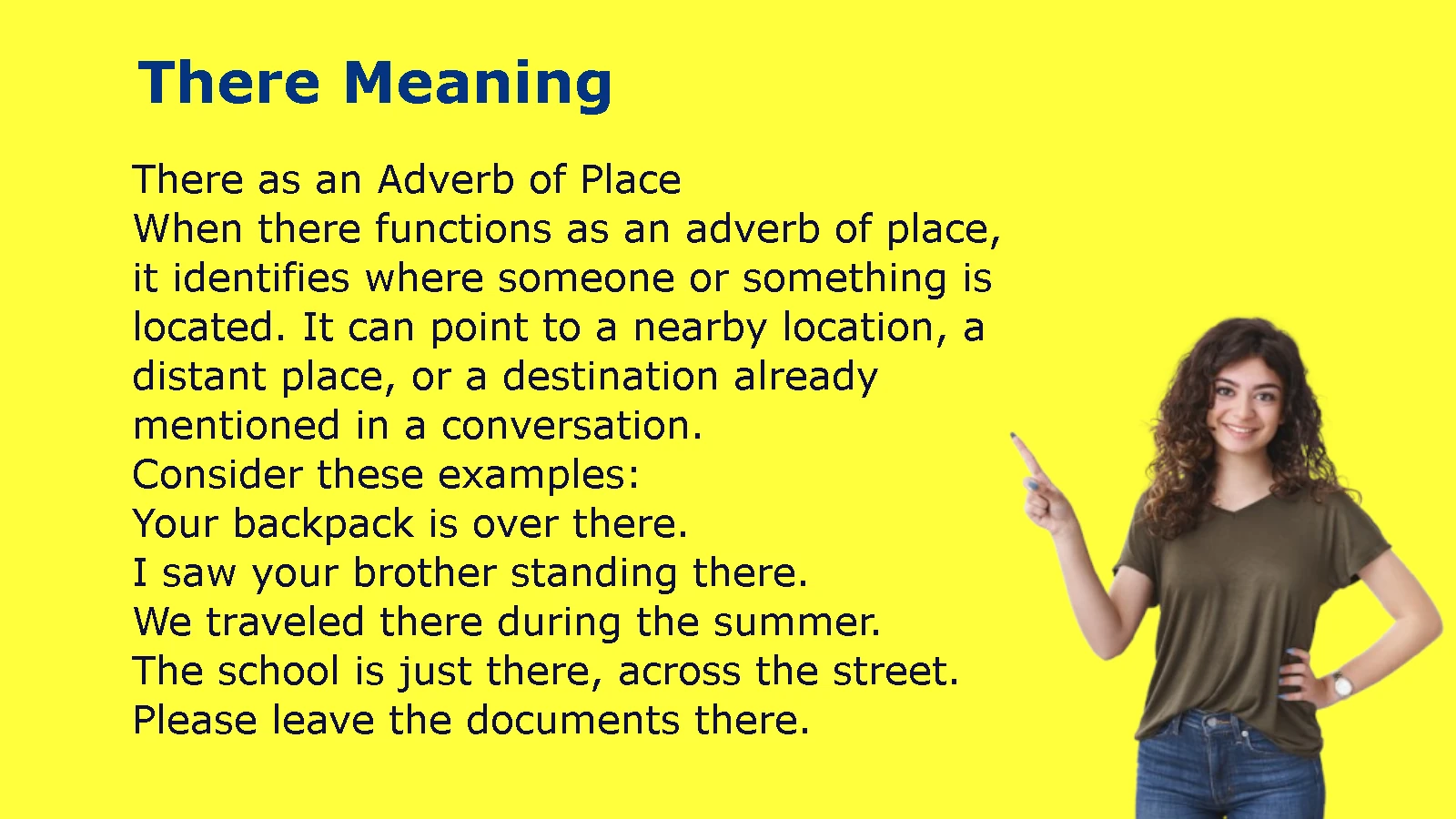
When there functions as an adverb of place, it identifies where someone or something is located. It can point to a nearby location, a distant place, or a destination already mentioned in a conversation.
Consider these examples:
- Your backpack is over there.
- I saw your brother standing there.
- We traveled there during the summer.
- The school is just there, across the street.
- Please leave the documents there.
There often contrasts with here.
- Here means the place where the speaker is.
- There means another place, usually away from the speaker.
For example:
“I am sitting here, but my friends are waiting over there.”
The word here identifies the speaker’s position, while there identifies the friends’ position.
Practical grammar tip: Use there when you want to direct someone’s attention toward a place. You can often replace it with “at that location” without changing the basic meaning.
There as an Introductory Word
The word there also introduces sentences that describe the existence or presence of something. Grammarians often call this construction existential there.
For example:
- There is a problem with the computer.
- There are five people in the room.
- There was a meeting yesterday.
- There will be an opportunity to participate.
In these examples, there does not identify a physical location. Instead, it introduces information about something that exists or happens.
Notice the difference:
- “There is a cat outside.” — Introduces the existence of a cat.
- “The cat is over there.” — Identifies the cat’s location.
Both sentences use there, but their grammatical purposes differ.
Subject-verb agreement also matters when using existential there.
| Sentence | Explanation |
| There is a student outside. | Is agrees with the singular noun student. |
| There are students outside. | Are agrees with the plural noun students. |
| There was an accident. | Was agrees with the singular noun accident. |
| There were several accidents. | Were agrees with the plural noun accidents. |
A common mistake is writing “There is three books on the table.” In standard formal English, write “There are three books on the table.”
There Meaning in Different Contexts
The meaning of there can change slightly depending on how people use it.
Location: It identifies a particular place.
Example: “Your office is over there.”
Existence: It introduces something that exists.
Example: “There is enough time to finish the project.”
Reassurance: It can appear in expressions that comfort or encourage someone.
Example: “There, there. Everything will be okay.”
Attention: It can help someone identify an object or situation.
Example: “There you are! I’ve been looking for you.”
Completion or success: It can appear in expressions that indicate a task is complete.
Example: “There you go. Your account is ready.”
These uses show why readers should examine the complete sentence rather than interpret there in isolation.
There Meaning Examples in Everyday English
The following examples demonstrate how there works in ordinary conversations and written communication.
| Example sentence | Meaning |
| Your keys are over there. | The keys are at another location. |
| There is a dog outside. | A dog exists or is present outside. |
| I have never been there. | The speaker has never visited that place. |
| There are two options available. | Two options exist. |
| Put the package there. | Place the package at that location. |
| There was a loud noise. | A loud noise occurred. |
| We finally arrived there. | We reached the mentioned destination. |
| There is nothing to worry about. | Nothing exists that should cause concern. |
The easiest way to understand there is to ask yourself whether the sentence refers to a place, position, or existence.
What Does Their Mean?
Their is a possessive determiner that shows ownership, belonging, or association. It indicates that something belongs to, relates to, or is connected with people or things already mentioned. Unlike there, their does not refer to a location.
For example:
- Their house is beautiful.
- The students forgot their homework.
- Their parents live nearby.
- Everyone should bring their identification.
In each sentence, their connects an object or characteristic with its owner or associated person.
Their as a Possessive Determiner
A possessive determiner appears before a noun to identify who owns or is associated with something.
Their works similarly to other possessive determiners, such as:
- My
- Your
- His
- Her
- Its
- Our
- Their
Compare these sentences:
- My phone is new.
- Your phone is new.
- Their phone is new.
The possessive word changes, but the sentence structure stays the same.
Here are additional examples:
- Their business has grown significantly.
- Their teacher explained the lesson.
- Their garden looks beautiful.
- Their decision surprised everyone.
- Their ideas helped improve the project.
One important rule: Their normally comes before a noun or a noun phrase.
For example, “Their car is expensive” is correct because car follows their.
However, “The car is their” is generally incorrect when you want to express ownership. In that situation, use the independent possessive pronoun theirs: “The car is theirs.”
Their in Singular and Plural Contexts
Most people learn that their refers to something belonging to multiple people. However, English also uses singular they and their when referring to one person.
For example:
- The students brought their books. (Plural)
- Someone left their umbrella. (Singular)
- Every employee should check their email. (Singular)
- Alex forgot their wallet. (Singular, gender-neutral reference)
Singular their has become a standard and widely accepted feature of modern English.
It is especially useful when:
- A person’s gender is unknown.
- You do not want to specify someone’s gender.
- A person uses they/them pronouns.
- You refer to someone using an indefinite pronoun such as everyone or someone.
Compare:
“Every student must submit his or her assignment.”
“Every student must submit their assignment.”
The second sentence offers a more concise, gender-neutral alternative.
Their Meaning Examples in Sentences
| Sentence | Explanation |
| Their house is near the park. | The house belongs to them. |
| The children packed their bags. | The bags belong to the children. |
| Their opinions matter. | The opinions are associated with them. |
| Everyone should bring their lunch. | Each person should bring their own lunch. |
| Their company hired new employees. | The company is associated with them. |
| The birds returned to their nests. | The nests belong to or are used by the birds. |
Common Mistakes When Using Their
Writers often confuse their with there and they’re because the three words sound alike.
Here are common mistakes and their corrections:
| Incorrect sentence | Correct sentence | Reason |
| There house is large. | Their house is large. | Shows ownership. |
| Their going to school. | They’re going to school. | Means they are going. |
| Put the books over their. | Put the books over there. | Refers to a location. |
| The students forgot there bags. | The students forgot their bags. | Shows possession. |
A useful trick is to ask: Does the sentence show ownership?
If the answer is yes, their is probably the correct choice.
For example:
“The children are playing with ___ toys.”
The toys belong to the children, so the correct word is their.
What Does They’re Mean?
They’re is a contraction of the two words they are. The apostrophe replaces the missing letter in the shortened form. People use they’re in everyday conversations, emails, social media posts, and informal writing to make sentences shorter and more natural.
For example:
- They’re happy with the results.
- They’re coming to the party.
- They’re working on a new project.
- They’re my closest friends.
Whenever you see they’re, try replacing it with they are. If the sentence still makes sense, you have probably used the correct word.
They’re as a Contraction of They Are
A contraction combines two words into one shorter form. English uses contractions frequently in spoken language and informal writing.
Here is how they’re is formed:
| Full expression | Contraction |
| They are | They’re |
| We are | We’re |
| You are | You’re |
| I am | I’m |
| He is | He’s |
| She is | She’s |
The apostrophe in they’re replaces the letter a from are.
For example:
- They are ready. → They’re ready.
- They are studying. → They’re studying.
- They are at home. → They’re at home.
- They are very talented. → They’re very talented.
Both forms communicate the same basic meaning. However, the full form can sound more formal or provide emphasis.
For example:
“They are responsible for the project.”
This sentence can emphasize who has responsibility.
“They’re responsible for the project.”
This version sounds more conversational.
They’re in Different Sentence Structures
They’re can appear in several sentence structures. Understanding these patterns makes it easier to recognize correct usage.
They’re + adjective
Use this structure to describe someone’s condition, personality, or feelings.
Examples:
- They’re excited.
- They’re intelligent.
- They’re disappointed.
- They’re ready.
They’re + verb ending in -ing
Use this structure to describe an action happening now or around the present time.
Examples:
- They’re watching television.
- They’re learning English.
- They’re building a new house.
- They’re preparing for the examination.
They’re + noun or noun phrase
Use this structure when identifying or describing a group of people.
Examples:
- They’re excellent teachers.
- They’re my neighbors.
- They’re the winners of the competition.
- They’re experienced professionals.
They’re + going to + verb
This construction often describes a future plan or intention.
Examples:
- They’re going to visit their grandparents.
- They’re going to launch a new website.
- They’re going to attend the meeting.
They’re Meaning Examples
Here are additional examples that show how they’re works in different situations.
| Sentence | Full form |
| They’re waiting outside. | They are waiting outside. |
| They’re very friendly. | They are very friendly. |
| They’re moving to London. | They are moving to London. |
| They’re interested in science. | They are interested in science. |
| They’re playing football. | They are playing football. |
| They’re planning a vacation. | They are planning a vacation. |
| They’re already here. | They are already here. |
| They’re doing their homework. | They are doing their homework. |
Notice the last example: “They’re doing their homework.”
It contains both they’re and their.
- They’re means they are.
- Their shows ownership of the homework.
This is an excellent example of why understanding grammatical function matters more than simply memorizing spelling.
How to Check Whether They’re Is Correct
The simplest way to identify they’re is to perform the they are replacement test.
Follow these steps:
- Find they’re in your sentence.
- Replace it with they are.
- Read the sentence again.
- Check whether the meaning and grammar remain correct.
For example:
“They’re going to the library.”
Replace they’re:
“They are going to the library.”
The sentence makes sense, so they’re is correct.
Now consider:
“Their going to the library.”
Replace their:
“They are going to the library.”
The replacement changes the original spelling but reveals the intended meaning. Therefore, they’re is the correct choice.
Remember that this test identifies they’re, not their. If you need to show ownership, use their.
There vs. Their vs. They’re: What’s the Difference?
There refers to a place or existence, their indicates possession, and they’re means they are. The correct choice depends on the grammatical role each word performs in a sentence.
Although these words sound almost identical in ordinary speech, they are not interchangeable in writing.
There vs. Their Meaning
The difference between there and their becomes clear when you understand location and possession.
- There: Refers to a place, position, or existence.
- Their: Shows that something belongs to or is associated with people or things.
Compare these sentences:
- Their house is over there.
- Their children are playing there.
- There is a problem with their computer.
- Their school is located over there.
The third example contains both words:
“There is a problem with their computer.”
Here, there introduces the existence of a problem, while their shows that the computer belongs to or is associated with them.
Their vs. They’re Meaning
Their indicates possession, while they’re is a contraction of they are.
Compare:
- Their parents are teachers.
- They’re parents of three children.
The first sentence identifies whose parents they are. The second uses they’re to mean they are.
More examples:
| Their | They’re |
| Their house is beautiful. | They’re building a house. |
| Their dog is friendly. | They’re playing with a dog. |
| Their children are young. | They’re raising three children. |
| Their business is successful. | They’re running a successful business. |
A useful way to remember the distinction is to associate the letter combination in their with heir, a person who receives an inheritance. This connection can remind you that their relates to ownership.
For they’re, remember the apostrophe. It signals that two words have been combined.
There, Their, and They’re Comparison Table
The following table provides a quick reference for all three words.
| Feature | There | Their | They’re |
| Meaning | Place or existence | Ownership or association | They are |
| Grammar | Adverb or introductory word | Possessive determiner | Contraction |
| Apostrophe | No | No | Yes |
| Refers to | Location or existence | People or things and what belongs to them | A group or singular person referred to as they |
| Example | There is a shop nearby. | Their shop is nearby. | They’re opening a shop. |
The difference becomes easier to remember when you focus on three simple questions:
- There: Where is it, or does it exist?
- Their: Who owns it?
- They’re: Can I replace this word with they are?
How to Remember the Difference
Many students memorize definitions but still make mistakes when writing quickly. A better approach is to connect each spelling with a specific meaning.
There = Here
The word there contains the word here. Both relate to places and locations.
Example: Your phone is over there.
Their = Heir
The word their contains heir, which relates to inheritance and ownership.
Example: Their property is valuable.
They’re = They Are
The apostrophe shows that they’re combines two words.
Example: They’re studying English.
Another useful method is to create one sentence containing all three words:
They’re putting their books over there.
Break it down:
- They’re = They are.
- Their = The books belong to them.
- There = A particular location.
This sentence demonstrates all three meanings without changing their grammatical functions.
Common There, Their, and They’re Mistakes
Even experienced writers sometimes confuse these words, especially when typing quickly.
Here are common errors and their corrections:
| Incorrect | Correct | Explanation |
| Their going home. | They’re going home. | They are going home. |
| There bags are missing. | Their bags are missing. | The bags belong to them. |
| Put it over their. | Put it over there. | Refers to a place. |
| They’re house is large. | Their house is large. | Shows ownership. |
| There coming tomorrow. | They’re coming tomorrow. | They are coming tomorrow. |
| Their is a problem. | There is a problem. | Introduces existence. |
Expert writing tip: When editing an article, email, or school assignment, search for every occurrence of there, their, and they’re. Read each sentence independently and check its meaning. A spellchecker may not identify these errors because all three spellings are valid English words.
What Does There Mean in Chat and Texting?
There meaning in chat usually stays the same as its standard English meaning. People use there to identify a place, confirm someone’s presence, or express encouragement. Informal conversations also contain expressions such as “there you go,” “I’m there,” and “been there,” which communicate different ideas depending on context.
There Meaning in Text Messages
In text messages, there commonly identifies a location or tells someone where to find something.
For example:
Conversation 1: Giving directions
Person A: Where is the restaurant?
Person B: It’s over there, next to the bank.
Conversation 2: Confirming a location
Person A: Are you at the office?
Person B: Yes, I’m there now.
Conversation 3: Finding something
Person A: I can’t find my notebook.
Person B: It’s there, beside your laptop.
These examples show that people generally use there in texting just as they do in ordinary speech.
Common Chat Expressions With There
Some expressions containing there have meanings beyond physical location.
| Chat expression | Meaning | Example |
| There you go | Something has been completed or provided | “There you go! I sent the file.” |
| I’m there | Someone has arrived or reached a place | “I’m there in five minutes.” |
| Been there | Experienced the same situation | “I know how you feel. Been there.” |
| There it is | Something has been found or identified | “There it is! Your missing key.” |
| You had to be there | An experience is difficult to explain | “The joke was hilarious. You had to be there.” |
| There you are | Someone has been found or has appeared | “There you are! I’ve been waiting.” |
These expressions are common in casual digital communication, but their meanings depend on the surrounding conversation.
There vs. Their in Online Conversations
Fast typing often causes people to use the wrong homophone. Autocorrect may also replace one word with another.
For example:
- “Their waiting for us” should be “They’re waiting for us.”
- “Your bag is over their” should be “Your bag is over there.”
- “There going to visit” should be “They’re going to visit.”
Consider this short chat:
Where are your friends?
Alex
They’re waiting over there.
You
Is that their car?
Alex
Yes, their car is next to the entrance.
You
The conversation uses all three grammatical ideas correctly: they’re describes what the friends are doing, there identifies their location, and their identifies ownership.
How to Explain There Meaning to Kids
There meaning for kids is easiest to explain through familiar places, objects, and simple sentences. Teach children that there can point to where something is or tell us that something exists. Use toys, school supplies, and everyday activities to make the meaning easier to understand.
What Does There Mean for Kids?
A child-friendly definition is:
There is a word we use when we talk about a place or say that something exists.
For example:
- Your pencil is over there.
- There is a ball under the table.
- Look! There is a bird.
- Your shoes are there.
Parents and teachers can make this explanation more effective by pointing toward objects while saying the word.
For instance, place a toy on a table and say, “The toy is there.”
Then move it to another place and repeat the sentence. This connects the word with a physical action.
Easy Examples of There for Children
Here are simple sentences that children can read and understand.
| Sentence | What it teaches |
| Look over there! | Identifying a location |
| There is a cat. | Something exists |
| Your bag is there. | Describing a position |
| There are two apples. | Introducing multiple objects |
| The school is over there. | Identifying a destination |
| There is a rainbow. | Describing something present |
Use short sentences at first. Once children understand the basic meaning, introduce longer sentences and different grammatical uses.
Teaching Kids the Difference Between There, Their, and They’re
Children can learn all three words by connecting each spelling with a simple question.
| Word | Child-friendly explanation | Example |
| There | A place or something that exists | The toy is over there. |
| Their | Something belongs to someone | Their toys are colorful. |
| They’re | Short for they are | They’re playing outside. |
Try this simple teaching activity:
Step 1: Teach there with location.
Point to a chair and say, “The chair is there.”
Step 2: Teach their with ownership.
Give two children separate toys and say, “These are their toys.”
Step 3: Teach they’re with action.
Point to the children playing and say, “They’re playing.”
Step 4: Mix the words.
Ask the children to complete sentences using the correct spelling.
This approach teaches meaning through real situations instead of relying only on memorization.
Fun Activities to Practice There, Their, and They’re
Learning grammar becomes easier when children actively participate.
Here are some activities parents and teachers can use:
- Word matching: Match there with a picture of a location, their with an ownership example, and they’re with an action.
- Fill-in-the-blanks: Give children sentences with missing words.
- Sentence building: Ask children to create one sentence using all three words.
- Classroom treasure hunt: Hide objects and ask children to describe where they are.
- Picture description: Show a picture of children playing and ask students to write what they’re doing and identify their belongings.
A short activity can make a lasting difference because children learn to recognize how each word works in context.
What Does There Mean in Arabic?
There can have several Arabic translations depending on its grammatical function and the context of a sentence. The most common translation for a location is هناك (hunāk), which means “there” or “in that place.” When there introduces existence, Arabic may use يوجد (yūjad) or هناك, depending on the sentence.
There as a Place in Arabic
The Arabic word هناك commonly translates there when referring to a location.
For example:
| English | Arabic |
| He is there. | هو هناك. |
| The school is over there. | المدرسة هناك. |
| I went there yesterday. | ذهبت إلى هناك أمس. |
| Put the book there. | ضع الكتاب هناك. |
| My friends are there. | أصدقائي هناك. |
The exact Arabic sentence may change depending on the speaker, gender, number, and sentence structure.
There as an Expression of Existence in Arabic
English frequently uses there to introduce the existence of something. Arabic expresses this meaning through different constructions.
For example:
| English | Arabic |
| There is a problem. | هناك مشكلة. |
| There is a book on the table. | يوجد كتاب على الطاولة. |
| There are many students. | يوجد العديد من الطلاب. |
| There is a beautiful garden. | توجد حديقة جميلة. |
| There are two restaurants nearby. | يوجد مطعمان بالقرب من هنا. |
Notice that Arabic does not always translate existential there with one fixed word. The best translation depends on the sentence and the noun being described.
There vs. Their in Arabic
There and their have different meanings in English, so their Arabic translations also differ.
- There: هناك — refers to a place.
- Their: لهم، ـهم, or other possessive constructions depending on context — indicates ownership or association.
For example:
| English | Arabic |
| Their house is beautiful. | منزلهم جميل. |
| Their children are studying. | أطفالهم يدرسون. |
| The books are over there. | الكتب هناك. |
| Their teacher is here. | معلمهم هنا. |
The English word their does not have one universal Arabic equivalent. Arabic uses possessive suffixes and other constructions that vary according to gender, number, and grammatical context.
Examples of There in English and Arabic
Here are some additional translations to help Arabic-speaking English learners understand the word.
| English sentence | Arabic translation |
| There is a hospital nearby. | يوجد مستشفى بالقرب من هنا. |
| Your bag is over there. | حقيبتك هناك. |
| There are many people outside. | هناك الكثير من الناس في الخارج. |
| I want to go there. | أريد الذهاب إلى هناك. |
| There is nothing here. | لا يوجد شيء هنا. |
Learning tip: If you’re translating there into Arabic, first determine whether the English sentence describes a location or introduces existence. This simple distinction helps you select a more natural translation.
Synonyms of There
Synonyms of there are words or expressions that communicate a similar meaning, particularly when there refers to a place or location. Common alternatives include over there, in that place, at that location, yonder, and in that area. However, the best replacement depends on the sentence because not every use of there has a direct synonym.
Synonyms of There When Referring to a Place
When there identifies a location, you can often replace it with another location-based expression.
| Synonym or alternative | Meaning | Example |
| Over there | At a place some distance away | Your jacket is over there. |
| In that place | Within the mentioned location | I have never been in that place. |
| At that location | At a specific position | The meeting will take place at that location. |
| Yonder | At some distance away | The village lies yonder. |
| In that area | Within a particular region | Several shops operate in that area. |
| At that spot | At a particular point | Leave the package at that spot. |
| On that side | At the indicated side | The entrance is on that side. |
| In that direction | Toward the indicated place | Walk in that direction. |
Some alternatives sound more natural in particular situations.
For example, yonder is an older or more literary expression that often appears in descriptive writing. Meanwhile, “at that location” sounds more formal and works well in professional communication.
Synonyms of There in Different Contexts
Not every use of there refers to a physical location. Therefore, you should choose alternatives based on the intended meaning.
When there refers to a location:
- Over there
- In that place
- At that location
- At that spot
- In that area
Example:
“The library is there.”
Alternative:
“The library is at that location.”
When there introduces existence:
There is no direct replacement that works in every sentence. However, you can sometimes restructure the sentence.
Example:
“There are several reasons for this decision.”
Alternative:
“Several reasons explain this decision.”
Another example:
“There is a problem with the software.”
Alternative:
“A problem exists with the software.”
These alternatives preserve the general meaning while changing the sentence structure.
When there appears in an expression:
Some phrases require a complete expression rather than a single-word synonym.
Example:
“There you go!”
Depending on the context, you might say:
- Here you are!
- That’s it!
- There it is!
Examples of There Synonyms in Sentences
Compare these original sentences with their alternatives.
| Original sentence | Alternative | Context |
| Your shoes are there. | Your shoes are over there. | Location |
| I worked there for five years. | I worked at that location for five years. | Workplace |
| The children live there. | The children live in that area. | Residence |
| The restaurant is there. | The restaurant is at that spot. | Direction |
| There are several solutions. | Several solutions exist. | Existence |
Remember that synonyms do not always have identical meanings. A good writer chooses alternatives that preserve the intended meaning, tone, and grammatical structure.
Words That Are Related to There
Several English words share a connection with there because they describe places, positions, or locations.
| Word | Meaning | Example |
| Here | The speaker’s current location | Come here. |
| Where | Asks about a location | Where are you? |
| Somewhere | An unspecified place | I left it somewhere. |
| Anywhere | Any possible place | You can sit anywhere. |
| Everywhere | All places | Flowers were growing everywhere. |
| Nowhere | No place | There is nowhere to park. |
These words help learners build a broader understanding of English location vocabulary.
What Does Where Mean?
Where is an English adverb commonly used to ask about or identify a place, position, or location. Unlike there, which points to a location or introduces existence, where generally asks which place someone means. It can also introduce clauses that describe locations.
Examples:
- Where do you live?
- Where is my phone?
- Where are the children?
- This is where we first met.
Where as a Question Word
Where is one of the most common question words in English. People use it to ask about a person’s location, an object’s position, or the destination of an activity.
Examples:
- Where are you going?
- Where did you buy that jacket?
- Where is the nearest hospital?
- Where can I find the information?
- Where do you want to meet?
In each sentence, where requests information about a place.
It often appears at the beginning of a question, followed by an auxiliary verb or another appropriate verb structure.
| Question | What it asks |
| Where are you? | Current location |
| Where is the bank? | Position of a building |
| Where did they go? | Past destination |
| Where will we meet? | Future meeting location |
| Where can I park? | Available parking location |
Where in Statements and Clauses
Where does not only appear in questions. It can also introduce clauses that provide information about a place.
For example:
- This is where I grew up.
- I remember where we first met.
- The restaurant is where the old cinema used to be.
- We found the place where the accident happened.
In these examples, where connects information about a location with the rest of the sentence.
Where can also introduce relative clauses.
Example:
“This is the house where my grandparents lived.”
The clause “where my grandparents lived” identifies the house.
Where vs. There: What’s the Difference?
Where and there both relate to locations, but they perform different functions.
- Where asks about a location or introduces information about one.
- There identifies a location or introduces the existence of something.
Compare:
| Where | There |
| Where is your office? | Your office is there. |
| Where are the keys? | The keys are over there. |
| Where did you go? | I went there yesterday. |
| Where is the school? | There is a school nearby. |
A simple way to remember the distinction is:
Where asks. There answers.
For example:
Person A: “Where is the library?”
Person B: “The library is over there.”
Where, There, and Here: Understanding the Difference
Here, there, and where are related location words, but each communicates a different idea.
| Word | Meaning | Example |
| Here | The place where the speaker is | I am here. |
| There | Another or previously mentioned place | Your friend is there. |
| Where | Asks about a place | Where is your friend? |
Consider this short conversation:
Person A: “Where are you?”
Person B: “I’m here.”
A: “Where is your brother?”
Person B: “He’s over there.”
This example demonstrates how all three words work together naturally.
Common Grammar Mistakes With There, Their, They’re, and Where
Writers often confuse these words because they perform different grammatical functions but sound similar or share a connection with location. The best way to avoid mistakes is to understand the intended meaning before choosing a spelling.
Using Their Instead of There
This mistake happens when someone uses the possessive word their to describe a location.
Incorrect: “Your shoes are over their.”
Correct: “Your shoes are over there.”
Why? The sentence identifies where the shoes are located. It does not describe ownership.
Another example:
Incorrect: “Their is a new restaurant nearby.”
Correct: “There is a new restaurant nearby.”
The second sentence introduces the existence of a restaurant.
Using There Instead of They’re
This error commonly occurs when someone forgets that they’re means they are.
Incorrect: “There going to the movies.”
Correct: “They’re going to the movies.”
Another example:
Incorrect: “There happy with the decision.”
Correct: “They’re happy with the decision.”
Apply the replacement test:
“They are happy with the decision.”
The sentence makes sense, so they’re is the correct spelling.
Confusing Where and There
People sometimes use where when they mean there or the other way around.
Incorrect: “I left my bag where.”
Correct: “I left my bag there.”
However, if you are asking about the location, use where:
“Where did I leave my bag?”
The difference is simple: where requests location information, while there identifies a location.
Simple Grammar Rules to Avoid These Mistakes
Use these practical rules whenever you write.
| Grammar rule | Correct word | Example |
| Referring to a location | There | The shop is over there. |
| Introducing existence | There | There is a solution. |
| Showing ownership | Their | Their house is beautiful. |
| Shortening they are | They’re | They’re coming soon. |
| Asking about location | Where | Where do you live? |
You can also use this quick editing checklist:
- Does the sentence describe a place? Consider there.
- Does it introduce something that exists? Consider there.
- Does it show ownership? Use their.
- Can you replace the word with they are? Use they’re.
- Are you asking about a location? Use where.
A Real-World Writing Example
Imagine you’re writing a message to a group of colleagues about a meeting.
A confusing version might read:
“Their going to meet us over their. There bringing they’re documents.”
This sentence contains three spelling mistakes.
The corrected version is:
“They’re going to meet us over there. They’re bringing their documents.”
Now each word performs the correct grammatical function:
- They’re = They are going to meet us.
- There = The meeting location.
- Their = The documents belong to them.
This kind of editing exercise is useful because it demonstrates how a small spelling mistake can change the meaning or clarity of an entire sentence.
Practice Exercises: There, Their, or They’re?
Practice helps you recognize the difference between these homophones without stopping to think about every spelling rule.
The following exercises test your understanding of there, their, and they’re in everyday situations.
Fill-in-the-Blank Questions
Choose the correct word to complete each sentence: there, their, or they’re.
- ______ going to visit their grandparents tomorrow.
- The children left ______ shoes outside.
- Your notebook is over ______.
- ______ is a new student in our classroom.
- ______ planning to open a new business.
- The students completed ______ assignments.
- Put the groceries over ______.
- ______ are several ways to solve this problem.
- My friends said ______ ready for the trip.
- The teachers collected ______ books.
Multiple-Choice Grammar Quiz
Choose the correct answer for each question.
Test your grammar
0 of 6 answered
1. _____ going to the library.
There
Their
They’re
2. The students forgot _____ homework.
there
their
they’re
3. Your keys are over _____.
there
their
they’re
4. _____ is a beautiful park nearby.
Their
They’re
There
5. _____ very excited about the results.
There
Their
They’re
6. The children are playing with _____ toys.
there
their
they’re
Check my answers
Answer Key With Explanations
Here are the correct answers to the fill-in-the-blank exercise.
| No. | Correct answer | Explanation |
| 1 | They’re | They are going to visit. |
| 2 | Their | The shoes belong to the children. |
| 3 | There | Identifies the notebook’s location. |
| 4 | There | Introduces the existence of a student. |
| 5 | They’re | They are planning to open a business. |
| 6 | Their | The assignments belong to the students. |
| 7 | There | Identifies where to put the groceries. |
| 8 | There | Introduces the existence of several ways. |
| 9 | They’re | They are ready for the trip. |
| 10 | Their | The books belong to the teachers. |
How to evaluate your progress:
- 9–10 correct: Excellent understanding.
- 7–8 correct: Good progress; review the differences between the words.
- 5–6 correct: Practice the replacement and ownership tests.
- Fewer than 5 correct: Revisit the definitions and examples before trying again.
Frequently Asked Questions About There Meaning
What is the simple meaning of there?
There is a word that refers to a place, position, or the existence of something. For example, “Your book is over there” identifies a location, while “There is a book on the table” introduces something that exists.
What is the difference between there and their?
There refers to a place or introduces existence, while their indicates ownership or association. For example, “Their house is over there” uses their to show ownership and there to identify the house’s location.
What does there mean in texting?
In texting, there generally has the same meaning as in standard English. It can identify a location or appear in casual expressions such as “there you go,” “I’m there,” and “been there.” Its meaning depends on the conversation.
What is the difference between their and they’re?
Their is a possessive determiner that shows ownership, while they’re is a contraction of they are. For example, “Their friends are here” shows association, while “They’re here” means they are here.
What does there mean in Arabic?
There commonly translates as هناك (hunāk) when referring to a location. When introducing existence, Arabic may use هناك or يوجد (yūjad). The correct translation depends on the sentence and its grammatical structure.
How do you teach children the difference between there, their, and they’re?
Start with three simple rules: there refers to a place, their shows ownership, and they’re means they are. Use pictures, classroom objects, short sentences, and fill-in-the-blank exercises to help children recognize the differences.
Conclusion: Remember the Difference Between There, Their, and They’re
Understanding there meaning becomes much easier when you recognize how the word functions in a sentence. There refers to a location or introduces the existence of something. Their shows ownership, while they’re is simply a shorter form of they are.
Although these three words sound alike, their grammatical purposes are different.
Remember these simple rules:
- There: Think of a place or something that exists.
- Their: Think of ownership or belonging.
- They’re: Replace it with they are.
- Where: Use it when asking about a location.
For example, “They’re putting their bags over there” demonstrates all three words correctly.
If you want to improve your English grammar, practice identifying these words in books, emails, text messages, and everyday conversations. Pay attention to their meanings rather than relying only on how they sound.
Ready to test your English skills? Try the exercises above, create your own sentences, and use the replacement test whenever you’re unsure whether to write there, their, or they’re.













