The bougie meaning depends on the context: in modern slang, bougie describes someone or something that seems fancy, luxurious, expensive, or overly concerned with social status. In medicine, a bougie is a slender instrument that clinicians use for purposes such as guiding an endotracheal tube or widening certain body passages. Although these meanings share the same spelling, they belong to different contexts.
You may encounter bougie slang in everyday conversations, social media captions, music, and discussions about expensive lifestyles. The word also raises questions about bougie vs. boujee, correct pronunciation, and its relationship with the French-derived word bourgeois. In healthcare, terms such as bougie intubation, bougie dilator, and bougie and stylet describe different clinical applications.
This guide explains both meanings, provides original sentence examples, and explores the differences between everyday slang and medical terminology.
| Question | Answer |
| What does bougie mean? | Bougie describes something fancy, luxurious, expensive, or associated with upper-middle-class tastes. |
| What does bougie mean in slang? | It describes people, places, or preferences that seem sophisticated, wealthy, or sometimes pretentious. |
| Is it bougie or boujee? | Both spellings appear in informal English. Bougie is the established spelling, while boujee is strongly associated with modern hip-hop culture. |
| How do you pronounce bougie? | Common American pronunciations include BOO-zhee and BOO-jee. |
| What does bougie mean in medicine? | A bougie is a slender medical instrument used for applications such as airway guidance or dilation. |
What Does Bougie Mean?
Bougie is an informal English word that usually describes someone or something associated with luxury, expensive preferences, sophistication, or upper-middle-class tastes. People often use it humorously to describe someone who enjoys premium products or dislikes ordinary alternatives. Depending on the speaker’s tone, the word can express admiration, playful teasing, or criticism.
For example, someone who refuses to drink ordinary coffee because they prefer a $9 specialty latte might jokingly describe themselves as bougie.
The word can describe several things:
- A person: Someone who enjoys expensive products, exclusive experiences, or upscale surroundings.
- A lifestyle: A way of living that emphasizes luxury, comfort, and premium experiences.
- A place: An expensive restaurant, stylish hotel, or high-end neighborhood.
- A preference: Choosing designer clothing, premium skincare, or specialty food over cheaper alternatives.
- A behavior: Acting sophisticated or socially superior because of personal tastes.
However, bougie does not always mean wealthy. Someone can enjoy luxurious experiences without having a high income. The word often describes preferences, attitudes, and appearances rather than actual financial circumstances.
Bougie Meaning in Simple Words
In simple English, bougie means fancy or luxurious, especially when someone has expensive tastes or enjoys things associated with a higher social class.
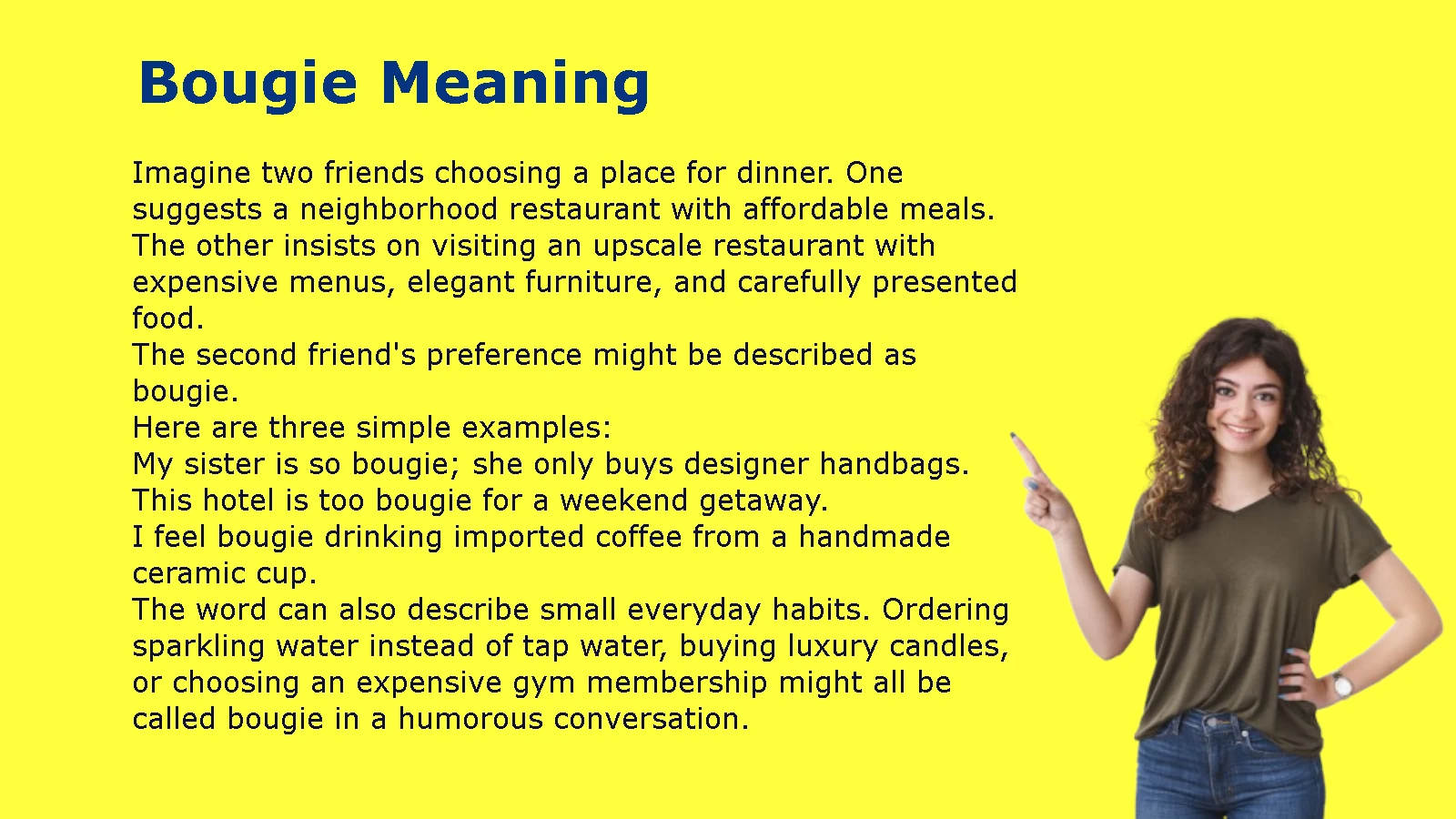
Imagine two friends choosing a place for dinner. One suggests a neighborhood restaurant with affordable meals. The other insists on visiting an upscale restaurant with expensive menus, elegant furniture, and carefully presented food.
The second friend’s preference might be described as bougie.
Here are three simple examples:
- My sister is so bougie; she only buys designer handbags.
- This hotel is too bougie for a weekend getaway.
- I feel bougie drinking imported coffee from a handmade ceramic cup.
The word can also describe small everyday habits. Ordering sparkling water instead of tap water, buying luxury candles, or choosing an expensive gym membership might all be called bougie in a humorous conversation.
What Does Bougie Mean in Slang?
Bougie meaning slang refers to someone or something that appears luxurious, expensive, sophisticated, or influenced by upper-class preferences.
Modern slang often uses the word playfully. Someone might call a friend bougie because they enjoy premium restaurants, fashionable clothing, expensive vacations, or specialty products.
However, the term can also carry a negative meaning. It may suggest that someone is pretentious, materialistic, snobbish, or overly concerned with appearing wealthy.
Consider these examples:
| Slang example | Intended meaning |
| She’s too bougie for fast food. | She prefers expensive or upscale dining. |
| That’s a bougie apartment. | The apartment looks luxurious or expensive. |
| Don’t get bougie on us! | Don’t start acting superior or overly fancy. |
| I bought bougie skincare products. | I purchased expensive or premium skincare. |
| This coffee shop is bougie. | The shop has an upscale or fashionable atmosphere. |
The meaning depends heavily on context.
When friends use bougie to tease one another, the word may express affection rather than genuine criticism. In a more serious discussion about social class, it can criticize people who prioritize status and luxury.
What Is a Bougie Person?
A bougie person is someone who enjoys expensive, fashionable, or luxurious things and may prefer upscale experiences over ordinary alternatives.
The label does not automatically mean that someone is rich. A person can have a modest income but still enjoy premium brands, carefully selected accessories, and expensive dining experiences.
Common characteristics associated with a bougie lifestyle include:
- Preferring designer clothing over basic fashion.
- Choosing premium restaurants for special occasions.
- Buying specialty coffee and imported food.
- Enjoying luxury hotels and exclusive vacations.
- Spending money on expensive skincare and beauty products.
- Paying attention to interior design and home decoration.
- Preferring high-end brands and personalized services.
For example, imagine someone who buys expensive candles, uses a premium coffee machine, and carefully selects designer furniture for a small apartment.
Their lifestyle might seem bougie even if they do not own a large house or an expensive car.
Important distinction: Enjoying quality products does not necessarily make someone pretentious. Bougie becomes more critical when someone uses expensive preferences to look down on others.
Is Bougie a Compliment or an Insult?
Bougie can be either a compliment or an insult. Its meaning depends on the speaker’s intention, relationship with the listener, and conversational context.
Some people use it positively to describe elegance, excellent taste, or an attractive lifestyle. Others use it negatively to criticize excessive spending, snobbery, or social superiority.
| Context | Meaning | Example |
| Positive | Stylish or luxurious | Your new apartment looks bougie! |
| Playful | Enjoying fancy things | You’re getting bougie with that coffee order. |
| Negative | Pretentious or snobbish | He acts too bougie to eat with everyone. |
| Neutral | Upscale or expensive | We booked a bougie hotel downtown. |
If someone says, “You look bougie tonight,” they may be complimenting your clothes or appearance.
However, if someone says, “You have become too bougie for your old friends,” they are probably criticizing your attitude.
The safest way to understand the word is to pay attention to tone and situation rather than assuming it always expresses praise or disapproval.
Bougie vs. Boujee: What’s the Difference?
Bougie and boujee have similar meanings in modern slang. Both can describe luxurious tastes, expensive lifestyles, fashionable preferences, or people who enjoy appearing sophisticated. However, bougie is the more established spelling, while boujee became especially popular through contemporary hip-hop and social media culture.
The two forms often overlap in everyday conversations. Writers generally choose bougie for the established slang expression and boujee when deliberately using the modern cultural spelling.
Bougie Meaning and Origin
The slang word bougie comes from bourgeois, a French-derived word associated with the middle class and, in modern social criticism, material comfort, conventional respectability, and class-conscious behavior.
Historically, the bourgeoisie referred to the urban middle class. Over time, bourgeois also developed a critical association with people who valued material possessions, social position, and conventional status.
English speakers shortened and adapted the term into bougie.
Its modern slang meaning developed beyond its original social-class definition. Today, people commonly use it to describe someone with expensive tastes or a preference for luxury.
For example:
- A person who only shops at high-end stores might be called bougie.
- A restaurant with expensive decorations and exclusive menus might be described as bougie.
- Someone who prefers premium products might jokingly call themselves bougie.
The connection to bourgeois remains important because it explains why the word sometimes carries a social-class or pretentiousness implication.
Boujee Meaning and Origin
Boujee is a popular alternative spelling of bougie. It became especially recognizable through hip-hop culture and the popularity of the song Bad and Boujee by Migos, featuring Lil Uzi Vert.
The song helped bring the spelling into mainstream conversations, particularly among younger audiences and social media users.
In modern usage, boujee often describes someone who enjoys luxury, fashionable products, expensive experiences, or a glamorous lifestyle.
For example:
- That restaurant has a boujee atmosphere.
- She bought a boujee handbag for her birthday.
- We’re having a boujee weekend at a luxury resort.
Boujee can also carry a playful sense of confidence. Someone might use it to celebrate their taste for expensive experiences rather than criticize another person’s behavior.
Bougie vs. Boujee: Comparison Table
| Feature | Bougie | Boujee |
| Meaning | Fancy, luxurious, or pretentious | Fancy, luxurious, stylish, or glamorous |
| Spelling | Established slang spelling | Modern alternative spelling |
| Origin | Connected to bourgeois | Popularized through modern hip-hop culture |
| Usage | Everyday conversations and writing | Music, social media, and casual conversations |
| Tone | Can be positive, playful, or critical | Often playful, stylish, or aspirational |
| Example | That restaurant is bougie. | That restaurant is boujee. |
The difference is mainly stylistic and cultural rather than a strict difference in dictionary meaning.
Which Spelling Is Correct: Bougie or Boujee?
Both spellings appear in informal English, but bougie is the more established form.
Choose bougie when writing about the general slang meaning of fancy, luxurious, or pretentious. Use boujee when you want to reflect the spelling associated with modern hip-hop culture or a particular social media style.
For example:
- Correct established slang: Her apartment looks bougie.
- Popular alternative spelling: Her apartment looks boujee.
Neither spelling should be confused with boogie, which usually refers to a style of dancing or music.
That distinction matters because the three words look similar but have different meanings.
How to Pronounce Bougie
The common American pronunciation of bougie is BOO-zhee or BOO-jee. The word has two syllables, with the stress on the first syllable. Its final consonant sound can resemble the sound in measure or the sound in judge, depending on the pronunciation used.
Bougie Pronunciation in American English
Two common pronunciations are:
| Pronunciation | IPA | Sound explanation |
| BOO-zhee | /ˈbuːʒi/ | The middle consonant sounds like the s in measure. |
| BOO-jee | /ˈbuːdʒi/ | The middle consonant sounds like the j in judge. |
Both pronunciations occur in American English.
The first syllable receives the strongest emphasis. The final syllable is shorter and lighter.
To practice:
- Start with the long vowel sound in blue.
- Add the middle consonant sound.
- Finish with a short, unstressed ending.
- Keep the stress on the first syllable.
The word is generally pronounced the same way whether someone uses the spelling bougie or boujee.
How to Pronounce Boujee
Boujee generally shares the same pronunciation as bougie in modern English slang.
The alternative spelling does not normally create a different spoken word.
For example:
- Bougie lifestyle.
- Boujee lifestyle.
- Bougie restaurant.
- Boujee restaurant.
In ordinary conversation, listeners generally understand both forms from context.
Common Bougie Pronunciation Mistakes
English learners sometimes confuse bougie with similar-looking words.
Avoid these mistakes:
- Confusing bougie with boogie: Boogie has a different vowel sound and usually relates to dancing or music.
- Overemphasizing the final syllable: The main stress belongs at the beginning.
- Treating the spelling as a pronunciation rule: The letter combinations do not necessarily tell you which common pronunciation a speaker will use.
- Assuming every speaker uses the same consonant: Both common American pronunciations are used.
Regional accent and personal speaking habits can influence pronunciation.
How to Use Bougie in a Sentence
Bougie functions mainly as an informal adjective in modern slang. It describes people, products, places, activities, and preferences associated with luxury or expensive tastes.
It can appear before a noun or after a linking verb.
Examples:
- She bought a bougie handbag.
- That restaurant is bougie.
- We stayed at a bougie hotel.
- His coffee preferences are getting bougie.
The word is flexible, which makes it useful in casual conversations, social media captions, and humorous descriptions.
Bougie Examples in Everyday Conversations
Here are original examples showing how people use bougie in different situations.
Food and restaurants
- My brother is so bougie that he refuses to eat at ordinary burger restaurants.
- This little café serves bougie desserts with edible gold decorations.
- We wanted a simple dinner, but she chose the most bougie restaurant in town.
Fashion and accessories
- Her new handbag looks expensive and incredibly bougie.
- I feel bougie wearing designer sunglasses to the grocery store.
- He bought a bougie watch even though his old one worked perfectly.
Travel and hotels
- Our vacation became bougie when we booked a private villa.
- That resort is too bougie for our usual weekend budget.
- They prefer bougie hotels with room service and ocean views.
Home decoration
- My living room looks bougie after I added velvet curtains and modern lighting.
- She bought a bougie coffee machine for her tiny kitchen.
- Those handmade decorations give the apartment an upscale feel.
Personal preferences
- I have become bougie about the coffee I drink.
- He is surprisingly bougie when choosing skincare products.
- We wanted a relaxed evening, but she planned a bougie dinner party.
These examples show that bougie does not always describe a wealthy person. It can describe an individual preference or a single expensive experience.
Bougie Examples in Social Media
Social media has helped popularize bougie as a humorous way to describe luxury and personal preferences.
People often use it in captions, comments, memes, and short videos.
Here are some natural examples:
- “A little bougie, a little budget-conscious.”
- “Sunday mornings deserve bougie coffee.”
- “My skincare routine has officially become bougie.”
- “Living my bougie dreams one vacation at a time.”
- “Too bougie for instant coffee today.”
- “A bougie dinner without the expensive restaurant bill.”
The word also works as a form of self-deprecating humor.
For example, someone might post a picture of an ordinary homemade breakfast and caption it, “Feeling bougie with my homemade avocado toast.”
The humor comes from describing a relatively simple experience with language associated with luxury.
Bougie Synonyms and Related Words
Several English words have meanings similar to bougie. However, each synonym emphasizes a slightly different quality.
| Synonym | Meaning | Example |
| Fancy | Elaborate, stylish, or expensive | She booked a fancy restaurant. |
| Posh | Associated with wealth and high social status | They stayed in a posh hotel. |
| Luxurious | Providing exceptional comfort or quality | The resort offers luxurious rooms. |
| Upscale | Designed for customers seeking premium experiences | We visited an upscale shopping district. |
| Classy | Elegant and tasteful | Her outfit looks classy. |
| Pretentious | Trying to appear more sophisticated or important | His comments sounded pretentious. |
| Snobbish | Treating others as socially inferior | Her snobbish attitude upset everyone. |
| High-end | Expensive or premium in quality | This store sells high-end furniture. |
What Does Bougie Mean in Medical Terms?
In medicine, a bougie is a slender instrument designed for specific clinical applications, including guiding devices through anatomical passages or gradually widening narrowed structures. Medical professionals use different types of bougies depending on the procedure. An airway introducer and an esophageal dilation instrument serve different purposes and should not be confused.
The medical meaning is unrelated to the modern slang meaning of luxury or expensive taste.
The term has a separate historical background. The French word bougie means candle and is also associated with Béjaïa, a city in present-day Algeria historically known in European trade for its candle wax. Early medical instruments used for dilation were long, narrow, and candle-like in shape.
What Is a Medical Bougie?
A medical bougie is an elongated instrument that clinicians use to access, guide, or dilate certain anatomical passages.
Its design varies according to its intended application. Some are flexible, while others have a more structured design. Materials, diameter, length, and surface characteristics also depend on the clinical purpose.
Common medical applications include:
- Airway management: A bougie can help guide an endotracheal tube during selected intubation procedures.
- Esophageal dilation: Certain bougies gradually widen a narrowed esophagus.
- Urethral dilation: Specialized instruments can help clinicians widen a narrowed urethra.
The word therefore does not refer to one universal medical device.
A bougie used in airway management is not interchangeable with an instrument designed for esophageal or urethral dilation.
What Is a Bougie Dilator?
A bougie dilator is an elongated medical instrument used to widen a narrowed anatomical passage.
Dilation is the medical process of increasing the diameter of a structure that has become abnormally narrow. Clinicians select the instrument according to the affected body part, the underlying condition, and the patient’s anatomy.
Bougie dilators have applications in areas such as:
Esophageal dilation
The esophagus is the muscular tube that carries food from the mouth to the stomach.
Certain conditions can cause this passage to narrow, making swallowing difficult. Clinicians may use specialized dilation instruments to gradually widen the affected area.
Urethral dilation
The urethra is the tube that carries urine out of the body.
A urethral stricture is an abnormal narrowing that can restrict urine flow. In selected cases, clinicians may use specialized instruments to widen the narrowed area.
Dilation requires appropriate assessment and clinical supervision. It can cause bleeding, tissue injury, infection, or perforation if performed incorrectly.
What Is an Esophageal Bougie?
An esophageal bougie is a medical instrument used in selected procedures to widen a narrowed section of the esophagus.
Esophageal narrowing can occur for several reasons, including:
- Scar tissue following chronic acid reflux.
- Inflammation and tissue damage.
- Previous surgery or medical treatment.
- Certain structural disorders.
- Benign esophageal strictures.
Patients with an esophageal stricture may experience symptoms such as difficulty swallowing, food sticking in the throat or chest, and discomfort when eating.
A clinician evaluates the underlying cause before selecting a treatment.
Depending on the situation, esophageal dilation may involve bougie dilators or balloon dilators.
| Feature | Bougie dilation | Balloon dilation |
| Instrument | Elongated dilator | Inflatable balloon |
| Main purpose | Gradually widen a narrowed passage | Expand a narrowed passage using controlled inflation |
| Contact | Applies pressure along the instrument’s contact area | Applies outward pressure through the inflated balloon |
| Clinical selection | Depends on anatomy and clinical circumstances | Depends on anatomy and clinical circumstances |
Neither approach is automatically better for every patient. The clinician chooses based on the location, shape, severity, and cause of the narrowing.
What Is a Urethral Bougie?
A urethral bougie is a specialized instrument used in selected medical procedures involving urethral narrowing.
A urethral stricture can develop when scar tissue reduces the normal diameter of the urethra. This narrowing may interfere with the normal flow of urine.
Possible symptoms include:
- A weak urine stream.
- Difficulty starting urination.
- Frequent urination.
- Pain or discomfort during urination.
- A feeling that the bladder has not emptied completely.
- Urinary retention in more severe cases.
A urologist assesses the condition before deciding whether dilation or another treatment is appropriate.
The treatment plan depends on the stricture’s length, location, severity, and recurrence history.
Repeated dilation does not permanently resolve every urethral stricture. Some patients require other interventions, such as urethrotomy or urethroplasty.
What Is Bougie Intubation?
Bougie intubation is an airway management technique in which a clinician uses a slender introducer to help guide an endotracheal tube into the trachea. Clinicians may consider this device when direct visualization of the vocal cords is difficult or when an alternative airway approach is appropriate.
An intubation bougie is different from a dilation bougie. Its primary purpose is to assist with endotracheal tube placement rather than widen an anatomical passage.
What Is an Intubation Bougie?
An intubation bougie, also called an endotracheal tube introducer, is a slender device used during certain airway management procedures.
It generally has a flexible, elongated design that allows a trained clinician to guide it into the trachea.
Some airway bougies have an angled tip, which can help with directional control. Certain models also include features designed to provide feedback about placement.
The device is particularly relevant when a clinician cannot obtain an ideal view of the vocal cords during laryngoscopy.
An intubation bougie helps separate two parts of the procedure:
- Establishing a pathway into the trachea.
- Guiding the endotracheal tube along that pathway.
The clinician must still confirm correct placement using appropriate clinical methods, especially waveform capnography when available.
When Is a Bougie Used for Intubation?
Clinicians may consider a bougie when airway anatomy or visibility makes conventional tube placement difficult.
Possible situations include:
- Limited visualization of the vocal cords.
- Selected difficult airway scenarios.
- Restricted anatomical views during laryngoscopy.
- Situations where an introducer may improve control of tube placement.
For example, a patient may have an airway that makes it difficult to visualize the vocal cords clearly.
A trained clinician may consider an introducer as part of the airway management strategy.
However, a bougie is not suitable for every patient or every intubation attempt. Device selection depends on the clinical situation, available equipment, training, and established airway protocols.
How Does Bougie-Assisted Intubation Work?
Bougie-assisted intubation involves using an introducer to establish a pathway for an endotracheal tube.
At a high level, the clinical process involves these stages:
Airway assessment
The clinician evaluates the patient’s airway and determines which approach is appropriate.
Selection of airway equipment
The clinician chooses an appropriate laryngoscope, endotracheal tube, introducer, and other necessary equipment.
Introducer placement
The trained professional uses the bougie as an aid to guide placement into the trachea under appropriate visualization and clinical conditions.
Endotracheal tube guidance
The endotracheal tube is advanced over the introducer according to the clinical technique and device instructions.
Confirmation of placement
The clinician confirms tracheal placement using appropriate methods. Continuous waveform capnography is the preferred method for confirming and monitoring endotracheal tube placement when available.
This is a high-level explanation, not a procedural guide. Intubation requires appropriate clinical training, patient monitoring, and readiness to manage complications.
Advantages and Limitations of an Intubation Bougie
An airway bougie can be useful in selected situations, but it does not eliminate the risks associated with intubation.
| Advantages | Limitations |
| Can assist with selected difficult airway situations | Requires appropriate training |
| Slim design can help when visibility is limited | Does not guarantee successful intubation |
| Provides a pathway for endotracheal tube placement | Incorrect use can cause airway injury |
| Can be used with different airway strategies | Not appropriate for every patient |
| May be useful as part of difficult airway equipment | Placement still requires clinical confirmation |
Practical example: Consider an emergency department where a patient needs airway protection, but the clinician has difficulty obtaining a clear view of the vocal cords. A bougie may be one of the available tools for managing that situation. The clinician must still assess the airway, select an appropriate technique, and confirm successful tube placement.
The device supports clinical decision-making; it does not replace it.
Bougie vs. Stylet: What’s the Difference?
A bougie and a stylet are both used in airway management, but they perform different functions. A bougie is a separate introducer that helps establish a pathway for an endotracheal tube. A stylet sits inside the tube and helps shape or control its direction during placement.
The distinction is important because the devices are not interchangeable in every clinical situation.
What Is an Intubation Stylet?
An intubation stylet is a shaping device placed inside an endotracheal tube before intubation.
Its main purpose is to help clinicians adjust the tube’s shape so they can direct it toward the trachea.
Stylets may have different designs, including flexible or malleable models.
Their characteristics depend on the intended airway technique and the endotracheal tube being used.
Common features include:
- An elongated design.
- A structure that fits inside an endotracheal tube.
- Adjustable shaping in many conventional models.
- A purpose focused on tube direction and control.
A stylet does not serve the same function as an independent airway introducer.
Bougie vs. Stylet Comparison Table
| Feature | Bougie | Stylet |
| Design | Separate elongated introducer | Shaping device |
| Position | Used independently of the endotracheal tube | Placed inside the tube |
| Main purpose | Helps guide tube placement | Helps shape the tube |
| Flexibility | Usually flexible | Depends on the model |
| Clinical use | Selected difficult airway situations | Tube shaping and directional control |
| Relationship to tube | Tube can be advanced along it | Sits within the tube |
The simplest way to remember the difference is:
A bougie provides a pathway, while a stylet helps shape the tube.
Can a Bougie and Stylet Be Used Together?
Bougies and stylets have different functions, and clinicians may select either device depending on the airway situation.
Their use together is not a universal requirement.
For example, a clinician may choose a stylet to shape an endotracheal tube when using a particular laryngoscope. In another situation, a bougie may be more appropriate because it provides a separate introducer.
Equipment selection depends on:
- Patient anatomy.
- Airway visibility.
- Endotracheal tube design.
- Available equipment.
- Clinician experience.
- Local airway management protocols.
The goal is safe and successful airway management, not using the greatest number of devices.
What Does Bougie Mean in Shows, Music, and Pop Culture?
In popular culture, bougie and boujee often describe luxury, expensive tastes, fashionable appearances, and people who enjoy an upscale lifestyle.
Music and social media have helped make the word more recognizable, especially among younger English speakers.
The term frequently appears in conversations about designer fashion, expensive restaurants, celebrity lifestyles, and social status.
Bad and Boujee: How Music Popularized the Word
One of the most recognizable cultural references is “Bad and Boujee” by Migos featuring Lil Uzi Vert.
Released in 2016, the song became a major hit and helped bring the alternative spelling boujee into mainstream popular culture.
The song connected the word with a lifestyle associated with fashion, money, confidence, and luxury.
Its popularity also helped spread the spelling through:
- Social media captions.
- Internet memes.
- Music discussions.
- Fashion conversations.
- Everyday slang.
The popularity of the phrase shows how music can influence informal language.
A word that previously appeared mainly in certain social and cultural settings can become widely recognized through a successful song.
What Does Bougie Mean in a TV Show?
In television and entertainment, bougie usually describes an upscale lifestyle, expensive surroundings, or a character who places considerable importance on social status.
For example, a television character might be described as bougie because they:
- Refuse to visit ordinary restaurants.
- Wear designer clothing.
- Prefer luxury apartments.
- Constantly discuss expensive vacations.
- Judge people based on their income or possessions.
A show might also have a bougie atmosphere if it features wealthy characters, elegant homes, premium fashion, and exclusive social events.
The keyword bougie show can therefore refer to different things depending on the search context. It may describe a television program with luxurious themes or point to a particular entertainment title.
It should not be treated as the name of a specific show without additional context.
Related Words and Expressions Similar to Bougie
Bougie belongs to a group of informal and descriptive expressions associated with luxury, social class, sophistication, and material preferences.
Understanding related words helps you choose a more accurate expression for different situations.
Boujee vs. Fancy
Both boujee and fancy can describe expensive or attractive things.
However, fancy is a broader word. It can describe anything elaborate, stylish, or special, even when social status is not involved.
For example:
- She wore a fancy dress to the wedding.
- She wore a bougie designer dress to the wedding.
The first sentence simply describes an attractive or elaborate dress. The second adds an association with luxury or expensive tastes.
Bougie vs. Posh
Posh describes something associated with wealth, high social status, or refined surroundings.
Bougie has a similar association but often carries a more informal or humorous tone.
Examples:
- They booked a posh hotel in London.
- They booked a bougie hotel for their weekend getaway.
Posh can sound more traditionally associated with upper-class culture, while bougie often appears in casual American slang.
Bougie vs. Pretentious
These words can overlap, but their meanings are not identical.
Bougie describes luxury-oriented tastes or behavior. Pretentious describes someone who tries to appear more important, knowledgeable, or sophisticated than they really are.
For example:
- Her bougie coffee preferences are well known.
- His pretentious comments annoyed everyone.
A person can be bougie without being pretentious.
However, someone who uses expensive possessions to make others feel inferior might be described as both.
Bougie vs. Classy
Classy generally describes elegance, good taste, and appropriate behavior.
Bougie emphasizes luxury, expensive preferences, or social-class associations.
Consider these examples:
- Her simple black dress looks classy.
- Her designer wardrobe looks bougie.
A person can be classy without buying expensive products. Similarly, owning expensive products does not automatically make someone classy.
Conclusion: Understanding the Different Meanings of Bougie
The bougie meaning changes depending on the context, but its most familiar modern use describes someone or something associated with luxury, expensive tastes, or upper-middle-class preferences.
In everyday slang, people use bougie to describe fancy restaurants, designer products, premium lifestyles, and people who enjoy upscale experiences. The word can express admiration, playful teasing, or criticism depending on the situation.
The spelling comparison is also straightforward: bougie is the established slang spelling, while boujee is a popular alternative associated with modern hip-hop and social media culture. Both generally share the same meaning and pronunciation.
In medicine, a bougie is an entirely different kind of instrument. Clinicians use specialized versions for airway guidance and dilation procedures. An intubation bougie, an esophageal dilator, and a urethral bougie have different clinical purposes.
Understanding these distinctions helps you interpret the word accurately, whether you encounter it in a conversation, a song, a social media post, or a medical discussion.
Next time you see someone describe a luxury restaurant as bougie, you’ll know exactly what they mean. And if you encounter the term in a medical setting, you’ll recognize that it refers to a specialized clinical instrument rather than an expensive lifestyle.













