Timeout meaning refers to a temporary pause or break in an activity, conversation, process, or interaction. People use the word in everyday English, parenting, cricket, relationships, medicine, and technology. Depending on the situation, a timeout can give someone time to calm down, allow a team to discuss strategy, or describe a system that stops responding.
The words timeout, time-out, and time out share a similar meaning, but they serve different grammatical purposes. You might hear a parent give a child a time-out, a couple take a timeout during an argument, or a YouTube user encounter a connection timeout. Each situation involves a pause, but the reason and purpose differ.
| Question | Answer |
| What does timeout mean? | A temporary pause or interruption in an activity or process. |
| Is timeout one word or two? | Timeout is one word, time-out is hyphenated, and time out is a two-word expression. |
| What does time-out mean for a child? | A discipline technique that temporarily removes a child from an activity after inappropriate behavior. |
| What does timeout mean in cricket? | It can refer to a break in play; timed out also describes a specific batter dismissal. |
| What is another word for timeout? | Break, pause, recess, interval, interruption, or suspension. |
What Does Timeout Mean?
A timeout is a temporary break or interruption that allows an activity, conversation, or process to stop for a specific reason. The pause may be planned, requested by someone, or triggered automatically by a system. Its purpose depends on the context.
For example, a basketball coach might request a timeout to discuss strategy, while a parent might give a child a timeout to address inappropriate behavior. A computer may also experience a timeout when it fails to receive a response within a specified period.
The central idea remains the same: something temporarily stops before it can continue or move forward.
The Basic Definition of Timeout
The word timeout describes a period when normal activity temporarily stops.
People use it in several situations:
- Everyday conversations: Someone takes a break from a discussion.
- Sports: Players and coaches pause a game.
- Parenting: A child temporarily leaves an activity as a behavioral consequence.
- Relationships: Partners pause an argument to manage their emotions.
- Technology: A system stops waiting for a response after a set period.
- Medicine: A healthcare team pauses before a procedure to verify important details.
Consider these examples:
- “The coach called a timeout after the opposing team scored.”
- “My daughter received a timeout for throwing her toys.”
- “We need a timeout before this disagreement gets worse.”
- “The website displayed a timeout error during checkout.”
Although these sentences describe different situations, each involves a temporary interruption.
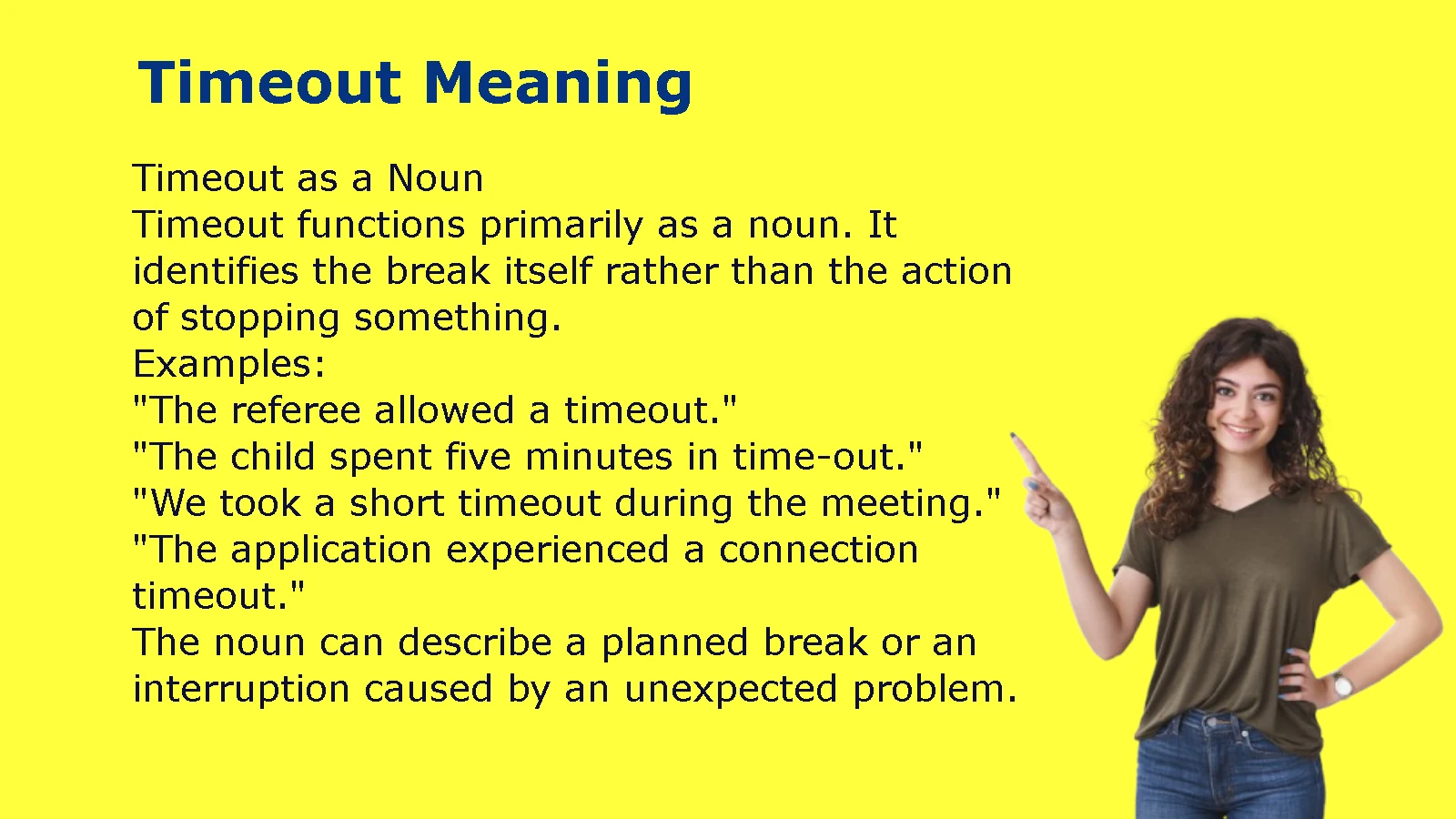
Timeout as a Noun
Timeout functions primarily as a noun. It identifies the break itself rather than the action of stopping something.
Examples:
- “The referee allowed a timeout.”
- “The child spent five minutes in time-out.”
- “We took a short timeout during the meeting.”
- “The application experienced a connection timeout.”
The noun can describe a planned break or an interruption caused by an unexpected problem.
Time Out as a Verb Phrase
The two-word expression time out appears in expressions describing a temporary break, particularly the phrase “take time out.”
Examples:
- “I need to take time out from work.”
- “Let’s take time out and discuss this tomorrow.”
- “She decided to take time out from her busy schedule.”
People also use “Time out!” as an informal instruction to stop an activity temporarily.
For example:
“Time out! I need a minute to think.”
Here, the expression acts as a request to pause.
Real-Life Examples of Timeout
| Situation | Example | Meaning |
| Sports | The coach called a timeout. | The game temporarily stopped. |
| Parenting | The child received a time-out. | The child faced a temporary disciplinary break. |
| Relationships | We took a timeout. | We paused our disagreement. |
| Technology | The request ended in a timeout. | The system stopped waiting for a response. |
| Workplace | The manager called a timeout. | The team paused its discussion. |
Timeout, Time-Out, or Time Out: Which Spelling Is Correct?
Timeout, time-out, and time out are related forms, but their spelling and grammatical functions differ. Time out appears in expressions such as “take time out.” The best choice depends on the sentence and writing style.
Timeout: The One-Word Form
Timeout is a standard spelling, particularly in sports, computing, and general writing.
Examples:
- “The game ended after the final timeout.”
- “The website returned a timeout error.”
- “The system has a 30-second timeout setting.”
- “The coach requested another timeout.”
In technical writing, timeout frequently describes a configured period. For example, a website might stop waiting for a server response after 30 seconds.
The one-word form also works well in general dictionary definitions and article titles.
Time-Out: The Hyphenated Form
Time-out is another accepted noun form. It appears frequently in parenting and sports contexts.
Examples:
- “The teacher gave the student a time-out.”
- “The child needed a short time-out.”
- “The team requested a time-out during the match.”
The hyphen connects the two words and signals that they function together as a single noun.
Some dictionaries and editorial styles prefer the hyphenated version in certain contexts. Others use timeout. Both forms can be correct.
Time Out: The Two-Word Form
Time out usually appears in expressions and phrases describing a temporary break.
Examples:
- “I need to take time out from work.”
- “Let’s take time out and discuss this tomorrow.”
- “She decided to take time out to reconsider her decision.”
The phrase also appears in informal speech when someone asks for a pause.
For example, a person might say:
“Time out! Let’s start this conversation again.”
Timeout vs. Time-Out vs. Time Out: Comparison
| Spelling | Typical grammatical use | Example |
| Timeout | Noun | The game had a timeout. |
| Time-out | Noun | The child received a time-out. |
| Time out | Expression or verb phrase | We need to take time out. |
Practical writing tip: Choose one noun spelling and use it consistently throughout an article. If your publication follows a particular dictionary or style guide, follow that standard.
What Does Time-Out Mean for a Child?
A time-out for a child is a discipline technique that temporarily removes a child from an activity or situation after certain inappropriate behavior. Parents and caregivers use it to interrupt unwanted behavior, reinforce boundaries, and give children an opportunity to settle down before returning to the activity.
A time-out is not supposed to humiliate or frighten a child. Its purpose is to create a brief, predictable consequence that helps the child understand behavioral expectations.
Why Do Parents Give Children a Time-Out?
Parents use time-outs to address behavior that requires an immediate and consistent response.
Common reasons include:
- Aggressive behavior: Hitting, kicking, or pushing another child.
- Repeated rule-breaking: Ignoring a clear instruction after reminders.
- Disruptive actions: Throwing objects or deliberately interrupting an activity.
- Unsafe behavior: Continuing an action that could hurt someone.
A time-out can help interrupt the behavior, but it does not automatically teach a child what to do differently.
Parents should explain the expected behavior and help children practice better responses after the break.
For example, if a child hits a sibling, a parent might explain:
“Hitting hurts people. We use gentle hands. Take a short break, and then we’ll talk about how to solve the problem.”
This approach connects the consequence to the behavior.
How Does a Child Time-Out Work?
A constructive time-out should remain simple, predictable, and appropriate for the child’s age.
A practical approach includes these steps:
Explain the rule. Tell the child which behavior needs to stop.
Give a clear warning when appropriate. Explain the consequence before applying it, especially when the behavior is not dangerous.
Apply the consequence calmly. Avoid shouting, threats, or lengthy arguments.
Keep the break brief and age-appropriate. Do not turn it into prolonged isolation.
Discuss the behavior afterward. Help the child understand what happened and what they can do differently.
Allow a return to normal activity. The child should understand that the consequence has ended.
The exact approach depends on the child’s age, development, temperament, and circumstances. Some children respond better to redirection, supervised calming activities, or positive reinforcement.
Is a Time-Out a Punishment?
A time-out can function as a punishment because it removes access to an activity or social interaction after unwanted behavior. However, its effectiveness depends on how caregivers use it.
A constructive time-out differs from harsh punishment in several ways:
| Constructive time-out | Harmful punishment |
| Uses clear expectations | Uses unpredictable rules |
| Remains brief and reasonable | Continues for excessive periods |
| Addresses specific behavior | Attacks the child’s character |
| Avoids humiliation | Uses shame or intimidation |
| Explains better alternatives | Provides no guidance |
For example, saying “You made a poor choice when you hit your brother” addresses behavior.
Saying “You’re a bad child” attacks the child’s identity.
That distinction matters. Children need boundaries, but they also need reassurance and guidance.
Examples of Time-Out in Parenting
Here are some realistic examples:
- A child throws a toy at another child, so the parent temporarily ends playtime.
- A student repeatedly disrupts a classroom activity and receives a supervised break.
- A child continues unsafe behavior after a clear instruction, so the caregiver removes access to the activity.
Case study: A playground disagreement
Imagine two children arguing over a toy. One child pushes the other after losing access to it.
A caregiver separates the children, checks that nobody is hurt, and calmly addresses the behavior. The child who pushed receives an appropriate break from the activity. Afterward, the caregiver explains how to ask for a turn or express frustration without physical aggression.
The timeout interrupts the immediate problem, while the follow-up conversation teaches a replacement behavior.
What Does Timeout Mean in Cricket?
In cricket, a timeout can describe a temporary break in play, but the term timed out also refers to a specific method of dismissal. Under the Laws of Cricket, an incoming batter must be ready to receive the next ball within three minutes of the previous batter being dismissed, unless the applicable playing conditions specify otherwise.
The distinction matters because a break in play and a timed-out dismissal are not the same thing.
What Is a Timeout in Cricket?
A break in cricket can occur for several reasons, including:
- Scheduled intervals between sessions.
- The interval between innings.
- Drinks breaks.
- Weather interruptions.
- Injury-related stoppages.
- Other interruptions permitted under competition regulations.
These breaks allow players to rest, receive instructions, and prepare for the next stage of play.
However, cricket does not use timeouts in exactly the same way as basketball. Teams cannot simply request unlimited strategic timeouts whenever they want.
The competition’s playing conditions determine which breaks are allowed.
What Does Timed Out Mean in Cricket?
Timed out is a specific form of batter dismissal covered by Law 40 of the Laws of Cricket.
The basic rule requires an incoming batter to be ready to receive the next ball within three minutes after the previous batter is dismissed, subject to applicable competition regulations.
If the incoming batter fails to meet the requirement, the fielding side can appeal, and the batter may be given out timed out.
The dismissal protects the flow of the match by preventing unnecessary delays between wickets.
How Does a Timed-Out Dismissal Happen?
The process works as follows:
- A batter gets dismissed.
- Another batter must enter the field.
- The incoming batter must be ready within the prescribed time.
- If the batter fails to meet the requirement, the fielding side may appeal.
- The umpire applies the relevant playing conditions and laws.
Important distinction: A player is not automatically dismissed every time a team takes longer than expected to resume play. The specific conditions for a timed-out dismissal must apply.
Why Is Timeout Important in Cricket?
Time management matters because cricket matches depend on an orderly sequence of play.
A timed-out rule helps:
- Prevent unnecessary delays.
- Maintain the pace of the match.
- Establish clear responsibilities for incoming batters.
- Ensure teams follow the same rules.
The term also appears in cricket discussions because fans sometimes use “timeout” loosely when describing breaks or delays.
For accurate writing, use timed-out dismissal when discussing the formal method of getting out.
What Does Timeout Mean in a Relationship?
A timeout in a relationship is a temporary pause during an argument or emotionally difficult conversation. Couples use it to calm down, manage frustration, and avoid saying hurtful things. A healthy timeout includes an agreement to return to the discussion rather than using silence to avoid the issue indefinitely.
Why Do Couples Take Timeouts?
Arguments can become unproductive when both partners feel angry, overwhelmed, or misunderstood.
A timeout creates room for emotional regulation.
Couples may take one when:
- A disagreement becomes increasingly heated.
- One partner feels overwhelmed.
- Both people keep repeating the same arguments.
- Someone needs time to organize their thoughts.
- The conversation begins turning into personal attacks.
Taking a break does not mean someone has lost the argument. It means both people recognize that continuing at that moment may make the situation worse.
Is Taking a Timeout in a Relationship Healthy?
Yes, a timeout can support healthy communication when both partners use it constructively.
However, the intention matters.
A healthy timeout involves:
- Explaining why a break is necessary.
- Agreeing to resume the conversation.
- Respecting each other’s need for space.
- Avoiding threats or manipulation.
- Returning to the original issue.
An unhealthy timeout may involve disappearing without explanation, refusing to communicate indefinitely, or using silence to control the other person.
There is an important difference between taking space to calm down and deliberately withholding communication to punish a partner.
How Long Should a Relationship Timeout Last?
There is no universal duration for a relationship timeout.
Some couples need 20 or 30 minutes to settle down. Others may need several hours before they can discuss a difficult issue calmly.
The best approach is to agree on a reasonable timeframe.
For example:
“I care about resolving this, but I’m getting frustrated. Can we take 30 minutes and talk again at 7 p.m.?”
This statement communicates three things:
- The person wants to resolve the issue.
- The break serves a specific purpose.
- The conversation will resume at an agreed time.
A timeout should not become an indefinite suspension of communication.
Timeout vs. Breakup: What’s the Difference?
People sometimes confuse a relationship timeout with a breakup. However, they describe different situations.
| Relationship timeout | Breakup |
| Temporarily pauses a conversation or interaction | Ends the romantic relationship |
| Usually focuses on emotional regulation | Changes or ends the relationship |
| Partners generally intend to reconnect | Partners may not intend to reconnect |
| Often lasts minutes or hours | Has no standard duration |
| Does not automatically change relationship status | Usually changes relationship status |
Some couples also use the phrase “taking a break” to describe a longer separation. That arrangement needs clear boundaries and mutual understanding.
Examples of Taking a Timeout During an Argument
Example one: A disagreement about money
One partner becomes frustrated while discussing household expenses. Instead of continuing the argument, they request a 30-minute break and agree to review the budget afterward.
Example two: A misunderstanding
A couple misinterprets each other’s messages. Both become defensive, so they pause the conversation and return to it after calming down.
Example three: Repeated arguments
Partners notice that every discussion about family responsibilities turns into an argument. They agree to pause when emotions rise and resume with one issue at a time.
The key principle is simple: take a timeout to improve the conversation, not to escape accountability.
What Does Timeout Mean on YouTube?
A timeout on YouTube generally describes a temporary interruption involving a connection, request, application process, or user session. It can happen when YouTube or a connected browser fails to receive a response within the expected period. The exact meaning depends on the error message.
What Causes a YouTube Timeout?
Several technical issues can cause a timeout while using YouTube.
Unstable internet connection
A weak or inconsistent connection can prevent the application from loading video information or completing a request.
Browser problems
An outdated browser, corrupted cache, or conflicting extension can interfere with YouTube.
Application errors
An outdated or malfunctioning mobile application may fail to complete certain operations.
Server-side delays
Sometimes the problem occurs on the service side rather than on the user’s device.
Expired sessions
A login session may expire, requiring the user to authenticate again.
What Does a YouTube Session Timeout Mean?
A session timeout occurs when a website or application ends a user’s session after a period of inactivity or under certain security conditions.
For example, you might leave a browser tab open for a long time. When you return, YouTube or a related Google service may require you to sign in again.
This does not necessarily mean your account has been deleted or restricted.
A session timeout is different from a video playback error:
| Session timeout | Playback timeout |
| Involves the user’s session | Involves video loading or playback |
| May require signing in again | May require checking connectivity |
| Can involve authentication settings | Can involve network or application problems |
| May affect account-related actions | May affect watching content |
How to Fix a YouTube Timeout Error
Try these troubleshooting steps:
- Check your internet connection: Open another website to see whether your connection works.
- Refresh YouTube: Reload the page or reopen the application.
- Restart your browser: Close unnecessary tabs and reopen YouTube.
- Clear browser cache: Remove corrupted temporary data if the problem continues.
- Update the application: Install the latest available version.
- Disable problematic extensions: Temporarily turn off extensions that interfere with video playback.
- Restart your device: This can resolve temporary software or network problems.
If the error affects multiple devices and other websites work normally, the problem may involve YouTube’s service rather than your internet connection.
What Does Timeout Mean in Medical Terms?
In medicine, a time-out is a deliberate pause before a clinical procedure that allows healthcare professionals to verify essential safety information. A surgical time-out typically confirms the patient’s identity, planned procedure, and correct surgical site before the team proceeds.
What Is a Surgical Time-Out?
A surgical time-out is a formal safety check performed immediately before a procedure begins.
The surgical team pauses to confirm that everyone understands what will happen.
The verification process commonly includes:
- Confirming the patient’s identity.
- Checking the planned procedure.
- Verifying the correct surgical site.
- Confirming the relevant consent and documentation.
- Reviewing important safety concerns.
- Ensuring the necessary equipment is available.
The team should communicate clearly rather than assume that everyone has the same information.
Why Is a Medical Time-Out Important?
Medical procedures involve multiple professionals, complex equipment, and important decisions.
Even when everyone has reviewed the patient’s records, a final shared verification helps identify inconsistencies before treatment begins.
A surgical time-out supports:
Patient identification: Confirms that the team is treating the correct patient.
Procedure verification: Ensures that the planned operation matches the documentation and consent.
Site verification: Helps prevent procedures on the wrong body part.
Team communication: Gives everyone an opportunity to raise concerns before proceeding.
A time-out is therefore a patient-safety practice, not simply a convenient pause.
What Happens During a Medical Time-Out?
Consider a patient scheduled for surgery on the left knee.
Before the procedure begins, the team pauses and verifies:
- The patient’s identity.
- The planned left-knee procedure.
- The consent documentation.
- The marked surgical site.
- Relevant allergies and safety considerations.
- The availability of required equipment.
If the documentation identifies the right knee while the surgical marking identifies the left knee, the team must resolve the discrepancy before proceeding.
This example shows why a brief pause can prevent a serious mistake.
Medical Timeout vs. Sports Timeout
| Medical time-out | Sports timeout |
| Supports patient safety | Supports game management |
| Verifies clinical information | Allows strategy discussions or rest |
| Involves healthcare professionals | Involves players, coaches, and officials |
| Occurs before specified procedures | Occurs according to sports rules |
| Prevents avoidable procedural errors | Helps teams manage play |
The word timeout describes a pause in both situations, but the objectives are entirely different.
Timeout Synonyms and Alternative Words
Common timeout synonyms include break, pause, recess, interval, interruption, suspension, and respite. However, no single synonym fits every situation. A sports timeout, a relationship timeout, and a technical timeout describe different kinds of interruptions, so choose an alternative that preserves the intended meaning.
Common Synonyms for Timeout
| Synonym | Meaning | Example |
| Break | A temporary rest | We need a break from this discussion. |
| Pause | A short stop | Let’s pause the meeting. |
| Recess | An official or organized break | The court took a recess. |
| Interval | A period between activities | There was a short interval between sessions. |
| Intermission | A scheduled break during an event | The audience returned after intermission. |
| Interruption | A break in continuity | The call ended after an unexpected interruption. |
| Suspension | A temporary stopping | The match faced a suspension. |
| Respite | A short period of relief | The quiet afternoon offered a respite. |
Other Ways to Say Timeout in Different Contexts
The best alternative depends on the situation.
For relationships:
- Strategic break
- Stoppage
- Official break
- Game interruption
For technology:
- Connection interruption
- Request expiration
- Session expiration
- Response delay
These alternatives are not always interchangeable. For example, a session expiration describes a specific technical event, while a breathing space describes a personal need.
How to Choose the Right Timeout Synonym
Use these simple guidelines:
- Choose break for everyday conversations and informal situations.
- Choose pause when an activity stops briefly but may continue soon.
- Choose recess for formal or organized breaks.
- Choose intermission for scheduled breaks during performances or events.
- Choose interruption when something stops unexpectedly.
- Choose respite when the break provides relief from stress or difficulty.
- Choose suspension when an activity stops temporarily under formal conditions.
For example, “The couple needed a respite from their stressful routine” sounds natural.
However, “The cricket team requested a respite” may not communicate the specific meaning of an official game break.
Timeout Examples in Everyday Sentences
Seeing the word in different sentences helps clarify how people use it.
Timeout in Casual Conversations
- “I need a timeout before I make a decision.”
- “Let’s take time out from our busy schedule.”
- “Give me a minute. I need a short break.”
- “The discussion needs a timeout before it becomes an argument.”
In casual conversation, timeout often communicates the need to stop temporarily.
Timeout in Sports
- “The coach called a timeout to change the team’s strategy.”
- “The players returned to the field after the break.”
- “The incoming batter was given out for being timed out.”
The final example describes the formal cricket dismissal rather than an ordinary break.
Timeout in Parenting
- “The parent gave the child a timeout after repeated hitting.”
- “The teacher explained why the student needed a time-out.”
- “The child returned to the activity after the supervised break.”
in Technology
- “The website displayed a timeout error because the server did not respond.”
- “The application stopped waiting after the request timed out.”
- “The user had to sign in again after the session expired.”
Timeout in Relationships
- “They agreed to take a timeout during their disagreement.”
- “He requested some breathing space before continuing the conversation.”
- “The couple returned to the issue after taking time to calm down.”
Common Misunderstandings About Timeout
The word timeout seems simple, but its meaning can change significantly across different situations.
Does Timeout Always Mean Punishment?
No. A timeout does not always involve discipline.
The context determines whether the pause involves punishment, rest, safety, or a technical limitation.
Is Timeout Always Temporary?
Generally, yes. A timeout describes a temporary interruption rather than a permanent ending.
However, its duration depends on the situation.
For example:
- A sports timeout may last only a short period.
- A relationship timeout may last minutes or hours.
- A technical timeout may occur after a configured number of seconds.
- A child’s time-out should remain brief and age-appropriate.
- A medical time-out lasts long enough to complete the required safety checks.
The word itself does not establish a universal duration.
Is Timeout the Same as a Break?
The words overlap, but they are not always identical.
A break can describe almost any period of rest or interruption. A timeout often suggests a pause requested, required, or triggered for a particular reason.
For example:
- “I need a break” expresses a general desire to rest.
- “The coach called a timeout” describes a specific sports procedure.
- “The system experienced a timeout” describes a technical interruption.
A timeout often has a more specific purpose than an ordinary break.
Does Timeout Always Involve Stopping an Activity?
Not necessarily in the same way.
Sometimes a person deliberately stops an activity. In other situations, a system automatically ends a request because it has waited too long.
For example, a browser might stop waiting for a server response after a set period. The user may not have requested the interruption.
The shared meaning remains a temporary stop or interruption, but the cause differs.
Related Words: Glitch, Grit, and Fawn
Words such as glitch, grit, and fawn sometimes appear alongside timeout in vocabulary searches, but they have different meanings. Understanding their differences can help English learners build a stronger vocabulary.
Glitch Meaning
A glitch is a small, unexpected problem or malfunction, especially in a machine, electronic device, computer program, or technical process.
Examples:
- “A software glitch prevented the video from playing.”
- “The website experienced a minor glitch.”
- “A temporary glitch caused the payment page to freeze.”
A glitch can cause a timeout, but the words do not mean the same thing.
A glitch describes the problem. A timeout describes the interruption that may happen when a process fails to respond.
| Glitch | Timeout |
| Unexpected malfunction | Temporary interruption |
| Describes a problem | Describes a pause or expired wait |
| May cause a timeout | May occur because of a glitch |
Grit Meaning
Grit means courage, determination, and perseverance when facing difficulties.
A person with grit continues working toward a goal despite obstacles, setbacks, or disappointment.
Examples:
- “Her grit helped her finish the difficult project.”
- “The athlete showed remarkable grit after the injury.”
- “Building a successful business requires patience and grit.”
Unlike timeout, which describes a pause, grit describes a personal quality.
Fawn Meaning
Fawn has several meanings depending on how someone uses it.
As a noun, a fawn is a young deer.
As a verb, to fawn means to show excessive admiration or affection toward someone, often to gain approval or favor.
Examples:
- “The young fawn stayed close to its mother.”
- “He tends to fawn over influential people.”
- “The deer gave birth to a fawn in the spring.”
The verb often carries a negative meaning when it describes excessive flattery or submissive behavior.
These distinctions make it important to treat glitch, grit, and fawn as separate vocabulary topics rather than as synonyms of timeout.
Frequently Asked Questions About Timeout Meaning
What Does Timeout Mean in Simple Words?
Timeout means a temporary pause or break in an activity, conversation, or process. People use it when they need time to rest, think, calm down, or resolve a problem. The exact meaning depends on the context.
Is Timeout One Word or Two Words?
Both one-word and hyphenated forms are accepted as nouns: timeout and time-out. The two-word form, time out, commonly appears in expressions such as “take time out.” Choose the spelling that matches your sentence and preferred style guide.
What Does Time-Out Mean for a Child?
A time-out for a child is a discipline technique that temporarily removes the child from an activity after inappropriate behavior. Parents use it to interrupt unwanted actions, reinforce boundaries, and help children understand behavioral expectations.
What Does Timeout Mean in a Relationship?
A relationship timeout is a temporary break from an argument or difficult conversation. Partners use it to calm down, manage emotions, and avoid escalating disagreements. A healthy timeout includes an agreement to resume the conversation.
What Is the Difference Between Timeout and Time Out in Cricket?
A timeout can describe a break in play, while timed out is a specific batter dismissal under cricket’s playing laws. The incoming batter must meet the prescribed arrival and readiness requirements after a wicket falls.
What Is Another Word for Timeout?
Common alternatives include break, pause, recess, interval, interruption, suspension, and respite. The best synonym depends on the situation. For example, pause suits a conversation, while recess describes an organized break.
Conclusion: Understanding Timeout in Different Contexts
The timeout meaning changes according to the situation, but its central idea remains a temporary pause or interruption.
Remember these spelling distinctions:
- Timeout: A commonly used one-word noun.
- Time-out: A hyphenated noun variant.
- Time out: A two-word expression, particularly in phrases such as “take time out.”
The best way to understand or use the word is to consider the context rather than relying on one definition.













