Other ways to say overall include generally, on the whole, all in all, broadly speaking, altogether, collectively, and all things considered. The best alternative depends on whether you want to summarize an argument, introduce a conclusion, describe research findings, or present a general assessment. Choosing the right synonym for overall makes your writing clearer, more natural, and less repetitive.
Writers often use overall in essays, research papers, business reports, summaries, and everyday conversations. However, repeating the same word throughout a document can make sentences sound predictable. Alternatives such as taken together, in general, on balance, and from a broader perspective help you express similar ideas while maintaining the right tone.
The following guide explores more than 35 alternatives, explains their meanings, and provides practical examples for academic and professional writing.
| Question | Answer |
| What is another word for overall? | Generally, broadly, altogether, and on the whole. |
| What is a formal synonym for overall? | Collectively, considered as a whole, and broadly speaking. |
| What can I use instead of overall in an essay? | On the whole, taken together, and all things considered. |
| What is another word for overall in a conclusion? | Ultimately, in summary, and to sum up. |
| What are the antonyms of overall? | Specifically, individually, separately, and partially, depending on context. |
What Does Overall Mean?
Overall means considering everything together, rather than focusing on individual details. It can describe a general impression, complete amount, or final assessment. Writers use it to summarize information, evaluate situations, and communicate the bigger picture. Its exact meaning depends on whether it functions as an adverb or an adjective.
For example:
- Adverb: Overall, the presentation was successful.
- Adjective: The overall performance exceeded expectations.
Understanding these two grammatical uses helps you choose suitable alternatives.
Overall as an Adverb
As an adverb, overall means generally, considering everything, or taking all relevant factors into account.
It often introduces a broad judgment after someone has considered several details.
Examples:
- Overall, the students performed well in their examinations.
- The restaurant received positive feedback overall.
- Overall, the research supports the original hypothesis.
- The project was successful overall, despite a few setbacks.
In these sentences, you can replace overall with expressions such as generally, on the whole, or all things considered.
Overall as an Adjective
As an adjective, overall describes something that includes all parts, elements, or categories.
It often appears before a noun.
Examples:
- The overall cost of construction increased.
- Our overall strategy needs improvement.
- The company recorded strong overall growth.
- Her overall health improved after adopting healthier habits.
Suitable adjective alternatives include:
- Total
- Complete
- Entire
- Combined
- Comprehensive
- Aggregate
- General
For example, you can replace “overall cost” with “total cost” without changing the central meaning.
However, not every alternative works in every situation. A comprehensive review suggests detailed coverage, while a total review sounds unnatural in most contexts.
Is Overall Formal or Informal?
Overall is a neutral word. You can use it in academic papers, professional reports, business communication, and casual conversations.
Its suitability depends on the sentence.
| Context | Example | Suitability |
| Academic writing | Overall, the findings support the theory. | Appropriate |
| Business reports | Overall performance improved. | Appropriate |
| Everyday conversation | Overall, I enjoyed the trip. | Appropriate |
| Research papers | Overall, the results were consistent. | Appropriate |
| Formal conclusions | All things considered, the proposal is beneficial. | More formal alternative |
You do not need to avoid overall in formal writing. Instead, use alternatives when they communicate your intended meaning more accurately.
35+ Best Synonyms for Overall With Examples
The best synonyms for overall express a general assessment, combined result, or complete picture. However, each expression carries a slightly different meaning.
Here are 35 useful alternatives with explanations and original examples.
Common Synonyms for Overall
These expressions work well in everyday communication, articles, reports, and general writing.
Generally
Generally means in most situations or as a broad statement.
Example: Generally, customers prefer products that offer good value for money.
In General
This expression introduces a broad observation without discussing every individual detail.
Example: In general, employees appreciate flexible working arrangements.
On the Whole
On the whole means considering all aspects of something.
Example: On the whole, the conference was informative and professionally organized.
All in All
This informal expression summarizes an experience or situation.
Example: All in all, our weekend trip was enjoyable.
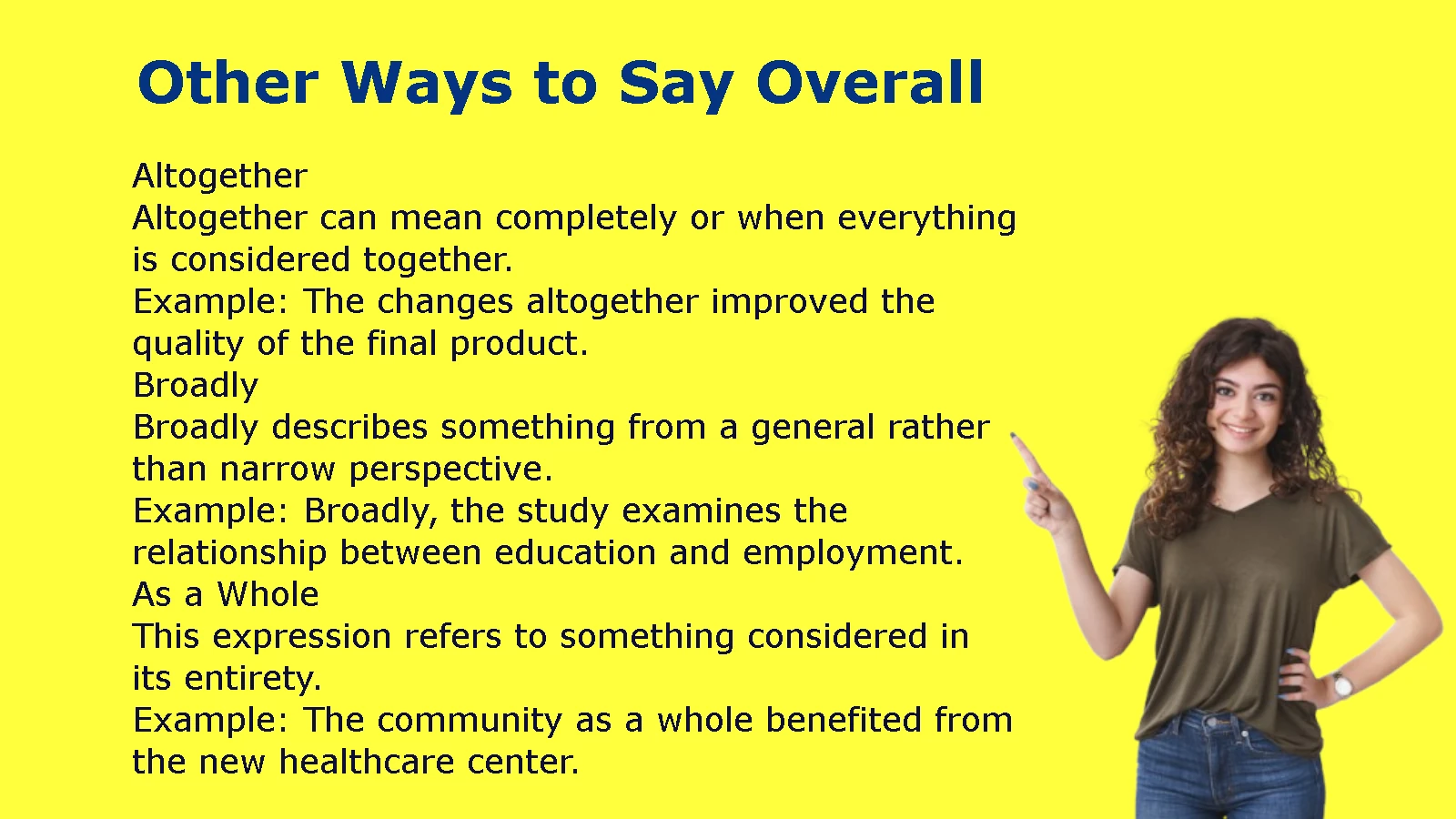
Altogether
Altogether can mean completely or when everything is considered together.
Example: The changes altogether improved the quality of the final product.
Broadly
Broadly describes something from a general rather than narrow perspective.
Example: Broadly, the study examines the relationship between education and employment.
As a Whole
This expression refers to something considered in its entirety.
Example: The community as a whole benefited from the new healthcare center.
In Essence
In essence means fundamentally or in its most important form.
Example: In essence, the proposal aims to reduce operating costs.
By and Large
This conversational expression means generally or for the most part.
Example: By and large, the new employees adapted quickly.
Taken Together
Taken together means considering multiple details, findings, or elements as one.
Example: Taken together, the survey responses indicate strong customer satisfaction.
Formal Synonyms for Overall
These alternatives are particularly useful in academic writing, professional documents, research papers, and business reports.
Broadly Speaking
This expression introduces a general statement without examining every detail.
Example: Broadly speaking, digital marketing has changed how businesses reach customers.
Collectively
Collectively means considered as a group or combined unit.
Example: Collectively, the departments contributed to the company’s growth.
Considered as a Whole
This formal expression emphasizes evaluating all parts together.
Example: Considered as a whole, the research provides convincing evidence.
In Aggregate
In aggregate means when individual amounts or results are combined.
Example: In aggregate, the participating businesses generated higher annual revenue.
In Total
This phrase refers to the complete amount or combined number.
Example: The organization hired 45 employees in total.
All Things Considered
This expression introduces a judgment after weighing different factors.
Example: All things considered, the investment offers reasonable long-term value.
From a Broader Perspective
This phrase encourages readers to consider a larger situation rather than isolated details.
Example: From a broader perspective, renewable energy supports economic and environmental goals.
In General Terms
This expression introduces an explanation without going into specific details.
Example: In general terms, the policy encourages responsible resource management.
Additional Alternatives for Overall
The following expressions provide more variety for different writing situations.
| Synonym | Meaning | Example |
| Ultimately | At the final stage or after considering everything | Ultimately, the decision benefited the organization. |
| Essentially | In the most important sense | Essentially, the plan focuses on improving efficiency. |
| Fundamentally | At the basic or underlying level | Fundamentally, both proposals address the same problem. |
| In Summary | A brief statement of the main points | In summary, the experiment produced positive results. |
| In Brief | In a short or concise form | In brief, the company needs a better strategy. |
| In Short | Expressing something concisely | In short, the project achieved its primary objectives. |
| On Balance | After weighing advantages and disadvantages | On balance, the benefits outweigh the costs. |
| For the Most Part | To a large extent | For the most part, the participants responded positively. |
| At Large | Generally or as a wider group | The issue affects society at large. |
| In Its Entirety | Including every part | The committee reviewed the proposal in its entirety. |
| As a General Rule | Usually or under normal circumstances | As a general rule, clear instructions improve productivity. |
| Looking at the Bigger Picture | Considering the wider situation | Looking at the bigger picture, the changes support sustainable growth. |
| When Viewed Together | When multiple elements are considered jointly | When viewed together, the results reveal a consistent pattern. |
| Taking Everything Into Account | Considering all relevant factors | Taking everything into account, the decision seems reasonable. |
| In the Grand Scheme of Things | In relation to a larger situation | In the grand scheme of things, the delay was relatively minor. |
| In the Final Analysis | After examining all relevant considerations | In the final analysis, effective leadership determines the outcome. |
| In a Broad Sense | In a general or wide-ranging way | In a broad sense, education supports social development. |
Synonyms for Overall in an Essay
The best synonyms for overall in an essay include on the whole, broadly speaking, taken together, all things considered, and from a broader perspective. These expressions help academic writers introduce general observations, connect arguments, and summarize evidence without repeatedly using the same transition.
Academic writing requires clarity and consistency. Although overall is perfectly acceptable, using a suitable alternative can improve sentence variety and make an argument easier to follow.
Best Formal Alternatives for Essays
Consider these expressions when writing an academic essay:
| Alternative | Best use | Example |
| On the whole | General assessment | On the whole, the policy has produced positive outcomes. |
| Broadly speaking | Introducing a general argument | Broadly speaking, technology improves access to education. |
| Taken together | Combining arguments or evidence | Taken together, these examples support the central claim. |
| All things considered | Evaluating different factors | All things considered, the proposal deserves further attention. |
| From a broader perspective | Discussing wider implications | From a broader perspective, urban development affects economic growth. |
| In general | Making a broad observation | In general, students benefit from regular feedback. |
Examples of Replacing Overall in Essay Sentences
Here are several examples showing how you can improve academic sentences.
Original: Overall, social media has changed communication.
Alternative: Broadly speaking, social media has transformed modern communication.
Original: Overall, the policy has been successful.
Alternative: On the whole, the policy has achieved its intended objectives.
Original: Overall, the evidence supports the argument.
Alternative: Taken together, the evidence supports the central argument.
Original: Overall, education improves employment opportunities.
Alternative: From a broader perspective, education expands employment opportunities.
Original: Overall, the advantages outweigh the disadvantages.
Alternative: On balance, the advantages outweigh the disadvantages.
These replacements work because they preserve the original message while making the relationship between ideas more precise.
Which Synonyms Should You Avoid in Formal Essays?
Some alternatives sound too conversational for academic assignments.
Consider the following expressions:
- In a nutshell: Better suited to informal explanations.
- All in all: Common in everyday conversations.
- At the end of the day: Conversational and sometimes vague.
- Basically: Often introduces an oversimplified explanation.
- You get the picture: Too informal for academic writing.
This does not mean these phrases are grammatically incorrect. They simply may not match the tone expected in formal academic work.
Another Word for Overall in a Conclusion
Another word for overall in a conclusion includes ultimately, all things considered, to sum up, in summary, and on balance. These expressions help writers present a final judgment, connect their main arguments, and reinforce the central message without repeating the same transition.
A conclusion should bring your discussion together. The best alternative depends on whether you want to summarize evidence, evaluate an argument, or emphasize the final outcome.
Best Alternatives for Conclusion Paragraphs
| Alternative | Purpose | Example |
| Ultimately | Presents a final judgment | Ultimately, education remains a powerful tool for social progress. |
| To Sum Up | Introduces a concise summary | To sum up, the research highlights three major challenges. |
| All Things Considered | Weighs different arguments | All things considered, the benefits justify the investment. |
| In Summary | Restates the main points | In summary, the findings support the proposed approach. |
| On Balance | Evaluates opposing factors | On balance, the advantages exceed the disadvantages. |
| In the Final Analysis | Presents a final assessment | In the final analysis, responsible leadership determines success. |
| Taking Everything Into Account | Considers all relevant factors | Taking everything into account, the strategy remains effective. |
Example Sentences Using Overall Alternatives in Conclusions
Academic essay:
Original: Overall, public transportation should receive more investment.
Improved: Ultimately, increased investment in public transportation can improve accessibility and reduce traffic congestion.
Business report:
Original: Overall, the marketing campaign performed well.
Improved: All things considered, the marketing campaign achieved its primary objectives and generated positive customer engagement.
Research discussion:
Original: Overall, the findings support the original hypothesis.
Improved: Taken together, the findings provide substantial support for the original hypothesis.
Argumentative writing:
Original: Overall, renewable energy is a better long-term option.
Improved: On balance, renewable energy offers significant environmental and economic advantages.
How to Start a Strong Conclusion Without Saying Overall
A strong conclusion does more than repeat the introduction. It brings your main ideas together and gives readers a clear final message.
Follow this simple approach:
- Restate your central argument: Express your main position using different wording.
- Connect the supporting points: Show how your arguments work together.
- Highlight the wider implication: Explain why the discussion matters.
- End with a meaningful final statement: Leave readers with a clear takeaway.
For example:
“Taken together, these findings demonstrate that accessible education can improve employment opportunities, reduce inequality, and support long-term economic development.”
This conclusion summarizes several arguments without relying on an unnecessary transition.
Another Word for Overall Summary
Another word for an overall summary includes general overview, comprehensive summary, broad overview, complete review, and consolidated overview. These alternatives describe a shortened presentation of the main information or a wider assessment of a subject.
However, a summary and an overview do not always mean the same thing. A summary condenses existing information, while an overview introduces the main features of a subject.
Best Alternatives for an Overall Summary
| Alternative | Meaning | Best context |
| General Summary | A brief account of the main points | Reports and articles |
| Comprehensive Summary | A detailed summary covering major aspects | Academic documents |
| Broad Overview | A general introduction to a subject | Presentations |
| Complete Overview | A wide-ranging account | Business reports |
| General Assessment | An evaluation of the main aspects | Performance reviews |
| Big-Picture View | A wider perspective | Strategic discussions |
| Consolidated Overview | Information combined from multiple sources | Research and business |
| Summary of Key Points | A concise presentation of important details | Meetings and reports |
Example Sentences for Summary Writing
Here are practical examples:
- The comprehensive summary explains the major findings of the investigation.
- The broad overview introduces the company’s financial position.
- This general assessment identifies the project’s main strengths and weaknesses.
- The consolidated overview combines information from all participating departments.
- The summary of key points highlights the most important recommendations.
These alternatives help you describe the purpose and scope of a summary more accurately.
Overall Summary vs. General Overview
Although these expressions sometimes overlap, they emphasize different things.
| Feature | Overall Summary | General Overview |
| Main purpose | Condenses important information | Introduces a subject broadly |
| Level of detail | Usually summarizes existing material | May provide background and context |
| Common use | Reports, research, and conclusions | Introductions and presentations |
| Example | The overall summary covers the research findings. | The general overview explains the research topic. |
Use overall summary when you want to present the main points of an existing discussion. Choose general overview when you want to introduce the wider subject.
Another Word for Overall in Research
Another word for overall in research includes collectively, in aggregate, taken together, considered as a whole, and across the findings. These expressions help researchers describe combined evidence, interpret multiple results, and communicate broad conclusions without making unsupported claims about individual observations.
Research writing requires particular attention to accuracy. A synonym should not change what your data actually demonstrates.
Best Alternatives for Research Papers
| Alternative | Research application | Example |
| Collectively | Combining individual contributions | Collectively, the participants reported improved satisfaction. |
| Taken Together | Interpreting several findings | Taken together, the results support the proposed model. |
| In Aggregate | Describing combined numerical data | In aggregate, the responses indicate a positive trend. |
| Across the Findings | Discussing patterns in multiple results | Across the findings, researchers identified three recurring themes. |
| On Balance | Weighing evidence | On balance, the evidence favors the proposed explanation. |
| Considered as a Whole | Evaluating the complete study | Considered as a whole, the study offers useful insights. |
| In General Terms | Providing a broad explanation | In general terms, the results indicate improved performance. |
| In the Broader Context | Connecting results to wider research | In the broader context, these findings support previous observations. |
Examples of Overall in Research Writing
Research findings:
Original: Overall, the findings indicate that sleep affects academic performance.
Alternative: Taken together, the findings indicate that sleep affects academic performance.
Statistical results:
Original: Overall, the participants showed improved test scores.
Alternative: In aggregate, the participants demonstrated higher test scores.
Survey responses:
Original: Overall, customers were satisfied with the service.
Alternative: Collectively, customer responses indicated satisfaction with the service.
Literature review:
Original: Overall, previous studies support the relationship between exercise and mental performance.
Alternative: Considered as a whole, previous studies support the relationship between exercise and mental performance.
Experimental outcomes:
Original: Overall, the experiment produced consistent results.
Alternative: Across the findings, the experiment produced consistent results.
Choosing the Right Alternative for Research Results
Different expressions serve different analytical purposes.
Collectively works when you combine separate observations, responses, or contributions.
Example: Collectively, the researchers identified five common themes.
In aggregate is particularly useful when discussing combined numerical values or statistical results.
Example: In aggregate, the participating institutions reported a 12% increase in enrollment.
On balance works when you weigh competing evidence.
Example: On balance, the experimental evidence supports the revised hypothesis.
Taken together connects multiple findings to establish a broader interpretation.
Example: Taken together, the results suggest a relationship between regular exercise and improved sleep quality.
One important distinction: avoid using these expressions to suggest statistical significance when your analysis has not established it. A broad conclusion must remain consistent with the actual evidence.
Another Word for Overall to Start a Sentence
Another word for overall to start a sentence includes generally speaking, broadly speaking, on the whole, in general, taken together, and all things considered. These expressions introduce broad observations, summarize preceding information, or establish a general perspective before presenting a specific point.
The right sentence starter depends on the connection between your current sentence and the previous one.
Best Sentence Starters Instead of Overall
Consider these alternatives:
- Generally speaking, for a broad observation.
- Broadly speaking, for a general explanation.
- On the whole, for an assessment of several aspects.
- All things considered, for a balanced judgment.
- In general, for a statement that applies to most situations.
- Ultimately, for a final result or judgment.
- Looking at the bigger picture, for a wider perspective.
- Taken together, for combined evidence or arguments.
- In most cases, for a statement about common situations.
- From a wider perspective, for a broader interpretation.
Examples of Sentence Openings
| Original sentence | Alternative sentence |
| Overall, the business performed well. | On the whole, the business performed well. |
| Overall, students benefit from reading. | Generally speaking, students benefit from reading. |
| Overall, the results were encouraging. | All things considered, the results were encouraging. |
| Overall, the policy needs revision. | Broadly speaking, the policy needs revision. |
| Overall, the evidence supports the theory. | Taken together, the evidence supports the theory. |
| Overall, the experience was positive. | In general, the experience was positive. |
| Overall, the changes improved efficiency. | Looking at the bigger picture, the changes improved efficiency. |
| Overall, the investment was worthwhile. | On balance, the investment was worthwhile. |
| Overall, the findings were consistent. | Across the findings, the results were consistent. |
| Overall, the company achieved its objectives. | Ultimately, the company achieved its objectives. |
How to Choose a Natural Sentence Starter
Before replacing overall, identify the purpose of your sentence.
Ask yourself:
- Are you presenting a general observation?
- Are you summarizing information from previous sentences?
- Are you comparing advantages and disadvantages?
- Are you introducing a final judgment?
- Are you combining several pieces of evidence?
For example, generally speaking works well for broad observations, but taken together is more suitable when you interpret multiple findings.
Avoid using the same transition at the beginning of every paragraph. A combination of precise transitions and direct sentences creates more natural writing.
Another Word for Overall to Start a Paragraph
Another word for overall to start a paragraph includes from a broader perspective, looking at the bigger picture, considering all aspects, taken together, and in light of these points. These expressions introduce a wider discussion, connect previous arguments, or establish the direction of a new paragraph.
Paragraph openings help readers understand how each section contributes to the larger discussion. Instead of repeating overall, choose a transition that reflects the paragraph’s actual purpose.
Best Paragraph Starters Instead of Overall
| Paragraph starter | Best use | Example |
| From a Broader Perspective | Introducing wider implications | From a broader perspective, education influences economic development. |
| Looking at the Bigger Picture | Moving beyond individual details | Looking at the bigger picture, the reform affects the entire industry. |
| Considering All Aspects | Presenting a balanced evaluation | Considering all aspects, the proposal offers several advantages. |
| Taken Together | Combining previous arguments | Taken together, these examples demonstrate the importance of planning. |
| When Viewed as a Whole | Discussing an entire subject | When viewed as a whole, the project achieved its main objectives. |
| At a Broader Level | Introducing a wider issue | At a broader level, the problem reflects structural challenges. |
| In Light of These Points | Connecting earlier discussion | In light of these points, further investigation is necessary. |
| Taking Everything Into Account | Presenting a final assessment | Taking everything into account, the strategy remains practical. |
Example Paragraph Openings
Academic essay:
From a broader perspective, access to education influences more than individual career opportunities. It also supports economic development, encourages social mobility, and helps communities address inequality.
Business report:
Looking at the bigger picture, the company’s recent improvements reflect changes across several departments. Better communication, stronger planning, and improved customer support have contributed to these results.
Research paper:
Taken together, the experimental findings suggest a consistent relationship between the variables. Although individual results varied, the combined evidence supports further investigation.
General article:
Considering all aspects, choosing a healthy lifestyle involves more than changing your diet. Physical activity, sleep quality, and daily habits also contribute to long-term well-being.
Overall vs. Other Paragraph Transitions
Not every paragraph needs a summary transition. Different transitions establish different relationships between ideas.
| Transition type | Examples | Purpose |
| Summary | In summary, to sum up | Restates key information |
| Generalization | Generally, broadly speaking | Introduces a wider observation |
| Contrast | However, nevertheless | Shows opposing ideas |
| Addition | Moreover, additionally | Introduces supporting information |
| Conclusion | Ultimately, all things considered | Presents a final judgment |
| Evidence synthesis | Taken together, collectively | Combines multiple findings |
Choose a transition that explains the relationship between paragraphs instead of adding one simply for variety.
Another Word for Overall in a Sentence: 15 Practical Examples
The easiest way to understand synonyms for overall is to see how they work in complete sentences. The following examples demonstrate how to replace the word while keeping the original meaning clear.
| Original sentence | Alternative sentence |
| Overall, the results were positive. | On the whole, the results were positive. |
| Overall, the project was successful. | All things considered, the project was successful. |
| Overall, the findings support the theory. | Taken together, the findings support the theory. |
| The overall cost was higher. | The total cost was higher. |
| Overall, the experience was enjoyable. | Generally speaking, the experience was enjoyable. |
| Overall, employees were satisfied. | Collectively, employees expressed satisfaction. |
| Overall, the policy was effective. | On balance, the policy was effective. |
| Overall, the company improved its performance. | In general, the company improved its performance. |
| Overall, the research was useful. | Considered as a whole, the research was useful. |
| Overall, the changes benefited the community. | From a broader perspective, the changes benefited the community. |
| Overall, the campaign achieved its goals. | Ultimately, the campaign achieved its goals. |
| The overall quality was impressive. | The general quality was impressive. |
| Overall, the arguments were convincing. | Taken together, the arguments were convincing. |
| Overall, the situation improved. | By and large, the situation improved. |
| Overall, the proposal deserves consideration. | All things considered, the proposal deserves consideration. |
How to Replace Overall Without Changing the Meaning
Replacing a word is not simply a matter of finding something that looks similar in a thesaurus. You must preserve its grammatical function and intended meaning.
Follow these steps:
Identify the original meaning.
Determine whether overall refers to a general assessment, a combined result, or a complete amount.
Check its grammatical role.
If overall modifies a noun, choose an adjective such as total, complete, or entire.
If it introduces a general judgment, consider adverbial expressions such as generally or on the whole.
Match the context.
A research paper may require collectively or taken together, while an informal conversation may sound more natural with all in all.
Read the revised sentence.
Make sure the replacement sounds natural and communicates the same idea.
For example:
Original: The overall number of participants increased.
Correct replacement: The total number of participants increased.
Less suitable replacement: The generally number of participants increased.
The second alternative fails because generally cannot function as an adjective modifying number.
Overall Antonyms: What Are the Opposite Words?
The antonyms of overall depend on its grammatical meaning. When overall describes a broad assessment, possible opposites include specifically, individually, separately, and in particular. When it describes completeness, words such as partial, limited, and incomplete express contrasting ideas.
There is no single opposite that works in every sentence.
Common Antonyms of Overall
| Antonym | Meaning | Example |
| Specifically | Referring to a particular detail | The report specifically examines employee retention. |
| Individually | Considering each person or item separately | Each participant was interviewed individually. |
| Separately | Apart from other things | The expenses were calculated separately. |
| Partially | In an incomplete or limited way | The building was partially renovated. |
| Narrowly | Within a limited scope | The study narrowly focuses on urban communities. |
| In Particular | Referring to one specific thing | The report discusses renewable energy in particular. |
| In Isolation | Without considering other factors | The variable was examined in isolation. |
| Piece by Piece | One part at a time | The technician inspected the equipment piece by piece. |
Overall vs. Specifically
Overall describes a broad assessment, while specifically focuses on a particular point or detail.
Examples:
- Overall, the company improved its operations.
- The company specifically improved its customer service department.
The first sentence discusses the company generally. The second identifies one particular area.
Overall vs. Individually
Overall considers multiple elements together. Individually examines each element separately.
Examples:
- Overall, the employees performed well.
- The employees were evaluated individually.
The difference becomes especially important in performance reviews, research, and statistical reporting.
Overall vs. Partially
Overall can communicate completeness when used as an adjective. Partially describes something that is incomplete or covers only part of a subject.
Examples:
- The overall renovation included every department.
- The renovation was partially completed.
These words express contrasting levels of coverage.
Overall vs. Generally vs. On the Whole: What’s the Difference?
Overall, generally, and on the whole can introduce similar ideas, but they are not always interchangeable. Overall often provides a broad assessment, generally introduces a common observation, and on the whole emphasizes a judgment after considering multiple aspects.
Understanding these differences helps you select a more accurate expression.
| Expression | Main meaning | Tone | Best use |
| Overall | Considering everything | Neutral | General assessments |
| Generally | In most cases | Neutral | Broad observations |
| On the Whole | Considering all aspects | Neutral to formal | Balanced evaluations |
| Altogether | Completely or in total | Neutral | Combined amounts or complete results |
| All in All | After considering everything | Conversational | Informal summaries |
Overall vs. Generally
Overall usually refers to a general assessment of a complete situation. Generally describes what usually happens or applies in most cases.
Examples:
- Overall, the new system improved productivity.
- Generally, employees prefer clear workplace policies.
The first sentence evaluates a particular system. The second makes a broader observation about employees.
Overall vs. On the Whole
Both expressions can introduce a general assessment.
However, on the whole often emphasizes a balanced evaluation that considers different aspects.
Examples:
- Overall, the event was successful.
- On the whole, the event was successful despite a few scheduling problems.
The second sentence more clearly suggests that the writer has considered both positive and negative aspects.
Overall vs. Altogether
Overall generally introduces a broad assessment, while altogether can mean completely or in total.
Examples:
- Overall, the project was successful.
- The project cost $25,000 altogether.
In the second sentence, altogether describes the combined cost rather than a general judgment.
Overall vs. All in All
Both expressions can summarize a situation, but their tones differ.
Overall is suitable for academic and professional writing. All in all sounds more conversational.
Examples:
- Overall, the training program was effective.
- All in all, the training program was a great experience.
Choose overall for neutral professional communication and all in all for a more relaxed tone.
Tips for Choosing the Best Synonym for Overall
The best alternative depends on your intended message, grammatical structure, and audience. A suitable synonym should improve clarity rather than make a sentence sound unnecessarily complicated.
Use these practical guidelines to make better choices.
When to Use Formal Alternatives
Formal alternatives work well in academic assignments, professional reports, research papers, and business communication.
Consider using:
- Collectively when discussing combined contributions or observations.
- Taken together when interpreting multiple findings.
- On balance when weighing different advantages and disadvantages.
- In aggregate when discussing combined numerical information.
- Considered as a whole when evaluating a complete subject.
- Broadly speaking when introducing a general explanation.
For example:
Instead of writing, “Overall, the research supports the proposed approach,” write, “Taken together, the research findings support the proposed approach.”
The replacement makes the connection between separate findings more explicit.
When to Use Conversational Alternatives
Everyday conversations, personal blogs, and informal articles allow more relaxed expressions.
Useful alternatives include:
- All in all
- By and large
- In short
- In a nutshell
- Looking at the bigger picture
- Generally speaking
Example:
“All in all, the holiday was worth the expense.”
This sounds natural in a personal review or casual conversation.
When Overall Is Better Than a Synonym
Sometimes, overall is the clearest and most natural option.
You should not replace every repeated word simply to make your vocabulary look more advanced. Unnecessary substitutions can make writing confusing.
For example:
“Overall, the results were positive.”
This sentence is concise and understandable. Replacing it with “When all relevant elements are considered in their entirety, the results were positive” adds unnecessary words.
Use an alternative when it:
- Makes your meaning more precise.
- Improves the connection between sentences.
- Reduces repetitive wording.
- Matches the tone of your audience.
- Clarifies the relationship between different ideas.
The goal is better communication, not complicated vocabulary.
Frequently Asked Questions About Other Ways to Say Overall
What Is Another Word for Overall?
Common alternatives for overall include generally, on the whole, broadly, altogether, all in all, and taken together. Use generally for broad observations, on the whole for balanced assessments, and taken together when combining multiple pieces of information.
What Is a More Formal Word for Overall?
Formal alternatives include collectively, considered as a whole, broadly speaking, in aggregate, and all things considered. Collectively works well when discussing combined contributions, while in aggregate is useful for numerical data and statistical results.
What Can I Say Instead of Overall in an Essay?
You can use on the whole, broadly speaking, taken together, all things considered, or from a broader perspective in an essay. For example, replace “Overall, the findings support the argument” with “Taken together, the findings support the argument.”
What Is Another Word for Overall in a Conclusion?
Useful alternatives include ultimately, to sum up, in summary, on balance, and all things considered. These phrases help introduce a final assessment or summarize the main arguments of an essay, report, or discussion.
Is Overall a Good Word to Start a Paragraph?
Yes. Overall is a suitable paragraph opener when you want to introduce a general assessment or summarize previous points. However, expressions such as from a broader perspective, taken together, and considering all aspects may communicate your intended connection more precisely.
What Is the Opposite of Overall?
Possible opposites include specifically, individually, separately, partially, and narrowly. The correct choice depends on the context. Specifically contrasts with a general assessment, while partially contrasts with something complete or comprehensive.
Final Thoughts on Other Ways to Say Overall
Finding the best alternative to overall requires more than selecting a similar word. You need to understand the sentence’s purpose, grammatical structure, and intended tone.
For everyday writing, expressions such as generally, on the whole, and all in all work well. Academic writers can choose taken together, collectively, and broadly speaking to present arguments and research findings. When writing conclusions, ultimately, on balance, and all things considered provide useful alternatives.
Remember that not every synonym fits every situation. A phrase that works in a casual conversation may sound out of place in a research paper.
Before replacing overall, consider what you want readers to understand. Choose the expression that communicates that meaning clearly and naturally.
Improve your writing by choosing precise words, varying your transitions, and using the right synonym for every context.