Other ways to say community include society, neighborhood, collective, fellowship, population, network, and social group. The best alternative depends on whether you mean people who live in the same area, individuals with shared interests, or a group connected by common values and experiences.
Choosing the right community synonym can make your writing more precise, engaging, and natural. Whether you’re describing a welcoming neighborhood, discussing social relationships, writing an academic essay, or looking for unique words to describe a group, several alternatives can communicate your intended meaning more effectively.
This guide explores unique words for community, positive adjectives, neighborhood alternatives, synonyms for a sense of community, and community antonyms. You’ll also find practical examples, formal expressions, and comparisons to help you choose the right word for every situation.
| Question | Answer |
| What is another word for community? | Society, group, collective, neighborhood, population, or fellowship. |
| What are three words to describe a community? | Welcoming, supportive, and inclusive. |
| What are unique words for community? | Fellowship, kinship, commune, collective, and solidarity. |
| What is a synonym for a sense of community? | Sense of belonging, togetherness, social connection, or collective spirit. |
| What is the opposite of community? | Isolation, alienation, separation, or disconnection. |
What Are Other Ways to Say Community?
A community is a group of people connected by a shared location, interest, identity, culture, profession, or common purpose. Other ways to say community include society, neighborhood, collective, association, network, and fellowship. Each alternative emphasizes a different aspect of human relationships, group membership, or social organization.
For example, neighborhood describes people living in the same geographical area, while fellowship emphasizes friendship and shared interests. Similarly, collective highlights cooperation, whereas society can describe a much broader group of people.
The right synonym depends on what you want readers to understand.
Quick List of Community Synonyms
Here are some useful alternatives to the word community:
- Society
- Neighborhood
- Collective
- Population
- Association
- Network
- Fellowship
- Group
- Public
- Circle
- Locality
- Coalition
- Congregation
- Commune
- Community group
- Organization
- Alliance
- Brotherhood
- Membership
- Social group
- Gathering
- Federation
- Consortium
- Cohort
- Settlement
These words don’t all have identical meanings. Some describe geographical groups, while others emphasize relationships, shared interests, or organized activities.
Community Synonyms With Meanings and Examples
Understanding the differences between community synonyms helps you avoid awkward word choices. The following table explains common alternatives and shows how to use them naturally.
| Synonym | Meaning | Example |
| Society | People living within a shared social structure | Society benefits when people support one another. |
| Neighborhood | A geographical residential area | Our neighborhood organizes an annual celebration. |
| Collective | A group working toward a shared purpose | The creative collective supports local artists. |
| Population | People living in a particular place | The local population needs better healthcare. |
| Association | An organized group with shared interests | The business association supports small companies. |
| Network | Connected individuals or organizations | The professional network shares useful resources. |
| Fellowship | Friendship and connection through shared interests | Their fellowship grew through volunteer work. |
| Coalition | Groups or individuals united around a common goal | The environmental coalition protects local parks. |
| Congregation | People gathered for religious worship | The congregation organizes community events. |
| Circle | A smaller group with shared interests | She belongs to a close circle of writers. |
| Alliance | People or organizations cooperating toward a goal | The alliance promotes educational opportunities. |
| Federation | An organization connecting several groups | The national federation represents local organizations. |
| Cohort | A group sharing a particular characteristic or experience | The student cohort works on projects together. |
| Commune | A group living together and sharing responsibilities | The commune practices cooperative living. |
| Settlement | A place where people establish a community | The settlement developed near the river. |
Writing tip: Don’t automatically replace every occurrence of community with society or group. First identify whether your sentence discusses location, population, relationships, or shared interests.
Unique Words for Community
Unique words for community add personality and meaning to your writing. Instead of relying on common alternatives such as group or society, you can choose expressions that highlight cooperation, friendship, shared identity, or cultural connections.
These alternatives work particularly well in creative writing, speeches, descriptive essays, social projects, and discussions about human relationships.
Uncommon and Interesting Words for Community
Consider these distinctive words when you want something more expressive than the ordinary word community.
| Unique word | Meaning | Example |
| Fellowship | Friendship and mutual support | Their fellowship created lasting relationships. |
| Kinship | A feeling of connection or shared identity | A sense of kinship brought the residents together. |
| Commune | A group sharing resources and responsibilities | The commune follows a cooperative lifestyle. |
| Consortium | An association of organizations working together | The consortium supports regional development. |
| Cohort | People sharing a common experience | The cohort completed the training program together. |
| Confraternity | A group united by religious or charitable purposes | The confraternity supports local families. |
| Congregation | A group assembled for worship | The congregation participates in charitable activities. |
| Coalition | A combination of groups working toward a goal | The coalition campaigns for cleaner streets. |
| Federation | An organized union of smaller groups | The federation connects regional clubs. |
| Enclave | A distinct group or area within a larger setting | The cultural enclave preserves traditional customs. |
| Guild | An association of people with a shared profession or craft | The artists’ guild organizes exhibitions. |
| Solidarity | Unity based on shared interests or responsibilities | Solidarity helped the residents overcome difficulties. |
Some of these words describe an actual organization, while others express the emotional relationships that make a community meaningful.
For instance, kinship communicates a close connection, whereas consortium describes a formal association. Choosing between them depends on the message you want to convey.
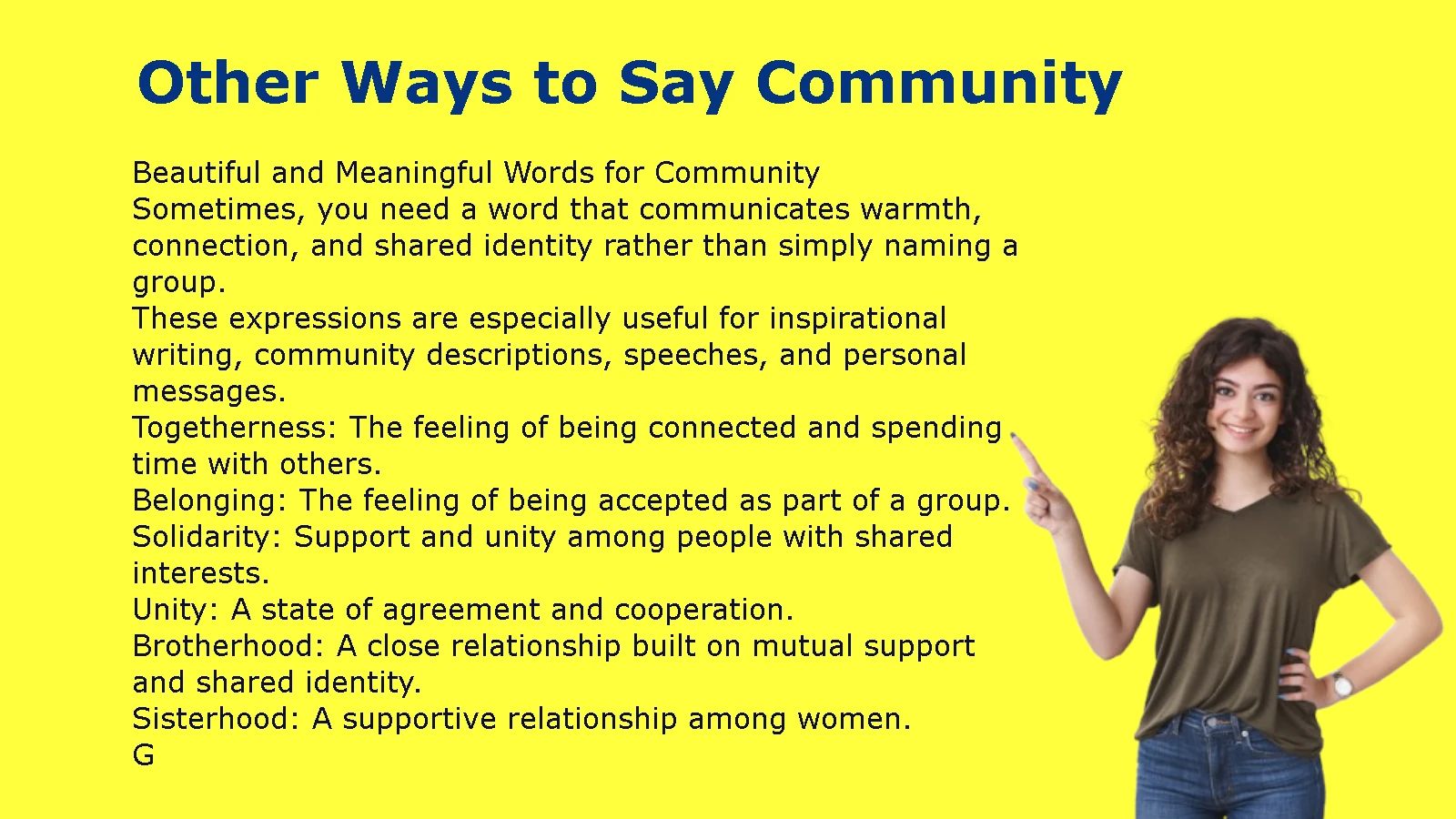
Beautiful and Meaningful Words for Community
Sometimes, you need a word that communicates warmth, connection, and shared identity rather than simply naming a group.
These expressions are especially useful for inspirational writing, community descriptions, speeches, and personal messages.
- Togetherness: The feeling of being connected and spending time with others.
- Belonging: The feeling of being accepted as part of a group.
- Solidarity: Support and unity among people with shared interests.
- Unity: A state of agreement and cooperation.
- Brotherhood: A close relationship built on mutual support and shared identity.
- Sisterhood: A supportive relationship among women.
- Camaraderie: Friendly trust and companionship among people.
- Harmony: Peaceful relationships and cooperation.
- Connection: A relationship or bond between individuals.
- Mutuality: A relationship involving shared responsibilities or benefits.
For example, a school might promote togetherness through group activities, while a neighborhood organization might encourage solidarity by helping families during difficult times.
How to Choose a Unique Word for Community
The most interesting synonym isn’t necessarily the best one. A good alternative should communicate the same general idea without confusing your readers.
Use this simple framework:
- Identify the shared purpose: Are people connected through work, friendship, location, culture, or common interests?
- Consider the relationship: Does the group emphasize cooperation, belonging, or formal organization?
- Match the tone: A creative essay may benefit from fellowship, while an academic paper may require social group.
- Check the meaning: Make sure the alternative doesn’t introduce a different idea.
- Read the sentence aloud: The best synonym should sound natural within the original sentence.
For example, replacing “the local community supports education” with “the local fellowship supports education” changes the emphasis. The original describes a broad group of residents, while the replacement suggests a closer relationship among members.
Positive Words to Describe a Community
Positive words to describe a community highlight its strengths, relationships, and shared values. Terms such as welcoming, inclusive, supportive, vibrant, compassionate, and united help readers understand what makes a group successful. These adjectives work well in essays, community profiles, promotional materials, speeches, and personal descriptions.
A strong description should explain more than whether a community is good or friendly. It should identify the qualities that make people feel connected and encourage cooperation.
Positive Adjectives for a Community
Here are positive adjectives you can use when describing a neighborhood, social group, online community, or organization.
| Positive word | Meaning | Example sentence |
| Welcoming | Friendly toward newcomers | The welcoming community makes new residents feel comfortable. |
| Inclusive | Accepting people from different backgrounds | An inclusive community values everyone’s contribution. |
| Supportive | Ready to provide help | The supportive community assists families in need. |
| Friendly | Pleasant and approachable | A friendly community makes everyday interactions enjoyable. |
| Vibrant | Full of energy and activity | The vibrant community hosts cultural events throughout the year. |
| Thriving | Growing and developing successfully | A thriving community creates opportunities for local businesses. |
| Diverse | Including different backgrounds and perspectives | A diverse community encourages cultural understanding. |
| Compassionate | Showing concern for others | Compassionate residents regularly help vulnerable neighbors. |
| Cooperative | Working together effectively | A cooperative community maintains shared public spaces. |
| Respectful | Showing consideration for others | Respectful communities encourage open communication. |
| Resilient | Recovering from difficulties | A resilient community rebuilds after challenging circumstances. |
| Connected | Maintaining strong relationships | A connected community shares information and resources. |
| Peaceful | Living with little conflict | The peaceful community values understanding and cooperation. |
| Empowering | Helping individuals develop confidence | An empowering community gives young people opportunities to lead. |
| Hospitable | Welcoming and generous toward visitors | The hospitable community makes visitors feel at home. |
| Collaborative | Working together toward shared outcomes | A collaborative community develops local improvement projects. |
Three Words to Describe a Community
If someone asks you to describe a community in just three words, choose adjectives that represent its most important qualities.
Here are several combinations for different situations.
| Three words | What they communicate |
| Welcoming, inclusive, supportive | A friendly environment where everyone feels accepted |
| United, resilient, compassionate | People who stand together during difficult times |
| Diverse, vibrant, connected | A lively group with different backgrounds |
| Peaceful, friendly, harmonious | A calm and cooperative environment |
| Creative, collaborative, inspiring | A group that encourages ideas and teamwork |
| Caring, safe, trustworthy | A community built on mutual support |
| Active, ambitious, innovative | A group focused on progress and development |
| Respectful, understanding, accepting | People who appreciate different perspectives |
| Generous, helpful, dependable | Residents who willingly support one another |
| Strong, united, determined | A group working toward common goals |
Best all-purpose answer: Welcoming, supportive, and inclusive.
These three adjectives describe a community that accepts newcomers, helps its members, and respects individual differences.
However, you should adjust the combination to match the situation. A professional community might be innovative, collaborative, and ambitious, while a rural neighborhood might be close-knit, peaceful, and welcoming.
Examples of Positive Community Descriptions
You can use the following sentences in essays, reports, presentations, and everyday conversations.
- Our community is welcoming, inclusive, and supportive.
- The neighborhood is vibrant, diverse, and full of life.
- A united and compassionate community can overcome difficult challenges.
- Their supportive environment encourages everyone to participate.
- The organization has created a safe and empowering space for young people.
- A thriving community depends on cooperation and mutual respect.
- The residents have built a peaceful environment through communication and understanding.
- Its collaborative spirit encourages people to share ideas and resources.
Positive Words for Different Types of Communities
Different communities have different strengths. The adjectives you choose should reflect their actual characteristics.
| Community type | Suitable positive words |
| Residential community | Friendly, peaceful, welcoming, safe |
| Online community | Engaging, helpful, active, supportive |
| Professional community | Collaborative, innovative, knowledgeable, ambitious |
| School community | Inclusive, encouraging, respectful, inspiring |
| Cultural community | Diverse, expressive, traditional, vibrant |
| Volunteer community | Compassionate, generous, committed, cooperative |
| Rural community | Close-knit, hospitable, resilient, connected |
| Creative community | Artistic, imaginative, collaborative, inspiring |
This approach makes descriptions more specific and meaningful than repeatedly using general adjectives such as nice, good, or friendly.
Another Word for Community or Neighborhood
Although community and neighborhood often appear in similar contexts, they don’t have exactly the same meaning. A neighborhood usually describes a geographical area where people live, while a community can include people connected through shared interests, beliefs, culture, professions, or experiences.
For example, residents living on the same street belong to a neighborhood. However, people participating in an online photography group can form a community without living near one another.
Synonyms for a Neighborhood
Use these alternatives when discussing a residential area, local district, or geographical location.
| Neighborhood synonym | Meaning | Example |
| Locality | A particular geographical area | The locality has several public parks. |
| District | An area within a town or city | The district is known for its restaurants. |
| Residential area | A place mainly used for housing | The residential area attracts young families. |
| Vicinity | The surrounding area | Several schools operate in the vicinity. |
| Settlement | A place where people establish homes | The settlement developed near the coast. |
| Borough | An administrative district in certain regions | The borough maintains several community centers. |
| Enclave | A distinct area within a larger area | The neighborhood includes a cultural enclave. |
| Quarter | A section of a town or city | The historic quarter attracts visitors. |
| Precinct | A defined geographical or administrative area | The precinct includes several residential streets. |
| Local area | The nearby geographical surroundings | Local businesses serve the surrounding area. |
Remember that some alternatives have specific geographical or administrative meanings. For instance, borough and precinct aren’t universal replacements for neighborhood.
Alternatives for a Local Community
When discussing people who live in a particular area, consider these expressions:
- Local population
- Area residents
- Neighborhood group
- Local society
- Residential community
- Town population
- Local network
- Regional population
- Village residents
- Community members
- Local association
- Resident group
Example: Instead of writing, “The community needs better transportation,” you could write, “Local residents need better transportation.”
The second sentence places more emphasis on the people affected by the issue.
Community vs. Neighborhood: What’s the Difference?
The distinction becomes clearer when you compare their typical uses.
| Feature | Community | Neighborhood |
| Main meaning | A group connected through shared characteristics or interests | A geographical residential area |
| Location required | No | Usually |
| Social relationships | Often emphasized | May or may not be emphasized |
| Common contexts | Culture, identity, profession, shared interests | Housing, streets, local facilities |
| Example | An online gaming community | A quiet residential neighborhood |
Example 1: Community
“The photography community shares techniques and encourages new artists.”
This group exists because its members share an interest, not because they live in the same place.
Example 2: Neighborhood
“The neighborhood has several parks and a public library.”
This sentence describes a geographical location and its facilities.
The distinction matters when choosing synonyms. A network may describe an online community, but it doesn’t necessarily describe a residential neighborhood.
Sense of Community Synonyms
A sense of community describes the feeling of belonging, connection, and shared responsibility among people. Its closest alternatives include sense of belonging, togetherness, social connection, community bond, collective spirit, and shared identity. These expressions emphasize relationships and emotional attachment rather than simply identifying a group.
For example, residents may live in the same neighborhood without developing a strong sense of community. Shared activities, communication, and mutual support can help create that connection.
Best Alternatives for Sense of Community
Use these expressions when you want to communicate belonging, friendship, and shared identity.
| Alternative expression | Meaning | Example |
| Sense of belonging | Feeling accepted as part of a group | The school creates a sense of belonging among students. |
| Feeling of togetherness | A shared feeling of unity | The festival encourages a feeling of togetherness. |
| Social connection | Relationships between individuals | Volunteering strengthens social connections. |
| Shared identity | Common characteristics or values | Their shared identity brings residents together. |
| Collective spirit | A shared commitment or attitude | The collective spirit motivates volunteers. |
| Community bond | A relationship connecting community members | Local events strengthen the community bond. |
| Social solidarity | Unity based on common interests | Social solidarity supports neighborhood development. |
| Mutual belonging | A shared feeling of acceptance | Their mutual belonging encourages cooperation. |
| Group identity | A shared understanding of membership | The team develops a strong group identity. |
| Spirit of unity | A shared sense of cooperation | The campaign promotes a spirit of unity. |
Examples of Sense of Community in Sentences
Here are original examples showing how to use these alternatives naturally.
- The annual festival creates a strong sense of belonging among residents.
- Volunteering helps build meaningful social connections.
- Shared traditions strengthen the collective spirit of the village.
- Their community bonds encourage mutual support.
- Regular neighborhood gatherings promote togetherness.
- The school encourages a shared identity among students and teachers.
- Local projects develop social solidarity among different age groups.
- Open communication helps residents feel connected and accepted.
Sense of Community vs. Community Spirit
These expressions are closely related, but they emphasize slightly different ideas.
Sense of community focuses on the emotional feeling of belonging to a group. It describes how connected and accepted people feel.
Community spirit focuses more on shared enthusiasm, cooperation, and willingness to help others.
Consider these examples:
- “The new residents quickly developed a sense of community.” This emphasizes their growing feeling of belonging.
- “The community spirit was evident when residents volunteered to repair the playground.” This emphasizes their willingness to cooperate.
Both expressions can describe a healthy social environment, but they highlight different aspects of group relationships.
Community Synonyms for Essays and Academic Writing
Academic writing often requires alternatives to the word community to avoid repetition and communicate ideas more precisely. Depending on the subject, suitable expressions include society, population, social group, collective body, local population, social network, and demographic group.
The best replacement depends on what your sentence discusses. For example, population works well when discussing residents and demographic characteristics, while social group is more suitable when examining shared identities or relationships.
Formal Words for Community in an Essay
These alternatives are useful in academic assignments, research papers, reports, and formal discussions.
| Formal alternative | Best usage | Example |
| Society | Broad social structures and relationships | Society plays an important role in education. |
| Population | People living in a specific area | The population requires improved healthcare. |
| Social group | People connected through shared characteristics | The social group promotes cultural awareness. |
| Collective body | An organized group acting together | The collective body supports regional development. |
| Local population | Residents of a particular geographical area | The local population faces economic challenges. |
| Social network | Connected individuals and relationships | Social networks influence information sharing. |
| Association | An organized group with common interests | The association promotes professional development. |
| Public | People considered as a general audience | The public supports environmental protection. |
| Demographic group | People sharing demographic characteristics | The demographic group has different educational needs. |
| Social structure | The organization of relationships within society | Social structures influence individual opportunities. |
Another Word for Communities in an Essay
The following examples show how to replace repeated uses of community while preserving the original meaning.
| Original sentence | Improved alternative |
| Different communities face economic challenges. | Different social groups face economic challenges. |
| Communities need better healthcare. | Local populations need better healthcare services. |
| Online communities share information. | Digital networks share information. |
| Rural communities depend on agriculture. | Rural populations depend on agriculture. |
| Communities benefit from education. | Society benefits from improved educational opportunities. |
| Small communities often support local businesses. | Small towns often support local businesses. |
| Communities experience environmental changes. | Local populations experience environmental changes. |
| Professional communities exchange ideas. | Professional networks exchange ideas. |
| Communities should participate in decision-making. | Local residents should participate in decision-making. |
| Cultural communities preserve traditions. | Cultural groups preserve their traditions. |
Notice how each replacement changes slightly depending on the sentence.
For instance, “rural populations” is appropriate when discussing the people who live in rural areas. However, “rural society” may refer to broader social relationships and institutions.
How to Avoid Repeating Community in Academic Writing
Repeated vocabulary can make an essay sound monotonous. However, replacing every occurrence with a different synonym can create confusion.
Follow these practical guidelines:
- Identify the exact subject: Determine whether you’re discussing residents, organizations, social relationships, or a geographical area.
- Use population for demographic discussions: This works well when describing the number or characteristics of people living somewhere.
- Choose society for broader discussions: Use it when discussing social structures, institutions, and human relationships.
- Use network for connected individuals: This is particularly suitable for professional and digital relationships.
- Choose collective for shared action: Use it when a group works toward a common purpose.
- Use residents for geographical discussions: This makes the people involved clear.
- Maintain consistency: Don’t introduce several alternatives when they refer to different groups.
For example:
Repetitive: “The community needs better schools. The community also needs improved transportation. The community should receive additional funding.”
Improved: “Local residents need better schools and improved transportation. Their population would also benefit from additional public funding.”
The revised version sounds more natural and reduces unnecessary repetition.
Formal vs. Informal Alternatives for Community
Different writing situations call for different vocabulary.
| Writing style | Suitable alternatives |
| Academic | Society, population, social group, demographic group |
| Professional | Network, association, collective, organization |
| Conversational | Neighborhood, group, local circle, residents |
| Creative | Fellowship, kinship, togetherness, collective spirit |
| Government and public policy | Local population, residents, constituency, public |
| Social research | Social group, population, social network, demographic group |
Practical example: In a research paper, “the local population” may sound more precise than “the neighborhood community” when discussing healthcare statistics.
Community Antonyms: What Is the Opposite of Community?
The opposite of community depends on which meaning you want to express. When community refers to social connection, suitable antonyms include isolation, alienation, loneliness, and disconnection. When it describes unity or cooperation, words such as division, separation, and fragmentation communicate contrasting ideas.
There isn’t one universal antonym that works in every sentence.
Common Community Antonyms
Here are common words that express the opposite of social connection, belonging, or group unity.
| Antonym | Meaning | Example |
| Isolation | Separation from others | Social isolation can affect personal well-being. |
| Alienation | Feeling disconnected or excluded | Alienation can weaken relationships. |
| Solitude | The state of being alone | He preferred solitude to group activities. |
| Separation | A state of being apart | Separation reduced communication between the groups. |
| Division | A lack of unity | Division prevented the residents from cooperating. |
| Disconnection | Absence of meaningful connection | Disconnection made collaboration difficult. |
| Fragmentation | Breaking into separate parts | Fragmentation weakened the organization. |
| Loneliness | Feeling alone or lacking companionship | Loneliness affected his social life. |
| Exclusion | Keeping someone outside a group | Exclusion prevented newcomers from participating. |
| Estrangement | A loss of closeness or connection | Estrangement developed between the two groups. |
| Individualism | Emphasis on individual interests | Extreme individualism can reduce group cooperation. |
| Segregation | Separation of groups, often by social characteristics | Segregation limits interaction between different populations. |
These words describe different kinds of separation. For example, solitude doesn’t always indicate an unhealthy situation. Someone may enjoy spending time alone without experiencing alienation or social exclusion.
Opposite of a Close-Knit Community
A close-knit community has strong relationships, mutual trust, and regular interaction. Its opposite describes a group where people have weak relationships or little cooperation.
Possible expressions include:
- Disconnected population
- Fragmented group
- Divided society
- Isolated individuals
- Socially disconnected group
- Disunited neighborhood
- Alienated population
- Fragmented social network
Example: “A close-knit neighborhood shares resources and supports its residents, whereas a fragmented neighborhood may experience weak relationships and limited cooperation.”
Examples of Community Antonyms in Sentences
Understanding antonyms becomes easier when you see how they work in context.
- Social isolation can weaken relationships between residents.
- Division prevents people from working toward common goals.
- Alienation makes individuals feel disconnected from society.
- Fragmentation can reduce cooperation among local organizations.
- Exclusion prevents certain individuals from participating in group activities.
- Disconnection makes it harder for residents to develop trust.
- Segregation creates barriers between different social groups.
Choose an antonym based on the specific opposite you intend to communicate.
Community Synonyms and Antonyms: Quick Comparison
A quick comparison makes it easier to identify the most suitable word when you’re writing about relationships, shared interests, and social connections.
| Community synonym | Community antonym | Context |
| Unity | Division | Shared identity |
| Fellowship | Alienation | Relationships |
| Connection | Disconnection | Social bonds |
| Togetherness | Separation | Group relationships |
| Cooperation | Conflict | Shared activities |
| Inclusion | Exclusion | Participation |
| Solidarity | Fragmentation | Collective support |
| Belonging | Isolation | Emotional connection |
| Harmony | Discord | Social relationships |
| Integration | Segregation | Social participation |
These are contextual opposites, not exact dictionary antonyms in every situation.
For example, cooperation and conflict describe contrasting relationships between people, while unity and division describe contrasting conditions within a group.
Understanding these distinctions helps you select vocabulary that communicates your intended meaning accurately.
How to Choose the Best Synonym for Community
Choosing the right community synonym requires more than finding a word with a similar dictionary definition. You should consider the group, its purpose, the relationships between its members, and the tone of your writing.
A word that works in an academic essay might sound unnatural in a casual conversation. Similarly, an expression suitable for a residential neighborhood might not describe an online group accurately.
Consider the Meaning You Want to Communicate
Start by identifying what your sentence actually describes.
Ask yourself:
- Are you referring to people living in one geographical area?
- Are the individuals connected through shared interests?
- Does the group have a formal organization?
- Are you describing emotional relationships?
- Does the sentence emphasize cooperation or shared identity?
Then choose an appropriate alternative.
| What you mean | Best synonym |
| People living in one area | Neighborhood or local population |
| People sharing common interests | Group or collective |
| A broad social structure | Society |
| People connected through professional relationships | Network |
| People working toward a shared goal | Coalition or association |
| A feeling of shared identity | Fellowship or kinship |
| A group organized around worship | Congregation |
| People connected through mutual support | Social group or fellowship |
Match the Word to Your Writing Style
Your audience and purpose should influence your vocabulary.
Academic writing: Choose society, population, demographic group, or social structure.
Example: “The local population requires improved access to educational facilities.”
Professional writing: Consider network, association, collective, or organization.
Example: “The professional network encourages collaboration between industry experts.”
Conversational writing: Use group, neighborhood, residents, or local circle.
Example: “Our neighborhood organizes a monthly cleanup.”
Creative writing: Choose fellowship, kinship, togetherness, or collective spirit.
Example: “A strong sense of kinship connected the families.”
Check the Context Before Replacing Community
Consider this sentence:
“The community came together to support the local school.”
You could replace community with several alternatives, but each creates a slightly different meaning.
- “The residents came together to support the local school.” This emphasizes people living nearby.
- “The neighborhood came together to support the local school.” This emphasizes the geographical area and its residents.
- “The association came together to support the local school.” This suggests an organized group.
- “The collective came together to support the local school.” This emphasizes shared action.
The original meaning remains similar, but the emphasis changes.
Avoid Common Synonym Mistakes
Some words appear interchangeable but have distinct meanings.
| Common mistake | Why it doesn’t always work |
| Using population instead of community | Population emphasizes people counted within a geographical area, not necessarily their relationships. |
| Using neighborhood instead of community | Neighborhood usually requires a geographical setting. |
| Using congregation instead of community | Congregation usually refers to a religious assembly. |
| Using consortium instead of community | Consortium generally describes a formal association of organizations or parties. |
| Using solitude as a direct antonym | Solitude describes being alone, which isn’t always the opposite of social belonging. |
| Using society instead of every community | Society often refers to a broader social structure. |
The main rule: Choose the word that preserves your intended meaning, not simply the word that sounds more sophisticated.
Practical Examples: How to Replace Community in Everyday Writing
Let’s look at how different contexts influence the best alternative. These examples demonstrate how you can improve sentence variety without changing the central message.
Example: Community in a School Setting
Original: “The school community supports students from different backgrounds.”
Alternative: “The school network supports students from different backgrounds.”
Another option: “The students, teachers, and families work together to support learners from different backgrounds.”
The second alternative identifies the people involved more clearly rather than replacing community with another broad noun.
Example: Community in a Business Setting
Original: “Our business community encourages innovation.”
Alternative: “Our professional network encourages innovation.”
You could also write:
“The local business association encourages innovation through collaboration and shared resources.”
The best choice depends on whether you mean business professionals generally or a formal organization.
Example: Community in a Residential Setting
Original: “The community organizes events to improve the neighborhood.”
Alternative: “Local residents organize events to improve their area.”
This version is direct and identifies the people responsible for the activity.
Example: Community in an Online Setting
Original: “The community shares helpful information about technology.”
Alternative: “The online network shares helpful information about technology.”
You could also use “digital group” or “online audience,” depending on the group’s structure and purpose.
Example: Community in an Academic Essay
Original: “The community faces several environmental challenges.”
Alternative: “The local population faces several environmental challenges.”
This version works especially well when discussing pollution, public health, housing, or demographic issues.
Case Study: Choosing the Right Community Synonym
Imagine a town introducing a project to improve public spaces, organize volunteer activities, and strengthen relationships between residents.
Although the meaning is understandable, the repetition makes the writing less effective.
A more precise version could read:
“Local residents support the project and organize volunteer activities. The neighborhood association coordinates improvements to public spaces, while the wider population benefits from the new facilities.”
This revision uses three different expressions:
- Local residents identifies the people participating.
- Neighborhood association identifies the organized group.
- Population describes the people benefiting from the project.
The revised paragraph communicates more information without unnecessary repetition.
Lesson: Strong synonym use improves clarity when each alternative identifies a specific group, relationship, or function.
Frequently Asked Questions About Community Synonyms
What Is the Best Synonym for Community?
The best synonym for community depends on the context. Society, group, collective, neighborhood, population, and fellowship are common alternatives. Use neighborhood for a geographical area, society for a broader social structure, and collective for people working toward a shared purpose.
What Are Three Words to Describe a Community?
Three excellent words to describe a community are welcoming, supportive, and inclusive. These adjectives communicate friendliness, mutual assistance, and acceptance. Other combinations include united, resilient, and compassionate or diverse, vibrant, and connected.
What Is a Unique Word for Community?
Fellowship is a distinctive word for a community built around friendship and shared interests. Other unique alternatives include kinship, commune, collective, consortium, and solidarity. Each highlights a different aspect of group relationships, organization, or shared identity.
What Is Another Word for Community in an Essay?
Suitable academic alternatives include society, population, social group, collective body, local population, and social network. Choose the expression that matches your subject. Population works well for demographic discussions, while social group is appropriate when examining shared characteristics or relationships.
What Is the Opposite of Community?
Common opposites of community include isolation, alienation, disconnection, separation, and fragmentation. The most suitable antonym depends on the intended meaning. Isolation describes a lack of social contact, while division and fragmentation emphasize a lack of unity.
What Is Another Way to Say Sense of Community?
Other ways to say sense of community include sense of belonging, togetherness, social connection, shared identity, collective spirit, and community bond. These expressions describe the emotional connection and mutual support that make people feel accepted within a group.
Conclusion: Choose the Right Word to Describe a Community
Finding the best alternatives to community becomes easier when you understand the different meanings behind the word. Society, neighborhood, collective, population, fellowship, and network can all work as synonyms, but each emphasizes a different type of group or relationship.
For positive descriptions, words such as welcoming, supportive, inclusive, and vibrant help communicate a community’s strengths. When discussing emotional connections, expressions such as sense of belonging, togetherness, and solidarity provide more specific meaning. For academic writing, alternatives such as social group, local population, and society can reduce repetition while maintaining clarity.
Remember that the best synonym isn’t always the most unusual one. It is the word that fits your sentence, audience, and intended meaning.
Before choosing an alternative, consider what connects the people, what role they play, and what you want your readers to understand. This simple approach will make your writing clearer, more varied, and more engaging.