The Hastings meaning refers primarily to an English surname and place name with historical roots. However, the word has several interpretations depending on where you encounter it. In Bridgerton, Hastings refers to the fictional aristocratic title held by Simon Basset, the Duke of Hastings. It also appears in geographical references, such as Hastings in East Sussex, England, and the name of the insurance company Hastings Direct. Understanding its origin, pronunciation, slang usage, and different contexts helps you recognize what the word means in everyday English.
| Question | Answer |
| What does Hastings mean? | Hastings is primarily an English surname and geographical place name with historical origins. |
| What does Hastings mean in Bridgerton? | It refers to the fictional dukedom held by Simon Basset, known as the Duke of Hastings. |
| Is Hastings a slang word? | It has no widely established general slang meaning in modern English. |
| How do you pronounce Hastings? | HAY-stingz, with two syllables and stress on the first. |
| Which county is Hastings in? | Hastings is a coastal town in East Sussex, England. |
What Does Hastings Mean?
Hastings is a proper noun commonly used as an English surname and place name. It has historical associations with an early English people and the town of Hastings in East Sussex. The name also appears in British history, literature, entertainment, and business. Its meaning depends on whether someone uses it to identify a person, location, family, or fictional title.
Unlike ordinary vocabulary words, Hastings does not have one simple dictionary definition that applies to every situation. It is a name whose significance developed through historical, geographical, and cultural use.
Hastings Definition and Basic Meaning
The word Hastings generally has three main uses:
- Surname: Hastings is a family name found in English-speaking countries.
- Place name: It identifies several geographical locations, most famously the coastal town in East Sussex, England.
- Title or cultural reference: It appears in fictional and historical contexts, including the Duke of Hastings in Bridgerton.
For example, consider these sentences:
- The Hastings family has lived in England for generations.
- We spent our summer holiday in Hastings.
- Simon Basset is known as the Duke of Hastings in Bridgerton.
Although each sentence uses the same spelling, the intended meaning changes with the context.
Hastings is normally capitalized because it is a proper noun. You should not write it as hastings when referring to the town, surname, or fictional title unless it appears in a stylized username or another informal format.
An important distinction: Hastings is not simply another word for speed, haste, or urgency. Those words have separate meanings, even though their spellings look somewhat similar.
What Is the Origin of the Name Hastings?
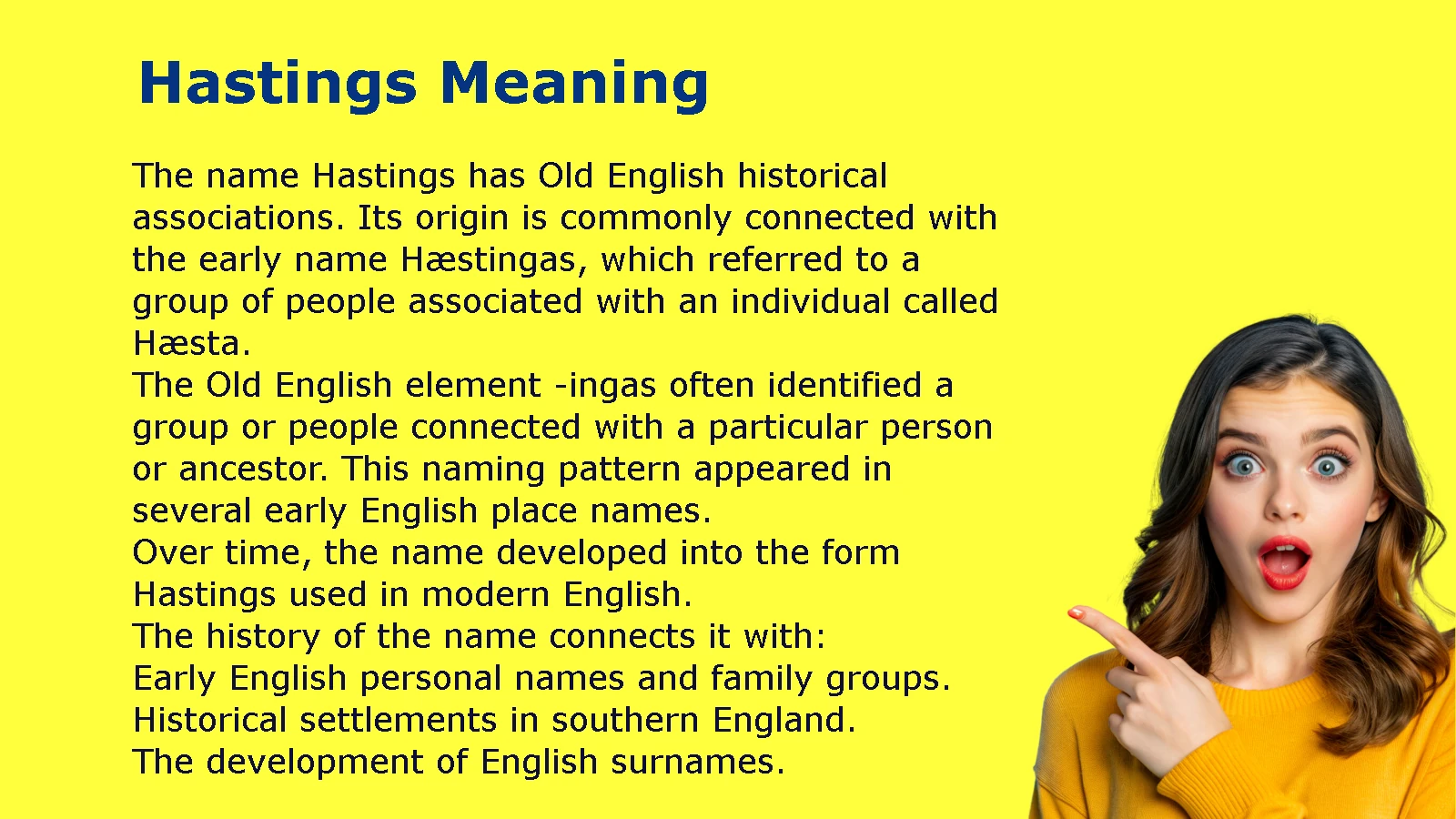
The name Hastings has Old English historical associations. Its origin is commonly connected with the early name Hæstingas, which referred to a group of people associated with an individual called Hæsta.
The Old English element -ingas often identified a group or people connected with a particular person or ancestor. This naming pattern appeared in several early English place names.
Over time, the name developed into the form Hastings used in modern English.
The history of the name connects it with:
- Early English personal names and family groups.
- Historical settlements in southern England.
- The development of English surnames.
- The geographical identity of Hastings in Sussex.
The town’s name also appears in one of the most famous events in English history: the Battle of Hastings in 1066.
However, the battle did not necessarily take place within the modern town itself. The fighting occurred near present-day Battle, a town several miles northwest of Hastings. The historical name became widely recognized because of its association with the Norman Conquest.
The surname Hastings later became established as a hereditary family name. Like many English surnames, it could develop through geographical association, family history, and the movement of people between settlements.
Is Hastings a First Name or a Last Name?
Hastings is traditionally a surname, although people occasionally use it as a first name.
As a family name, Hastings has a long history in English-speaking societies. Families carrying this surname can be found in Britain, North America, Australia, and other countries.
Its use as a first name is less common. Parents may choose it because of its historical character, family connections, or association with a particular place.
Here is how the two uses differ:
| Type | Meaning | Example |
| First name | A given name chosen for an individual | Hastings arrived early for the meeting. |
| Last name | A hereditary family name | Mr. Hastings attended the ceremony. |
| Place name | A geographical location | Hastings attracts visitors throughout the year. |
| Fictional title | A noble title associated with a character | The Duke of Hastings appears in Bridgerton. |
The surrounding words usually make the intended meaning clear.
Hastings Meaning in Slang
Hastings does not have a widely recognized slang definition in standard modern English. People may use it as a surname, nickname, location reference, or reference to a fictional character. Its interpretation depends on the conversation rather than a fixed informal definition.
This distinction matters because search results sometimes group proper names, internet expressions, and slang terms together. However, a word does not automatically become slang simply because people use it casually online.
Does Hastings Have a Slang Meaning?
There is no broadly established English slang meaning for Hastings that gives the word a special informal definition.
For example, someone might mention Hastings while discussing a person, a television series, or a holiday destination. In each situation, the word identifies something specific rather than functioning as a slang expression.
Consider these examples:
- “I met Hastings at the office.” Here, Hastings is a person’s surname.
- “We’re going to Hastings this weekend.” Here, Hastings identifies a town.
- “The Duke of Hastings is my favorite character.” Here, Hastings refers to a fictional aristocratic title.
None of these examples uses Hastings as conventional slang.
However, online communities sometimes develop their own expressions around names, fictional characters, and popular entertainment. A particular group might use Hastings in a humorous or symbolic way. That local usage does not establish a universal slang definition.
The safest interpretation is to treat Hastings as a proper noun unless the surrounding conversation clearly establishes another meaning.
How Is Hastings Used in Informal Conversations?
In everyday conversations, people usually use Hastings to refer to someone or something with that name.
Its informal use can involve several situations:
Talking about a person
Someone might say:
“Have you spoken to Hastings about the project?”
The name identifies a colleague, friend, or another person.
Discussing a location
A conversation about travel might include:
“We’re planning a short trip to Hastings.”
In this example, the speaker refers to the English coastal town.
Discussing entertainment
A fan might say:
“The Duke of Hastings made the first season of Bridgerton interesting.”
Here, Hastings identifies the fictional noble title associated with Simon Basset.
Using a surname as a nickname
Friends may address someone by their surname. For example, a person named Daniel Hastings might be called simply Hastings by teammates or colleagues.
These examples demonstrate why context matters when interpreting the word.
Is Hastings an Insult or a Nickname?
Hastings is not inherently an insult or offensive expression. It is primarily a surname and place name.
Someone might use it as a nickname when addressing a person with that surname. In other situations, people may use it as a playful reference to a character or historical figure.
Whether the name sounds humorous, affectionate, or critical depends on the speaker’s intention.
For example:
- “Ask Hastings to join us.” Neutral use of a surname.
- “You’re acting like the Duke of Hastings today.” A possible playful reference to the fictional character.
- “The Hastings family organized the event.” A straightforward family reference.
You should not assume that someone is insulting another person simply because they use the word Hastings.
Hastings Meaning in Bridgerton
In Bridgerton, Hastings refers to the fictional aristocratic title held by Simon Basset, a central character in the first season. Simon is known as the Duke of Hastings. The title connects him to an imaginary English dukedom and explains why other characters address him using his noble rank rather than only his personal name.
The series uses historical British aristocratic customs as part of its fictional Regency-era setting.
Who Is the Duke of Hastings in Bridgerton?
The Duke of Hastings is Simon Basset, played by Regé-Jean Page in the first season of Netflix’s Bridgerton.
Simon is one of the main characters in the show’s first season. He is a wealthy aristocrat who returns to London society after spending time away from England.
His story becomes closely connected to Daphne Bridgerton, the eldest Bridgerton daughter.
Their relationship develops through a social arrangement that initially benefits both characters. They pretend to have a romantic connection to influence how other members of London’s high society view them.
However, their relationship gradually becomes more complicated as genuine feelings develop.
Simon’s character also has a difficult relationship with his father and the expectations associated with his family title.
His personal history helps explain his reluctance to embrace marriage, family life, and the responsibilities that come with his position.
Some important details about the character include:
| Detail | Information |
| Character | Simon Basset |
| Popular title | Duke of Hastings |
| Television series | Bridgerton |
| Actor | Regé-Jean Page |
| Main romantic connection | Daphne Bridgerton |
| Setting | Fictional Regency-era British high society |
| First appearance | Season 1 |
The character became widely recognized because the series combines romance, aristocratic customs, family conflict, and social expectations.
What Does the Duke of Hastings Title Mean?
The Duke of Hastings title identifies Simon Basset as a fictional member of the British aristocracy.
A duke traditionally holds one of the highest hereditary ranks in the British peerage. The title generally ranks above marquess, earl, viscount, and baron.
A dukedom is a noble title rather than an ordinary surname or nickname.
Historically, British dukes held significant social prestige. Their titles often connected them to particular territories, estates, or family lineages.
The title also influenced how people addressed them in formal settings.
Here is a simplified comparison of traditional British peerage ranks:
| Aristocratic rank | Position in the peerage |
| Duke | Highest ordinary hereditary peerage rank |
| Marquess | Below duke |
| Earl | Below marquess |
| Viscount | Below earl |
| Baron | Below viscount |
In Bridgerton, Simon’s title gives him considerable social standing. Other characters recognize his position, wealth, and influence within London’s aristocratic society.
The title Hastings does not mean that Simon owns or governs the modern town of Hastings. It identifies his fictional dukedom.
Why Is Simon Basset Called Hastings?
Simon Basset has two important identifying elements: his personal name and his noble title.
Simon Basset is his personal name, while Duke of Hastings identifies his aristocratic rank.
In British noble traditions, people often use a duke’s territorial title when addressing him socially.
For example:
- Simon Basset identifies the individual.
- The Duke of Hastings identifies his noble rank.
- His Grace is a formal style of address traditionally used for a duke.
This explains why characters in the series frequently refer to Simon as the Duke of Hastings rather than using his full personal name.
The distinction also helps viewers understand the social structure represented in the show.
Is the Duke of Hastings a Real Historical Title?
The Duke of Hastings portrayed in Bridgerton is fictional.
The series uses recognizable elements of British aristocratic society, including inherited titles, formal introductions, estate ownership, and marriage expectations. However, Simon Basset and his particular dukedom belong to the show’s fictional world.
The distinction between historical inspiration and actual history is important.
British peerage titles have existed for centuries, and real dukedoms have played important roles in the country’s political and social development.
However, the fictional Duke of Hastings should not be confused with a documented historical holder of that exact title.
The series takes creative liberties with its Regency-inspired setting. Its main purpose is to tell a romantic and dramatic story rather than provide a precise account of British aristocratic history.
How to Pronounce Hastings
Hastings is pronounced HAY-stingz. It contains two syllables, with the strongest emphasis on the first syllable. The opening sound rhymes with “day,” while the ending sounds like “stings” without an additional syllable.
The pronunciation remains essentially the same when Hastings appears as a surname, geographical name, or fictional title.
Hastings Phonetic Spelling
The International Phonetic Alphabet (IPA) represents the pronunciation of Hastings as:
/ˈheɪstɪŋz/
A simple breakdown makes the pronunciation easier to understand:
| Part | Sound | Explanation |
| Hay | /heɪ/ | Rhymes with day and say |
| Sting | /stɪŋ/ | Sounds like the beginning of the word stinger |
| Z | /z/ | A voiced final consonant |
When you combine the sounds, you get the complete pronunciation.
The first syllable carries the main stress, while the second syllable receives less emphasis.
How Many Syllables Does Hastings Have?
Hastings has two syllables:
- Hast
- ings
The stress falls on the first syllable.
You can identify the two syllables by saying the word slowly and listening for its two vowel sounds.
Unlike some longer English surnames, Hastings does not require complicated syllable changes or unusual pronunciation rules.
Common Pronunciation Mistakes
Some English learners may mispronounce Hastings because its spelling does not immediately reveal every sound.
Here are a few mistakes to avoid:
- Using a short opening vowel: The first vowel should have the long A sound found in “day.”
- Adding an extra syllable: Hastings has two syllables, not three.
- Pronouncing the ending as a separate word: The final sound belongs to the second syllable.
- Ignoring the stress: The first syllable receives the main emphasis.
A useful practice method is to say “HAY” first, then add the remaining sounds without inserting a pause.
Repeat the complete word several times at a natural speaking speed.
Hastings: Which County Is It In?
Hastings is in East Sussex, England. It is a coastal town in southeastern England, located on the English Channel. The town is part of the historic county of Sussex and belongs to the modern administrative county of East Sussex. Its name is also associated with the famous Battle of Hastings in 1066.
Where Is Hastings Located in England?
Hastings lies on the southeastern coast of England, facing the English Channel.
It is part of the county of East Sussex and is known for its seaside setting, historic Old Town, fishing heritage, and cultural attractions.
The town has several well-known features:
- Hastings Old Town: A historic area with narrow streets, independent shops, and traditional buildings.
- Hastings Castle: A medieval castle associated with the Norman Conquest.
- The Stade: A historic fishing beach and working fishing area.
- Hastings Pier: A prominent seaside attraction.
- The seafront: A popular area for walking, sightseeing, and coastal activities.
Hastings also has a long association with the English fishing industry. Its coastal location helped shape the town’s economy and local identity.
The town is particularly recognizable for its traditional beach-launched fishing boats and historic fishing community.
Is Hastings in East Sussex or West Sussex?
Hastings is in East Sussex, not West Sussex.
Sussex is a historic county in southeastern England. Modern local government divides the area into two administrative counties:
| County | General location | Examples of towns |
| East Sussex | Eastern part of Sussex | Hastings, Eastbourne, Lewes, Bexhill-on-Sea |
| West Sussex | Western part of Sussex | Chichester, Worthing, Crawley, Horsham |
Hastings belongs to the eastern administrative county.
This distinction matters because people sometimes use Sussex as a general geographical description without specifying which modern county contains a particular town.
If someone asks, “Hastings which county?” the clearest answer is East Sussex.
Why Is Hastings Historically Famous?
Hastings is closely associated with the Battle of Hastings, fought on October 14, 1066.
The battle was a major event in English history because it resulted in the victory of William, Duke of Normandy, over King Harold II of England.
William later became known as William the Conqueror.
The battle changed England’s political leadership and helped establish Norman influence over the country.
Some important historical facts include:
| Historical detail | Information |
| Battle | Battle of Hastings |
| Date | October 14, 1066 |
| Norman leader | William, Duke of Normandy |
| English king | Harold II |
| Result | Norman victory |
| Historical consequence | Beginning of the Norman rule of England |
Although the battle is called the Battle of Hastings, the main fighting took place near the present-day town of Battle, approximately seven miles northwest of Hastings.
The name became famous because Hastings was the nearest prominent settlement associated with the event.
The Norman Conquest influenced several areas of English life, including:
- Government and administration.
- Land ownership and the feudal system.
- Architecture and castle construction.
- The development of the English language.
- The relationship between England and continental Europe.
The Battle of Hastings remains one of the most widely remembered events in British history.
What Does Hastings Direct Mean?
Hastings Direct is a UK insurance brand that provides insurance products, including car and home insurance. In this phrase, Hastings is part of a company name rather than a separate English vocabulary word. People searching for Hastings Direct usually want information about the insurance provider, not the historical meaning of Hastings.
Is Hastings Direct an Insurance Company?
Yes. Hastings Direct is a British insurance brand known particularly for motor insurance.
The company operates in the UK insurance market and provides products designed for individuals who want to insure vehicles, homes, and other assets.
Its services have included:
- Car insurance.
- Home insurance.
- Motorcycle insurance.
- Van insurance.
- Related insurance products and services.
The brand is associated with online insurance quotations and policy management.
For example, someone might search for Hastings Direct when comparing car insurance prices, renewing a policy, or contacting an insurer about a claim.
This is a commercial use of the name.
It has no special connection to the Duke of Hastings in Bridgerton or to an established slang definition.
Does Hastings Direct Have a Different Meaning?
The phrase Hastings Direct is a brand name, so it should be interpreted as the name of an insurance business.
Compare these examples:
| Expression | Meaning |
| Hastings | An English surname or geographical name |
| Hastings Direct | A UK insurance brand |
| Duke of Hastings | A fictional aristocratic title in Bridgerton |
| Hastings, East Sussex | A coastal town in England |
Although all four expressions contain the same word, they refer to different things.
When you encounter Hastings Direct in search results, advertisements, or insurance documents, the commercial context makes its meaning clear.
What Does Hasting Up Mean?
“Hasting up” is not a widely recognized standard English expression with an established dictionary meaning. It may result from a spelling mistake, an unusual sentence construction, or confusion with the verb “hasten.” Hasten means to make something happen sooner or to move more quickly.
Understanding the difference between these words helps prevent grammatical mistakes.
Is Hasting Up a Correct English Expression?
In ordinary modern English, “hasting up” is not a natural or commonly accepted expression.
The problem comes from the difference between a proper noun and a verb.
Hastings is usually a proper noun, while hasting is a less common grammatical form associated with the verb hasten.
Even when hasting is used as a participle, the phrase “hasting up” generally sounds unnatural without a specific context.
For example:
Incorrect or unnatural: “She was hasting up the project.”
More natural: “She was hastening the project.”
Another option:
“She was speeding up the project.”
These alternatives communicate the intended meaning more clearly.
What Does Hasten Mean?
Hasten is a verb that means to make something happen sooner, accelerate an action, or move quickly toward a destination.
It commonly appears in formal writing, professional communication, news reports, and everyday English.
Here are several examples:
- The manager wanted to hasten the approval process.
- Heavy rain could hasten the arrival of winter conditions.
- The announcement hastened the company’s decision.
- She hastened to explain the misunderstanding.
- New technology may hasten the development of medical treatments.
Hasten can describe both physical movement and the acceleration of an event or process.
For instance, “He hastened home” describes someone moving quickly, while “The discovery hastened the investigation” describes an event that caused an activity to progress faster.
Common forms of the verb include:
| Form | Word | Example |
| Base form | Hasten | We should hasten the process. |
| Third-person singular | Hastens | The change hastens development. |
| Past tense | Hastened | The news hastened their decision. |
| Present participle | Hastening | They are hastening the work. |
Hasting vs. Hastings vs. Hastening
These words look similar, but they do not perform the same grammatical function.
| Word | Meaning | Part of speech or use | Example |
| Hastings | A surname or place name | Proper noun | Hastings is in East Sussex. |
| Hasting | An uncommon participial form of hasten | Verb form | The hasting process is an archaic construction. |
| Hastening | Making something happen sooner or moving faster | Verb form or gerund | Hastening the process requires careful planning. |
Hastings usually identifies a person, place, or title.
Hasting is a much less common form related to hasten. You may encounter it in older or literary writing, but modern English generally favors “hastening.”
Hastening is the natural present participle and gerund form of the verb.
For most modern writing, use hastening rather than hasting when you want to express acceleration.
Hastings vs. Similar Names and Expressions
The spelling of Hastings can create confusion because English contains several words with similar letters and sounds.
However, their meanings and grammatical functions differ.
Hastings vs. Hasting
The difference between Hastings and hasting mainly involves their grammatical roles.
Hastings is a proper noun. It can identify a family, person, town, or fictional title.
Hasting is an uncommon verb form associated with hasten.
Examples:
- The Hastings family attended the event.
- The old text described the hasting of the journey.
The first sentence identifies a family. The second uses an unusual form related to moving quickly.
In modern English, “hastening” would usually sound more natural in the second sentence.
Hastings vs. Hastening
Hastings identifies a proper name, while hastening describes an action.
Compare the following sentences:
- We visited Hastings during our holiday.
- The new system is hastening the approval process.
The first sentence describes a destination. The second explains how something is happening more quickly.
A useful way to remember the difference is to look at the grammatical role of each word.
If you need a name, use Hastings. If you want to describe acceleration, use hastening.
Hastings as a Surname vs. a Place Name
The same spelling can identify different things.
When Hastings appears after a person’s first name or in a family reference, it usually functions as a surname.
When it appears after words such as “town,” “coast,” or “visit,” it may identify a geographical location.
For example:
- “James Hastings wrote the report.” Hastings is a surname.
- “Hastings has a historic fishing community.” Hastings is a town.
- “The Duke of Hastings is a popular character.” Hastings is part of a fictional noble title.
Context provides the information needed to understand the intended meaning.
Examples of Hastings Used in Sentences
The best way to understand a proper noun is to see how writers use it in different situations.
Here are original examples covering the main meanings of Hastings.
| Context | Example sentence | Explanation |
| Surname | Sarah Hastings manages the department. | Hastings identifies a person. |
| Family name | The Hastings family organized a reunion. | It identifies a family. |
| Geography | We spent three days in Hastings. | It identifies the English town. |
| History | The Battle of Hastings changed English history. | It refers to the famous historical event. |
| Bridgerton | Simon Basset holds the title Duke of Hastings. | It identifies a fictional dukedom. |
| Entertainment | Fans often discuss the Duke of Hastings online. | It refers to a fictional character. |
| Business | Hastings Direct offers insurance products. | It identifies a commercial brand. |
Practical Examples in Everyday Writing
Here are some additional examples that show how Hastings works in complete sentences.
When discussing a person:
“Mr. Hastings will lead the presentation tomorrow.”
The word identifies an individual by surname.
When discussing a location:
“Hastings attracts visitors interested in English coastal history.”
The name identifies the town in East Sussex.
When discussing history:
“The Norman victory at the Battle of Hastings marked a major turning point in England.”
The word identifies the historical battle.
When discussing television:
“The Duke of Hastings became a widely recognized character after Bridgerton premiered.”
The phrase identifies Simon Basset’s fictional title.
When discussing a company:
“She compared several policies before choosing Hastings Direct.”
The name identifies an insurance provider.
A Practical Case Study: Understanding Hastings From Context
Imagine that someone encounters the word Hastings in five different online searches.
Each search produces a different type of information.
| Search phrase | What the person wants to know | Correct interpretation |
| Hastings meaning | The definition and origin of the name | Surname and place name |
| Hastings meaning slang | Whether the word has an informal definition | No widely established general slang meaning |
| Hastings Bridgerton | The character associated with the name | Simon Basset, Duke of Hastings |
| Hastings pronunciation | How to say the word | HAY-stingz |
| Hastings which county | Where the town is located | East Sussex, England |
This example shows why a comprehensive meaning article should not treat every search as a request for the same definition.
The most effective explanation starts with the general meaning and then separates the cultural, geographical, grammatical, and commercial contexts.
That approach also helps readers find the answer they need without confusing a surname with a place or a fictional title.
Frequently Asked Questions About Hastings
What Does Hastings Mean in English?
Hastings is primarily an English surname and place name with historical roots. It is associated with the early English name Hæstingas and is also the name of a coastal town in East Sussex. Its meaning depends on the context in which someone uses it.
What Does Hastings Mean in Bridgerton?
In Bridgerton, Hastings refers to the fictional dukedom held by Simon Basset. He is known as the Duke of Hastings and is one of the central characters in the first season. The title represents his aristocratic status.
Is Hastings a Slang Word?
No widely established general slang meaning exists for Hastings in modern standard English. People generally use it as a surname, place name, or cultural reference. A particular online community may use it differently, but that does not make it universally recognized slang.
How Do You Pronounce Hastings?
Hastings is pronounced HAY-stingz, with two syllables and stress on the first. Its IPA pronunciation is /ˈheɪstɪŋz/. The first syllable rhymes with “day,” while the ending sounds like “stings.”
Which County Is Hastings In?
Hastings is in East Sussex, England. It is a coastal town in southeastern England on the English Channel. It is historically associated with the Battle of Hastings in 1066, although the battle itself took place near the modern town of Battle.
What Does Hastings Direct Mean?
Hastings Direct is a UK insurance brand known for products such as car and home insurance. Hastings is part of the company’s name rather than a separate slang expression or dictionary definition.
Is Hastings a First Name or a Surname?
Hastings is traditionally a surname, although some people use it as a given name. It has English historical associations and is found in several English-speaking countries.
What Does Hasting Up Mean?
“Hasting up” is not a standard, widely recognized English expression. It may be a mistaken form of “hastening,” which means making something happen sooner or move faster. In most modern writing, hastening is the more natural choice.
Is Hastings Connected to the Battle of 1066?
Yes. The Battle of Hastings took place on October 14, 1066, between the Norman forces led by William, Duke of Normandy, and the English army led by King Harold II. The battle resulted in a Norman victory and helped establish William as king of England.
Conclusion: Understanding the Hastings Meaning
The Hastings meaning changes depending on its context, but its main uses are straightforward. It is an English surname and geographical name with historical roots. It also identifies the fictional dukedom held by Simon Basset in Bridgerton.
When you encounter Hastings, consider the surrounding words before deciding what it means.
Remember these key points:
- Hastings is primarily an English surname and place name.
- Its historical roots connect it with the Old English name Hæstingas.
- Hastings slang has no widely established general definition.
- The Duke of Hastings is Simon Basset in Bridgerton.
- Hastings pronunciation is HAY-stingz.
- The town of Hastings belongs to East Sussex, England.
- Hastings Direct is a UK insurance brand.
- Hasting up is not a standard expression; hastening is generally the correct modern form when referring to acceleration.
Whether you encountered the name in a television series, historical discussion, insurance search, or everyday conversation, understanding these distinctions will help you interpret it correctly.
If you want to improve your English vocabulary, explore more word meanings, spelling differences, pronunciation guides, and commonly confused expressions. Understanding how words change across different contexts makes your writing clearer and your communication more accurate.