Invective means insulting, abusive, or offensive language used to express strong anger, criticism, or disapproval. It can refer to harsh words, verbal attacks, or a strongly insulting way of speaking or writing about someone or something.
If you’re searching for “invective meaning,” “what does invective mean,” or “invective definition,” you’re likely looking for its simple meaning and how to use it in a sentence. In modern English, invective usually describes language that attacks or harshly criticizes a person, idea, group, or situation. It can be used as a noun for the abusive language itself or as an adjective to describe something insulting or verbally aggressive.
| Question | Answer |
|---|---|
| What does invective mean? | Insulting or abusive language used to express anger or strong criticism. |
| What is the meaning of invective? | Harsh, offensive, or insulting speech or writing. |
| Is invective a negative word? | Yes. It usually describes strongly insulting or abusive language. |
| What is a synonym for invective? | Insult, abuse, verbal attack, denunciation, or vitriol. |
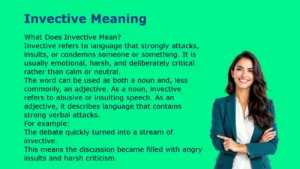
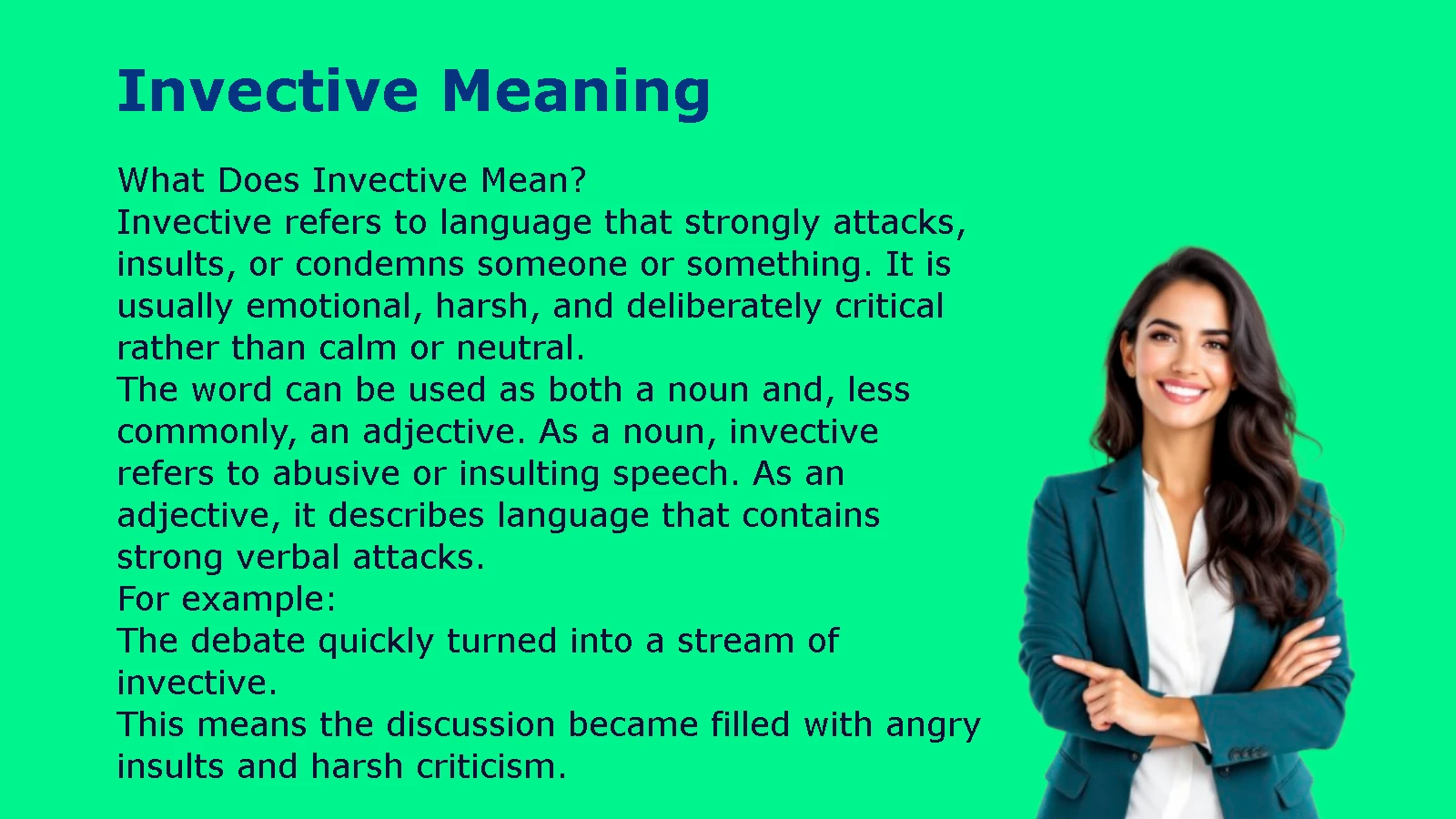
What Does Invective Mean?
Invective refers to language that strongly attacks, insults, or condemns someone or something. It is usually emotional, harsh, and deliberately critical rather than calm or neutral.
The word can be used as both a noun and, less commonly, an adjective. As a noun, invective refers to abusive or insulting speech. As an adjective, it describes language that contains strong verbal attacks.
For example:
The debate quickly turned into a stream of invective.
This means the discussion became filled with angry insults and harsh criticism.
Quick definition
Invective: insulting, abusive, or strongly offensive language used to attack someone or something.
Part of speech: Noun; also adjective
Pronunciation: /ɪnˈvek.tɪv/
Related word: Invectively
Related concept: Verbal abuse or harsh denunciation
Simple examples
- The speaker directed invective at his political opponent.
- Her response was filled with angry invective.
- The article contained sharp invective against the company.
- Instead of offering useful criticism, he resorted to invective.
The central idea is harsh verbal attack.
Invective Definition
The invective definition focuses on language that attacks a person, idea, or institution with strong criticism or insults.
Unlike ordinary disagreement, invective usually has an aggressive or abusive quality. Someone using invective is not merely saying that they disagree. They are attacking their target through forceful language.
For instance:
The critic offered a detailed argument against the movie.
This is criticism, but it is not necessarily invective.
Now consider:
The critic launched a vicious verbal attack against the director.
That description is much closer to invective.
What makes language invective?
Invective often contains one or more of these characteristics:
- Insults
- Harsh criticism
- Anger
- Contempt
- Ridicule
- Hostile language
- Strong condemnation
- Personal attacks
The target may be an individual, organization, political movement, belief, product, policy, or social practice.
Invective Meaning in Simple English
In simple English, invective means very harsh or insulting language used to attack someone or something.
That second person’s language may be described as invective.
A simple way to remember the word is:
Invective = verbal attack with harsh words.
It is stronger than ordinary criticism because it often carries anger, hostility, or personal abuse.
Is Invective a Noun or Adjective?
Invective is primarily a noun, but it can also function as an adjective.
As a noun, it refers to abusive or insulting language:
The speech was filled with invective.
Here, invective names the harsh language itself.
As an adjective, it describes something that contains or expresses verbal abuse:
The editorial adopted an invective tone.
In modern everyday English, the noun use is more common.
Noun examples
- a stream of invective
- a barrage of invective
- political invective
- angry invective
- bitter invective
- personal invective
- verbal invective
Adjective examples
- invective language
- invective remarks
- an invective speech
- an invective tone
Invective Examples
The meaning becomes clearer when you see how the word works in different situations.
1. Political invective
The campaign speech was filled with political invective.
The speaker used harsh and insulting language against political opponents.
2. Personal invective
Their disagreement quickly turned into personal invective.
Instead of debating the issue, they began attacking each other personally.
3. Literary invective
The poem uses invective to criticize the corruption of society.
The writer uses strong, attacking language to condemn social problems.
4. Online invective
The discussion section was overwhelmed by online invective.
People were posting hostile and insulting comments instead of having a productive conversation.
5. Public criticism
The actor faced a wave of invective after the controversial interview.
The actor received a large amount of harsh or abusive criticism.
6. Against an institution
The writer directed his invective toward the banking industry.
The criticism was aimed at an entire institution or industry rather than one individual.
7. During an argument
What began as a disagreement eventually descended into invective.
The conversation became increasingly hostile and insulting.
8. In journalism
The columnist’s review contained considerable invective.
The review included strong attacks or insults rather than only reasoned criticism.
9. Against an idea
Her essay contains strong invective against the theory.
The target is an idea or theory rather than a person.
10. In everyday speech
There was little constructive discussion, only invective.
The conversation consisted mostly of hostile language.
Invective in a Sentence
Here are several natural examples of invective in a sentence:
- The debate ended with both candidates exchanging invective.
- His letter was full of personal invective.
- The editorial uses strong invective against government corruption.
- She ignored the invective and focused on the actual argument.
- The speaker’s criticism gradually became outright invective.
- Social media users responded with a wave of invective.
- The novel contains political invective aimed at the ruling class.
- Rather than answering the question, he responded with invective.
- The review was unusually harsh and full of invective.
- Personal invective rarely leads to a productive conversation.
A particularly common construction is:
a stream of invective
For example:
The journalist faced a stream of invective after publishing the article.
Another useful structure is:
direct invective at + person or thing
For example:
The speaker directed his invective at the opposition.
How to Use Invective
Because invective is mainly a noun, it often appears after verbs such as use, direct, launch, employ, contain, exchange, and resort to.
“Use invective”
The speaker used invective instead of presenting evidence.
This means the speaker relied on harsh or insulting language.
“Direct invective at”
The columnist directed his invective at the company.
The phrase identifies the target of the verbal attack.
“Launch invective against”
The politician launched invective against his critics.
This describes an aggressive verbal attack.
“Resort to invective”
When challenged, he resorted to invective.
This phrase suggests that someone abandoned reasoned discussion and turned to insults.
“A stream of invective”
The actor received a stream of invective online.
This means the person received a large amount of abusive or hostile language.
“Full of invective”
His response was full of invective.
The response contained many harsh or insulting statements.
Invective vs Insult
Invective and insult are closely related, but they are not exactly the same.
An insult is a rude or offensive remark directed at someone.
Invective refers more broadly to harsh, abusive, or strongly attacking language.
| Insult | Invective |
| Usually a specific offensive remark | Can be a whole style or stream of hostile language |
| Often directed at one person | Can target people, groups, ideas, or institutions |
| Can be brief | Often involves sustained criticism or abuse |
| May be casual | Usually sounds more formal or literary |
For example:
“You’re an idiot” is an insult.
A long speech filled with angry personal attacks could be described as:
a speech full of invective.
An insult can be part of invective, but invective is broader.
Invective vs Criticism
Not all criticism is invective.
Criticism means pointing out faults, problems, or weaknesses. It can be calm, objective, and constructive.
Invective is much more aggressive. It often includes insults, contempt, or emotionally charged attacks.
Compare:
The report criticizes the company’s poor customer service.
This could be reasonable criticism.
The report launches a vicious attack on the company’s incompetent leadership.
This is much closer to invective.
The distinction matters because criticism can be constructive, while invective usually focuses on attacking or condemning its target.
Invective vs Abuse
Verbal abuse and invective overlap considerably.
Verbal abuse generally refers to language intended to hurt, intimidate, humiliate, or control another person.
Invective emphasizes harsh verbal condemnation or insulting attacks.
Someone may use invective against an idea or institution, while verbal abuse more often describes harmful treatment directed at a person.
For example:
The editorial contains political invective.
But:
The employee experienced verbal abuse from a supervisor.
The first emphasizes harsh language. The second emphasizes harmful interpersonal behavior.
Invective Synonyms
The best invective synonyms depend on context.
| Synonym | Meaning | Best context |
| Insults | Offensive remarks | Personal attacks |
| Abuse | Cruel or offensive language | Interpersonal situations |
| Vitriol | Bitter and hostile criticism | Angry public criticism |
| Denunciation | Strong public condemnation | Formal criticism |
| Diatribe | A long, angry attack | Speeches or writing |
| Tirade | A long angry outburst | Emotional speech |
| Censure | Strong official criticism | Formal settings |
| Condemnation | Strong expression of disapproval | Public or moral criticism |
| Slander | False spoken statements that damage reputation | Defamation contexts |
| Verbal attack | Direct hostile criticism | General usage |
Invective vs vitriol
Vitriol is one of the closest synonyms for invective.
Both words can describe bitter, hostile criticism. However, vitriol emphasizes bitterness and hatred, while invective emphasizes insulting or abusive language.
The article was filled with political invective.
The article was filled with political vitriol.
Both work, but the second emphasizes the bitterness of the writing.
Invective vs diatribe
A diatribe is usually a long, angry speech or piece of writing that attacks someone or something.
Invective refers to the harsh language itself.
A diatribe may therefore contain a great deal of invective.
Invective Antonyms
There is no single perfect opposite of invective, but several words express contrasting ideas.
Useful antonyms include:
- praise
- compliment
- approval
- encouragement
- commendation
- respect
- diplomacy
- civility
- reasoned criticism
- constructive feedback
For example:
The meeting was marked by invective.
An opposite situation might be:
The meeting was marked by respectful discussion and constructive feedback.
The contrast is between hostile language and respectful communication.
Is Invective Always Negative?
Yes, invective almost always has a negative meaning or connotation. The word describes language that is harsh, abusive, insulting, or strongly condemning.
However, using invective does not necessarily mean the underlying criticism is false.
Someone can make a valid criticism while expressing it through invective. The word describes how the criticism is delivered, not whether the criticism itself is factually correct.
For example:
The writer made a valid point but expressed it through personal invective.
The argument may have merit, but the language used to express it is hostile or insulting.
Common Collocations With Invective
Learning common combinations can make the word easier to recognize in reading and writing.
Some common collocations include:
- political invective
- personal invective
- bitter invective
- angry invective
- harsh invective
- public invective
- verbal invective
- literary invective
- online invective
- a stream of invective
- a barrage of invective
- a torrent of invective
- full of invective
- resort to invective
- direct invective at
- launch invective against
- exchange invective
- use invective
These combinations often appear in journalism, politics, literature, criticism, and discussions of public debates.
Common Mistakes With Invective
1. Thinking invective means ordinary criticism
Not every negative comment is invective.
The reviewer criticized the restaurant’s slow service.
That is criticism.
The reviewer launched a vicious verbal attack on the restaurant’s incompetent staff.
That is much closer to invective.
2. Using invective to mean “argument”
An argument can be calm and logical. Invective specifically involves harsh or abusive language.
3. Assuming invective only targets people
Invective can target much more than individuals.
It can be directed at:
- politicians
- organizations
- governments
- companies
- social systems
- beliefs
- policies
- ideas
- cultural practices
4. Confusing invective with inventive
Invective and inventive look similar but have completely different meanings.
Invective = harsh or insulting language.
Inventive = creative or imaginative.
For example:
The writer used invective against the government.
The designer created an inventive solution.
5. Confusing invective with invective-related words
Words such as invective, invectively, vitriol, diatribe, and tirade are related in meaning but do not always function in the same way.
Pay attention to whether you are describing the language, the speaker’s outburst, or the act of condemning something.
What Is the Origin of Invective?
Invective comes from the Latin word invectivus, meaning abusive or attacking. It is related to the Latin verb * invehi*, which carries the idea of attacking or assailing.
The English word has been used for centuries to describe forceful verbal attacks.
Its historical connection to the idea of attacking with words helps explain its modern meaning. Today, you are most likely to encounter invective in discussions of politics, literature, journalism, public arguments, and strongly worded criticism.
Invective in Literature
Writers have long used invective as a literary technique.
A character may insult an enemy to reveal anger or hostility. A poet may use harsh language to condemn social injustice. A satirist can use verbal attacks to ridicule political or cultural behavior.
In literary analysis, invective can therefore describe more than casual insults. It may be a deliberate rhetorical device used to express anger, contempt, condemnation, or moral outrage.
For example:
The poem uses invective to condemn the speaker’s political opponents.
Here, the word identifies a deliberate style of attack within the writing.
Frequently Asked Questions About Invective
What does invective mean?
Invective means harsh, insulting, abusive, or strongly critical language used to attack someone or something. It can describe personal insults, political attacks, literary criticism, or other forms of hostile verbal expression.
What is the simple meaning of invective?
In simple English, invective means using harsh or insulting words to attack someone or something. A person who responds to disagreement with angry personal attacks may be using invective.
Is invective a noun or adjective?
Invective is primarily a noun, meaning abusive or insulting language. It can also function as an adjective, as in “invective language” or “an invective tone.”
What is an example of invective?
A politician repeatedly insulting an opponent during a speech instead of discussing the opponent’s policies would be an example of invective. The focus is on the hostile and abusive language.
What is a synonym for invective?
Common synonyms include vitriol, abuse, insults, diatribe, tirade, denunciation, condemnation, and verbal attack. The closest choice depends on the context.
What is the opposite of invective?
Possible opposites include praise, approval, encouragement, commendation, civility, diplomacy, and constructive criticism. The best opposite depends on the sentence.
Is invective the same as an insult?
Not exactly. An insult is usually a specific offensive remark, while invective can refer to a broader pattern or stream of harsh, abusive, or attacking language.
Is invective the same as criticism?
No. Criticism can be neutral or constructive, while invective is strongly hostile, insulting, or abusive. A person can criticize something without using invective.
What does “resort to invective” mean?
“Resort to invective” means to turn to harsh or insulting language, usually instead of using calm reasoning or constructive discussion.
What does “a stream of invective” mean?
“A stream of invective” means a continuous or substantial amount of harsh, insulting, or abusive language. The phrase is common when describing heated public arguments or criticism.
Can invective be used for ideas?
Yes. Invective can target ideas, policies, institutions, organizations, and beliefs as well as people. For example, a writer may use invective to attack a political ideology or government policy.
Final Thoughts
The invective meaning is simple once you connect it with the idea of a verbal attack. Invective refers to harsh, insulting, abusive, or strongly condemning language.
It is stronger than ordinary criticism and broader than a single insult. You may encounter the word in political debates, journalism, literature, online discussions, and heated arguments.
Remember the key distinction:
Invective = harsh language used to attack or condemn.
Criticism = pointing out faults or problems.
Insult = an offensive remark.
Understanding these differences will help you use invective accurately and recognize it when you encounter it in formal writing or everyday discussions.