The movement meaning refers to the act or process of changing position, location, direction, or condition. It can describe the physical motion of a person or object, a biological process, a political effort, or a major change in society. The word also has specialized meanings in history, science, biology, and music, depending on the context in which someone uses it.
In everyday English, movement often means motion or physical activity. However, it can also describe collective action, cultural development, scientific motion, and sections of musical compositions. Understanding these meanings helps you use the word accurately in conversations, academic writing, and professional communication.
| Question | Answer |
| What does movement mean? | Movement means an act or process of changing position, location, direction, or state. |
| What is another word for movement? | Motion, action, activity, shift, transition, and progress are common synonyms. |
| What does movement mean in history? | It describes organized efforts that bring social, political, cultural, or economic change. |
| What is movement in science? | It refers to a change in an object’s position over time. |
| What is the difference between movement and moment? | Movement describes motion or change, while moment refers to a particular point or short period of time. |
What Does Movement Mean?
Movement is the act, process, or result of changing position or producing a change. It can involve a physical object traveling from one place to another, a person performing an action, or a group working toward a shared objective. The term also describes developments in science, culture, politics, and the arts.
For example, a bird flying across the sky demonstrates physical movement. A group campaigning for equal rights represents a social movement. Similarly, a shift in public opinion can represent a movement toward cultural or political change.
The meaning depends on the subject and situation.
Movement Definition in Simple Words
In simple words, movement means changing from one position, place, or condition to another.
Consider these examples:
- A person walking across a room shows movement.
- A ball rolling down a hill demonstrates movement.
- Leaves moving in the wind show natural movement.
- A community demanding better education represents a social movement.
- A business changing its strategy demonstrates a movement toward a new direction.
Movement does not always require a person or object to travel physically. It can also describe an abstract change in ideas, attitudes, or circumstances.
For instance, when someone says, “There has been a movement toward healthier lifestyles,” the word describes a general change in people’s behavior rather than physical travel.
Movement as a Noun
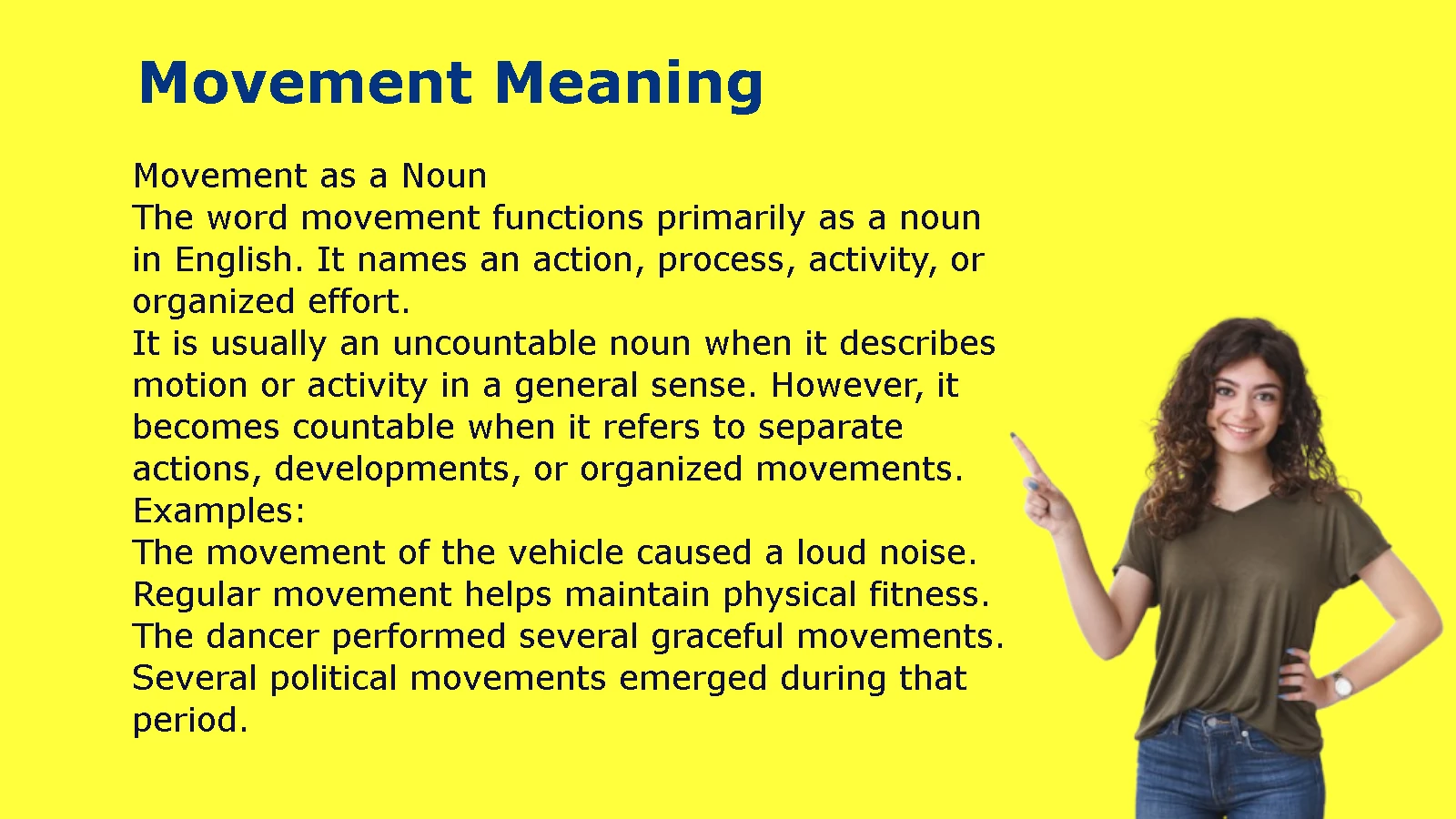
The word movement functions primarily as a noun in English. It names an action, process, activity, or organized effort.
It is usually an uncountable noun when it describes motion or activity in a general sense. However, it becomes countable when it refers to separate actions, developments, or organized movements.
Examples:
- The movement of the vehicle caused a loud noise.
- Regular movement helps maintain physical fitness.
- The dancer performed several graceful movements.
- Several political movements emerged during that period.
The plural form is movements.
| Form | Usage | Example |
| Movement | Singular noun | The movement was unexpected. |
| Movements | Plural noun | The athlete practiced several movements. |
Movement can also appear in common grammatical constructions:
- Movement of something: The movement of air affects the temperature.
- Movement toward something: The movement toward reform gained support.
- Freedom of movement: Citizens have freedom of movement.
- Range of movement: The injury reduced his range of movement.
Different Meanings of Movement
Movement has several meanings across different situations. Although these definitions vary, they share a common idea of action, motion, or change.
| Context | Meaning | Example |
| Everyday English | Physical motion or activity | The movement of the crowd |
| History | Organized historical change | The Renaissance movement |
| Politics | Collective political action | The independence movement |
| Physics | Change in an object’s position | The movement of a falling ball |
| Biology | Motion in living organisms | The movement of muscles |
| Music | A section of a larger composition | The second movement of a symphony |
| Art | A recognizable style or approach | The Impressionist movement |
| Society | Collective efforts to change conditions | The environmental movement |
These different meanings make movement a useful word in both everyday communication and specialized academic subjects.
Movement Meaning and Examples
The movement meaning and examples become easier to understand when you examine how people use the word in ordinary situations. Movement can describe walking, transportation, gestures, environmental activity, and changes in society. Its meaning depends on what moves, how it moves, and whether the change is physical or abstract.
Everyday Examples of Movement
Here are several examples that demonstrate the word’s different uses.
Physical movement:
- The movement of the train slowed near the station.
- She noticed movement behind the curtains.
- The cat followed the movement of a small insect.
- The movement of water created ripples across the lake.
Human movement:
- Regular movement keeps the body active.
- The dancer practiced each movement carefully.
- His hand movement made the instructions easier to understand.
- The athlete improved her movement through daily training.
Social and abstract movement:
- The movement for equal rights attracted public attention.
- The company experienced a movement toward digital services.
- A movement toward renewable energy is changing the industry.
- The movement of public opinion influenced the election.
These examples show that movement can describe both visible actions and broader developments.
Movement in Sentences
The following sentences demonstrate how movement works in different grammatical and contextual situations.
| Sentence | Meaning |
| The movement of the car was smooth. | Physical motion |
| I noticed a slight movement in the bushes. | A small change in position |
| The dancer’s movements were graceful. | Body actions |
| The movement gained support from local communities. | Organized collective action |
| Scientists studied the movement of the planets. | Scientific motion |
| The first movement of the symphony sounded peaceful. | A musical section |
| The movement toward equality continued. | Social progress |
| The doctor examined the patient’s range of movement. | Physical mobility |
Notice how the same word communicates different ideas without changing its spelling.
Common Expressions Using Movement
English speakers frequently combine movement with other words to create meaningful expressions.
| Expression | Meaning | Example |
| Freedom of movement | The ability to travel or move freely | Freedom of movement is important in many societies. |
| Range of movement | The extent to which a body part can move | The injury limited his range of movement. |
| Movement toward change | Progress in a new direction | The organization showed movement toward change. |
| Movement of goods | Transportation of products | The company manages the movement of goods. |
| Movement of people | Travel or migration | The movement of people increased during the holiday. |
| Body movement | Physical actions performed by the body | Yoga improves body movement. |
| Political movement | Organized political activity | The political movement demanded reform. |
These expressions are useful in everyday conversations, academic writing, journalism, and professional communication.
Movement Meaning Synonyms: What Are Other Words for Movement?
Common movement meaning synonyms include motion, action, activity, shift, transition, progress, displacement, and transfer. However, these words do not always mean exactly the same thing. The best synonym depends on whether movement describes physical motion, a change in circumstances, organized activity, or development toward a goal.
Common Synonyms for Movement
Here are useful alternatives to the word movement, along with their meanings.
| Synonym | Meaning | Example |
| Motion | Physical change in position | The motion of the wheels was smooth. |
| Action | Something done or performed | Her action attracted attention. |
| Activity | An action or process | Physical activity improves fitness. |
| Shift | A change in position or direction | There was a shift in public opinion. |
| Transition | A change from one condition to another | The transition took several months. |
| Progress | Forward development | The project made steady progress. |
| Change | A difference in condition or state | The change affected everyone. |
| Displacement | Movement from an original position | The force caused displacement. |
| Transfer | Movement from one place to another | The transfer of equipment took time. |
| Mobility | The ability to move freely | The injury affected his mobility. |
| Migration | Movement from one region to another | Bird migration occurs seasonally. |
| Circulation | Movement around a system | Blood circulation supports the body. |
Synonyms for Different Types of Movement
Not every synonym works in every sentence. Choosing the right alternative requires understanding the context.
For physical movement:
- Motion
- Mobility
- Locomotion
- Displacement
- Motion activity
Example: “The movement of the machine became faster.”
You could rewrite this as:
“The motion of the machine became faster.”
For social or political movement:
- Campaign
- Initiative
- Mobilization
- Movement for reform
- Collective action
Example: “The movement demanded changes to employment laws.”
Alternative: “The campaign demanded changes to employment laws.”
For movement that describes change:
- Shift
- Transition
- Development
- Progress
- Transformation
Example: “The movement toward renewable energy continues.”
Alternative: “The transition toward renewable energy continues.”
Best Movement Synonym Based on Context
The following guide helps you select an appropriate synonym when writing.
| If you mean… | Use this synonym | Why it works |
| Physical motion | Motion | Describes a change in position |
| Body activity | Action | Refers to something a person does |
| Change in direction | Shift | Highlights a change in course |
| Gradual development | Progress | Emphasizes forward movement |
| Change between stages | Transition | Describes movement from one condition to another |
| Movement of people | Migration | Describes travel between regions |
| Organized public effort | Campaign | Highlights collective action toward a goal |
| Ability to move | Mobility | Focuses on freedom or capacity of movement |
For example, using “migration” instead of “movement” makes sense when discussing people or animals traveling between geographical regions. However, it would not work when describing a dancer’s movements.
Antonyms of Movement
Antonyms are words with opposite or contrasting meanings.
Common antonyms of movement include:
- Stillness: A condition without movement.
- Inactivity: A lack of action or activity.
- Immobility: The inability or state of not moving.
- Rest: A period without physical activity.
- Stagnation: A lack of development or progress.
- Stability: A condition of remaining steady or unchanged.
Examples:
- The stillness of the lake contrasted with the movement of the river.
- The machine remained inactive throughout the night.
- Political stagnation prevented further reform.
The correct antonym depends on whether movement describes physical activity or broader change.
Movement Meaning in History
In history, a movement refers to an organized effort by individuals or groups to achieve social, political, cultural, religious, or economic change. Historical movements often develop over several years or generations. They influence public attitudes, challenge existing institutions, and sometimes transform entire societies.
A historical movement differs from a single event because it usually involves a continuing collection of ideas, actions, and efforts.
What Is a Historical Movement?
A historical movement is a series of connected activities that pursue a shared objective during a particular period.
These movements can emerge when people become dissatisfied with existing conditions or want to introduce new ideas.
For example, the Civil Rights Movement in the United States challenged racial segregation and discrimination. It involved community organizing, peaceful protests, legal action, public speeches, and political campaigns.
Historical movements commonly have several characteristics:
- Shared goals: Participants support a common cause.
- Collective participation: Individuals or organizations work together.
- Historical context: The movement develops in response to specific conditions.
- Public influence: Participants attempt to change society or institutions.
- Long-term effects: The movement can influence future generations.
Not every historical movement succeeds immediately. Some face resistance, internal disagreements, or changing political conditions.
Famous Historical Movements
Several important movements have shaped modern societies.
The Renaissance
<PRIVATE_PERSON> The Renaissance was a major cultural and intellectual movement that began in Italy during the 14th century and spread across Europe. It encouraged renewed interest in classical Greek and Roman learning, humanism, scientific investigation, architecture, and artistic innovation.
Artists such as Leonardo da Vinci and Michelangelo became influential figures during this period.
The Industrial Revolution
The Industrial Revolution transformed manufacturing, transportation, and economic activity. Beginning in Britain during the 18th century, it introduced new machinery, factory production, and major changes in urban life.
It changed how people worked, traveled, produced goods, and organized their communities.
The Civil Rights Movement
The American Civil Rights Movement of the 1950s and 1960s fought racial segregation and discrimination. Leaders, activists, students, and local communities organized protests and campaigns to secure equal rights.
The Civil Rights Act of 1964 and the Voting Rights Act of 1965 marked major legislative achievements.
The Women’s Suffrage Movement
The Women’s Suffrage Movement campaigned for women’s voting rights. In the United States, the 19th Amendment, ratified in 1920, prohibited denying the right to vote on the basis of sex.
The movement involved decades of organizing, public demonstrations, political pressure, and legal efforts.
The Protestant Reformation
The Protestant Reformation began in the 16th century and challenged established practices and authority within Western Christianity. It reshaped religious institutions and influenced European politics, education, and culture.
Why Historical Movements Matter
Historical movements help explain how societies develop and why major institutions change.
Their influence extends across several areas:
- Social transformation: Movements challenge unfair customs and practices.
- Political reform: Organized campaigns can influence laws and government policies.
- Cultural development: New ideas influence literature, art, education, and public values.
- Economic change: Labor and reform movements can affect workplace conditions.
- Human rights: Collective action can expand legal protections and social opportunities.
A useful way to understand a historical movement is to examine three things: the conditions that created it, the people who supported it, and the changes it produced.
Movement Meaning in Politics
In politics, a movement is an organized group of individuals who share political or social objectives and work together to influence public policy, government decisions, or existing systems. Political movements can seek reform, independence, equality, environmental protection, or changes in national leadership.
Unlike an individual political opinion, a political movement involves collective participation.
What Is a Political Movement?
A political movement develops when people organize around a shared political goal.
Participants may use demonstrations, public campaigns, petitions, community meetings, education, and other forms of civic participation to communicate their demands.
Some movements operate within existing political systems, while others challenge the structure of those systems.
Political movements often include:
- A common ideology or set of beliefs.
- Shared political objectives.
- Public supporters and organizers.
- Communication and campaign strategies.
- Efforts to influence government or society.
A movement does not always have one formal leader. Some rely on decentralized networks, local organizers, or community groups.
Examples of Political Movements
Political movements can focus on different issues.
Democratic movements: These movements promote representative government, political participation, free elections, and civil liberties.
Independence movements: They seek political independence for a territory or population. The Indian independence movement, for example, campaigned against British colonial rule and achieved independence in 1947.
Environmental movements: These groups advocate environmental protection, climate action, conservation, and sustainable development.
Civil rights movements: They work to secure equal treatment and legal protections for individuals and communities.
Labor movements: These movements organize workers to improve wages, working conditions, workplace safety, and employment rights.
Political Movement vs. Political Party
Political movements and political parties can influence each other, but they are not the same.
| Feature | Political Movement | Political Party |
| Main purpose | Promote a shared cause or change | Gain political representation and influence government |
| Structure | May be informal or decentralized | Usually has a formal organization |
| Membership | Can include diverse supporters | Typically has defined membership or affiliation |
| Activities | Protests, campaigns, advocacy, organizing | Elections, policy development, legislative activity |
| Leadership | May have several leaders or organizers | Usually has established leadership |
| Political participation | Can operate inside or outside electoral systems | Usually participates in elections |
For example, an environmental movement can pressure several political parties to adopt stronger climate policies without becoming a political party itself.
This distinction helps explain why political movements can influence public policy even when they do not directly contest elections.
Movement Definition in Science
In science, movement generally describes a change in the position of an object or organism over time. Scientists study movement through concepts such as motion, speed, velocity, acceleration, direction, and displacement. These concepts help explain how objects behave under different forces and physical conditions.
Physics provides the most precise mathematical framework for studying movement.
What Is Movement in Physics?
In physics, movement is commonly discussed through the scientific concept of motion.
An object is in motion when its position changes relative to a reference point over time.
For example, imagine a car traveling along a straight road. A tree beside the road can serve as a reference point. As the car changes its position relative to the tree, the car is moving.
Scientists use several measurements to describe this process.
Distance: The total length of the path an object travels.
Displacement: The straight-line change from an object’s starting position to its ending position, including direction.
Speed: The distance traveled per unit of time.
Velocity: The rate of change of displacement, including direction.
Acceleration: The rate at which velocity changes over time.
For example, if a car travels 100 meters in 10 seconds at a constant speed, its average speed is:
Speed = Distance ÷ Time
Speed = 100 ÷ 10 = 10 meters per second.
This simple calculation helps describe how quickly an object moves.
Types of Movement in Science
Scientists classify motion into several types based on the path or pattern of movement.
Linear movement
Linear movement occurs when an object travels along a straight line.
Examples include:
- A train moving along a straight track.
- An elevator traveling vertically.
- A ball rolling across a straight surface.
Circular movement
Circular movement occurs when an object follows a circular path around a fixed center or axis.
Examples include:
- A satellite orbiting Earth.
- A rotating Ferris wheel.
- The tip of a clock’s second hand.
Rotational movement
Rotational movement happens when an object turns around an internal axis.
Examples include:
- A spinning wheel.
- A rotating ceiling fan.
- Earth rotating on its axis.
Oscillatory movement
Oscillatory movement involves repeated motion around an equilibrium or central position.
Examples include:
- A swinging pendulum.
- A vibrating guitar string.
- A spring moving back and forth.
Periodic movement
Periodic movement repeats at regular intervals.
Examples include:
- The oscillation of a pendulum under suitable conditions.
- The regular rotation of a wheel.
- Repeated vibrations in a musical instrument.
| Type | Description | Example |
| Linear | Movement along a straight path | A moving train |
| Circular | Movement along a circular path | A satellite orbit |
| Rotational | Turning around an axis | A spinning wheel |
| Oscillatory | Repeated movement around a central position | A pendulum |
| Periodic | Movement that repeats at regular intervals | Regular vibrations |
Movement and Motion: Are They the Same?
Movement and motion often have similar meanings in everyday English. Both can describe a change in position or physical activity.
However, motion is the more established technical term in physics.
Movement is a broader everyday word that can also describe social change, body actions, and artistic activity.
For example:
- The movement of the ball caught everyone’s attention.
- The motion of the ball was measured using scientific instruments.
The first sentence uses ordinary English. The second emphasizes scientific observation.
When writing about physics, motion is often the more precise term.
Movement Meaning in Biology
In biology, movement refers to the ability of living organisms or their parts to change position. It includes walking, swimming, flying, muscle contraction, cellular movement, and the movement of substances within organisms. Biological movement allows living things to interact with their environments and perform essential life processes.
Movement can occur at the level of an entire organism, an individual cell, or a structure within the body.
What Is Movement in Living Organisms?
Living organisms demonstrate movement in different ways.
Animals commonly move from one location to another through locomotion. Humans walk, run, jump, and swim. Birds fly, while fish use their fins and body muscles to move through water.
Plants also show movement, although they generally do not travel from place to place like animals.
For example, plant shoots can grow toward light, and certain leaves respond to touch or changes in environmental conditions.
Microorganisms also demonstrate movement. Some bacteria use flagella, while amoebas move using temporary extensions of their cell membranes called pseudopodia.
Biologists study these activities to understand how organisms survive, respond, and interact with their surroundings.
Types of Biological Movement
Biological movement includes several distinct processes.
Locomotion
Locomotion is the movement of an entire organism from one place to another.
Examples include:
- Humans walking.
- Birds flying.
- Fish swimming.
- Horses running.
- Snakes crawling.
Locomotion helps organisms find food, escape predators, locate shelter, and reproduce.
Muscular movement
Muscular movement occurs when muscles contract and relax to produce motion.
In humans, skeletal muscles work with bones and joints to produce voluntary actions such as walking and lifting objects.
Smooth muscles also create involuntary movements inside organs. For example, they help move food through the digestive tract.
Cellular movement
Some cells can move independently or change their shape.
Amoebas use pseudopodia to move. Certain immune cells also travel through body tissues to reach areas where they are needed.
Cellular movement plays an important role in development, tissue repair, and immune responses.
Movement in plants
Plants respond to environmental conditions through different forms of movement.
Examples include:
- Shoots growing toward light, known as phototropism.
- Roots growing in response to gravity, known as gravitropism.
- Some plants folding their leaves after touch.
- Flowers opening or closing in response to light and environmental conditions.
These movements help plants obtain resources and respond to their surroundings.
Movement of substances within cells
Not all biological movement involves an organism traveling.
Cells constantly transport substances such as water, nutrients, proteins, and ions.
For example, diffusion allows particles to move from areas of higher concentration to areas of lower concentration. Active transport uses cellular energy to move substances against their concentration gradients.
Examples of Movement in Biology
| Organism or process | Type of movement | Purpose |
| Human walking | Locomotion | Travel and daily activity |
| Birds flying | Locomotion | Travel and food searching |
| Fish swimming | Locomotion | Movement through water |
| Amoeba | Cellular movement | Movement and feeding |
| Plant shoots | Phototropism | Growth toward light |
| Intestinal muscles | Muscular movement | Moving digestive contents |
| White blood cells | Cellular movement | Immune defense |
Why Is Movement Important for Living Organisms?
Movement supports several essential biological functions.
- Finding food: Animals move to locate and obtain nutrients.
- Avoiding predators: Movement helps organisms escape danger.
- Reproduction: Many organisms move to find mates or suitable breeding locations.
- Environmental response: Organisms adjust their positions or behavior in response to changes.
- Internal transportation: Movement within cells and organs distributes essential substances.
- Growth and development: Cellular movement helps form tissues and organs during development.
Movement is therefore much more than walking or running. It operates at several biological levels and supports the survival of living organisms.
Movement Meaning in Music
In music, a movement is a self-contained section of a larger musical composition. It commonly appears in symphonies, sonatas, and concertos. Each movement has its own musical structure, tempo, rhythm, and character while contributing to the overall composition.
A multi-movement musical work can contain contrasting sections that create a larger artistic experience.
What Is a Movement in a Musical Composition?
Classical compositions often contain several movements rather than one continuous musical section.
Each movement usually has a distinct beginning and ending. A composer may separate movements with a short pause so listeners can recognize the change.
For example, a symphony might begin with an energetic movement, continue with a slower and more emotional section, and finish with a lively finale.
The movements work together to create a complete musical experience.
A movement may differ from the others in:
- Tempo.
- Rhythm.
- Musical key.
- Emotional character.
- Instrumentation.
- Structural design.
Although movements are separate sections, they belong to the same larger composition.
Types of Musical Movements
Traditional classical compositions often use different movement styles.
Fast movements
Fast movements commonly feature energetic rhythms and lively musical passages.
They may create excitement, urgency, or dramatic intensity.
Slow movements
Slow movements often emphasize melody, emotion, and expressive musical phrasing.
They can create a reflective, peaceful, or dramatic atmosphere.
Dance-inspired movements
Some movements use rhythms and structures associated with traditional dances.
Examples include minuets and scherzos.
Finale movements
A finale is the concluding movement of a larger composition. It often creates a strong sense of completion through energetic passages, dramatic contrasts, or a return to important musical themes.
Examples of Movements in Classical Music
Several well-known musical forms commonly contain multiple movements.
Symphony movements
A symphony often contains several contrasting movements. A traditional four-movement structure may include:
- A fast opening movement.
- A slower second movement.
- A dance-like third movement.
- A fast and energetic finale.
This structure gives composers room to explore different moods and musical ideas.
Sonata movements
A sonata is an instrumental composition that may contain multiple movements. Its opening movement often uses sonata form, which commonly includes an exposition, development, and recapitulation.
Concerto movements
A concerto typically features a solo instrument alongside an orchestra. Many traditional concertos contain three movements: fast, slow, and fast.
Movement vs. Song: What’s the Difference?
A musical movement and a song are not necessarily the same.
A song is generally an independent musical composition, often involving vocals and lyrics, although instrumental songs also exist.
A movement is usually a section of a larger musical work.
| Feature | Movement | Song |
| Structure | Part of a larger composition | Usually an independent work |
| Length | Depends on the complete composition | Varies |
| Vocals | May be instrumental or vocal | Often includes vocals |
| Common context | Symphony, sonata, concerto | Popular, folk, classical, and other music |
| Example | Second movement of a symphony | An individual recorded song |
The distinction helps listeners understand how composers organize longer musical works.
Movement vs. Moment: Meaning and Differences
What Does Moment Mean?
A moment is a brief period of time or a particular point in time.
People use the word when discussing short experiences, important events, or specific points in a sequence.
Examples include:
- Please wait a moment.
- That was an unforgettable moment.
- She stopped for a moment before answering.
- At that moment, everyone became silent.
Moment can also describe an important or meaningful experience.
For example, “Winning the championship was a proud moment for the team.”
In this sentence, moment refers to a significant point in someone’s life rather than a physical action.
Movement vs. Moment Comparison Table
| Feature | Movement | Moment |
| Meaning | Action, motion, or change | A point or short period of time |
| Part of speech | Noun | Noun |
| Main idea | Physical or abstract change | Time or an occasion |
| Related words | Motion, action, shift | Instant, second, occasion |
| Example | The movement of the car was smooth. | Wait a moment. |
| Common expression | Freedom of movement | A memorable moment |
The main difference is simple: movement relates to action or change, while moment relates to time.
Movement and Moment in Sentences
Compare these examples to understand the distinction.
Movement examples:
- The movement of the crowd blocked the entrance.
- The political movement attracted thousands of supporters.
- Scientists measured the movement of the object.
- The dancer’s movements looked natural.
Moment examples:
- Give me a moment to finish this task.
- It was the happiest moment of her life.
- He paused for a moment before speaking.
- At that moment, the lights went out.
Some sentences can use both words naturally:
“The movement began at a defining moment in the country’s history.”
Here, movement describes organized collective action, while moment identifies a particular point in time.
Common Mistakes When Using Movement and Moment
Writers sometimes confuse these words because they share several letters and have similar-looking endings.
Avoid these mistakes:
Mistake: I need a movement to think.
Correct: I need a moment to think.
The sentence refers to time, not physical action.
Mistake: The moment of the machine was noisy.
Correct: The movement of the machine was noisy.
The sentence describes physical activity.
Mistake: The movement was the best moment of my life.
This sentence is grammatically possible, but its meaning depends on context. If you mean an experience, moment may be more appropriate.
A useful trick is to ask yourself whether the sentence describes something happening or time passing. Use movement for the first and moment for the second.
Different Types of Movement
Movement can take several forms, including physical, social, political, scientific, biological, artistic, and cultural movement. Each type describes a different kind of action, change, or organized activity. Recognizing these categories makes it easier to understand the word in different academic, professional, and everyday situations.
Physical Movement
Physical movement refers to a change in the position of a person or object.
It can occur voluntarily or involuntarily.
Examples include:
- Walking across a room.
- Moving furniture.
- Turning the head.
- Throwing a ball.
- A vehicle traveling along a road.
Physical movement plays an important role in sports, exercise, transportation, and daily activities.
Social Movement
A social movement is an organized effort by individuals or groups to promote or resist changes in society.
These movements often focus on equality, education, public health, environmental protection, or human rights.
For example, the global environmental movement includes organizations and individuals who campaign for conservation and climate action.
Social movements can influence public opinion, government policies, and cultural expectations.
Political Movement
A political movement involves collective action directed toward political goals.
It may seek government reform, national independence, electoral change, or greater political representation.
Political movements often use campaigns, public demonstrations, community organizing, and advocacy to influence decision-makers.
Scientific Movement
Scientific movement generally refers to the motion of objects and the physical processes involved in changing position.
Scientists examine movement through observation, measurement, experiments, and mathematical models.
Examples include planetary orbits, falling objects, rotating machinery, and vibrating systems.
Biological Movement
Biological movement involves motion in living organisms and their internal structures.
It includes locomotion, muscular contractions, cellular movement, and plant responses to environmental conditions.
For example, a fish swimming and a plant shoot growing toward light demonstrate different forms of biological movement.
Artistic and Cultural Movement
An artistic or cultural movement is a recognizable group of ideas, styles, or creative practices that influence art, literature, architecture, or other cultural activities.
Examples include:
- Renaissance art.
- Impressionism.
- Romanticism.
- Surrealism.
- Modernism.
These movements often develop when artists and thinkers introduce new approaches or challenge established traditions.
How to Use Movement Correctly in English
Using movement correctly requires understanding its meaning, grammatical role, and surrounding words. The term works in everyday conversations, academic writing, professional communication, and creative expression. Choosing the right context helps readers understand whether you mean physical motion, organized activity, or a broader change.
Movement in Formal and Informal Writing
Movement works in both formal and informal English.
In casual conversations, people commonly use it to describe everyday physical actions.
Informal examples:
- I noticed some movement outside.
- The baby made a sudden movement.
- We need more movement during the day.
Formal examples:
- The study examined patterns of human movement.
- The movement toward renewable energy has accelerated.
- Researchers analyzed the movement of particles under different conditions.
In academic writing, you should use more precise terms when the subject requires them.
For example, physics writing may use motion, velocity, and displacement rather than relying on the general word movement.
Similarly, biology writing may use locomotion when discussing an organism traveling from one location to another.
Common Collocations With Movement
A collocation is a combination of words that frequently appear together.
Learning common movement collocations can make your English sound more natural.
| Collocation | Meaning | Example |
| Physical movement | Movement of the body or an object | Physical movement supports an active lifestyle. |
| Free movement | Ability to move without restriction | The athlete regained free movement. |
| Political movement | Organized political activity | The political movement gained attention. |
| Social movement | Collective action for social change | The social movement attracted young supporters. |
| Movement pattern | A repeated or recognizable way of moving | The coach studied the player’s movement pattern. |
| Range of movement | Extent of possible movement | The doctor checked her range of movement. |
| Movement of goods | Transportation of products | The company tracks the movement of goods. |
| Forward movement | Progress in a particular direction | The negotiations showed forward movement. |
| Movement toward change | Development in a new direction | The organization showed movement toward reform. |
Common Mistakes to Avoid
Here are some errors to watch for when using movement.
Confusing movement with moment
Movement describes action or motion, whereas moment describes time.
Incorrect: Give me a movement.
Correct: Give me a moment.
Using synonyms without considering context
Motion, shift, transition, and progress are related words, but they do not always communicate the same idea.
For example, “the movement of the car” can become “the motion of the car,” but replacing it with “the progress of the car” changes the meaning.
Confusing movement with locomotion
Locomotion specifically refers to the movement of an organism from one location to another. Movement has a much broader meaning.
Treating a political movement as a political party
A political movement can campaign for change without participating directly in elections. A political party usually has a formal structure and seeks political representation.
Using movement when a more precise scientific term is needed
When discussing physics, terms such as motion, velocity, acceleration, and displacement provide more specific information.
A Practical Case Study: Understanding Movement Through Different Contexts
Imagine a university student researching the word movement for an English assignment.
The student finds the word in five different sources:
- A physics textbook discusses the movement of objects.
- A history book describes the Civil Rights Movement.
- A biology lesson explains the movement of cells.
- A music textbook discusses the first movement of a symphony.
- A newspaper reports a movement toward environmental reform.
At first, these examples may seem unrelated. However, each uses movement to describe an action, process, or development.
The student can understand them through the following framework:
| Source | Meaning of movement | Key concept |
| Physics textbook | Change in an object’s position | Motion |
| History book | Organized historical change | Collective action |
| Biology lesson | Motion in living organisms | Locomotion and cellular activity |
| Music textbook | Section of a composition | Musical structure |
| Newspaper | Organized effort for change | Social development |
This example illustrates why context matters when interpreting vocabulary.
Instead of memorizing one definition, readers should identify the subject and determine what kind of action or change the word describes.
Frequently Asked Questions About Movement
What Is the Simple Meaning of Movement?
Movement means changing position, location, direction, or condition. It can describe a person walking, an object traveling, or a group working toward a shared goal. The word also appears in scientific, biological, political, historical, and musical contexts.
What Is Another Word for Movement?
Common synonyms for movement include motion, action, activity, shift, transition, progress, displacement, and mobility. The best alternative depends on the context. Motion works well for physical movement, while transition and progress describe different types of change.
What Does Movement Mean in History?
In history, movement refers to organized efforts by individuals or groups to bring social, political, cultural, or economic change. Examples include the Renaissance, the Civil Rights Movement, the Women’s Suffrage Movement, and the Protestant Reformation.
What Is the Meaning of Movement in Science?
In science, movement generally describes a change in the position of an object over time. Physics examines this process through motion, speed, velocity, acceleration, and displacement. Examples include a falling ball, a rotating wheel, and a moving vehicle.
What Is the Difference Between Movement and Moment?
Movement describes physical motion, action, or change. Moment refers to a particular point in time or a brief period. For example, “the movement of the car” describes motion, while “wait a moment” refers to a short period of time.
What Does Movement Mean in Music?
In music, a movement is a self-contained section of a larger composition, such as a symphony, sonata, or concerto. Each movement often has its own tempo, structure, and musical character while contributing to the complete work.
Conclusion: Understanding the Meaning of Movement
The movement meaning extends far beyond simple physical motion. It describes changes in position, human activity, biological processes, scientific motion, political organization, historical developments, and musical structures.
In everyday English, movement commonly refers to an action or change in position. In specialized subjects, however, its meaning becomes more specific. Physics uses movement to discuss motion, biology examines how organisms and cells move, history explores organized social change, and music uses movement to identify sections of larger compositions.
Remember these key distinctions:
- Movement describes action, motion, or change.
- Motion is a closely related term, especially in physics.
- Movement synonyms include action, shift, transition, and progress.
- Movement in history and politics often describes collective efforts toward change.
- Movement in biology includes locomotion, cellular activity, and muscular action.
- Movement in music refers to a section of a larger composition.
- Moment describes time rather than physical action.
When you encounter the word movement, pay attention to its surrounding words and subject. Context will help you identify its intended meaning and choose the most accurate synonym.













