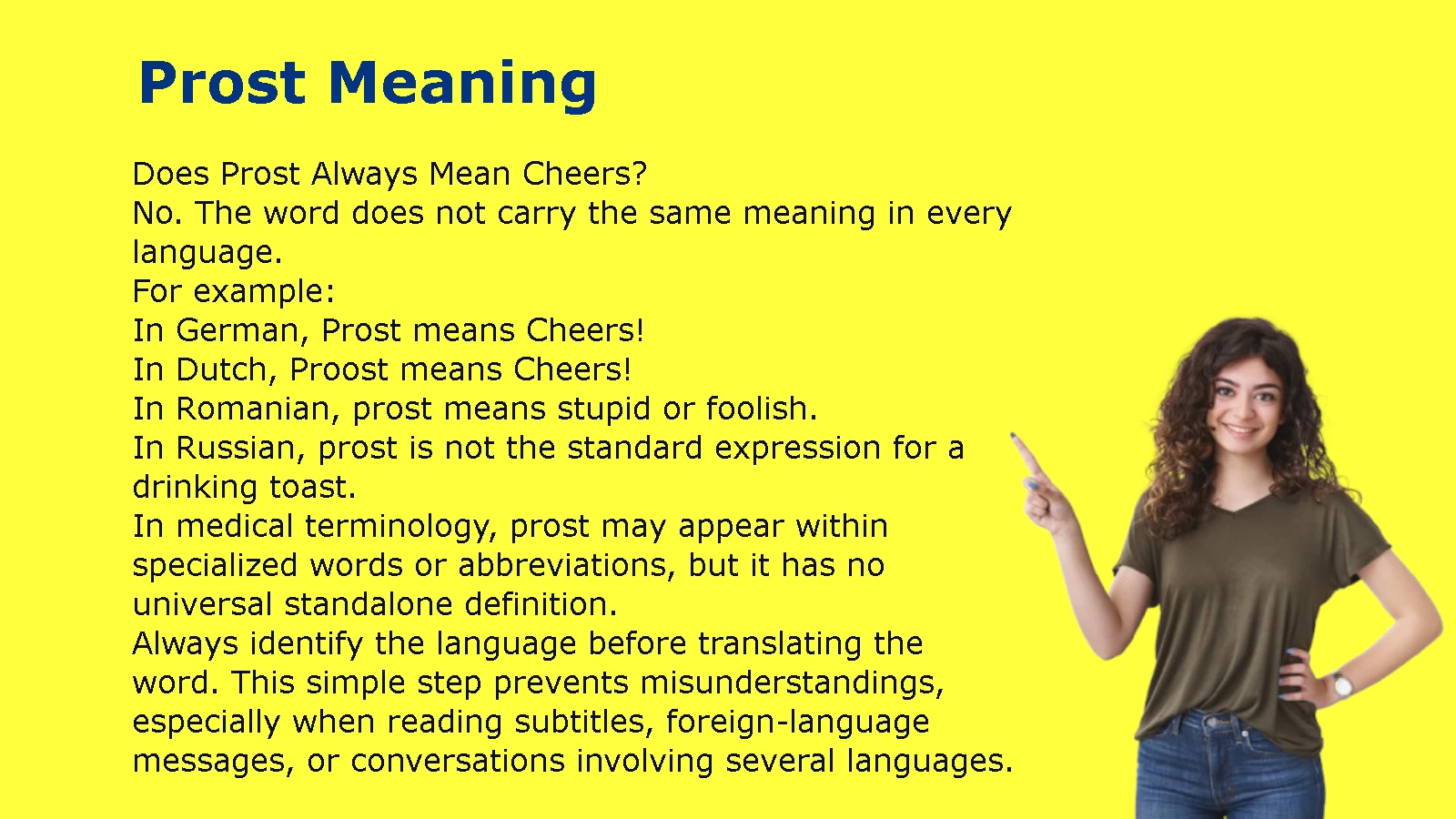
The prost meaning depends on the language and context in which you encounter the word. In German, Prost means “Cheers!” and is commonly used when people raise their glasses before drinking. In Dutch, the similar word proost has the same meaning, while Romanian prost describes someone or something foolish or unintelligent. The word can also appear in medical terminology, television dialogue, and informal conversations.
Understanding these differences helps you avoid confusing a friendly German drinking toast with an unrelated word in another language. This guide explains Prost pronunciation, its German and Dutch translations, its Romanian meaning, possible medical connections, and the phrase “she was a prost.” You’ll also learn related German expressions such as Bis bald and Natürlich, along with ways to say cheers in Russian.
| Question | Answer |
| What does Prost mean in English? | In German, Prost means “Cheers!” |
| How do you pronounce Prost? | Approximately “prohst,” with one syllable and a long German O sound. |
| What does Prost mean in Romanian? | It means foolish or unintelligent. |
| What does Prost mean in Dutch? | The Dutch spelling is usually Proost, meaning “Cheers!” |
| What does Prost mean in medical terminology? | It is not a universal medical term; its interpretation depends on the complete medical word or abbreviation. |
What Does Prost Mean?
Prost is a German expression that people use to say “Cheers!” when drinking together. It is especially common in Germany, Austria, and other German-speaking communities. People typically say it while raising their glasses, making it a familiar part of celebrations, social gatherings, and traditional beer-drinking customs.
However, German isn’t the only language in which you might encounter this spelling. Romanian uses prost as an adjective meaning foolish. Dutch speakers use the closely related spelling proost as a drinking toast.
The meaning therefore depends on several factors:
- Language: German, Romanian, and Dutch have different vocabulary conventions.
- Context: A word used during a toast may have a different meaning in a sentence describing someone’s behavior.
- Spelling: Prost and proost look similar but belong to different language systems.
- Subject: Medical terminology and entertainment references may involve abbreviations, names, or specialized expressions.
The Most Common Meaning of Prost
The most familiar meaning of Prost is the German equivalent of “Cheers!” It expresses goodwill when people drink together.
For example:
- German: Prost!
- English: Cheers!
- German: Prost auf deinen Geburtstag!
- English: Cheers to your birthday!
You might hear the expression at a restaurant, family celebration, beer garden, wedding, or Oktoberfest gathering.
Unlike a sentence that requires a subject and verb, Prost! works as a complete toast on its own. Someone raises a glass, says the word, and invites everyone to share the moment.
Where Does the Word Prost Come From?
The German expression has a historical connection to the Latin word prosit, meaning “may it benefit” or “may it be useful.”
Over time, this expression developed into a shorter toast used in German-speaking communities. Its original sense of wishing someone well fits naturally with the modern practice of raising a glass to celebrate health, friendship, or a special occasion.
The related expression Prosit still appears in German, although Prost is generally more familiar in everyday conversation.
This linguistic background also explains why Prost resembles drinking expressions in other European languages. Many cultures developed traditional toasts around wishes for good health, happiness, and prosperity.
Does Prost Always Mean Cheers?
No. The word does not carry the same meaning in every language.
For example:
- In German, Prost means Cheers!
- In Dutch, Proost means Cheers!
- In Romanian, prost means foolish.
- In Russian, prost is not the standard expression for a drinking toast.
- In medical terminology, prost may appear within specialized words or abbreviations, but it has no universal standalone definition.
Always identify the language before translating the word. This simple step prevents misunderstandings, especially when reading subtitles, foreign-language messages, or conversations involving several languages.
Prost Meaning in German
The Prost meaning in German is straightforward: it means “Cheers!” and functions as a drinking toast.
German speakers use Prost when they raise glasses with friends, family members, coworkers, or other people at social events. The expression is informal, friendly, and widely understood.
You can use it with beer, wine, champagne, or another drink. It isn’t restricted to one type of beverage.
How Germans Use Prost in Everyday Conversations
Germans commonly say Prost immediately before taking a drink together.
Here are some situations where the expression fits naturally:
At a restaurant
Two friends order beer and raise their glasses.
- Person A: Prost!
- Person B: Prost!
At a birthday celebration
Guests raise their glasses to celebrate someone’s special day.
- German: Auf deinen Geburtstag! Prost!
- English: To your birthday! Cheers!
At a family gathering
Relatives share wine during dinner.
- German: Prost zusammen!
- English: Cheers, everyone!
The expression also appears in traditional beer gardens and festivals. At Oktoberfest, for example, large groups raise their beer glasses and exchange toasts as part of the celebration.
Prost vs. Prosit: What’s the Difference?
Prost and Prosit have essentially the same meaning. Both are German drinking toasts associated with wishing others well.
The main difference involves their form and everyday usage.
| Expression | Meaning | Usage |
| Prost! | Cheers! | Common everyday toast |
| Prosit! | Cheers! | Traditional or more formal-sounding toast |
| Zum Wohl! | To your health! | A friendly drinking toast |
Prost is shorter and more familiar in ordinary conversations. Prosit has a more traditional character and may appear in songs, celebrations, and established drinking customs.
You can use either expression when raising a glass.
How to Respond When Someone Says Prost
The simplest response is to say Prost! back.
You don’t need to learn a complicated German sentence to participate in a toast. A smile, a raised glass, and the same expression are usually enough.
Other possible responses include:
- Zum Wohl! – To your health!
- Auf uns! – To us!
- Auf dich! – To you!
- Danke, Prost! – Thanks, cheers!
One important German drinking custom involves looking at the other person’s eyes when clinking glasses. In many social settings, people consider eye contact part of proper toast etiquette.
Is Prost Used Only for Beer?
No. Although people strongly associate Prost with German beer culture, the expression works with many beverages.
You can say Prost when drinking:
- Beer
- Wine
- Champagne
- Sparkling water
- Juice
- Nonalcoholic beer
The word expresses the social act of making a toast, not the contents of the glass.
For example, someone celebrating a birthday with sparkling water can still say Prost. The expression remains appropriate because the occasion, rather than the beverage, determines its purpose.
Prost Pronunciation: How to Say It Correctly
Prost pronunciation is relatively simple for English speakers. The German word has one syllable and is pronounced approximately “prohst.”
Its International Phonetic Alphabet (IPA) transcription is /pʁoːst/.
The pronunciation includes a long O sound, a German R sound, and a clearly pronounced final ST combination. You don’t need to separate the letters into individual sounds when speaking naturally.
Prost Phonetic Spelling and IPA
Here is a breakdown of the German pronunciation:
| Sound | Pronunciation guidance |
| P | Like the P in “party” |
| R | A German R, often produced toward the back of the mouth or throat |
| O | A long, pure O sound |
| S | Like the S in “sun” |
| T | A clearly pronounced T |
The most important feature is the long O vowel.
English speakers sometimes pronounce the word with the changing vowel sound found in words such as “go.” German generally keeps the vowel steadier.
The German R also varies by speaker and region. Many speakers use a uvular R, while some regional accents use other pronunciations.
Common Prost Pronunciation Mistakes
English speakers sometimes make these mistakes:
Turning the German O into an English diphthong
The German O should remain relatively steady. Avoid adding an unnecessary second vowel sound.
Ignoring the final T
The word ends with a clear T sound. Don’t allow the ending to disappear.
Using an English R automatically
An English R is not identical to the standard German uvular R. However, regional differences mean you may hear more than one acceptable pronunciation.
How to Practice Saying Prost Naturally
Use this simple practice method:
- Start with the P sound.
- Add the long O vowel.
- Practice the German R without forcing an exaggerated throat sound.
- Finish with the ST combination.
- Say the complete word at a natural conversational speed.
Next, practice it in a short exchange:
- Speaker A: Prost!
- Speaker B: Zum Wohl!
This approach helps you learn the pronunciation in its actual conversational setting rather than memorizing an isolated word.
Prost Meaning in Dutch
The Dutch expression proost means “Cheers!” and is used when people raise their glasses together.
It serves a similar purpose to German Prost. Dutch speakers commonly use it at parties, dinners, celebrations, and casual drinking occasions.
The most noticeable difference is the spelling. Dutch generally adds another O, producing proost instead of German Prost.
Is Dutch Proost the Same as German Prost?
The two expressions have similar meanings and cultural functions, but they belong to different languages.
| Feature | German | Dutch |
| Spelling | Prost | Proost |
| Meaning | Cheers! | Cheers! |
| Language | German | Dutch |
| Common usage | Drinking toast | Drinking toast |
| Pronunciation | /pʁoːst/ | Approximately /proːst/ |
Both expressions communicate goodwill when people drink together.
However, you should preserve the correct spelling when writing in either language. Using Proost in German or Prost in Dutch may look unfamiliar or incorrect to native readers, even though the expressions are closely related.
When Do Dutch Speakers Say Proost?
Dutch speakers use Proost in many everyday situations.
Examples include:
- Raising glasses during a birthday celebration.
- Sharing drinks with friends at a restaurant.
- Celebrating a successful event.
- Enjoying a social gathering with colleagues.
- Making a toast during a wedding reception.
Example:
Dutch: We heffen het glas. Proost!
English: Let’s raise our glasses. Cheers!
The word is short, friendly, and easy to recognize in social settings.
Prost Meaning in Romanian
The prost meaning in Romanian is very different from the German drinking toast.
In Romanian, prost is an adjective that generally means foolish, unintelligent, or poor in quality, depending on the sentence.
It can describe a person, a decision, an idea, or something that doesn’t meet expectations.
For example:
- Un răspuns prost. – A bad answer.
- O idee proastă. – A bad idea.
The Romanian word has grammatical forms that change according to gender and number.
What Does Prost Mean When Describing a Person?
When someone uses prost to describe a person, the word generally suggests that the person lacks intelligence, judgment, or common sense.
The masculine singular form is prost, while the feminine singular form is proastă.
The plural forms are proști for masculine or mixed groups and proaste for feminine groups.
These examples show why the Romanian meaning needs its own explanation. It has nothing to do with the German drinking toast.
Is Prost an Insult in Romanian?
Yes, it can be insulting, especially when directed at another person.
Calling someone prost may communicate that you consider them unintelligent or foolish. The expression can sound harsh, depending on the relationship and tone of the conversation.
However, Romanian speakers also use the word to describe poor decisions, unsuccessful attempts, or low-quality things.
Consider these examples:
- Am făcut o alegere proastă. – I made a bad choice.
- A fost un film prost. – It was a bad movie.
The context determines whether the adjective describes intelligence, quality, or judgment.
Avoid using prost casually when speaking Romanian unless you understand its tone. It may offend someone if you direct it at them.
Romanian Examples With English Translations
Here are additional examples showing how the adjective works in everyday Romanian.
| Romanian sentence | English translation |
| A fost o idee proastă. | It was a bad idea. |
| Nu lua o decizie proastă. | Don’t make a bad decision. |
| El a dat un răspuns prost. | He gave a poor answer. |
| Nu te comporta ca un prost. | Don’t behave like a fool. |
Notice that the adjective changes form according to the noun it describes. This grammatical distinction is important when learning Romanian vocabulary.
Prost Meaning in Russian
The word prost is not the standard Russian expression for “Cheers!”
Russian uses its own vocabulary for drinking toasts. One familiar expression is За здоровье! (Za zdorovye!), which translates to “To your health!”
You may encounter prost in Latin-letter text, but that doesn’t automatically make it a Russian word with the same meaning as German Prost.
Does Prost Have a Russian Translation?
There is no single standard Russian translation of German Prost that uses the same spelling.
When translating the German toast into Russian, the most useful approach is to choose a natural Russian expression based on the situation.
For example:
- German: Prost!
- Russian: За здоровье!
- English: Cheers! / To your health!
The Russian phrase communicates the same general intention, even though the words are different.
How to Say Cheers in Russian
Russian has several expressions that people use during toasts.
| Russian expression | Transliteration | English meaning |
| За здоровье! | Za zdorovye! | To your health! |
| Ваше здоровье! | Vashe zdorovye! | Your health! |
| Будем! | Budem! | Let’s drink! / Here’s to us! |
| За нас! | Za nas! | To us! |
| За любовь! | Za lyubov! | To love! |
За здоровье! is a recognizable traditional toast. За нас! works when people want to celebrate themselves or their shared achievements.
The expression Будем! is short and conversational. Its exact tone depends on the occasion and the speakers.
German Prost vs. Russian Drinking Toasts
German and Russian drinking expressions serve similar social purposes, but their vocabulary differs.
| Feature | German | Russian |
| Common toast | Prost! | За здоровье! |
| Meaning | Cheers! | To your health! |
| Writing system | Latin alphabet | Cyrillic alphabet |
| Typical setting | Parties and celebrations | Parties and celebrations |
| Language family | Germanic | Slavic |
If you want to translate Prost into Russian, use an appropriate Russian toast rather than copying the German word.
Prost Meaning in Medical Terminology
The phrase prost meaning medical requires a little more care because prost is not a universal medical abbreviation or standalone medical term.
You may encounter similar letter combinations in words such as prostate, prosthesis, prosthetic, and prostaglandin. These terms belong to different medical fields and have different definitions.
The important distinction is that a shared sequence of letters does not automatically establish a shared medical meaning.
Does Prost Refer to the Prostate?
The word prost may appear as a shortened form in informal medical notes, specialist shorthand, or database labels, but its exact meaning depends on the source.
The prostate is a small gland in the male reproductive system. It sits below the bladder and surrounds part of the urethra.
Its main functions include producing fluid that forms part of semen.
Common prostate-related terms include:
- Prostate gland
- Prostatitis
- Prostate enlargement
- Prostate-specific antigen (PSA)
- Prostate cancer
If you encounter prost in a medical report, check the complete sentence or abbreviation list before interpreting it as prostate.
Prost as a Medical Prefix or Word Element
Medical terminology often combines word roots, prefixes, and suffixes to describe body structures, procedures, and conditions.
However, prost- should not be treated as a universal medical prefix.
For example, prosthesis and prostaglandin are separate medical terms with different origins and meanings.
Understanding the complete word is more reliable than assigning a definition to its first few letters.
Common Medical Terms Containing Prost
| Medical term | Meaning |
| Prostate | A gland in the male reproductive system |
| Prostatitis | Inflammation of the prostate gland |
| Prosthesis | An artificial device that replaces a missing body part |
| Prosthetic | Relating to an artificial replacement body part |
| Prostaglandin | A group of lipid compounds involved in several bodily processes |
Prostaglandins deserve special attention because their name has a historical connection to the prostate gland. Researchers originally identified them in prostate-related material, although they are now known to occur throughout the body.
They play roles in inflammation, pain, blood flow, and other physiological processes.
If you see prost in a medical document, don’t assume it refers to one of these terms without checking the surrounding information.
She Was a Prost Meaning: What Does This Phrase Mean?
The phrase “she was a prost” does not have one widely established English meaning.
Unlike the German expression Prost, which functions as a drinking toast, this sentence appears to use prost as a noun describing a woman. That grammatical difference makes the surrounding context especially important.
It could involve a misspelling, a speech-to-text error, a subtitle mistake, or a context-specific expression.
Is Prost a Slang Word for a Woman?
Prost is not a standard, widely recognized English slang term for a woman.
If someone says “she was a prost,” you should not automatically assume that the speaker intended the German word or a recognized English insult.
The phrase may contain a spelling error or an incorrectly transcribed word.
For example, the speaker might have intended another word that sounds similar. Without the original sentence, identifying that word would be speculation.
Could Prost Be a Misspelling or Transcription Error?
Yes. This is one possible explanation.
Automatic transcription software sometimes confuses unfamiliar names, foreign-language expressions, and similar-sounding English words.
Subtitles can also contain mistakes when translators work with unclear audio or unfamiliar vocabulary.
To investigate the phrase, consider these steps:
- Find the original audio or written source.
- Listen to the complete sentence rather than one isolated word.
- Check the surrounding dialogue.
- Consider the speaker’s language and accent.
- Compare the subtitles with the original spoken words.
This approach is more reliable than assigning a meaning based on spelling alone.
How Context Changes the Meaning of Prost
Context can completely change how you interpret an unfamiliar expression.
For example, consider three different situations:
Situation A: A German drinking scene
Someone raises a glass and says Prost. The intended meaning is almost certainly “Cheers!”
Situation B: A Romanian conversation
Situation C: An English television conversation
A character says something that sounds like prost. The word might be a name, a slang expression, or a transcription mistake.
These examples show why you should identify the language and sentence structure before translating an unfamiliar expression.
Prost Meaning in True Detective
The search phrase “prost meaning True Detective” suggests that some viewers have encountered the word while watching the television series True Detective.
However, the word alone does not establish what a particular character means. The interpretation depends on the episode, scene, original audio, and subtitle wording.
The German meaning of Prost is “Cheers!” If the word appears during a drinking scene, that interpretation may fit. If it appears in another situation, you need more evidence.
What Does Prost Mean in the True Detective Context?
To understand a specific reference, start with the scene rather than the dictionary definition.
Ask these questions:
- Is a character raising a glass?
- Does the conversation involve German or another European language?
- Is the word spoken clearly?
- Does the subtitle match the original audio?
- Does the expression appear to be a name or nickname?
If the character uses Prost while drinking, the German toast is a reasonable interpretation.
If the scene doesn’t involve drinking, you should avoid assuming that the word has its usual German meaning.
Is Prost Connected to a Character or Cultural Reference?
A television script may include foreign expressions, surnames, nicknames, or references to particular cultures.
The same spelling can therefore perform different roles.
For example, Prost might be:
- A foreign-language expression.
- A character’s name or surname.
- A reference to German-speaking culture.
- A subtitle transcription of a different spoken word.
The surrounding dialogue determines which possibility makes sense.
How to Interpret Foreign Words in TV Dialogue
When a foreign expression appears in a television series, use the following method:
Check the original language. Subtitles may translate expressions loosely instead of preserving their literal wording.
Consider the scene. A toast, insult, greeting, or name will usually become clearer through the character’s actions.
Compare subtitle versions. Different translations may interpret the same expression differently.
Look at the complete dialogue. A single word rarely provides enough information to establish a character’s intended meaning.
For an exact True Detective interpretation, the episode or dialogue line is necessary. This prevents confusing an actual foreign expression with a subtitle or transcription error.
German to English: What Does Prost Translate To?
The direct German to English translation of Prost is “Cheers!”
It is an informal expression that people use when making a drinking toast. Depending on the occasion, English speakers may also use phrases such as “To your health!” or “Here’s to us!”
These alternatives communicate similar sentiments, although they aren’t always exact translations.
German Drinking Expressions and Their English Meanings
German has several expressions that people use when raising a glass.
| German expression | English translation | Typical use |
| Prost! | Cheers! | Everyday drinking toast |
| Prosit! | Cheers! | Traditional toast |
| Zum Wohl! | To your health! | Friendly toast |
| Auf uns! | To us! | Celebrating a group |
| Auf dich! | To you! | Toasting an individual |
| Auf das Leben! | To life! | Celebratory toast |
Each expression communicates goodwill, but the intended focus changes.
For example, Auf uns! celebrates a shared achievement, while Auf dich! directs the toast toward one person.
When Should You Use Prost Instead of Zum Wohl?
Both expressions work as drinking toasts, but their tone differs slightly.
Prost is short, familiar, and widely used in casual situations. It’s a natural choice when drinking with friends or attending a social gathering.
Zum Wohl literally means “to your well-being” or “to your health.” It can sound a little more deliberate or traditional.
Consider these examples:
- At a casual beer gathering: Prost!
- During a dinner celebration: Zum Wohl!
- Celebrating a friend’s success: Auf dich!
You don’t need to memorize strict rules. Native speakers can use these expressions in overlapping situations.
Bis Bald Meaning: Another Useful German Expression
Bis bald is a German expression meaning “See you soon” in English.
People use it when saying goodbye to someone they expect to meet again. It is friendly and conversational, making it suitable for everyday interactions with friends, family, and colleagues.
Unlike Prost, which functions as a toast, Bis bald belongs to the vocabulary of greetings and farewells.
How to Pronounce Bis Bald
The expression contains two words:
- Bis: Approximately “biss.”
- Bald: Approximately “bahlt,” with a German A sound and a clearly pronounced final consonant.
Together, the words form a short and familiar goodbye.
Bis Bald vs. Auf Wiedersehen
Both expressions mean goodbye, but they differ in tone and typical use.
| German expression | English meaning | Tone |
| Bis bald | See you soon | Friendly and conversational |
| Auf Wiedersehen | Goodbye | More formal or neutral |
| Bis später | See you later | Casual |
| Bis morgen | See you tomorrow | Specific to the next day |
| Tschüss | Bye | Informal |
Use Bis bald when you expect to see someone again soon but don’t necessarily have a fixed meeting time.
For example:
German: Danke für den schönen Abend. Bis bald!
English: Thanks for the lovely evening. See you soon!
Examples of Bis Bald in German Conversations
Here are a few natural examples:
Between friends
German: Es war schön, dich zu sehen. Bis bald!
English: It was nice seeing you. See you soon!
At work
German: Danke für das Gespräch. Bis bald!
English: Thanks for the conversation. See you soon!
In a message
German: Wir sprechen nächste Woche. Bis bald!
English: We’ll talk next week. See you soon!
Learning Bis bald alongside Prost gives you two useful expressions for different social situations.
Natürlich Meaning: What Does It Mean in German?
Natürlich is a German word that means “of course,” “naturally,” or “obviously,” depending on the sentence.
German speakers use it to agree with someone, express something expected, or describe a natural process.
For example:
German: Natürlich helfe ich dir.
English: Of course I’ll help you.
The word is common in everyday conversation and appears in both spoken and written German.
Natürlich Pronunciation
The German word Natürlich is pronounced approximately “nah-TUUR-likh.”
Its IPA transcription is /naˈtyːɐ̯lɪç/.
The main pronunciation challenge is the German ü sound and the final ch sound.
To pronounce it more naturally:
- Start with the N sound.
- Keep the A relatively open.
- Pronounce the stressed long Ü sound.
- Finish with the soft German CH sound.
The final CH is not the same as the English CH in “chair.” It has a softer, friction-based sound.
Different Meanings of Natürlich
The meaning changes according to the sentence.
Of course
German: Natürlich komme ich!
English: Of course I’ll come!
Here, the word expresses agreement or confirmation.
Naturally
German: Kinder lernen natürlich durch Erfahrung.
English: Children naturally learn through experience.
In this sentence, Natürlich describes something that happens as part of a normal process.
Obviously
German: Natürlich weiß er das.
English: Obviously, he knows that.
Here, the speaker expresses confidence that something should be understood or expected.
Natürlich in Everyday German Sentences
| German sentence | English translation |
| Natürlich! | Of course! |
| Natürlich helfe ich dir. | Of course I’ll help you. |
| Das ist ganz natürlich. | That’s completely natural. |
| Natürlich weiß ich das. | Of course I know that. |
| Natürlich kannst du mitkommen. | Of course you can come along. |
These examples show how one German word can communicate agreement, certainty, or natural behavior.
How to Say Cheers in Different Languages
Learning how to say Cheers in different languages helps you understand cultural expressions and communicate more naturally when traveling.
Although the basic purpose is similar, each language has its own traditional toast.
Cheers in German
The most familiar German drinking toast is Prost!
Another popular option is Zum Wohl!, which means “To your health!”
Examples:
- Prost!
- Zum Wohl!
- Auf uns!
These expressions work in different social situations, from casual gatherings to special celebrations.
Cheers in Dutch
Dutch speakers say Proost! when raising their glasses.
The expression has a similar meaning to German Prost.
Example:
Dutch: Proost op een mooie avond!
English: Cheers to a lovely evening!
Remember that Dutch uses the additional O in its standard spelling.
Cheers in Russian
Russian speakers have several expressions for making a toast.
Common examples include:
- За здоровье! (Za zdorovye!) – To your health!
- Ваше здоровье! (Vashe zdorovye!) – Your health!
- За нас! (Za nas!) – To us!
- За любовь! (Za lyubov!) – To love!
Russian toasts often refer to health, friendship, love, or shared happiness.
Cheers in Romanian
The Romanian expression Noroc! is commonly used to say “Cheers!”
Interestingly, Noroc also means luck or good fortune.
The word can therefore express more than one positive sentiment.
Example:
Romanian: Noroc!
English: Cheers!
This is a useful expression to learn if you’re traveling to Romania or speaking with Romanian friends.
Cheers in French, Spanish, and Italian
Other European languages also have recognizable drinking toasts.
| Language | Expression | English meaning |
| German | Prost! | Cheers! |
| Dutch | Proost! | Cheers! |
| Russian | За здоровье! | To your health! |
| Romanian | Noroc! | Cheers! |
| French | Santé! | To health! |
| Spanish | ¡Salud! | To health! |
| Italian | Salute! | Cheers! |
Many of these expressions connect drinking with health and good fortune.
They also demonstrate how different cultures developed their own ways to express goodwill during shared celebrations.
Quick Comparison: All Major Meanings of Prost
The easiest way to remember the different interpretations is to compare them by language and context.
| Language or context | Word or expression | Meaning |
| German | Prost | Cheers! |
| Dutch | Proost | Cheers! |
| Romanian | Prost | foolish, or unintelligent |
| Russian | Prost | Not the standard Russian drinking toast |
| Medical terminology | Prost | Context-dependent; not a universal standalone term |
| True Detective | Prost | Requires the original scene and dialogue |
| English phrase | She was a prost | No established standard meaning; context required |
Three distinctions deserve particular attention:
First, German Prost is positive and friendly. It is a toast used to celebrate a moment with other people.
Second, Romanian prost can be offensive. When directed at a person, it may describe them as unintelligent or foolish.
Third, Dutch Proost is a different spelling. It shares the German expression’s drinking-toast meaning but belongs to Dutch vocabulary.
These distinctions are especially useful when translating messages, interpreting subtitles, or learning foreign expressions.
Practical Examples: Understanding Prost in Different Situations
A useful way to understand an unfamiliar word is to examine how people use it in real-world situations.
Consider these three scenarios.
Case Study: A German Dinner Celebration
Imagine you’re having dinner with German-speaking friends.
Everyone receives a glass of wine, and one person raises a glass before saying Prost!
The correct interpretation is “Cheers!”
You can respond with Prost or Zum Wohl.
There is no insult or negative meaning involved. The word simply functions as a social toast.
Case Study: A Romanian Conversation
Imagine a Romanian speaker says:
„A fost o idee proastă.”
The English translation is:
“It was a bad idea.”
Here, proastă is the feminine form of the adjective prost. It describes the quality of an idea, not a drinking custom.
Translating it as “Cheers” would completely change the sentence’s meaning.
Case Study: A Foreign Word in Television Dialogue
Imagine watching a television episode where a character says something that sounds like Prost.
Before translating it, consider the scene.
If the character raises a glass, the German toast may be the intended expression. If the dialogue concerns a person or event, another interpretation may be more appropriate.
The lesson is simple: understand the sentence before translating the individual word.
Frequently Asked Questions About Prost
What Does Prost Mean in English?
Prost means “Cheers!” in German. People say it when raising their glasses before drinking together. It is common at parties, family gatherings, restaurants, and celebrations. The expression can be used with beer, wine, champagne, and nonalcoholic beverages.
Is Prost German or Dutch?
Prost is the standard German spelling, while Dutch speakers generally write Proost. Both expressions mean “Cheers!” and serve as drinking toasts. Their pronunciation and cultural usage are similar, although each belongs to a different language.
How Do You Pronounce Prost?
Prost is pronounced approximately “prohst.” Its German IPA transcription is /pʁoːst/. The word has one syllable, a long O sound, and a clearly pronounced final ST combination.
What Does Prost Mean in Romanian?
In Romanian, prost means foolish, or unintelligent. It is an adjective that changes according to gender and number. The feminine singular form is proastă, while the masculine plural form is proști.
What Does Prost Mean in True Detective?
The meaning depends on the specific episode and dialogue. If a character uses the German word during a drinking scene, it may mean “Cheers!” However, the original audio and surrounding conversation are necessary to establish the intended interpretation.
What Is the Russian Equivalent of Prost?
A common Russian equivalent of the German drinking toast is За здоровье! (Za zdorovye!), meaning “To your health!” Other expressions include Ваше здоровье! and За нас!, depending on the occasion.
Does Prost Have a Medical Meaning?
Prost does not have one universal medical definition. It may appear as an abbreviation or within specialized terminology, but its interpretation depends on the complete term and medical context. Related words include prostate, prosthesis, prosthetic, and prostaglandin.
What Does She Was a Prost Mean?
“She was a prost” has no widely established standard English meaning. It may contain a misspelling, transcription error, or context-specific expression. The original sentence or audio is needed to identify the intended word accurately.
Conclusion: Understand the Meaning of Prost Before Using It
The prost meaning changes depending on the language and situation. In German, it is a friendly drinking toast that translates to “Cheers!” Dutch speakers use the related spelling Proost, while Romanian uses prost as an adjective meaning foolish.
You should also recognize that the word doesn’t have one universal medical meaning or a confirmed interpretation in every television reference. The phrase “she was a prost” requires additional context before anyone can translate it accurately.
If you’re learning German, start with these three useful expressions:
- Prost! – Cheers!
- Bis bald! – See you soon!
- Natürlich! – Of course!
For Russian, remember За здоровье! as a familiar way to make a toast. For Romanian, learn the difference between prost and its feminine form proastă.
Understanding these distinctions will help you translate foreign expressions accurately, avoid embarrassing language mistakes, and use everyday phrases with greater confidence.













