Other ways to say have a great weekend can help you sound friendly, professional, funny, or thoughtful, depending on whom you’re speaking to. Whether you’re writing a business email, texting a friend, replying to a coworker, or wishing someone well in Spanish, the right phrase makes your message feel more natural.
Popular alternatives include “Enjoy your weekend,” “Have a wonderful weekend,” “Wishing you a relaxing weekend,” and “Have a fantastic weekend.” You can also choose funny weekend wishes, formal expressions, warm messages, and short email sign-offs to match the situation.
The key is to consider your relationship with the recipient, the tone of your message, and the communication channel. A friendly text to a close friend can sound playful, while a message to a client should remain polite and professional.
What Are Other Ways to Say Have a Great Weekend?
Other ways to say “Have a Great Weekend” include “Enjoy your weekend,” “Have a wonderful weekend,” “Have a lovely weekend,” and “Wishing you a relaxing weekend.” These expressions communicate the same basic wish but offer different levels of warmth, formality, and enthusiasm.
Here are some useful alternatives you can use in everyday conversations, emails, and text messages.
Quick Alternatives to “Have a Great Weekend”
| Alternative phrase | Best situation |
| Enjoy your weekend! | Everyday conversations |
| Have a wonderful weekend! | Friendly or professional messages |
| Have a lovely weekend! | Warm, thoughtful wishes |
| Wishing you a fantastic weekend! | Enthusiastic messages |
| Hope you have a relaxing weekend! | Someone who needs a break |
| Have an amazing weekend! | Friends and colleagues |
| Enjoy your time off! | Someone taking a break from work |
| Have a fantastic couple of days! | Casual conversations |
| Make the most of your weekend! | Encouraging messages |
| Wishing you a peaceful weekend! | Calm, considerate wishes |
| Have a fun-filled weekend! | Someone with plans or activities |
| Hope your weekend is a good one! | Informal conversations |
Each expression carries a slightly different feeling. For example, “Enjoy your weekend” sounds direct and natural, while “Wishing you a peaceful weekend” emphasizes rest and relaxation.
If you’re unsure which phrase to choose, “Enjoy your weekend!” works in most everyday situations.
Professional and Formal Ways to Say Have a Great Weekend
Professional alternatives to “Have a Great Weekend” include “I hope you have a pleasant weekend,” “Wishing you a relaxing weekend,” and “I hope you enjoy your weekend.” These expressions suit workplace emails, business conversations, and messages to clients because they sound courteous without becoming overly formal.
The best professional weekend wishes feel natural rather than stiff. You don’t need complicated vocabulary to sound respectful.
Formal Weekend Wishes for Colleagues and Managers
Use these phrases when writing to a manager, senior colleague, supervisor, or someone you don’t know particularly well.
- I hope you have a pleasant weekend.
- Wishing you a relaxing and enjoyable weekend.
- I hope you enjoy a well-deserved break.
- Have a restful weekend.
- Wishing you a wonderful weekend ahead.
- I hope you have an enjoyable weekend with your family.
- Enjoy your time away from work.
- Best wishes for a relaxing weekend.
For example, after completing a project update, you could write:
“Thank you for reviewing the report. I’ve incorporated your feedback and attached the revised version. I hope you have a pleasant weekend.”
This message acknowledges the work, confirms the next step, and closes politely.
For a manager who has worked through a demanding week, “I hope you enjoy a well-deserved break” adds a thoughtful touch without sounding overly personal.
Professional Weekend Wishes for Clients and Business Partners
Client communication often requires a balance between friendliness and professionalism. Choose a phrase that acknowledges the relationship without assuming too much familiarity.
Useful options include:
- I hope you have a wonderful weekend.
- Wishing you an enjoyable weekend ahead.
- Thank you for your time. I hope you enjoy your weekend.
- I hope you have a pleasant and relaxing weekend.
- It’s been a pleasure working with you this week. Have a great weekend.
- Thank you for your continued collaboration. Enjoy your weekend.
Consider this example:
“Thank you for meeting with us today. I’ll send the updated proposal by Tuesday morning. In the meantime, I hope you have a wonderful weekend.”
The message works because it combines a clear commitment with a courteous closing. The weekend wish adds warmth without distracting from the business purpose.
Avoid overly familiar expressions such as “Have an epic weekend!” when you’re communicating with a new client or a senior business contact unless your relationship supports that tone.
Is “Have a Nice Weekend” Formal Enough?
Yes, “Have a nice weekend” is appropriate for most professional settings. It is polite, grammatically correct, and widely understood. However, “I hope you have a pleasant weekend” can sound slightly more polished in formal correspondence.
The difference is subtle:
| Phrase | Tone | Suitable context |
| Have a nice weekend. | Neutral and polite | General workplace communication |
| Have a great weekend. | Friendly and positive | Colleagues and familiar clients |
| I hope you have a pleasant weekend. | Polished and courteous | Formal emails |
| Wishing you a relaxing weekend. | Warm and considerate | Professional or personal messages |
| Enjoy your well-deserved break. | Appreciative | Someone finishing a demanding week |
You don’t need to avoid “Have a nice weekend” simply because you’re writing to a manager. In many workplaces, natural and concise communication is preferable to unnecessarily formal language.
Funny Ways to Say Have a Good Weekend
Funny ways to say “Have a Good Weekend” use humor, exaggeration, or playful references to work, sleep, food, and free time. These expressions work best with friends, close coworkers, and people who appreciate your sense of humor.
A little humor can make an ordinary Friday message more memorable. However, consider your audience before using sarcasm or jokes about work.
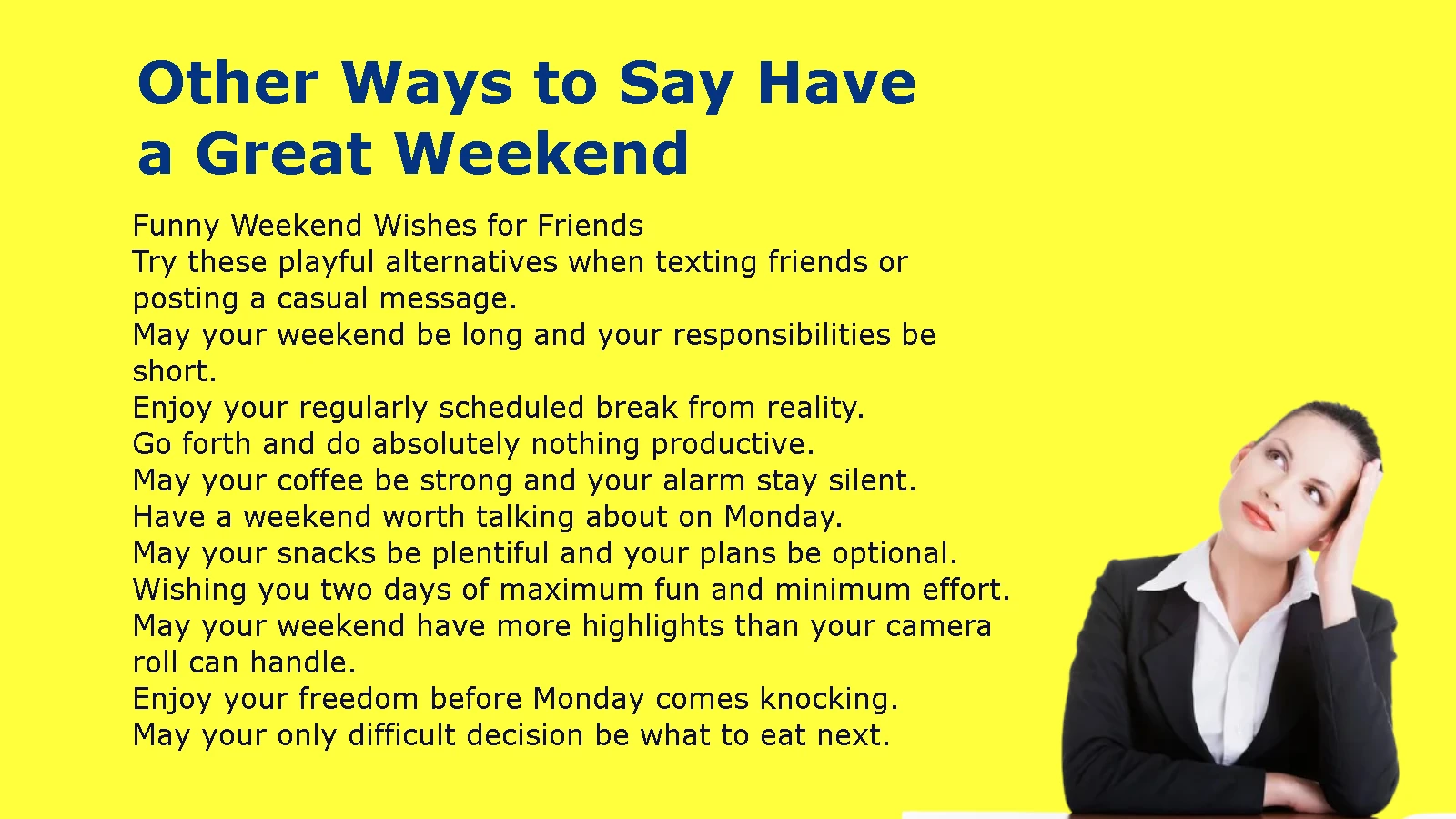
Funny Weekend Wishes for Friends
Try these playful alternatives when messaging friends or people you know well.
- May your weekend be long and your to-do list short.
- Enjoy your two-day vacation from responsibilities.
- May your alarm clock forget you exist.
- Have a weekend full of fun and zero regrets.
- Go forth and do absolutely nothing.
- May your snacks be plentiful and your plans optional.
- Have a weekend so good you’ll need another weekend to recover.
- May your biggest decision be what to eat next.
- Enjoy your freedom while Monday is still far away.
- Have fun, sleep late, and ignore unnecessary responsibilities.
For example, you could text a friend:
“May your weekend be full of good food, great company, and absolutely no responsibilities. Enjoy!”
This sounds more personal than a standard weekend greeting because it adds details that many people associate with time off.
Funny Weekend Wishes for Coworkers
Work-related humor can be especially effective on Friday afternoons, when colleagues are wrapping up their tasks.
Here are some examples:
- Survive Friday and enjoy your freedom.
- May your inbox stay quiet until Monday.
- Enjoy your temporary escape from meetings.
- Have a weekend with no spreadsheets in sight.
- May your laptop remain closed and your coffee remain strong.
- You’ve earned two days without work notifications. Enjoy!
- Clock out mentally and enjoy your weekend!
- May Monday take its time getting here.
You could write in a team chat:
“Great work this week, everyone! May your inbox stay quiet and your weekend stay completely meeting-free.”
This combines appreciation with light humor. It also gives the message a positive ending without making the joke the entire focus.
Use these phrases with colleagues who share your humor. Avoid jokes that suggest a coworker is lazy, unproductive, or unhappy with their job.
Playful and Sarcastic Weekend Messages
If you and the recipient regularly exchange jokes, a slightly sarcastic message can be fun.
- Try not to miss work too much.
- May your weekend be full of exciting plans, like sitting down.
- Enjoy your weekend. Monday can wait its turn.
- Have fun pretending your chores don’t exist.
- Happy weekend! Your couch is calling.
- May your weekend last approximately five business days.
- Relax now. Your responsibilities will still be there on Monday.
The last example works because it acknowledges a familiar frustration in a playful way.
Still, sarcasm depends on context. A phrase that makes a close friend laugh might sound dismissive to a new colleague. When you aren’t sure how someone will interpret a joke, choose a warm, straightforward wish instead.
Casual and Friendly Alternatives to Have a Great Weekend
Casual alternatives to “Have a Great Weekend” sound natural in text messages, group chats, social media comments, and conversations with friends. Expressions such as “Have an awesome weekend,” “Have fun this weekend,” and “Hope you get some time to relax” help you communicate warmth without sounding formal.
Choose a phrase that matches your relationship with the person. Short wishes work well for quick conversations, while thoughtful messages suit people you know more closely.
Short Weekend Wishes for Text Messages
When someone is leaving work, heading home, or sharing their weekend plans, a short message is usually enough.
- Have a good one!
- Enjoy your weekend!
- Have an awesome weekend!
- Have fun this weekend!
- Hope it’s a good one!
- Enjoy the time off!
- Have the best weekend!
- Take it easy this weekend!
- Hope you have a blast!
- Have a relaxing one!
These expressions work well because they don’t require a lengthy response. For example, after a friend tells you they’re going on a short trip, “Have a blast!” sounds more enthusiastic than a generic goodbye.
Warm and Thoughtful Weekend Wishes
Sometimes, you want to show that you genuinely care about someone’s well-being. A thoughtful weekend wish can acknowledge their workload, personal plans, or need for rest.
Consider these options:
- Hope you get some time to relax this weekend.
- Wishing you a weekend full of happiness.
- I hope you get to do something you love.
- Enjoy some well-deserved downtime.
- Hope you have plenty of time for yourself.
- Wishing you a peaceful and refreshing weekend.
- I hope this weekend gives you a chance to recharge.
- Enjoy every moment of your time off.
For example, if a friend has been preparing for exams, you might say:
“You’ve been working so hard lately. I hope you get some time to relax and do something fun this weekend.”
This message feels personal because it connects the wish to the person’s circumstances.
The most effective thoughtful messages are specific without being intrusive. You don’t need to explain everything the recipient has been through; a simple acknowledgment is often enough.
Romantic and Sweet Weekend Wishes
For a partner or someone you’re dating, a weekend wish can express affection and anticipation.
- Hope your weekend is as lovely as you are.
- Have a beautiful weekend, sweetheart.
- Wish I could spend the weekend with you.
- Enjoy every moment of your weekend, love.
- Sending you a little happiness for the weekend ahead.
- I hope your weekend is full of smiles.
- Have a wonderful weekend, and know that I’m thinking of you.
- Can’t wait to hear about your weekend adventures.
If you have plans together, you can make the message more specific:
“Have a lovely Friday, love. I’m looking forward to spending Saturday with you!”
A personal detail makes the greeting more meaningful than a generic romantic phrase. However, choose affectionate wording that matches the stage of your relationship.
How to Wish Someone a Great Weekend in an Email
To wish someone a great weekend in an email, use a brief closing that matches the purpose of your message. “Have a great weekend” works for most workplace emails, while “I hope you have a pleasant weekend” suits more formal communication. Add the wish after your main message and before your sign-off.
A weekend greeting should complement the email rather than replace important information. Finish the business discussion first, then close with a friendly wish.
Professional Weekend Wishes for Work Emails
Here are phrases you can use in different workplace situations.
For a routine work email:
“I’ve attached the revised document for your review. Have a great weekend!”
For a message to your manager:
“Thank you for your guidance on this project. I hope you have a relaxing weekend.”
For a client update:
“We’ll follow up with the remaining details on Monday. In the meantime, I hope you enjoy your weekend.”
For a team message:
“Thanks for all your hard work this week, everyone. Wishing you a wonderful weekend!”
For a formal business email:
“Thank you for your time and consideration. I hope you have a pleasant weekend.”
Each example puts the main message first. The weekend wish then serves as a natural closing rather than an unnecessary extra paragraph.
Friendly Weekend Wishes for Team Emails
Team emails allow a little more warmth, especially when colleagues have worked together throughout the week.
You could write:
“Thanks for everyone’s effort on the launch this week. We’ve made good progress, and I’ll share the next steps on Monday. Enjoy your weekend!”
Or:
“That’s everything from me for today. Thanks for your help this week, and I hope you all have a relaxing weekend.”
If your team works across different time zones, remember that not everyone may be approaching the weekend at the same time. In that case, a more general closing such as “Hope you have a great weekend when it arrives” may be appropriate.
Wishing You a Great Weekend Email Examples
The following complete examples are ready to adapt to your own messages.
Example: Short professional email
Subject: Updated Project Report
Hi Jordan,
I’ve attached the updated project report with the requested changes. Please let me know if you’d like me to revise anything else.
Have a great weekend!
Best regards,
Alex
Example: Friendly email to a coworker
Subject: Friday Update
Hi Taylor,
Thanks for helping me finish the presentation today. I appreciate your input, and the final version is ready to share with the team.
Hope you have a wonderful weekend!
Thanks,
Morgan
Example: Client-facing email
Subject: Follow-Up on Our Meeting
Hello Ms. Carter,
Thank you for taking the time to meet with us today. I’ll send the revised proposal by Tuesday morning, including the additional information we discussed.
I hope you have a pleasant and relaxing weekend.
Best regards,
Chris
Example: Friday follow-up email
Subject: Next Steps for the Project
Hi Sam,
I’ve completed the first round of updates and added the remaining questions to the shared document. We can review them together on Monday.
Thanks for your collaboration this week. Enjoy your weekend!
Best,
Jamie
These examples follow a useful pattern: provide the necessary information, clarify any next steps, and close with a brief weekend wish.
How to Use “Have a Great Weekend” as an Email Sign-Off
“Have a great weekend” works as a closing sentence, but it usually isn’t a replacement for a traditional email sign-off such as “Best regards” or “Thanks.”
A simple format looks like this:
“Thanks again for your help. Have a great weekend!
Best regards,
Taylor”
You can also use a shorter structure for informal communication:
“Enjoy your weekend!
Thanks,
Alex”
Here is how common email sign-offs compare:
| Closing phrase | Best use |
| Have a great weekend! | Friendly professional emails |
| I hope you have a pleasant weekend. | Formal correspondence |
| Enjoy your weekend! | Everyday workplace emails |
| Wishing you a relaxing weekend. | Warm, considerate messages |
| Thanks, and have a great weekend! | Emails that acknowledge someone’s help |
| Best wishes for the weekend. | Polished, slightly formal messages |
Avoid adding several closing phrases that communicate the same idea. For example, “Have a great weekend, enjoy your time off, and I hope you have a wonderful couple of days” feels repetitive. One sincere sentence is usually more effective.
How to Reply When Someone Says Have a Great Weekend
When someone says “Have a Great Weekend,” the most natural reply is “Thanks, you too!” You can also say “Thanks! Enjoy your weekend,” “Same to you,” or “Thank you. I hope you have a wonderful weekend as well.” Choose a response that matches the other person’s tone and your relationship.
You don’t need to create a new or elaborate response every time. A brief acknowledgment is polite and appropriate in most situations.
Simple and Natural Replies
These replies work well in everyday conversations, text messages, and workplace chats.
- Thanks, you too!
- Thanks! Have a good one.
- You too. Enjoy!
- Thanks, same to you!
- Thank you! Have a great weekend as well.
- I will, thanks! You too.
- Thanks! Hope you enjoy yours.
If a coworker says the phrase while leaving the office, “Thanks, you too!” is usually all you need.
For text messages, you can keep things even shorter:
“Thanks! You too 😊”
The emoji is optional. Use it if it fits your normal communication style.
Professional Replies to Have a Great Weekend
When responding to a manager, client, or business contact, you can remain concise while adding a little formality.
Examples include:
- Thank you. I hope you have a wonderful weekend as well.
- Thanks for the kind wishes. Enjoy your weekend, too.
- Thank you, and have a pleasant weekend.
- I appreciate it. Wishing you a relaxing weekend as well.
- Thanks! I hope you enjoy your time off.
Suppose a client ends a Friday meeting by saying, “Have a great weekend.”
A suitable reply would be:
“Thank you! I hope you have a great weekend as well. I’ll follow up with the revised proposal on Monday.”
This response acknowledges the greeting and confirms the next action without extending the conversation unnecessarily.
Funny Replies to Have a Great Weekend
If the other person is joking or you share a relaxed relationship, try one of these responses.
- I plan to do absolutely nothing. Thanks!
- Only if Monday stays away!
- Thanks! My couch and I have big plans.
- That’s the plan!
- I’ll try not to spend the whole weekend sleeping.
- Thanks! May your weekend be free of responsibilities, too.
- I intend to make the most of my snack collection.
For example:
Friend: “Have a great weekend!”
You: “Thanks! I’ve already scheduled several hours of doing nothing.”
This works because the response adds humor while remaining friendly. Avoid playful replies in formal settings where they might distract from the conversation.
How to Reply When Your Boss or Client Wishes You a Good Weekend
A boss or client usually doesn’t expect a lengthy response. A polite acknowledgment is enough unless you need to address another matter.
When your boss says it in person:
“Thanks! You have a great weekend, too.”
When your manager writes it in an email:
“Thank you. I hope you have a relaxing weekend as well.”
When a client says it after a meeting:
“Thank you! It was great speaking with you. Enjoy your weekend.”
When a coworker says it in a group chat:
“Thanks, everyone! Have a good weekend!”
The important point is to return the courtesy without making the exchange more formal than necessary.
Have a Great Weekend Meaning and Usage
“Have a great weekend” is a friendly expression that means you hope someone enjoys the time between the end of the workweek and the start of the next week. People commonly use it on Fridays, before holidays, or whenever they expect someone to have time away from their regular responsibilities.
The expression is a good example of a conventional social wish. It communicates goodwill rather than making a literal prediction about how someone’s weekend will unfold.
What Does “Have a Great Weekend” Mean?
The phrase expresses a wish for someone to experience an enjoyable weekend. Depending on the situation, that might mean relaxing at home, spending time with friends, traveling, pursuing hobbies, or simply taking a break from work.
For example:
- A manager says it to employees at the end of Friday’s shift.
- A friend uses it when ending a conversation before the weekend.
- A customer service representative includes it at the end of a Friday email.
- A teacher says it to students before they leave class for the weekend.
In each case, the speaker expresses a positive wish for the recipient’s time off.
The phrase doesn’t require the recipient to have exciting plans. A quiet weekend at home can be just as enjoyable as a busy schedule.
Have a Lovely Weekend Meaning
“Have a lovely weekend” means that you hope someone has a pleasant, enjoyable, or relaxing weekend. The word “lovely” often gives the expression a softer and warmer tone than “great,” making it suitable for friends, family members, colleagues, and polite professional messages.
Compare these examples:
- “Have a great weekend!” sounds upbeat and broadly applicable.
- “Have a lovely weekend!” sounds warm and thoughtful.
- “Have a relaxing weekend!” emphasizes rest.
- “Have a wonderful weekend!” conveys enthusiasm and goodwill.
The difference is not strict. English speakers often use these expressions interchangeably, and the recipient’s interpretation will depend on the context.
In some varieties of English, especially British English, “Have a lovely weekend” is a familiar and natural closing. However, it is also widely understood in American English.
Is “Have a Great Weekend” Correct English?
Yes, “Have a great weekend” is grammatically correct and widely used in spoken and written English. It is an imperative construction that functions as a friendly wish. Although the sentence uses the imperative form, it doesn’t normally sound like an order.
The structure is straightforward:
- Have: The verb.
- A: The indefinite article.
- Great: An adjective describing the weekend.
- Weekend: The noun referring to the end-of-week period.
The subject “you” is understood, as it often is in imperative sentences.
For example, “Have a safe trip,” “Enjoy your meal,” and “Have a nice day” follow a similar pattern. They express goodwill rather than demand an action.
You can write the phrase with an exclamation mark for extra enthusiasm or with a period for a more neutral tone.
Examples:
- Have a great weekend!
- I hope you have a great weekend.
- Have a great weekend, everyone.
- Thanks again, and have a great weekend.
All four examples are natural. Choose the one that best fits the sentence and the level of enthusiasm you want to convey.
Difference Between “Have a Great Weekend” and “Enjoy Your Weekend”
Both expressions communicate a positive wish, but they emphasize slightly different ideas.
| Expression | Main emphasis | Typical tone |
| Have a great weekend | General happiness and enjoyment | Friendly and upbeat |
| Enjoy your weekend | Making the most of the time | Natural and conversational |
| Have a lovely weekend | Pleasant experiences | Warm and thoughtful |
| Have a relaxing weekend | Rest and recovery | Considerate |
| Have a wonderful weekend | Overall enjoyment | Positive and enthusiastic |
Consider these examples:
“Have a great weekend!” works as a general farewell to a colleague.
“Enjoy your weekend!” feels especially natural when someone has mentioned plans, such as visiting family or taking a short trip.
“I hope you have a relaxing weekend” works well when someone has described a busy week.
None of these expressions is universally better than the others. The right choice depends on what you want to communicate.
How to Say Have a Great Weekend in Spanish
A common way to say “Have a Great Weekend” in Spanish is “¡Que tengas un excelente fin de semana!” You can also say “¡Que tengas un buen fin de semana!” for “Have a good weekend.” Use “tengas” when speaking informally to one person and “tenga” for a formal singular greeting.
Spanish offers several natural ways to express the same wish. The best choice depends on how formal you want to sound and whom you’re addressing.
Common Spanish Translations
| English phrase | Spanish translation |
| Have a great weekend! | ¡Que tengas un excelente fin de semana! |
| Have a nice weekend! | ¡Que tengas un buen fin de semana! |
| Have a lovely weekend! | ¡Que tengas un lindo fin de semana! |
| Enjoy your weekend! | ¡Disfruta del fin de semana! |
| Have a wonderful weekend! | ¡Que tengas un fin de semana maravilloso! |
| Have a relaxing weekend! | ¡Que tengas un fin de semana relajante! |
These translations convey similar meanings, although the naturalness of individual adjectives can vary by region.
For a simple, broadly understood greeting, “¡Que tengas un buen fin de semana!” is a reliable choice.
Formal and Informal Spanish Weekend Wishes
Spanish changes the verb form depending on whom you’re addressing.
Informal singular:
“¡Que tengas un buen fin de semana!”
Use this when speaking to a friend, family member, or someone you address with tú.
Formal singular:
“¡Que tenga un buen fin de semana!”
Use this when addressing someone formally with usted, such as a client or a person you don’t know well.
Informal plural in Spain:
“¡Que tengáis un buen fin de semana!”
Use this when speaking informally to a group you address with vosotros.
Plural in many Latin American contexts:
“¡Que tengan un buen fin de semana!”
Use this when addressing several people. Many Latin American varieties use ustedes for both formal and informal plural situations.
These distinctions help you avoid a translation that sounds grammatically correct but doesn’t match your relationship with the recipient.
Which Spanish Weekend Greeting Should You Use?
For everyday communication, “¡Que tengas un buen fin de semana!” is a natural option when addressing one person informally. For a client or formal business contact, use “¡Que tenga un buen fin de semana!”
You can also use “¡Disfruta del fin de semana!” when you want to emphasize enjoyment.
Here are two practical examples:
To a Spanish-speaking friend:
“Gracias por la invitación. ¡Que tengas un buen fin de semana!”
Meaning: “Thanks for the invitation. Have a good weekend!”
To a business contact:
“Muchas gracias por su tiempo. ¡Que tenga un buen fin de semana!”
Meaning: “Thank you very much for your time. Have a good weekend!”
Remember that fin de semana is the standard Spanish expression for “weekend.” The phrase doesn’t change to a plural form simply because you’re wishing someone a great weekend.
How to Choose the Best Weekend Wish for Any Situation
The best weekend wish depends on your audience, your relationship, and the setting. Use a straightforward phrase for everyday conversations, a polished expression for professional emails, and a playful alternative for friends who appreciate humor. A thoughtful message can also acknowledge someone’s plans or need for rest.
Instead of memorizing dozens of expressions, learn which types of phrases work in different situations.
Weekend Wishes by Tone and Relationship
Use this comparison table when you need to choose a phrase quickly.
| Situation | Suggested phrase | Why it works |
| Manager or supervisor | I hope you have a pleasant weekend. | Courteous and polished |
| Close coworker | Have a great weekend! | Friendly and natural |
| New client | Wishing you an enjoyable weekend. | Professional and warm |
| Close friend | Have an awesome weekend! | Relaxed and enthusiastic |
| Friend who needs rest | Hope you get some time to recharge. | Thoughtful and supportive |
| Romantic partner | Have a lovely weekend, love. | Affectionate |
| Group chat | Enjoy your weekend, everyone! | Inclusive and simple |
| Funny conversation | May your weekend be long and your chores be few. | Playful |
| Spanish-speaking client | ¡Que tenga un buen fin de semana! | Formal and courteous |
| Email after a meeting | Thank you for your time. Enjoy your weekend. | Polite and purposeful |
The goal is not to make every message sound different. It is to choose wording that fits the situation.
A standard phrase can be more effective than an unusual alternative if it communicates your intention clearly.
Weekend Wishes by Communication Channel
Different communication channels call for different levels of detail.
Emails: Use complete sentences and place the weekend wish near the end. If necessary, include a traditional sign-off after it.
Workplace chats: Keep the message short and friendly. “Thanks for your help today. Have a great weekend!” works well.
Text messages: Use natural expressions and optional emojis if they fit your relationship.
Social media: Choose more expressive wording, especially when commenting on a friend’s plans or posting a weekend greeting.
Face-to-face conversations: A simple “Enjoy your weekend!” usually sounds more natural than a long, prepared statement.
For example, you might write a complete sentence in a client email but use “Have a good one!” in a casual conversation with a colleague.
Matching the channel helps the phrase sound natural rather than rehearsed.
Common Mistakes to Avoid When Wishing Someone a Great Weekend
Even a simple greeting can sound awkward when you ignore the context. Keep these common mistakes in mind.
Using too much slang in formal emails
“Have an epic weekend!” may suit a close teammate but might not fit a formal message to a new client. Choose neutral wording when you aren’t sure about the recipient’s preferences.
Making the greeting unnecessarily long
A weekend wish usually needs only a sentence. Avoid combining several phrases that express the same idea.
Using humor with the wrong audience
Sarcastic remarks about work, Monday mornings, or responsibilities can be misunderstood. Use humor when you know the recipient will appreciate it.
Repeating the same closing in every email
You don’t need a completely different phrase every time, but varying your wording occasionally can make messages feel less repetitive. Alternate between “Enjoy your weekend,” “Have a pleasant weekend,” and “Wishing you a relaxing weekend.”
Confusing the weekend wish with the email sign-off
“Have a great weekend” is a closing sentence. “Best regards” and “Best” are traditional email sign-offs. You can use both when the situation calls for a complete professional closing.
Translating too literally
A word-for-word translation may sound unnatural in another language. Learn common expressions and choose the appropriate formal or informal form rather than translating each English word separately.
Frequently Asked Questions
What Is Another Way to Say “Have a Great Weekend”?
Other ways to say “Have a Great Weekend” include “Enjoy your weekend,” “Have a wonderful weekend,” “Have a lovely weekend,” “Wishing you a fantastic weekend,” and “Hope you have a relaxing weekend.” Choose a phrase that matches your relationship with the recipient and the tone of your conversation.
How Do You Say “Have a Great Weekend” Professionally?
You can say “I hope you have a pleasant weekend,” “Wishing you an enjoyable weekend,” or “I hope you have a relaxing weekend.” These phrases work well in emails to managers, clients, colleagues, and business partners. Keep the wording simple and courteous.
What Is a Funny Way to Say “Have a Good Weekend”?
Funny alternatives include “May your weekend be long and your to-do list short,” “May your alarm clock forget you exist,” and “Enjoy your temporary escape from meetings.” Use playful expressions with friends and coworkers who appreciate humor, and avoid jokes that might sound disrespectful in formal settings.
How Do You Reply to “Have a Great Weekend”?
The most common reply is “Thanks, you too!” Other natural responses include “Thanks! Enjoy your weekend,” “Same to you,” and “Thank you. I hope you have a wonderful weekend as well.” A short acknowledgment is appropriate in most conversations.
Is “Have a Lovely Weekend” Correct?
Yes, “Have a lovely weekend” is correct English. It expresses a wish for someone to have a pleasant and enjoyable weekend. The word “lovely” gives the phrase a warm, thoughtful tone, making it suitable for both personal messages and many professional conversations.
How Do You Say “Have a Great Weekend” in Spanish?
A common translation is “¡Que tengas un excelente fin de semana!” For a simpler greeting, use “¡Que tengas un buen fin de semana!” When addressing one person formally, replace tengas with tenga. For a group, “¡Que tengan un buen fin de semana!” works in many Spanish-speaking regions.
Conclusion
Finding the right alternative to “Have a Great Weekend” doesn’t require complicated wording. A short, thoughtful phrase can make your message feel warmer, more professional, or more personal.
Use “Enjoy your weekend” for everyday conversations, “I hope you have a pleasant weekend” for formal emails, and funny expressions when you’re speaking with friends or close coworkers. If someone wishes you a great weekend, “Thanks, you too!” is a natural response. For Spanish-speaking recipients, choose a translation that matches the level of formality.