An infectious smile is a smile that makes other people smile, feel happier, or share the joy of the person smiling. If you’re looking for other ways to say infectious smile, you can use expressions such as contagious smile, radiant smile, uplifting smile, or a smile that brightens everyone’s day, depending on the feeling you want to convey.
Some alternatives emphasize happiness, while others highlight warmth, charm, beauty, or friendliness. Knowing these differences helps you choose the right words for compliments, text messages, professional writing, social media captions, and creative storytelling.
Quick Answer: Other Ways to Say Infectious Smile
| Question | Answer |
| What is another way to say infectious smile? | Contagious smile, uplifting smile, or joyful smile |
| What is the closest synonym for infectious smile? | Contagious smile |
| Can you say someone has an infectious smile? | Yes. It’s natural and grammatically correct English. |
| What does infectious smile mean? | A smile that makes other people feel happy or smile back |
| What is infectious smile meaning in Urdu? | ایسی مسکراہٹ جو دوسروں کے چہروں پر بھی مسکراہٹ لے آئے |
What Does Infectious Smile Mean?
An infectious smile is a smile that spreads happiness or encourages others to smile, too. The word infectious has a figurative meaning here. It describes how one person’s cheerful expression can influence the emotions of people around them. The phrase usually carries a warm, positive meaning.
For example:
Her infectious smile made everyone at the table feel welcome.
This sentence suggests that her smile did more than make her look happy. It helped create a happier atmosphere for everyone else.
Infectious Smile Meaning in Simple English
In simple English, an infectious smile is a smile that makes other people smile, too.
Imagine walking into a room after a tiring day. Someone greets you with a genuine, cheerful smile. You find yourself smiling back without even planning to.
That is the idea behind an infectious smile.
The expression can describe several situations:
- Shared happiness: Someone’s smile makes other people feel cheerful.
- Friendly interactions: A person’s smile helps strangers or guests feel comfortable.
- Positive energy: Someone’s expression lifts the mood of a group.
- Memorable personality: A person’s smile becomes one of their most noticeable qualities.
An infectious smile doesn’t have to be exceptionally beautiful or perfectly symmetrical. Its appeal comes from the feeling it creates.
Infectious Smile Meaning in Urdu
The natural Urdu meaning of infectious smile is:
ایسی مسکراہٹ جو دوسروں کے چہروں پر بھی مسکراہٹ لے آئے۔
Another simple explanation is:
ایسی مسکراہٹ جو دوسروں کو بھی خوش کر دے۔
In English, the expression describes a smile that spreads happiness or makes others smile.
Example:
English: She has an infectious smile that makes everyone feel better.
Urdu: اس کی مسکراہٹ ایسی ہے کہ اسے دیکھ کر ہر کسی کے چہرے پر مسکراہٹ آ جاتی ہے۔
The translation focuses on the intended meaning rather than translating infectious literally. In this context, the phrase is a compliment, not a reference to illness.
Is an Infectious Smile the Same as a Contagious Smile?
Yes. Infectious smile and contagious smile usually mean the same thing. Both describe a smile that encourages other people to smile or share a happy feeling.
The difference is mainly stylistic.
| Expression | Main emphasis | Example |
| Infectious smile | Spreading happiness | Her infectious smile cheered us up. |
| Contagious smile | Making others smile, too | His contagious smile had everyone grinning. |
Both expressions sound natural in everyday English.
You can use either phrase in a compliment, personal message, story, or character description without changing the central meaning.
35+ Other Ways to Say Infectious Smile
The best other ways to say infectious smile depend on what you want to communicate. Some alternatives closely match the original meaning, while others describe a person’s appearance, friendliness, or emotional effect.
Here are useful choices grouped by meaning and context.
Best Synonyms for Infectious Smile
These alternatives work well in everyday conversations, descriptions, and compliments.
| Alternative | Meaning or emphasis | Example |
| Contagious smile | Makes others smile | His contagious smile cheered everyone up. |
| Joyful smile | Expresses happiness | She greeted us with a joyful smile. |
| Radiant smile | Looks bright and happy | He flashed a radiant smile. |
| Warm smile | Shows kindness | Her warm smile put me at ease. |
| Heartwarming smile | Creates a tender, happy feeling | Grandma welcomed us with a heartwarming smile. |
| Cheerful smile | Expresses a positive mood | His cheerful smile lifted the mood. |
| Uplifting smile | Improves someone’s mood | Her uplifting smile helped me relax. |
| Bright smile | Looks lively and pleasant | She greeted her classmates with a bright smile. |
| Charming smile | Has an appealing quality | His charming smile won everyone’s attention. |
| Delightful smile | Creates pleasure or happiness | She has a delightful smile. |
Best choice: Contagious smile is the closest replacement because it preserves the idea that one person’s smile influences others.
However, radiant smile and warm smile can work better when you want to describe appearance or personality rather than emotional influence.
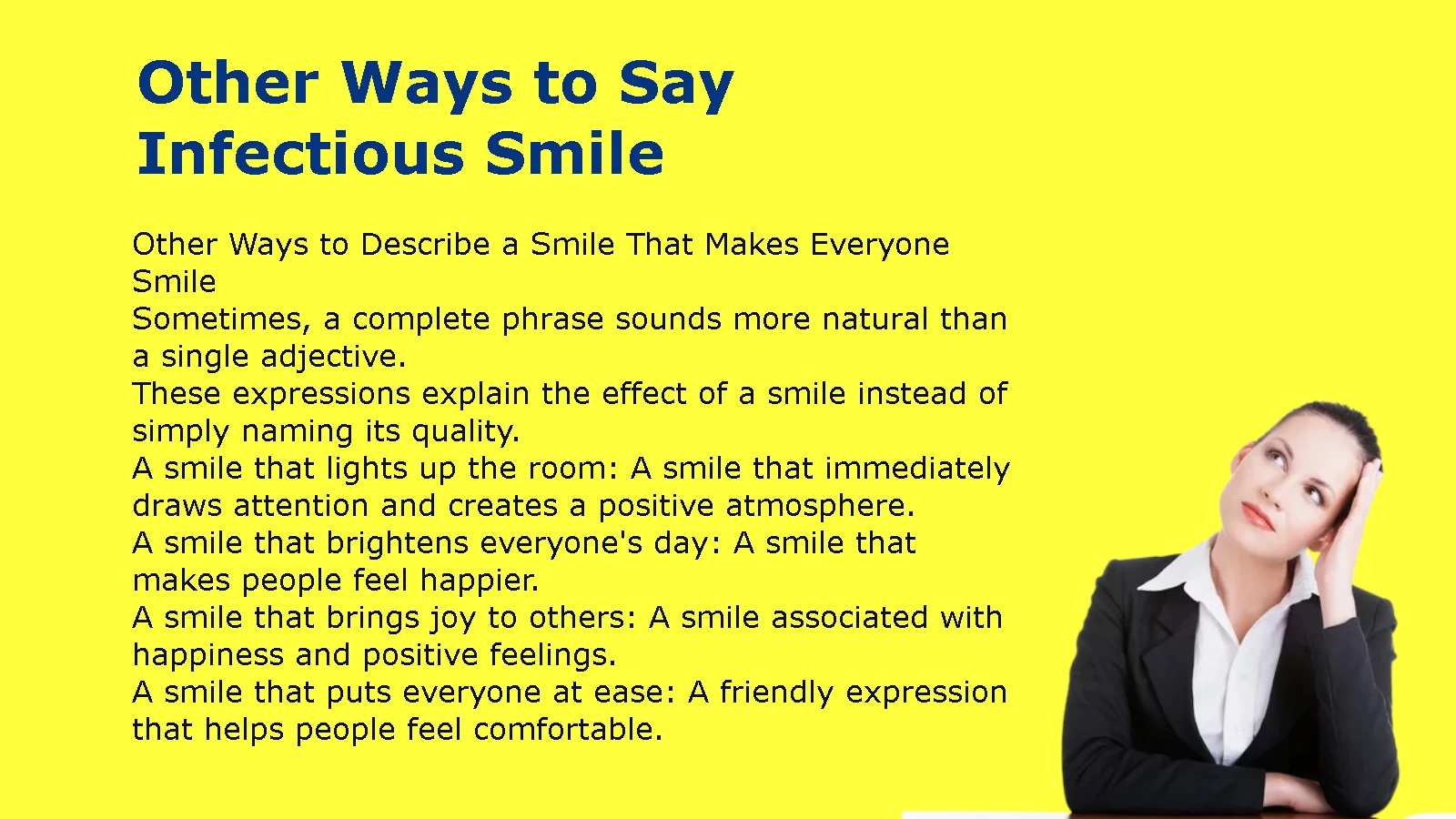
Other Ways to Describe a Smile That Makes Everyone Smile
Sometimes, a complete phrase sounds more natural than a single adjective.
These expressions explain the effect of a smile instead of simply naming its quality.
- A smile that lights up the room: A smile that immediately draws attention and creates a positive atmosphere.
- A smile that brightens everyone’s day: A smile that makes people feel happier.
- A smile that brings joy to others: A smile associated with happiness and positive feelings.
- A smile that puts everyone at ease: A friendly expression that helps people feel comfortable.
- A smile that lifts everyone’s spirits: A smile that improves the group’s mood.
- A smile that spreads happiness: A close paraphrase of an infectious smile.
- A smile that makes people smile back: A straightforward, conversational description.
- A smile that’s impossible not to return: A playful way to describe a particularly engaging smile.
- A smile that changes the mood of a room: A descriptive option for storytelling.
- A smile that makes a tough day feel lighter: A warm expression for personal compliments.
- A smile that brings people together: A phrase emphasizing connection.
- A smile that leaves everyone grinning: A lively description of shared amusement.
These phrases are particularly useful when you want your writing to sound personal rather than formulaic.
For example, instead of writing:
He has an infectious smile.
You could write:
He has a smile that makes even the quietest people around him grin.
The second version gives readers a clearer picture of his effect on others.
Beautiful and Expressive Alternatives for Creative Writing
If you’re describing a character, friend, family member, or romantic interest, you might want a more expressive alternative.
| Alternative | Best use |
| Beaming smile | Strong happiness |
| Glowing smile | Visible happiness or pride |
| Dazzling smile | A striking, attention-grabbing smile |
| Captivating smile | A smile that holds someone’s attention |
| Delightful smile | A pleasant and appealing expression |
| Sunny smile | Cheerfulness and optimism |
| Welcoming smile | Friendliness and hospitality |
| Sweet smile | Tenderness or affection |
| Luminous smile | A vivid, literary description |
| Enchanting smile | A smile with a magical or captivating quality |
Keep the distinctions in mind.
A dazzling smile may describe someone’s appearance without suggesting that other people smile back. A welcoming smile emphasizes hospitality. A sunny smile suggests cheerfulness.
These expressions can replace infectious smile in some contexts, but they don’t always preserve its precise meaning.
How to Say Someone Has an Infectious Smile
Yes, you can naturally say someone has an infectious smile. The phrase is grammatically correct and works in casual conversation, compliments, messages, and descriptive writing. For example, “You have an infectious smile” is a friendly way to tell someone that their smile makes others feel happier.
Is It Correct to Say “You Have an Infectious Smile”?
Yes. “You have an infectious smile” is a correct and natural English sentence.
The structure is simple:
- You: The subject.
- Have: The main verb.
- An infectious smile: The noun phrase describing what the person has.
The article an is correct because infectious begins with a vowel sound.
You can also use the phrase with different subjects:
- She has an infectious smile.
- He has an infectious smile.
- My friend has an infectious smile.
- They have infectious smiles.
Notice the difference between the singular and plural forms.
Singular: She has an infectious smile.
Plural: They have infectious smiles.
The plural form often works when you’re describing several people individually or collectively.
You can also describe the smile directly:
- Your smile is infectious.
- Her smile is contagious.
- His smile spreads happiness.
- Their smiles brighten the room.
All these sentences are natural, although each emphasizes a slightly different quality.
Natural Ways to Compliment Someone’s Infectious Smile
A good compliment sounds sincere and fits the relationship. You don’t need complicated vocabulary to express genuine appreciation.
Here are natural examples.
Simple and friendly compliments
- You have such an infectious smile.
- Your smile always makes me smile.
- You have a really cheerful smile.
- Your smile brightens everyone’s day.
- You have such a warm smile.
Thoughtful compliments
- Your smile makes people feel welcome.
- There’s something genuinely uplifting about your smile.
- Your smile has a way of making difficult days feel easier.
- You bring so much happiness with that smile.
- Your smile makes every conversation feel more pleasant.
Short compliments
- Your smile is contagious.
- What a beautiful smile!
- That smile is unforgettable.
- Your smile is pure sunshine.
- Keep that lovely smile.
Choose a compliment that reflects what you actually notice. If someone’s smile makes conversations easier, mention that effect rather than giving a generic compliment about their appearance.
How to Compliment Someone’s Smile Without Sounding Awkward
Compliments work best when they feel natural instead of rehearsed.
Use these practical guidelines:
Be specific. Rather than saying, “Your smile is amazing,” explain what you appreciate.
Example: Your smile makes everyone feel welcome.
Match the situation. A casual compliment works well with a friend, while a simple, respectful comment may suit a coworker.
Example: You always bring such a positive energy to the team.
Avoid exaggeration. You don’t need dramatic phrases such as “Your smile is the most beautiful thing in the universe.”
A sincere sentence usually feels more genuine.
Respect personal boundaries. If you don’t know someone well, keep your compliment friendly and brief.
Example: You have a very warm smile.
A compliment should make someone comfortable, not pressure them to respond in a particular way.
Other Ways to Say Infectious Smile in Different Situations
The same expression doesn’t work equally well in every setting. A phrase that feels sweet in a romantic text might sound excessive in a professional introduction.
Here’s how to choose an alternative that fits the situation.
Casual Ways to Describe an Infectious Smile
For friends, everyday conversations, and informal messages, use expressions that sound relaxed.
- Your smile is contagious.
- You make everyone smile.
- Your smile is so uplifting.
- You’ve got such a cheerful smile.
- Your smile makes everything better.
- You have a smile that spreads good vibes.
- Your grin is impossible not to return.
Example conversation:
A: How was your first day at the new office?
B: Pretty good! My new coworker has such a contagious smile. She made everyone feel comfortable.
The expression sounds natural because it describes a specific social effect.
Romantic Ways to Describe Someone’s Infectious Smile
Romantic compliments often communicate personal affection in addition to happiness.
These alternatives work well in messages, cards, or conversations with a partner.
- Your smile makes my day.
- I can’t help smiling when I see you smile.
- Your smile is one of my favorite things about you.
- Your smile makes ordinary moments feel special.
- I love how your smile brightens even my busiest days.
- Your smile always gives me something to look forward to.
- I could recognize that smile anywhere.
Example:
I love your infectious smile. Even when my day feels overwhelming, seeing you smile makes everything seem a little lighter.
This sentence keeps the original idea but makes the compliment more personal.
Use these phrases when the relationship supports that level of affection. A romantic compliment may feel too intimate when directed at someone you barely know.
Professional and Polished Ways to Describe an Infectious Smile
In professional writing, you may want to communicate warmth, confidence, and approachability without sounding overly personal.
Consider these alternatives:
- A warm and welcoming smile
- An engaging smile
- A cheerful and approachable expression
- A smile that puts others at ease
- A friendly and reassuring smile
- A positive and inviting presence
Example for a recommendation:
She greets clients with a warm, welcoming smile and helps them feel comfortable from the beginning.
Example for a professional introduction:
He brings a friendly presence to the team and has a smile that puts people at ease.
These descriptions can work in recommendations, workplace profiles, customer service examples, and character references.
However, professional writing should focus on relevant qualities. If you’re describing someone’s work performance, connect the smile to a meaningful behavior, such as welcoming clients or easing communication, rather than treating appearance as a measure of ability.
Creative Ways to Describe an Infectious Smile in Writing
Writers can use imagery to make a smile memorable.
Instead of relying on the same adjective repeatedly, describe what happens when someone smiles.
Examples:
- Her smile spread through the room like sunshine.
- His grin broke the tension before anyone said a word.
- One cheerful smile was enough to make the entire group laugh.
- Her smile lifted the mood of the crowded waiting room.
- He flashed a sunny grin, and the awkward silence disappeared.
- Her smile brought a little warmth to an otherwise difficult morning.
- A single grin traveled around the table as everyone began laughing.
These descriptions work because they show the effect of the smile.
Writing tip: Use sensory details and reactions sparingly. If every character has a smile that lights up the room, the description loses its impact.
Give each character a distinct expression.
For example:
Lena offered a quiet, reassuring smile.
Marcus greeted the room with a wide, contagious grin.
Both characters may be friendly, but their expressions create different impressions.
Infectious Smile Examples in Sentences
Understanding a phrase becomes easier when you see how people use it in different contexts.
Everyday Examples
Here are original sentences using infectious smile naturally.
- She has an infectious smile that makes everyone feel welcome.
- His infectious smile cheered me up after a difficult day.
- Whenever she laughs, her infectious smile follows.
- He greeted his guests with an infectious smile.
- My little brother has an infectious smile that brightens our mornings.
- The teacher’s infectious smile helped calm the nervous students.
- Even during stressful moments, her infectious smile brought a little relief.
- Everyone remembered his infectious smile long after the event ended.
These examples show that the expression can describe friends, relatives, teachers, colleagues, and other people.
The phrase works especially well when the smile affects the atmosphere or emotions of others.
Examples Using Other Ways to Say Infectious Smile
You can change the wording while keeping a similar positive message.
| Original sentence | Alternative |
| She has an infectious smile. | She has a contagious smile. |
| His infectious smile cheered us up. | His uplifting smile cheered us up. |
| She greeted us with an infectious smile. | She greeted us with a warm smile. |
| His infectious smile brightened the room. | His radiant smile brightened the room. |
| Her infectious smile made everyone happy. | Her smile spread happiness throughout the group. |
These sentences aren’t perfect one-to-one replacements in every context.
For instance, a warm smile suggests kindness, while a contagious smile more directly suggests that others begin smiling, too.
Choose the version that preserves the meaning you intend.
Infectious Smile in Text Messages and Social Captions
Short expressions work well for captions, personal messages, and friendly comments.
Here are some options:
- Your smile is seriously contagious.
- That smile makes every picture better.
- Keep smiling. Your happiness is catching.
- One smile, and suddenly everyone’s smiling.
- A smile that brightens the whole day.
- Spreading happiness, one smile at a time.
- That cheerful grin deserves its own spotlight.
- Your smile brings sunshine to ordinary moments.
For a photo caption:
The kind of smile that makes everyone smile back.
For a friend’s birthday message:
Happy birthday to someone with the most contagious smile and the kindest heart.
For a personal text:
Just wanted to say that your smile made my day today.
Avoid using the same caption style for every photo. A more specific detail can make the message feel personal and less predictable.
Infectious Smile vs. Similar Words and Expressions
Many smile-related adjectives carry positive meanings, but they describe different qualities.
Understanding these distinctions helps you select the most accurate expression.
Infectious Smile vs. Contagious Smile
Both phrases usually describe a smile that encourages others to smile.
Infectious smile may sound slightly more expressive or descriptive in some contexts.
Contagious smile is equally natural and often feels straightforward in everyday conversation.
Examples:
- Her infectious smile made the gathering feel brighter.
- His contagious smile had everyone grinning.
Both sentences suggest that happiness spreads from one person to others.
You can generally use either expression without changing the central message.
Infectious Smile vs. Radiant Smile
A radiant smile looks bright, joyful, or full of warmth.
An infectious smile influences how other people feel or react.
Compare these examples:
She gave me a radiant smile.
This sentence emphasizes the brightness or beauty of her expression.
She gave me an infectious smile, and I immediately smiled back.
This version emphasizes the effect of her smile on another person.
A radiant smile can also be infectious, but the two descriptions aren’t identical.
Infectious Smile vs. Warm Smile
A warm smile communicates friendliness, kindness, or genuine welcome.
An infectious smile suggests that a person’s expression spreads happiness.
For example:
- The receptionist greeted us with a warm smile.
This emphasizes hospitality. - His infectious smile soon had everyone laughing.
This emphasizes shared happiness.
Use warm smile when the main idea is kindness. Choose infectious smile when you want to emphasize its effect on others.
Infectious Smile vs. Charming Smile
A charming smile attracts attention or makes someone seem appealing, pleasant, or likable.
An infectious smile makes people more likely to smile or share a positive feeling.
For example:
He has a charming smile that makes a strong first impression.
This sentence highlights appeal.
He has an infectious smile that makes everyone around him grin.
This sentence highlights emotional influence.
A person can have both qualities, but neither expression automatically implies the other.
Similar Words to Infectious
The word infectious has several synonyms, but the right choice depends on the noun it describes.
When discussing smiles, laughter, happiness, or enthusiasm, some alternatives work better than others.
| Word | Meaning | Example |
| Contagious | Spreads through influence or shared reactions | Contagious laughter |
| Catching | Easily spreads to others | Catching enthusiasm |
| Uplifting | Improves mood or confidence | Uplifting smile |
| Invigorating | Gives energy or freshness | Invigorating atmosphere |
| Spreading | Passing from one person or place to another | Spreading happiness |
| Inspiring | Encourages or motivates others | Inspiring enthusiasm |
| Enthusiastic | Shows strong excitement or interest | Enthusiastic greeting |
Contagious is the closest general alternative to infectious when describing a smile.
Catching can also describe laughter, excitement, or enthusiasm, although it may sound less polished in some sentences.
Uplifting and inspiring describe related positive effects, but they don’t necessarily mean that other people start smiling.
How to Choose the Right Synonym
Ask yourself what you want readers to notice.
- If the smile makes others grin, use contagious.
- If it looks bright and happy, use radiant.
- If it expresses kindness, use warm.
- If it improves someone’s mood, use uplifting.
- If it attracts attention, use captivating.
- If it communicates friendliness, use welcoming.
This simple distinction can improve both everyday communication and professional writing.
Common Mistakes When Using “Infectious Smile”
The phrase is easy to use, but a few common misunderstandings can lead to awkward descriptions.
Is “Infectious Smile” Always a Compliment?
Usually, yes. Infectious smile normally carries a positive meaning because it suggests happiness, friendliness, or emotional connection.
For example:
Her infectious smile made everyone feel at home.
However, context matters.
A smile can be described as infectious in a humorous, sarcastic, or unusual situation. The phrase itself doesn’t guarantee that the writer intends a compliment.
In ordinary conversations, though, it is a friendly expression.
Can You Use “Infectious” for Laughter and Happiness?
Yes. The word infectious can describe emotions, behaviors, and reactions that seem to spread among people.
Common examples include:
- Infectious laughter
- Infectious enthusiasm
- Infectious happiness
- Infectious optimism
- Infectious excitement
- Infectious energy
Example:
His infectious laughter soon had the entire group laughing.
This sentence uses the same figurative idea as infectious smile.
The word doesn’t suggest that laughter or happiness is a literal disease. It describes the way emotions and reactions can influence other people.
Is “Infectious Smile” Better Than “Beautiful Smile”?
Neither expression is universally better. They describe different qualities.
A beautiful smile emphasizes attractiveness.
An infectious smile emphasizes its influence on others.
Compare:
She has a beautiful smile.
This tells readers that her smile looks attractive.
She has an infectious smile.
This suggests that her smile makes people feel happier or smile themselves.
You can also combine the two descriptions:
She has a beautiful, infectious smile that makes everyone feel welcome.
This works when you want to communicate both appearance and emotional effect.
However, use both adjectives only when both meanings matter.
A Practical Guide: Choosing the Best Alternative
Suppose you’re writing a birthday message, a character description, or a professional recommendation. How do you choose among dozens of possible alternatives?
Use this simple decision framework.
Match the Expression to Your Purpose
| Your purpose | Recommended expression |
| A close synonym | Contagious smile |
| A casual compliment | Your smile always makes me smile. |
| A heartfelt message | Your smile brightens my day. |
| A romantic compliment | Your smile is one of my favorite things about you. |
| A professional description | A warm, welcoming smile |
| A vivid character description | A smile that lights up the room |
| A beautiful visual description | Radiant smile |
| A friendly introduction | An approachable smile |
| A cheerful social caption | A smile that spreads happiness |
This approach prevents you from choosing an alternative simply because it sounds impressive.
Mini Case Study: Improving a Generic Description
Consider this sentence:
Sarah has an infectious smile.
The sentence is correct, but it doesn’t reveal much about Sarah or the situation.
You can improve it by adding context.
Version for a workplace profile:
Sarah greets every client with a warm smile that immediately puts them at ease.
This version highlights friendliness and professional interaction.
Version for a personal story:
Sarah’s contagious grin spread around the dinner table until everyone was laughing.
This version shows the effect of her expression through other people’s reactions.
Version for a romantic message:
Your smile makes even my most ordinary days feel special.
This version focuses on affection rather than the literal meaning of infectious.
What changes?
The central idea remains positive, but each version serves a different purpose.
The workplace version emphasizes trust. The story version emphasizes shared joy. The romantic version emphasizes emotional connection.
That is the real value of using alternatives: you can express a more precise thought instead of repeating the same adjective.
Frequently Asked Questions
What Is Another Way to Say Infectious Smile?
The closest alternative is contagious smile. Other options include uplifting smile, joyful smile, radiant smile, and a smile that brightens everyone’s day. Choose contagious smile when you want to preserve the original meaning most closely.
Can You Say Someone Has an Infectious Smile?
Yes. “Someone has an infectious smile” is grammatically correct and sounds natural. You can also say, “You have an infectious smile,” or “Her smile is contagious.” All three expressions work in everyday English.
How Do You Describe a Smile That Makes Everyone Smile?
You can say “a smile that spreads happiness,” “a smile that makes people smile back,” or “a smile that brightens everyone’s day.” These expressions describe the smile’s effect more directly than a simple adjective.
What Is the Difference Between an Infectious Smile and a Contagious Smile?
Both expressions usually mean the same thing. They describe a smile that influences other people and encourages them to smile or feel happier. The difference is mostly stylistic rather than a strict difference in meaning.
What Is Infectious Smile Meaning in Urdu?
Infectious smile means ایسی مسکراہٹ جو دوسروں کے چہروں پر بھی مسکراہٹ لے آئے. It describes a smile that makes other people feel happy or smile back. The expression is usually a compliment.
What Is the Opposite of an Infectious Smile?
There is no single exact antonym for infectious smile. Depending on the context, you could use cold expression, unwelcoming look, joyless expression, or stern expression. These phrases describe different qualities rather than exact opposites.
Conclusion: Choose the Right Way to Describe an Infectious Smile
The best other ways to say infectious smile include contagious smile, uplifting smile, radiant smile, warm smile, and a smile that brightens everyone’s day.
Each expression communicates something slightly different.
Use contagious smile when you want the closest synonym. Choose radiant smile to emphasize brightness and happiness, or warm smile to highlight kindness and friendliness. For heartfelt compliments, a complete sentence such as “Your smile always makes me smile” often sounds more natural than an elaborate description.