Other words for explain include clarify, describe, illustrate, demonstrate, elaborate, interpret, elucidate, and simplify. Each synonym communicates a slightly different meaning, so the best choice depends on what you want to express. Whether you’re writing an essay, preparing a presentation, sending a professional email, or having a casual conversation, choosing the right explain synonym can make your message clearer and more engaging.
Some words focus on making complicated information easier to understand, while others emphasize providing details, showing how something works, or giving reasons. For example, clarify removes confusion, illustrate uses examples, and elaborate adds more information. Understanding these differences helps you improve your vocabulary, writing style, and communication skills without changing your intended meaning.
| Question | Answer |
| What are the best other words for explain? | Clarify, describe, illustrate, demonstrate, elaborate, and interpret. |
| What is a more formal word for explain? | Elucidate, explicate, expound, or clarify. |
| What is another word for explains? | Clarifies, describes, demonstrates, illustrates, or interprets. |
| What is a synonym for explaining? | Clarifying, describing, illustrating, demonstrating, or elaborating. |
| What is a simple way to say explain? | Tell, show, break down, make clear, or walk through. |
What Are the Best Other Words for Explain?
The best alternatives to explain include clarify, describe, demonstrate, illustrate, elaborate, interpret, and elucidate. These words help communicate information in different ways. Use clarify when removing confusion, describe when providing details, demonstrate when showing how something works, and elaborate when adding more information to an existing explanation.
Quick Comparison of Explain Synonyms
Not every synonym works in every sentence. Some alternatives describe an action, while others communicate a reason, interpretation, or demonstration.
| Word | Best used when | Example |
| Clarify | Removing confusion | Please clarify your instructions. |
| Describe | Providing details | Describe the situation. |
| Illustrate | Giving examples | Illustrate your argument with evidence. |
| Demonstrate | Showing how something works | Demonstrate the procedure. |
| Elaborate | Adding information | Elaborate on your findings. |
| Interpret | Explaining meaning | Interpret the results. |
| Outline | Summarizing main points | Outline the proposed changes. |
| Simplify | Making something easier | Simplify the instructions. |
| Justify | Giving supporting reasons | Justify your decision. |
| Elucidate | Explaining complex ideas | Elucidate the theory. |
Different Types of Explain Synonyms and When to Use Them
Choosing an alternative to explain becomes easier when you identify the purpose of your sentence. You might want to remove confusion, provide a description, support an argument, or teach someone how to complete a task. Each situation calls for a different word.
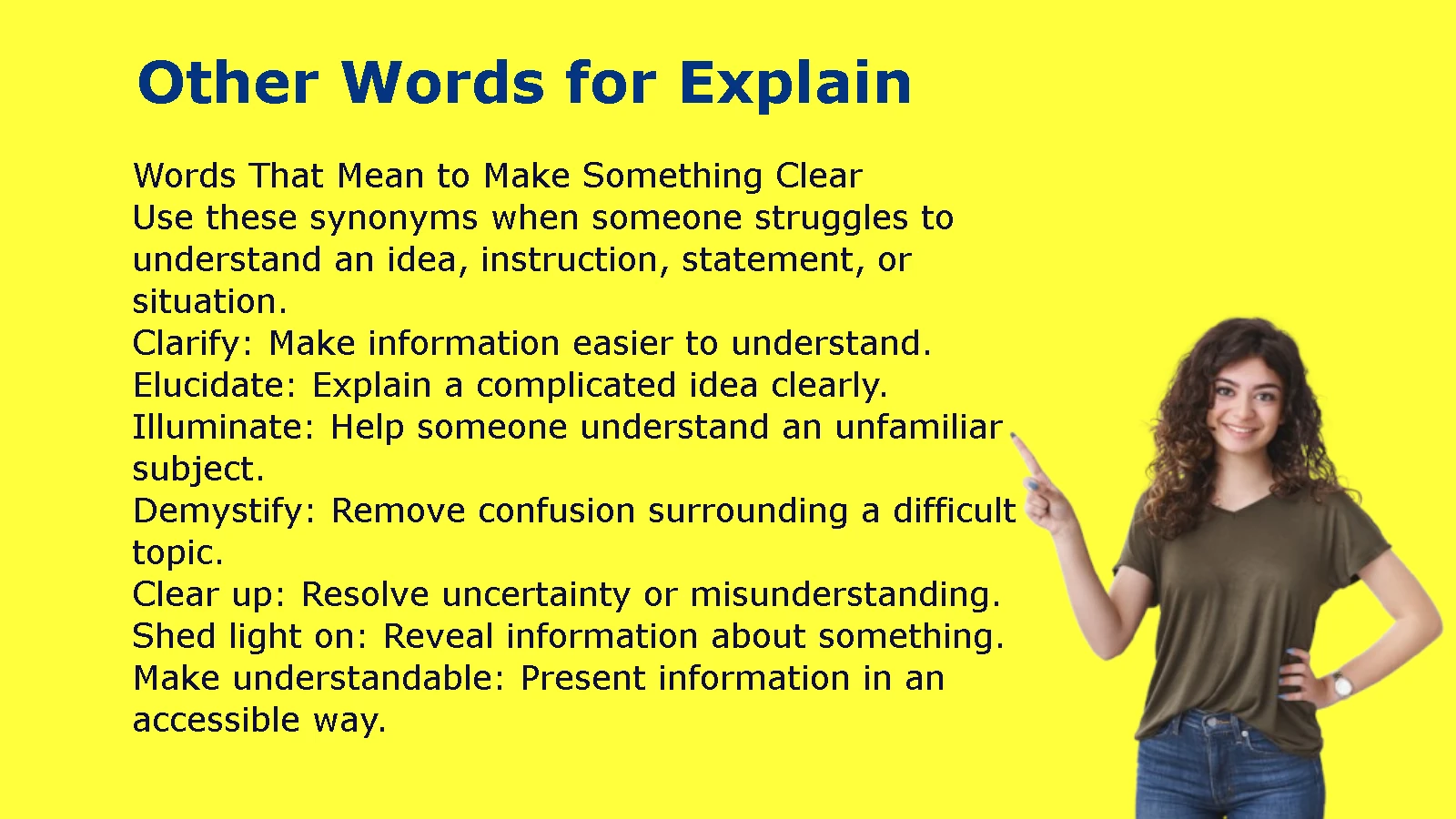
Words That Mean to Make Something Clear
Use these synonyms when someone struggles to understand an idea, instruction, statement, or situation.
- Clarify: Make information easier to understand.
- Elucidate: Explain a complicated idea clearly.
- Illuminate: Help someone understand an unfamiliar subject.
- Demystify: Remove confusion surrounding a difficult topic.
- Clear up: Resolve uncertainty or misunderstanding.
- Shed light on: Reveal information about something.
- Make understandable: Present information in an accessible way.
Examples:
- The manager clarified the new workplace policy.
- The professor elucidated the main principles of the theory.
- This guide demystifies the process of filing taxes.
- Her research sheds light on the causes of the problem.
- The additional instructions cleared up the confusion.
Best choice: Use clarify for everyday communication and elucidate for complex or academic subjects.
Words That Mean to Describe Something
These alternatives work when you want to communicate the appearance, characteristics, qualities, or details of a person, object, event, or situation.
- Describe: Provide details about something.
- Depict: Represent something through words or images.
- Portray: Present someone or something in a particular way.
- Characterize: Identify defining qualities.
- Detail: Provide specific information.
- Present: Introduce information to an audience.
Examples:
- The witness described what happened outside the building.
- The author portrayed the challenges of modern society.
- The report details the company’s financial performance.
- The documentary depicts life in a remote village.
Best choice: Use describe for general details and depict or portray when discussing representation.
Words That Mean to Give More Information
Sometimes an initial explanation does not provide enough detail. These alternatives help you introduce additional information, supporting points, or a deeper discussion.
- Elaborate: Add more information to an existing point.
- Expand on: Develop an idea further.
- Expound: Discuss a subject in detail.
- Discuss: Examine a topic through conversation or writing.
- Spell out: State something clearly and explicitly.
- Unpack: Examine the different parts of an idea.
Examples:
- Could you elaborate on your previous statement?
- The researcher expanded on the findings during the presentation.
- The speaker expounded on the importance of education.
- Let me spell out the requirements before we begin.
- The article unpacks the reasons behind the recent changes.
Best choice: Use elaborate on when someone needs additional details and unpack when you want to examine a complicated idea.
Words That Mean to Show or Demonstrate Something
Use these words when you explain an idea by providing evidence, examples, visual information, or practical demonstrations.
- Demonstrate: Show how something works or provide evidence.
- Illustrate: Explain an idea through examples.
- Exhibit: Display something for observation.
- Show: Make something visible or understandable.
- Exemplify: Provide an example that represents an idea.
- Prove: Establish something through evidence.
Examples:
- The instructor demonstrated how to operate the equipment.
- The chart illustrates the company’s annual growth.
- Her experience exemplifies the importance of preparation.
- The experiment proves that the method works under the tested conditions.
Best choice: Use demonstrate for practical instructions and illustrate when supporting an explanation with examples.
Words That Mean to Give Reasons
Some sentences use explain to communicate why something happened or why someone made a particular decision. These alternatives focus more directly on causes, evidence, and justification.
- Account for: Provide a reason or explanation for something.
- Justify: Give reasons that support a decision or action.
- Rationalize: Offer reasons to make an action seem reasonable.
- Defend: Support a position against criticism.
- Attribute: Identify the source or cause.
- Establish: Provide evidence supporting a conclusion.
Examples:
- The director accounted for the delay in the project.
- The employee justified the decision with supporting evidence.
- The report attributes the increase to higher production costs.
- The lawyer defended the client’s actions.
- Researchers established a connection between the two variables.
Important distinction: Justify does not always mean the same thing as explain. Explaining describes why something happened, while justifying attempts to show why an action or decision was reasonable.
Words That Mean to Simplify a Complicated Idea
These alternatives work especially well when communicating with beginners, students, customers, or people unfamiliar with a technical subject.
- Break down: Divide information into smaller parts.
- Simplify: Remove unnecessary complexity.
- Unpack: Examine an idea step by step.
- Make sense of: Help someone understand information.
- Spell out: Explain something explicitly.
- Walk through: Guide someone through a process.
- Put into plain English: Replace complicated language with simple wording.
Examples:
- The teacher broke down the mathematical problem into smaller steps.
- This tutorial simplifies the process of building a website.
- Let me walk you through the registration process.
- The consultant put the technical requirements into plain English.
Best choice: Use break down when explaining complicated information and walk through when guiding someone through a sequence of actions.
Formal Synonyms for Explain
Formal synonyms for explain help you communicate ideas professionally in academic papers, business reports, presentations, and official correspondence. Words such as elucidate, explicate, clarify, demonstrate, and elaborate provide different levels of detail and formality.
Academic Alternatives to Explain
Academic writing often requires precise language. Instead of repeating explain throughout an essay or research paper, choose a word that describes the exact purpose of your discussion.
| Alternative | Meaning | Example |
| Elucidate | Make a complex subject clear | The study elucidates the relationship between sleep and memory. |
| Explicate | Explain something in detail | The researcher explicates the central argument. |
| Expound | Develop an idea through detailed discussion | The author expounds on the theory. |
| Interpret | Explain the meaning of information | The researchers interpret the findings. |
| Articulate | Express an idea clearly | The paper articulates the main research question. |
| Illustrate | Support an idea with examples | The results illustrate the proposed concept. |
| Examine | Investigate a subject | The study examines the effects of stress. |
Academic writers should avoid choosing complicated vocabulary simply to sound intelligent. A precise, familiar word often communicates more effectively than an unnecessarily technical alternative.
Professional Alternatives to Explain
Business communication requires clarity and efficiency. Choose words that help colleagues, customers, and managers understand information without making messages unnecessarily complicated.
Consider these alternatives:
- Clarify: Clarify the project requirements before starting.
- Outline: Outline the proposed strategy in the meeting.
- Present: Present the findings to the management team.
- Demonstrate: Demonstrate the new software features.
- Detail: Detail the changes in the updated contract.
- Account for: Account for the unexpected increase in expenses.
- Communicate: Communicate the revised expectations to employees.
For example, instead of writing:
“Could you explain the changes to the project?”
You could write:
“Could you outline the recent changes to the project?”
The second sentence sounds more specific because it asks the recipient to identify the main changes rather than provide an unrestricted explanation.
Formal Example Sentences
Here are additional examples showing how to replace explain in professional and academic writing.
| Original sentence | Improved alternative |
| The professor explained the concept. | The professor elucidated the concept. |
| The report explains the results. | The report interprets the results. |
| The manager explained the new policy. | The manager outlined the new policy. |
| The researcher explained the findings. | The researcher detailed the findings. |
| The presentation explains the process. | The presentation demonstrates the process. |
| The author explained the argument. | The author articulated the argument. |
| The document explains the requirements. | The document specifies the requirements. |
| The consultant explained the issue. | The consultant clarified the issue. |
| The study explains the relationship. | The study examines the relationship. |
| The lawyer explained the decision. | The lawyer justified the decision. |
Informal and Casual Ways to Say Explain
In everyday conversations, simple expressions often sound more natural than formal vocabulary. Words and phrases such as tell, show, go over, talk through, and break down work well when speaking with friends, classmates, colleagues, or family members.
Everyday Alternatives to Explain
Here are common informal alternatives:
- Tell: Give someone information.
- Show: Help someone understand through demonstration.
- Go over: Review information together.
- Talk through: Discuss something step by step.
- Break down: Make complicated information easier.
- Fill someone in: Provide missing information.
- Walk someone through: Guide someone through a process.
- Clear up: Resolve confusion.
- Lay out: Present information clearly.
- Fill in the details: Provide additional information.
Examples:
- Can you tell me what happened?
- Let me show you how this application works.
- We can go over the instructions together.
- I’ll talk you through the entire process.
- Can you fill me in on the latest developments?
- Let me break down the problem for you.
Conversational Phrases Instead of Explain
You can also replace explain with complete expressions. These phrases help your communication sound natural and friendly.
| Phrase | Example |
| Let me put it simply. | Let me put it simply: we need more time. |
| Here’s what I mean. | Here’s what I mean: the deadline has changed. |
| Let me walk you through it. | Let me walk you through the registration process. |
| Let me break it down. | Let me break it down into three simple steps. |
| Here’s how it works. | Here’s how it works: you submit the form first. |
| Let me make this clear. | Let me make this clear: everyone must participate. |
| I’ll fill you in. | I’ll fill you in on what happened yesterday. |
| Let me show you. | Let me show you where to find the settings. |
Examples of Informal Explain Synonyms in Conversations
Conversation 1: Asking for clarification
Person A: I don’t understand the new assignment.
Person B: Let me break it down for you.
Conversation 2: Giving instructions
Person A: How do I submit this application?
Person B: I’ll walk you through the steps.
Conversation 3: Sharing information
Person A: What happened during the meeting?
Person B: I’ll fill you in when we have a minute.
These examples show why conversational phrases often work better than formal synonyms. They communicate the same general purpose without making an ordinary discussion sound like an academic presentation.
Other Words for Explain in Different Contexts
The best synonym depends on what you’re writing and what you want the reader to understand. An essay may require an academic alternative, while a business email needs a polite and direct expression. A technical tutorial may benefit from words that emphasize step-by-step instructions.
Another Word for Explain in an Essay
When writing an essay, choose alternatives that support your argument and communicate information accurately.
Useful options include:
- Clarify: Make a complicated point easier to understand.
- Illustrate: Support an argument with examples.
- Interpret: Explain the meaning of evidence or information.
- Demonstrate: Show that a claim has support.
- Elaborate: Add further information.
- Examine: Investigate a subject carefully.
- Discuss: Explore different aspects of an issue.
- Establish: Present evidence supporting a conclusion.
Examples:
- The author illustrates the importance of environmental protection through real-world examples.
- The second paragraph examines the causes of economic inequality.
- The research demonstrates the relationship between exercise and productivity.
- The conclusion clarifies the central argument.
Writing tip: Avoid replacing every occurrence of explain with a different synonym. Repetition is sometimes better than using an inaccurate word. Choose alternatives only when they preserve the intended meaning.
Another Word for Explain in Academic Writing
Academic writing often deals with theories, research findings, arguments, and technical concepts.
Consider these alternatives:
| Word | Academic application |
| Elucidate | Making difficult theories understandable |
| Explicate | Analyzing and explaining complex texts |
| Interpret | Explaining research findings |
| Articulate | Expressing a central argument |
| Expound | Developing a theoretical discussion |
| Illustrate | Supporting a point with examples |
| Analyze | Examining evidence and relationships |
| Contextualize | Explaining information within a wider setting |
Example:
Original: “The researcher explains the relationship between economic growth and employment.”
Alternative: “The researcher analyzes the relationship between economic growth and employment.”
The alternative changes the emphasis slightly. Analyzes suggests a deeper investigation rather than simply presenting an explanation.
Another Word for Explain in Business Communication
Business writing benefits from direct, specific language. Choose alternatives that communicate responsibilities, expectations, decisions, and project details.
Useful options include:
- Outline
- Clarify
- Present
- Detail
- Demonstrate
- Communicate
- Specify
- Account for
Examples:
- Please outline the main objectives of the project.
- The supervisor clarified the updated responsibilities.
- The consultant presented the proposed solution.
- The finance department detailed the additional expenses.
- The trainer demonstrated the new software.
Practical example: Imagine you’re sending an email to a colleague who needs more information about a deadline. Instead of writing, “Can you explain the deadline?” you could write, “Could you clarify the submission deadline and any related requirements?”
The revised sentence identifies exactly what information you need.
Another Word for Explain a Process
When describing a process, choose alternatives that emphasize actions, stages, and instructions.
Useful synonyms include:
- Demonstrate
- Walk through
- Guide
- Show
- Break down
- Outline
- Detail
- Describe
Examples:
- The instructor demonstrates how to install the software.
- The manual outlines the installation procedure.
- The technician walks users through the setup process.
- This guide breaks down the application process into simple steps.
For longer processes, walk through and break down are especially useful because they suggest a sequence that readers can follow.
Another Word for Explain Why
When your sentence focuses on reasons or causes, choose a synonym that communicates the relationship between an action and its explanation.
Useful alternatives include:
- Account for
- Justify
- Give reasons for
- Establish the cause of
- Attribute to
- Identify the reason
- Provide evidence for
Examples:
- Can you account for the sudden increase in expenses?
- The manager justified the decision with financial evidence.
- Researchers identified the main reason for the decline.
- The report attributes the delay to supply chain problems.
Remember that justify often suggests defending a decision, while account for focuses on giving a reason or explanation.
Another Word for Explain Something Simply
When your audience includes beginners or people unfamiliar with a subject, avoid technical language where possible.
Useful alternatives include:
- Simplify
- Break down
- Make clear
- Spell out
- Put into plain English
- Make understandable
- Walk through
- Unpack
Examples:
- Can you simplify the instructions?
- Let me break down the process.
- The teacher made the difficult concept understandable.
- Please spell out the requirements.
- The guide puts technical information into plain English.
A good explanation does not need complicated vocabulary. Its purpose is to help someone understand information with as little confusion as possible.
Another Word for Explain in an Email
Professional emails require a balance between politeness and clarity. Instead of repeatedly asking someone to explain something, use phrases that specify the information you need.
| Alternative phrase | Example |
| Could you clarify? | Could you clarify the updated schedule? |
| Could you provide more details? | Could you provide more details about the proposal? |
| Could you walk me through this? | Could you walk me through the approval process? |
| Could you help me understand? | Could you help me understand this requirement? |
| Could you elaborate on this point? | Could you elaborate on the final section? |
| Could you outline the process? | Could you outline the next steps? |
| Could you shed some light on this? | Could you shed some light on the recent changes? |
Professional email example:
Instead of:
“Can you explain why the report was delayed?”
Write:
“Could you clarify the reasons behind the report’s delay and let me know when we can expect the completed version?”
This version sounds polite while clearly identifying the information you need.
Synonyms for Explaining
The word explaining is the present participle or gerund form of the verb explain. Its alternatives depend on how you use it in a sentence. Common synonyms include clarifying, describing, demonstrating, illustrating, elaborating, interpreting, and detailing.
Common Synonyms for Explaining
| Synonym | Meaning | Example |
| Clarifying | Making something understandable | She is clarifying the instructions. |
| Describing | Providing details | He is describing the situation. |
| Demonstrating | Showing how something works | The instructor is demonstrating the technique. |
| Illustrating | Explaining through examples | The teacher is illustrating the concept. |
| Elaborating | Adding more information | The speaker is elaborating on the proposal. |
| Interpreting | Explaining meaning | The analyst is interpreting the results. |
| Detailing | Providing specific information | The report is detailing the findings. |
| Expounding | Discussing something in depth | The professor is expounding on the theory. |
| Breaking down | Simplifying information | She is breaking down the problem. |
| Walking through | Guiding someone step by step | He is walking the team through the process. |
Example Sentences Using Explaining Synonyms
Here are examples showing how these words work in natural sentences.
- The teacher is clarifying the instructions for the students.
- The guide is describing the different stages of the process.
- The technician is demonstrating how to use the equipment.
- The speaker is illustrating the argument with practical examples.
- The manager is elaborating on the company’s new strategy.
- The researcher is interpreting the experimental results.
- The consultant is detailing the proposed changes.
- The professor is expounding on the historical background.
- The instructor is breaking down the complex formula.
- The supervisor is walking the employees through the updated procedure.
Explaining vs. Clarifying vs. Describing
These three words are closely related, but they don’t communicate exactly the same thing.
| Word | Main purpose | Example |
| Explaining | Helping someone understand why or how something happens | She is explaining the new policy. |
| Clarifying | Removing confusion or uncertainty | She is clarifying the new policy. |
| Describing | Providing details about something | She is describing the new policy. |
Consider a workplace policy as an example.
- Explaining: The manager discusses why the company introduced the policy.
- Clarifying: The manager answers questions about confusing requirements.
- Describing: The manager lists the policy’s main rules and conditions.
Understanding these differences helps you select the most accurate synonym instead of using similar words interchangeably.
Synonyms for Explains
The best synonyms for explains include clarifies, describes, illustrates, demonstrates, defines, interprets, details, and accounts for. Because explains is the third-person singular present-tense form of explain, its replacement should generally maintain the same grammatical form and agree with the subject.
Common Words That Can Replace Explains
Here are useful alternatives with examples.
| Synonym | Example sentence |
| Clarifies | The teacher clarifies the difficult concept. |
| Describes | The author describes the historical events. |
| Illustrates | The diagram illustrates the process. |
| Demonstrates | The experiment demonstrates the theory. |
| Defines | The dictionary defines the term. |
| Interprets | The analyst interprets the results. |
| Details | The report details the proposed changes. |
| Elaborates on | The professor elaborates on the subject. |
| Accounts for | The report accounts for the financial differences. |
| Shows | The example shows how the system works. |
| Outlines | The document outlines the main requirements. |
| Specifies | The contract specifies the conditions. |
Example Sentences Using Explains Synonyms
Consider how these alternatives replace explains in different situations.
Original: The teacher explains the concept.
Alternatives:
- The teacher clarifies the concept.
- The teacher illustrates the concept with examples.
- The teacher describes the concept in detail.
- The teacher demonstrates the concept through an experiment.
Original: The report explains the results.
Alternatives:
- The report interprets the results.
- The report details the findings.
- The report accounts for the differences.
- The report outlines the major findings.
Original: The diagram explains the process.
Alternatives:
- The diagram illustrates the process.
- The diagram shows how the process works.
- The diagram outlines the different stages.
How to Choose the Correct Synonym for Explains
Choosing another word for explains requires more than finding a similar dictionary definition. You must consider the subject, tense, sentence structure, and intended meaning.
For example:
- “The teacher explains the lesson” can become “The teacher clarifies the lesson.”
- “The chart explains the results” can become “The chart illustrates the results.”
- “The report explains the cause” can become “The report identifies the cause.”
Notice that the best replacement changes with the subject. A teacher might clarify an idea, a chart might illustrate information, and a report might identify a cause.
Also remember subject-verb agreement. Singular subjects generally take verbs ending in -s in the simple present tense.
Correct:
- The teacher explains the topic.
- The report clarifies the issue.
- The diagram illustrates the process.
Incorrect:
- The teacher explain the topic.
- The report clarify the issue.
- The diagram illustrate the process.
How to Choose the Right Synonym for Explain
The right synonym should communicate your intended meaning without changing the purpose of your sentence. Consider what you want the reader to understand, how much detail you plan to provide, and whether your writing requires a formal or conversational tone.
Consider the Meaning You Want to Communicate
Start by identifying the purpose of your explanation.
| Your purpose | Recommended word |
| Remove confusion | Clarify |
| Provide general details | Describe |
| Show how something works | Demonstrate |
| Give examples | Illustrate |
| Add more information | Elaborate |
| Explain a difficult meaning | Interpret |
| Present the main points | Outline |
| Give reasons for an action | Justify |
| Make something simpler | Simplify |
| Examine a complicated idea | Unpack |
For example, if you’re explaining how a machine works, demonstrate may be more suitable than describe. However, if you’re discussing its appearance, describe is more accurate.
Match the Word to Your Audience
Your audience affects which words sound natural and appropriate.
For business professionals: Use outline, detail, present, and clarify.
For everyday conversations: Use tell, show, go over, and talk through.
A technical word can communicate precision in an academic paper but create unnecessary difficulty in a casual conversation.
Consider Formality and Tone
Different synonyms create different impressions.
Compare these examples:
- Casual: “Let me break down the problem.”
- Neutral: “Let me clarify the problem.”
- Formal: “Let me elucidate the problem.”
All three communicate an intention to make something understandable, but their tone and level of formality differ.
Choose vocabulary that matches the situation rather than automatically selecting the longest or most sophisticated word.
Avoid Using Synonyms That Change Your Meaning
Some synonyms overlap in meaning but aren’t interchangeable.
Here are common mistakes:
- Using justify instead of explain: Justify suggests defending an action or decision.
- Using describe instead of demonstrate: Describe provides details, while demonstrate shows how something works.
- Using interpret instead of clarify: Interpret communicates meaning, while clarify removes confusion.
- Using elaborate without the correct preposition: The natural construction is usually “elaborate on a subject.”
- Using prove instead of illustrate: Prove requires sufficient evidence, while illustrate may simply provide an example.
A strong vocabulary improves your writing only when you use each word accurately.
Common Mistakes When Using Explain and Its Synonyms
Although many synonyms share a similar meaning, they follow different grammatical patterns. Understanding these differences prevents awkward sentences and helps you communicate more accurately.
Explain Me vs. Explain to Me
One common grammatical mistake involves using explain me instead of explain to me.
The verb explain normally takes the information being explained as its direct object. The person receiving the explanation usually follows the preposition to.
Incorrect: Please explain me the situation.
Correct: Please explain the situation to me.
You can also write:
- Please clarify the situation for me.
- Could you describe the problem to me?
- Can you explain how the system works?
Remember this structure:
Explain + something + to + someone.
Examples:
- Explain the rules to the students.
- Explain the decision to your manager.
- Explain the process to the customer.
Explain vs. Clarify
Explain means to make something understandable by providing information about its meaning, cause, or operation.
Clarify means to remove confusion or make an existing statement more precise.
Examples:
- The teacher explained how photosynthesis works.
- The teacher clarified the confusing part of the lesson.
Use explain when introducing or developing information. Choose clarify when someone already has some information but needs a clearer understanding.
Explain vs. Describe
Explain focuses on meaning, reasons, or how something works. Describe focuses on details, characteristics, and observations.
Examples:
- The scientist explained why the chemical reaction occurred.
- The scientist described the appearance of the chemical reaction.
The first sentence focuses on the cause. The second focuses on what someone could observe.
Explain vs. Justify
Explain and justify often appear in academic, legal, and professional writing.
However, their meanings differ:
- Explain: Provide information about why or how something happened.
- Justify: Provide reasons or evidence showing why an action or decision was reasonable.
Examples:
- The employee explained why the meeting started late.
- The employee justified the decision to postpone the meeting.
The first sentence communicates a reason. The second defends a decision.
Using Elaborate and Expound Correctly
The verbs elaborate and expound both refer to developing an idea through additional information.
However, they follow slightly different patterns.
Elaborate on is the common construction in everyday and professional English.
Example: Could you elaborate on your proposal?
Expound on is more formal and often appears in academic or intellectual discussions.
Example: The professor expounded on the philosophical argument.
Avoid writing “elaborate me the topic.” Instead, write “elaborate on the topic” or “explain the topic to me.”
Real-World Examples: Choosing the Best Explain Synonym
Understanding synonyms becomes easier when you see how writers and professionals use them in practical situations.
Consider these three scenarios.
Case Study: A Teacher Explaining a Difficult Concept
A teacher needs to introduce a complicated mathematical formula to students who have limited knowledge of the subject.
A basic sentence might read:
“The teacher explained the formula.”
However, different alternatives can communicate more specific teaching methods:
- The teacher simplified the formula for beginners.
- The teacher demonstrated how to solve the equation.
- The teacher illustrated the concept with practical examples.
- The teacher broke down the formula into smaller steps.
Each alternative describes a different teaching action. The best choice depends on what the teacher actually did.
Case Study: A Business Manager Communicating a Policy
A company manager needs to inform employees about a revised attendance policy.
Instead of repeatedly writing “explain,” the manager can use more precise alternatives:
- The manager outlined the revised attendance requirements.
- The manager clarified the rules about late arrivals.
- The manager detailed the changes to the reporting procedure.
- The manager addressed employee questions during the meeting.
These words make the communication more specific and professional.
Case Study: A Student Writing an Academic Essay
A student is discussing research findings and needs to explain how the results support a central argument.
Possible alternatives include:
- The research demonstrates a relationship between the variables.
- The evidence illustrates the main argument.
- The findings support the proposed theory.
- The analysis examines the factors behind the results.
- The discussion interprets the collected data.
These alternatives help avoid unnecessary repetition while maintaining academic accuracy.
Frequently Asked Questions About Explain Synonyms
What Is the Most Common Synonym for Explain?
Common synonyms for explain include clarify, describe, illustrate, demonstrate, and interpret. Clarify works when you want to remove confusion, while describe provides details about something. Use illustrate when examples help communicate an idea and demonstrate when you want to show how something works.
What Is a More Professional Word for Explain?
Professional alternatives include clarify, outline, demonstrate, detail, present, and elaborate. These words work well in business emails, reports, presentations, and workplace conversations. For example, instead of writing “The manager explains the requirements,” you could write “The manager outlines the requirements.”
What Is a More Formal Word for Explain?
Elucidate, explicate, and expound are formal alternatives to explain. Elucidate means to make something clear, while explicate involves explaining something carefully and thoroughly. Expound means to develop an idea through detailed discussion. These words are especially useful in academic and formal writing.
What Is Another Word for Explains?
Another word for explains can be clarifies, describes, illustrates, demonstrates, interprets, or details. The correct choice depends on the subject and context. For example, a teacher clarifies a concept, a diagram illustrates a process, and a report details its findings.
What Is a Synonym for Explaining?
Synonyms for explaining include clarifying, describing, demonstrating, illustrating, elaborating, interpreting, and detailing. These are present participle forms that can replace explaining when the sentence requires the same grammatical structure.
How Can I Say Explain in Simple English?
You can replace explain with tell, show, make clear, break down, go over, or walk through. These expressions work well in everyday conversations and beginner-friendly writing. For example, “Let me explain the process” can become “Let me walk you through the process.”
Conclusion: Choose the Best Alternative to Explain
Finding the best other words for explain depends on the message you want to communicate. Clarify works when you need to remove confusion, describe provides details, demonstrate shows how something works, and elaborate adds more information. Other useful choices include illustrate, interpret, simplify, outline, elucidate, and expound.
For professional writing, choose precise alternatives such as clarify, outline, and detail. Academic writers can use elucidate, interpret, and explicate when those words accurately express their ideas. In everyday conversations, simple expressions such as break down, show, and walk through often sound more natural.
The goal isn’t to replace every occurrence of explain with a different word. Instead, select vocabulary that makes your sentences clearer, more accurate, and easier to understand.