Looking for other ways to say “please see below”? Depending on your situation, you can say “please review the information below,” “see the details below,” “please refer to the information below,” “details are provided below,” or “please find the information below.” Each option has a slightly different tone and works better in certain types of emails or documents.
Here are 27 natural alternatives you can use:
| Alternative | Best For | Tone |
| Please review the information below | General work emails | Professional |
| Please see the details below | Sharing specific details | Professional |
| Please refer to the information below | Instructions or reference material | Formal |
| See the details below | Short workplace messages | Neutral |
| Please find the information below | Business correspondence | Formal |
| The details are provided below | Introducing information | Professional |
| Please review the details below | Documents and updates | Professional |
| More information is provided below | Additional information | Neutral |
| Please take a look at the information below | Friendly workplace emails | Friendly |
| The information you need is below | Direct communication | Neutral |
| Please read the information below | Important instructions | Direct |
| Please refer to the details below | Formal communication | Formal |
| You’ll find the details below | Emails and messages | Friendly |
| The relevant information is below | Specific information | Professional |
| Please review the following information | Formal emails and documents | Formal |
| Please see the information that follows | Formal writing | Formal |
| Further details are included below | Reports and business emails | Professional |
| Additional details are listed below | Lists and instructions | Professional |
| The following details may be helpful | Helpful information | Friendly |
| For more details, see below | Concise emails | Neutral |
| Please check the details below | Quick workplace communication | Neutral |
| The requested information is below | Responding to a request | Professional |
| I’ve included the details below | Personal and direct emails | Friendly |
| I’ve provided the information below | Sharing requested information | Professional |
| You can find the details below | General communication | Neutral |
| Please review the following | Formal documents | Formal |
| The information is outlined below | Summaries and explanations | Professional |
What Does “Please See Below” Mean?
“Please see below” is a common phrase used in emails and other written communication to direct someone to information that appears later in the message.
For example:
Please see below for the updated meeting schedule.
The phrase tells the reader that the information they need is further down in the email.
It can introduce a list, explanation, attachment details, instructions, an answer to a question, or other relevant information.
Although “please see below” is perfectly understandable, it can become repetitive if you use it in every email. Choosing a more specific alternative can make your message sound clearer and more natural.
Best Alternatives to “Please See Below”
1. Please Review the Information Below
Meaning: This asks the reader to look at and consider the information that follows.
Best for: Workplace emails, updates, reports, and instructions.
Tone: Professional.
Example:
“Please review the information below before our meeting tomorrow.”
This is one of the most versatile replacements for “please see below.”
2. Please See the Details Below
Meaning: This directs the reader to specific details included later in the message.
Best for: Schedules, project information, pricing, plans, and instructions.
Tone: Professional.
Example:
“Please see the details below for the upcoming training session.”
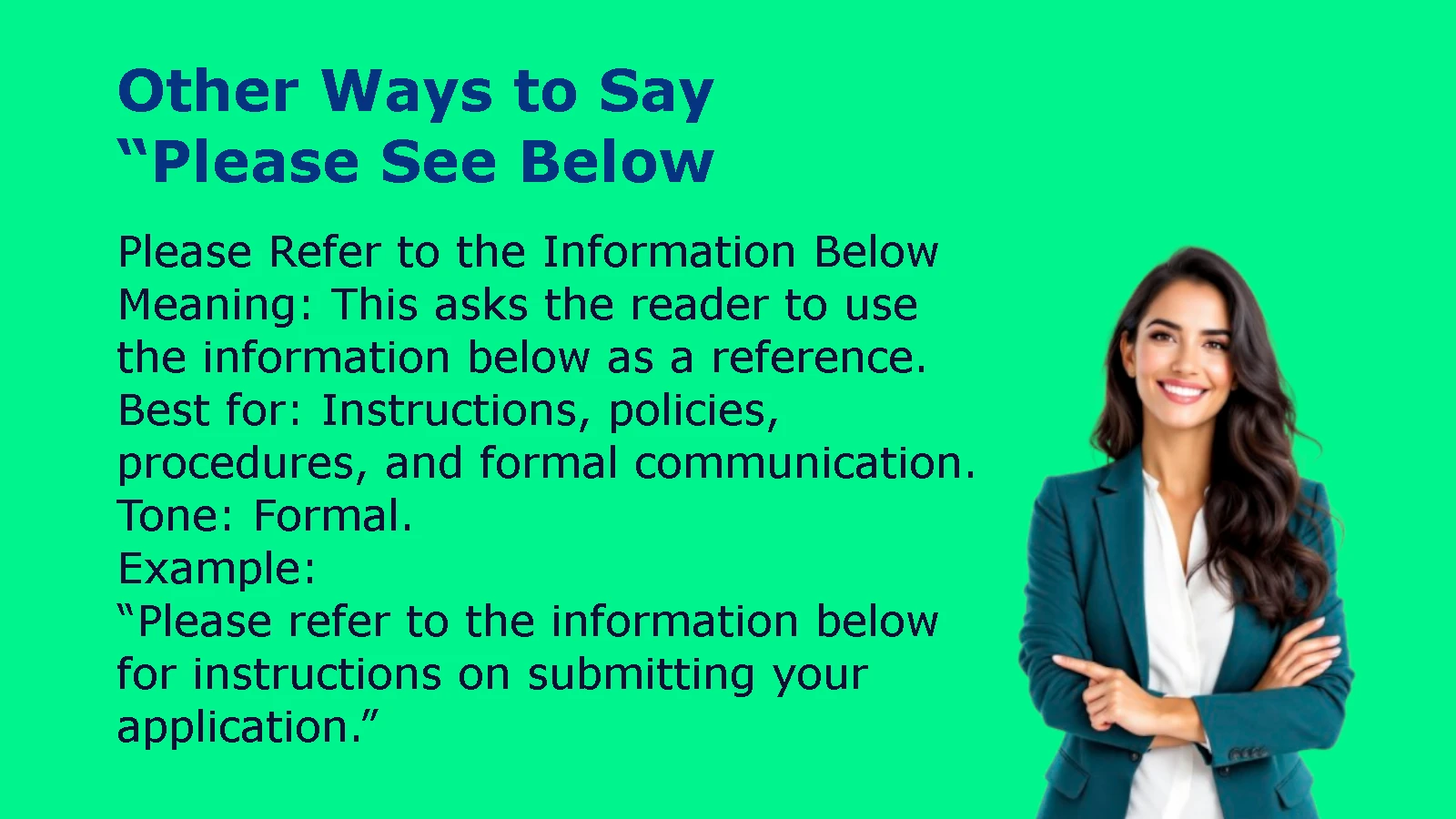
3. Please Refer to the Information Below
Meaning: This asks the reader to use the information below as a reference.
Best for: Instructions, policies, procedures, and formal communication.
Tone: Formal.
Example:
“Please refer to the information below for instructions on submitting your application.”
4. See the Details Below
Meaning: A shorter way to tell someone that relevant details appear later in the message.
Best for: Quick workplace emails and messages.
Tone: Neutral.
Example:
“See the details below for the revised project timeline.”
5. Please Find the Information Below
Meaning: This introduces information that you have included in the message.
Best for: Business emails and professional correspondence.
Tone: Formal.
Example:
“Please find the information below regarding your request.”
It sounds formal, although “please review the information below” may feel more natural when you actually want the recipient to read or evaluate it.
6. The Details Are Provided Below
Meaning: This simply tells the reader that the relevant details appear later.
Best for: Reports, instructions, and professional emails.
Tone: Professional.
Example:
“The details are provided below for your reference.”
7. Please Review the Details Below
Meaning: This asks the reader to examine the specific details that follow.
Best for: Work updates, project information, and documents.
Tone: Professional.
Example:
“Please review the details below and let me know if anything needs to be changed.”
8. More Information Is Provided Below
Meaning: This tells the reader that additional information follows.
Best for: Explanations, announcements, and longer emails.
Tone: Neutral.
Example:
“More information is provided below about the changes to the schedule.”
9. Please Take a Look at the Information Below
Meaning: A friendly way to ask someone to read the information that follows.
Best for: Coworkers, familiar clients, and informal professional communication.
Tone: Friendly.
Example:
“Please take a look at the information below before you make your decision.”
10. The Information You Need Is Below
Meaning: This directly tells the reader that the requested information appears later in the message.
Best for: Answering questions or fulfilling requests.
Tone: Neutral.
Example:
“The information you need is below, including the updated contact details.”
11. Please Read the Information Below
Meaning: A direct request for the recipient to read the information that follows.
Best for: Important instructions, notices, and workplace announcements.
Tone: Direct.
Example:
“Please read the information below carefully before completing the form.”
12. Please Refer to the Details Below
Meaning: This tells the reader to consult the details that follow.
Best for: Professional and formal communication.
Tone: Formal.
Example:
“Please refer to the details below for the revised payment schedule.”
13. You’ll Find the Details Below
Meaning: A natural way to tell someone where the information is located.
Best for: Emails, customer communication, and workplace messages.
Tone: Friendly.
Example:
“You’ll find the details below, along with the documents you requested.”
14. The Relevant Information Is Below
Meaning: This points the reader toward information that directly relates to the topic.
Best for: Business emails, reports, and responses to questions.
Tone: Professional.
Example:
“The relevant information is below for your review.”
15. Please Review the Following Information
Meaning: This introduces information that the reader should examine.
Best for: Formal emails, reports, and official communication.
Tone: Formal.
Example:
“Please review the following information before submitting your request.”
This option is especially useful when you don’t literally want to refer to the bottom of an email.
16. Please See the Information That Follows
Meaning: This directs the reader to information appearing after the current sentence.
Best for: Formal documents and structured correspondence.
Tone: Formal.
Example:
“Please see the information that follows for a summary of the proposed changes.”
17. Further Details Are Included Below
Meaning: This tells the reader that additional details appear later.
Best for: Business updates, reports, and longer emails.
Tone: Professional.
Example:
“Further details are included below regarding the revised schedule.”
18. Additional Details Are Listed Below
Meaning: This indicates that more information appears in a list below.
Best for: Instructions, schedules, requirements, and bullet points.
Tone: Professional.
Example:
“Additional details are listed below for each training session.”
19. The Following Details May Be Helpful
Meaning: A softer way to introduce useful information.
Best for: Customer service, workplace communication, and helpful explanations.
Tone: Friendly.
Example:
“The following details may be helpful as you prepare for the meeting.”
20. For More Details, See Below
Meaning: This directs readers to additional information later in the message.
Best for: Short emails and concise communication.
Tone: Neutral.
Example:
“For more details, see below.”
21. Please Check the Details Below
Meaning: This asks the reader to look over the information that follows.
Best for: Quick workplace messages and routine communication.
Tone: Neutral.
Example:
“Please check the details below and confirm that everything is correct.”
22. The Requested Information Is Below
Meaning: This tells someone that you have included the information they asked for.
Best for: Responding to requests from clients, coworkers, or managers.
Tone: Professional.
Example:
“The requested information is below for your review.”
23. I’ve Included the Details Below
Meaning: A direct and personal way to explain that you’ve added relevant details to the message.
Best for: Emails and one to one workplace communication.
Tone: Friendly.
Example:
“I’ve included the details below so you can review the proposed schedule.”
24. I’ve Provided the Information Below
Meaning: This tells the reader that you have supplied the requested or relevant information.
Best for: Business communication and responses to questions.
Tone: Professional.
Example:
“I’ve provided the information below to help clarify the next steps.”
25. You Can Find the Details Below
Meaning: This tells the reader where to locate the information.
Best for: General emails and everyday professional communication.
Tone: Neutral.
Example:
“You can find the details below, including the dates and meeting location.”
26. Please Review the Following
Meaning: A concise request to examine whatever information, list, or material comes next.
Best for: Formal documents, instructions, and professional emails.
Tone: Formal.
Example:
“Please review the following and let me know if you have any questions.”
27. The Information Is Outlined Below
Meaning: This indicates that the main points or details are explained below.
Best for: Reports, proposals, plans, and detailed emails.
Tone: Professional.
Example:
“The information is outlined below for your reference.”
Professional Alternatives to “Please See Below”
When writing at work, the best alternative depends on what you’re asking the reader to do.
- “Please review the information below.”
- “Please review the details below.”
- “Please review the following information.”
If you’re simply pointing them toward information, use:
- “Please see the details below.”
- “You’ll find the details below.”
- “The relevant information is below.”
you’re answering a request, use:
- “The requested information is below.”
- “I’ve provided the information below.”
- “I’ve included the details below.”
the information is part of a formal document, consider:
- “Please refer to the information below.”
- “Please refer to the details below.”
- “The information is outlined below.”
The most natural choice is often the simplest one.
Formal Ways to Say “Please See Below”
For formal correspondence, avoid making the sentence unnecessarily complicated. Clear language usually works best.
Good options include:
- Please refer to the information below.
- Please refer to the details below.
- Please review the following information.
- Please see the information that follows.
- Further details are included below.
- The information is outlined below.
- Please review the following.
For example:
“Please refer to the information below for details regarding the revised agreement.”
This is appropriate for a formal business message because it clearly tells the recipient where to look and what the information concerns.
Casual Ways to Say “Please See Below”
If you’re writing to a coworker you know well, a friend, or someone in an informal setting, you can use simpler wording.
Natural options include:
- See the details below.
- You’ll find the details below.
- You can find the information below.
- I’ve included the details below.
- Take a look below.
- For more details, see below.
For example:
“I’ve included the details below. Let me know what you think.”
This feels more conversational than a formal phrase such as “Please refer to the information below.”
What to Say Instead of “Please See Below” in an Email
In email, it’s often better to tell the recipient what they should look at rather than simply saying “please see below.”
Compare:
“Please see below.”
with:
“Please review the updated schedule below.”
The second version is more useful because the reader immediately knows what they’re looking for.
Here are several complete alternatives:
5instructions:
“Please refer to the instructions below.”
For a client:
“Please review the project details below and let me know if you have any questions.”
How to Choose the Right Alternative
The best phrase depends on your purpose, not simply how formal you want to sound.
| Phrase | Tone | Best For | Example |
| Please review the information below | Professional | General business emails | “Please review the information below.” |
| Please see the details below | Professional | Specific details | “Please see the details below.” |
| Please refer to the information below | Formal | Instructions and references | “Please refer to the information below.” |
| See the details below | Neutral | Short emails | “See the details below.” |
| Please find the information below | Formal | Business correspondence | “Please find the information below.” |
| I’ve included the details below | Friendly | Direct email communication | “I’ve included the details below.” |
| The requested information is below | Professional | Answering a request | “The requested information is below.” |
| Further details are included below | Professional | Reports and updates | “Further details are included below.” |
| You’ll find the details below | Friendly | General emails | “You’ll find the details below.” |
| Please review the following | Formal | Documents and instructions | “Please review the following.” |
| The information is outlined below | Professional | Reports and proposals | “The information is outlined below.” |
| For more details, see below | Neutral | Concise messages | “For more details, see below.” |
Common Mistakes When Using “Please See Below”
Using “Please see below” without context
Simply writing:
“Please see below.”
can force the reader to search through the email to understand what they should be looking for.
A clearer option is:
“Please see the updated pricing information below.”
Using overly formal language
You don’t always need phrases such as “Please find the information provided hereunder.” That wording can make a simple email sound unnecessarily complicated.
Plain English is usually better:
“I’ve included the information below.”
Using “below” when there is no information below
Make sure the information actually appears later in the message. If you’re referring to an attachment, link, or separate document, say so directly.
For example:
“Please review the attached report.”
is clearer than:
“Please see below.”
when the report isn’t actually below the sentence.
Repeating the same phrase
If you use “please see below” several times in your emails, vary the wording based on the purpose. You might use “please review the details below” in one message and “I’ve included the information below” in another.
Common Questions
What is another way to say “please see below”?
Natural alternatives include “please review the information below,” “please see the details below,” “please refer to the information below,” “see the details below,” and “I’ve included the details below.”
What is a professional way to say “please see below”?
“Please review the information below” is one of the safest and most versatile professional alternatives. “Please refer to the information below” works well in more formal communication.
Is “please see below” professional?
Yes. “Please see below” is common and understandable in professional emails. However, a more specific phrase can make your message clearer by telling the reader exactly what information they should review.
What can I say instead of “please see below” in an email?
You can say “Please review the details below,” “I’ve included the information below,” “You’ll find the details below,” or “Please refer to the information below.”
Is “please see below” formal or informal?
“Please see below” is generally neutral to professional. It can appear in workplace emails, business correspondence, and everyday messages.
What is a formal phrase for “please see below”?
Good formal options include “Please refer to the information below,” “Please review the following information,” and “Please see the information that follows.”
What is a polite way to say “please see below”?
“Please review the information below” is polite and professional. “You’ll find the details below” is another friendly option that sounds less formal.
Should I say “please see below” or “please see the details below”?
“Please see the details below” is usually clearer because it tells the reader what they’re expected to find. “Please see below” is shorter but less specific.
Final Thoughts
There are plenty of natural alternatives to “please see below,” but you don’t need to use a complicated phrase to sound professional.
For most workplace emails, “please review the information below,” “please see the details below,” and “I’ve included the details below” are strong choices. Use “please refer to the information below” for more formal communication, and choose a simple option such as “see the details below” for a quick message.
The most effective wording tells your reader what is below and what you want them to do with it. That small change can make your emails clearer, more direct, and easier to read.