Other ways to say to confirm include verify, double-check, validate, make sure, clarify, acknowledge, and reconfirm. The best alternative depends on what you want to communicate: checking whether information is correct, confirming an appointment, requesting a response, or formally acknowledging an agreement.
In professional emails, phrases such as “Could you please confirm?” and “I would appreciate your confirmation” sound polite and direct. In everyday conversations, “just checking,” “make sure,” and “are we still on?” often feel more natural. However, confirm vs. verify, confirm vs. affirm, and the opposite of confirm have different meanings that matter when you choose the right words.
This guide covers more than 25 alternatives to confirm, with original sentence examples, professional email templates, definitions, grammar tips, and practical comparisons to help you communicate clearly.
What Does “To Confirm” Mean?
To confirm means to establish that something is true, correct, agreed upon, or arranged. People use the word to check information, finalize plans, acknowledge decisions, and remove uncertainty. For example, you might confirm a meeting time, confirm a customer’s order, or confirm that a document contains the correct information.
The word can describe both an action and the result of checking something.
Confirm Meaning in Everyday English
In everyday English, confirm usually means checking or establishing that something is correct.
For example:
- “Please confirm your attendance.” This asks someone to state whether they will attend.
- “The receptionist confirmed my appointment.” This means the receptionist verified that the appointment was scheduled.
- “The test confirmed the diagnosis.” This means the test provided evidence supporting the diagnosis.
- “She confirmed that the package had arrived.” This means she established that the delivery was complete.
The exact meaning depends on the situation. Confirming a reservation usually means checking that the booking exists.
Key distinction: Confirmation establishes that a detail, arrangement, or statement is correct or accepted. It does not always prove that the information is true beyond doubt.
What Does “Just to Confirm” Mean?
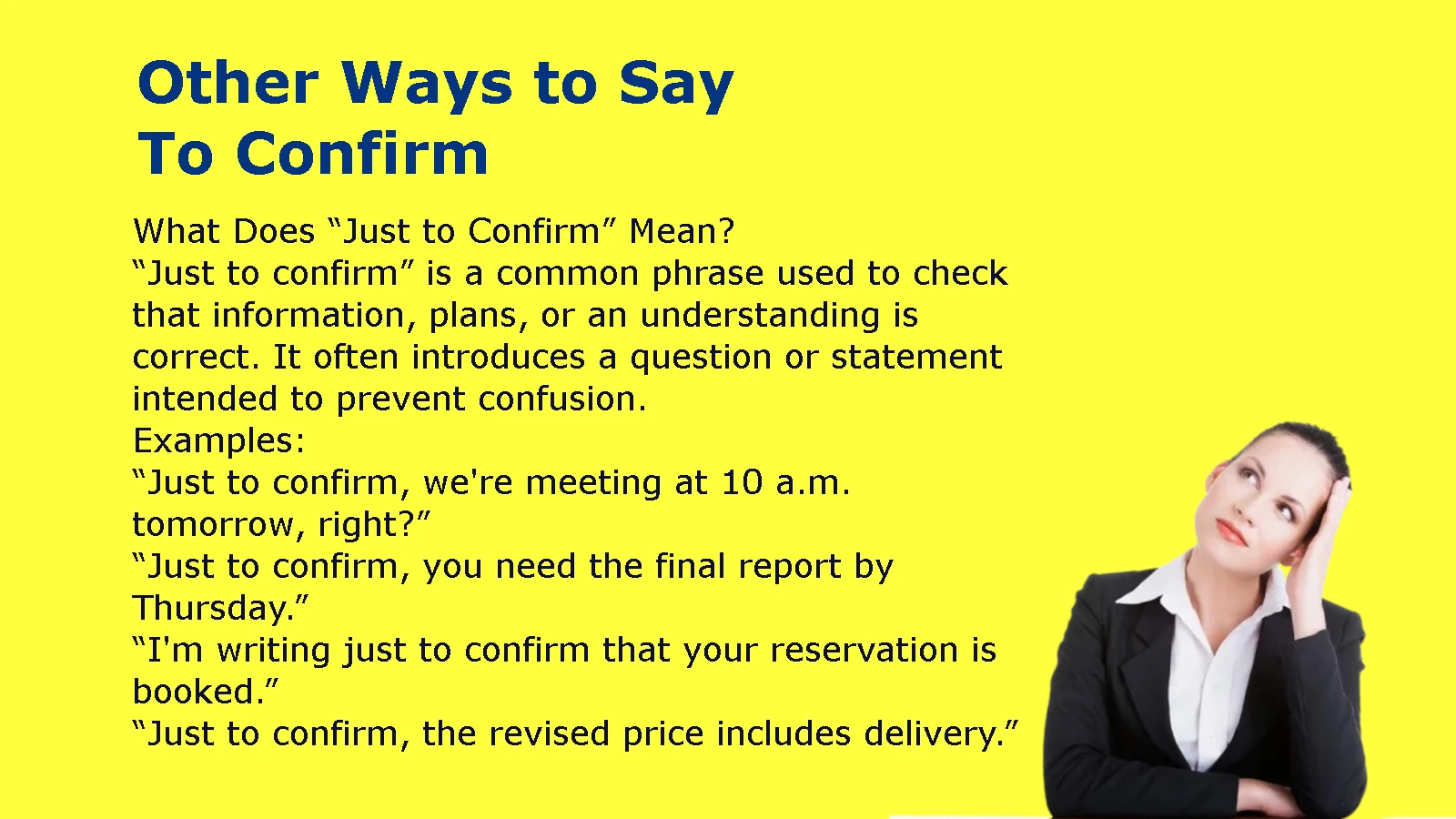
“Just to confirm” is a common phrase used to check that information, plans, or an understanding is correct. It often introduces a question or statement intended to prevent confusion.
Examples:
- “Just to confirm, we’re meeting at 10 a.m. tomorrow, right?”
- “Just to confirm, you need the final report by Thursday.”
- “I’m writing just to confirm that your reservation is booked.”
- “Just to confirm, the revised price includes delivery.”
The word just softens the request and makes it sound like a routine check rather than a challenge. However, using the phrase repeatedly can make emails sound repetitive.
You can vary it with expressions such as:
- “To make sure we’re on the same page…”
- “Could you clarify one detail?”
- “I’m checking that the arrangements are still correct.”
- “I’d like to verify the meeting time.”
How to Use “Confirm” in a Sentence
The verb confirm commonly takes a direct object, a clause beginning with that or whether, or the preposition with when you identify the person you’re checking with.
| Sentence pattern | Example | Purpose |
| Confirm + noun | “Please confirm the appointment.” | Check an arrangement |
| Confirm + that-clause | “She confirmed that the payment cleared.” | Establish a statement |
| Confirm + whether-clause | “Can you confirm whether the office is open?” | Check which possibility is correct |
| Confirm + with + person | “I’ll confirm with the manager.” | Check with someone |
| Confirm + details | “We need to confirm the final details.” | Make sure information is correct |
Avoid writing “Please confirm me the date” when you mean to ask someone to verify a date. Better choices include “Please confirm the date with me” or “Please let me know the confirmed date.”
25+ Other Ways to Say “To Confirm”
The best synonym for to confirm depends on what you’re checking and how formal the situation is. Some alternatives emphasize accuracy, others express agreement, and some simply ask another person to respond.
Formal and Professional Ways to Say “To Confirm”
Use these alternatives in business correspondence, official documents, reports, and professional conversations.
1. Verify
Verify means to check something against evidence, records, or another reliable source to establish its accuracy.
Example: “Please verify the client’s contact information before sending the contract.”
Best for checking facts, figures, identities, records, and documents.
2. Validate
Validate means to establish that something meets specific requirements, standards, or expectations.
Example: “The quality assurance team validated the results before releasing the report.”
Best for technical procedures, data, forms, processes, and compliance checks.
3. Establish
Establish means to determine or demonstrate something with sufficient evidence or authority.
Example: “The investigation established the actual cause of the delay.”
Best for formal reports, investigations, research, and evidence-based conclusions.
4. Substantiate
Substantiate means to support a statement or claim with evidence.
Example: “Please substantiate the expense claim with the relevant receipts.”
Best when someone must provide proof rather than simply agree with a statement.
5. Authenticate
Authenticate means to establish that something is genuine or comes from the source it claims to represent.
Example: “The bank authenticated the customer’s identity before processing the request.”
Best for identity checks, documents, signatures, and digital security.
Polite Ways to Ask Someone to Confirm Something
These phrases work well when you need a response without sounding demanding.
6. Could you please confirm?
A polite, direct request suitable for most professional situations.
Example: “Could you please confirm whether the revised schedule works for you?”
7. Would you mind confirming?
A courteous expression that makes a request sound less forceful.
Example: “Would you mind confirming your availability for Friday’s meeting?”
8. Could you verify this for me?
Use this when you want someone to check accuracy rather than merely acknowledge information.
Example: “Could you verify the figures in the attached spreadsheet for me?”
9. Please let me know if this is correct.
This phrase invites someone to check a statement and correct it if necessary.
Example: “I’ve listed the delivery address below. Please let me know if this is correct.”
10. I would appreciate your confirmation.
A more formal expression that works well when you need a clear response.
Example: “I would appreciate your confirmation of the proposed deadline by Wednesday.”
11. Please confirm at your earliest convenience.
This requests a response without giving a specific deadline. Use it when the matter deserves attention but doesn’t require an immediate answer.
Example: “Please confirm at your earliest convenience so we can complete the booking.”
If timing matters, a specific deadline is clearer: “Please confirm by 3 p.m. Thursday.”
Casual and Conversational Alternatives
Everyday conversations often call for shorter expressions that sound natural rather than formal.
12. Double-check
To double-check means to check something again to reduce the chance of an error.
Example: “I’ll double-check the address before we leave.”
13. Make sure
To make sure means to take steps to establish that something is correct or happens as intended.
Example: “Make sure everyone has the meeting link.”
14. Check with you
This phrase works when you want to ask someone directly about a detail or arrangement.
Example: “I wanted to check with you before booking the tickets.”
15. Get confirmation
Use this expression when you need an explicit response or official acknowledgment.
Example: “Let’s get confirmation from the supplier before ordering the materials.”
16. Make certain
This means the same as make sure, but it can sound slightly more formal or emphatic.
Example: “Please make certain that all the files are saved before closing the application.”
17. Check in
Use check in when you want an update or a quick response, not necessarily proof.
Example: “I’m checking in to see whether you’ve had a chance to review the proposal.”
This phrase is especially useful for follow-up emails.
Alternatives for Confirming Plans and Appointments
When discussing schedules, reservations, or arrangements, choose language that makes the next step clear.
18. Finalize the arrangements
This means completing the remaining decisions so a plan is ready.
Example: “Let’s finalize the arrangements before sending the invitations.”
19. Lock in the date
An informal expression meaning to settle on a date and treat it as agreed.
Example: “Can we lock in the date for our next team meeting?”
20. Make sure we’re still on
A conversational way to check whether an existing plan remains unchanged.
Example: “Just making sure we’re still on for lunch tomorrow.”
21. Check that we’re all set
Use this when checking whether all necessary arrangements are complete.
Example: “I’ll check that we’re all set for the conference before leaving the office.”
22. Reconfirm the booking
Use reconfirm when you want to check an arrangement that has already been confirmed.
Example: “Please reconfirm the hotel booking before your flight.”
Reconfirmation is particularly useful when plans could change or when an important event is approaching.
Alternatives for Confirming Information or Details
Use these expressions when accuracy matters more than agreement.
23. Check the information
This is a straightforward way to ask someone to review details.
Example: “Please check the information in the customer profile before submitting the form.”
24. Clarify the details
To clarify means to make something easier to understand or remove ambiguity.
Example: “Could you clarify the payment terms before we sign the agreement?”
Clarifying information and confirming information are related but different actions. Confirmation checks whether something is correct; clarification explains what something means.
25. Ensure accuracy
This expression emphasizes the importance of correct information.
Example: “We reviewed the records to ensure accuracy before publishing the results.”
26. Check the facts
Use this phrase when you need to determine whether statements match the available evidence.
Example: “Let’s check the facts before including that claim in the report.”
27. Cross-check
To cross-check means to compare information with another source or record.
Example: “The accountant cross-checked the invoices against the bank statements.”
This is especially useful when a single source might contain an error.
Alternatives for Confirming Receipt or Agreement
These expressions help distinguish receiving something from approving it.
28. Acknowledge receipt
This means formally recognizing that a message, document, or payment has arrived.
Example: “Please acknowledge receipt of the signed agreement.”
29. Approve the request
Use approve when someone with the appropriate authority accepts a request or proposal.
Example: “The department head approved the budget request.”
Approval goes beyond confirmation. A person can confirm receiving a request without approving it.
30. Agree to the terms
This means accepting the conditions of an agreement.
Example: “Both parties agreed to the terms before signing the contract.”
31. Give the green light
This informal expression means to authorize or allow something to proceed.
Example: “The director gave the green light for the project to begin.”
32. Acknowledge
To acknowledge means to recognize receipt, awareness, or the existence of something.
Example: “Please acknowledge the updated policy before Friday.”
An acknowledgment does not necessarily indicate agreement. For example, acknowledging a complaint means recognizing that it was received, not admitting that the complaint is valid.
Quick Comparison of Alternatives to Confirm
| Alternative | Tone | Best use case | Example |
| Verify | Professional | Checking facts or records | “Please verify the figures.” |
| Validate | Technical or formal | Checking requirements or standards | “Validate the submitted data.” |
| Double-check | Casual | Reviewing something again | “I’ll double-check the time.” |
| Clarify | Neutral | Resolving confusion | “Could you clarify the deadline?” |
| Reconfirm | Professional | Checking existing arrangements | “Please reconfirm the booking.” |
| Acknowledge receipt | Formal | Recognizing delivery | “Please acknowledge receipt of the file.” |
| Approve | Formal | Authorizing a request | “The manager approved the proposal.” |
| Lock in | Casual | Settling a date or plan | “Let’s lock in the date.” |
| Substantiate | Formal | Supporting a claim with evidence | “Substantiate the statement with records.” |
| Cross-check | Professional | Comparing multiple sources | “Cross-check the totals.” |
How to Say “To Confirm” in Professional Emails
Professional emails require more than a synonym. The wording should explain what you need, why you need it, and when you need a response.
A useful approach is to state the detail, make the request, and provide a deadline when necessary. This reduces back-and-forth messages and helps the recipient respond accurately.
How to Politely Request Confirmation
Choose your wording according to the formality of the relationship and the urgency of the request.
For a routine workplace email:
“Hi Jordan,
Could you please confirm whether the revised meeting time works for you?
Thanks.”
For a client or external partner:
“Hello Morgan,
I would appreciate your confirmation that the proposed delivery date works for your team. Please let me know by Thursday so we can finalize the schedule.
Best regards.”
For a quick internal message:
“Can you double-check that the report is ready for submission?”
These examples demonstrate three different approaches: a direct request, a formal request with a deadline, and a casual request for a review.
Avoid making every confirmation request overly formal. “I would be grateful if you could kindly provide confirmation” is grammatically acceptable, but it uses more words than most situations require.
How to Confirm Details Without Sounding Repetitive
Repeatedly writing “I just wanted to confirm” can make messages sound formulaic. You can keep the same meaning while varying the sentence structure.
Instead of:
“I just wanted to confirm that the meeting is tomorrow. I just wanted to confirm that you received the agenda.”
Try:
- “Could you confirm that we’re meeting tomorrow?”
- “I’m checking that the agenda reached you.”
- “Please let me know whether the revised schedule works.”
- “To make sure we’re aligned, the deadline is Friday.”
- “The meeting remains scheduled for tomorrow at 10 a.m.”
Practical tip: If you’re stating a fact that has already been agreed upon, you may not need to ask for confirmation at all. State the detail and invite corrections only if necessary.
For example:
“The meeting is scheduled for 10 a.m. tomorrow. Please let me know if your availability has changed.”
This approach saves time while leaving room for updates.
How to Confirm a Meeting, Appointment, or Deadline
Scheduling messages should make the date, time, location, and requested action clear.
Meeting confirmation:
“Hi Alex,
I’m confirming our project meeting for Tuesday, October 27, at 2 p.m. Please let me know if anything has changed.
Thanks.”
Appointment confirmation:
“Your appointment is scheduled for November 3 at 11 a.m. Please reply to confirm that this time works for you.”
Deadline confirmation:
“Could you confirm that you’ll submit the final draft by Friday, October 30?”
Informal plans:
“Are we still on for coffee tomorrow morning?”
Notice the difference between confirming a plan and asking whether someone can attend. “I’m confirming our meeting” states the arrangement, while “Could you confirm your availability?” asks for a response.
Use reconfirm when you have already established the arrangement and want to check it again closer to the event.
How to Confirm Receipt of an Email or Document
When someone asks you to confirm receipt, they usually want acknowledgment that the message or file arrived. They may not expect you to review or approve it yet.
Here are several ways to respond:
- Simple: “Received, thank you.”
- Professional: “I confirm receipt of the attached document.”
- Friendly: “Thanks, I’ve received the files.”
- With a next step: “I’ve received the proposal and will review it by Thursday.”
- Formal: “This email acknowledges receipt of your submission.”
If you need to confirm both receipt and accuracy, say so explicitly.
For example: “I’ve received the invoice and checked the amount against our purchase order. The figures match.”
That sentence confirms two separate things: receipt and accuracy.
How to Use “Confirm” in a Sentence
The word confirm is a transitive verb in common uses, meaning it often takes an object. You can confirm a fact, an appointment, a booking, an identity, or an understanding.
Confirm Something
Use this pattern when the object is clear.
Examples:
- “Please confirm your attendance by Monday.”
- “The airline confirmed our reservation.”
- “We need to confirm the final price before signing.”
- “The school confirmed the exam date.”
This is usually the shortest and clearest construction.
Confirm That Something Is Correct
Use confirm that when you want to establish the truth of a complete statement.
Examples:
- “The technician confirmed that the system was working.”
- “The supplier confirmed that the order had shipped.”
- “She confirmed that the information in the report was accurate.”
- “The manager confirmed that the team had met its target.”
The word that is often optional in everyday English. “She confirmed the report was accurate” is also natural.
Confirm Whether Something Is True
Use confirm whether when you’re asking someone to establish which of two or more possibilities is correct.
Examples:
- “Could you confirm whether the office will be open on Saturday?”
- “Please confirm whether the payment has cleared.”
- “We need to confirm whether the new policy applies to contractors.”
This structure is useful when the answer is not yet known.
Compare these sentences:
- “Confirm that the payment cleared.” This suggests you expect the statement to be true and want verification.
- “Confirm whether the payment cleared.” This leaves both possibilities open.
Confirm With Someone
Use confirm with when you want to identify the person or organization you will check with.
Examples:
- “I’ll confirm the delivery date with the supplier.”
- “Please confirm the room number with reception.”
- “We should confirm the details with the project manager.”
- “Let me confirm with my team before giving you an answer.”
Do not confuse “confirm with someone” with “confirm someone.” The first means checking with a person. The second can mean establishing that something about the person is true, as in “The records confirmed his identity.”
Confirm Meaning, Pronunciation, and Grammar
Understanding the grammar and pronunciation of confirm makes it easier to use the word accurately in speech and writing.
How to Pronounce Confirm
The American English pronunciation of confirm is commonly represented as /kənˈfɝːm/. The British English pronunciation is commonly represented as /kənˈfɜːm/.
The word has two syllables, and the stress falls on the second syllable.
To pronounce it naturally:
- Keep the first syllable short and unstressed.
- Place the main stress on the second syllable.
- Finish with the m sound.
In a sentence, you might say: “Please confirm the booking.”
Avoid placing equal stress on both syllables. The second syllable carries the emphasis.
Is Confirm a Verb or a Noun?
Confirm is a verb. It describes the action of establishing or checking that something is correct.
The related noun is confirmation.
| Word | Part of speech | Example |
| Confirm | Verb | “Please confirm the date.” |
| Confirms | Verb, third-person singular | “The email confirms the appointment.” |
| Confirmed | Past-tense verb or adjective | “They confirmed the booking.” |
| Confirming | Present participle or gerund | “I’m confirming the arrangements.” |
| Confirmation | Noun | “We received confirmation yesterday.” |
Use the form that fits your sentence.
For example, write “Please confirm your attendance,” not “Please confirmation your attendance.” If you need the noun, write “Please provide confirmation of your attendance.”
What Are the Different Forms of Confirm?
The main verb forms are confirm, confirms, confirmed, and confirming.
- Present: “I confirm the details.”
- Third-person singular: “She confirms the booking.”
- Past: “They confirmed the appointment.”
- Present participle: “We are confirming the final schedule.”
- Past participle: “The appointment has been confirmed.”
The noun confirmation refers to the act or result of confirming something.
Examples:
- “We are waiting for confirmation.”
- “The confirmation email arrived this morning.”
- “Written confirmation is required before payment.”
Common Grammar Mistakes When Using Confirm
A few small grammar mistakes can make a confirmation request unclear.
| Incorrect or awkward | Better alternative | Why |
| “Please confirm me the time.” | “Please confirm the time for me.” | Confirm usually takes the information as its object. |
| “Please confirmation the order.” | “Please confirm the order.” | Confirm is the verb; confirmation is the noun. |
| “I confirmed about the meeting.” | “I confirmed the meeting details.” | The verb normally takes a direct object in this meaning. |
| “Can you confirm me if it’s ready?” | “Can you confirm whether it’s ready?” | Use whether to introduce the question. |
| “I confirm to you the details.” | “I’ll confirm the details with you.” | The revised version sounds more natural in everyday professional English. |
You can also use the passive voice when the person performing the action is unimportant.
For example: “Your booking has been confirmed.”
This construction is common in automated emails, invoices, and reservation notices.
What Is the Opposite of Confirm?
The opposite of confirm depends on what the word means in context. Deny rejects a statement, dispute challenges its accuracy, and refute provides evidence or reasoning against a claim. No single antonym works perfectly in every situation.
Common Opposites of Confirm
Deny means to state that something is not true or that you did not do something.
Example: “The company denied the allegation.”
Dispute means to challenge whether a statement, decision, or claim is correct.
Example: “The customer disputed the charge on the invoice.”
Refute means to demonstrate that a claim is wrong or unsupported.
Example: “The new evidence refuted the original theory.”
Contradict means to state the opposite of what someone else has said or to conflict with an existing statement.
Example: “The witness’s account contradicted the earlier report.”
Reject means to refuse to accept a proposal, suggestion, or claim.
Example: “The committee rejected the proposed changes.”
Confirm vs. Deny
These verbs express opposing responses to a statement or question.
- “The spokesperson confirmed the report.” This means the spokesperson established that the report was correct.
- “The spokesperson denied the report.” This means the spokesperson stated that the report was untrue or rejected the claim.
Use deny when someone rejects a claim or allegation. However, denial does not automatically prove that the claim is false.
Confirm vs. Dispute
Confirm supports or establishes a statement, while dispute challenges it.
Examples:
- “The bank confirmed that the transaction was completed.”
- “The customer disputed the transaction because the amount appeared incorrect.”
A disputed statement may still be true. The word describes a challenge, not the final outcome.
Confirm vs. Refute
Confirm establishes that a statement is correct or supported. Refute argues against a claim by showing why it is wrong.
Examples:
- “The experiment confirmed the hypothesis.”
- “The follow-up experiment refuted the hypothesis.”
Refutation generally implies more than simple disagreement. It suggests that evidence or reasoning undermines the original claim.
Confirm vs. Affirm vs. Verify
Affirm and verify overlap, but they serve different purposes. Confirm means to establish that something is correct or agreed upon. Affirm means to state or reinforce something positively. Verify means to check something against evidence or a reliable source.
Choosing the right verb makes your message more precise.
Confirm vs. Affirm
Confirm is commonly used for facts, arrangements, and details. Affirm is often used to express a position, belief, decision, or commitment.
Examples:
- “The hotel confirmed our reservation.” The hotel established that the booking existed.
- “The witness affirmed that the statement was true.” The witness stated or maintained that the statement was true.
- “The director affirmed the company’s commitment to safety.” The director reinforced a stated commitment.
- “The manager confirmed the deadline.” The manager established the agreed date.
In legal or formal contexts, affirm can have specialized meanings. For ordinary email writing, confirm is generally the more natural word for schedules, bookings, and routine facts.
Confirm vs. Verify
These verbs are close in meaning, but the emphasis differs.
Confirm often checks whether a detail, arrangement, or understanding is correct. Verify emphasizes the process of checking accuracy, usually through evidence, records, or another source.
| Feature | Confirm | Verify |
| Main emphasis | Establishing correctness or agreement | Checking accuracy or authenticity |
| Common contexts | Meetings, bookings, decisions, statements | Records, identity, figures, documents |
| Example | “Please confirm the appointment.” | “Please verify the customer’s identity.” |
| Does it always require evidence? | No | Usually implies a check or supporting evidence |
| Typical tone | Neutral to professional | Often professional or technical |
For example, a receptionist might confirm that you have an appointment. The receptionist may verify your identity before allowing access to a restricted area.
Both words can be appropriate in the same situation, but they emphasize different actions.
Confirm vs. Validate
Validate means to establish that something meets a standard, requirement, or expectation. It often appears in technical, scientific, business, and quality-control settings.
Examples:
- “Please confirm that you received the form.”
- “Please validate the form to ensure that all required fields meet the system’s rules.”
The first sentence asks for acknowledgment. The second asks for a check against requirements.
You might confirm a customer order and validate the customer’s address. The distinction becomes especially useful in software, data analysis, auditing, and compliance work.
Which Word Should You Use?
Use this quick decision guide when you’re unsure:
- Choose confirm when checking an arrangement, statement, decision, or understanding.
- Choose verify when accuracy requires checking records, evidence, or identity.
- Choose affirm when expressing or reinforcing a position, belief, or commitment.
- Choose validate when checking whether something meets requirements or standards.
- Choose clarify when the meaning is unclear.
- Choose acknowledge when you need to recognize receipt or awareness.
For example, if a colleague sends you a meeting invitation, you can confirm the time. If the invitation contains conflicting dates, you should clarify the schedule. If the invitation came from an unfamiliar sender and you need to check its authenticity, you may need to verify the source.
Common Phrases Related to Confirm
Several expressions containing confirm have slightly different meanings. Understanding those differences helps you choose wording that matches your purpose.
“Just to Confirm” Meaning and Examples
“Just to confirm” introduces a quick check, usually to make sure that both people understand a detail in the same way.
Examples:
- “Just to confirm, the deadline is next Monday.”
- “Just to confirm, you’re bringing the presentation.”
- “Just to confirm, the quoted price includes installation.”
The phrase works well in both spoken and written English. In formal documents, however, a more direct statement may sound cleaner.
For example: “Please confirm that the quoted price includes installation.”
“Please Confirm” Meaning and Polite Alternatives
“Please confirm” is a direct request for someone to establish or acknowledge a detail. It is common in workplace emails, booking messages, formal notices, and instructions.
Examples:
- “Please confirm your attendance by Friday.”
- “Please confirm receipt of the attached file.”
- “Please confirm whether the revised quote is acceptable.”
Although the phrase is polite in many situations, it can sound abrupt without context. If you need a softer tone, try:
- “Could you please confirm the details?”
- “Would you mind confirming your availability?”
- “Please let me know if everything looks correct.”
- “I’d appreciate it if you could confirm by Thursday.”
The most appropriate option depends on your relationship with the recipient and how urgently you need the answer.
“Can You Confirm?” vs. “Could You Confirm?”
Both phrases ask someone to confirm information, but could you confirm often sounds more courteous in professional communication.
- “Can you confirm the delivery date?” This is direct and suitable for routine conversations.
- “Could you confirm the delivery date?” This sounds slightly softer and is often a good choice for clients or unfamiliar recipients.
Neither phrase is inherently rude. Tone, context, and the surrounding wording matter.
For a very formal message, you might write: “Would you please confirm the delivery date by noon tomorrow?”
When the deadline matters, state it clearly rather than relying on politeness alone.
“Confirm With You” Meaning and Usage
“Confirm with you” usually means checking a detail with someone or making sure that both people agree on an arrangement.
Examples:
- “I wanted to confirm the meeting time with you.”
- “Let me confirm the revised price with you before we proceed.”
- “I’ll confirm the arrangements with you tomorrow.”
The phrase is natural when the other person is involved in the decision or arrangement.
However, avoid using it when you mean to ask someone to confirm something directly. Instead of “Please confirm with me your attendance,” write “Please confirm your attendance” or “Please let me know whether you can attend.”
“For Confirmation” vs. “To Confirm”
These phrases serve different grammatical purposes.
To confirm commonly introduces the purpose of an action.
Example: “I’m emailing to confirm our appointment.”
For confirmation usually indicates that something is being submitted, provided, or shared so that it can be checked or acknowledged.
Example: “I’ve attached the schedule for confirmation.”
Compare the following:
- “I’m calling to confirm the booking.” The call is being made to check the booking.
- “Please review the booking details for confirmation.” The recipient should review the details and confirm them.
In many everyday messages, a direct sentence is simpler than either phrase: “Please confirm the booking details.”
Practical Examples: Choosing the Right Alternative to Confirm
Consider a few realistic situations. The right word depends on what the sender needs from the recipient, not simply on how formal the message sounds.
Case Study: Confirming a Client’s Project Deadline
A project manager needs to make sure a client agrees to a delivery date.
Less precise:
“Just checking the project.”
This message doesn’t explain what needs checking.
Clearer:
“Could you please confirm that the final delivery date is October 30? We’ll use that date to finalize the project schedule.”
Why it works:
- It identifies the exact detail.
- It asks for a clear response.
- It explains why confirmation matters.
If the client has already agreed to the date and the manager is checking again shortly before delivery, reconfirm may be appropriate.
Case Study: Checking Financial Information
An accountant receives a spreadsheet containing payment totals and needs to compare them with transaction records.
Less precise:
“Please confirm these numbers.”
This could mean simply agreeing that the numbers look right.
More specific:
“Please verify the totals against the bank statements and flag any discrepancies.”
Why it works:
- Verify emphasizes checking evidence.
- “Against the bank statements” identifies the source.
- “Flag any discrepancies” explains what to do if the figures do not match.
If the accountant has already completed the review, they could then confirm that the figures match the records.
Case Study: Confirming Receipt of a Document
A client sends a signed contract and wants to know whether it arrived.
Unnecessary response:
“I confirm that I have reviewed, approved, and accepted the contract.”
This response goes beyond acknowledging receipt and could imply approval or acceptance.
Better response:
“I confirm receipt of the signed contract. I’ll review the document and follow up if I have any questions.”
Why it works:
- It confirms receipt without implying approval.
- It explains the next step.
- It avoids creating confusion about the status of the contract.
These examples show why a precise verb matters. A short message can prevent misunderstandings about schedules, evidence, approvals, and responsibilities.
Frequently Asked Questions
What Is Another Way to Say “To Confirm”?
Common alternatives include verify, double-check, validate, make sure, clarify, reconfirm, and establish. Use verify for checking accuracy, clarify for resolving confusion, and reconfirm when checking an arrangement that was already agreed upon.
What Is a More Professional Word for Confirm?
Verify and validate are useful professional alternatives, but they are not exact replacements in every sentence. Use verify when checking accuracy, validate when testing against requirements, and confirm when establishing an arrangement or agreement.
What Does “Just to Confirm” Mean?
“Just to confirm” means that you’re checking whether a detail, statement, or arrangement is correct. For example, “Just to confirm, our meeting starts at 10 a.m.” asks the other person to verify a shared understanding.
Is Confirm the Same as Verify?
No. Confirm means to establish that something is correct, agreed upon, or arranged. Verify emphasizes checking accuracy, often against evidence or records. You might confirm a meeting time and verify the identity of someone attending it.
What Is the Opposite of Confirm?
Common opposites include deny, dispute, refute, contradict, and reject. Deny rejects a claim, dispute challenges it, and refute attempts to show that it is wrong. The right antonym depends on the sentence.
How Do You Politely Ask Someone to Confirm Something?
Use a clear, courteous request such as “Could you please confirm the details?” or “Would you mind confirming your availability?” If you need a response by a certain time, add a specific deadline.
Conclusion: Choose the Right Alternative to Confirm
The best alternative to to confirm depends on what you need to establish. Use verify when checking facts, validate when checking requirements, clarify when resolving confusion, and reconfirm when checking an existing arrangement. For polite professional emails, “Could you please confirm?” remains a clear, versatile option.
Before sending your next message, identify the action you need from the reader. Do you need them to check a fact, acknowledge receipt, approve a request, or agree to a date? Choose a phrase that makes that action obvious.