Other ways to say yes include absolutely, certainly, definitely, of course, gladly, you bet, count me in, and sounds good. The best alternative depends on your tone, audience, and situation. Whether you’re replying to a professional email, accepting an invitation, texting a friend, or expressing excitement, the right phrase can make your response more natural and meaningful.
Using different ways to say yes helps you avoid repetitive conversations and communicate your intentions clearly. You can choose formal expressions for workplace communication, creative phrases for personal conversations, funny responses for friends, or short affirmative replies for text messages. You can even explore how people express agreement in different languages and historical forms of English.
| Question | Answer |
| What are other ways to say yes? | Absolutely, certainly, definitely, of course, gladly, and you bet. |
| What are some creative ways to say yes? | Count me in, let’s make it happen, consider it done, and I’m all for it. |
| How do you say yes formally? | Certainly, I would be pleased to, and I’d be happy to assist. |
| What are funny ways to say yes? | Heck yes, affirmative, you bet your boots, and a thousand times yes. |
| How do you say yes in text? | Yep, yup, bet, 100%, sounds good, and for sure. |
What Are Other Ways to Say Yes?
Other ways to say yes are words and expressions that communicate agreement, acceptance, approval, permission, or enthusiasm without relying on the same word every time. These alternatives help you adjust your response to different situations, from casual conversations to formal business discussions.
For example, saying “certainly” sounds professional, while “heck yes!” communicates excitement. Similarly, “count me in” shows willingness to participate, and “gladly” expresses a positive attitude toward helping someone.
The best alternative depends on what you want to communicate.
Why Use Alternatives to the Word Yes?
Although “yes” is one of the simplest words in English, repeating it in every conversation can make your communication sound predictable.
Different expressions allow you to communicate more precisely.
Here are several reasons to use alternatives:
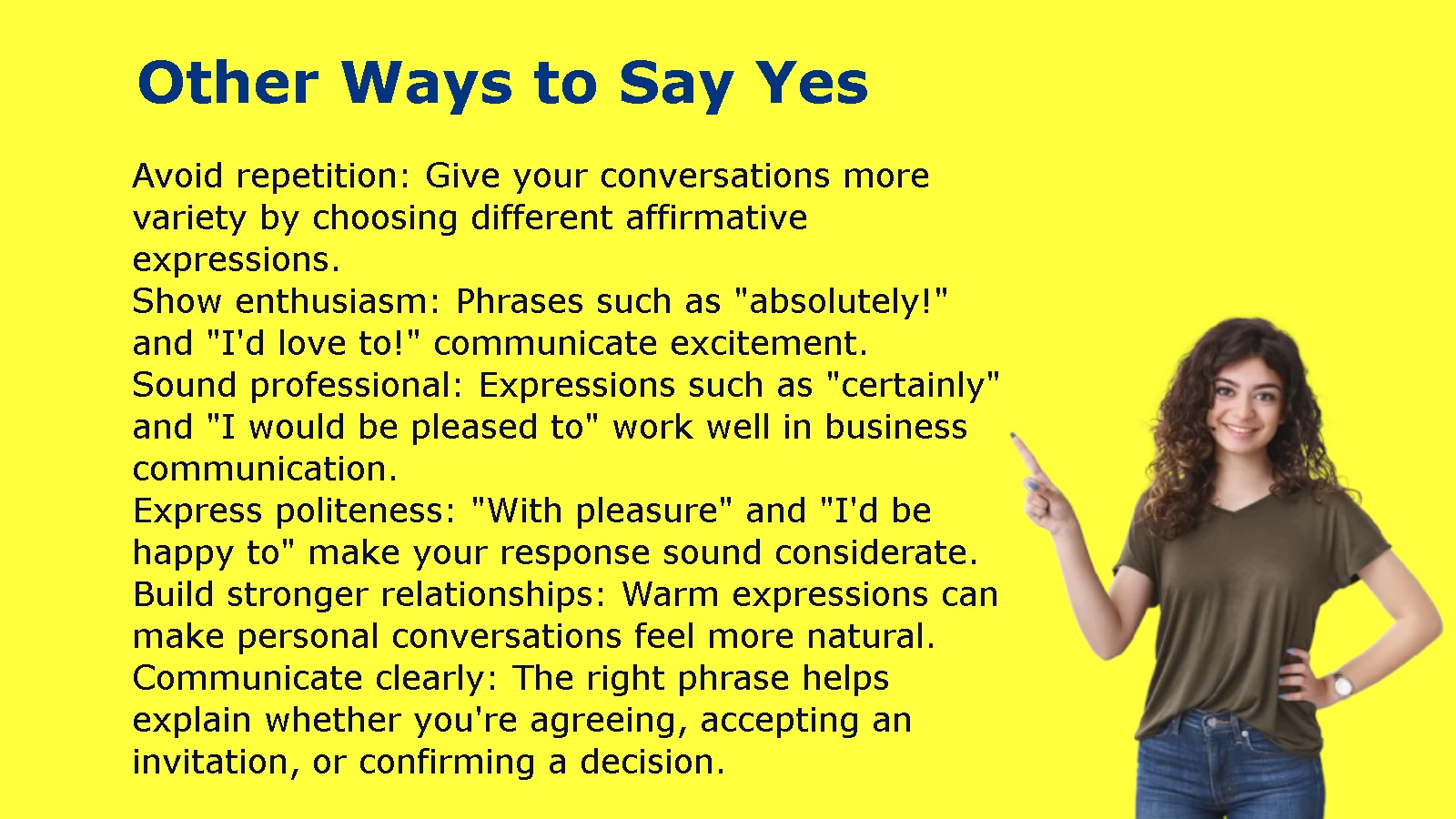
- Avoid repetition: Give your conversations more variety by choosing different affirmative expressions.
- Show enthusiasm: Phrases such as “absolutely!” and “I’d love to!” communicate excitement.
- Sound professional: Expressions such as “certainly” and “I would be pleased to” work well in business communication.
- Express politeness: “With pleasure” and “I’d be happy to” make your response sound considerate.
- Build stronger relationships: Warm expressions can make personal conversations feel more natural.
- Communicate clearly: The right phrase helps explain whether you’re agreeing, accepting an invitation, or confirming a decision.
How to Choose the Right Way to Say Yes
Before choosing an alternative, consider the relationship between you and the other person.
For example, “bet” might work perfectly when texting a close friend, but it may sound too casual in a business email.
Use these guidelines:
| Situation | Recommended expression |
| Professional email | Certainly |
| Business meeting | I agree |
| Friendly conversation | You bet |
| Romantic conversation | I’d love to |
| Accepting an invitation | Count me in |
| Confirming a task | Consider it done |
| Casual text message | Yep |
| Showing excitement | Absolutely! |
Think about the message behind your answer, too. Agreeing with someone’s opinion is different from accepting a responsibility. Choose an expression that communicates the right meaning rather than simply replacing “yes” with another word.
100+ Other Ways to Say Yes
If you want a quick alternative, this collection includes common, polite, enthusiastic, casual, and direct expressions. Some phrases communicate simple agreement, while others show excitement or willingness to participate.
Common Ways to Say Yes
These expressions work in everyday conversations, messages, and many professional situations.
| Alternative | Meaning or best use |
| Absolutely | Strong agreement |
| Certainly | Polite agreement |
| Definitely | Clear confirmation |
| Of course | Natural agreement |
| Sure | Simple acceptance |
| Indeed | Strong affirmation |
| Without a doubt | Complete agreement |
| For sure | Confident agreement |
| You bet | Friendly agreement |
| No problem | Willingness to help |
| Sounds good | Agreement with a suggestion |
| I’m in | Willingness to participate |
| Agreed | Sharing the same opinion |
| Right on | Enthusiastic agreement |
| That’s right | Confirming something is correct |
| No question | Strong certainty |
| Naturally | Agreement that seems expected |
| Absolutely right | Complete agreement with an opinion |
| That’s correct | Confirming information |
| I agree | Direct agreement |
Polite Ways to Say Yes
Polite alternatives help you sound respectful without becoming unnecessarily formal.
- Certainly.
- I’d be happy to.
- With pleasure.
- Of course, I’d love to.
- By all means.
- That would be wonderful.
- Gladly.
- I would be delighted.
- Yes, please.
- I’d be more than happy to.
- It would be my pleasure.
- I’d gladly help.
- That sounds lovely.
- I would welcome that.
- Please count on me.
Example:
Person A: Could you help me prepare the presentation?
Person B: Certainly. I’d be happy to help.
This response sounds more considerate than a simple “yes” because it communicates willingness as well as agreement.
Enthusiastic Ways to Say Yes
When someone shares exciting news or invites you to something enjoyable, an enthusiastic response can communicate your feelings better than an ordinary affirmative.
- Absolutely!
- A thousand times yes!
- Count me in!
- I’m all for it!
- Let’s do it!
- I’m totally on board!
- You don’t have to ask twice!
- Heck yes!
- I’m excited about it!
- That’s a big yes!
- I’m in without hesitation!
- Sounds amazing!
- I wouldn’t miss it!
- Let’s make it happen!
- Yes, please!
Example:
Friend: We’re planning a weekend road trip. Want to come?
You: A thousand times yes! I wouldn’t miss it.
Casual and Everyday Ways to Say Yes
Casual expressions are useful when speaking with friends, relatives, classmates, or familiar coworkers.
- Yep.
- Yeah.
- Yup.
- Sure thing.
- You got it.
- No worries.
- Works for me.
- I’m game.
- Sounds great.
- Definitely.
- All right.
- I’m down.
- Why not?
- Totally.
- Fair enough.
Example:
Friend: Want to grab coffee after work?
You: Sure thing. Sounds great!
Short and Direct Ways to Say Yes
Sometimes a brief response is more effective than a complete sentence. These expressions work especially well in quick conversations and messages.
- OK.
- Agreed.
- Done.
- Yes.
- Right.
- True.
- Bet.
- 100%.
- Confirmed.
- Deal.
- Absolutely.
- Sure.
- Correct.
- Accepted.
- Approved.
Remember that short responses can sometimes sound cold. Adding an exclamation mark or a few extra words can make your message friendlier.
Creative Ways to Say Yes
Creative ways to say yes help you express agreement with personality. Instead of using predictable responses, you can choose phrases that communicate excitement, confidence, humor, or affection.
These expressions work particularly well in personal conversations, social media comments, friendly invitations, and informal messages.
Unique and Interesting Ways to Express Agreement
Try these alternatives when you want to make your response more memorable.
| Creative expression | What it communicates |
| Consider it done | Confidence and commitment |
| I’m on board | Agreement and participation |
| Let’s make it happen | Enthusiasm and determination |
| You’ve got my vote | Support and approval |
| I’m jumping in | Willingness to participate |
| That’s right up my alley | Personal interest |
| I’m sold | Complete acceptance |
| Say no more | Immediate understanding and agreement |
| Lead the way | Willingness to follow |
| I’m in without hesitation | Strong enthusiasm |
| Where do I sign? | Eager acceptance |
| You’ve convinced me | Agreement after persuasion |
| I’m ready when you are | Readiness to begin |
| Let’s get this show on the road | Excitement about starting |
| You can count on me | Commitment and reliability |
Example:
Person A: Would you like to join our team for the competition?
Person B: You’ve got my vote. I’m ready when you are!
The response communicates more enthusiasm than a simple “yes.”
Romantic and Sweet Ways to Say Yes
When communicating with someone you love, a warm response can make the moment more meaningful.
Here are some sweet alternatives:
- With all my heart.
- I’d love nothing more.
- You already know my answer.
- A million times yes.
- Anything for you.
- Happily, always.
- My answer is yes.
- I’d choose that every time.
- Of course, sweetheart.
- You make saying yes easy.
- Without a second thought.
- Absolutely, my love.
- I wouldn’t want it any other way.
Example:
Partner: Would you like to spend the weekend together?
You: I’d love nothing more. You already know my answer.
Choose affectionate expressions that match your relationship. A romantic phrase should sound genuine rather than forced.
Enthusiastic Ways to Accept an Invitation
An invitation deserves a response that makes the other person feel appreciated.
Consider these alternatives:
- I’d love to join!
- Save me a seat!
- Absolutely, I’m there!
- Sounds like a plan.
- I’m looking forward to it.
- You can count me in.
- That sounds fantastic.
- I’d be delighted to come.
- Definitely, see you there!
- I wouldn’t miss it.
Example:
Colleague: We’re organizing a team dinner on Friday. Would you like to join?
You: Absolutely! I’m looking forward to it.
Creative Ways to Say Yes Without Saying Yes
Sometimes you can communicate agreement without using the actual word “yes.”
These expressions are especially useful when you want your response to sound natural and conversational.
- That works perfectly.
- I’m ready when you are.
- Let’s make it official.
- You’ve convinced me.
- Where do I sign?
- I wouldn’t miss it.
- Sounds like a winner.
- I’m happy to go along with that.
- You have my full support.
- Let’s get started.
- I’m completely on board.
- That’s exactly what I had in mind.
For example, if a friend asks whether you’re interested in visiting a new restaurant, you could reply, “Where do I sign?”
The expression communicates excitement and acceptance without directly saying yes.
How to Say Yes Formally and Professionally
Formal ways to say yes communicate agreement while maintaining respect and professionalism. They are useful in workplace conversations, business emails, interviews, meetings, official requests, and discussions with clients.
However, professional communication requires more than replacing “yes” with a longer word. Your response should clearly explain what you accept or agree to.
Formal Ways to Say Yes in Business Communication
Use these expressions when speaking with managers, colleagues, clients, or business partners.
| Formal expression | Example |
| Certainly | Certainly, I can review the proposal. |
| I agree with your proposal | I agree with your proposal and support the suggested changes. |
| That is acceptable | That is acceptable under the current agreement. |
| I would be pleased to | I would be pleased to attend the meeting. |
| I can confirm that | I can confirm that the documents are ready. |
| I approve | I approve the revised schedule. |
| That works well for me | Thursday afternoon works well for me. |
| I am in agreement | I am in agreement with the proposed strategy. |
| I support this decision | I support this decision and its objectives. |
| I have no objections | I have no objections to the suggested changes. |
These expressions sound professional because they communicate a clear position without unnecessary informality.
Professional Ways to Accept a Request
When someone asks you to complete a task, your answer should communicate both acceptance and responsibility.
Consider these alternatives:
- I’d be happy to assist.
- Consider it taken care of.
- I can certainly handle that.
- I would be glad to help.
- You have my confirmation.
- I can take responsibility for that.
- I’ll be happy to manage this.
- I can accommodate that request.
- That is something I can arrange.
- I’ll proceed as discussed.
Example:
Manager: Can you prepare the monthly performance report by Thursday?
Employee: Certainly. I’ll prepare the report and share it by Thursday afternoon.
The second response is particularly effective because it confirms the task and provides a clear deadline.
Formal Ways to Say Yes in Emails
Business emails require clarity, courtesy, and a suitable level of formality. Your response should address the request directly rather than forcing the reader to guess what you mean.
Here are practical examples.
Accepting a meeting invitation
Instead of writing:
“Yes, I’ll come.”
Write:
“Thank you for the invitation. I would be pleased to attend the meeting.”
Confirming a deadline
Instead of writing:
“Sure, no problem.”
Write:
“Certainly. I can complete the assignment by the proposed deadline.”
Agreeing to a business proposal
Instead of writing:
“Yeah, that sounds good.”
Write:
“I agree with the proposed terms and would be happy to move forward.”
Accepting additional responsibilities
Instead of writing:
“Okay, I’ll do it.”
Write:
“I’d be happy to take responsibility for this task.”
Responding to a professional request
Instead of writing:
“Yep, that’s fine.”
Write:
“Of course. I’ll make the necessary arrangements.”
Formal vs. Informal Ways to Say Yes
The same message can sound completely different depending on your choice of words.
| Informal expression | Formal alternative |
| Yep | Certainly |
| Sure thing | Of course |
| Sounds good | That sounds acceptable |
| I’m in | I would be pleased to participate |
| No problem | I’d be happy to assist |
| You bet | Absolutely |
| Deal | I agree to those terms |
| Yeah, okay | Yes, that is acceptable |
| Got it | Understood; I’ll proceed |
| Works for me | That arrangement is suitable |
One important distinction: formal language should not become unnecessarily complicated. “Certainly” is often better than an elaborate expression that makes a simple agreement sound unnatural.
Different Ways to Say Yes in Text Messages
Text messages often need shorter, more expressive responses than emails or face-to-face conversations. Different ways to say yes in text allow you to communicate agreement quickly while matching the other person’s tone.
You can use abbreviations, playful spelling, emojis, or complete sentences depending on your relationship and the situation.
Short Text Responses That Mean Yes
These responses work well when someone asks a simple question or suggests a plan.
- Yup
- Yep
- Yeah
- Yess
- Sure
- OK
- Bet
- 100%
- Definitely
- For sure
- Totally
- Absolutely
- I’m down
- Sounds good
- Count me in
Example:
Friend: Are we still meeting at 6?
You: 100%! See you there.
Cute Ways to Say Yes in Text
If you want your response to sound affectionate or playful, try these expressions:
- Yessss!
- Of course, silly!
- I’d love that!
- Absolutely, dear!
- You already know!
- A big yes from me!
- Happily!
- That would make me smile.
- Yes, please!
- Can’t wait!
Example:
Partner: Can I take you out for dinner tonight?
You: Yessss! I’d love that.
Funny Ways to Say Yes in Text
Funny text responses can make ordinary conversations more entertaining.
- Affirmative!
- Roger that!
- Mission accepted.
- Permission granted.
- Say less.
- I’m so in.
- Consider it done.
- The answer is obviously yes.
- Your wish is my command.
- Approved by the committee of me.
Example:
Friend: Are you coming to the party?
You: Mission accepted. Prepare for my arrival!
Ways to Say Yes to a Text Invitation
Your response should match the invitation and communicate whether you’re genuinely interested.
| Situation | Suggested response |
| Dinner invitation | I’d love to! |
| Meeting a friend | Sounds like a plan! |
| Accepting a date | Absolutely, that sounds wonderful. |
| Weekend plans | Count me in! |
| Group invitation | I’m definitely joining! |
| Coffee invitation | Sure thing, see you there! |
| Movie night | You bet! |
| Family gathering | I’d be happy to come. |
How to Say Yes in Text Without Sounding Rude
Short replies can sometimes create misunderstandings because text messages lack facial expressions and vocal tone.
For example, replying with “K” might sound dismissive even when you intend to agree.
Use these tips:
- Add a friendly phrase: “Sure, that sounds great!”
- Use punctuation naturally: “Absolutely!” sounds more enthusiastic than “Absolutely.”
- Include an emoji when appropriate: “Yes! 😊”
- Confirm important details: “Definitely. I’ll be there at 7.”
- Avoid overly short responses when someone has made a thoughtful invitation.
A little extra warmth can make your messages feel more personal.
Funny Ways to Say Yes
Funny ways to say yes bring humor into ordinary conversations. They work especially well with friends, family members, and people who appreciate playful communication.
However, humor depends on context. A joke that works with your best friend might sound inappropriate when responding to a client.
Hilarious Alternatives to Yes
Try these funny expressions when you want to make someone smile.
- Heck yeah!
- You bet your boots!
- Affirmative, captain!
- Absolutely, positively!
- Permission to party granted!
- The answer is a spectacular yes!
- Does a bear live in the woods?
- Is the sky blue?
- A million percent!
- Well, obviously!
- Consider me convinced!
- Let’s get this party started!
- That’s a yes from the peanut gallery!
- My enthusiasm says yes!
Example:
Friend: Do you want another slice of pizza?
You: Does a bear live in the woods?
This humorous question indirectly communicates an enthusiastic yes.
Sarcastic and Playful Ways to Agree
Sarcastic expressions can make your agreement sound entertaining, especially when you’re talking to someone who understands your sense of humor.
- Well, obviously!
- What took you so long to ask?
- I thought you’d never ask.
- Against my better judgment, yes.
- Fine, twist my arm.
- What could possibly go wrong?
- Oh, absolutely not a chance of me saying no!
- Do I even need to think about it?
- You know me too well.
- I suppose I can make an exception.
Use sarcasm carefully. Someone unfamiliar with your humor might misunderstand your actual answer.
Funny Ways to Say Yes to Friends
These expressions are suitable for casual conversations and group chats.
- I’m there like a bear.
- Let’s roll!
- Count my name twice.
- You had me at hello.
- I’m already on my way.
- Where’s the adventure?
- Sign me up immediately.
- I’m bringing my enthusiasm.
- Let’s cause some harmless trouble.
- My schedule suddenly looks free.
Example:
Friend: Want to go bowling this evening?
You: Sign me up immediately. I’m bringing my questionable bowling skills!
Funny Ways to Say Yes at Work
Humor can also work in relaxed workplaces, provided you understand the company’s communication culture.
Consider these responses:
- Mission accepted.
- Challenge accepted.
- Roger that, boss.
- Consider it handled.
- Green light from my side.
- Let’s get this done.
- On it!
- Operation approved.
Avoid overly sarcastic or exaggerated expressions when communicating with senior managers, unfamiliar clients, or people who expect formal language.
Different Ways to Say Yes in Different Languages
People around the world express agreement using different words and expressions. Learning how to say yes in other languages can help you communicate while traveling, studying, working internationally, or connecting with people from different cultures.
However, direct translations do not always capture the full meaning of an English response. Some languages use different expressions depending on the question, level of politeness, and social situation.
Ways to Say Yes in European Languages
Here are common affirmative expressions in several European languages.
| Language | Way to say yes | Pronunciation guide |
| Spanish | Sí | See |
| French | Oui | Wee |
| German | Ja | Yah |
| Italian | Sì | See |
| Portuguese | Sim | Seem |
| Dutch | Ja | Yah |
| Russian | Да (Da) | Dah |
| Swedish | Ja | Yah |
| Norwegian | Ja | Yah |
| Greek | Ναι (Nai) | Neh |
| Polish | Tak | Tahk |
| Danish | Ja | Yah |
| Finnish | Kyllä | Kül-lä |
| Romanian | Da | Dah |
| Turkish | Evet | Eh-vet |
Example in Spanish:
“¿Quieres café?”
“¡Sí, por favor!”
The English translation is:
“Would you like coffee?”
“Yes, please!”
Ways to Say Yes in Asian Languages
Asian languages often use different affirmative expressions depending on politeness and context.
| Language | Way to say yes | Meaning |
| Chinese (Mandarin) | 是的 (Shì de) | Yes |
| Japanese | はい (Hai) | Yes |
| Korean | 네 (Ne) | Yes |
| Hindi | हाँ (Haan) | Yes |
| Urdu | ہاں (Haan) | Yes |
| Bengali | হ্যাঁ (Hyã) | Yes |
| Thai | ใช่ (Chai) | Yes / That’s right |
| Vietnamese | Vâng | Yes, polite |
| Indonesian | Ya | Yes |
| Malay | Ya | Yes |
Cultural note: Japanese and Korean have several levels of politeness. For example, Japanese “はい” is a common polite affirmative, while Korean “네” is a respectful way to respond. The appropriate expression depends on your relationship with the listener.
Ways to Say Yes in African and Middle Eastern Languages
Here are some common ways to express agreement in African and Middle Eastern languages.
| Language | Way to say yes |
| Arabic | نعم (Na’am) |
| Swahili | Ndiyo |
| Hebrew | כן (Ken) |
| Amharic | አዎ (Awo) |
| Turkish | Evet |
| Persian | بله (Baleh) |
| Hausa | I (Yes, in suitable contexts) |
| Zulu | Yebo |
These expressions can help with everyday communication, but pronunciation and context matter. Some languages also use different responses to express agreement, confirmation, or acceptance.
Do Different Languages Express Agreement Differently?
Yes. Although many languages have a direct equivalent of “yes,” people do not always use it in the same way.
Consider these differences:
- Politeness: Japanese and Korean distinguish between different levels of respectful speech.
- Context: Some expressions confirm that information is correct rather than accepting an invitation.
- Grammar: Certain languages use verb-based answers instead of repeating a general affirmative word.
- Social expectations: In some situations, speakers may use indirect language to avoid sounding too forceful.
- Regional variation: People may use different informal expressions depending on their location.
For example, the Japanese word “はい” can acknowledge what someone says, but it does not automatically mean agreement with every proposal.
This distinction matters when learning another language. A dictionary translation might be technically correct but still sound unnatural in a real conversation.
Old-Fashioned and Traditional Ways to Say Yes
Old-fashioned ways to say yes add a historical or literary quality to conversations. Expressions such as “aye,” “yea,” and “verily” appear in older writing, traditional speech, historical fiction, and theatrical dialogue.
Some remain in modern English, although their use is limited to particular settings.
Old English and Historical Expressions for Yes
Here are several traditional affirmative expressions.
| Expression | Meaning | Modern usage |
| Yea | Yes or indeed | Formal or historical writing |
| Aye | Yes | Nautical and traditional contexts |
| Verily | Truly or certainly | Literary or biblical style |
| Indeed | Certainly or truly | Common modern English |
| Assuredly | Certainly | Formal English |
| Forsooth | In truth or indeed | Archaic and humorous |
| Truly | Sincerely or certainly | Modern English |
| Aye, aye | Affirmative acknowledgment | Nautical and playful contexts |
Yea is a historical affirmative expression that appears in older English texts. It can also be used in modern formal voting contexts.
Aye remains familiar in parliamentary and nautical settings. For example, a sailor might respond “Aye, captain” to acknowledge an order.
Verily is strongly associated with older literary and religious language. It means truly or certainly.
Shakespearean and Literary Ways to Say Yes
Historical plays and literary dialogue often use expressive affirmative phrases.
Examples include:
- Ay, indeed.
- Most assuredly.
- By all means.
- I shall.
- It shall be so.
- Without question.
- I give my consent.
- So be it.
- As you wish.
- With all my heart.
These expressions can help create a traditional atmosphere in storytelling, role-playing, and theatrical performances.
However, not every expression is exclusively Shakespearean. Many are simply formal or literary phrases that have existed across different periods.
Traditional Ways to Express Agreement
Traditional affirmative language often communicates more than simple acceptance.
For example:
- I give my word: A promise or commitment.
- So be it: Acceptance of a decision or outcome.
- As you wish: Agreement to another person’s preference.
- Without question: Strong agreement.
- By all means: Permission or enthusiastic acceptance.
- I shall: A commitment to perform an action.
Understanding these distinctions helps you choose an expression that fits the situation.
Are Old-Fashioned Ways to Say Yes Still Used Today?
Yes. Several traditional expressions remain in modern English, although their usage depends on the setting.
You may encounter them in:
- Historical novels and period dramas.
- Theater and literary dialogue.
- Traditional ceremonies.
- Parliamentary discussions.
- Nautical communication.
- Humorous conversations.
For example, “aye” still appears in certain voting procedures, while “by all means” remains a natural way to grant permission.
Other Ways to Say No
Knowing alternatives to yes is only one part of effective communication. You should also understand how to express disagreement or refusal without sounding unnecessarily harsh.
Other ways to say no range from friendly and indirect responses to firm, professional refusals.
Polite Ways to Say No
Polite refusals communicate your decision while respecting the other person.
- I’m afraid I can’t.
- Unfortunately, not.
- I appreciate the offer, but no.
- I’d rather not.
- Not this time.
- Thank you, but I’ll pass.
- I won’t be able to make it.
- Perhaps another time.
- I appreciate you asking.
- That doesn’t work for me.
Example:
Friend: Would you like to come to dinner tonight?
You: Thank you for inviting me, but I won’t be able to make it tonight.
This response communicates your decision without making the other person feel rejected.
Formal Ways to Say No
Professional situations sometimes require a more careful refusal.
Consider these expressions:
- I must respectfully decline.
- That won’t be possible.
- I cannot approve that request.
- I am unable to commit.
- I regret that I cannot agree.
- Unfortunately, I cannot accommodate that request.
- I appreciate the opportunity, but I must decline.
- I am not in a position to approve this.
- That arrangement would not be suitable.
Example:
Client: Can you deliver the complete project by tomorrow?
You: I appreciate the request, but I am unable to commit to that deadline without compromising the quality of the work.
This answer explains the refusal and maintains a professional tone.
Casual Ways to Say No
When speaking with friends or family, you can use shorter expressions.
- Nope.
- Nah.
- Not really.
- Maybe another time.
- I’m good.
- No thanks.
- Not today.
- I don’t think so.
- Probably not.
- I’ll pass.
Funny Ways to Say No
Humorous refusals can make an uncomfortable moment feel lighter when the situation allows it.
- Not in a million years.
- Hard pass.
- When pigs fly.
- Not today!
- My answer is a solid no.
- Not even if you paid me.
- That’s a no from me.
- I’d rather wrestle a cactus.
- My calendar says absolutely not.
- Nice try, though!
Use these expressions with people who understand your humor. Avoid joking when someone needs a serious answer.
How to Say No Without Sounding Rude
Saying no does not mean you must be unfriendly or disrespectful.
Follow these practical steps:
- Show appreciation: Thank the person for asking or offering.
- Be clear: Avoid vague answers that create false expectations.
- Give a brief explanation: Share a reason when it helps the other person understand.
- Offer an alternative: Suggest another date or solution if appropriate.
- Maintain your boundaries: Do not accept something simply because you feel pressured.
For example, instead of saying “Maybe” when you already know you cannot attend, say, “Thanks for inviting me. I can’t make it this weekend, but I’d love to catch up another time.”
Clear communication saves everyone time.
Other Ways to Say Yes or No: Understanding the Difference
Yes and no communicate opposite positions, but conversations often require more precise answers.
Understanding the difference between affirmative, negative, conditional, and uncertain responses helps you avoid misunderstandings.
Affirmative vs. Negative Responses
An affirmative response communicates agreement, approval, or acceptance. A negative response communicates disagreement, refusal, or rejection.
| Response type | Example | Meaning |
| Affirmative | Absolutely | Strong agreement |
| Polite affirmative | Certainly | Respectful agreement |
| Enthusiastic affirmative | Count me in | Excited acceptance |
| Negative | Not really | Soft disagreement |
| Direct negative | Definitely not | Strong refusal |
| Polite negative | I’d rather not | Respectful refusal |
| Conditional | It depends | Agreement depends on circumstances |
| Uncertain | Maybe | No definite decision |
How to Choose Between Yes, No, and Maybe
Not every question requires an immediate yes or no.
Sometimes you need more information before making a decision.
Consider these situations:
Use yes when:
- You understand the request.
- You agree with the proposal.
- You can fulfill the commitment.
- You genuinely want to participate.
Use no when:
- You disagree with the suggestion.
- You cannot accept the responsibility.
- The request conflicts with your priorities.
- You do not want to participate.
Maybe when:
- You need additional information.
- Your availability is uncertain.
- You want time to consider the proposal.
- The decision depends on another condition.
Examples include:
- “It depends on the final schedule.”
- “Let me check my availability first.”
- “I might be able to join.”
- “I’ll give you a definite answer tomorrow.”
These responses communicate uncertainty without making a promise you may not be able to keep.
Examples of Positive, Negative, and Neutral Responses
Imagine a colleague asks whether you can attend a meeting next Monday.
Here are different ways to respond:
- Positive: “Absolutely. I’ll be there.”
- Polite positive: “Certainly. I would be pleased to attend.”
- Negative: “Unfortunately, I won’t be available.”
- Polite negative: “Thank you for the invitation, but I must decline.”
- Conditional: “I can attend if the meeting starts after 2 p.m.”
- Uncertain: “I’m not sure yet. I’ll confirm my availability tomorrow.”
Each answer communicates a different intention. Choose the one that accurately reflects your decision.
How to Use Yes in a Sentence
The word “yes” can function as an independent response, an introductory word, or part of a sentence. Its punctuation and placement depend on how you use it.
Simple Sentences Using Yes
Here are some everyday examples:
- Yes, I understand the instructions.
- She said yes to the invitation.
- Yes, we can finish the project today.
- He nodded yes when I asked him.
- Yes, that is exactly what I meant.
- They answered yes without hesitation.
- Yes, I would like another cup of tea.
- My parents said yes to the trip.
- Yes, everything is ready.
- The committee voted yes on the proposal.
Formal Sentences Using Yes
Use these examples to understand how yes works in professional communication.
- Yes, I would be happy to attend the meeting.
- Yes, I can confirm the proposed schedule.
- Yes, I agree with your recommendation.
- Yes, we can proceed with the revised plan.
- Yes, the documents have been reviewed.
- Yes, I approve the suggested changes.
- Yes, I can complete the assignment by Friday.
Casual Sentences Using Yes
These sentences work in everyday conversations.
- Yes, let’s grab lunch together.
- Yes, that sounds like fun.
- Yes, I’ll see you tomorrow.
- Yes, I’m coming with you.
- Yes, we should try that restaurant.
- Yes, I would love to watch the movie.
- Yes, let’s make some plans.
Funny Sentences Using Yes
You can also use yes to create humorous responses.
- Yes, but only if there’s pizza.
- Yes, and I expect a trophy.
- Yes, my enthusiasm has no limits.
- Yes, as long as nobody makes me wake up early.
- Yes, I accept this extremely important mission.
- Yes, but I reserve the right to complain.
Grammar and Punctuation Rules for Yes
The word “yes” follows a few simple punctuation rules.
Use a comma after introductory yes.
When yes begins a sentence as an introductory response, place a comma after it.
Correct: “Yes, I can help you.”
Incorrect: “Yes I can help you.”
Use a period when yes stands alone.
Example:
“Are you ready?”
“Yes.”
Capitalize yes at the beginning of a sentence.
Example: “Yes, we have completed the assignment.”
Use quotation marks when reporting someone’s exact response.
Example: She replied, “Yes, I’ll be there.”
Use appropriate punctuation in dialogue.
Example: “Yes! I’m excited about the trip.”
The punctuation can communicate enthusiasm, certainty, or neutrality.
How to Pick the Best Alternative to Yes for Any Situation
Choosing the right alternative depends on your audience, purpose, and communication style. A phrase that works in a casual conversation may sound inappropriate in a professional setting.
The following recommendations make the choice easier.
Best Expressions for Work and Business
Professional conversations benefit from clear and respectful language.
Recommended expressions include:
- Certainly.
- I agree.
- I would be pleased to.
- That is acceptable.
- I can confirm that.
- I’d be happy to assist.
- I support this proposal.
For important commitments, include the action and deadline in your response.
Instead of saying “Sure,” write, “Certainly. I’ll send the completed report by Thursday.”
Best Expressions for Friends and Family
Personal conversations allow more relaxed and expressive language.
Try:
- You bet!
- Absolutely!
- I’m in!
- Sounds great!
- Count me in!
- For sure!
- Heck yes!
- Let’s do it!
Choose expressions that match your normal personality. You do not need to sound overly enthusiastic if a simple “sounds good” communicates your feelings.
Best Expressions for Emails and Messages
Emails require clarity, while text messages often allow shorter responses.
| Communication type | Recommended expression |
| Formal business email | Certainly |
| Client communication | I’d be happy to assist |
| Meeting confirmation | I can confirm my attendance |
| Friendly email | Sounds wonderful |
| Quick text | Yep |
| Group chat | Count me in |
| Romantic message | I’d love that |
| Professional chat | Absolutely, I’ll take care of it |
Best Expressions for Romantic Conversations
Romantic communication benefits from warmth and sincerity.
Consider:
- I’d love to.
- With all my heart.
- Absolutely, my love.
- You already know my answer.
- A million times yes.
- I wouldn’t want it any other way.
The most effective response is one that reflects your actual feelings rather than an expression chosen simply because it sounds impressive.
Best Expressions for Accepting Invitations and Requests
When accepting an invitation, show appreciation and confirm your willingness to participate.
Examples:
- “I’d love to join you.”
- “Thank you for inviting me. I’d be delighted to come.”
- “Absolutely! I’ll be there.”
- “Count me in. It sounds like fun.”
- “That works perfectly for me.”
For requests involving responsibilities, be more specific:
- “Certainly. I’ll take care of it.”
- “I’d be happy to help with the arrangements.”
- “I can handle that by tomorrow.”
A clear response helps prevent confusion about what you have agreed to do.
Frequently Asked Questions
What Are 10 Other Ways to Say Yes?
Ten common alternatives to yes are absolutely, certainly, definitely, of course, gladly, indeed, sure, you bet, agreed, and without a doubt.
Each expression communicates agreement slightly differently. For example, “certainly” sounds polite, while “you bet” feels more casual and friendly.
What Is a More Professional Way to Say Yes?
A more professional way to say yes includes expressions such as “certainly,” “I would be pleased to,” “I agree with your proposal,” and “I’d be happy to assist.”
For workplace communication, choose a phrase that clearly confirms your decision or commitment.
What Are Some Creative Ways to Say Yes?
Creative alternatives include “count me in,” “consider it done,” “where do I sign,” “let’s make it happen,” “I’m all for it,” and “you’ve got my vote.”
These expressions help you communicate enthusiasm and agreement without repeating the same word.
How Do You Say Yes in a Cute Way Over Text?
You can say yes in a cute way by using expressions such as “Yessss!”, “I’d love that!”, “Of course, silly!”, “A big yes from me!” and “You already know!”
Choose a response that matches your relationship and feels natural.
What Is an Old-Fashioned Word for Yes?
Some old-fashioned alternatives to yes include “yea,” “aye,” “verily,” and “forsooth.”
“Aye” remains familiar in nautical and traditional voting contexts, while “verily” and “forsooth” generally sound literary or archaic today.
What Are Some Ways to Say No Politely?
Polite alternatives to no include “I’m afraid I can’t,” “Thank you, but I’ll pass,” “Unfortunately, not,” “I’d rather not,” and “Perhaps another time.”
These expressions help you decline invitations and requests without sounding unnecessarily harsh.
Conclusion: Find the Right Way to Say Yes
Using other ways to say yes makes your communication more expressive, natural, and appropriate for different situations. Whether you’re responding to a professional request, accepting an invitation, texting a friend, or expressing excitement, the right phrase can communicate much more than simple agreement.
For everyday conversations, expressions such as absolutely, sure, definitely, and you bet work well. When communicating professionally, choose certainly, I would be pleased to, or I’d be happy to assist. For playful conversations, try heck yes, count me in, or a thousand times yes.
Remember that the best alternative depends on your audience and intended meaning. A simple, sincere response will always work better than an impressive phrase that feels unnatural.
Next time someone asks you a question, move beyond the usual “yes.” Choose an expression that matches your personality, communicates your intention, and makes your response memorable.