Other ways to say for example include for instance, to illustrate, such as, namely, specifically, as a case in point, and to demonstrate. These alternatives help you introduce supporting details, explain unfamiliar ideas, strengthen arguments, and avoid repeating the same expression in essays, professional documents, and everyday conversations.
However, not every alternative works in every situation. Some expressions introduce specific examples, while others identify exact details or provide supporting evidence. Understanding these differences helps you choose more natural language and improve your writing. Whether you’re writing an academic essay, preparing a business report, or learning English, the right transition phrase makes your ideas easier to follow.
| Question | Answer |
| What is another way to say for example? | For instance, to illustrate, such as, and as an example. |
| What is a formal alternative to for example? | To illustrate, by way of illustration, and as a case in point. |
| What is another word for example in an essay? | For instance, specifically, in particular, and to demonstrate. |
| How do you start a sentence instead of saying for example? | Use phrases such as one example is, consider, and a case in point. |
| How do you say for example in French and Spanish? | The standard translations are par exemple in French and por ejemplo in Spanish. |
What Does For Example Mean?
For example is a common English expression that introduces a specific instance to explain, support, or clarify a general statement. Writers use it to make abstract ideas easier to understand by connecting them to real situations, objects, people, or experiences.
For example, consider this statement:
“Regular exercise improves physical health.”
A supporting example makes the statement more meaningful:
“Regular exercise improves physical health. For example, walking, swimming, and cycling can strengthen the cardiovascular system.”
The expression tells readers that the information following it illustrates the broader point.
Definition of For Example
The phrase for example means introducing one or more specific cases that help explain a general idea.
It usually appears before a supporting detail, but it can also appear in the middle of a sentence.
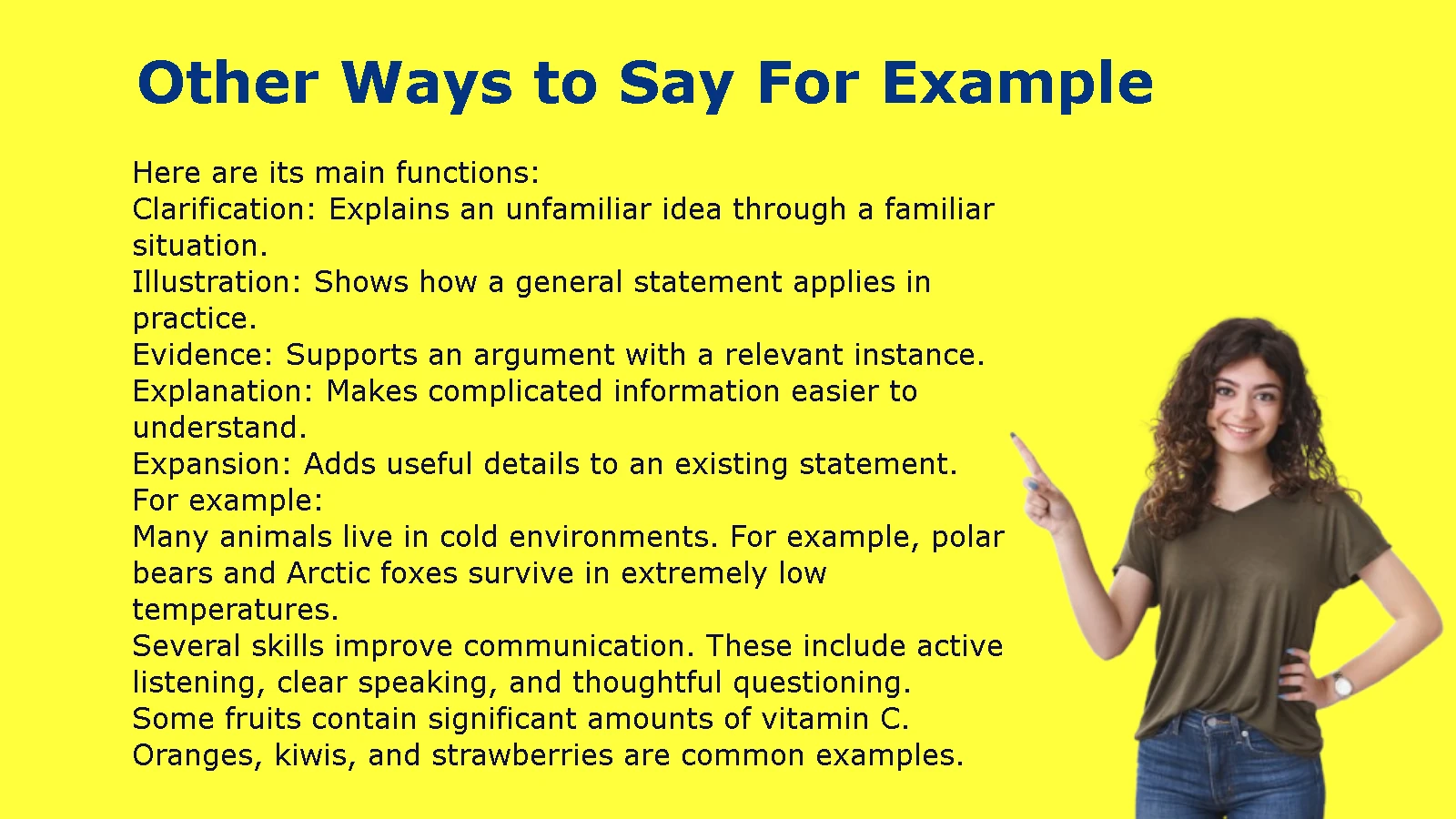
Here are its main functions:
- Clarification: Explains an unfamiliar idea through a familiar situation.
- Illustration: Shows how a general statement applies in practice.
- Evidence: Supports an argument with a relevant instance.
- Explanation: Makes complicated information easier to understand.
- Expansion: Adds useful details to an existing statement.
For example:
- Many animals live in cold environments. For example, polar bears and Arctic foxes survive in extremely low temperatures.
- Several skills improve communication. These include active listening, clear speaking, and thoughtful questioning.
- Some fruits contain significant amounts of vitamin C. Oranges, kiwis, and strawberries are common examples.
When Should You Use For Example?
Use for example when your reader needs a specific instance to understand a broader statement.
It works particularly well in:
- Academic essays and research papers.
- Blog posts and educational articles.
- Business reports and presentations.
- Everyday conversations.
- Instructional guides and explanations.
- Emails and professional communication.
The expression works best when the example directly supports the preceding statement.
For instance, if you write, “Technology has changed education,” you could introduce online classrooms, digital textbooks, and educational applications as examples.
However, avoid adding examples that do not contribute anything meaningful. A useful example should clarify your point rather than simply make a paragraph longer.
For Example vs. For Instance: What’s the Difference?
For example and for instance have almost identical meanings. Both introduce specific cases that illustrate a general statement. The main difference involves style and sentence flow rather than meaning.
| Feature | For Example | For Instance |
| Meaning | Introduces an illustration | Introduces an illustration |
| Formality | Neutral | Neutral to slightly formal |
| Academic writing | Common | Common |
| Professional writing | Suitable | Suitable |
| Conversational English | Very common | Very common |
| Sentence position | Beginning or middle | Beginning or middle |
Consider these sentences:
- Some vegetables contain high amounts of fiber. For example, broccoli and carrots provide dietary fiber.
- Some vegetables contain high amounts of fiber. For instance, broccoli and carrots provide dietary fiber.
Both sentences communicate the same information.
You can alternate between these expressions to improve sentence variety. However, changing the phrase alone will not improve a paragraph if every sentence follows the same structure.
How to Punctuate For Example in a Sentence
Correct punctuation helps readers understand how an introductory expression connects to the rest of a sentence.
Follow these basic rules:
At the beginning of a sentence:
Place a comma after the introductory expression.
- For example, several countries have introduced renewable energy programs.
- For instance, many schools now use digital learning platforms.
In the middle of a sentence:
Use commas when the expression interrupts the main sentence.
- Several fruits, for example, contain natural antioxidants.
- Some employees, for instance, prefer flexible working arrangements.
When introducing examples within a list:
You can use a colon after a complete introductory clause.
- Several activities improve mental well-being: walking, reading, gardening, and meditation.
Avoid placing a colon directly after a verb or preposition when the sentence does not require one.
Incorrect: “Popular fruits include: apples, oranges, and bananas.”
Better: “Popular fruits include apples, oranges, and bananas.”
35+ Other Ways to Say For Example
There are many alternatives to for example, but the best choice depends on your purpose, audience, and sentence structure. Some expressions work well in formal writing, while others sound more natural in conversations.
The following alternatives provide different ways to introduce examples without repeating the same phrase.
For Instance
For instance is one of the closest alternatives to for example. It introduces a specific case that supports a general statement.
Example sentences:
- Many people prefer outdoor activities. For instance, hiking and cycling offer opportunities to exercise in nature.
- Some programming languages are beginner-friendly. For instance, Python has a relatively simple syntax.
- Several countries depend heavily on tourism. For instance, the Maldives attracts visitors through its beaches and resorts.
Use this expression in essays, reports, articles, and everyday communication.
Such As
Such as introduces specific items that belong to a broader category. Unlike for example, it usually connects directly to a noun or noun phrase.
Example sentences:
- Many musical instruments, such as guitars, pianos, and violins, require regular practice.
- Outdoor activities such as camping and fishing help people spend more time in nature.
- Some professions, such as teaching and nursing, require specialized training.
Grammar tip: Do not automatically place a comma before such as. Use punctuation according to the sentence structure.
To Illustrate
To illustrate introduces an example that makes an explanation or argument easier to understand.
It works particularly well in academic writing, presentations, and professional reports.
Example sentences:
- To illustrate, a small business can increase sales by improving its online visibility.
- The effects of poor sleep can be significant. To illustrate, sleep deprivation may reduce concentration and memory.
- To illustrate this principle, consider how a budget changes when monthly expenses increase.
As an Example
As an example directly signals that the following information represents a particular case.
Example sentences:
- As an example, consider a company that reduces unnecessary expenses to improve profitability.
- You can develop several useful habits. As an example, reading for twenty minutes each day can improve vocabulary.
- As an example of effective leadership, the manager encouraged employees to share their ideas.
To Give an Example
To give an example is a straightforward expression that introduces supporting information.
Example sentences:
- To give an example, many remote employees use video conferencing to communicate with colleagues.
- To give an example of this approach, consider a student who creates a weekly study schedule.
- Several foods provide healthy fats. To give an example, avocados and almonds contain unsaturated fats.
By Way of Illustration
By way of illustration is a formal alternative that introduces a situation or detail to clarify an idea.
Example sentences:
- By way of illustration, the report compares the performance of two competing businesses.
- By way of illustration, a company might reduce operating costs by automating repetitive tasks.
- The principle applies to several industries. By way of illustration, consider modern manufacturing.
Including
Including introduces particular members of a larger group. It is especially useful when adding examples directly to a sentence.
Example sentences:
- Several European countries, including France, Germany, and Italy, use the euro.
- The course covers essential writing skills, including grammar, punctuation, and sentence structure.
- Many household expenses, including electricity and transportation, affect monthly budgets.
Namely
Namely introduces exact information or identifies the specific items being discussed.
Unlike for example, it often suggests that the following information completes or defines the preceding statement.
Example sentences:
- The company has two main objectives, namely improving customer satisfaction and reducing costs.
- Only three students received awards, namely Olivia, James, and Daniel.
- The project requires one essential resource, namely reliable funding.
Use namely when you want to identify specific details rather than provide a few possible illustrations.
Specifically
Specifically introduces precise information that narrows down a general statement.
Example sentences:
- Several employees need additional training, specifically those working in customer support.
- The organization focuses on environmental protection, specifically reducing plastic waste.
- I enjoy outdoor activities, specifically hiking and mountain biking.
In Particular
In particular highlights one or more specific items within a larger group.
Example sentences:
- Several subjects require regular practice. Mathematics, in particular, can become challenging without consistent revision.
- I enjoy reading historical books, particularly those about ancient civilizations.
- The company wants to improve customer service, in particular its response times.
To Demonstrate
To demonstrate introduces information that shows how an idea, principle, or argument works.
Example sentences:
- To demonstrate the importance of planning, consider how a detailed schedule improves productivity.
- The experiment used several measurements to demonstrate the effectiveness of the treatment.
- To demonstrate this concept, the teacher presented a practical classroom activity.
As Evidence
As evidence introduces information that supports a claim or argument.
Example sentences:
- As evidence, the researchers presented data collected over several months.
- The organization reported improved customer satisfaction. As evidence, it shared the results of its latest survey.
- Several factors support this argument. As evidence, consider the findings from the recent experiment.
Use this phrase when the following information genuinely supports a claim. An ordinary example does not automatically count as strong evidence.
Consider
Consider invites readers to think about a particular situation that illustrates an idea.
Example sentences:
- Consider a student who studies for thirty minutes every morning instead of cramming before an examination.
- Consider how a small business benefits from maintaining a professional website.
- Consider the effects of regular exercise on someone who spends most of the day sitting.
This expression creates a direct and engaging writing style.
Take, for Instance
Take, for instance introduces a particular person, situation, or object as an illustration.
Example sentences:
- Take, for instance, a business that uses customer feedback to improve its products.
- Take, for instance, the growing popularity of online education.
- Several habits improve productivity. Take, for instance, planning your daily tasks before starting work.
One Example Is
One example is introduces a particular case without requiring a complicated transition.
Example sentences:
- One example is renewable energy, which can reduce dependence on fossil fuels.
- Several skills improve leadership. One example is effective communication.
- One example is regular exercise, which supports cardiovascular health.
A Case in Point
A case in point refers to a specific situation that clearly demonstrates a broader statement.
Example sentences:
- Many businesses have benefited from digital marketing. A case in point is a local retailer that expanded its customer base through social media.
- Poor planning can create serious problems. The recent project delay is a case in point.
- Several inventions have changed daily life. The smartphone is a case in point.
As Demonstrated By
As demonstrated by introduces a fact, result, or situation that shows something to be true.
Example sentences:
- The strategy improved employee productivity, as demonstrated by the latest performance report.
- The benefits of regular practice are clear, as demonstrated by the students’ improved results.
- Customer demand continues to grow, as demonstrated by increasing sales figures.
To Name a Few
To name a few indicates that you are mentioning selected examples from a larger group.
Example sentences:
- Several countries offer excellent opportunities for international students, including Canada, Australia, and Germany, to name a few.
- Popular recreational activities include swimming, cycling, and hiking, to name a few.
- Many skills help professionals succeed, including communication, teamwork, and problem-solving, to name a few.
Among Others
Among others signals that the listed examples represent only some members of a larger group.
Example sentences:
- The conference welcomed teachers, researchers, and business owners, among others.
- The company produces laptops, smartphones, and tablets, among other electronic devices.
- Several factors influence productivity, including sleep quality and workplace conditions, among others.
As Seen In
As seen in connects an explanation to an observable example, publication, situation, or real-world case.
Example sentences:
- The benefits of remote collaboration are clear, as seen in many modern workplaces.
- This writing technique appears in academic publications, as seen in several research papers.
- The trend is common in digital marketing, as seen in successful online campaigns.
Other Ways to Say For Example or For Instance in Different Contexts
The best alternative depends on how formal your writing needs to sound. A phrase that works in a university essay may feel unnatural in a casual conversation.
Here is how to choose expressions for different situations.
Formal Alternatives to For Example
Formal writing benefits from precise transitions that introduce relevant illustrations without making the paragraph sound conversational.
Consider these alternatives:
- To illustrate
- By way of illustration
- As demonstrated by
- As evidenced by
- A case in point
- Specifically
- In particular
- Namely
Example:
Basic: “For example, companies can improve productivity through employee training.”
More formal: “To illustrate, organizations can improve productivity by investing in structured employee development programs.”
The second version sounds more professional because it uses precise wording and a more developed explanation.
Informal Alternatives to For Example
Everyday conversations do not require complicated expressions. Simple phrases often communicate ideas more naturally.
Useful alternatives include:
- Like
- Say
- Take
- For instance
- One example is
- Let’s say
- Imagine
Example:
“For example, you could visit a nearby park.”
More conversational:
“Say you wanted to spend the afternoon outdoors. You could visit a nearby park.”
Another example:
“Some people enjoy creative hobbies, like painting, cooking, and photography.”
These expressions help conversations flow without sounding overly formal.
Professional Alternatives for Business Writing
Business communication requires clarity and confidence. Choose expressions that introduce relevant situations, supporting information, or measurable results.
Useful options include:
| Alternative | Best business use |
| To illustrate | Explaining a business strategy |
| For instance | Introducing a practical situation |
| Specifically | Identifying exact requirements |
| As demonstrated by | Supporting a performance claim |
| A case in point | Highlighting a business situation |
| Including | Listing products, services, or responsibilities |
Example:
“Several changes could improve customer satisfaction. For instance, the company could shorten response times, simplify its ordering process, and provide better after-sales support.”
This sentence gives readers practical information instead of relying on a vague statement.
Conversational Alternatives for Everyday English
In casual conversations, natural expressions usually work better than formal transitions.
Examples include:
- “Like when you forget your keys and have to return home.”
- “Say you have an unexpected day off. You could use it to visit your family.”
- “Take my neighbor, for instance. She walks to work every morning.”
- “One example would be learning a new language.”
Choose the expression that matches the situation and the people you’re speaking with.
Academic Alternatives for Research and Reports
Academic writing requires accurate explanations and appropriate support.
Use expressions such as:
- To illustrate
- For instance
- Specifically
- As demonstrated by
- A case in point
- In particular
- As evidenced by
Example:
“Several factors influence student performance. For instance, access to learning resources, classroom conditions, and consistent feedback can affect academic outcomes.”
When presenting research findings, distinguish between an illustrative example and actual empirical evidence. A hypothetical situation explains an idea, but it does not prove a research claim.
Another Word for Example in an Essay
Students often search for another word for example in an essay because repeating the same transition makes their writing sound predictable.
The solution is not to replace every occurrence with a different synonym. Instead, select expressions that match the purpose of each paragraph.
Academic Alternatives to For Example
These alternatives work well in essays, research papers, and formal assignments.
| Alternative | Meaning and usage | Example |
| For instance | Introduces a relevant case | For instance, renewable energy reduces reliance on fossil fuels. |
| To illustrate | Explains an idea through an example | To illustrate, consider the effects of regular exercise. |
| Specifically | Adds precise information | Specifically, the study examined three age groups. |
| In particular | Highlights a specific detail | In particular, students benefit from regular feedback. |
| A case in point | Introduces a representative situation | A case in point is the growth of online education. |
| As demonstrated by | Connects a statement to supporting information | This pattern is clear, as demonstrated by the survey results. |
| Namely | Identifies exact information | Two factors matter most, namely cost and accessibility. |
Formal Transition Phrases for Introducing Evidence
When writing an argumentative essay, examples should support your claims rather than simply repeat them.
Useful expressions include:
- As evidenced by
- As demonstrated by
- This is illustrated by
- One relevant example is
- A notable case is
- This can be observed in
- The findings suggest
- This is particularly evident in
Example:
Weak: “For example, students who receive regular feedback may improve their academic performance.”
Stronger: “This is particularly evident in classrooms where teachers provide regular feedback and targeted learning support.”
The revised sentence creates a clearer connection between the claim and its supporting situation.
Remember that phrases such as “the findings suggest” should introduce actual findings, not invented evidence.
How to Avoid Repeating For Example in an Essay
Repetition can make academic writing feel mechanical. However, replacing the same phrase repeatedly with different synonyms can create another problem: unnatural transitions.
Use these strategies instead.
Vary your sentence structure.
Instead of introducing every example with a transition, incorporate supporting details directly into the sentence.
Repetitive:
“For example, exercise improves heart health. For example, exercise also supports mental health.”
Improved:
“Exercise supports heart health and mental well-being. Walking, swimming, and cycling are accessible activities that help people stay physically active.”
Use specific examples.
Avoid vague references. Identify the actual situation, subject, or evidence.
Connect examples to your argument.
Explain why each example matters rather than leaving readers to interpret its relevance.
Alternate between transitions and direct explanations.
You do not need a transition phrase before every supporting detail.
Examples of Better Academic Sentence Structures
Here are practical ways to improve repetitive academic writing.
| Repetitive sentence | Improved sentence |
| For example, online courses provide flexibility. | Online courses, particularly self-paced programs, provide flexibility. |
| For example, exercise improves health. | Activities such as walking and swimming support physical health. |
| For example, businesses use social media. | A notable case is the use of social media to reach new customers. |
| For example, students need feedback. | Regular feedback helps students identify and correct mistakes. |
| For example, technology improves communication. | This benefit is particularly evident in workplaces that use collaborative communication platforms. |
Another Word for For Example to Start a Sentence
Starting every sentence with “for example” can make an essay or article sound repetitive. Fortunately, several alternatives introduce supporting information naturally.
The best sentence starter depends on whether you want to explain an idea, highlight evidence, or invite readers to consider a situation.
Sentence Starters for Formal Writing
Choose professional transitions that maintain a clear and objective tone.
- To illustrate,
- For instance,
- Specifically,
- In particular,
- As demonstrated by,
- A case in point is,
- One notable example is,
- By way of illustration,
Examples:
- To illustrate, effective communication can reduce misunderstandings between employees.
- Specifically, the policy addresses workplace safety and employee training.
- A case in point is the company’s successful transition to renewable energy.
Sentence Starters for Essays and Academic Papers
Academic writing benefits from varied transitions and precise sentence construction.
Useful options include:
- One example of this is…
- This is illustrated by…
- A notable case involves…
- This becomes clear when…
- Consider the case of…
- This can be observed in…
- A relevant example is…
Examples:
- One example of this is the growing use of digital textbooks in universities.
- This is illustrated by research examining the relationship between sleep and memory.
- A notable case involves communities that use solar energy to reduce electricity costs.
Sentence Starters for Professional Emails
Professional emails should communicate information quickly. Use simple expressions rather than unnecessarily complicated phrases.
Examples:
- One option is…
- For instance,…
- A practical example would be…
- Consider…
- This includes…
- Specifically,…
Example email sentence:
“We can improve the onboarding process in several ways. One option is to introduce short training sessions for new employees.”
This sounds more natural than repeating “for example” throughout the message.
Natural Sentence Starters for Everyday Conversations
Conversational English allows more flexible expressions.
Try these:
- “Let’s say…”
- “Imagine…”
- “Take…”
- “Like…”
- “Think about…”
- “One example would be…”
Examples:
- Let’s say you have an extra hour after work. You could use it to exercise or read.
- Imagine you are planning a trip with limited money. You might choose a nearby destination.
- Take my brother, for instance. He learned to cook by watching online tutorials.
Before-and-After Sentence Examples
Compare these sentences to understand how different openings affect readability.
Before:
“For example, people can save money by cooking at home.”
After:
“One practical way to save money is to prepare meals at home.”
Before:
“For example, employees need effective communication skills.”
After:
“Effective communication is particularly important for employees who work in collaborative teams.”
Before:
“For example, students can improve their writing by reading regularly.”
After:
“Consider students who read regularly; they often encounter new vocabulary and different sentence structures.”
The improved versions do more than replace a phrase. They make the sentence structure more varied and informative.
Another Way to Say Another Example
Sometimes you have already introduced one example and want to present an additional one. Repeating “another example” can make your writing feel repetitive.
These alternatives help you introduce a second, third, or related illustration.
A Further Example
A further example introduces an additional case that supports the same argument.
Example:
“Online learning provides flexibility for students. A further example is its usefulness for professionals who need to study while working full-time.”
An Additional Example
An additional example clearly indicates that you are adding another supporting detail.
Example:
“Walking improves cardiovascular health. An additional example is its role in supporting everyday mobility.”
Another Illustration
Another illustration introduces a different situation that explains the same principle.
Example:
“Clear communication reduces workplace confusion. Another illustration is the way written instructions help employees complete tasks consistently.”
One More Instance
One more instance introduces an extra occurrence of a particular situation or behavior.
Example:
“The company has improved its customer service several times. One more instance is its introduction of a faster support system.”
A Second Case
A second case introduces another situation that can be compared with the first.
Example:
“The first business expanded through social media marketing. A second case involves a retailer that increased sales through email campaigns.”
Another Case in Point
Another case in point introduces an additional situation that supports a broader statement.
Example:
“Technology continues to transform education. Another case in point is the growing use of interactive learning applications.”
A Different Example
A different example introduces a contrasting or separate situation.
Example:
“Some students prefer studying independently. A different example is a student who learns more effectively through group discussions.”
A Related Illustration
A related illustration introduces a situation connected to the previous example.
Example:
“Regular exercise supports physical health. A related illustration is the positive role of daily movement in maintaining mobility.”
How to Introduce Multiple Examples Without Repetition
Use different sentence structures when presenting several supporting details.
For example:
“Several habits improve productivity. Planning daily tasks is one effective approach. Another useful strategy involves reducing unnecessary distractions. A further benefit comes from taking short breaks throughout the day.”
Notice how the paragraph introduces three examples without repeating the same transition.
A practical approach is to organize examples by purpose:
- First example: Introduce the main illustration.
- Second example: Add another relevant situation.
- Third example: Provide a contrasting or more specific case.
- Final example: Highlight an important real-world application.
This structure helps readers follow your argument.
Other Ways to Say For Example in French
The most common French translation of for example is par exemple. However, French offers several alternatives depending on the formality, sentence structure, and meaning you want to communicate.
Learning these expressions helps English speakers write and speak French more naturally.
Par Exemple
Par exemple is the standard French equivalent of for example. It works in everyday conversations, academic writing, and professional communication.
Examples:
- J’aime les fruits, par exemple les pommes et les oranges.
- I like fruits, for example apples and oranges.
- Plusieurs activités sont intéressantes. Par exemple, la lecture et la randonnée.
- Several activities are interesting. For example, reading and hiking.
À Titre d’Exemple
À titre d’exemple is a more formal expression that means by way of example.
It works well in professional documents, academic writing, and formal presentations.
Examples:
- À titre d’exemple, cette entreprise propose des formations gratuites.
- By way of example, this company offers free training.
- Nous pouvons examiner plusieurs solutions, à titre d’exemple, une réduction des coûts.
- We can examine several solutions, for example, a reduction in costs.
Notamment
Notamment means notably, particularly, or especially. It highlights important items within a larger group.
It does not always mean exactly the same thing as for example.
Examples:
- Plusieurs villes françaises, notamment Paris et Lyon, attirent les touristes.
- Several French cities, particularly Paris and Lyon, attract tourists.
- J’aime les activités de plein air, notamment la randonnée.
- I enjoy outdoor activities, particularly hiking.
Comme
Comme means like or such as when introducing examples.
Examples:
- J’aime les sports comme le football et le tennis.
- I like sports such as football and tennis.
- Certains animaux, comme les lions et les tigres, sont carnivores.
- Some animals, such as lions and tigers, are carnivores.
Entre Autres
Entre autres means among others. It indicates that the examples mentioned belong to a larger group.
Examples:
- Nous étudions la grammaire, le vocabulaire et la prononciation, entre autres.
- We study grammar, vocabulary, and pronunciation, among other things.
- Plusieurs pays, entre autres la France et la Belgique, utilisent le français.
- Several countries, including France and Belgium, use French.
French Example Sentences With English Translations
| French expression | English meaning | Best use |
| Par exemple | For example | General situations |
| À titre d’exemple | By way of example | Formal writing |
| Notamment | Particularly / notably | Highlighting details |
| Comme | Such as / like | Introducing items |
| Entre autres | Among others | Partial lists |
When to Use Each French Expression
Choose the expression based on the information you want to introduce.
- Use par exemple for general illustrations.
- Choose à titre d’exemple for formal explanations.
- Use notamment to emphasize particular details.
- Choose comme when introducing examples within a sentence.
- Use entre autres when indicating that your list is incomplete.
For English speakers learning French, par exemple is the safest general-purpose translation. The other expressions add variety and precision.
How to Say For Example in Spanish
The standard Spanish translation of for example is por ejemplo. Spanish speakers use this expression in everyday conversations, educational settings, professional communication, and written documents.
However, several related expressions can provide more natural alternatives depending on the context.
Por Ejemplo
Por ejemplo is the most common and direct Spanish equivalent of for example.
Examples:
- Me gustan las frutas, por ejemplo, las manzanas y las naranjas.
- I like fruits, for example, apples and oranges.
- Muchos estudiantes aprenden idiomas. Por ejemplo, estudian inglés y francés.
- Many students learn languages. For example, they study English and French.
Como
Como means like or such as when introducing examples.
Examples:
- Me gustan los deportes como el fútbol y el tenis.
- I like sports such as football and tennis.
- Algunos animales, como los perros y los gatos, viven con las personas.
- Some animals, such as dogs and cats, live with people.
A Modo de Ejemplo
A modo de ejemplo means by way of example. It sounds more formal than por ejemplo.
Examples:
- A modo de ejemplo, podemos analizar esta situación.
- By way of example, we can analyze this situation.
- La empresa presenta varias soluciones, a modo de ejemplo, un nuevo sistema de atención.
- The company presents several solutions, by way of example, a new customer service system.
Tal Como
Tal como means just as or such as, depending on the sentence. It introduces a comparison or refers to something previously described.
Examples:
- Algunas ciudades, tal como Madrid, reciben muchos turistas.
- Some cities, such as Madrid, receive many tourists.
- Debemos seguir las instrucciones, tal como aparecen en el documento.
- We must follow the instructions as they appear in the document.
Entre Otros
Entre otros means among others. It indicates that the examples are part of a larger group.
Examples:
- Estudiamos matemáticas, ciencias e historia, entre otros temas.
- We study mathematics, science, and history, among other subjects.
- Hay varios idiomas populares, entre otros, el inglés y el español.
- There are several popular languages, including English and Spanish.
Spanish Example Sentences With English Translations
| Spanish expression | English meaning | Best use |
| Por ejemplo | For example | General situations |
| Como | Such as / like | Introducing items |
| A modo de ejemplo | By way of example | Formal writing |
| Tal como | Just as / such as | Comparisons and illustrations |
| Entre otros | Among others | Incomplete lists |
Differences Between Spanish Alternatives
These expressions are related, but they are not interchangeable in every sentence.
Por ejemplo is the most versatile choice when you want to introduce a straightforward illustration.
Como works naturally before examples within a sentence, particularly when listing people, objects, or categories.
A modo de ejemplo suits formal explanations and professional documents.
Tal como often introduces comparisons or information that reflects a previously mentioned situation.
Entre otros indicates that the examples do not represent the entire group.
If you’re unsure which phrase to use, choose por ejemplo. It communicates the intended meaning clearly in most everyday and academic situations.
How to Choose the Best Alternative to For Example
Choosing the right synonym involves more than finding a phrase with a similar dictionary meaning. You should consider your audience, sentence structure, writing purpose, and the relationship between your main point and supporting information.
Consider Your Writing Audience
Think about who will read your content.
A university professor expects precise academic language, while a friend usually prefers simple conversational expressions.
For example:
- Academic audience: “As demonstrated by the research findings, regular practice improves performance.”
- Business audience: “For instance, the company could introduce a more efficient payment system.”
- General audience: “One example is learning a new skill through online videos.”
Your language should help readers understand the message without making them work harder.
Match the Phrase to Your Sentence Structure
Some alternatives work independently at the beginning of a sentence, while others connect directly to nouns.
Compare:
“For example, several animals live in the desert.”
“Desert animals, such as camels and foxes, have adapted to harsh environments.”
Both sentences introduce examples, but their grammatical structures differ.
Remember these patterns:
| Expression | Typical grammatical use |
| For instance | Introduces a clause or sentence |
| To illustrate | Introduces an explanation or example |
| Such as | Connects to nouns or noun phrases |
| Including | Introduces items in a list |
| Namely | Identifies specific information |
| Specifically | Adds precise details |
| Consider | Introduces a situation for readers to examine |
Understanding these patterns prevents awkward sentence construction.
Choose the Right Level of Formality
A phrase should match the tone of the surrounding paragraph.
For formal documents, use expressions such as:
- To illustrate
- By way of illustration
- As demonstrated by
- Specifically
For everyday writing, prefer:
- For instance
- Like
- Say
- One example is
Avoid choosing complicated expressions simply because they sound more professional. Clear writing matters more than unnecessary vocabulary.
Avoid Repeating the Same Transition Words
Repeated expressions can make an article feel mechanical.
However, using a different synonym in every sentence can also make the writing sound unnatural.
Instead, combine different approaches:
- Introduce one example with for instance.
- Incorporate another example using such as.
- Explain a third example through a direct sentence.
- Use a case in point when highlighting a particularly relevant situation.
This approach creates variety without sacrificing readability.
Make Sure the Alternative Preserves Your Meaning
Some expressions introduce examples, while others identify exact details or emphasize evidence.
Consider these differences:
For example: Introduces one or more possible illustrations.
“Several renewable energy sources are widely used. For example, solar and wind power generate electricity.”
Namely: Identifies specific items.
“The company offers two payment options, namely cash and bank transfer.”
Such as: Introduces examples within a sentence.
“Renewable energy sources such as solar and wind power can generate electricity.”
As evidenced by: Introduces supporting evidence.
“The intervention improved attendance, as evidenced by the school’s attendance records.”
Choosing the wrong expression can change the meaning of your sentence. Always consider what the following information actually represents.
Common Mistakes When Using Alternatives to For Example
Even familiar transition phrases can create problems when writers use them incorrectly. Understanding these mistakes will help you write more naturally and avoid confusing your readers.
Using Such As and For Instance Interchangeably
Although both expressions introduce examples, their grammatical roles differ.
Such as usually connects directly to a noun or noun phrase.
Correct: “I enjoy outdoor activities such as hiking and cycling.”
For instance can introduce a complete sentence or independent clause.
Correct: “I enjoy outdoor activities. For instance, I often go hiking on weekends.”
Incorrect: “I enjoy outdoor activities such as, I often go hiking.”
The problem is not the meaning but the sentence construction.
Confusing Namely With For Example
These expressions have different purposes.
For example introduces selected illustrations from a larger category.
“Several countries in Europe use the euro. For example, France and Germany use the currency.”
Namely identifies specific information.
“The two countries we discussed were France and Germany, namely the countries involved in the agreement.”
Use namely when you want to specify or identify something, not simply provide an optional illustration.
Using Too Many Transition Words
Adding a transition to every sentence makes writing unnecessarily repetitive.
Consider this paragraph:
“For example, exercise improves health. For instance, walking supports heart health. To illustrate, swimming improves fitness. Another example is cycling.”
The paragraph contains several transitions, but they do not add much value.
A better version:
“Exercise improves overall health. Walking supports cardiovascular fitness, while swimming and cycling provide additional ways to stay active.”
The revised version communicates the same information more efficiently.
Incorrect Punctuation After Introductory Expressions
Many writers forget commas after introductory phrases.
Correct:
- For instance, regular practice improves writing skills.
- To illustrate, consider a student learning a new language.
- As an example, the company introduced a flexible schedule.
However, do not automatically insert a comma before every occurrence of such as.
Correct: “Activities such as swimming and walking improve physical fitness.”
Choosing Formal Expressions for Casual Conversations
Expressions such as “by way of illustration” may sound unnatural in everyday conversations.
Imagine telling a friend:
“By way of illustration, I prefer walking to work.”
A more natural version would be:
“For instance, I usually walk to work instead of driving.”
Match your vocabulary to the situation. Effective communication depends on clarity and natural expression, not the number of sophisticated words you use.
Frequently Asked Questions
What Is Another Way to Say For Example?
Some common alternatives to for example include for instance, to illustrate, such as, as an example, specifically, and a case in point. Choose an expression based on your sentence structure and writing purpose. For instance works well in general writing, while to illustrate is useful when explaining a concept.
What Is a More Professional Way to Say For Example?
Professional alternatives include to illustrate, by way of illustration, specifically, as demonstrated by, and a case in point. These expressions work well in business reports, presentations, proposals, and formal emails. Choose a phrase that introduces relevant information without making your writing sound unnecessarily complicated.
How Can I Say For Example in an Essay Without Repeating It?
You can replace repeated expressions with for instance, to illustrate, in particular, specifically, and as demonstrated by. You can also change your sentence structure by incorporating examples directly into your explanations. This makes academic writing more natural and reduces unnecessary repetition.
What Is Another Word for Example at the Beginning of a Sentence?
You can start a sentence with for instance, to illustrate, consider, one example is, a case in point is, or a notable example is. These expressions introduce supporting information while creating variety in your writing. Most introductory expressions require a comma before the main clause.
How Do You Say For Example in French and Spanish?
The standard French translation is par exemple, while the standard Spanish translation is por ejemplo. French alternatives include à titre d’exemple and notamment. Spanish alternatives include a modo de ejemplo and como. The correct choice depends on the sentence and intended meaning.
Is For Instance More Formal Than For Example?
Both expressions have a similar level of formality and communicate almost the same meaning. For example is slightly more common in everyday English, while for instance can sound a little more polished in some contexts. However, both are suitable for academic, professional, and general writing.
Conclusion: Choose Better Alternatives to For Example
Finding other ways to say for example can make your writing clearer, more engaging, and less repetitive. Expressions such as for instance, to illustrate, such as, specifically, namely, and a case in point give you more flexibility when introducing supporting information.
However, the best alternative depends on what you want to communicate. Use for instance when introducing a general illustration, such as when listing items within a category, and namely when identifying exact details. Choose to illustrate when explaining an idea and as demonstrated by when connecting a statement to supporting evidence.
For essays and academic writing, combine transition phrases with varied sentence structures instead of replacing every occurrence of for example with another synonym. For French and Spanish translations, remember the standard expressions par exemple and por ejemplo.
Your next step: Review your writing and identify places where you repeat for example. Replace unnecessary repetitions with context-appropriate alternatives, and make sure each example adds meaningful information to your argument.