The voulez vous meaning in English is “Do you want?” or, more politely, “Would you like?” It is a French expression formed from the verb vouloir (to want) and the pronoun vous (you). Although the phrase appears in everyday French conversations, it became internationally famous through ABBA’s 1979 disco hit “Voulez-Vous.”
The exact meaning depends on context. Someone might use voulez-vous to offer a drink, ask a question, or invite another person to dance. In ABBA’s song, the expression carries a more playful and flirtatious meaning. Understanding its grammar, pronunciation, and connection to expressions such as voulez-vous coucher avec moi helps explain why this short French phrase has become so recognizable.
Quick Answer: Voulez-Vous Meaning
| Question | Answer |
| What does voulez-vous mean in English? | “Do you want?” or “Would you like?” |
| What language is voulez-vous? | French |
| How do you pronounce voulez-vous? | Voo-lay voo |
| What does voulez-vous mean in ABBA’s song? | A playful, flirtatious invitation, roughly asking “Do you want?” |
| What does voulez-vous coucher avec moi mean? | “Do you want to sleep with me?” |
| What does voulez-vous mean in Greek? | Θέλετε; (Do you want?) or Θα θέλατε; (Would you like?) |
What Does Voulez-Vous Mean in English?
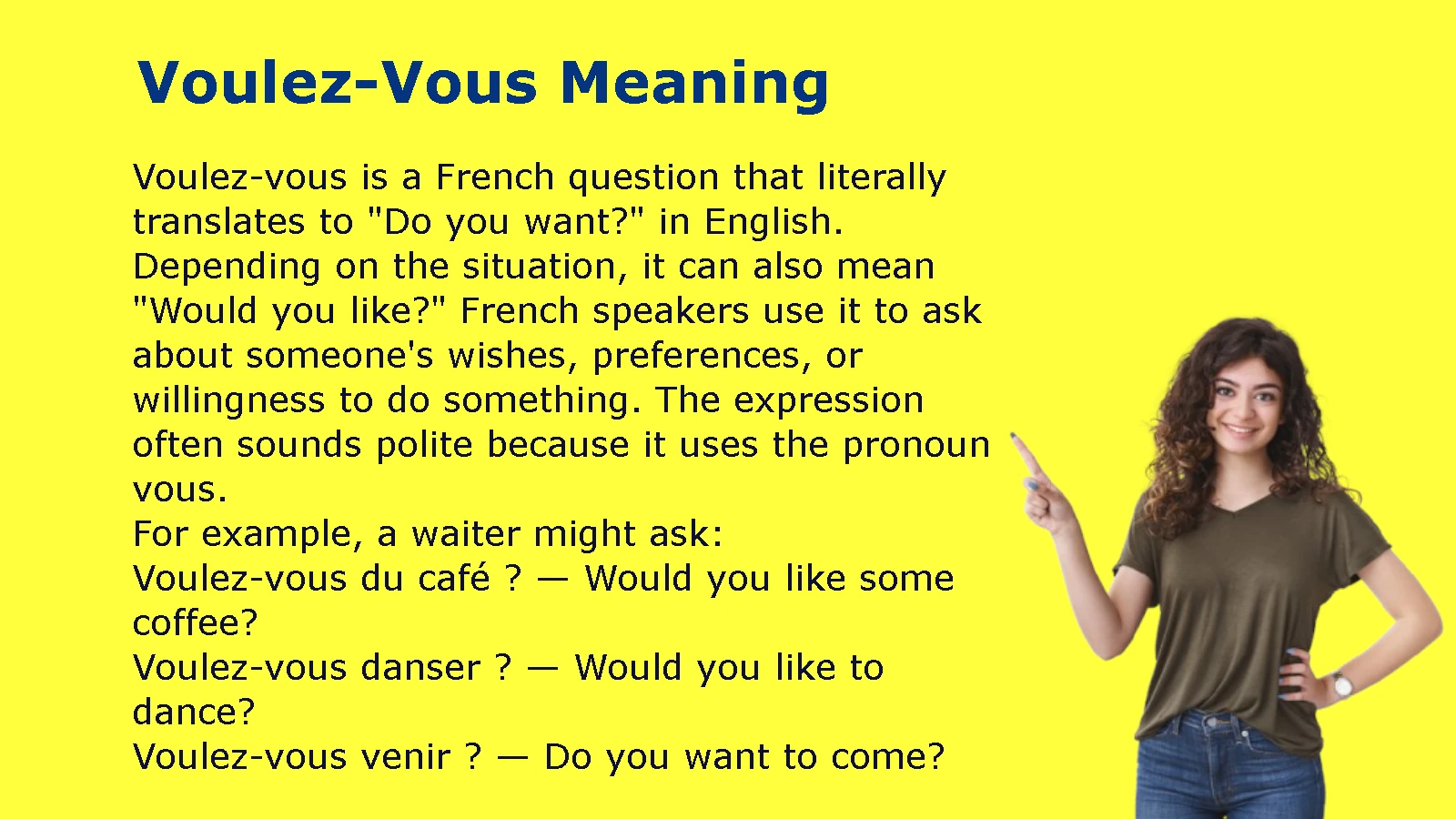
Voulez-vous is a French question that literally translates to “Do you want?” in English. Depending on the situation, it can also mean “Would you like?” French speakers use it to ask about someone’s wishes, preferences, or willingness to do something. The expression often sounds polite because it uses the pronoun vous.
For example, a waiter might ask:
- Voulez-vous du café ? — Would you like some coffee?
- Voulez-vous danser ? — Would you like to dance?
- Voulez-vous venir ? — Do you want to come?
The expression usually needs additional context to explain exactly what someone wants. The verb voulez communicates wanting, while the rest of the sentence identifies the object or action.
The Literal English Translation of Voulez-Vous
The two main English translations are:
- Do you want?
- Would you like?
The first translation stays closer to the original French structure. The second sounds more natural in many polite English conversations.
Consider this example:
French: Voulez-vous du thé ?
Literal English: Do you want some tea?
Natural English: Would you like some tea?
Both translations communicate the same basic request. However, the second sounds more courteous in a restaurant or formal setting.
The correct translation also depends on what follows the expression.
| French expression | English translation |
| Voulez-vous de l’eau ? | Would you like some water? |
| Voulez-vous un café ? | Would you like a coffee? |
| Voulez-vous sortir ? | Do you want to go out? |
| Voulez-vous essayer ? | Would you like to try? |
| Voulez-vous rester ? | Would you like to stay? |
One important distinction is that voulez-vous does not automatically express romance or attraction. Its tone comes from the surrounding words, the speaker’s intention, and the situation.
Is Voulez-Vous a French Phrase?
Yes. Voulez-vous is a standard French expression that uses an inverted question structure. French speakers place the conjugated verb before the subject pronoun to form certain questions.
For example:
- Vous voulez du café. — You want some coffee.
- Voulez-vous du café ? — Would you like some coffee?
Both sentences use the same main words. The difference lies in their structure and purpose.
The hyphen connects the verb and pronoun in the inverted question. Therefore, voulez-vous is the standard written form.
You may also encounter voulez vous without a hyphen in informal online searches, song-related searches, or text messages. However, standard French spelling uses the hyphen.
What Does Voulez Mean in French?
Voulez is a conjugated form of the French verb vouloir, which means “to want” or “to wish.”
It is the present-tense form used with vous. French speakers use it when addressing one person formally or speaking to multiple people.
Here is the present-tense conjugation of vouloir:
| French | English |
| Je veux | I want |
| Tu veux | You want (informal singular) |
| Il/Elle veut | they wants |
| Nous voulons | We want |
| Vous voulez | You want (formal singular or plural) |
| Ils/Elles veulent | They want |
Notice that voulez appears with vous, not tu.
For example:
- Tu veux manger ? — Do you want to eat?
- Vous voulez manger ? — Do you want to eat? (formal or plural)
- Voulez-vous manger ? — Would you like to eat?
The verb stays connected to the subject even when the sentence changes from a statement into a question.
What Does Vous Mean in French?
Vous is a French subject pronoun that means “you.” It has two main uses:
- Formal singular: Addressing one person politely.
- Plural: Addressing two or more people, regardless of formality.
French speakers commonly use vous with strangers, customers, older people, and professional contacts.
The informal singular pronoun is tu. People generally use it with friends, family members, children, and others with whom they share a familiar relationship.
Compare these examples:
| French | English | Usage |
| Tu veux danser ? | Do you want to dance? | Informal |
| Vous voulez danser ? | Would you like to dance? | Formal or plural |
| Voulez-vous danser ? | Would you like to dance? | Inverted question |
This distinction matters because voulez-vous can address either one person politely or a group of people.
How to Pronounce Voulez-Vous
The French expression voulez-vous is pronounced approximately voo-lay voo. Its International Phonetic Alphabet (IPA) transcription is /vu.le.vu/. It contains three syllables when spoken naturally: the two syllables in voulez followed by the syllable in vous. The pronunciation is relatively straightforward once you understand the French vowel sounds.
Voulez-Vous Pronunciation in English
English speakers can use the following breakdown:
- Vou: Pronounce it like “voo.”
- Lez: Pronounce it like “lay,” without a strong English Z sound.
- Vous: Pronounce it like “voo.”
The final expression should sound smooth rather than like three separate English words.
The emphasis stays fairly even across the phrase. French does not use the same strong word-by-word stress pattern that English speakers often expect.
How to Pronounce Voulez and Vous Separately
Understanding each word makes the complete expression easier to say.
Voulez: The first part contains the French sound /vu/, followed by /le/. The final written letters are not pronounced as a strong English Z.
Vous: This word contains the French vowel sound /u/. Keep your lips rounded while producing the sound.
A common mistake involves pronouncing the French U like the English “uh.” French /u/ sounds closer to the vowel in “food,” although the exact articulation should remain French.
Tips for Saying Voulez-Vous Naturally
Follow these simple pronunciation tips:
- Keep your lips rounded when saying both instances of the French /u/.
- Avoid adding an extra syllable at the end.
- Do not pronounce the final letters as a strong English Z.
- Connect the words smoothly.
- Listen to native French speakers to understand the natural rhythm.
Try practicing with these short expressions:
- Voulez-vous venir ?
- Voulez-vous manger ?
- Voulez-vous danser ?
- Voulez-vous parler français ?
Repeating complete sentences helps you learn the rhythm rather than memorizing isolated sounds.
How Voulez-Vous Is Used in French Sentences
In everyday French, voulez-vous introduces a question about someone’s wishes, preferences, or willingness. It often appears in polite requests, offers, and invitations. The expression does not have a fixed romantic meaning. Its purpose changes depending on the verb or noun that follows it.
Voulez-Vous in Everyday Conversations
French speakers use voulez-vous in many ordinary situations.
At a restaurant
A server might ask:
“Voulez-vous un dessert ?”
English: “Would you like a dessert?”
The question gives the customer an opportunity to accept or decline.
At someone’s home
A host might ask:
“Voulez-vous du café ?”
English: “Would you like some coffee?”
Here, the expression communicates a polite offer.
When making plans
Someone might ask:
“Voulez-vous venir avec nous ?”
English: “Would you like to come with us?”
The question asks whether another person wants to join an activity.
During a social event
A person might ask:
“Voulez-vous danser ?”
English: “Would you like to dance?”
This example is particularly relevant to ABBA’s song because dancing and social interaction form part of its nightclub atmosphere.
Examples of Voulez-Vous in French With English Translations
The following examples show how the expression works in different situations.
| French sentence | English meaning | Situation |
| Voulez-vous du café ? | Would you like some coffee? | Offering a drink |
| Voulez-vous danser ? | Would you like to dance? | Social invitation |
| Voulez-vous venir ? | Do you want to come? | Making plans |
| Voulez-vous manger ? | Would you like to eat? | Offering food |
| Voulez-vous essayer ? | Would you like to try? | Making a suggestion |
| Voulez-vous rester ? | Would you like to stay? | Offering hospitality |
| Voulez-vous m’aider ? | Would you like to help me? | Requesting assistance |
| Voulez-vous écouter ? | Would you like to listen? | Offering information or entertainment |
These examples demonstrate why context matters. The same opening expression can introduce questions about food, entertainment, travel, or personal preferences.
Is Voulez-Vous Formal or Informal?
Voulez-vous is generally polite or formal when addressing one person. It also works as a plural question when speaking to several people.
French speakers often choose between tu and vous based on their relationship with the listener.
Compare:
| Informal French | Formal French | English |
| Tu veux un café ? | Voulez-vous un café ? | Would you like coffee? |
| Tu veux sortir ? | Voulez-vous sortir ? | Do you want to go out? |
| Tu veux danser ? | Voulez-vous danser ? | Would you like to dance? |
However, French speakers do not always need inversion to ask questions. In conversation, they may say Vous voulez un café ? with a rising tone.
The inverted form voulez-vous often sounds more polished or deliberate, especially in formal questions.
What Does Voulez-Vous Mean in Greek?
The French expression voulez-vous translates into Greek as Θέλετε; (Thélete?), meaning “Do you want?” A more polite equivalent of “Would you like?” is Θα θέλατε; (Tha thé late?). Both expressions communicate a similar question, although their exact use depends on the situation and level of politeness.
Voulez-Vous Translation in Greek
Here are the main Greek equivalents:
| French | Greek | English |
| Voulez-vous ? | Θέλετε; | Do you want? |
| Voulez-vous du café ? | Θέλετε καφέ; | Would you like coffee? |
| Voulez-vous danser ? | Θέλετε να χορέψετε; | Would you like to dance? |
| Voulez-vous venir ? | Θέλετε να έρθετε; | Do you want to come? |
| Voulez-vous essayer ? | Θέλετε να δοκιμάσετε; | Would you like to try? |
Greek and French use different grammatical structures. Greek often uses a construction with να before another verb, while French can use the infinitive directly after voulez-vous.
For example:
- French: Voulez-vous danser ?
- Greek: Θέλετε να χορέψετε;
- English: Would you like to dance?
The translations communicate the same invitation without following identical word order.
Is Voulez-Vous a Greek or French Expression?
Voulez-vous is French, not Greek.
The confusion often comes from searching for the expression alongside Greek translations. People who speak Greek may want to understand the phrase from ABBA’s song or translate it into their native language.
The distinction is simple:
- Origin: French.
- Literal English meaning: Do you want?
- Greek equivalent: Θέλετε;
- Polite Greek equivalent: Θα θέλατε;
The expression keeps its French spelling and pronunciation regardless of the language used to explain it.
What Does Voulez-Vous Mean in ABBA’s Song?
ABBA’s “Voulez-Vous” uses the French expression as a playful question associated with attraction, dancing, and romantic anticipation. The song appeared in 1979 and became the title track of the Swedish group’s sixth studio album. Its energetic disco sound and memorable French chorus helped make the expression recognizable worldwide.
The Meaning Behind ABBA’s Voulez-Vous
ABBA released “Voulez-Vous” in 1979 during the height of the international disco era.
The song presents a nightclub encounter in which people meet, dance, observe one another, and consider whether to take a romantic chance.
Its central question, voulez-vous, works as an invitation. The song does not simply ask whether someone wants a particular object. Instead, it creates a playful atmosphere around attraction and possibility.
Several themes shape the song:
- Attraction: People notice one another in a lively social setting.
- Anticipation: The characters wonder whether a connection will develop.
- Confidence: The nightclub environment encourages people to take chances.
- Choice: The recurring question suggests that both people must decide whether to participate.
The French title adds a stylish international touch. It also fits the song’s energetic, dance-focused arrangement.
ABBA Voulez-Vous Lyrics English Meaning
People searching for ABBA Voulez-Vous lyrics English generally want to understand the message behind the French title and the English lyrics.
The song mainly explores the excitement of meeting someone in a nightclub. Its narrator describes an atmosphere filled with music, movement, and romantic possibilities. The repeated question creates suspense around whether two people will act on their attraction.
Rather than treating the song as a literal French-language conversation, it helps to understand its central message:
The song asks whether two people want to take a chance on a possible connection.
Its main ideas include:
| Song element | Meaning or interpretation |
| The French title | “Do you want?” or “Would you like?” |
| Nightclub setting | A place for social interaction and attraction |
| Repeated question | An invitation to make a choice |
| Disco rhythm | Energy, movement, and excitement |
| Romantic atmosphere | The possibility of a new connection |
The song’s English lyrics carry most of the narrative, while the French phrase gives its chorus a distinctive identity.
For readers looking for a complete English translation, a summary of the lyrics is more useful than treating the French title as the translation of every line. The title and the song’s full message are related, but they are not interchangeable.
What Does “La Question C’est Voulez-Vous” Mean?
The French expression “La question, c’est voulez-vous” can be translated as:
“The question is, do you want to?”
Here is the breakdown:
| French words | English meaning |
| La | The |
| Question | Question |
| C’est | It is / That’s |
| Voulez-vous | Do you want? |
The phrase reinforces the central idea of the song. The important issue is not simply what happens in the nightclub. It is whether the people involved want to take the next step.
This wording gives the chorus a direct, memorable quality.
Why Did ABBA Use a French Phrase for the Song Title?
French has a strong cultural association with romance, fashion, art, and sophisticated expression. International pop musicians have often used French words because they create a recognizable atmosphere without requiring listeners to understand the entire language.
ABBA’s choice works for several reasons:
- Memorability: The repeated French question is easy to recognize.
- Musical rhythm: The phrase fits the song’s rhythmic arrangement.
- International appeal: French gives the title a distinctive identity.
- Meaning: The question naturally connects to the song’s theme of attraction.
The group did not need to make the entire song French. Using one memorable expression was enough to establish its identity.
What Does Voulez-Vous Mean in Mamma Mia?
The phrase voulez-vous has the same French translation in Mamma Mia! as it does in everyday conversation. The song appears in the stage musical and the 2008 film adaptation. Its lively disco arrangement fits the musical’s celebratory atmosphere and connects the original ABBA recording with the story’s romantic themes.
Is Voulez-Vous Featured in Mamma Mia?
Yes. ABBA’s “Voulez-Vous” is part of the Mamma Mia! musical.
The stage musical premiered in London in 1999 and uses ABBA songs to support its story. The 2008 film adaptation also features the track during the celebratory events surrounding Sophie and her friends.
The song’s energetic rhythm makes it a natural fit for a scene involving dancing and social interaction.
It is important to distinguish three related things:
- ABBA’s original song: Released in 1979.
- Mamma Mia! stage musical: Uses ABBA’s music in a theatrical story.
- Mamma Mia! film: Adapts the musical into a movie with its own performances and scenes.
All three connect to the same underlying song, although the performances and presentation differ.
Does Voulez-Vous Have a Different Meaning in Mamma Mia?
No. The French phrase does not change its literal meaning in the musical.
It still means “Do you want?” or “Would you like?”
However, the setting influences how audiences interpret it. In Mamma Mia!, the song appears in a festive environment where characters celebrate, dance, and interact.
This makes the expression feel like a playful invitation rather than a formal question.
The distinction between literal meaning and contextual meaning is important. A phrase can retain its dictionary definition while taking on a more specific emotional meaning in a song or film.
What Does Voulez-Vous Coucher Avec Moi Mean?
Voulez-vous coucher avec moi ? translates to “Do you want to sleep with me?” in English. Although voulez-vous alone means “Do you want?” or “Would you like?”, adding coucher avec moi changes the expression into a direct and sexually suggestive invitation.
This longer expression has become widely recognized in popular culture, especially through the song “Lady Marmalade.”
What Does Coucher Mean in French?
Coucher is a French verb with several related meanings. Depending on its grammatical construction, it can mean to put someone to bed, lie down, or sleep.
Its reflexive form, se coucher, commonly means “to go to bed.”
Consider these examples:
| French expression | English meaning |
| Coucher un enfant | To put a child to bed |
| Se coucher | To go to bed |
| Je vais me coucher. | I’m going to bed. |
| Coucher avec quelqu’un | To sleep with someone |
| Une heure de coucher | Bedtime |
The phrase coucher avec quelqu’un can have a sexual meaning rather than simply describing the act of sleeping.
That difference becomes important when translating longer French expressions.
What Does Voulez-Vous Coucher Avec Moi Mean in English?
The complete expression breaks down as follows:
| French word | English meaning |
| Voulez | Want |
| Vous | You |
| Coucher | To sleep |
| Avec | With |
| Moi | Me |
Together, the words mean:
“Do you want to sleep with me?”
In ordinary English usage, this phrase usually carries a sexual implication.
It is much more direct than simply asking someone whether they want to dance, have dinner, or spend time together.
For example:
- Voulez-vous danser ? — Would you like to dance?
- Voulez-vous dîner ? — Would you like to have dinner?
- Voulez-vous coucher avec moi ? — Do you want to sleep with me?
The addition of coucher avec moi completely changes the tone.
Is Voulez-Vous Coucher Avec Moi a Romantic or Sexual Phrase?
The expression is primarily understood as a sexual proposition, although its interpretation can depend on context.
It does not simply mean that someone wants to spend the night at another person’s home. In many conversational and cultural settings, it directly suggests sexual intimacy.
The phrase became particularly famous through the 1974 song “Lady Marmalade”, originally recorded by Labelle.
That song helped introduce the French expression to a much wider English-speaking audience.
People sometimes confuse the phrase with ABBA’s “Voulez-Vous.” However, the two songs have different titles and themes.
- ABBA’s “Voulez-Vous” uses a short French question.
- “Lady Marmalade” features the longer, sexually suggestive expression.
- Both use French wording, but they are not the same song.
What Is the Difference Between Voulez-Vous and Voulez-Vous Coucher?
The difference comes from the additional verb and phrase.
| Expression | English meaning | Tone |
| Voulez-vous ? | Do you want? | Neutral or polite |
| Voulez-vous danser ? | Would you like to dance? | Social invitation |
| Voulez-vous coucher ? | Do you want to sleep? | Context-dependent |
| Voulez-vous coucher avec moi ? | Do you want to sleep with me? | Sexually suggestive |
This comparison shows why translating only the first two words can create confusion. The remaining words determine what the speaker actually wants.
What Does Voulez-Vous Rendezvous Mean?
The phrase voulez-vous rendezvous combines two French expressions, but it is not a natural standalone construction in standard French. Voulez-vous means “Do you want?” while rendez-vous means “appointment,” “meeting,” or sometimes “date.” A grammatically clearer sentence uses an appropriate verb to express the intention to meet.
What Does Rendez-Vous Mean in French?
Rendez-vous is a French noun that refers to an arranged meeting or appointment.
English speakers also use the word, especially when referring to romantic meetings or planned encounters.
Its meaning depends on the context.
| Expression | English meaning |
| Un rendez-vous | An appointment |
| Un rendez-vous médical | A medical appointment |
| Un rendez-vous professionnel | A business meeting |
| Un rendez-vous amoureux | A romantic date |
| Prendre rendez-vous | To make an appointment |
The word does not always refer to romance.
For example, a person might say:
“J’ai rendez-vous chez le médecin.”
English: “I have a doctor’s appointment.”
In another situation, rendez-vous might describe a planned meeting between two people who are dating.
Is Voulez-Vous Rendezvous Correct French?
Not usually as a complete sentence.
The issue is that rendez-vous functions as a noun, while voulez-vous needs a suitable complement to complete the question.
For example:
- Voulez-vous un rendez-vous ? — Would you like an appointment?
- Voulez-vous me rencontrer ? — Would you like to meet me?
- Voulez-vous prendre rendez-vous ? — Would you like to make an appointment?
These alternatives communicate different intentions.
The first asks whether someone wants an appointment. The second asks whether they want to meet. The third asks whether they want to arrange a meeting.
Examples of French Expressions About Meeting Someone
Here are several useful alternatives:
| French expression | English translation |
| Voulez-vous me rencontrer ? | Would you like to meet me? |
| Voulez-vous sortir avec moi ? | Would you like to go out with me? |
| Avez-vous rendez-vous ? | Do you have an appointment? |
| Voulez-vous prendre rendez-vous ? | Would you like to make an appointment? |
| On peut se voir demain ? | Can we see each other tomorrow? |
These examples help distinguish a casual meeting from a formal appointment or romantic invitation.
What Does Chiquitita Mean in ABBA’s Song?
Chiquitita is a Spanish word that means “little girl” or “little one.” It is an affectionate feminine form derived from chica, meaning “girl.” ABBA used the word as the title of its 1979 song, which explores themes of sadness, friendship, comfort, and emotional encouragement.
Chiquitita Meaning in English
The Spanish word chiquitita is a feminine diminutive.
It comes from the idea of something or someone being small, young, or little.
Its meaning can include:
- Little girl.
- Little one.
- Dear girl.
- Little sweetheart.
The exact translation depends on the relationship between the speaker and the person being addressed.
The word can express affection rather than simply describing physical size.
For example, a Spanish speaker might use an affectionate diminutive when talking to a child or someone close to them.
The masculine counterpart is chiquitito.
| Spanish word | English meaning |
| Chico | Boy |
| Chica | Girl |
| Chiquito | Little boy or little one |
| Chiquita | Little girl |
| Chiquitito | Little boy or little one |
| Chiquitita | Little girl or affectionate little one |
What Is ABBA’s Chiquitita Song About?
ABBA released “Chiquitita” in 1979. The song appears on the group’s Voulez-Vous album.
Unlike “Voulez-Vous,” which explores attraction and nightclub excitement, “Chiquitita” focuses on emotional support.
Its narrator addresses someone who appears unhappy or troubled. The song offers reassurance and encourages that person to talk about their feelings rather than face their problems alone.
Its main themes include:
- Friendship: Supporting someone during a difficult period.
- Comfort: Offering reassurance when another person feels sad.
- Hope: Encouraging someone to believe that difficult times can improve.
- Emotional connection: Showing care through understanding and encouragement.
The contrast between the two ABBA songs makes their titles especially interesting.
“Voulez-Vous” revolves around a question about desire, while “Chiquitita” uses an affectionate Spanish expression to address someone who needs support.
Is Chiquitita French or Spanish?
Chiquitita is Spanish, not French.
Although both Chiquitita and Voulez-Vous appear in ABBA’s music catalog, they come from different languages.
| Word or phrase | Language | Meaning |
| Voulez-vous | French | Do you want? |
| Chiquitita | Spanish | Little girl or little one |
| Coucher | French | To lie down or sleep |
| Rendez-vous | French | Appointment or meeting |
The two ABBA song titles show how the group used expressions from different languages to create memorable international pop music.
Are There Other Songs Called Voulez-Vous Besides ABBA’s?
Yes, the French expression is not exclusive to ABBA. Since voulez-vous is an ordinary French question, other musicians can use it as a song title or include it in their lyrics. However, identifying a particular non-ABBA song requires additional information, such as the artist, genre, album, or a line from the recording.
Voulez-Vous Songs by Other Artists
The phrase has a natural appeal as a song title because it is short, recognizable, and easy to associate with a question or invitation.
Artists working in different genres can use the same expression without copying ABBA’s song or its musical meaning.
When comparing tracks with identical titles, consider:
- Artist or performer.
- Release year.
- Album name.
- Musical genre.
- Lyrics and overall theme.
- Recording or performance style.
These details help distinguish different recordings.
How to Find the Voulez-Vous Song That Is Not by ABBA
If you are searching for a song called “Voulez-Vous” but do not mean the ABBA track, use more specific search terms.
For example:
- “Voulez-Vous song” followed by the artist’s name.
- “Voulez-Vous” with the album title.
- “Voulez-Vous” followed by a remembered lyric.
- “Voulez-Vous” with the genre or approximate release year.
You can also search a short lyric fragment in a music-identification service.
The important point is that a shared title does not establish that two songs have the same lyrics, artist, or meaning.
Why Do Different Artists Use the Same Song Title?
Song titles are not unique identifiers. Musicians frequently choose common words, questions, expressions, and short phrases because they communicate an idea quickly.
French expressions can also create a distinctive sound in international music.
“Voulez-Vous” works particularly well because it:
- Sounds rhythmic and memorable.
- Has a recognizable meaning.
- Suggests a question or invitation.
- Fits several musical themes.
- Is short enough to work as a title or chorus phrase.
Therefore, finding another song with this title would not be surprising.
Common Misunderstandings About Voulez-Vous
The phrase often causes confusion because people encounter it in different contexts. Some see it in a French lesson, others hear it in an ABBA song, and some recognize it from famous expressions in popular music. Understanding its grammar prevents these meanings from becoming mixed together.
Does Voulez-Vous Always Mean Something Romantic?
No. The basic expression is neutral.
It means “Do you want?” or “Would you like?” A person can use it when offering food, asking about plans, or inviting someone to participate in an activity.
For example:
- Voulez-vous du thé ? — Would you like tea?
- Voulez-vous travailler ? — Do you want to work?
- Voulez-vous danser ? — Would you like to dance?
The phrase becomes romantic only when the surrounding context gives it that meaning.
Is Voulez-Vous a Sexual Expression?
Not by itself.
The expression does not contain an explicit sexual meaning. It simply asks whether someone wants something.
However, longer expressions can change its meaning.
For example, voulez-vous coucher avec moi is a sexually suggestive question because the words coucher avec moi introduce the idea of sleeping with the speaker.
This is why it is important to understand the complete sentence rather than translating only its first two words.
Is Voulez Vous Correct Without a Hyphen?
In standard French writing, the correct form is voulez-vous, with a hyphen between the verb and the subject pronoun.
French uses this hyphen in inverted questions.
Compare:
- Statement: Vous voulez danser.
- Inverted question: Voulez-vous danser ?
The first sentence means “You want to dance.” The second means “Would you like to dance?”
Although search engines and casual messages often display voulez vous, the hyphenated version is the standard spelling.
Does Voulez-Vous Mean I Love You?
No. Voulez-vous does not mean “I love you.”
The two expressions have completely different meanings.
| French expression | English meaning |
| Voulez-vous ? | Do you want? |
| Je t’aime. | I love you. |
| Je vous aime. | I love you. (formal or plural) |
| Tu me plais. | I like you / I’m attracted to you. |
| Voulez-vous danser ? | Would you like to dance? |
The confusion may come from the romantic themes associated with ABBA’s song. However, its title is a question about wanting, not a declaration of love.
Is Voulez-Vous the Same as Rendez-Vous?
No. Both expressions come from French, but they perform different grammatical functions.
Voulez-vous is a question formed from a verb and a subject pronoun. It asks whether someone wants something.
Rendez-vous is a noun that refers to a meeting, appointment, or date.
For example:
- Voulez-vous sortir ? — Would you like to go out?
- Avez-vous un rendez-vous ? — Do you have an appointment?
Understanding this distinction helps prevent incorrect combinations and translations.
Conclusion: Understanding the True Voulez-Vous Meaning
The voulez vous meaning is simple: “Do you want?” or “Would you like?” in French. The expression combines the verb vouloir with the pronoun vous to create a polite or plural question.
However, its meaning becomes more interesting when you explore how people use it. In everyday French, it can introduce ordinary offers and invitations. In ABBA’s 1979 disco hit, it becomes a playful question associated with attraction and romantic possibilities. Adding words such as coucher avec moi creates a much more suggestive expression.
You should also remember the differences between the related terms:
- Voulez-vous: Do you want?
- Voulez: A conjugated form of the French verb vouloir.
- Coucher: To lie down, put to bed, or sleep.
- Rendez-vous: An appointment or meeting.
- Chiquitita: A Spanish term meaning little girl or little one.
Whether you discovered the phrase through ABBA, Mamma Mia!, a French lesson, or a translation search, understanding its grammar and context gives you a much clearer picture of its meaning.