Have you ever heard the word “defenestration” and wondered why it sounds so strange? While Defenestration Meaning may seem complicated at first, the word has a surprisingly simple definition. It refers to the act of throwing someone or something out of a window.
Defenestration is a noun that describes the act of throwing a person or object through a window. The word can be used literally, but it can also appear in humorous or figurative contexts when someone wants to describe a dramatic removal or rejection.
Examples:
- The angry man threatened defenestration after the argument.
- The historical event became famous for its act of defenestration.
The confusion is understandable. People often search for what does defenestration mean, defenestration definition, defenestration meaning in English, or how to use defenestration in a sentence because this unusual word isn’t part of everyday vocabulary. And here’s the kicker: despite its bizarre sound, its meaning is remarkably direct.
In this guide, you’ll learn the complete Defenestration Meaning, its definition, pronunciation, origin, correct usage, and examples in sentences. You’ll also discover where the word came from, how it became associated with historical events, and how to use defenestration correctly in everyday writing.
What Does Defenestration Mean?
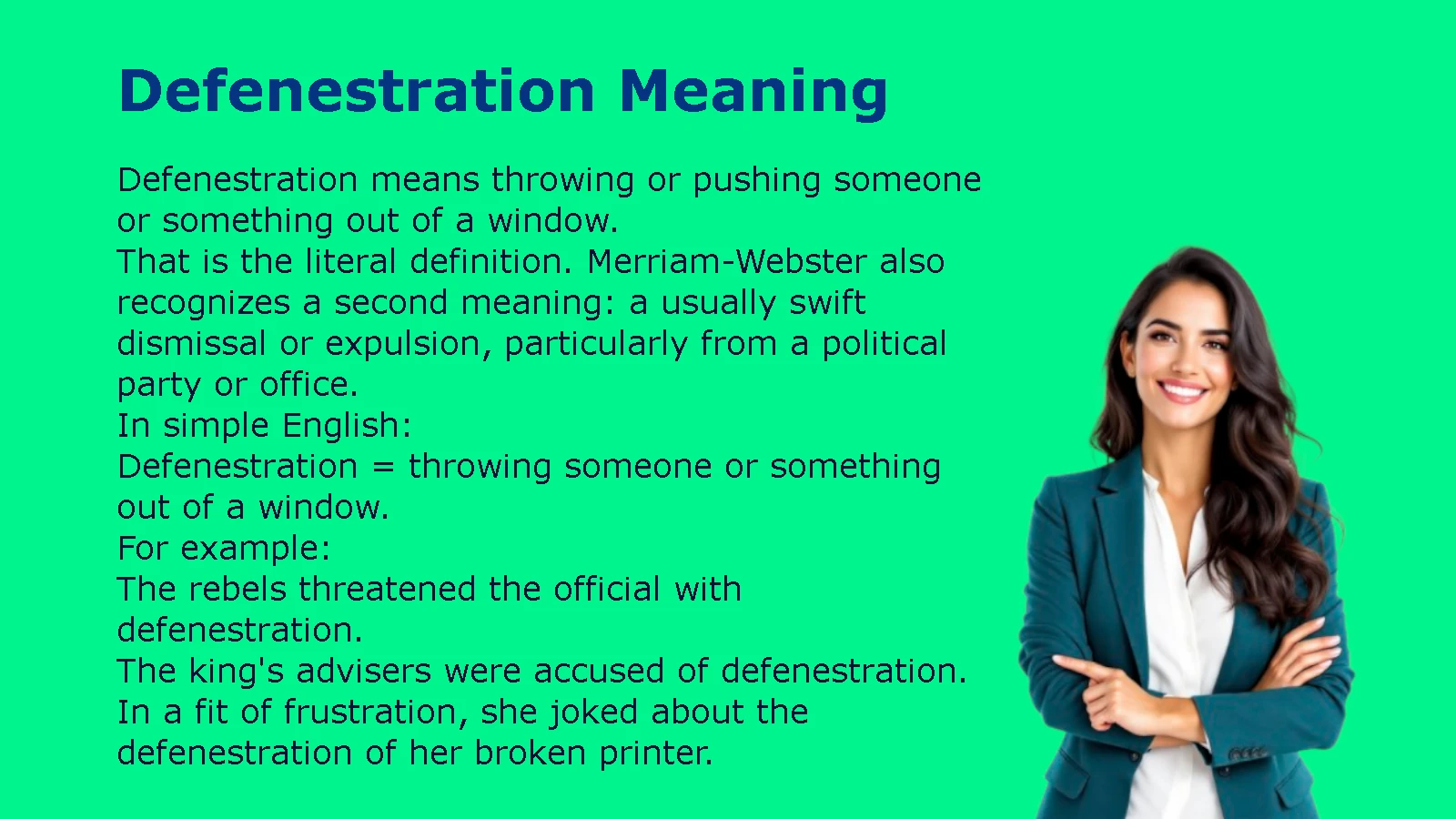
Defenestration means throwing or pushing someone or something out of a window.
That is the literal definition. Merriam-Webster also recognizes a second meaning: a usually swift dismissal or expulsion, particularly from a political party or office.
In simple English:
Defenestration = throwing someone or something out of a window.
For example:
- The rebels threatened the official with defenestration.
- The king’s advisers were accused of defenestration.
- In a fit of frustration, she joked about the defenestration of her broken printer.
The first sentence uses the word in its literal historical sense. The last one uses it humorously.
The important detail is the window. If someone simply removes another person from a building, that isn’t defenestration. If a manager fires an employee, the literal meaning doesn’t apply. However, modern English sometimes uses defenestration figuratively for a dramatic removal from power.
Defenestration Definition in Simple English
If you want the shortest possible explanation, remember this:
Defenestration is the act of throwing or pushing someone or something out of a window.
In political writing, however, it can mean forcing someone out of a position of power or influence. Cambridge specifically identifies this humorous British usage for forcing someone, especially a leader, out of a job.
Defenestration Pronunciation
The standard pronunciation of defenestration is:
dee-fen-uh-STRAY-shun
Cambridge gives the US and UK pronunciation as:
/ˌdiː.fen.ɪˈstreɪ.ʃən/
The main stress falls on STRAY.
You can break the word into these parts:
de + fen + es + tra + tion
Or, more naturally:
dee-FEN-uh-STRAY-shun
The word contains five syllables, although the unstressed middle sounds can blend together when spoken quickly.
How to Pronounce Defenestration
Try saying it in stages:
- dee
- fen
- uh
- STRAY
- shun
Put them together:
dee-fen-uh-STRAY-shun
The tricky part isn’t the beginning. It’s the middle. Once you get used to fenestration, the pronunciation becomes much easier.
The related verb defenestrate is pronounced approximately:
dee-FEN-uh-strayt
Cambridge lists the US pronunciation as /ˌdiːˈfen.ɪ.streɪt/.
Defenestration Definition and Part of Speech
Defenestration is a noun.
It names an action or event rather than describing the person performing the action.
The related verb is defenestrate, which means to throw or push someone out of a window. Cambridge identifies defenestrate as a transitive verb.
Here’s the difference:
| Word | Part of Speech | Meaning |
| Defenestration | Noun | The act of throwing or pushing someone or something out of a window |
| Defenestrate | Verb | To throw or push someone or something out of a window |
| Defenestrated | Past participle/past tense | Threw or was thrown out of a window |
| Defenestrating | Present participle | Throwing someone or something out of a window |
Compare these sentences:
- They defenestrated the prisoner.
- The prisoner’s defenestration became a subject of historical debate.
The first sentence describes the action with a verb. The second names the action with a noun.
Defenestrate vs. Defenestration
These two words are closely related, but they don’t perform the same grammatical job.
Defenestrate is the action:
The rebels defenestrated the officials.
Defenestration is the event or act:
The officials’ defenestration shocked the city.
A useful shortcut is:
defenestrate = do it
defenestration = the act of doing it
The distinction becomes especially useful in historical writing because historians often discuss a defenestration as an event.
Defenestration Origin and Etymology
The origin of defenestration is remarkably straightforward once you know a little Latin.
The word comes from de- plus the Latin fenestra, meaning “window.” Merriam-Webster gives the etymology as de- + Latin fenestra and records the first known English use of defenestration in 1619.
Etymonline dates the noun to around 1620 and likewise connects it with Latin fenestra, “window.”
The history behind the word is especially interesting because the English term appeared around the same period as one of the most famous acts that inspired its historical association: the 1618 Defenestration of Prague.
So the word wasn’t invented to describe an ordinary household mishap. Its early history is tied to a major political conflict.
What Does Fenestra Mean?
The Latin word fenestra means “window” or an opening that admits light.
That same root appears in other English vocabulary.
For example, fenestration refers to the arrangement or design of windows and doors in architecture. In specialized fields, it can also describe an opening in a surface.
This gives you an easy way to remember the vocabulary:
| Word | Meaning |
| Fenestra | Latin for “window” |
| Fenestration | Arrangement or design of windows and doors |
| Defenestrate | Throw or push out of a window |
| Defenestration | The act of throwing or pushing out of a window |
The shared fenestr- element is the giveaway. If you see it, think window or opening.
History of Defenestration
The word’s history is closely connected with political violence in Central Europe, especially Prague.
The most famous examples are known as the Defenestrations of Prague. These events involved political and religious conflict in Bohemia, a historical region of Central Europe.
The best-known incident occurred in 1618, when Bohemian Protestant nobles threw imperial representatives from a window at Prague Castle. The incident helped trigger the Bohemian Revolt, which developed into the wider Thirty Years’ War.
The word therefore carries an unusual historical image. Many political disputes involve speeches, votes, arrests, or battles. These disputes involved windows.
And not just metaphorical windows.
The Defenestrations of Prague
The phrase Defenestration of Prague can be confusing because historians use it for more than one event.
Prague experienced several political defenestrations, with major episodes occurring in 1419 and 1618. Merriam-Webster notes that the 1618 event was actually the third historical defenestration in Prague, although it was the first one to be referred to as such by English speakers.
That distinction matters because you may see different numbering systems in historical sources.
The events weren’t simply random acts of violence. They emerged from serious political, religious, and constitutional conflicts.
The First Defenestration of Prague
The First Defenestration of Prague took place in 1419.
The event occurred during growing religious and political tension in Bohemia. Followers of the reformer Jan Hus had become increasingly dissatisfied with the Catholic establishment and the political authorities.
On July 30, 1419, a group of Hussites led by the preacher Jan Želivský marched through Prague. The confrontation escalated at the New Town Hall.
Several town councilors were thrown from a window.
The event helped ignite the Hussite Wars, a series of conflicts that lasted from 1419 to 1434.
This is a crucial historical example because it demonstrates the literal meaning of defenestration. The word isn’t merely a clever modern invention for firing someone from a job. Its historical roots involve people physically being thrown from windows during political struggles.
Why the First Defenestration Mattered
The significance of the 1419 event goes beyond the dramatic method.
It represented a major breakdown in political and religious relations. The act helped transform existing tensions into open conflict.
In other words, the window was the dramatic moment. The real story was the conflict behind it.
That distinction helps explain why historians continue to use the term. Defenestration identifies a striking event, but the surrounding political circumstances explain why the event happened.
The Second Defenestration of Prague
The Second Defenestration of Prague took place on May 23, 1618.
This is the incident most closely associated with the word in English language dictionaries and popular history.
Bohemian Protestant nobles were angry about restrictions on their religious rights and the policies of the Catholic Habsburg authorities. Tensions reached a breaking point at Prague Castle.
The nobles confronted several imperial representatives.
Two imperial governors, Jaroslav Bořita of Martinice and Vilém Slavata of Chlum, along with their secretary Philipp Fabricius, were thrown from a castle window.
They survived the fall.
Merriam-Webster describes the drop as roughly 50 feet and notes that the men landed in a moat.
The survival of the victims became part of the event’s mythology.
Catholic accounts attributed the survival to divine intervention. Protestant interpretations offered different explanations. One commonly repeated explanation points to the soft material below the window, while other accounts emphasize the physical circumstances of the fall.
Whatever explanation you accept, the political consequences were far more important than the mechanics of the landing.
The Defenestration That Helped Start a War
The 1618 defenestration became a turning point in the Bohemian Revolt.
The revolt eventually formed part of the larger Thirty Years’ War, which lasted from 1618 to 1648. HISTORY describes the conflict as a major 17th century European war that caused enormous loss of life through fighting, famine, and disease.
That makes the word’s history unusually memorable.
A single word about throwing someone through a window is connected to one of the most destructive conflicts in early modern European history.
A Historical Case Study: Prague in 1618
The 1618 event is worth examining as a compact case study because it shows exactly how defenestration moved from a literal action into a political symbol.
The situation
Bohemian Protestant nobles feared that their religious rights were being restricted under the Habsburg monarchy.
The confrontation
They confronted representatives of the imperial government at Prague Castle.
The act
Three officials were thrown from a window.
The immediate result
The incident became a decisive moment in the Bohemian Revolt.
The larger consequence
The revolt became the opening stage of the Thirty Years’ War.
This sequence demonstrates an important point: defenestration itself didn’t cause the entire Thirty Years’ War. It was a dramatic catalyst within a much larger network of religious, political, and dynastic conflicts.
That distinction prevents the history from becoming too simplistic.
Defenestration in Modern English
Modern English uses defenestration in both literal and figurative ways.
The literal meaning remains straightforward: throwing or pushing someone or something out of a window.
However, the figurative meaning has become especially useful in political and organizational writing.
Merriam-Webster defines the figurative sense as a usually swift dismissal or expulsion, such as from political office or a political party.
Cambridge also recognizes a humorous use involving forcing someone, especially a leader, out of a job.
This produces sentences such as:
- The minister’s sudden defenestration shocked the party.
- The board’s defenestration of the CEO ended months of internal conflict.
- After losing support, the chairman faced political defenestration.
No one necessarily expects a window to be involved.
That’s the joke.
The writer borrows the violent literal image and applies it to a political or professional removal.
Is Defenestration Always Literal?
No.
Defenestration has both literal and figurative uses.
The literal meaning refers to an actual person or object being thrown or pushed through a window.
The figurative meaning refers to someone being abruptly removed from a position, organization, or sphere of influence.
| Context | Meaning | Example |
| Literal | Thrown or pushed out of a window | The prisoner faced defenestration. |
| Historical | A political act involving a window | The Defenestration of Prague changed European history. |
| Political | Removed from power | The leader’s defenestration followed a party revolt. |
| Workplace | Abruptly removed from a position | The executive’s defenestration surprised investors. |
| Humorous | Playfully thrown out or discarded | The broken laptop narrowly avoided defenestration. |
The figurative meaning isn’t merely an internet joke. It appears in serious modern writing as well. Merriam-Webster’s usage examples include references to political figures and organizational removals.
Defenestration Examples in a Sentence
Here are original examples showing the word in different contexts.
Historical Examples
The 1618 defenestration of Prague became a turning point in the Bohemian Revolt.
This sentence uses the word in its classic historical sense.
Historians still debate the circumstances surrounding the officials’ defenestration.
Here, defenestration functions as a noun referring to the act itself.
Literal Modern Examples
The novel describes the villain’s dramatic defenestration from a castle tower.
The prisoner threatened his captor with defenestration.
These examples retain the literal window related meaning.
Humorous Examples
After the printer jammed for the sixth time, its owner joked about defenestration.
The alarm clock’s constant buzzing nearly resulted in defenestration.
The humor comes from using an extremely formal word for a mundane act.
Nobody needs to say “I might throw this alarm clock out the window.” Saying “this alarm clock is facing defenestration” makes the sentence sound dramatically overqualified.
That’s part of the word’s modern appeal.
Defenestration Examples in Political Writing
The figurative sense is especially useful when discussing the sudden removal of a powerful person.
For example:
The party’s internal rebellion led to the leader’s political defenestration.
Here, nobody is being thrown through a window. The phrase means that the leader was forced out of power.
This usage works because the original image is so vivid. A normal word such as dismissal tells you someone lost a position. Defenestration suggests a sudden, dramatic, and possibly ruthless removal.
Merriam-Webster’s recent usage examples show this figurative sense in political, corporate, and institutional contexts.
Why Writers Use the Figurative Meaning
The word can add several shades of meaning:
- Suddenness
- Force
- Political conflict
- Humiliation
- Finality
- Dramatic removal
Compare:
The board dismissed the executive.
with:
The board defenestrated the executive.
The first is neutral and administrative.
The second sounds like the board didn’t simply hand over a termination letter. It grabbed the executive by the metaphorical collar and sent the person flying.
That dramatic quality is precisely why journalists and commentators sometimes choose the word.
Defenestration vs. Ejection
Defenestration and ejection overlap, but they aren’t exact synonyms.
| Word | Meaning | Does a Window Matter? |
| Defenestration | Throwing or pushing out of a window | Yes |
| Ejection | Forcing someone or something out | No |
| Expulsion | Forcing someone to leave a place or organization | No |
| Dismissal | Removing someone from a job or position | No |
| Ousting | Forcing someone out of power or a position | No |
| Removal | Taking someone or something away | No |
If the window matters, defenestration is the precise term.
If the window doesn’t matter, another word will usually sound more natural.
For example:
- The employee was dismissed. ✓
- The employee was ousted. ✓
- The employee was defenestrated. ✓, figurative and dramatic
- The employee was literally defenestrated. This means something completely different and much more serious.
Can Defenestration Refer to Objects?
Yes.
Although historical examples often involve people, the literal definition also includes things.
Merriam-Webster defines defenestration as the throwing of a person or thing out of a window.
For example:
- The old chair suffered accidental defenestration.
- The broken television met an unfortunate fate by defenestration.
- The frustrated programmer joked about the defenestration of his malfunctioning computer.
This broader meaning makes the word useful in humorous writing.
Still, context matters. If you write that a person experienced “defenestration,” readers will normally understand that something serious happened. If you use it for an object, the tone may be playful.
Is Defenestration a Real Word?
Yes. Defenestration is a genuine English word with a documented history.
Merriam-Webster records its first known use in 1619 and traces it to de- plus Latin fenestra, meaning “window.”
The word may look like something invented for a vocabulary quiz, but it has been part of English for centuries.
Its unusual appearance comes partly from its Latin construction. English has borrowed thousands of Latin words, and some retained structures that feel unfamiliar to modern readers.
Defenestration simply happens to be one of the stranger-looking examples.
Why Does Defenestration Sound So Strange?
The word feels unusual because English has simpler expressions for the same literal action.
Most people would say:
“throw someone out of a window.”
Very few people would casually say:
“The defenestration occurred at noon.”
Yet that’s exactly what makes the word memorable.
It compresses an entire phrase into one noun.
Instead of saying:
“the act of throwing a person out of a window”
you can say:
“defenestration.”
This is one reason specialized vocabulary can survive even when everyday speakers prefer simpler phrases.
Defenestration and the Word “Fenestration”
Don’t confuse defenestration with fenestration.
They share the Latin root fenestra, but their meanings are very different.
Fenestration generally concerns windows and openings, especially their arrangement or design in architecture. Merriam-Webster defines architectural fenestration as the arrangement, proportioning, and design of windows and doors in a building.
Defenestration, on the other hand, concerns throwing or pushing something out of a window.
A simple memory trick:
fenestration = windows
defenestration = out the window
The prefix de- helps distinguish the two.
A Note About the Famous Prague Events
It’s tempting to assume that the 1618 event was the only defenestration in Prague.
It wasn’t.
The city had already witnessed a major defenestration in 1419. Merriam-Webster notes that the 1618 event was historically the third such Prague defenestration, although English speakers first used the term for the 1618 episode.
This explains why different sources may use slightly different labels.
When reading about Prague, pay attention to the year rather than relying solely on “first,” “second,” or “third.”
The two dates most important for understanding the word are:
- 1419 — First Defenestration of Prague
- 1618 — Second Defenestration of Prague and the event most strongly associated with the English word
The 1618 Defenestration and the Thirty Years’ War
The relationship between the 1618 event and the Thirty Years’ War deserves careful wording.
The defenestration did not single-handedly create every cause of the war. Europe already faced deep religious, political, and dynastic tensions.
However, the event became a crucial trigger for the Bohemian Revolt, which formed the opening phase of the Thirty Years’ War. HISTORY identifies the 1618 revolt as the beginning of open rebellion in the Bohemian states and the start of the wider conflict.
The war eventually spread across much of Central Europe and lasted until 1648.
So when a dictionary mentions Prague in its explanation of defenestration, that reference isn’t decorative trivia. It points to one of the word’s most important historical contexts.
Defenestration in Modern Political Language
The figurative meaning has become particularly useful for describing political turnover.
A politician can be defenestrated without ever going near a window.
For instance:
The party’s leadership revolt led to the prime minister’s political defenestration.
This means the prime minister was forced from power.
Cambridge identifies this kind of use as humorous, particularly when describing the removal of a leader from a job.
Merriam-Webster takes the figurative sense more broadly, defining it as a usually swift dismissal or expulsion from a political party or office.
The word therefore occupies an interesting space between formal vocabulary and dark humor.
It’s serious enough for political commentary, yet vivid enough to make a sentence memorable.
Common Mistakes About Defenestration
Mistake: Thinking it only means murder
Defenestration does not automatically mean murder.
The core definition describes the act of throwing or pushing someone or something out of a window. The outcome isn’t built into the word itself.
A historical defenestration might result in death, injury, or survival.
Mistake: Assuming it always involves a person
It can involve a person or a thing.
An object thrown through a window can also be described as undergoing defenestration.
Mistake: Treating it as only a historical word
The word has a long historical association with Prague, but modern dictionaries recognize figurative contemporary usage as well.
Mistake: Using it as a synonym for every kind of firing
Not every dismissal is a defenestration.
The figurative meaning suggests a forceful or abrupt removal, often from a position of influence or authority.
Mistake: Confusing defenestration with fenestration
Fenestration concerns windows or openings.
Defenestration concerns throwing something out of a window.
That one prefix changes everything.
Defenestration Meaning: Quick Reference Table
| Detail | Answer |
| Word | Defenestration |
| Part of speech | Noun |
| Literal meaning | Throwing or pushing a person or thing out of a window |
| Figurative meaning | Swift dismissal or removal from a position |
| Related verb | Defenestrate |
| Pronunciation | dee-fen-uh-STRAY-shun |
| US IPA | /ˌdiː.fen.ɪˈstreɪ.ʃən/ |
| Key Latin root | fenestra |
| Latin meaning | Window |
| First known English use | 1619 |
| Famous historical association | Defenestrations of Prague |
| Major Prague dates | 1419 and 1618 |
| Modern use | History, politics, journalism, literature, and humor |
The first known use date comes from Merriam-Webster, while the pronunciation comes from Cambridge.
Defenestration Facts
Here are the most useful facts to remember:
- Defenestration is a noun.
- It literally means throwing or pushing someone or something out of a window.
- Defenestrate is the corresponding verb.
- The word comes from Latin fenestra, meaning “window.”
- Merriam-Webster records the first known English use in 1619.
- The 1419 Defenestration of Prague helped trigger the Hussite Wars.
- The 1618 Defenestration of Prague helped trigger the Bohemian Revolt.
- The 1618 revolt became part of the Thirty Years’ War, which lasted from 1618 to 1648.
- The 1618 officials thrown from Prague Castle survived the fall.
- Modern English also uses defenestration figuratively for sudden political or professional removal.
Frequently Asked Questions About Defenestration Meaning
What does defenestration mean?
Defenestration means the act of throwing or pushing someone or something out of a window. It can also mean the sudden removal of someone from a political position, organization, or other position of influence.
What does defenestrate mean?
Defenestrate is the verb form. It means to throw or push someone out of a window. It can also be used humorously to mean forcing someone, especially a leader, out of a job.
How do you pronounce defenestration?
The word is pronounced approximately dee-fen-uh-STRAY-shun. Cambridge gives the pronunciation /ˌdiː.fen.ɪˈstreɪ.ʃən/.
Is defenestration a noun or a verb?
Defenestration is a noun. The related verb is defenestrate.
Where does the word defenestration come from?
The word comes from de- plus the Latin fenestra, meaning “window.” Merriam-Webster records its first known English use in 1619.
Why is Prague associated with defenestration?
Prague experienced several famous political incidents in which people were thrown from windows. The 1419 and 1618 events are particularly important. The 1618 incident helped launch the Bohemian Revolt and became an opening event of the Thirty Years’ War.
Can defenestration refer to an object?
Yes. The literal definition includes both people and things. Throwing an object through a window can therefore be described as defenestration.
Is defenestration still used today?
Yes. Although it isn’t an everyday word, modern writers use it in historical, political, journalistic, literary, and humorous contexts. Its figurative meaning often describes the abrupt removal of someone from a position of power.
Is defenestration always literal?
No. The literal meaning involves a window. The figurative meaning describes a forceful or sudden removal from a position, such as political office.
What is a synonym for defenestration?
For the literal meaning, phrases such as throwing out of a window or throwing from a window are the closest alternatives.
For the figurative meaning, words such as dismissal, ousting, expulsion, removal, and ejection can work depending on context. None captures every shade of meaning.
Final Takeaway: Defenestration Meaning
Defenestration means throwing or pushing someone or something out of a window. That’s the core definition.
The word becomes even more interesting when you look at its history. It comes from the Latin fenestra, meaning “window,” and entered English around the early 17th century. Merriam-Webster records 1619 as its first known use.
Its strongest historical association is with the Defenestrations of Prague, especially the 1618 incident in which three imperial officials were thrown from a window at Prague Castle. The event helped trigger the Bohemian Revolt and became part of the chain of events that led to the Thirty Years’ War.
Today, defenestration has another useful life. Writers can use it figuratively for the abrupt removal of a politician, executive, leader, or other influential person.
So if you want one memory trick, keep it simple:
Defenestration = out the window.
Whether the word describes a literal fall from a castle window or a politician’s sudden fall from power, the window remains at the heart of the word.