Cornball meaning refers to someone or something that seems cheesy, corny, overly sentimental, predictable, or uncool. In everyday American slang, people use cornball to describe a person who makes awkward jokes, acts overly romantic, says something embarrassing, or tries too hard to be funny. The word can sound insulting, but friends also use it as playful teasing.
You may encounter cornball slang on TikTok, Reddit, memes, and everyday social media conversations. Its meaning can change depending on the speaker’s tone and situation. For example, when a girl calls someone a cornball, she might be teasing him for being cheesy rather than genuinely criticizing him. The word also connects to expressions such as corny, cringe, sentimental, and trite, although these terms have slightly different meanings.
| Question | Answer |
| What does cornball mean? | Someone or something that seems cheesy, corny, overly sentimental, or uncool. |
| What does cornball mean on TikTok? | It describes awkward, embarrassing, cheesy, or try-hard behavior. |
| Is cornball an insult? | It can be an insult or playful teasing, depending on context. |
| What does cornball mean from a girl? | She may be calling someone cheesy, overly romantic, or awkward. |
| Is cornball the same as corny? | They have similar meanings, but cornball often describes a person, while corny frequently describes an action or thing. |
What Does Cornball Mean?
Cornball is an informal American English word that describes a person, joke, comment, or action that seems overly cheesy, sentimental, predictable, or uncool. People often use it when someone behaves in a way that feels awkward, old-fashioned, or unnecessarily dramatic.
For example, imagine someone sending an extremely romantic message after knowing another person for only one day. A friend might respond, “You’re such a cornball!”
The comment suggests that the person is being overly sentimental or cheesy. However, it does not always express genuine annoyance. The speaker might simply be making fun of a friend’s harmless behavior.
The word can function as both a noun and an adjective, depending on how someone uses it.
Cornball Meaning in Slang
In slang, cornball usually refers to someone who acts cheesy, makes unfunny jokes, or behaves in a way that others consider embarrassing or uncool.
It is common in casual conversations, particularly when people want to tease someone without making a serious accusation.
Consider these examples:
- “Stop acting like a cornball.” This means someone should stop behaving in a cheesy or embarrassing way.
- “That joke was so cornball.” This describes a predictable or unfunny joke.
- “He’s a complete cornball, but he’s funny.” This suggests that someone has a cheesy personality that others find entertaining.
- “Don’t be a cornball in front of everyone.” This playfully warns someone against doing something embarrassing.
The expression can also describe someone who tries too hard to impress others. For example, a person might constantly make exaggerated jokes, use outdated expressions, or perform dramatic gestures to attract attention.
Context matters: Calling someone a cornball does not automatically mean that you dislike them. Sometimes, people use the word to show familiarity and affection.
Is Cornball an Insult or a Compliment?
Cornball is generally a mildly negative or teasing expression, not a traditional compliment. However, its meaning depends on the relationship between the speakers, their tone, and the situation.
A close friend might call you a cornball because you made a cheesy joke. Someone who does not know you well might use the same word to criticize your personality or behavior.
Here is how the expression can sound in different situations:
| Context | Example | Intended meaning |
| Friendly teasing | “You’re such a cornball!” | You’re being cheesy, but it’s funny. |
| Romantic conversation | “That message was corny, you cornball.” | Your message was overly sweet. |
| Genuine criticism | “Stop being a cornball.” | Your behavior is embarrassing or annoying. |
| Humorous reaction | “What a cornball move!” | That action was ridiculous or cheesy. |
| Affectionate comment | “I love that you’re a cornball.” | Your cheesy personality is endearing. |
One useful way to understand the word is to look at the speaker’s reaction after saying it. If they smile, laugh, or continue the conversation warmly, they probably intend playful teasing. If they sound dismissive or repeatedly criticize your behavior, they may mean it negatively.
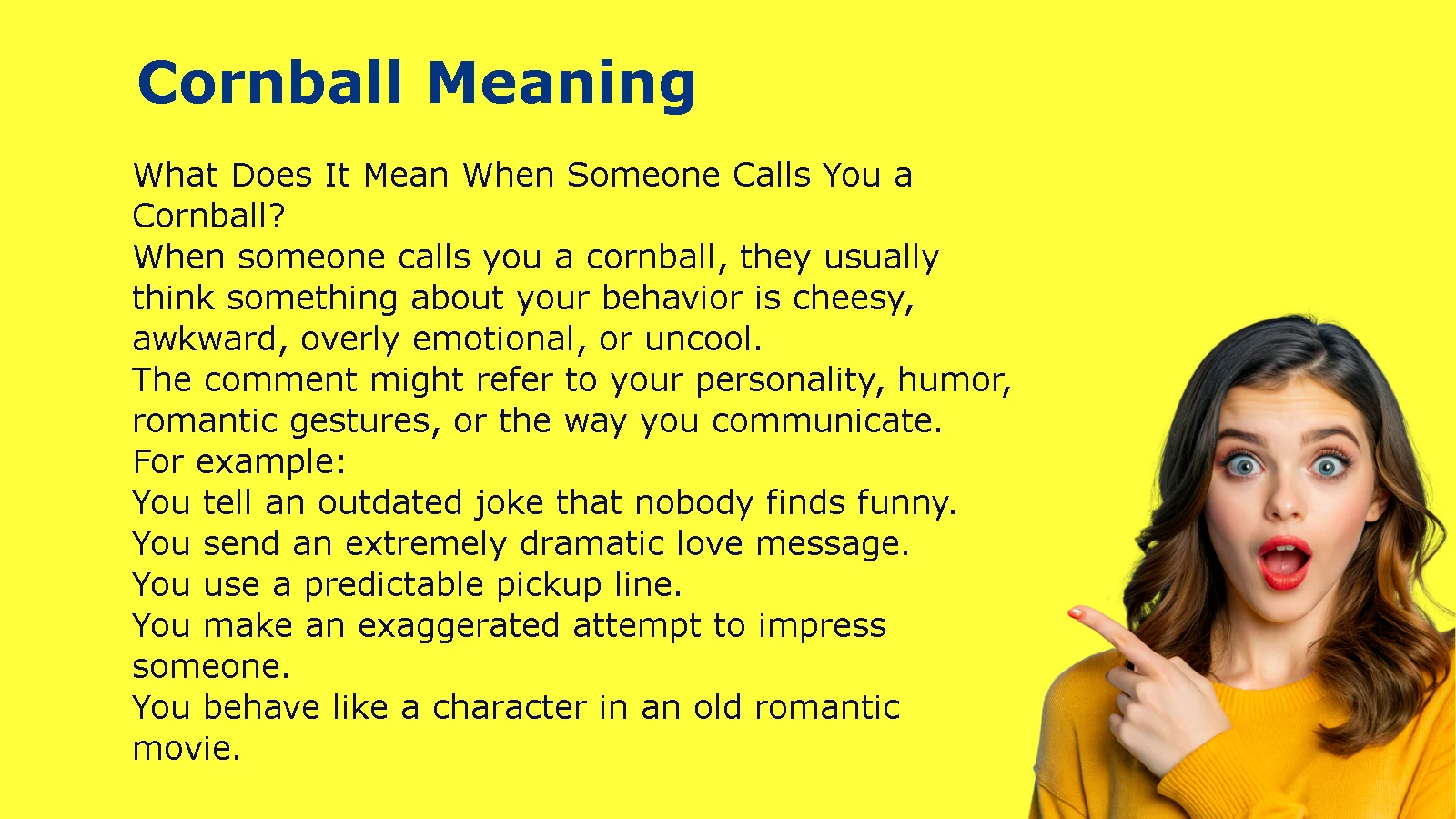
What Does It Mean When Someone Calls You a Cornball?
When someone calls you a cornball, they usually think something about your behavior is cheesy, awkward, overly emotional, or uncool.
The comment might refer to your personality, humor, romantic gestures, or the way you communicate.
For example:
- You tell an outdated joke that nobody finds funny.
- You send an extremely dramatic love message.
- You use a predictable pickup line.
- You make an exaggerated attempt to impress someone.
- You behave like a character in an old romantic movie.
However, the label does not necessarily describe your entire personality. Someone might consider one particular action corny without thinking that you are generally embarrassing.
Example conversation:
Person A: “I wrote her a poem and sent her 20 messages explaining how much I like her.”
Person B: “Bro, you’re such a cornball!”
Here, Person B is teasing Person A for being overly romantic and dramatic.
Cornball Meaning on TikTok and in Gen Z Slang
On TikTok and in Gen Z conversations, cornball describes someone who behaves in a cheesy, awkward, embarrassing, or unnecessarily dramatic way. Users often apply it to people who try too hard to look funny, romantic, impressive, or entertaining.
The expression works particularly well in short online comments because it communicates criticism or amusement without requiring a long explanation.
Cornball Meaning on TikTok
The cornball meaning on TikTok is closely connected to embarrassing behavior, cheesy humor, and exaggerated social interactions.
People may use the word in video captions, comment sections, reaction videos, and conversations about relationships or popular trends.
For example, imagine a TikTok video showing someone delivering an extremely dramatic pickup line. A viewer might comment:
“Bro is a professional cornball.”
The comment suggests that the person’s behavior is so cheesy that it becomes funny.
Other examples include:
- “This entire video is cornball behavior.”
- “Why would he say that? What a cornball.”
- “That was the most cornball pickup line I’ve ever heard.”
- “She’s being a little cornball, but it’s actually cute.”
TikTok users can also use the expression ironically. Someone might deliberately perform an embarrassing dance or tell an extremely cheesy joke because they know viewers will find it funny.
In this situation, being a cornball becomes part of the entertainment rather than a genuine social criticism.
Cornball Meaning in Gen Z Conversations
In Gen Z slang, cornball often describes someone who acts uncool, makes awkward jokes, or does something that feels socially embarrassing.
The word overlaps with popular expressions such as cringe, boring, and try-hard, but each term communicates a slightly different idea.
For example, a person who constantly makes predictable jokes might be called corny. Someone who tries desperately to impress a group might be called a cornball.
Here are some everyday examples:
- “That was a cornball thing to say.”
- “You’re acting like a cornball right now.”
- “I can’t believe he posted that. So corny.”
- “Being a little cornball isn’t always a bad thing.”
It is also worth remembering that slang changes across communities. Not every Gen Z speaker uses cornball in exactly the same way, and the word is not exclusive to younger generations.
Older speakers have used the expression in American English for decades. Its appearance in modern online conversations reflects the continued use of an established slang term rather than an entirely new Gen Z invention.
Cornball Meaning in Memes
In memes, cornball is usually a humorous label for something extremely cheesy, predictable, awkward, or embarrassing.
Meme creators often use it to make fun of exaggerated romantic behavior, outdated jokes, dramatic speeches, or people who take themselves too seriously.
For example, consider a meme showing someone writing a long romantic paragraph and adding several heart emojis. The caption might say:
“Me after sending one text and immediately becoming a cornball.”
The humor comes from recognizing how exaggerated the behavior looks.
Common meme situations involving cornball include:
- Someone using an extremely outdated pickup line.
- A person making a dramatic speech over a minor problem.
- Friends teasing someone for being too romantic.
- Someone posting an unnecessarily inspirational quote.
- A person trying too hard to look cool.
The word can also appear in self-deprecating humor. A person might call themselves a cornball because they recognize that their own behavior is cheesy.
This type of usage makes the expression less aggressive. Instead of attacking someone else, the speaker acknowledges their own awkwardness.
Cornball Meaning on Reddit
On Reddit, cornball can describe a person, opinion, joke, or behavior that users consider cheesy, immature, predictable, or embarrassing.
The word may appear in discussions about relationships, entertainment, humor, celebrities, online trends, and everyday social experiences.
For example, someone might describe an overly dramatic romantic gesture as cornball behavior. Another user might call a predictable movie dialogue cornball because it feels artificial or unoriginal.
Consider these examples:
- “That entire speech sounded like cornball dialogue.”
- “I know it’s cheesy, but I actually like it.”
- “His jokes are corny, but the group enjoys them.”
- “Posting inspirational quotes every hour feels a little cornball.”
The important distinction is that cornball expresses an opinion, not an objective description.
One Reddit user might consider a romantic gesture sweet, while another might consider the same gesture embarrassing. Their reactions depend on personal taste, cultural expectations, and the surrounding discussion.
What Does Cornball Mean From a Girl?
When a girl calls someone a cornball, she usually means that the person is acting cheesy, overly romantic, awkward, or silly. She might be teasing him affectionately, expressing amusement, or criticizing something he said.
The word alone does not reveal whether she likes someone romantically. Her tone, behavior, and the rest of the conversation provide better clues.
Does It Mean She Likes You?
Not necessarily. When a girl calls you a cornball, she might enjoy your playful personality, but the expression does not automatically indicate romantic interest.
The situation matters more than the word itself.
For example, compare these two conversations:
Example A: Playful teasing
You: “I was thinking about you all day.”
Her: “You’re such a cornball 😂”
This response might suggest that she finds your message cheesy but appreciates the attention.
Example B: Genuine criticism
You: “I sent you 15 messages because you didn’t reply.”
Her: “You’re being a cornball. Relax.”
Here, she may be expressing annoyance with your behavior rather than flirting.
Look for other signs before interpreting the comment:
- Does she continue the conversation willingly?
- Does she joke with you regularly?
- Does she respond warmly to your messages?
- Does she show interest in spending time with you?
- Does she use playful language beyond this one expression?
A single slang word cannot establish someone’s feelings.
What Does It Mean When a Girl Calls Your Joke Cornball?
When a girl calls your joke cornball, she probably thinks it sounds cheesy, predictable, or slightly embarrassing.
However, she might still find it entertaining.
For example:
You: “Are you a magician? Because whenever I look at you, everyone else disappears.”
Her: “That was so cornball!”
She is pointing out that the pickup line is predictable and overly romantic. Her response might be playful rather than dismissive.
Other examples include:
- “That joke was cornball, but I’ll give you points for trying.”
- “You’re really using jokes from 2005?”
- “That was cheesy. Don’t try that again.”
- “You’re such a cornball, and you know it.”
If she laughs while saying it, she may simply be enjoying the interaction.
How to Respond When a Girl Calls You a Cornball
The best response is usually relaxed and confident. You do not need to defend yourself or turn a harmless comment into an argument.
Here are some natural responses:
| Her comment | Possible response |
| “You’re such a cornball!” | “I prefer the term professionally cheesy.” |
| “That was so corny.” | “At least I committed to the joke.” |
| “Stop being a cornball.” | “No promises. It’s part of my personality.” |
| “That pickup line was terrible.” | “I never said I was a professional.” |
| “You’re so cheesy.” | “Someone has to bring the cheese.” |
A lighthearted response keeps the conversation comfortable.
If she seems genuinely uncomfortable, however, respect that reaction instead of continuing the same joke.
What Does Holy Cornball Mean?
Holy cornball is an informal, exaggerated expression that can communicate surprise, amusement, or disbelief about something extremely cheesy, awkward, or ridiculous.
It combines holy, an exclamation used to express surprise, with cornball, a word associated with cheesy or embarrassing behavior.
For example:
“Did he really sing a love song outside her house? Holy cornball!”
The speaker is reacting to an unusually dramatic romantic gesture. The expression makes the reaction sound humorous and exaggerated.
Is Holy Cornball a Real Slang Expression?
Holy cornball is understandable as a playful combination of two familiar English expressions, but it is not a fixed or universally established idiom.
People can create similar humorous expressions by combining an exclamation with a descriptive word.
Its meaning comes from the surrounding context rather than a special dictionary definition.
For instance:
- “Holy cornball, that speech was dramatic!”
- “Holy cornball! Who still uses those pickup lines?”
- “That outfit is something else. Holy cornball!”
- “He wrote an entire song about their first date. Holy cornball!”
These examples show how someone might use the expression to react to exaggerated or cheesy behavior.
Holy Cornball Examples in Conversations
The expression works best in informal situations where people already understand the meaning of cornball.
Example: Romantic gesture
Person A: “He rented a restaurant, hired musicians, and read her a poem.”
Person B: “Holy cornball! That’s a lot for a first date.”
Example: Cheesy humor
Person A: “Why did the bicycle fall over? Because it was two-tired.”
Person B: “Holy cornball. That joke is ancient.”
Example: Dramatic behavior
Person A: “She posted a 20-minute video explaining why he didn’t like her picture.”
Person B: “Holy cornball! That’s dramatic.”
In each situation, the speaker expresses amusement or disbelief rather than making a formal judgment.
Cornball Meaning in Chinese
There is no single exact Chinese translation for cornball because its meaning changes with context. It can describe someone who is cheesy, tacky, overly sentimental, or predictable.
The best Chinese equivalent depends on whether the speaker is criticizing someone’s style, humor, or emotional behavior.
Three useful translations are 土气 (tǔqì), 老套 (lǎotào), and 肉麻 (ròumá).
Cornball Chinese Translation by Context
| Chinese expression | Pinyin | English meaning | When to use it |
| 土气 | Tǔqì | Tacky or unfashionable | Someone’s style or behavior seems old-fashioned. |
| 老套 | Lǎotào | Clichéd or predictable | A joke, idea, or expression feels unoriginal. |
| 肉麻 | Ròumá | Overly sentimental or cheesy | Someone uses excessively romantic or emotional language. |
These translations are related to different meanings of cornball, but they are not interchangeable.
For example, if someone makes a predictable joke, 老套 may communicate the intended meaning better than 肉麻.
However, if someone writes an excessively romantic message, 肉麻 may be more appropriate.
How to Use Cornball in Chinese-English Conversations
Here are a few examples showing how the word changes across situations.
Example 1: Overly romantic behavior
English: “That message was so cornball.”
Chinese: “那条消息太肉麻了。”
Meaning: The message was excessively romantic or sentimental.
Example 2: Predictable humor
English: “That joke was cornball.”
Chinese: “那个笑话太老套了。”
Meaning: The joke was predictable and unoriginal.
Example 3: Unfashionable behavior
English: “His style looks cornball.”
Chinese: “他的风格有点土气。”
Meaning: His style looks tacky or old-fashioned.
For English learners, the most important lesson is that translation should preserve the intended meaning rather than simply replace one word with another.
Cornball vs. Corny: What’s the Difference?
Cornball and corny have closely related meanings. Both describe something cheesy, predictable, or lacking sophistication. However, cornball frequently functions as a noun describing a person, while corny is an adjective that commonly describes jokes, behavior, comments, and other things.
For example:
- “He’s a cornball.” This describes the person.
- “That joke is corny.” This describes the joke.
Both sentences communicate a similar idea, but they use different grammatical forms.
Cornball vs. Corny Examples
The following examples show how the words work in everyday English.
| Cornball | Corny |
| “He’s such a cornball.” | “He’s such a corny guy.” |
| “That cornball made another joke.” | “That was another corny joke.” |
| “You’re acting like a cornball.” | “You’re acting corny.” |
| “She’s a lovable cornball.” | “She’s a lovable, corny person.” |
The words can sometimes replace each other without significantly changing the meaning.
However, corny is generally more flexible because it works naturally as an adjective in many situations.
Cornball vs. Cringe
Cringe describes something so awkward or embarrassing that it makes someone feel uncomfortable or experience secondhand embarrassment.
Consider these examples:
- “He used a cornball pickup line.” The line sounds cheesy and predictable.
- “He started shouting the pickup line in a crowded restaurant.” The situation might make other people cringe.
The first example focuses on the style of the expression. The second focuses on the uncomfortable reaction.
| Word | Main meaning | Example |
| Cornball | Cheesy or uncool | “He’s a cornball.” |
| Corny | Predictable or cheesy | “That joke is corny.” |
| Cringe | Embarrassing or uncomfortable | “That video is cringe.” |
Cornball vs. Cheesy vs. boring
These three expressions sometimes describe the same behavior, but they have different shades of meaning.
Cheesy usually describes something excessively sentimental, artificial, or predictable. boring suggests something is unimpressive, boring, weak, or uncool. Cornball often combines these ideas when describing a person or behavior.
For example:
- Cornball: “He made another cornball speech.”
- Cheesy: “That was an extremely cheesy speech.”
- boring: “That speech was boring.”
The first describes the behavior as overly sentimental or uncool. The second focuses on its exaggerated emotional quality. The third suggests that the speech was unimpressive.
Related Words: Sentimental, Trite, and Cheesy
Understanding related vocabulary helps explain why people use cornball in different situations.
Although sentimental, trite, and cheesy can overlap with cornball, they describe separate characteristics. Sentimental relates to emotion, trite relates to originality, and cheesy often describes something excessively sweet or artificial.
What Does Sentimental Mean?
Sentimental describes something that strongly expresses or appeals to emotions, especially feelings connected to love, memories, relationships, and personal experiences.
The word does not automatically have a negative meaning. Sentimental behavior can be sincere, touching, and meaningful.
For example:
- “She kept the letters because they were sentimental.”
- “His speech was sentimental and emotional.”
- “That song reminds me of my childhood. It’s very sentimental.”
- “He made a sentimental video about his family.”
However, people sometimes use sentimental negatively when they believe someone is being excessively emotional.
This is where sentimental and cornball can overlap.
Imagine someone writing a long romantic message filled with exaggerated declarations of love. One person might call it sentimental because it expresses strong feelings. Another might call it cornball because it seems overly cheesy.
The difference: Sentimental describes emotional content, while cornball adds an informal judgment about how that content comes across.
What Does Trite Mean?
Trite means overused, unoriginal, or lacking freshness because people have repeated an expression, idea, or statement too many times.
A trite comment often sounds predictable because audiences have heard it repeatedly.
For example:
- “Everything happens for a reason.”
- “Time heals all wounds.”
- “Follow your dreams.”
- “Never give up.”
These expressions are not necessarily wrong. However, someone might consider them trite when they appear in situations where a more thoughtful or original response would be appropriate.
Trite and cornball can overlap when someone uses an overused expression that also sounds cheesy.
For example:
“His motivational speech was full of trite expressions.”
This describes the speech as unoriginal.
“His motivational speech was so cornball.”
This suggests that the speech felt cheesy, awkward, or overly sentimental.
Other Words Similar to Cornball
Several informal English words describe behavior similar to cornball. However, each one carries a slightly different meaning.
| Word | Meaning | Example |
| Cheesy | Excessively sentimental or predictable | “That movie ending was cheesy.” |
| Cringey | Embarrassing or uncomfortable | “His performance was cringey.” |
| Goofy | Silly or playfully foolish | “He’s a goofy person.” |
| boring | Unimpressive or uncool | “That excuse was boring.” |
| Sappy | Excessively emotional or sentimental | “That was a sappy love story.” |
| Clichéd | Overused or predictable | “The storyline was clichéd.” |
| Uncool | Not socially fashionable or impressive | “That behavior is uncool.” |
| Corny | Cheesy, predictable, or unoriginal | “That’s a corny joke.” |
Choosing the correct word depends on what you want to communicate.
For example, use sappy when something feels overly emotional, trite when an idea lacks originality, and cringey when a situation causes embarrassment.
Cornball Examples in Everyday Conversations
The easiest way to understand cornball is to see how people use it in different social situations.
The word can describe romantic gestures, jokes, awkward comments, and exaggerated behavior. Its meaning changes slightly depending on the subject and tone.
Cornball in Friendly Conversations
Friends often use cornball to tease one another about harmless behavior.
Example 1
Person A: “I made a playlist with 50 love songs for my crush.”
Person B: “You’re such a cornball!”
Meaning: Person B thinks the gesture is overly romantic or cheesy.
Example 2
Person A: “I still laugh at the same joke I told last week.”
Person B: “Bro, you’re a cornball.”
Meaning: Person B is making fun of the predictable humor.
Example 3
Person A: “I gave my dog a birthday speech.”
Person B: “That’s some serious cornball behavior.”
Meaning: The gesture seems silly and overly sentimental.
Cornball in Romantic Situations
Romantic conversations provide many opportunities to use the word because affection and exaggerated emotions can sometimes seem cheesy.
For example:
- “He wrote her a love letter after their first date. Total cornball.”
- “She called me a cornball because I sent her flowers.”
- “That couple is so corny, but they’re adorable.”
- “I know it’s a cornball thing to say, but I really miss you.”
Notice that the word does not necessarily criticize romantic behavior. Some people genuinely enjoy cheesy gestures and affectionate language.
In these situations, cornball can become an affectionate description rather than a negative judgment.
Cornball as an Insult
Although people often use the word humorously, it can also express genuine disapproval.
For example:
- “Stop making cornball jokes. Nobody is laughing.”
- “That was a cornball thing to post.”
- “He acts like a cornball whenever he wants attention.”
- “Don’t be such a cornball. Take the situation seriously.”
Here, the speaker is criticizing behavior rather than simply teasing someone.
A useful distinction is whether the speaker treats the behavior as harmless entertainment or as something they genuinely dislike.
Funny Cornball Sentences
Here are additional original sentences showing how to use the word naturally.
- “My brother is a cornball who still uses pickup lines from old movies.”
- “That was such a cornball way to propose.”
- “I tried to sound romantic, but my message came out completely cornball.”
- “Everyone laughed when he made another cornball joke.”
- “She loves his cornball personality because he always makes her smile.”
- “Posting that dramatic caption was a little cornball.”
- “I can be a cornball sometimes, but at least I’m having fun.”
These examples also show how the word can function as a noun or adjective.
Where Did the Word Cornball Come From?
Cornball developed in American English as an informal expression associated with corniness, old-fashioned humor, and unsophisticated or overly sentimental behavior.
Its meaning connects to the older figurative use of corny, which describes something simple, predictable, or lacking sophistication.
The word later became a familiar way to describe people who make cheesy jokes or behave in an overly sentimental manner.
Origin and History of Cornball
The word draws on the figurative association of corn with something rustic, ordinary, or unsophisticated.
In American informal language, corn and corny developed associations with sentimental entertainment, predictable jokes, and humor that seemed old-fashioned or unsophisticated.
Adding -ball created the informal noun cornball, which could describe a person associated with that kind of behavior.
Over time, the word developed several related uses:
- Describing someone who makes cheesy jokes.
- Referring to a person with an overly sentimental personality.
- Criticizing predictable or old-fashioned humor.
- Teasing someone for behaving awkwardly or uncoolly.
The exact interpretation has shifted with different social settings, but the connection to corniness remains central.
How Cornball Became Modern Internet Slang
Although cornball existed long before social media, online communication gave the word additional opportunities to appear in everyday conversations.
Social platforms encourage short, expressive reactions. Words such as cornball, cringe, and corny allow users to communicate strong opinions without writing lengthy explanations.
For example, a person watching an exaggerated romantic video can simply comment, “Cornball behavior.”
That short comment communicates amusement, criticism, or embarrassment.
Modern online usage also encourages ironic self-description. Someone might proudly call themselves a cornball because they enjoy cheesy jokes, romantic movies, or old-fashioned gestures.
This reflects an important feature of slang: a word can keep its original meaning while developing new social uses.
Conclusion: Understanding the Meaning of Cornball
The cornball meaning is closely connected to being cheesy, corny, overly sentimental, predictable, or uncool. People use the word to describe individuals, jokes, romantic gestures, comments, and other behaviors that seem awkward or exaggerated.
On TikTok and in Gen Z conversations, it often appears as a humorous reaction to embarrassing or try-hard behavior. When a girl calls someone a cornball, she might be teasing them affectionately, although the expression does not automatically indicate romantic interest.
The word also has useful connections to corny, sentimental, trite, cheesy, and cringey. Understanding these differences helps you interpret the expression more accurately.
The next time someone calls you a cornball, pay attention to the situation rather than focusing only on the word. They might be criticizing your behavior, laughing at your cheesy joke, or simply enjoying your playful personality.
Want to understand more everyday slang and confusing English expressions? Explore related word-meaning guides to improve your vocabulary and use informal English more confidently.