Focus synonyms include concentration, attention, emphasis, priority, focal point, and center. The best alternative depends on what you want to express: directing your attention, highlighting an important idea, concentrating on a task, or identifying a main objective. Whether you’re writing an IELTS essay, conducting research, preparing a business report, or improving everyday communication, choosing the right synonym makes your writing clearer and more precise.
The word focus works as both a noun and a verb. It can describe mental concentration, the central subject of a discussion, or the act of directing attention toward something. Related expressions such as concentrate on, emphasize, prioritize, and pay attention to offer useful alternatives, but each carries a slightly different meaning.
| Question | Answer |
| What is the best synonym for focus? | Concentration, attention, emphasis, and priority are common alternatives. |
| What is another way to say focus on? | Concentrate on, center on, prioritize, and direct attention toward. |
| What is a professional word for focus? | Prioritize, emphasize, concentrate, or direct efforts toward. |
| What is a good synonym for focus in an essay? | Examine, explore, analyze, address, and emphasize. |
| What is the opposite of focus? | Distraction, inattention, neglect, and scattered attention. |
Focus Synonyms: What Are Other Words for Focus?
Focus synonyms are words that express concentration, attention, importance, or the central subject of something. Common alternatives include concentration, emphasis, attention, priority, and focal point. However, the right choice depends on the sentence. For example, concentration describes mental effort, while emphasis highlights importance.
Common Synonyms for Focus
Here are some of the most useful synonyms for focus, along with their meanings and typical applications.
| Synonym | Meaning | Example sentence |
| Concentration | Mental effort directed toward something | Her concentration helped her finish the assignment. |
| Attention | Notice or consideration given to something | Please give your attention to the instructions. |
| Emphasis | Special importance placed on something | The presentation puts emphasis on customer satisfaction. |
| Priority | Something considered more important than other things | Improving communication remains our priority. |
| Focal point | The central element that attracts attention | The new building became the focal point of the neighborhood. |
| Center | The middle or most important part of something | Education is at the center of the discussion. |
| Interest | Curiosity or concern about a subject | His research focuses on public health interests. |
| Concern | Something that requires attention | Employee safety is our primary concern. |
| Objective | A specific goal or intended result | The main objective is to improve productivity. |
| Highlight | An important feature or point | The report highlights several major challenges. |
| Purpose | The reason something exists or happens | The project’s main purpose is to improve access. |
| Subject | The topic being discussed or studied | Climate change is the subject of the investigation. |
These alternatives are related, but they are not always interchangeable.
For example:
- Concentration: She needs better concentration while studying.
- Emphasis: The teacher placed emphasis on practical learning.
- Priority: Completing the assignment is my priority.
- Attention: The manager paid attention to customer feedback.
Each sentence communicates a different aspect of focus.
Best Synonyms for Focus Based on Meaning
Choosing a synonym based on meaning produces more natural writing than replacing every occurrence of focus with the same alternative.
| What you want to express | Best synonym | Example |
| Mental effort | Concentration | I need concentration to complete this task. |
| Giving notice to something | Attention | Pay attention to the details. |
| Highlighting importance | Emphasis | The report places emphasis on quality. |
| Something important | Priority | Customer service is our priority. |
| Central subject | Focal point | Technology is the focal point of the discussion. |
| Main goal | Objective | Our primary objective is growth. |
| Directing effort | Direction | The team needs clear direction. |
| Showing importance | Significance | The research explains the significance of education. |
Writing tip: Before choosing an alternative, identify what focus means in your sentence. If you mean mental effort, use concentration. If you mean importance, use emphasis or priority.
Focus Synonyms by Part of Speech
The word focus has several grammatical forms. Understanding these forms helps you choose an alternative that fits the sentence structure.
| Word form | Part of speech | Meaning | Example |
| Focus | Noun | The central subject or point of attention | The focus of the meeting was teamwork. |
| Focus | Verb | To direct attention toward something | We need to focus on the results. |
| Focused | Adjective | Giving attention to a particular task | She remained focused throughout the exam. |
| Focusing | Present participle | Directing attention toward something | He is focusing on his studies. |
| Focuses | Verb | Directs attention toward something | The research focuses on education. |
For example, you can replace the noun focus with emphasis in a sentence such as:
“The main focus of the report is customer satisfaction.”
A better alternative is:
“The main emphasis of the report is customer satisfaction.”
However, when focus functions as a verb, you might use concentrate instead:
“Students should focus on their assignments.”
“Students should concentrate on their assignments.”
The grammatical structure and intended meaning determine which replacement works best.
Other Ways to Say Focus On
Other ways to say focus on include concentrate on, pay attention to, prioritize, center on, emphasize, and direct attention toward. These expressions help writers avoid repetition while communicating whether they mean mental concentration, importance, or a particular area of effort.
Formal Alternatives to Focus On
Formal alternatives work well in academic papers, workplace communication, business reports, and professional documents.
| Alternative | Example sentence |
| Concentrate on | Researchers should concentrate on reliable evidence. |
| Direct attention toward | The campaign directs attention toward environmental protection. |
| Give priority to | The organization gives priority to employee development. |
| Place emphasis on | The policy places emphasis on workplace safety. |
| Center efforts on | The company centers its efforts on customer satisfaction. |
| Devote attention to | The committee devotes attention to educational reform. |
| Give consideration to | The panel gives consideration to every application. |
| Prioritize | Managers should prioritize essential responsibilities. |
| Address | The report addresses several financial concerns. |
| Target | The initiative targets communities with limited resources. |
These expressions are particularly useful when you want to make professional writing more precise.
For example:
Original: The company will focus on improving customer service.
Alternative: The company will prioritize improvements in customer service.
The revised sentence communicates a specific decision about importance rather than simply describing attention.
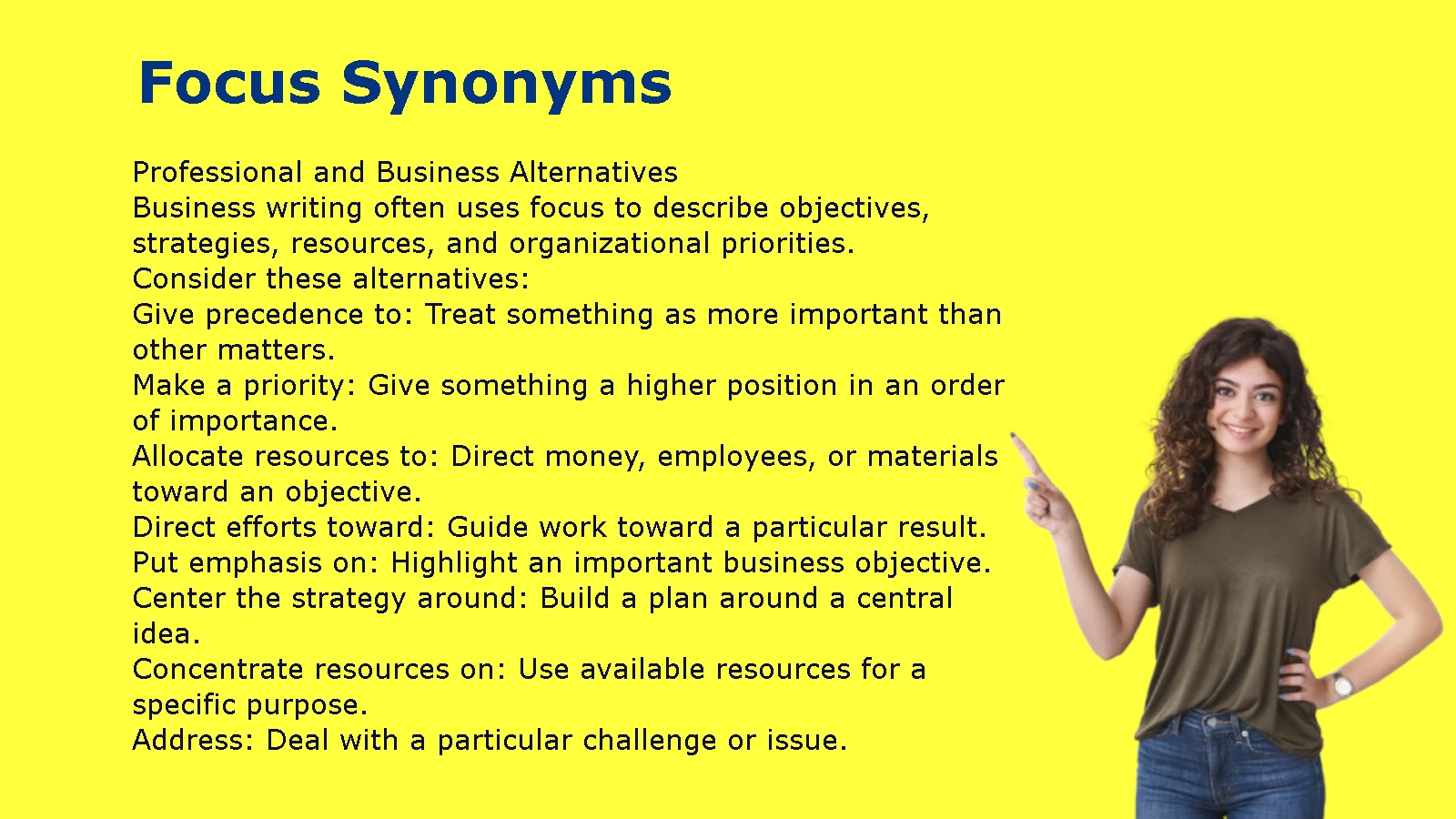
Professional and Business Alternatives
Business writing often uses focus to describe objectives, strategies, resources, and organizational priorities.
Consider these alternatives:
- Give precedence to: Treat something as more important than other matters.
- Make a priority: Give something a higher position in an order of importance.
- Allocate resources to: Direct money, employees, or materials toward an objective.
- Direct efforts toward: Guide work toward a particular result.
- Put emphasis on: Highlight an important business objective.
- Center the strategy around: Build a plan around a central idea.
- Concentrate resources on: Use available resources for a specific purpose.
- Address: Deal with a particular challenge or issue.
Example sentences:
- The management team will give precedence to employee retention.
- Our organization will make customer satisfaction a priority.
- The department will allocate resources to digital transformation.
- The new strategy centers around sustainable development.
- The company will direct its efforts toward improving product quality.
These alternatives also help distinguish between attention and action. For example, allocating resources to a project means committing practical support, not merely thinking about it.
Casual and Conversational Alternatives
In everyday conversations, simple expressions often sound more natural than formal vocabulary.
Here are some useful options:
- Pay attention to
- Zero in on
- Keep your eye on
- Stick to
- Work on
- Tune into
- Give your attention to
- Put your mind to
- Keep an eye on
- Stay focused on
Examples:
- You should zero in on the most important details.
- Let’s stick to the main topic.
- I need to work on my communication skills.
- Keep your eye on the deadline.
- Try to put your mind to the assignment.
Zero in on is especially useful when someone wants to identify or concentrate on one specific thing.
Example Sentences Using Alternatives to Focus On
The following examples show how to replace repetitive expressions without changing the intended message.
| Original sentence | Improved alternative |
| We need to focus on customer needs. | We need to prioritize customer needs. |
| The research focuses on social behavior. | The research examines social behavior. |
| Students should focus on their goals. | Students should concentrate on their goals. |
| The presentation focuses on financial growth. | The presentation emphasizes financial growth. |
| The team will focus on the problem. | The team will address the problem. |
| The discussion focuses on education. | The discussion centers on education. |
Notice that some alternatives change the emphasis slightly. Examine suggests investigation, while prioritize suggests importance. Choose the expression that accurately describes the action.
Other Ways to Say Focus on Yourself
Other ways to say focus on yourself include prioritize yourself, invest in yourself, work on yourself, put yourself first, and concentrate on personal growth. These expressions describe directing your time, attention, and energy toward your own goals, development, and well-being.
Positive Alternatives to Focus on Yourself
Use these expressions when discussing self-improvement, personal development, or setting healthy priorities.
| Alternative | Meaning | Example |
| Prioritize yourself | Give your needs appropriate importance | You should prioritize yourself during difficult times. |
| Invest in yourself | Spend time and effort improving your abilities | Invest in yourself by learning new skills. |
| Work on yourself | Improve your habits, behavior, or abilities | Take time to work on yourself. |
| Put yourself first | Consider your needs before unnecessary demands | Sometimes, you need to put yourself first. |
| Take time for yourself | Make space for personal activities | Take time for yourself after a busy week. |
| Focus on personal growth | Develop your abilities and understanding | She decided to focus on personal growth. |
| Concentrate on your goals | Direct your effort toward personal objectives | Concentrate on your goals instead of comparisons. |
| Devote time to self-improvement | Commit time to becoming better | He devotes time to self-improvement every morning. |
These expressions are not identical. For example, put yourself first often refers to personal boundaries, while invest in yourself usually suggests education, skills, or long-term development.
Casual Ways to Say Focus on Yourself
If you want a relaxed or conversational expression, consider these options:
- Mind your own business: Avoid interfering in other people’s affairs.
- Stay in your lane: Concentrate on your responsibilities.
- Do your own thing: Follow your personal interests and choices.
- Keep working on yourself: Continue improving your habits and abilities.
- Put your energy into yourself: Spend your effort on personal priorities.
- Run your own race: Avoid comparing your progress with others.
Examples:
“Don’t worry about what everyone else is doing. Just run your own race.”
“Stay in your lane and keep working toward your goals.”
These expressions work well in informal conversations, motivational messages, and social media captions.
Professional and Motivational Expressions
In professional settings, personal development language often sounds more appropriate than casual phrases.
Try these alternatives:
- Prioritize personal development.
- Invest in professional growth.
- Set meaningful personal goals.
- Build self-awareness.
- Strengthen individual capabilities.
- Develop new competencies.
- Direct energy toward personal improvement.
- Take ownership of your development.
For example:
Instead of saying, “Employees should focus on themselves,” a professional development document might say:
“Employees should invest in their professional growth and strengthen their individual capabilities.”
This version identifies practical actions rather than relying on a broad expression.
Focus Synonyms for Academic Writing and Research
Focus synonyms in academic writing and research include investigate, examine, explore, analyze, address, and emphasize. These alternatives help researchers explain their objectives, describe their methods, and identify the main subject of a study without repeating the same expression throughout a paper.
Focus Synonyms in Research
Research writing requires precise vocabulary because different words describe different research activities.
For example, investigating a subject is not always the same as analyzing data or emphasizing a finding.
Here are useful alternatives:
| Research synonym | Meaning | Example sentence |
| Investigate | Examine a question or problem systematically | This study investigates the effects of remote work. |
| Examine | Study something carefully | The research examines workplace satisfaction. |
| Explore | Investigate a subject to gain understanding | This paper explores the relationship between education and income. |
| Analyze | Examine information in detail | Researchers analyze the collected responses. |
| Study | Investigate a particular subject | The project studies consumer behavior. |
| Address | Deal with a particular issue | The paper addresses gaps in existing research. |
| Center on | Make something the main subject | The investigation centers on environmental changes. |
| Emphasize | Give special importance to something | The findings emphasize the value of early education. |
| Highlight | Draw attention to an important point | The report highlights several limitations. |
| Evaluate | Assess quality, value, or effectiveness | The researchers evaluate the proposed method. |
Practical distinction: Use investigate when describing the research question, analyze when discussing data, examine when describing a detailed review, and highlight when presenting an important finding.
Formal Alternatives to Focus in Research Papers
Academic writing benefits from words that explain exactly what the researcher intends to do.
Consider the following examples:
Original: This research focuses on the impact of social media on teenagers.
Possible alternatives:
- This research examines the impact of social media on teenagers.
- This study investigates how social media affects teenagers.
- This paper explores the relationship between social media use and teenage behavior.
- This investigation analyzes the effects of social media on adolescent development.
Each sentence has a slightly different emphasis.
The word examines describes a detailed study. Investigates suggests a systematic inquiry. Explores often suits a broader or less narrowly defined subject. Analyzes suggests a detailed examination of information or evidence.
Avoid replacing every occurrence of focus with explore or investigate. Choose based on the actual research method and purpose.
Another Word for Focus On in an Essay
Essay writers often repeat phrases such as “this essay focuses on” or “the main focus is.” Using suitable alternatives improves vocabulary and makes arguments easier to follow.
Here are some effective choices:
- Discuss
- Examine
- Highlight
- Explore
- Address
- Consider
- Analyze
- Investigate
- Emphasize
- Evaluate
- Assess
- Demonstrate
Examples:
Original: This essay will focus on the advantages of online education.
Improved alternatives:
- This essay will discuss the advantages of online education.
- This essay will examine the benefits of digital learning.
- This paper will evaluate the advantages of online education.
- This essay will analyze the positive effects of online learning.
You can also avoid the phrase entirely:
“Online education offers several advantages, including flexibility, accessibility, and lower travel costs.”
This approach often creates a stronger introduction because it presents the subject directly.
Focus Synonyms for IELTS Writing
IELTS candidates can use focus synonyms to demonstrate vocabulary range and avoid repeating the same expressions in Writing Task 2.
However, advanced vocabulary does not automatically improve an essay. The word must fit the meaning, grammar, and context of the sentence.
| IELTS alternative | Example sentence |
| Concentrate on | Governments should concentrate on improving public transportation. |
| Emphasize | Schools should emphasize practical learning. |
| Highlight | The discussion highlights the importance of education. |
| Give priority to | Authorities should give priority to public health. |
| Pay particular attention to | Policymakers should pay particular attention to rural communities. |
| Center on | The debate centers on environmental protection. |
| Place importance on | Modern workplaces place importance on employee well-being. |
| Address | Governments must address the problem of unemployment. |
IELTS vocabulary tip: Use a variety of accurate verbs rather than forcing uncommon synonyms into your essay.
For example:
Weak: Governments should focus on pollution and focus on public transportation.
Better: Governments should address pollution and prioritize improvements in public transportation.
The second version communicates two different actions more clearly.
IELTS Example Sentences Using Focus Alternatives
Here are additional examples suitable for academic-style writing.
Education
- Educational institutions should emphasize critical thinking and problem-solving skills.
- Schools should prioritize students’ overall development.
- Teachers should pay particular attention to individual learning needs.
Environment
- Governments must address the growing problem of air pollution.
- Environmental policies should center on sustainable development.
- Researchers should examine the long-term effects of climate change.
Technology
- The discussion should consider the impact of artificial intelligence.
- Policymakers should evaluate the risks associated with digital privacy.
- Businesses should concentrate on improving cybersecurity.
These alternatives help IELTS candidates express complex ideas with more precision.
Main Focus Synonyms and Alternatives
Main focus synonyms describe the central subject, most important concern, or primary objective of a discussion, project, research paper, or organization. Useful alternatives include primary concern, central theme, key priority, principal subject, core issue, and main objective.
Synonyms for Main Focus
Choose from these alternatives depending on what you want to communicate.
| Alternative | Meaning | Example |
| Primary concern | The most important issue | Public safety is our primary concern. |
| Main objective | The central goal | Our main objective is to increase efficiency. |
| Central theme | The main idea of a discussion | Trust is the central theme of the book. |
| Key priority | An important task or responsibility | Staff development is a key priority. |
| Principal subject | The main topic | Economic growth is the principal subject. |
| Core issue | The central problem or matter | Unemployment remains a core issue. |
| Central idea | The main thought being communicated | Equality is the central idea of the article. |
| Main emphasis | The point receiving the most importance | Prevention is the main emphasis of the campaign. |
| Primary area of interest | The most important subject of attention | Renewable energy is our primary area of interest. |
| Focal point | The central point of attention | The new library became the focal point of the community. |
Another Way to Say Focus Areas
The expression focus areas describes subjects, responsibilities, or objectives that receive special attention.
It appears frequently in business plans, performance reviews, educational documents, and research proposals.
Useful alternatives include:
- Key areas
- Priority areas
- Main concerns
- Core subjects
- Areas of interest
- Strategic priorities
- Main objectives
- Key topics
- Development areas
- Areas of concentration
- Critical responsibilities
- Primary targets
Examples:
Business report: Our three strategic priorities are customer retention, product development, and operational efficiency.
Research proposal: The study examines three key areas: access to education, teaching quality, and student performance.
Performance review: The employee’s main development areas include communication, leadership, and time management.
Choose strategic priorities when discussing business direction and development areas when identifying skills or performance improvements.
Examples of Main Focus in Sentences
Here are several ways to use main focus alternatives naturally.
- Business: Customer retention remains the company’s primary objective.
- Research: The central theme of the study is economic inequality.
- Education: Improving literacy is a key priority for the school.
- Technology: Data security is the core concern of the development team.
- Marketing: Brand awareness is the main objective of the campaign.
- Personal development: Building confidence is her primary area of interest.
These examples show why context matters when choosing a replacement.
More Focused Synonyms
More focused synonyms describe someone who pays closer attention, concentrates more effectively, or works with greater purpose. Useful alternatives include more attentive, more concentrated, more disciplined, more dedicated, more determined, and more goal-oriented.
Synonyms for More Focused
Use these expressions when describing improved concentration or a stronger commitment to a task.
| Synonym | Meaning | Example |
| More concentrated | Giving greater mental effort | She became more concentrated during practice. |
| More attentive | Paying closer attention | The students were more attentive after the break. |
| More disciplined | Following a consistent approach | A more disciplined routine improved his performance. |
| More dedicated | Showing greater commitment | She became more dedicated to her studies. |
| More determined | Having a stronger desire to succeed | He felt more determined to reach his goal. |
| More purposeful | Acting with a clear intention | The team adopted a more purposeful approach. |
| More engaged | Taking a greater interest or active part | Employees became more engaged in the project. |
| More organized | Arranging tasks and responsibilities effectively | A more organized schedule improved productivity. |
| More goal-oriented | Working toward specific objectives | The new manager became more goal-oriented. |
Other Words for a Focused Person
A focused person directs attention toward a specific goal or activity and avoids unnecessary distractions.
Here are some useful descriptions:
- Attentive: Someone who notices details and listens carefully.
- Concentrated: Someone who directs mental effort toward a task.
- Dedicated: Someone who commits time and effort to an objective.
- Committed: Someone who remains devoted to a responsibility.
- Mindful: Someone who remains aware of the present situation.
- Intentional: Someone who acts with a clear purpose.
- Single-minded: Someone who concentrates strongly on one objective.
- Purposeful: Someone whose actions have a clear direction.
- Determined: Someone who continues working toward a goal despite difficulties.
- Engaged: Someone who actively participates in an activity.
For example:
“She is a focused employee.”
You could write:
“She is a dedicated employee who approaches every responsibility with purpose.”
The revised sentence gives the reader more information about the person’s working style.
Example Sentences Using Focused Synonyms
- A disciplined student follows a consistent study schedule.
- The attentive employee noticed an error in the report.
- A determined athlete continues training despite setbacks.
- The dedicated researcher spends several hours reviewing the findings.
- A purposeful manager sets clear objectives for the team.
- The engaged audience actively participates in the discussion.
Remember that focused usually describes attention, while dedicated and determined describe commitment and motivation. These words overlap, but they express different qualities.
Concentrate Synonyms and Attention Synonyms
Concentrate synonyms describe directing mental effort toward a task, while attention synonyms describe the act of noticing, considering, or being aware of something. Common alternatives include focus, direct, devote, awareness, attentiveness, consideration, and mindfulness.
Synonyms for Concentrate
Here are useful alternatives to the verb concentrate.
| Synonym | Meaning | Example |
| Focus | Direct attention toward something | Try to focus on the assignment. |
| Center | Direct attention toward a subject | The discussion centers on education. |
| Direct | Guide attention or effort | Direct your attention to the main problem. |
| Apply oneself | Make a serious effort | She applied herself to learning English. |
| Devote oneself | Commit time and effort | He devoted himself to his research. |
| Fix one’s attention | Keep attention on something | She fixed her attention on the speaker. |
| Give full attention | Consider something carefully | Give your full attention to the instructions. |
| Zero in | Concentrate on a specific target | The investigation zeroed in on the main issue. |
| Immerse oneself | Become deeply involved in an activity | He immersed himself in his studies. |
Usage note: Immerse oneself often suggests deep involvement, while concentrate describes mental effort. They are related but do not always mean the same thing.
Attention Synonyms
Attention can refer to awareness, interest, observation, or consideration.
Here are its most useful alternatives:
- Awareness: Knowledge or understanding of something.
- Concentration: Mental effort directed toward a particular activity.
- Notice: The act of becoming aware of something.
- Consideration: Careful thought about a matter.
- Regard: Attention or respect given to something.
- Interest: Curiosity or concern about a subject.
- Observation: The act of watching or examining something.
- Attentiveness: The quality of paying careful attention.
- Mindfulness: Awareness of the present moment.
- Awareness of detail: The ability to notice small or important elements.
Examples:
- The teacher appreciated the students’ attentiveness.
- Public awareness of environmental issues continues to grow.
- The manager gave careful consideration to the proposal.
- Her observation helped identify the problem.
- The presentation attracted considerable interest.
Difference Between Focus, Concentration, and Attention
Although these words often appear as synonyms, they describe different aspects of mental activity.
| Word | Main meaning | Example |
| Focus | The direction of attention | My focus is on completing the project. |
| Concentration | The mental effort used to maintain attention | Good concentration helps me study. |
| Attention | The act of noticing or considering something | Pay attention to the teacher. |
Think of them this way:
- Focus identifies what receives your attention.
- Attention describes the awareness you give something.
- Concentration describes how strongly you maintain that attention.
For example, a student may focus on mathematics, pay attention to the teacher’s explanation, and use concentration to solve a difficult problem.
This distinction helps you select the most accurate word in academic and everyday writing.
Focus as a Verb: Meaning, Synonyms, and Examples
Focus functions as a verb when someone directs attention, effort, or resources toward a particular subject or objective. Its common verb synonyms include concentrate, center, direct, emphasize, prioritize, target, and highlight. The phrase focus on usually introduces the subject receiving attention.
How to Use Focus as a Verb
The verb focus commonly appears in several sentence structures.
Focus on something
Use this structure when directing attention toward a particular subject.
Example: “We need to focus on customer satisfaction.”
Focus attention on something
Use this structure to emphasize the act of directing attention.
Example: “The report focuses attention on workplace safety.”
Focus your efforts on something
Use this expression when directing work or energy toward an objective.
Example: “The team focused its efforts on improving sales.”
Focus on doing something
Use this structure when describing an activity.
Example: “She focuses on improving her writing skills.”
One common grammar mistake involves forgetting the preposition on.
Incorrect: “We need to focus the problem.”
Correct: “We need to focus on the problem.”
However, focus can take a direct object in other constructions:
“Focus your attention on the speaker.”
Both sentence structures are correct because they follow different grammatical patterns.
Focus Verb Synonyms
Here are alternatives that work when focus functions as a verb.
| Verb synonym | Meaning | Example |
| Concentrate | Direct mental effort | Concentrate on the main question. |
| Center | Make something the central subject | The discussion centers on innovation. |
| Direct | Guide attention or effort | Direct your efforts toward improvement. |
| Aim | Point toward an objective | The campaign aims to increase awareness. |
| Target | Select something as an objective | The program targets vulnerable communities. |
| Emphasize | Give special importance | The teacher emphasizes practical skills. |
| Prioritize | Give something higher importance | The manager prioritizes urgent tasks. |
| Highlight | Draw attention to something | The article highlights key findings. |
| Address | Deal with a particular issue | The report addresses financial challenges. |
Focus Verb Examples in Different Contexts
Education
“Students should concentrate on understanding the lesson rather than memorizing every sentence.”
Workplace
“The manager will prioritize the tasks that affect customer satisfaction.”
Research
“The study examines the relationship between sleep and academic performance.”
Everyday conversation
“Let’s stick to the main subject instead of discussing unrelated matters.”
Marketing
“The campaign targets customers who are interested in sustainable products.”
Each example uses a verb that communicates a specific action more clearly than repeatedly using focus.
Focus Antonyms and Opposite Words
Focus antonyms describe distraction, lack of attention, neglect, or an inability to concentrate on a particular subject. Common opposites include distraction, inattention, carelessness, confusion, and scattered attention. The best antonym depends on whether focus describes mental concentration, importance, or a central subject.
Common Antonyms of Focus
| Antonym | Meaning | Example |
| Distraction | Something that takes attention away | Noise became a major distraction. |
| Inattention | Failure to pay attention | Inattention caused several mistakes. |
| Neglect | Failure to give something proper care | The project suffered from neglect. |
| Carelessness | Lack of sufficient attention or caution | Carelessness affected the quality of the work. |
| Confusion | Lack of clarity or understanding | Confusion prevented the team from making progress. |
| Scattered attention | Attention divided among different things | Scattered attention made studying difficult. |
| Absent-mindedness | A tendency to forget or overlook things | His absent-mindedness caused him to miss the appointment. |
| Dispersal | Movement or spreading in different directions | The dispersal of resources weakened the project. |
Not every antonym works in every situation.
For example, distraction is the opposite of mental concentration, while neglect describes failing to give something the attention or care it needs.
Focus Synonyms and Antonyms Comparison
The following table connects common alternatives with their closest opposites.
| Focus synonym | Related antonym |
| Concentration | Distraction |
| Attention | Inattention |
| Awareness | Unawareness |
| Emphasis | De-emphasis |
| Attentiveness | Carelessness |
| Clarity | Confusion |
| Engagement | Disengagement |
| Priority | Low priority |
| Commitment | Indifference |
The opposite of priority is not necessarily distraction. It may simply be something that receives less importance.
Similarly, the opposite of emphasis can be de-emphasis, which means reducing the importance placed on something.
Examples of Focus Antonyms in Sentences
- Concentration: Distractions made concentration difficult.
- Attention: His inattention caused him to miss important instructions.
- Awareness: A lack of awareness created unnecessary problems.
- Engagement: Employee disengagement affected team performance.
- Neglect: Neglect of maintenance eventually damaged the equipment.
Understanding these differences makes it easier to use antonyms accurately in essays and professional documents.
Other Ways to Say Focus Group
Other ways to say focus group include discussion group, research panel, participant group, feedback panel, consumer panel, and evaluation panel. These alternatives describe groups of people who share opinions, discuss a subject, or provide feedback, although the exact meaning depends on the research method.
Focus Group Synonyms
| Alternative | Meaning | Example |
| Discussion group | People who meet to discuss a subject | The discussion group reviewed the new proposal. |
| Research panel | A selected group involved in research | The research panel evaluated the product. |
| Participant group | People taking part in a study | The participant group completed the survey. |
| Feedback panel | People selected to provide opinions | The feedback panel reviewed the new design. |
| Consumer panel | Customers who share product-related opinions | The consumer panel tested the packaging. |
| Study group | People who study or examine a subject together | The study group discussed the findings. |
| Interview group | People participating in a group interview | The interview group answered questions about the service. |
| Evaluation panel | People who assess something | The evaluation panel reviewed the applications. |
Professional Alternatives to Focus Group
The best expression depends on the activity being performed.
For market research:
- Consumer panel
- Customer research panel
- Market research group
- Product testing panel
Academic research:
- Research participant group
- Discussion group
- Study participant panel
- Qualitative research group
Customer feedback:
- Feedback panel
- Customer advisory group
- User testing group
- Product evaluation panel
Important distinction: A focus group is a specific qualitative research method that usually involves guided group discussion. A survey panel, interview group, or consumer panel may use different methods. Do not replace the term automatically when describing a formal research procedure.
Another Way to Say Focus Time
Another way to say focus time is dedicated work time, deep work, concentration time, uninterrupted work period, or productivity block. These expressions describe a scheduled period when someone works on an important task with minimal distractions.
Focus Time Synonyms
| Alternative | Meaning | Example |
| Deep work | Concentrated work on a demanding task | I scheduled two hours of deep work. |
| Dedicated work time | Time reserved for a specific responsibility | Monday morning is my dedicated work time. |
| Concentration time | A period reserved for focused effort | I need concentration time to finish the report. |
| Quiet time | A period with limited interruptions | She reserves quiet time for reading. |
| Uninterrupted work period | Time without unnecessary interruptions | The team requested an uninterrupted work period. |
| Productivity block | A scheduled period for completing tasks | I added a productivity block to my calendar. |
| Work session | A period spent working on an activity | Our next work session starts at 10 a.m. |
| Study session | A dedicated period for learning | He planned a two-hour study session. |
Professional Ways to Describe Focus Time
In workplace communication, you may need a polished alternative to focus time when scheduling meetings, organizing calendars, or communicating availability.
Consider these examples:
- Dedicated work session: “I have a dedicated work session scheduled this afternoon.”
- Deep work block: “Please avoid scheduling meetings during my deep work block.”
- Uninterrupted work period: “The team needs an uninterrupted work period to complete the report.”
- Concentration period: “We have reserved a concentration period for strategic planning.”
- Individual work time: “Friday morning is reserved for individual work time.”
These expressions help communicate why someone is unavailable and what they intend to accomplish.
How to Choose the Right Focus Synonym
The best focus synonym depends on the sentence’s purpose, grammatical structure, and tone. Start by identifying whether you mean concentration, attention, importance, investigation, or a central subject. Then select an alternative that expresses that meaning without changing the original message.
Choose According to Context
Use the following guide to select an appropriate replacement.
| Intended meaning | Best choice | Example |
| Mental effort | Concentrate | Concentrate on completing the assignment. |
| Giving importance | Emphasize | The report emphasizes workplace safety. |
| Ranking tasks | Prioritize | Prioritize urgent responsibilities. |
| Academic investigation | Examine | The study examines social behavior. |
| Drawing attention | Highlight | The article highlights key findings. |
| Identifying a central subject | Center on | The discussion centers on education. |
| Handling a problem | Address | The policy addresses unemployment. |
| Identifying a goal | Aim at | The initiative aims at improving access. |
A useful editing technique is to ask yourself one question:
What exactly is receiving attention in this sentence, and why?
If the sentence describes a mental activity, choose concentrate. If it describes an important issue, choose emphasize.
Choose According to Writing Tone
Different situations call for different vocabulary.
| Writing tone | Suitable alternatives |
| Academic | Examine, investigate, analyze, explore |
| Professional | Prioritize, address, emphasize, direct efforts toward |
| Conversational | Pay attention to, work on, zero in on |
| Motivational | Invest in yourself, pursue, dedicate yourself to |
| Business | Strategic priority, core objective, key area |
| Research | Investigate, evaluate, examine, assess |
For example, consider the sentence:
“We need to focus on improving employee performance.”
In an academic report, you might write:
“The study examines methods for improving employee performance.”
In a business plan, you might write:
“The organization will prioritize employee performance improvements.”
In everyday conversation, you might say:
“We need to work on improving employee performance.”
The subject remains similar, but the wording changes to suit the situation.
Avoid Common Synonym Mistakes
Synonyms share related meanings, but they do not always work in the same grammatical or semantic context.
Here are some common mistakes to avoid.
Mistake: Using emphasize when you mean concentrate
Incorrect: “I cannot emphasize on my homework.”
Correct: “I cannot concentrate on my homework.”
Emphasize means to highlight importance. Concentrate means to direct mental effort.
Mistake: Using prioritize when you mean examine
Unnatural: “The researchers prioritized the effects of pollution.”
Better: “The researchers examined the effects of pollution.”
Prioritize describes ranking importance, while examine describes studying something carefully.
Mistake: Using attention as a direct verb replacement
Incorrect: “Please attention to the instructions.”
Correct: “Please pay attention to the instructions.”
Attention is a noun. The phrase pay attention forms the correct expression.
Mistake: Replacing every occurrence of focus with concentration
Original: “The main focus of the conference was education.”
Awkward: “The main concentration of the conference was education.”
Better: “The central theme of the conference was education.”
A synonym should preserve both meaning and natural grammar.
How to Avoid Repeating Focus in Writing
Repeated words can make an otherwise strong article or essay sound monotonous. However, replacing every repeated word with a different synonym can create unnatural sentences.
Use these techniques instead:
- Identify the intended meaning: Determine whether focus means attention, importance, investigation, or a goal.
- Change the sentence structure: Replace “The report focuses on…” with “The report examines…”
- Use precise verbs: Choose analyze, address, investigate, or highlight when appropriate.
- Remove unnecessary expressions: Sometimes you can delete “the main focus is” and state the central idea directly.
- Use related nouns carefully: Terms such as objective, priority, central theme, and concern can reduce repetition.
- Read the paragraph aloud: Listen for repeated expressions and awkward substitutions.
Consider this paragraph:
“The research focuses on education. It also focuses on student performance. The final section focuses on teaching quality.”
A more natural version would be:
“The research examines education, with particular attention to student performance. Its final section evaluates teaching quality.”
The revised version uses fewer repeated words while making the research structure clearer.
Practical Case Study: Improving a Repetitive Business Report
Imagine a marketing manager preparing a report about a new advertising campaign.
The original paragraph reads:
“Our campaign focuses on customer awareness. We also focus on social media engagement. The next phase will focus on increasing conversions.”
Although the message is understandable, repeated use of focuses on makes the writing less engaging.
A more precise version would be:
“Our campaign emphasizes customer awareness and aims to increase social media engagement. The next phase will prioritize higher conversion rates.”
What improved?
- Emphasizes identifies the campaign’s central message.
- Increase describes the intended improvement in engagement.
- Prioritize shows that conversions will receive greater importance in the next phase.
The revised paragraph communicates the strategy more directly.
This approach works in business reports, academic writing, marketing documents, and professional emails.
Frequently Asked Questions About Focus Synonyms
What Is the Best Synonym for Focus?
The best synonyms for focus are concentration, attention, emphasis, and priority. However, the right choice depends on the intended meaning. Use concentration for mental effort, attention for awareness, emphasis for importance, and priority when something deserves attention before other matters.
What Is Another Way to Say Focus On?
Other ways to say focus on include concentrate on, center on, prioritize, emphasize, direct attention toward, and pay attention to. Use concentrate on for mental effort, prioritize for important tasks, and emphasize when highlighting a particular point.
What Is a More Professional Word for Focus?
Professional alternatives include prioritize, emphasize, concentrate, address, examine, and direct efforts toward. In business writing, prioritize works well for responsibilities and objectives, while emphasize highlights an important point in a report or presentation.
What Is a Good Synonym for Focus in an Essay?
Good synonyms for focus in an essay include examine, explore, analyze, investigate, discuss, address, and emphasize. Choose the verb according to your argument. Use examine for detailed discussion, analyze for breaking down information, and emphasize for highlighting importance.
What Are the Opposite Words of Focus?
Common opposites of focus include distraction, inattention, neglect, carelessness, confusion, and scattered attention. The most appropriate antonym depends on the meaning. Distraction opposes concentration, while inattention describes a failure to notice or consider something.
What Is the Difference Between Focus and Concentration?
Focus describes the direction of attention, while concentration describes the mental effort used to maintain that attention. For example, a student can focus on mathematics and use concentration to solve a difficult equation. Both words relate to attention, but they serve different purposes.
Conclusion: Choose the Right Focus Synonym for Clearer Writing
The best focus synonyms depend on the meaning you want to communicate. Words such as concentration, attention, emphasis, and priority work in different situations, while verbs such as examine, analyze, investigate, and prioritize provide more precise alternatives in academic and professional writing.
If you’re writing an IELTS essay, choose expressions that communicate your argument naturally. For research papers, use verbs that accurately describe your investigation and findings. In business communication, select alternatives that distinguish between objectives, responsibilities, and strategic priorities.
Before replacing focus, consider its grammatical role and the message behind the sentence. A precise synonym will improve clarity, strengthen your vocabulary, and make your writing sound more natural.
Next time you use the word focus, ask yourself whether you mean concentration, importance, attention, or investigation. That simple distinction will help you choose a better word.